 Скачать презентацию Classification and numbering of teeth in dental bitewing
ec08da21e214120d3aa1a160f01d719a.ppt
- Количество слайдов: 15



Classification and numbering of teeth in dental bitewing images M. H. Mahoor and M. Abdel-Mottaleb Pattern Recognition, Vol. 38, No. 4, pp. 577586, April 2005. Speaker: Cheng-Hsiung Li 1 Date: 2005 -06 -02
Outline l Introduction l Method l Feature extraction and pre-classification l Final classification and numbering l Experiments and results l Conclusion 2
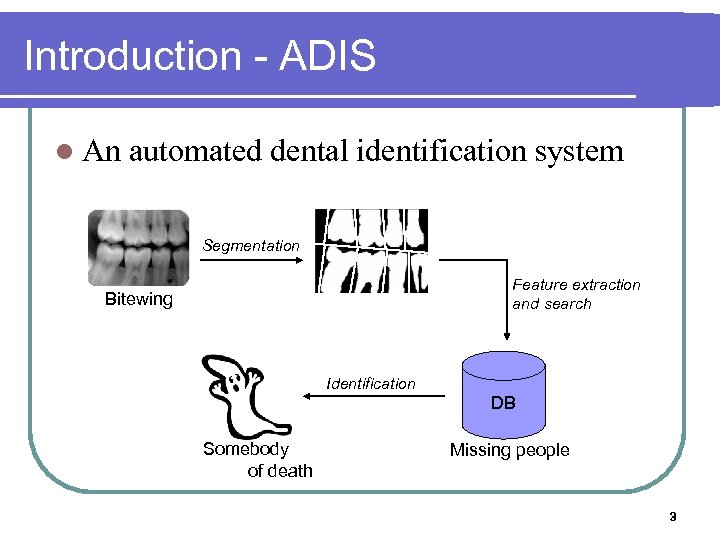
Introduction - ADIS l An automated dental identification system Segmentation Feature extraction and search Bitewing Identification DB Somebody of death Missing people 3
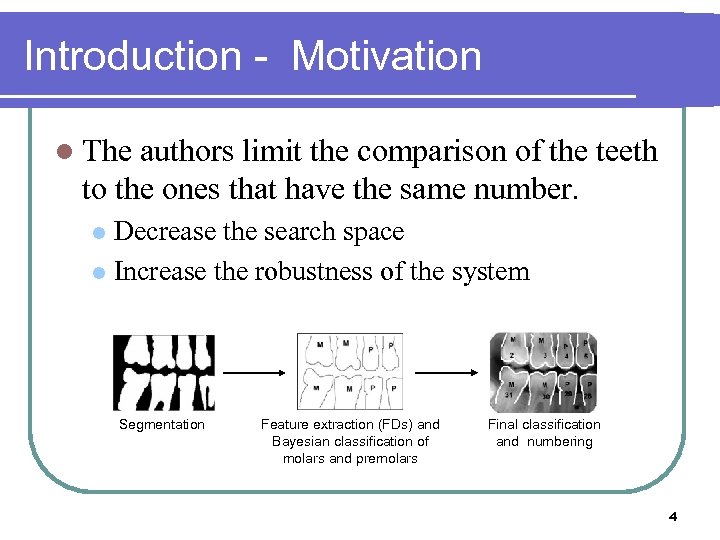
Introduction - Motivation l The authors limit the comparison of the teeth to the ones that have the same number. Decrease the search space l Increase the robustness of the system l Segmentation Feature extraction (FDs) and Bayesian classification of molars and premolars Final classification and numbering 4
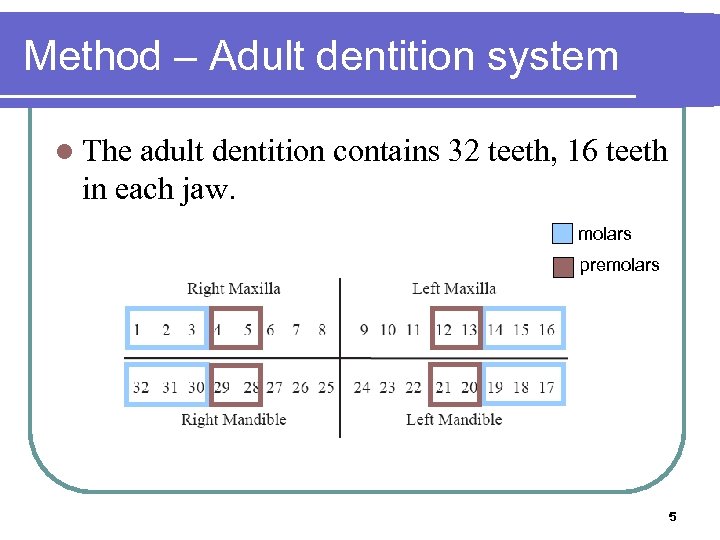
Method – Adult dentition system l The adult dentition contains 32 teeth, 16 teeth in each jaw. molars premolars 5
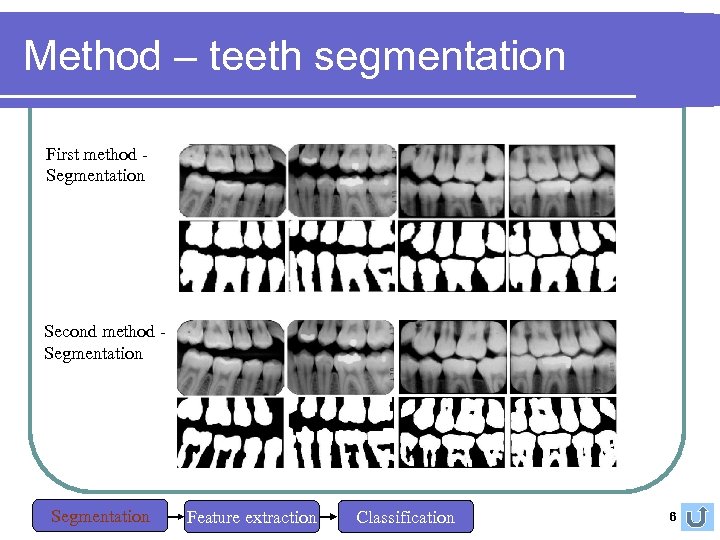
Method – teeth segmentation First method Segmentation Second method Segmentation Feature extraction Classification 6
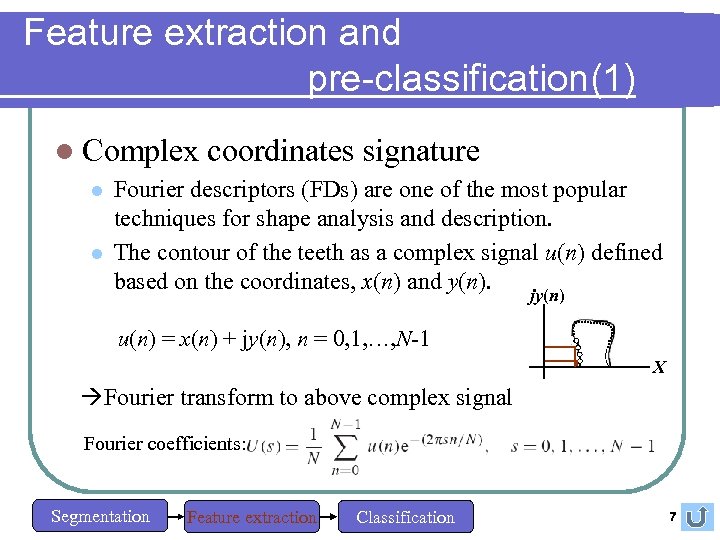
Feature extraction and pre-classification(1) l Complex l l coordinates signature Fourier descriptors (FDs) are one of the most popular techniques for shape analysis and description. The contour of the teeth as a complex signal u(n) defined based on the coordinates, x(n) and y(n). jy(n) u(n) = x(n) + jy(n), n = 0, 1, …, N-1 X Fourier transform to above complex signal Fourier coefficients: Segmentation Feature extraction Classification 7
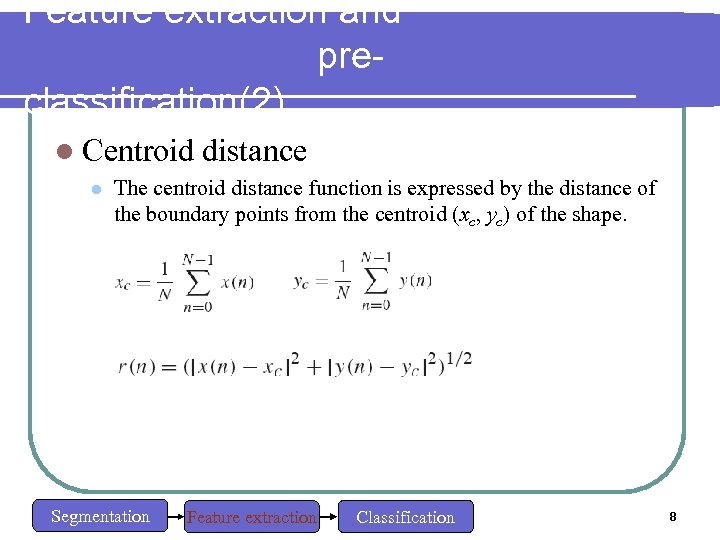
Feature extraction and preclassification(2) l Centroid l distance The centroid distance function is expressed by the distance of the boundary points from the centroid (xc, yc) of the shape. Segmentation Feature extraction Classification 8
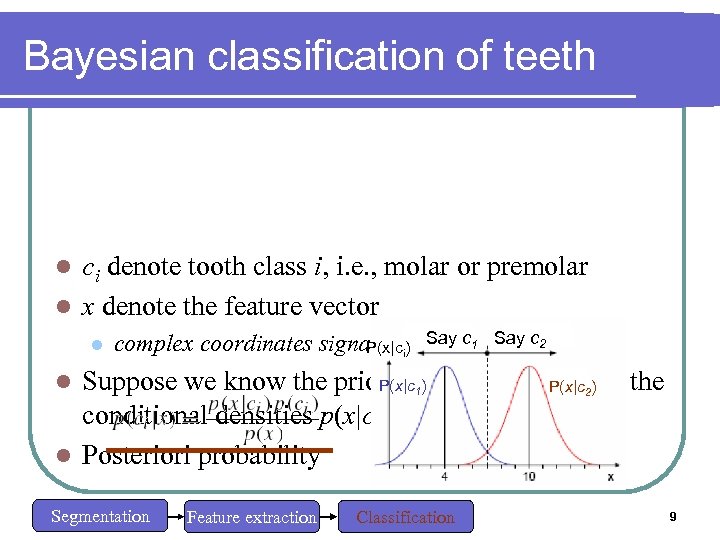
Bayesian classification of teeth l ci denote tooth class i, i. e. , molar l x denote the feature vector l or premolar Say c 1 Say c 2 complex coordinates signature) or centroid distance P(x|ci Suppose we know the prior probability p(ci) and the P(x|c ) conditional densities p(x|ci). l Posteriori probability l Segmentation 1 Feature extraction Classification 2 9
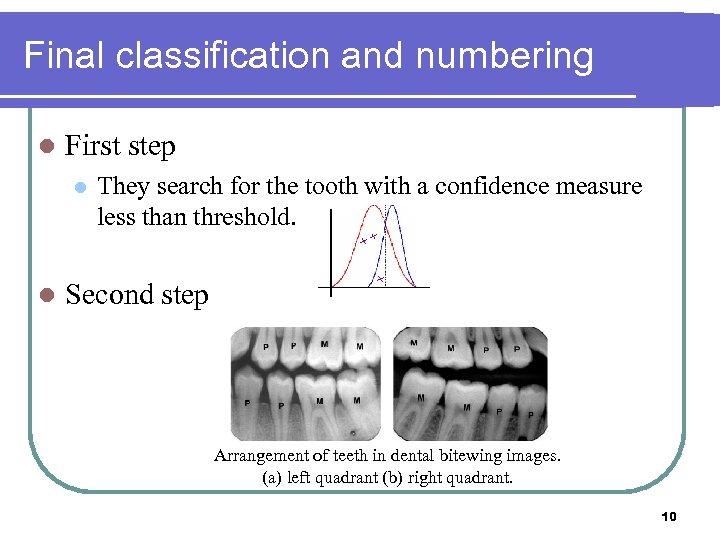
Final classification and numbering l First step l l They search for the tooth with a confidence measure less than threshold. Second step Arrangement of teeth in dental bitewing images. (a) left quadrant (b) right quadrant. 10
Experiments and results(1) l Training set l l The authors used 25 bitewing images as a training set to estimate the prior distribution p(ci) and the conditional distribution p(x|ci). Testing set l For classification, 50 images, containing 220 molar and 180 premolar. 11
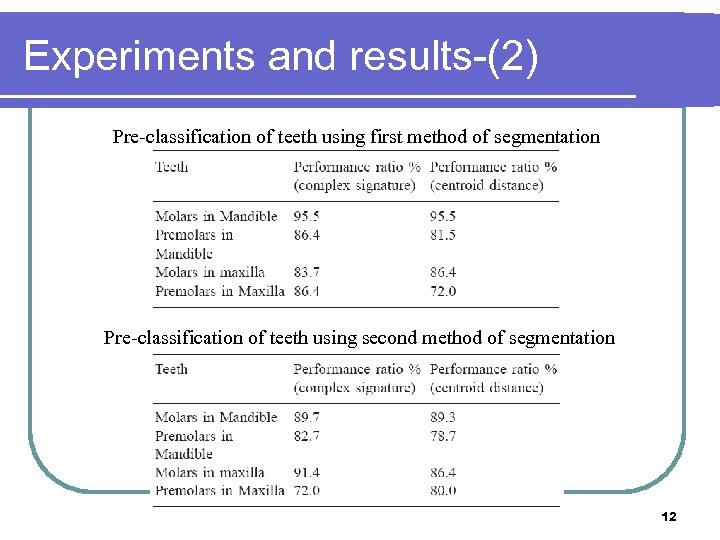
Experiments and results-(2) Pre-classification of teeth using first method of segmentation Pre-classification of teeth using second method of segmentation 12
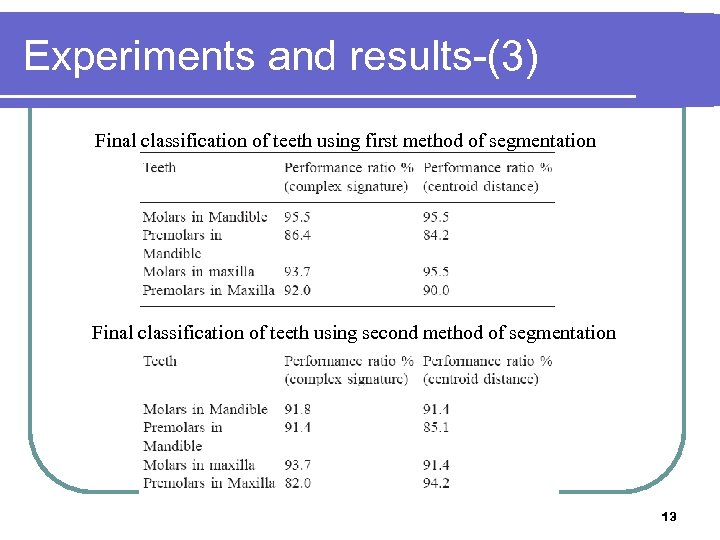
Experiments and results-(3) Final classification of teeth using first method of segmentation Final classification of teeth using second method of segmentation 13
Conclusion l The authors introduced a method for robust classification and numbering of molar and premolar teeth in bitewing images using Bayesian classification. 14
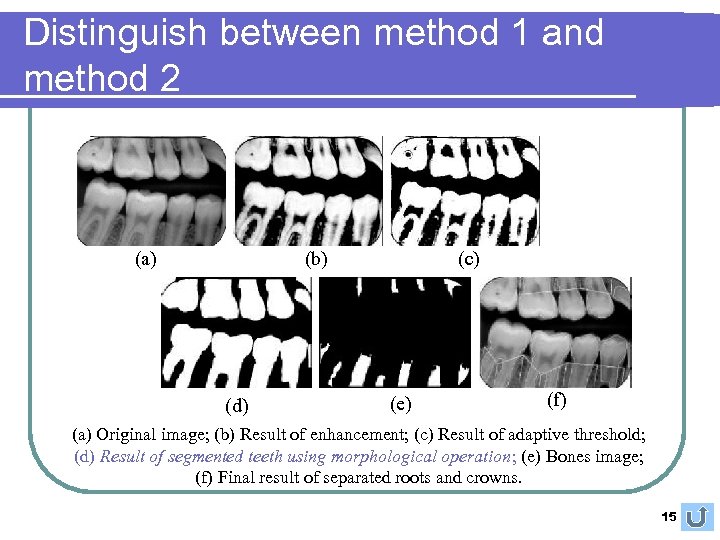
Distinguish between method 1 and method 2 (a) (b) (d) (c) (e) (f) (a) Original image; (b) Result of enhancement; (c) Result of adaptive threshold; (d) Result of segmented teeth using morphological operation; (e) Bones image; (f) Final result of separated roots and crowns. 15
Скачать презентацию Classification and numbering of teeth in dental bitewing
ec08da21e214120d3aa1a160f01d719a.ppt