


 Скачать презентацию Classical Thinkers KARL MARX 1818 1883
Classical_Thinkers.ppt
- Количество слайдов: 43
 Classical Thinkers
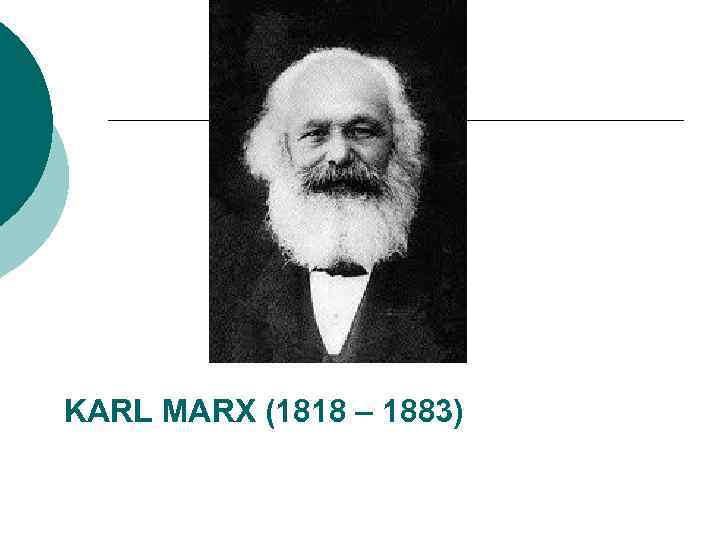 KARL MARX (1818 – 1883)
 The following concepts of Marx have aided sociological thought significantly: · Dialectical Materialism · Materialistic Interpretation of History i. e Historical Materialism · Class and Class conflict · Alienation
 Dialectical Materialism ¡ ¡ Marx believed that he could study history and society scientifically and discern tendencies of history and the resulting outcome of social conflicts. Marx argued that it is the material world that is real and that our ideas of it are consequences, not causes, of the world. Thus, like Hegel and other philosophers, Marx distinguished between appearances and reality. But he did not believe that the material world hides from us the "real" world of the ideal; on the contrary, he thought that historically and socially specific ideologies prevented people from seeing the material conditions of their lives clearly.
 Historical dialectic ¡ ¡ ¡ Phrase "existence precedes consciousness". The point is that who a person is, is determined by where and when he is - social context takes precedence over innate behavior; Marx did not believe that how one works is entirely personal and individual. He argued that work is a social activity and that the conditions and forms under and through which people work are socially determined and change over time.
 Historical dialectic Marx's analysis of history is based on his distinction between the means / forces of production (things, such as land, natural resources, and technology, that are necessary for the production of material goods) and the relations of production (the social and technical relationships people enter into as they use the means of production). ¡ Together these comprise the mode of production ¡
 Historical dialectic Within any given society the mode of production changes. ¡ European societies had progressed from an antique to feudal and then to a capitalist mode of production. ¡
 Historical dialectic ¡ ¡ Marx believed that the means of production change more rapidly than the relations of production. This mismatch between (economic) base and (social) superstructure is a major source of social disruption and conflict.
 Class theory ¡ ¡ ¡ Marx understood the "social relations of production" to comprise not only relations among individuals, but between or among groups of people, or classes. He did not understand classes as purely subjective (in other words, groups of people who consciously identified with one another). He sought to define classes in terms of objective criteria, such as their access to resources. Different classes have divergent interests, which is another source of social disruption and conflict. Conflict between social classes being something which is inherent in all human history
 Alienation Marx was especially concerned with how people relate to that most fundamental resource of all, their own labour-power. Marx wrote extensively about this in terms of the problem of alienation. ¡ people under capitalism are alienated from their own labourpower. ¡
 Alienation ¡ ¡ By ideology they meant ideas that reflect the interests of a particular class at a particular time in history, but which are presented as universal and eternal. And such beliefs serve an important political function. The control that one class exercises over the means of production includes not only the production of food or manufactured goods; it includes the production of ideas as well (this provides one possible explanation for why members of a subordinate class may hold ideas contrary to their own interests).
 Religion is the opium of the people - because its social function is a way of expressing and coping with social inequality, thereby maintaining the status quo. ¡
 Future Marx believed that cycle of growth, collapse, and growth would be punctuated by increasingly severe crises in capitalist society. ¡ Moreover, he believed that the longterm consequence of this process was necessarily the enrichment and empowerment of the capitalist class and the impoverishment of the proletariat. ¡
 Future ¡ ¡ Marx thought that peaceful negotiation of this problem was impracticable, and that a massive, well-organized and violent revolution would in general be required, because the ruling class would not give up power without violence. Thanks to various processes overseen by capitalism, such as urbanisation, the working class, the proletariat, should grow in numbers and develop class consciousness, in time realising that they have to and can change the
 Future In this new society the selfalienation would end, and humans would be free to act without being bound by the labour market. It would be a demcratic society, enfranchising the entire population. ¡ In such a world there would also be little if any need for a state, which goal was to enforce the alienation. ¡
 Future ¡ ¡ He theorized that to establish the socialist system, a dictatorship of the proletariat - a period where the needs of the working-class, not of capital, will be the common deciding factor - must be created on a temporary basis. As he wrote "between capitalist and communist society there lies the period of the revolutionary transformation of the one into the other. Corresponding to this is also a political transition period in which the state can be nothing but the revolutionary dictatorship of the proletariat. "
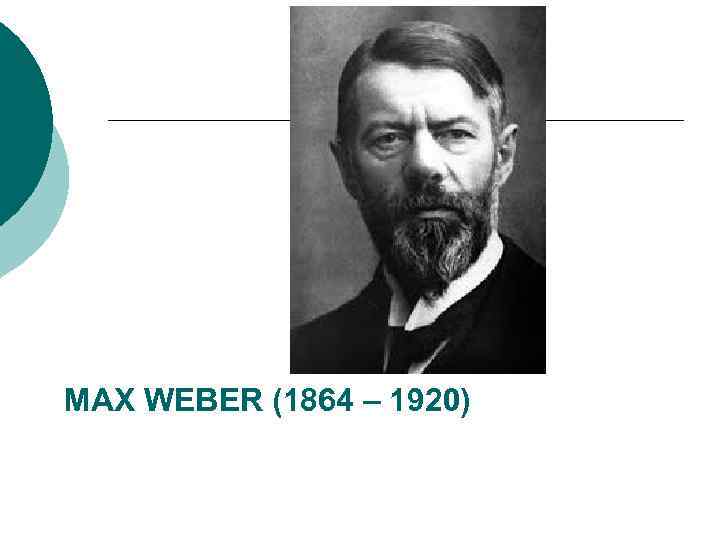 MAX WEBER (1864 – 1920)
 Weber's two most celebrated contributions: the “rationalization thesis, ” a grand meta-historical analysis of the dominance of the west in modern times ¡ The “Protestant Ethic thesis, ” a non. Marxist genealogy of modern capitalism. ¡
 ¡ ¡ Max Weber conceived of sociology as a comprehensive science of social action. In his analytical focus on individual human actors he differed from many of his predecessors whose sociology was conceived in social-structural terms. Weber concentrated on the individuals and their actions and in contrast to Marx argued for the primacy of the material world over the world of ideas.
 Comparison to Marx's vision of society was informed by his preoccupation with the conflicts between social classes within changing social structures and productive relations. ¡ In contrast, Weber's primary focus was on the subjective meanings that human actors attach to their actions in their mutual orientations within specific social-historical contexts ¡
 ¡ Weber was arguing for the study of social action through interpretive (rather than purely empiricist) means, based on understanding the purpose and meaning that individuals attach to their own actions
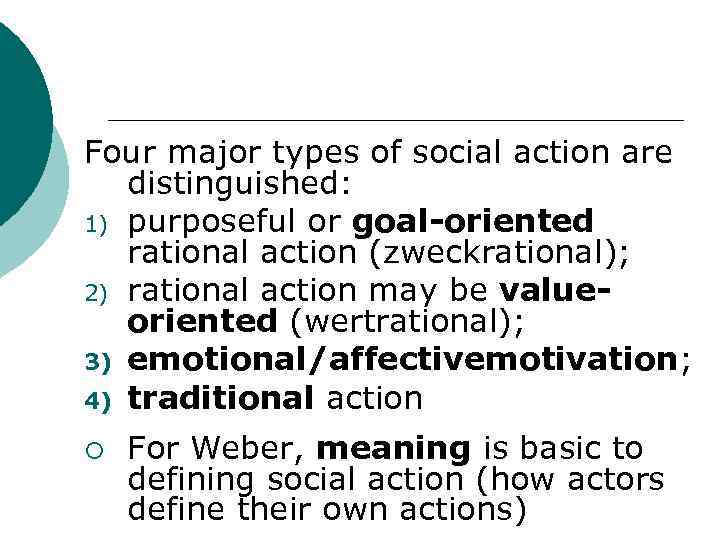 Four major types of social action are distinguished: 1) purposeful or goal-oriented rational action (zweckrational); 2) rational action may be valueoriented (wertrational); 3) emotional/affectivemotivation; 4) traditional action ¡ For Weber, meaning is basic to defining social action (how actors define their own actions)
 Roots of capitalism ¡ Weber is perhaps best known for his book The Protestant Ethic and the Spirit of Capitalism, in which he proposed that ascetic Protestantism was one of the major "elective affinities" associated with the rise in the Western world of marketdriven capitalism and the rational-legal nation-state.
 ¡ Weber argued that there were many reasons to look for the origins of modern capitalism in the religious ideas of the Reformation. ¡ This Weber called the "spirit of capitalism": it was the Protestant religious ideology that was behind – and inevitably lead to – the capitalist economic system
 ¡ ¡ ¡ The Protestant ethic (or more specifically, Calvinist ethic) motivated the believers to work hard, be successful in business and reinvest their profits in further development rather than frivolous pleasures. The notion of calling meant that each individual had to take action as an indication of their salvation; just being a member of the Church was not enough. Predestination also reduced antagonising over economic inequality and further, it meant that a material wealth could be taken as a sign of salvation in the afterlife.
 Roots of capitalism ¡ He also examined the religions of China, India and ancient Judaism, with particular regard to the apparent nondevelopment of capitalism in the corresponding societies, as well as to their differing forms of social stratification.
 Social authority He was also the first to categorise social authority into distinct forms, which he labelled as charismatic, traditional, and rational-legal. ¡ His analysis of bureaucracy emphasised that modern state institutions are increasingly based on rational-legal authority. ¡
 Bureaucracy Rationalization is a large part of Weber's theories on bureaucracy. Weber defined such bureaucracies as goal oriented organizations designed according to rational principles in order to efficiently attain their goals (Verstehen).
 Rationalization Features of rationalisation include increasing knowledge, growing impersonality and enhanced control of social and material life. ¡ Weber was ambivalent towards rationalisation; while admitting it was responsible for many advances, in particular, freeing humans from traditional, restrictive and illogical social guidelines, ¡ He also criticised it for dehumanising individuals as "cogs in the machine" and curtailing their freedom, trapping them in the bureaucratic iron cage of rationality and bureaucracy. ¡
 Future ¡ Related to rationalisation is the process of disenchantment, in which the world is becoming more explained and less mystical, moving from polytheistic religions to monotheistic ones and finally to the Godless science of modernity ¡ In a dystopian critique of rationalisation, Weber notes that modern society is a product of an individualistic drive of the Reformation, yet at the same time, the society created in this process is less and less welcoming of individualism.
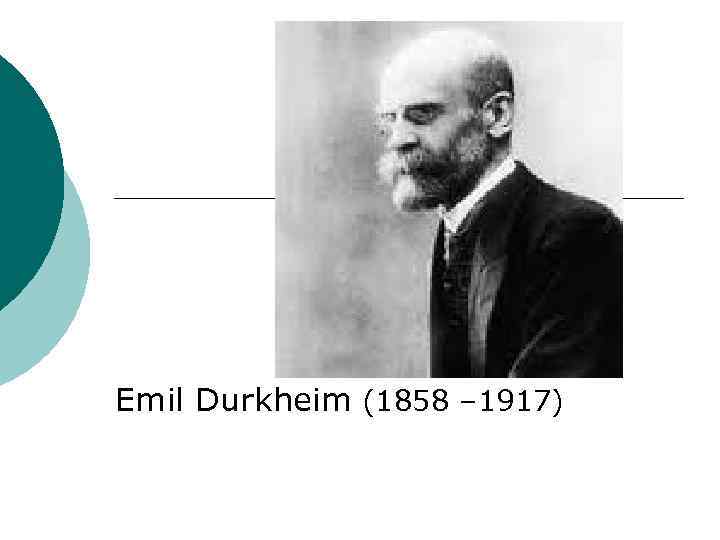 Emil Durkheim (1858 – 1917)
 ¡ Along with Karl Marx and Max Weber, he is credited as being one of the principal founders of modern sociology.
 ¡ Chief among his claims is that society is a sui generis reality, or a reality unique to itself and irreducible to its composing parts. It is created when individual consciences interact and fuse together to create a synthetic reality that is completely new and greater than the sum of its parts.
 ¡ For this purpose he developed a new methodology, which focuses on what Durkheim calls “social facts, ” or elements of collective life that exist independently of and are able to exert an influence on the individual.
 ¡ ¡ According to Durkheim, all elements of society, including morality and religion, are products of history and can be studied scientifically. This psychic reality is sometimes referred to by Durkheim with the term conscience collective, which can alternately be translated into English as collective conscience or collective consciousness.
 Social integration Durkheim attempted to answer the question of what holds the society together. He assumes that humans are inherently egoistic, but norms, beliefs ¡ and values (collective consciousness) form the moral basis of the society, resulting in social integration. ¡
 Religion ¡ ¡ ¡ During Durkheim’s life, his thinking about religion changed in important ways. First he argued that human societies could exist on a secular basis without religion. Later he saw religion as a more and more fundamental element of social life. He saw religion as a part of the human condition, and while the content of religion might be different from society to society over time, religion will always be a part of social life. He argues that religion is the most fundamental social institution.
 Theory of social change ¡ ¡ He argues that social change is a mechanical process, meaning that it is not directed in any intentional way. Changes in the ways that people interact with each other, which in turn depend upon the demographic and material conditions of a society. The two main factors affecting social interaction are increases in population density and advances in technology, (because they increase social connectivity, leading to interactions that differ in quantity, intimacy, frequency, and content).
 At their beginning, societies are characterized by mechanical solidarity. ¡ In mechanical solidarity, groups are small, individuals in the group resemble each other, and their individual conscience is dependent on the collective conscience. There is little to no individual volition and individuals belong to the group. ¡
 ¡ The more a society grows in moral density, the more the labor of a society will divide and the more specialized the tasks of its individuals will become. This leads to organic solidarity, or solidarity based upon the functional interdependence of society’s individual parts, much the way the organs of a body are interdependen.
 Anomie ¡ As the society, Durkheim noted there are several possible pathologies that could lead to a breakdown of social integration and disintegration of the society: the two most important ones are anomie and forced division of labor; lesser ones include the lack of coordination and suicide.
 Anomie ¡ ¡ ¡ By anomie Durkheim means a state when too rapid population growth reduces the amount of interaction between various groups, which in turn leads a breakdown of understanding (norms, values, and so on). By forced division of labor Durkheim means a situation where power holders, driven by their desire for profit (greed), results in people doing the work they are unsuited for. Such people are unhappy, and their desire to change the system can destabilize the society.
 Suicide ¡ In Suicide (1897) Durkheim treated suicide as a social fact, explaining variations in its rate on a macro level, considering society-scale phenomena such as lack of connections between people (group attachment) and lack of regulations of behavior, rather than individuals' feelings and motivations.