


 Скачать презентацию Class Exercise Volunteers for Focus Group Topic
65f48966214fdcb223b52b1c3528b93f.ppt
- Количество слайдов: 91
 Class Exercise
 Volunteers for Focus Group Topic: security issues on campus Requirement: that you have some concerns
 Social Mapping divide people into 3 groups, one who mostly is on upper campus, other in HSL International students together draw map of Health Sciences Center (bring in large sheets of paper & marker pens, just hand it to people in groups and ask them to draw a map, don’t explain what to put on it)
 Participant Observation Hand in Comments? ? ?
 RAP developed in late 1970’s, early 1980’s out of dissatisfaction with large scale questionnaire surveys which gave delayed and questionable results concern that RAP was an extractive process
 History of PRA 1980’s, group working in rural India developed methods by which community members could express complex information about their homes, environment, work & lives results obtained were faster & cheaper than previous methods, & had greater range of information & greater accuracy
 Definition of PRA “organized common sense” a family of approaches and methods to enable rural people to share, enhance and analyze their knowledge of life and conditions to plan and to act defined as “semi-structured process of learning from, with an by rural people about rural conditions”
 Resource for reading/manual Freudenberger, K. S. (1999). Rapid Rural Appraisal (RRA) and Participatory Rural Appraisal (PRA): A Manual for CRS Field Workers and Partners. Baltimore, Catholic Relief Services. http: //www. catholicrelief. org/what_we_do_overseas/R RA_Manual. pdf http: //www. catholicrelief. org/what_we_do_overseas/R RA_Case_Studies. pd Readings on reserve in library on health applications
 Principles of PRA learning rapidly & progressively with: flexible use of methods, improvisation iteration, not following blue printed program, but adapting in learning process
 offsetting biases of rural development tourism, not rushing, but relaxing biases include: – spatial, – project, – person, – seasonal, (Nepal 1995 eval. not during monsoon) – professional, – diplomatic, etc.
 learning from and with rural people, directly, face-to-face development workers to act as: facilitators, rather than dictators about community needs triangulating optimizing (don't try to find out everything- Benjamin's law) link information with – decision making, – decentralized local planning, – allowing those who manage programs to collect the information
 critical self-awareness, reflecting on what is seen & not seen,
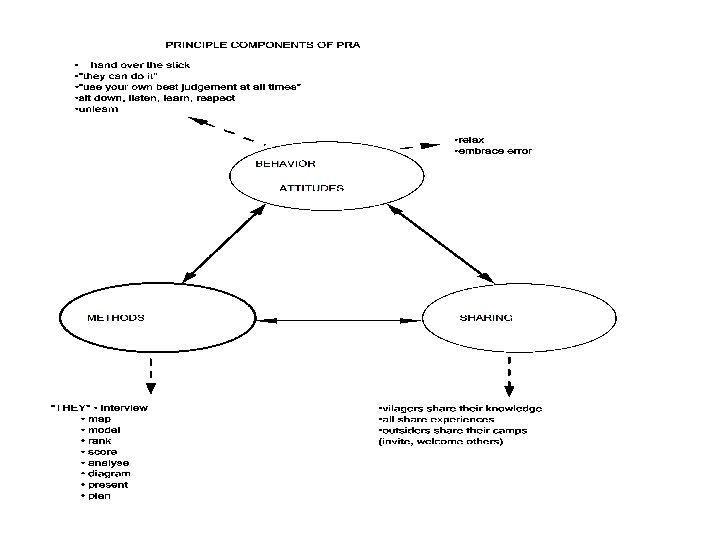
 Components of PRA “use your own best judgment at all times” is one sentence manual
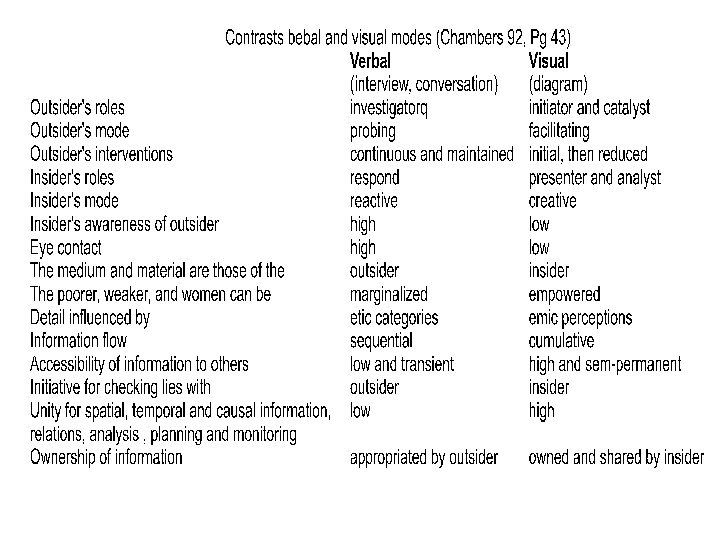
 orientation from verbal to Visual
 Methods: VISUAL SHARING mapping transects & group walks workshops & brainstorming diagrams rapid report writing in the field (& feeding back)
 View video of Indian PRA
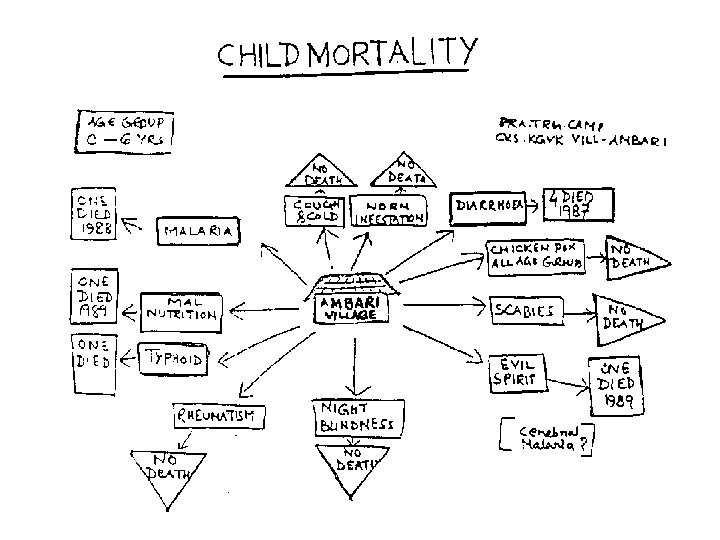
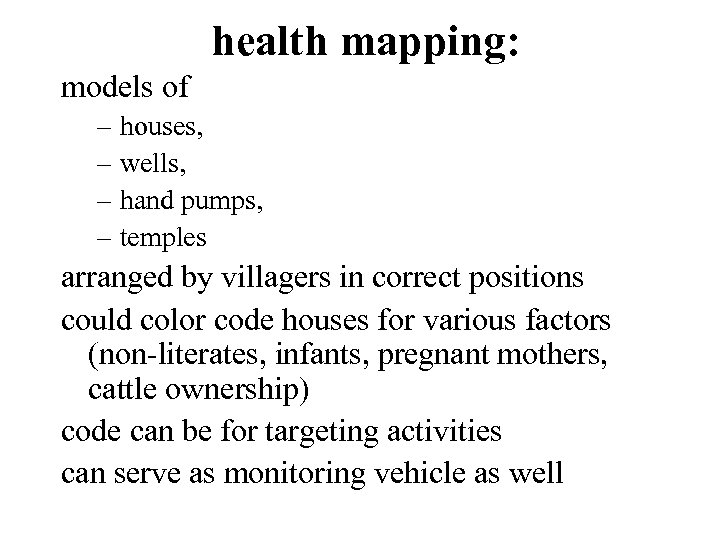 health mapping: models of – houses, – wells, – hand pumps, – temples arranged by villagers in correct positions could color code houses for various factors (non-literates, infants, pregnant mothers, cattle ownership) code can be for targeting activities can serve as monitoring vehicle as well
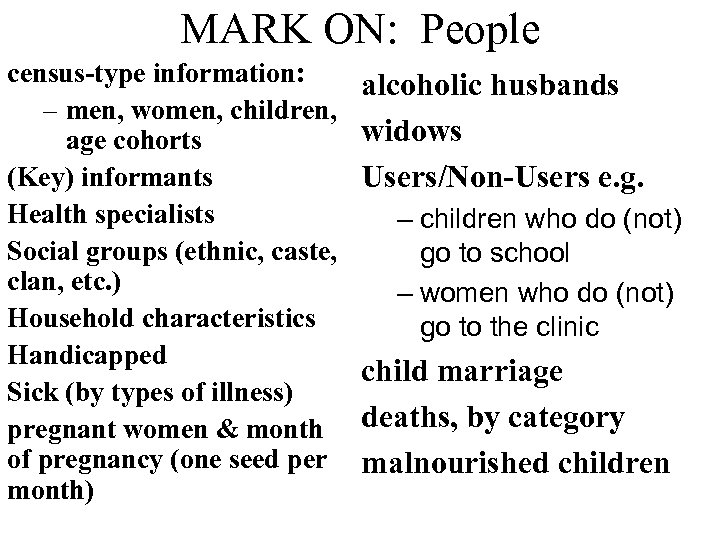 MARK ON: People census-type information: – men, women, children, age cohorts (Key) informants Health specialists Social groups (ethnic, caste, clan, etc. ) Household characteristics Handicapped Sick (by types of illness) pregnant women & month of pregnancy (one seed per month) alcoholic husbands widows Users/Non-Users e. g. – children who do (not) go to school – women who do (not) go to the clinic child marriage deaths, by category malnourished children
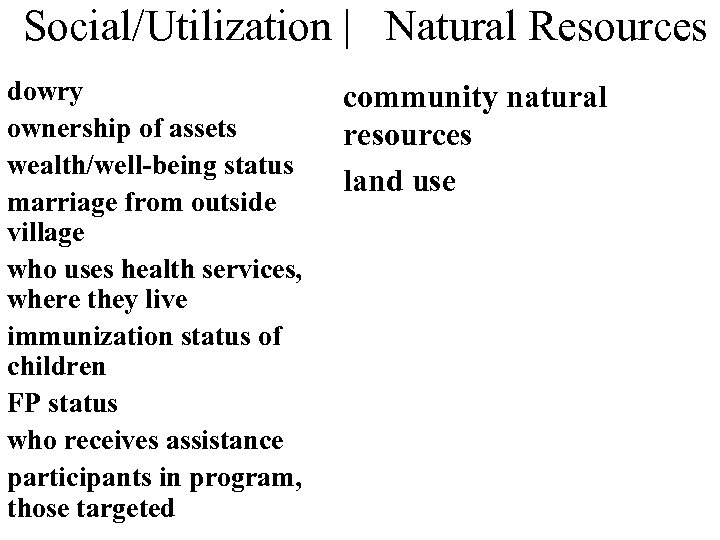 Social/Utilization | Natural Resources dowry ownership of assets wealth/well-being status marriage from outside village who uses health services, where they live immunization status of children FP status who receives assistance participants in program, those targeted community natural resources land use
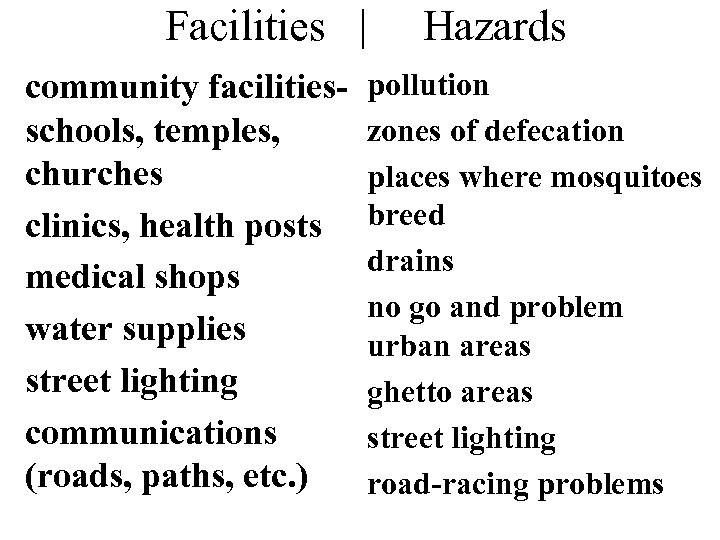 Facilities | community facilitiesschools, temples, churches clinics, health posts medical shops water supplies street lighting communications (roads, paths, etc. ) Hazards pollution zones of defecation places where mosquitoes breed drains no go and problem urban areas ghetto areas street lighting road-racing problems
 Seasonal Analysis festivals, seasons, intervals months represented by 12 stones # of seeds or length of sticks as a HISTOGRAM summer 1995 Nuwakot scheduled immunizations, no one came because were in high pastures with animals crop/harvest labor/time availability food availability illness by type & prevalence gender perceptions of diseaseprone periods water supply fuel sources access to facilities stress, happiness
 BODY MAP
 Walking transects of village with farmers as guides
 Transects useful for: timing of interventions with respect to variations in – migration – festivals – how busy/free people are – monitoring by them & by us – health workers’ & communities’ monthly monitoring of biggest problems
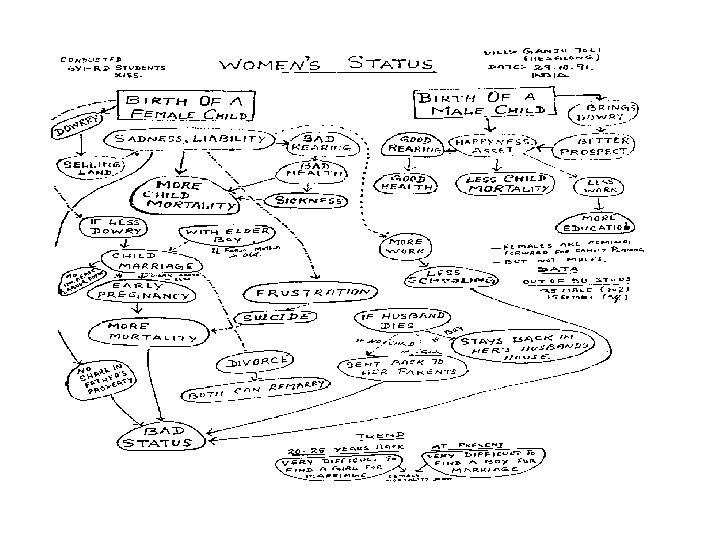
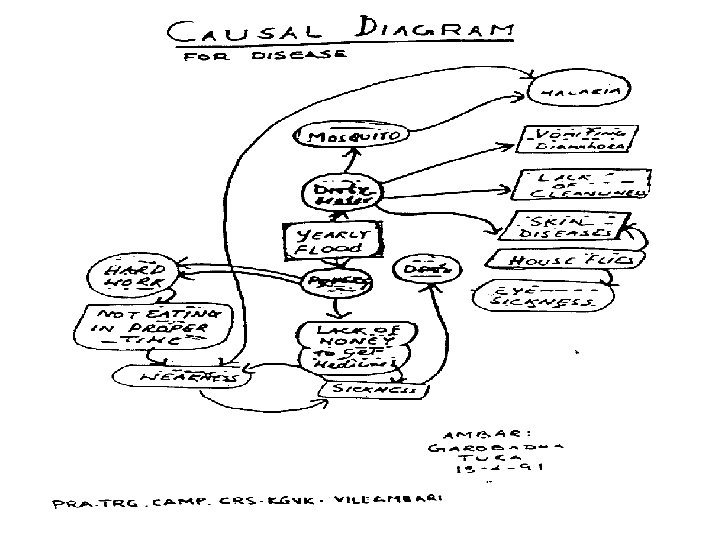
 Venn chappati diagramming Local ideas on causality
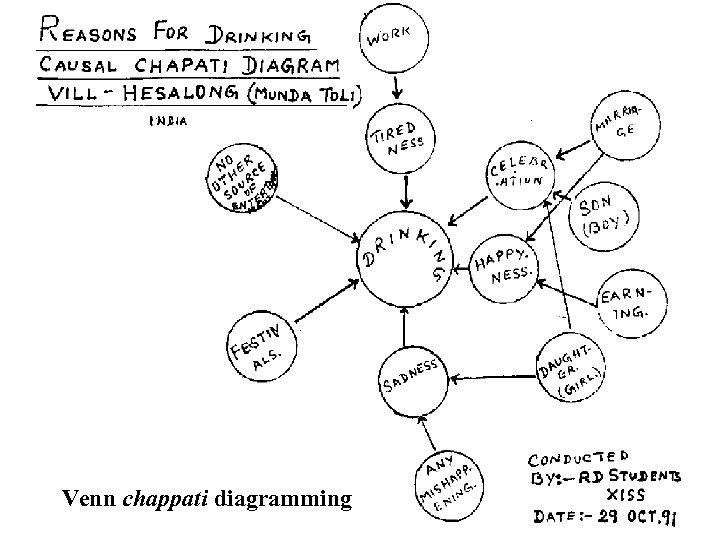 Venn chappati diagramming
 Example of Participatory Diagramming of women's HIV risk in Zimbabwe Kesby: Soc Sci Med (50) 2000 1723 -41
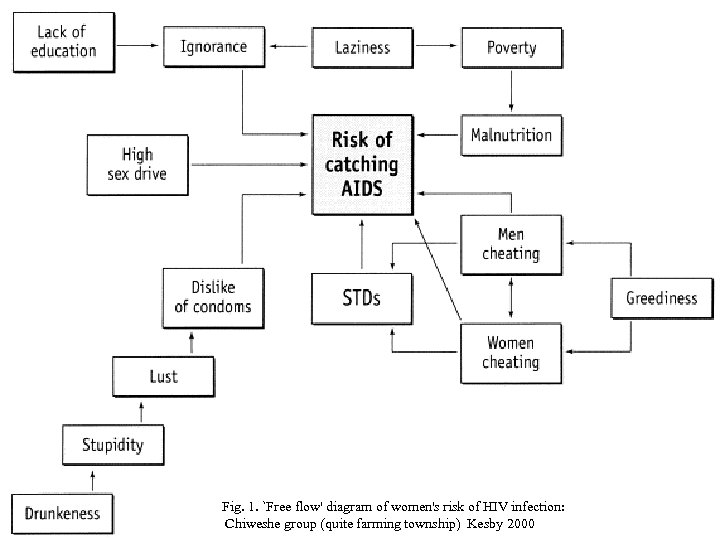 Fig. 1. `Free flow' diagram of women's risk of HIV infection: Chiweshe group (quite farming township) Kesby 2000
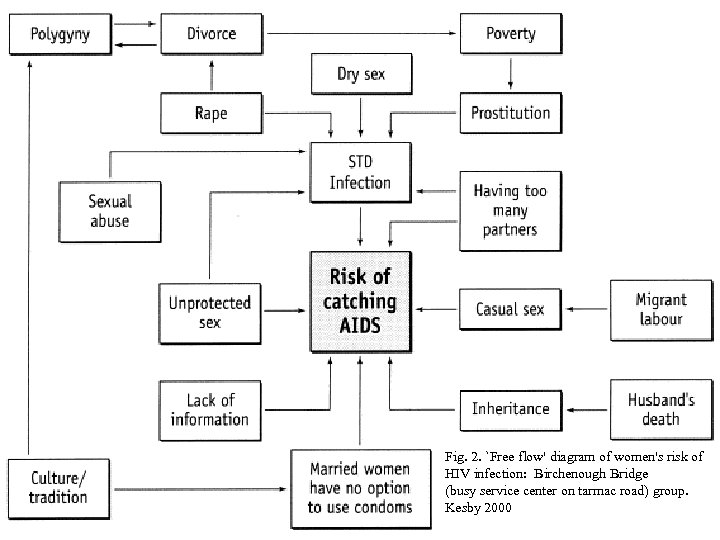 Fig. 2. `Free flow' diagram of women's risk of HIV infection: Birchenough Bridge (busy service center on tarmac road) group. Kesby 2000
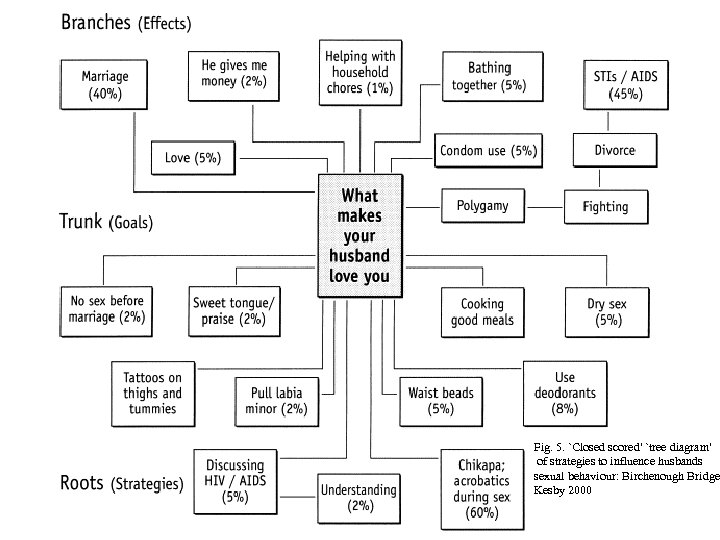 Fig. 5. `Closed scored' `tree diagram' of strategies to influence husbands sexual behaviour: Birchenough Bridge. Kesby 2000
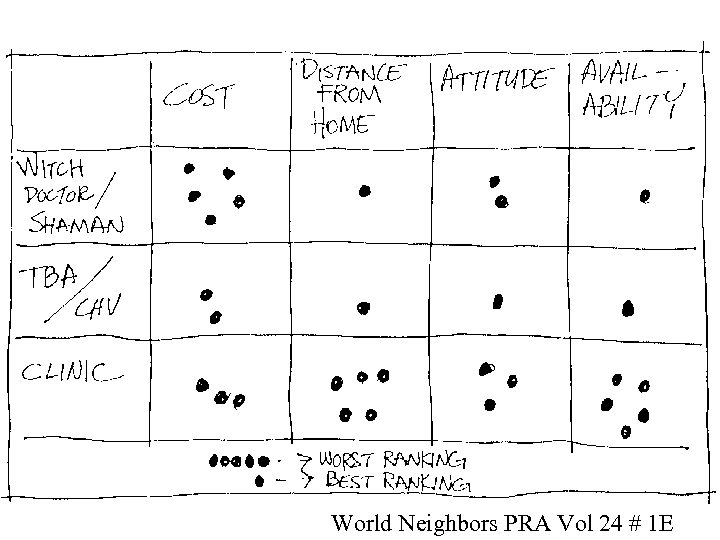
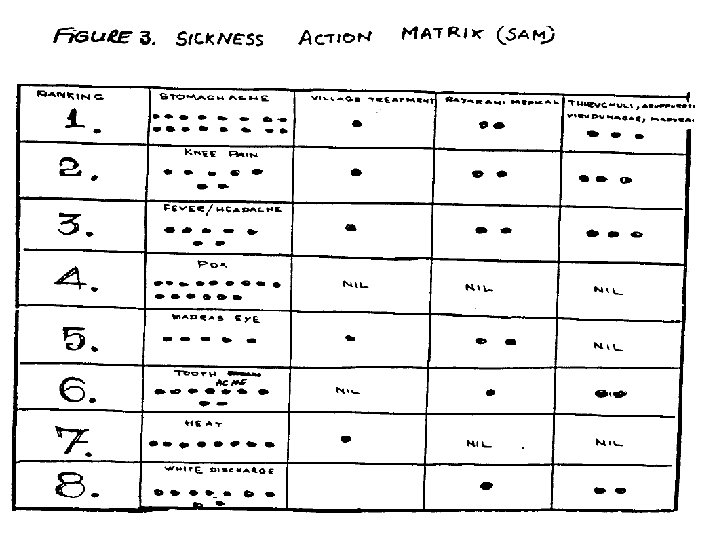
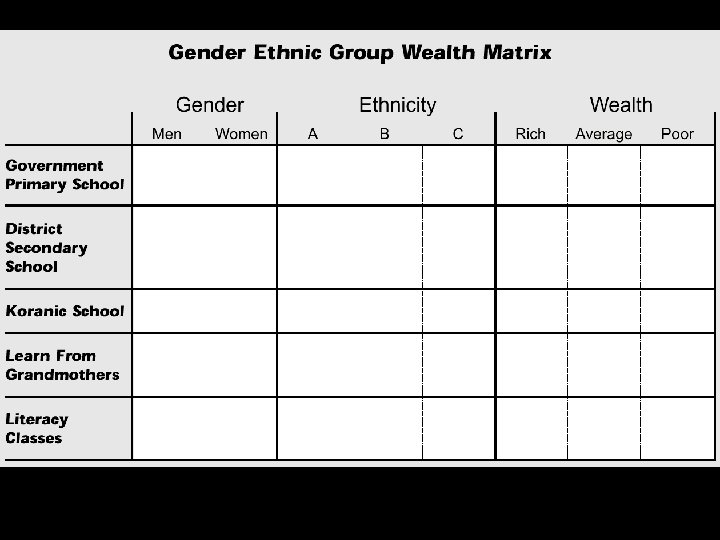
 Matrix Ranking and Scoring: types of illness vs access & utilization scoring characteristics of health providers scoring characteristics/effectiveness of types of treatment by types of illness characteristics of diseases food availability/food use: what is there vs what is used health/nutrition problems food preferences and characteristics
 Matrix Ranking and Scoring: sources of credit & characteristics sources of income & characteristics reasons for needing credit (illness, funeral, hunger etc. ) vs choices of sources (husband, sister, moneylender etc. ) areas according to health/disease status patterns of health service usage patterns of service supply/drug availability vulnerability/debility (linked to income, food supply etc. )
 World Neighbors PRA Vol 24 # 1 E
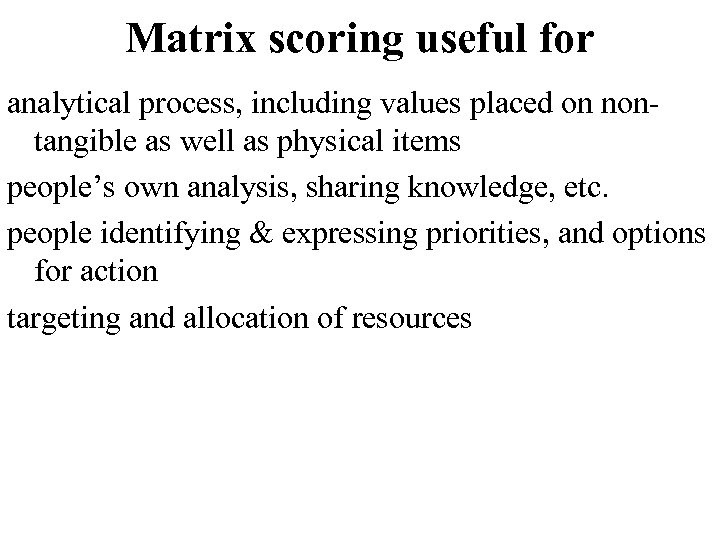 Matrix scoring useful for analytical process, including values placed on nontangible as well as physical items people’s own analysis, sharing knowledge, etc. people identifying & expressing priorities, and options for action targeting and allocation of resources
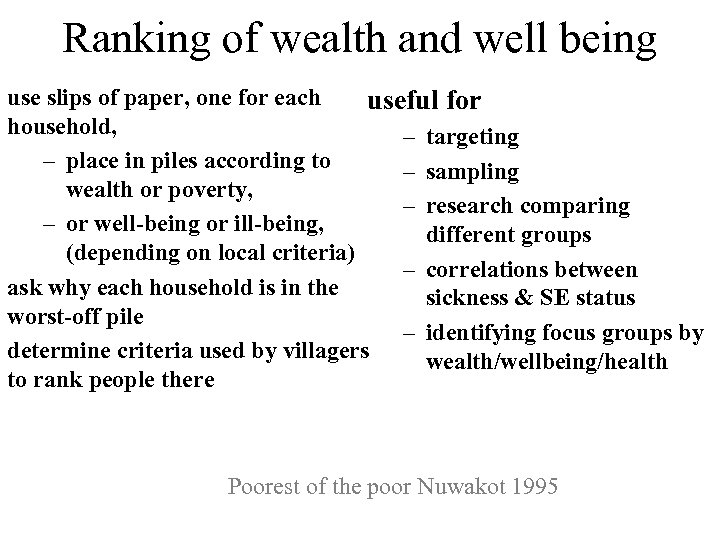 Ranking of wealth and well being use slips of paper, one for each useful for household, – targeting – place in piles according to – sampling wealth or poverty, – research comparing – or well-being or ill-being, different groups (depending on local criteria) – correlations between ask why each household is in the sickness & SE status worst-off pile – identifying focus groups by determine criteria used by villagers wealth/wellbeing/health to rank people there Poorest of the poor Nuwakot 1995
 Family genogram
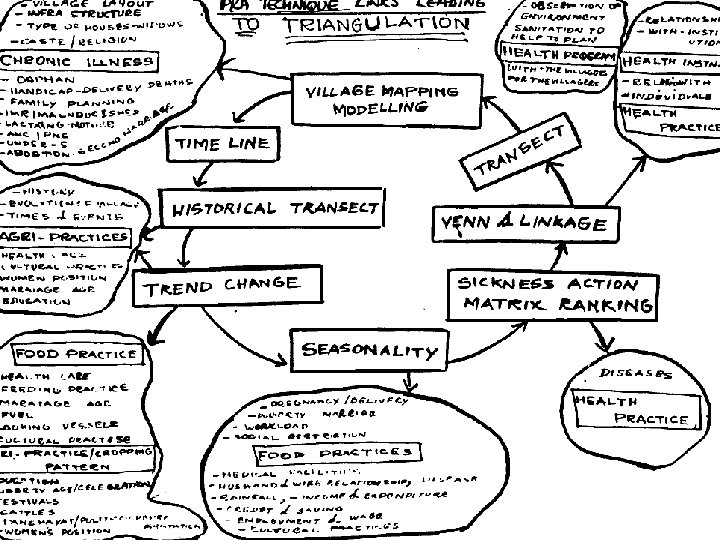
 Triangulation done by villagers themselves:
 Discoveries of PRA villagers knowledge & capabilities – villagers have greater capacity to map, model, quantify and estimate, rank, score and diagram than outsiders have generally supposed them capable of relaxed rapport established early in the process traditional ethnographer feels this takes a long time participatory diagramming and visual sharing is popular and powerful
 Discoveries of PRA sequences are powerful and popular several maps can be drawn, each more detailed social maps can generate household listings, indicating many characteristics transects can lead to identifying problems & opportunities… Accuracy of information obtained is very high – high correlation with 'scientific' information
 Training and orientation for some outsiders need not be long before they can go off and practice 1 hour to a week is the range Students in this class now know all they need to to do this
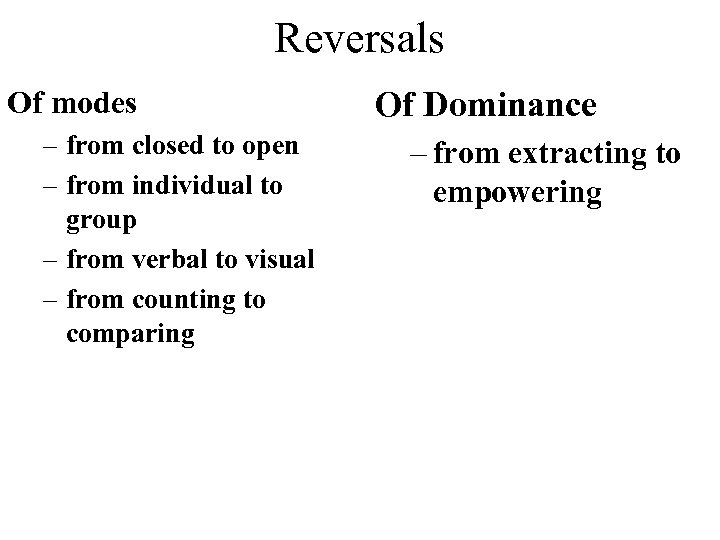 Reversals Of modes – from closed to open – from individual to group – from verbal to visual – from counting to comparing Of Dominance – from extracting to empowering
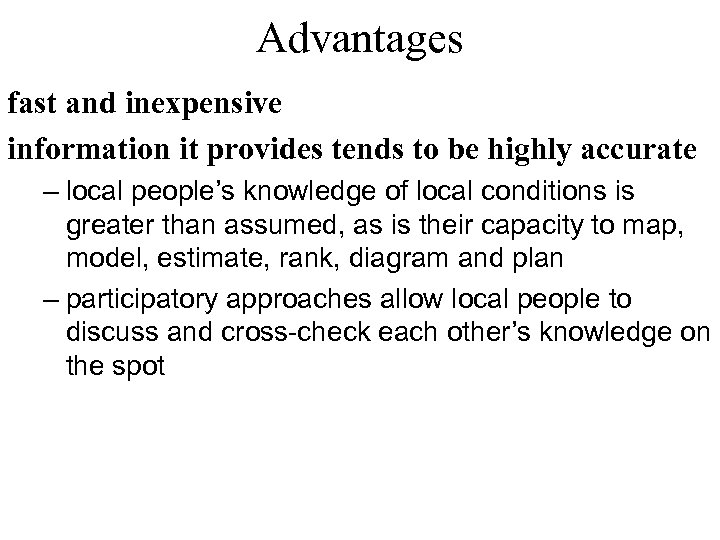 Advantages fast and inexpensive information it provides tends to be highly accurate – local people’s knowledge of local conditions is greater than assumed, as is their capacity to map, model, estimate, rank, diagram and plan – participatory approaches allow local people to discuss and cross-check each other’s knowledge on the spot
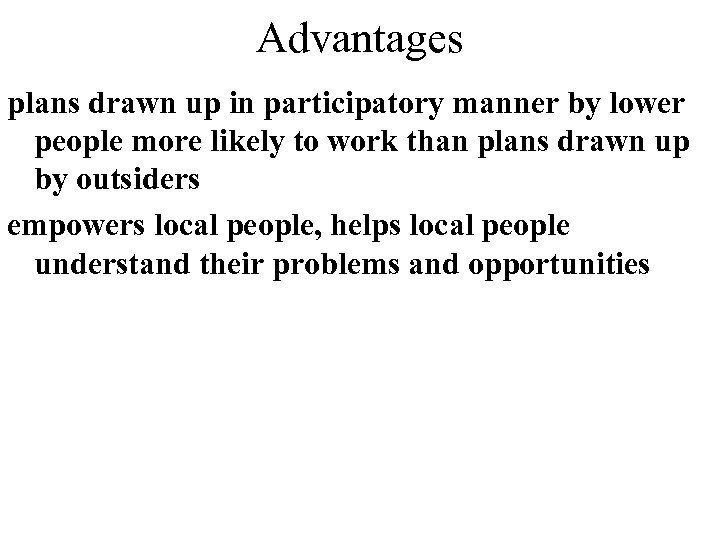 Advantages plans drawn up in participatory manner by lower people more likely to work than plans drawn up by outsiders empowers local people, helps local people understand their problems and opportunities
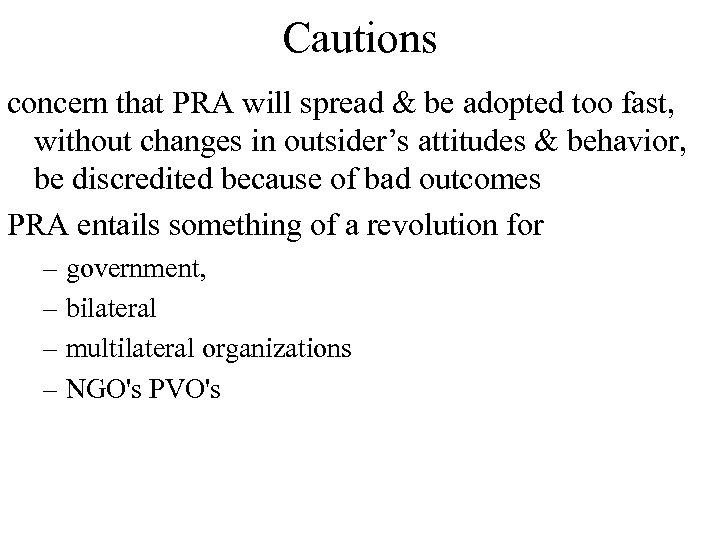 Cautions concern that PRA will spread & be adopted too fast, without changes in outsider’s attitudes & behavior, be discredited because of bad outcomes PRA entails something of a revolution for – government, – bilateral – multilateral organizations – NGO's PVO's
 PRA: Answer for decreasing poverty? Based on your experience?
 PRA: Answer for decreasing poverty? Practitioners and participants: – Ritualistic processes that are manipulative or harmful? Participation as Tyranny? : – Tyranny: illegitimate or unjust use of POWER – (Cooke, B. and U. Kothari, Eds. (2001). Participation: the new tyranny? London, Zed Books. )
 Cautions dominant medical value systems, with taught knowledge of medical school, points away from rural life
 INDOCTRINATION
 Some Consider: indigenous technical knowledge is – usually considered weaker in health – than in agriculture, external scientific knowledge is said to be relatively stronger in health than agriculture
 Schema of application If you come here to help me then you are wasting your time, . . . but if you come here because your liberation is bound up in mine, then let us begin Lily Walkers, Australian Aboriginal Leader
 For routine use in every village Clients’ perceptions of health/nutrition situation Village mapping – identify clients for service delivery & education – target non-users of services – target high risk individuals or groups Qualitative feedback on program performance Verbal autopsies
 Using PRA for program monitoring & management Adjust local health care priorities monitor service performance
 Using PRA to facilitate research & development e. g. gain villagers perspective on why obstetrical emergencies are referred too late
 Resources • International Institute for Environment & Development (IIED) • 3 Endsleigh Street • London, WC 1 H ODD • England • Phone 44 -071 388 2117, Fax 44 -071 388 -2826 • www. iied. org search Research Centre for Participatory Learning and Action • www. oneworld. org/iied/resource/ • PUBLICATIONS MOSTLY HARD COPY TO DATE • www. parnet. org (much smaller)
 History of Participatory Research Methods
 Participatory Rural Appraisal Focus RRA is extractive (will talk about May 18), PRA shifts presentation & analysis of information to “them” rather than “us” good PRA implies radical personal and institutional change
 Corrects two common errors roles of teacher & learner are reversed, ‘“they” teach “us” – rural people own more of the process & output – appraisal & learning are not • just by us from them, • but with them and by them
 Corrects two common errors rapport with villagers is primary – requires reorientation & relaxation of outsiders & critical self-awareness – ignorance of rural people a self-sustaining myth
 Activist approach poor people are creative and capable, – can and should do much of their own investigation, analysis and planning outsiders have a role as conveners, catalysts and facilitators weak should be empowered
 Need appropriate attitudes, demeanor & behavior participation by outsider respect for rural people interest in what they know, say and show patience, wandering around, not rushing & not interrupting humility materials and methods which empower villagers to express, share, enhance, and analyze their knowledge
 Applications of PRA
 General Principle
 Participatory mapping methods
 health mapping villagers use seeds, tikas, stones or other markers to indicate households with pregnant women, handicapped, malnourished children, widows, relative wealth and poverty – determine households, individuals at risk
 health mapping men tend to take over, so let them make their own maps
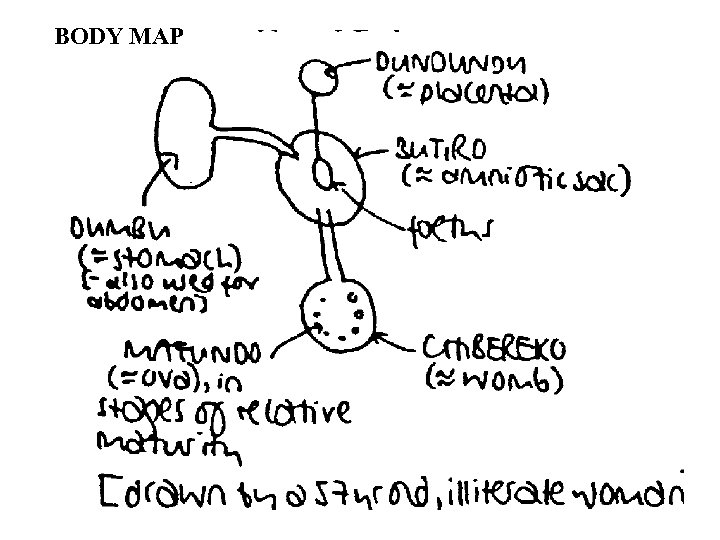
 body mapping to explore people’s perceptions of a range of bodily processes and the effects of medical interventions in the body
 Participatory Research Methods Learning Objectives carry out a social mapping exercise as a class describe the history of participatory research methods relate the principles of participatory rural appraisal in third world development work
 Utilization who uses health services, where they live immunization status of children FP status who receives assistance participants in program, those targeted
 Useful for establishing rapport starting point of entry with community part of analytical process of better understanding the health/nutrition situation demographic-census, hh survey, baseline
 Useful for identifying vulnerable groups identifying health risk factors according to wealth/wellbeing/health monitoring by community, graphical representation of changes in health/nutrition over time
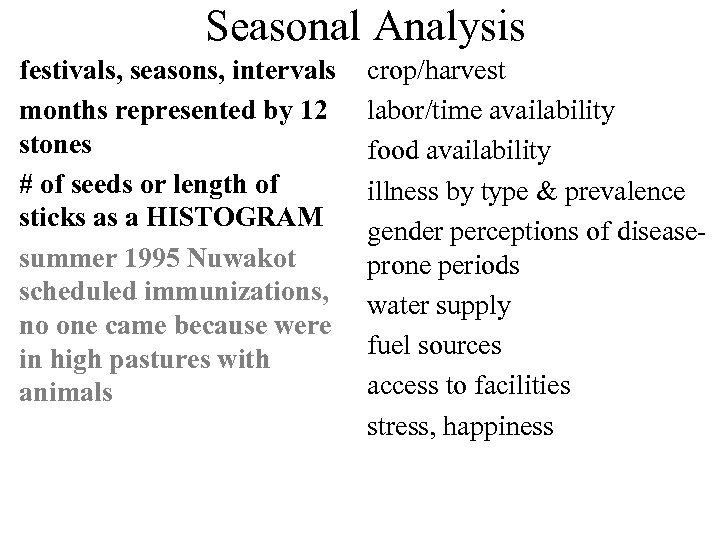
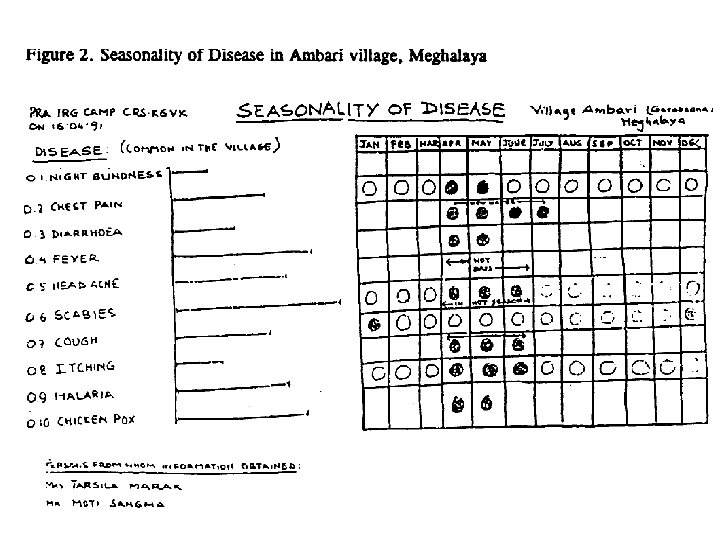
 Seasonal Diagramming: Useful for awareness and planning, – esp. CHW, & health initiatives in relation to disease trends, times of stress, etc.
 Seasonal Diagramming Useful for: timing of interventions with respect to variations in – water supply – disease – type & availability of food – income
 Time lines & trends changes in the composition of diets
 Sequence Matrices sequence of going for consultation & treatment sequence of a disease with characteristics and treatments Useful for – agency for discussion, participatory definition of needs & services – learning how services can be improved
 tracing sequence of disease & action taken at each stage causal diagram-impact of a cash crop food chain what happened after immunization sequence of weaning practices in relation to seasonality and food availability
 Useful for analysis of processes, sequences of action, causes, choices & potential effects planning sequences of shorter and longer-term actions “what if” analysis before and after, understanding what has happened and what might happen evaluation
 Food chart histogram what currently consuming, etc.
 Causal and flow diagramming
 From Reserve to Rapport, from Tedium to fun sharing in the culture and spread of PRA is important
 Difficulties faced using PRA in women’s health efforts in India barrier of participation, for centuries women contributed their labor, not their conscious thoughts, women see themselves as passive recipients of handed-down knowledge devising suitable methods, need to be flexible
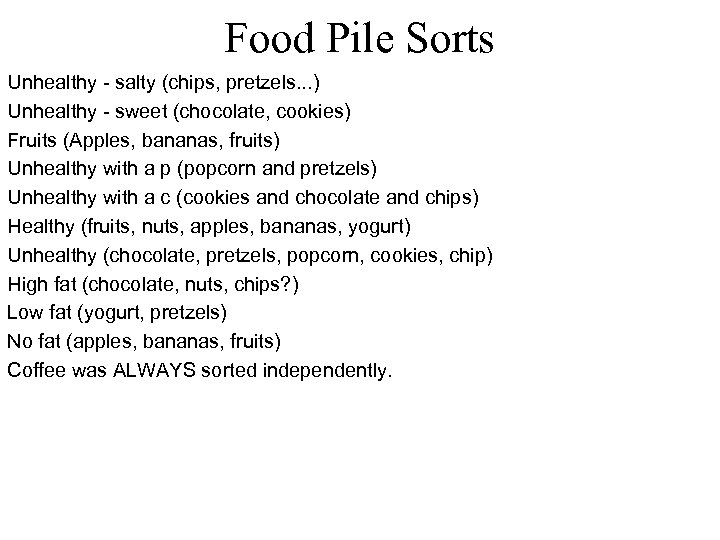 Food Pile Sorts Unhealthy - salty (chips, pretzels. . . ) Unhealthy - sweet (chocolate, cookies) Fruits (Apples, bananas, fruits) Unhealthy with a p (popcorn and pretzels) Unhealthy with a c (cookies and chocolate and chips) Healthy (fruits, nuts, apples, bananas, yogurt) Unhealthy (chocolate, pretzels, popcorn, cookies, chip) High fat (chocolate, nuts, chips? ) Low fat (yogurt, pretzels) No fat (apples, bananas, fruits) Coffee was ALWAYS sorted independently.