 Скачать презентацию Class BIOLOGICAL AND LANDSCAPE DIVERSITY Instructor Prof
Biodiversity-2015-1.pptx
- Количество слайдов: 10



Class BIOLOGICAL AND LANDSCAPE DIVERSITY Instructor – Prof. Mykhailo Grodzynskyi, Office # 501, E-mail: mgrodz@ukr. net
Bio- and landscape diversity: Theme # 1 Theme 1: Introduction • What is Bio- and Landscape diversity – general introductory remarks • Why the Bio- and Landscape diversity are important • How the class will be organized • Suggested readings and Internet resources
Bio- and landscape diversity: Theme # 1 What is Bio- and Landscape diversity (very briefly as the issue to be continued next week) The United Nations Convention on Biological Diversity (CBD) defines biological diversity as ‘‘the variability among living organisms from all sources, including terrestrial, marine, and other aquatic ecosystems and the ecological complexes of which they are part; this includes diversity within species, between species, and of ecosystems”. Diversity is considered at different levels, between individuals, subspecies, biological communities, and ecosystems. Concerns about biodiversity are relatively new. Only during the last quarter of the twentieth century did scientists begin to study it and governments make efforts to protect it. One reason for the growing interest in biodiversity is the threat that human activities may pose for plant and animal species. As humans take over more land for agriculture, cities, highways, and other uses, natural habitats are seriously disrupted. Whole populations may be destroyed, upsetting the balance of nature that exists in an area. The loss of a single plant may result in the loss of animals that depend on that plant for food. The loss of those animals may, in turn, result in the loss of predators who prey on those animals. The World Conservation Union, World Resources Institute, and United Nations Environment Program are three important agencies whose purpose is to conserve and protect the world's biodiversity. These agencies have developed the Global Biodiversity Strategy, an international program to help protect plant and animal habitats for this and future generations. This program began in the late 1970 s.
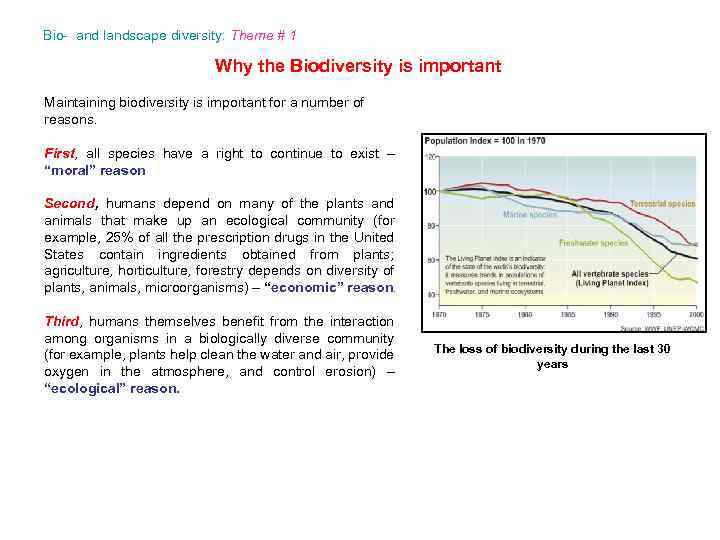
Bio- and landscape diversity: Theme # 1 Why the Biodiversity is important Maintaining biodiversity is important for a number of reasons. First, all species have a right to continue to exist – “moral” reason Second, humans depend on many of the plants and animals that make up an ecological community (for example, 25% of all the prescription drugs in the United States contain ingredients obtained from plants; agriculture, horticulture, forestry depends on diversity of plants, animals, microorganisms) – “economic” reason. Third, humans themselves benefit from the interaction among organisms in a biologically diverse community (for example, plants help clean the water and air, provide oxygen in the atmosphere, and control erosion) – “ecological” reason. The loss of biodiversity during the last 30 years
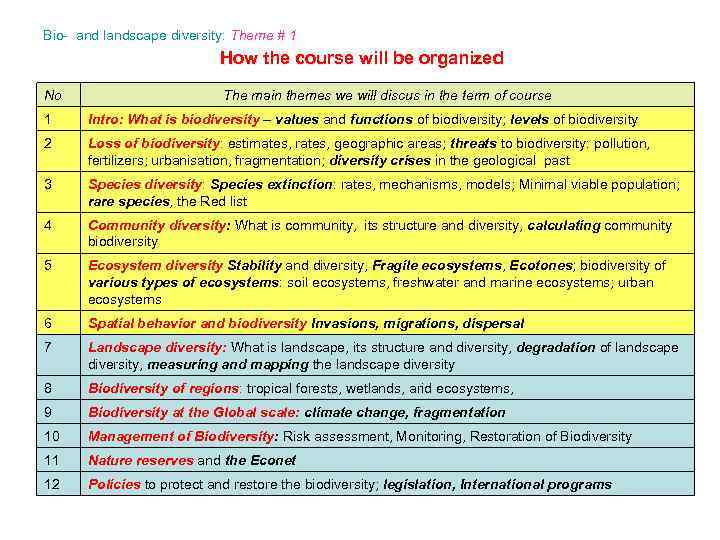
Bio- and landscape diversity: Theme # 1 How the course will be organized No The main themes we will discus in the term of course 1 Intro: What is biodiversity – values and functions of biodiversity; levels of biodiversity 2 Loss of biodiversity: estimates, rates, geographic areas; threats to biodiversity: pollution, fertilizers; urbanisation, fragmentation; diversity crises in the geological past 3 Species diversity: Species extinction: rates, mechanisms, models; Minimal viable population; rare species, the Red list 4 Community diversity: What is community, its structure and diversity, calculating community biodiversity 5 Ecosystem diversity Stability and diversity, Fragile ecosystems, Ecotones; biodiversity of various types of ecosystems: soil ecosystems, freshwater and marine ecosystems; urban ecosystems 6 Spatial behavior and biodiversity Invasions, migrations, dispersal 7 Landscape diversity: What is landscape, its structure and diversity, degradation of landscape diversity, measuring and mapping the landscape diversity 8 Biodiversity of regions: tropical forests, wetlands, arid ecosystems, 9 Biodiversity at the Global scale: climate change, fragmentation 10 Management of Biodiversity: Risk assessment, Monitoring, Restoration of Biodiversity 11 Nature reserves and the Econet 12 Policies to protect and restore the biodiversity; legislation, International programs
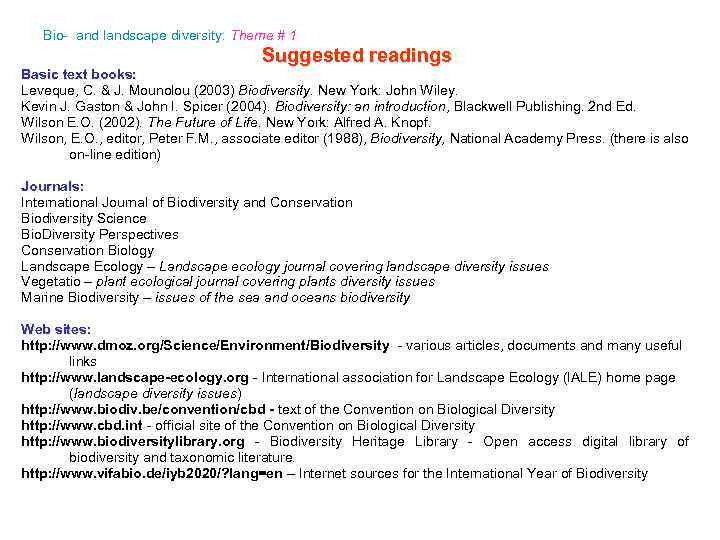
Bio- and landscape diversity: Theme # 1 Suggested readings Basic text books: Leveque, C. & J. Mounolou (2003) Biodiversity. New York: John Wiley. Kevin J. Gaston & John I. Spicer (2004). Biodiversity: an introduction, Blackwell Publishing. 2 nd Ed. Wilson E. O. (2002). The Future of Life. New York: Alfred A. Knopf. Wilson, E. O. , editor, Peter F. M. , associate editor (1988), Biodiversity, National Academy Press. (there is also on-line edition) Journals: International Journal of Biodiversity and Conservation Biodiversity Science Bio. Diversity Perspectives Conservation Biology Landscape Ecology – Landscape ecology journal covering landscape diversity issues Vegetatio – plant ecological journal covering plants diversity issues Marine Biodiversity – issues of the sea and oceans biodiversity Web sites: http: //www. dmoz. org/Science/Environment/Biodiversity - various articles, documents and many useful links http: //www. landscape-ecology. org - International association for Landscape Ecology (IALE) home page (landscape diversity issues) http: //www. biodiv. be/convention/cbd - text of the Convention on Biological Diversity http: //www. cbd. int - official site of the Convention on Biological Diversity http: //www. biodiversitylibrary. org - Biodiversity Heritage Library - Open access digital library of biodiversity and taxonomic literature. http: //www. vifabio. de/iyb 2020/? lang=en – Internet sources for the International Year of Biodiversity
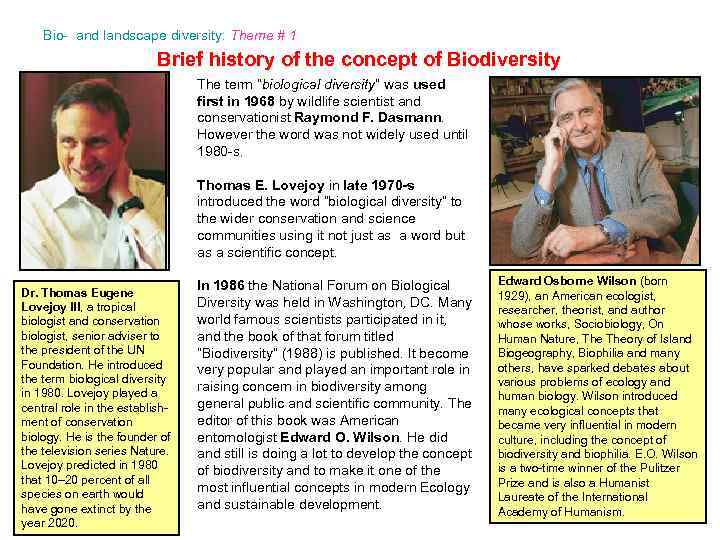
Bio- and landscape diversity: Theme # 1 Brief history of the concept of Biodiversity The term “biological diversity” was used first in 1968 by wildlife scientist and conservationist Raymond F. Dasmann. However the word was not widely used until 1980 -s. Thomas E. Lovejoy in late 1970 -s introduced the word “biological diversity” to the wider conservation and science communities using it not just as a word but as a scientific concept. Dr. Thomas Eugene Lovejoy III, a tropical biologist and conservation biologist, senior adviser to the president of the UN Foundation. He introduced the term biological diversity in 1980. Lovejoy played a central role in the establishment of conservation biology. He is the founder of the television series Nature. Lovejoy predicted in 1980 that 10– 20 percent of all species on earth would have gone extinct by the year 2020. In 1986 the National Forum on Biological Diversity was held in Washington, DC. Many world famous scientists participated in it, and the book of that forum titled “Biodiversity” (1988) is published. It become very popular and played an important role in raising concern in biodiversity among general public and scientific community. The editor of this book was American entomologist Edward O. Wilson. He did and still is doing a lot to develop the concept of biodiversity and to make it one of the most influential concepts in modern Ecology and sustainable development. Edward Osborne Wilson (born 1929), an American ecologist, researcher, theorist, and author whose works, Sociobiology, On Human Nature, Theory of Island Biogeography, Biophilia and many others, have sparked debates about various problems of ecology and human biology. Wilson introduced many ecological concepts that became very influential in modern culture, including the concept of biodiversity and biophilia. E. O. Wilson is a two-time winner of the Pulitzer Prize and is also a Humanist Laureate of the International Academy of Humanism.
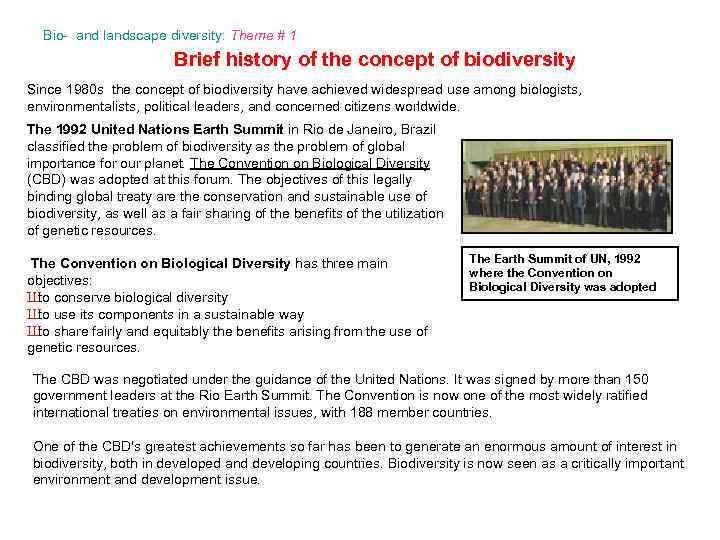
Bio- and landscape diversity: Theme # 1 Brief history of the concept of biodiversity Since 1980 s the concept of biodiversity have achieved widespread use among biologists, environmentalists, political leaders, and concerned citizens worldwide. The 1992 United Nations Earth Summit in Rio de Janeiro, Brazil classified the problem of biodiversity as the problem of global importance for our planet. The Convention on Biological Diversity (CBD) was adopted at this forum. The objectives of this legally binding global treaty are the conservation and sustainable use of biodiversity, as well as a fair sharing of the benefits of the utilization of genetic resources. The Convention on Biological Diversity has three main objectives: Ш conserve biological diversity to Ш use its components in a sustainable way to Ш share fairly and equitably the benefits arising from the use of to genetic resources. The Earth Summit of UN, 1992 where the Convention on Biological Diversity was adopted The CBD was negotiated under the guidance of the United Nations. It was signed by more than 150 government leaders at the Rio Earth Summit. The Convention is now one of the most widely ratified international treaties on environmental issues, with 188 member countries. One of the CBD's greatest achievements so far has been to generate an enormous amount of interest in biodiversity, both in developed and developing countries. Biodiversity is now seen as a critically important environment and development issue.
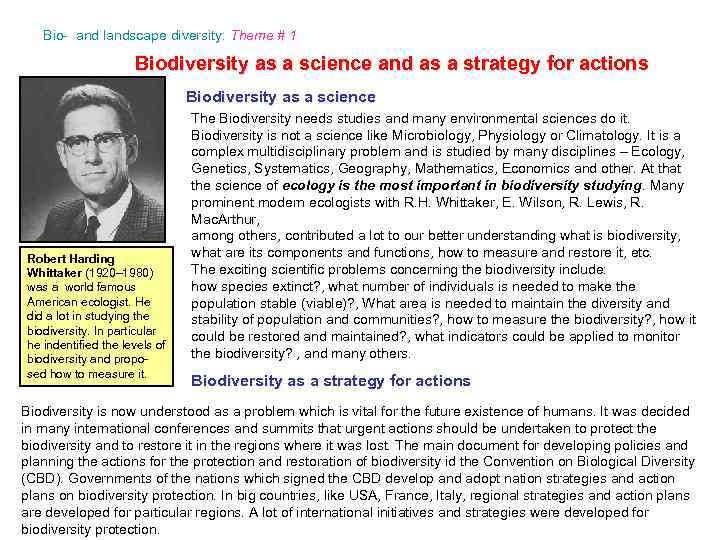
Bio- and landscape diversity: Theme # 1 Biodiversity as a science and as a strategy for actions Biodiversity as a science Robert Harding Whittaker (1920– 1980) was a world famous American ecologist. He did a lot in studying the biodiversity. In particular he indentified the levels of biodiversity and proposed how to measure it. The Biodiversity needs studies and many environmental sciences do it. Biodiversity is not a science like Microbiology, Physiology or Climatology. It is a complex multidisciplinary problem and is studied by many disciplines – Ecology, Genetics, Systematics, Geography, Mathematics, Economics and other. At that the science of ecology is the most important in biodiversity studying. Many prominent modern ecologists with R. H. Whittaker, E. Wilson, R. Lewis, R. Mac. Arthur, among others, contributed a lot to our better understanding what is biodiversity, what are its components and functions, how to measure and restore it, etc. The exciting scientific problems concerning the biodiversity include: how species extinct? , what number of individuals is needed to make the population stable (viable)? , What area is needed to maintain the diversity and stability of population and communities? , how to measure the biodiversity? , how it could be restored and maintained? , what indicators could be applied to monitor the biodiversity? , and many others. Biodiversity as a strategy for actions Biodiversity is now understood as a problem which is vital for the future existence of humans. It was decided in many international conferences and summits that urgent actions should be undertaken to protect the biodiversity and to restore it in the regions where it was lost. The main document for developing policies and planning the actions for the protection and restoration of biodiversity id the Convention on Biological Diversity (CBD). Governments of the nations which signed the CBD develop and adopt nation strategies and action plans on biodiversity protection. In big countries, like USA, France, Italy, regional strategies and action plans are developed for particular regions. A lot of international initiatives and strategies were developed for biodiversity protection.
Bio- and landscape diversity: Theme # 1 Next theme: What is Biodiversity and Landscape Diversity. • Definition of biodiversity • Levels of biodiversity • Geographical distribution of biodiversity • Evolution and biodiversity • Human impact on bio- and landscape diversity
Скачать презентацию Class BIOLOGICAL AND LANDSCAPE DIVERSITY Instructor Prof
Biodiversity-2015-1.pptx