


 Скачать презентацию Class 24 P NP Remaining Exam 2 comments now
2d5698e57769c65950df97a558cff82d.ppt
- Количество слайдов: 45
 Class 24: P=NP? Remaining Exam 2 comments now posted. PS 6 (the last one) is due Thursday, April 24. David Evans http: //www. cs. virginia. edu/evans cs 302: Theory of Computation University of Virginia Computer Science Protein model, Berger Lab UC Berkeley
 Final Exam • Scheduled by registrar: – Saturday, May 3, 9 am-noon (exam is scheduled for 3 hours, but will be designed to take 1. 5 hours) • No notes or books allowed – My sense from grading Exam 2 is people used their notes as a crutch, not helpfully – Enables “easier” questions and more partial credit • In class next Tuesday, I will hand out a “preview” of some of the exam questions and possibly discuss them 2
 Final Exam Topics • Everything covered through this Thursday: – Exams 1 and 2 and comments – Problem Sets 1 -6 and comments – Lectures 1 -25 – Sipser, Chapters 0 -5, 7 – Additional Readings: Aaronson (spring break), one of the NP-completeness papers • Roughly ⅓ Exam 1 material, ⅓ Exam 2 material, ⅓ since Exam 2 (but many individual questions will combine material from multiple parts) 3
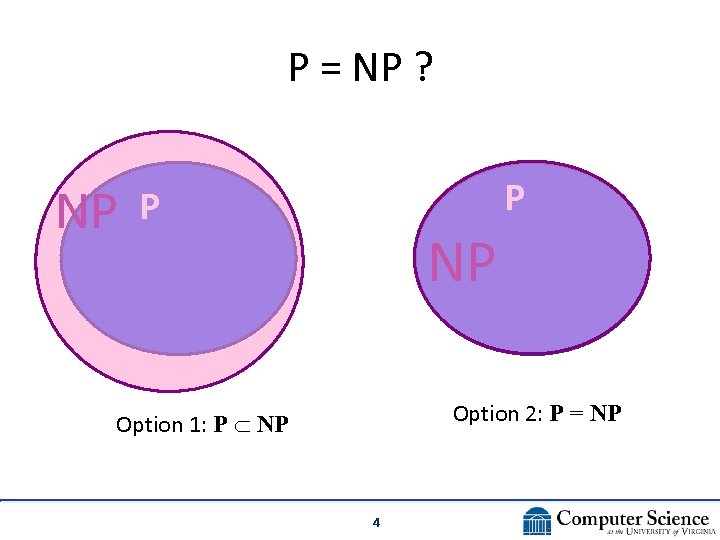 P = NP ? NP P P NP Option 2: P = NP Option 1: P NP 4
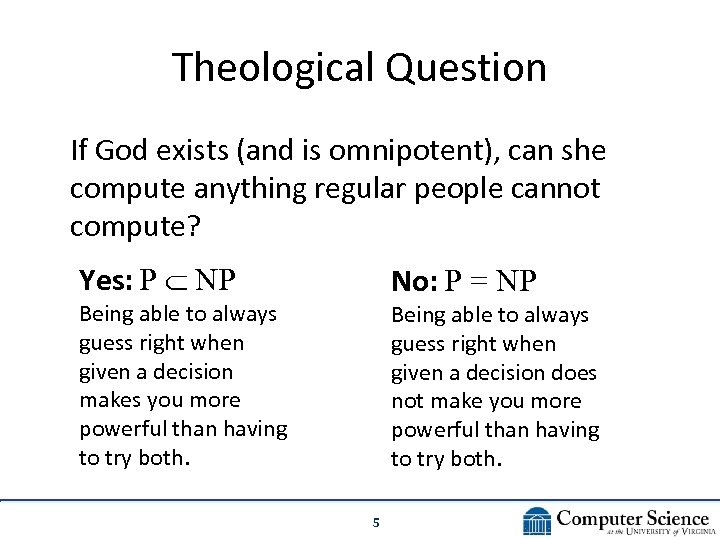 Theological Question If God exists (and is omnipotent), can she compute anything regular people cannot compute? Yes: P NP No: P = NP Being able to always guess right when given a decision makes you more powerful than having to try both. Being able to always guess right when given a decision does not make you more powerful than having to try both. 5
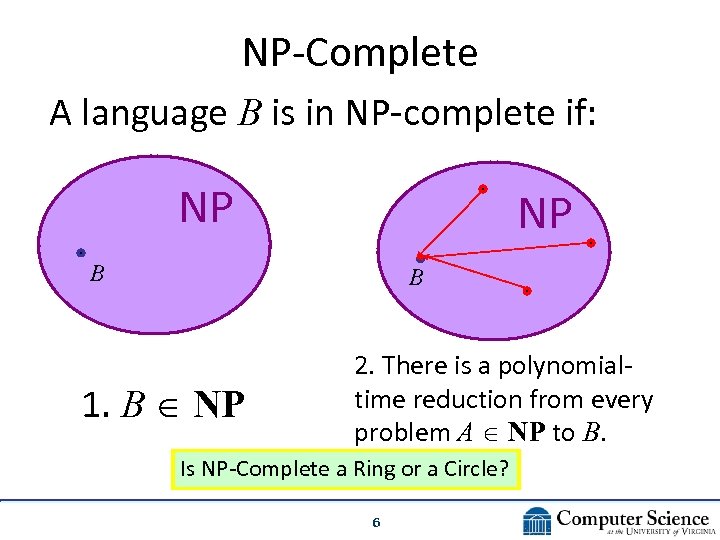 NP-Complete A language B is in NP-complete if: NP NP B B 1. B NP 2. There is a polynomialtime reduction from every problem A NP to B. Is NP-Complete a Ring or a Circle? 6
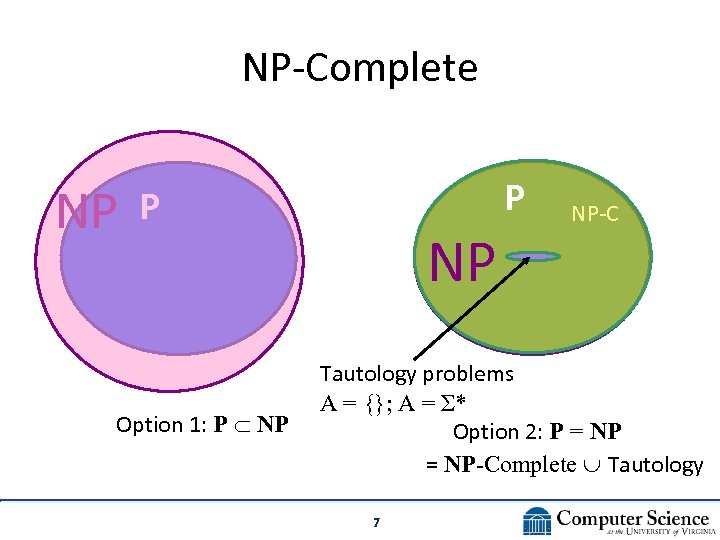 NP-Complete NP P P Option 1: P NP NP NP-C Tautology problems A = {}; A = Σ* Option 2: P = NP-Complete Tautology 7
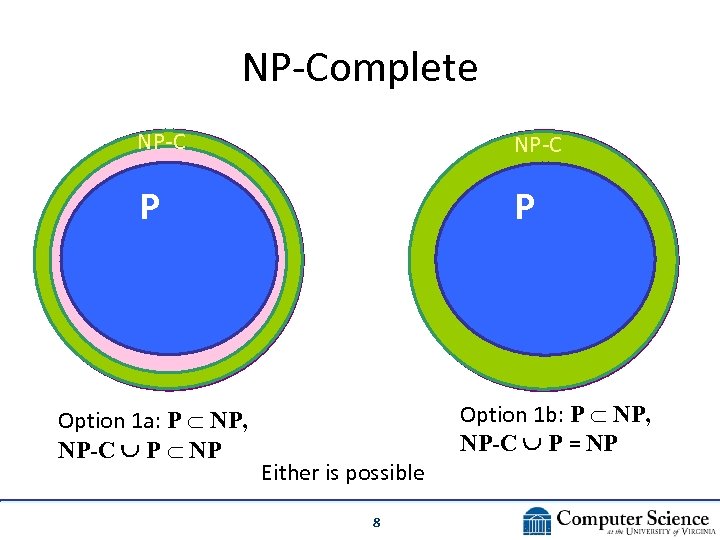 NP-Complete NP-C P P Option 1 a: P NP, NP-C P NP Either is possible 8 Option 1 b: P NP, NP-C P = NP
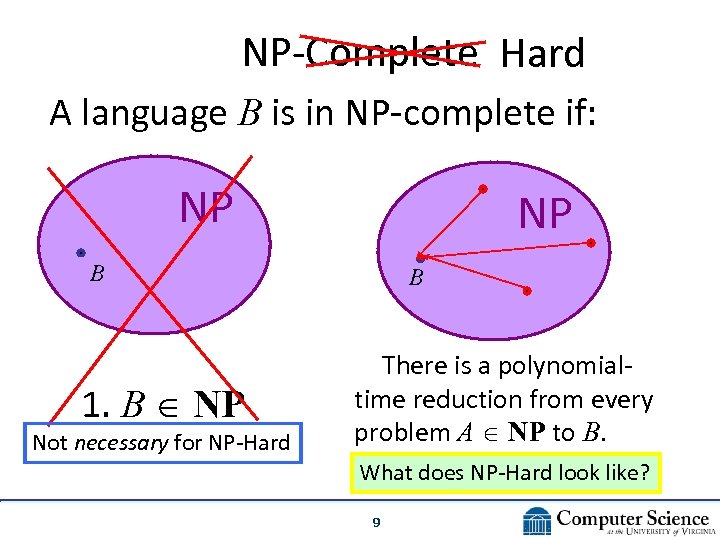 NP-Complete Hard A language B is in NP-complete if: NP NP B 1. B NP Not necessary for NP-Hard B 2. There is a polynomialtime reduction from every problem A NP to B. What does NP-Hard look like? 9
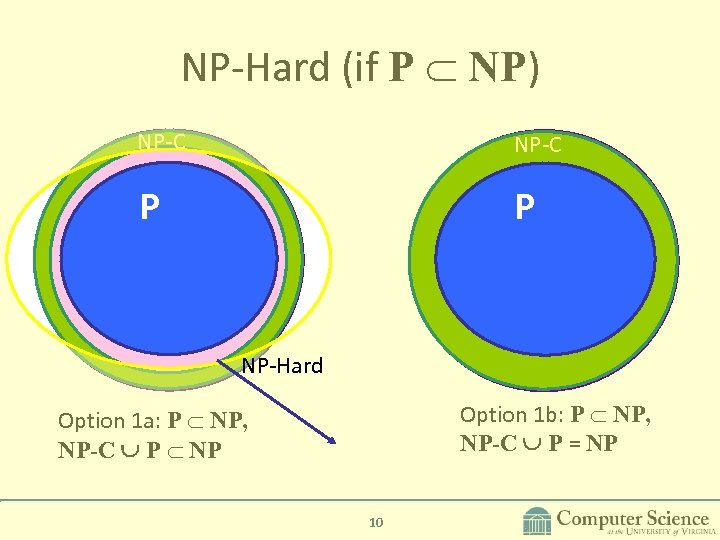 NP-Hard (if P NP) NP-C P P NP-Hard Option 1 b: P NP, NP-C P = NP Option 1 a: P NP, NP-C P NP 10
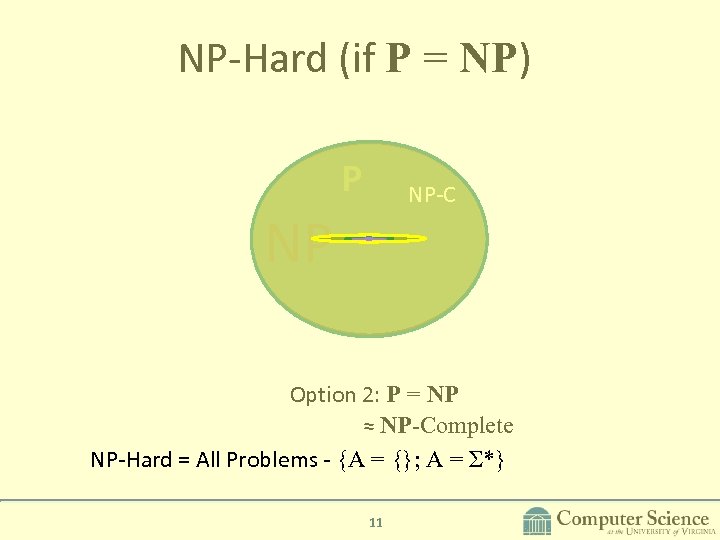 NP-Hard (if P = NP) P NP-C NP Option 2: P = NP ≈ NP-Complete NP-Hard = All Problems - {A = {}; A = Σ*} 11
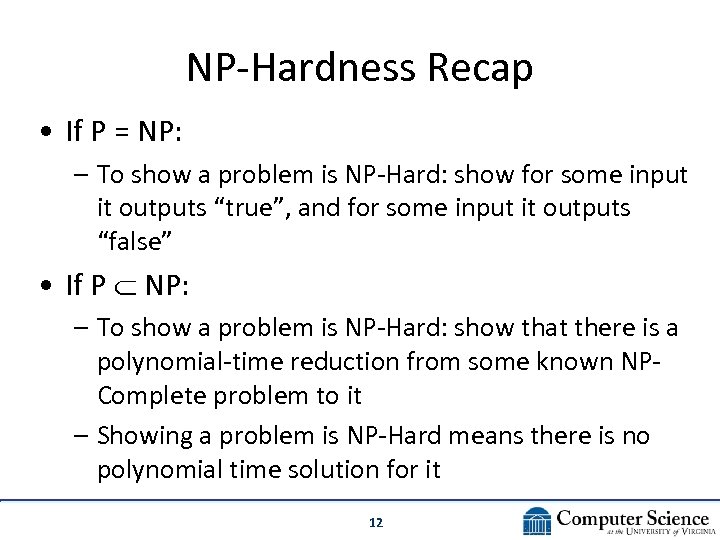 NP-Hardness Recap • If P = NP: – To show a problem is NP-Hard: show for some input it outputs “true”, and for some input it outputs “false” • If P NP: – To show a problem is NP-Hard: show that there is a polynomial-time reduction from some known NPComplete problem to it – Showing a problem is NP-Hard means there is no polynomial time solution for it 12
 Games and NP-Hardness 13
 Papers from Last Class • (Generalized) Cracker Barrel Puzzle is NPComplete • (Generalized) March Madness is NP-Hard – Is it NP-Complete also? • (Generalized) Minesweeper Consistency is NPComplete • . . . ? Are these special cases, or is there something about “interesting” games that makes them NP-Hard? 14
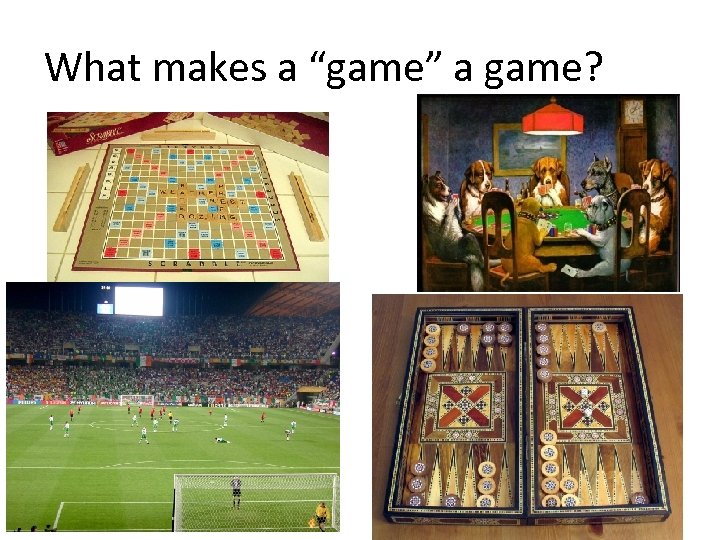 What makes a “game” a game?
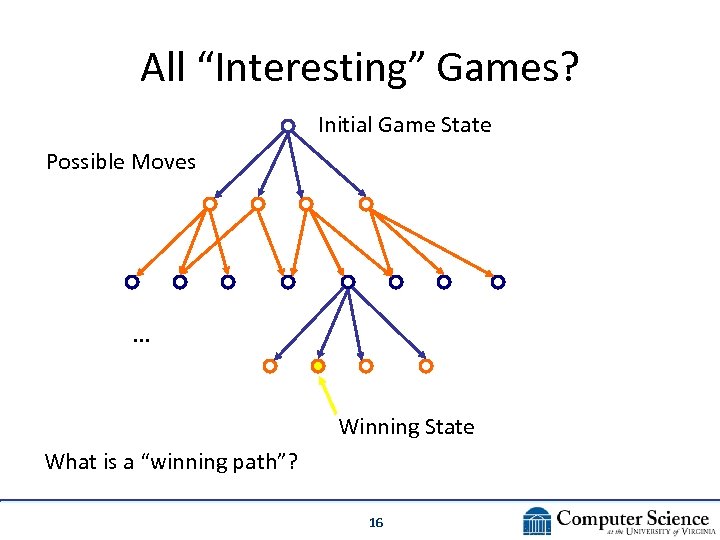 All “Interesting” Games? Initial Game State Possible Moves . . . Winning State What is a “winning path”? 16
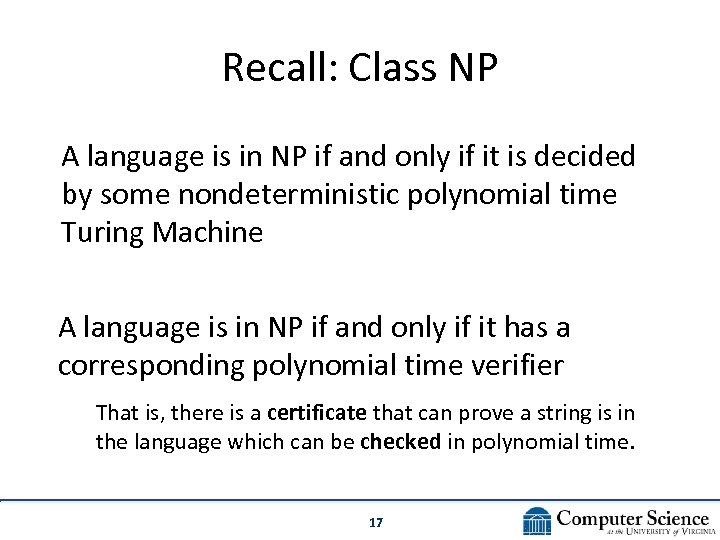 Recall: Class NP A language is in NP if and only if it is decided by some nondeterministic polynomial time Turing Machine A language is in NP if and only if it has a corresponding polynomial time verifier That is, there is a certificate that can prove a string is in the language which can be checked in polynomial time. 17
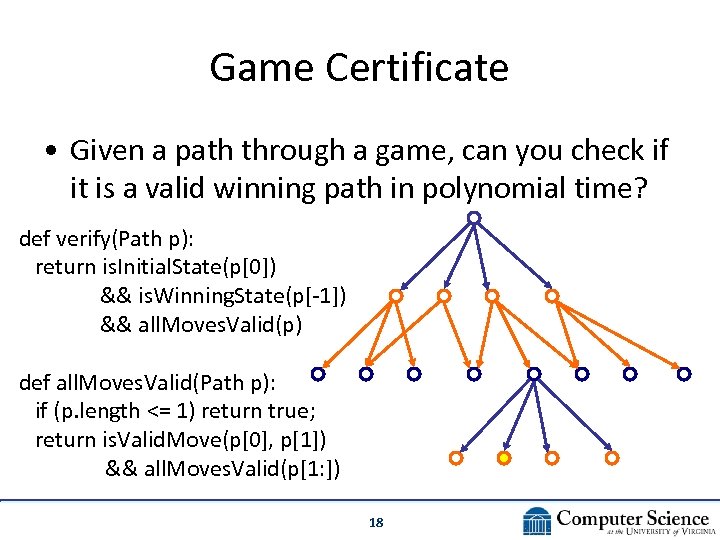 Game Certificate • Given a path through a game, can you check if it is a valid winning path in polynomial time? def verify(Path p): return is. Initial. State(p[0]) && is. Winning. State(p[-1]) && all. Moves. Valid(p) def all. Moves. Valid(Path p): if (p. length <= 1) return true; return is. Valid. Move(p[0], p[1]) && all. Moves. Valid(p[1: ]) 18
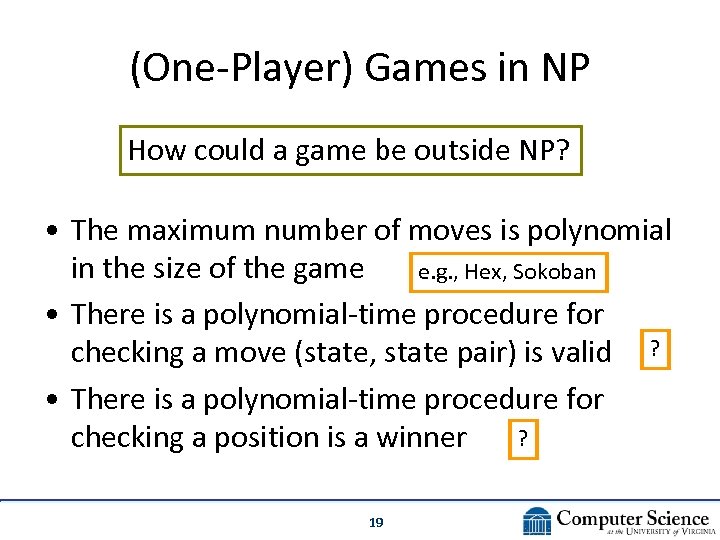 (One-Player) Games in NP How could a game be outside NP? • The maximum number of moves is polynomial in the size of the game e. g. , Hex, Sokoban • There is a polynomial-time procedure for checking a move (state, state pair) is valid ? • There is a polynomial-time procedure for ? checking a position is a winner 19
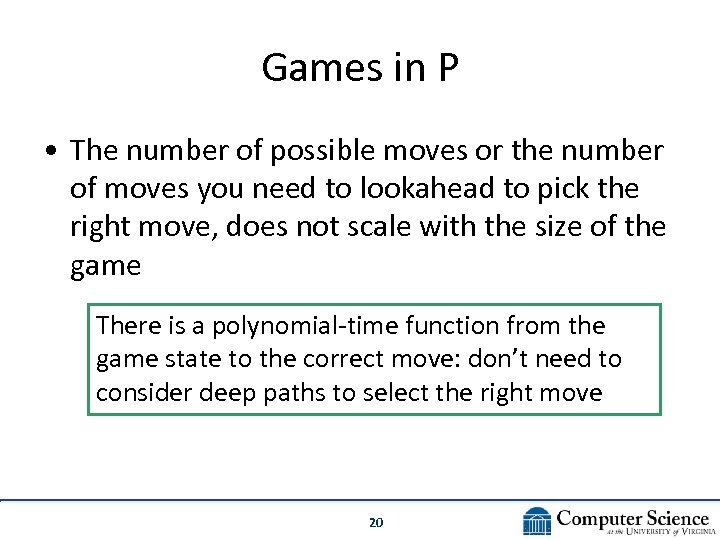 Games in P • The number of possible moves or the number of moves you need to lookahead to pick the right move, does not scale with the size of the game There is a polynomial-time function from the game state to the correct move: don’t need to consider deep paths to select the right move 20
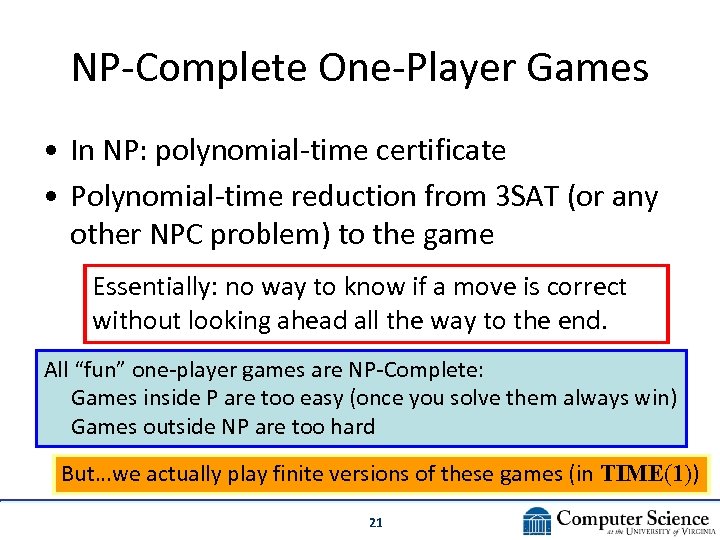 NP-Complete One-Player Games • In NP: polynomial-time certificate • Polynomial-time reduction from 3 SAT (or any other NPC problem) to the game Essentially: no way to know if a move is correct without looking ahead all the way to the end. All “fun” one-player games are NP-Complete: Games inside P are too easy (once you solve them always win) Games outside NP are too hard But…we actually play finite versions of these games (in TIME(1)) 21
 Reduction Proofs 22
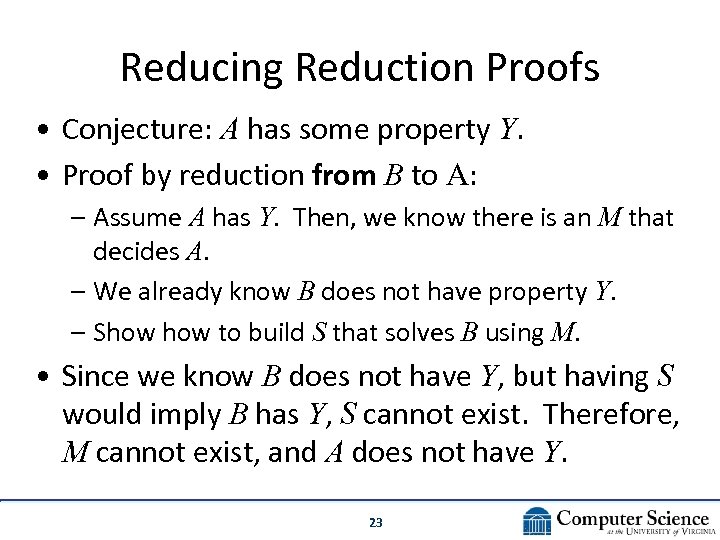 Reducing Reduction Proofs • Conjecture: A has some property Y. • Proof by reduction from B to A: – Assume A has Y. Then, we know there is an M that decides A. – We already know B does not have property Y. – Show to build S that solves B using M. • Since we know B does not have Y, but having S would imply B has Y, S cannot exist. Therefore, M cannot exist, and A does not have Y. 23
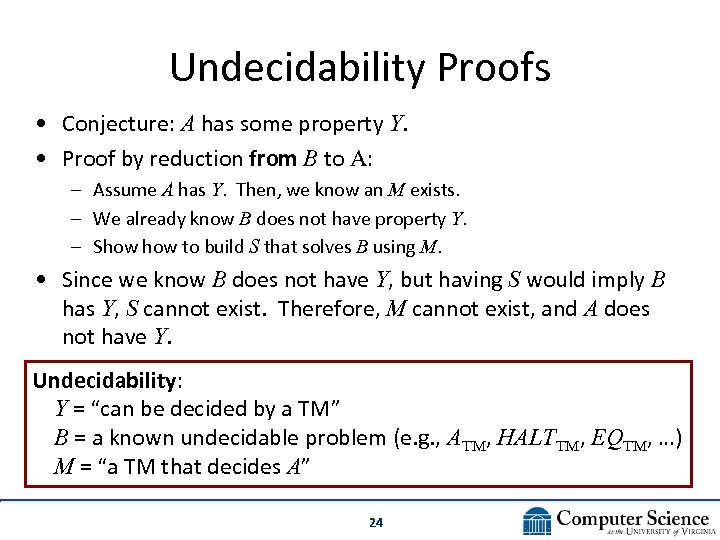 Undecidability Proofs • Conjecture: A has some property Y. • Proof by reduction from B to A: – Assume A has Y. Then, we know an M exists. – We already know B does not have property Y. – Show to build S that solves B using M. • Since we know B does not have Y, but having S would imply B has Y, S cannot exist. Therefore, M cannot exist, and A does not have Y. Undecidability: Y = “can be decided by a TM” B = a known undecidable problem (e. g. , ATM, HALTTM, EQTM, …) M = “a TM that decides A” 24
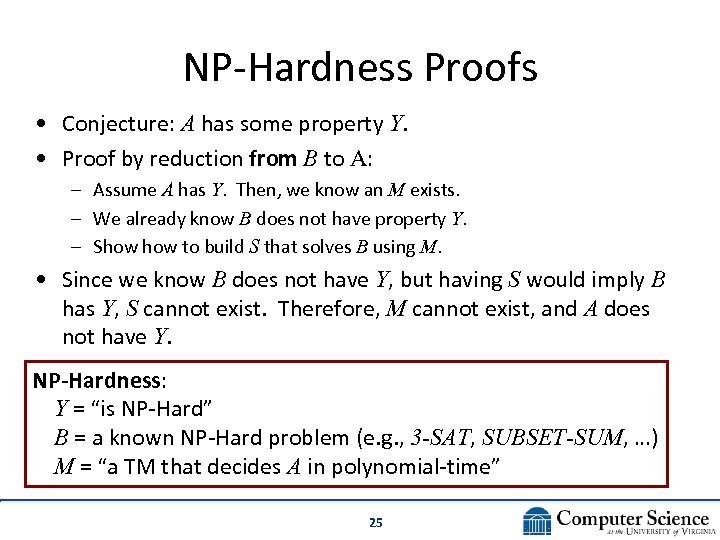 NP-Hardness Proofs • Conjecture: A has some property Y. • Proof by reduction from B to A: – Assume A has Y. Then, we know an M exists. – We already know B does not have property Y. – Show to build S that solves B using M. • Since we know B does not have Y, but having S would imply B has Y, S cannot exist. Therefore, M cannot exist, and A does not have Y. NP-Hardness: Y = “is NP-Hard” B = a known NP-Hard problem (e. g. , 3 -SAT, SUBSET-SUM, …) M = “a TM that decides A in polynomial-time” 25
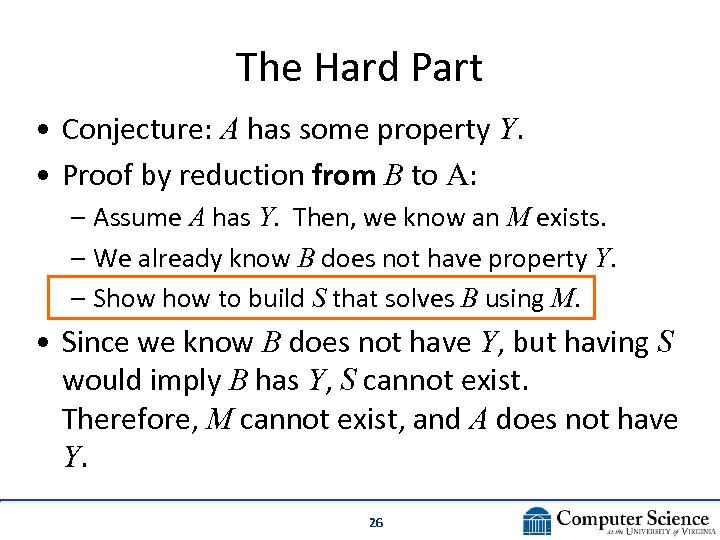 The Hard Part • Conjecture: A has some property Y. • Proof by reduction from B to A: – Assume A has Y. Then, we know an M exists. – We already know B does not have property Y. – Show to build S that solves B using M. • Since we know B does not have Y, but having S would imply B has Y, S cannot exist. Therefore, M cannot exist, and A does not have Y. 26
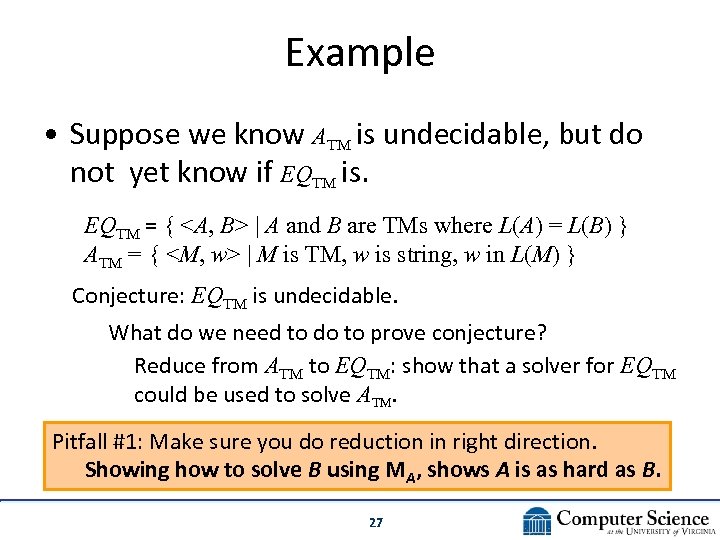 Example • Suppose we know ATM is undecidable, but do not yet know if EQTM is. EQTM = {
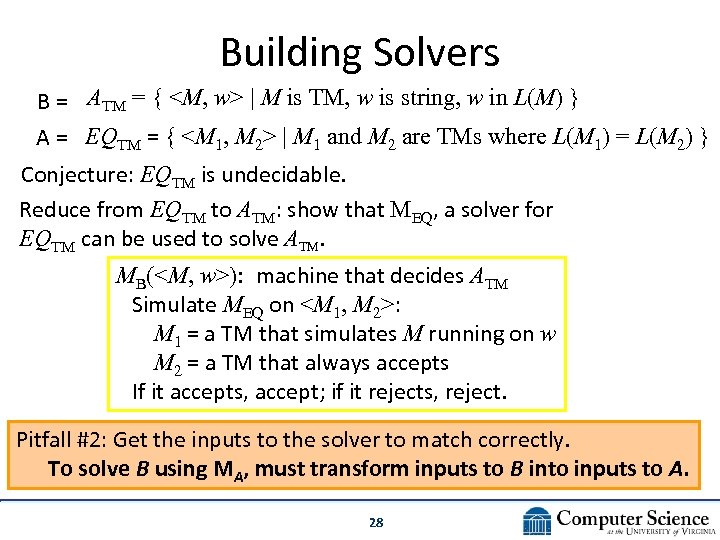 Building Solvers B = ATM = {
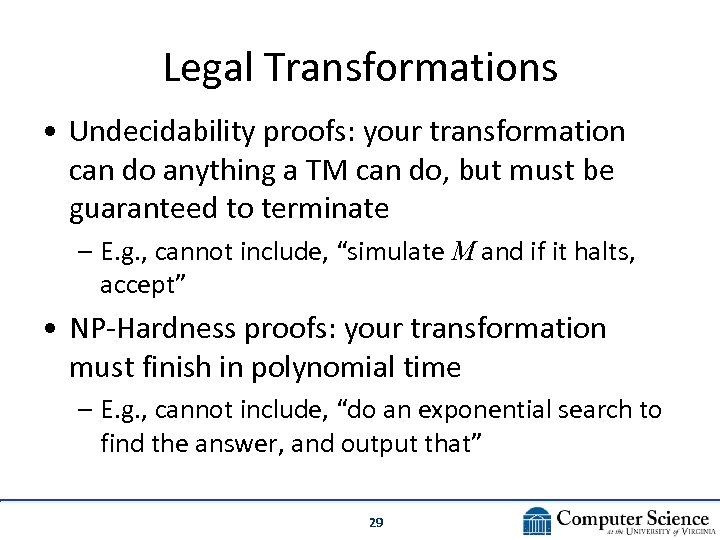 Legal Transformations • Undecidability proofs: your transformation can do anything a TM can do, but must be guaranteed to terminate – E. g. , cannot include, “simulate M and if it halts, accept” • NP-Hardness proofs: your transformation must finish in polynomial time – E. g. , cannot include, “do an exponential search to find the answer, and output that” 29
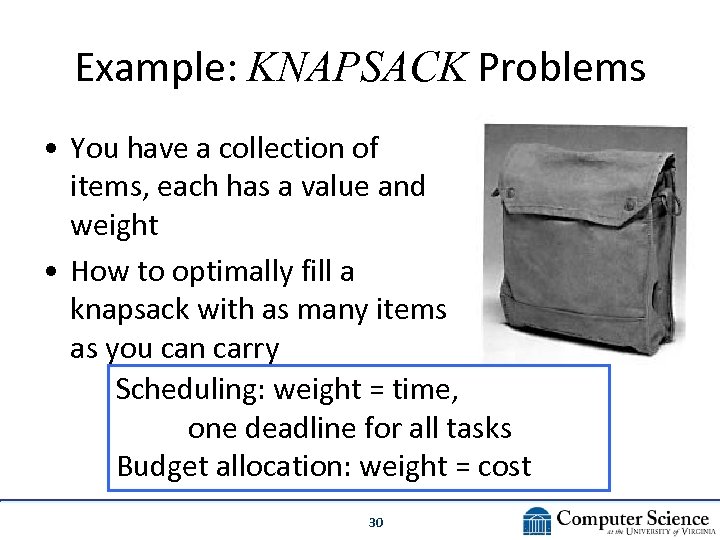 Example: KNAPSACK Problems • You have a collection of items, each has a value and weight • How to optimally fill a knapsack with as many items as you can carry Scheduling: weight = time, one deadline for all tasks Budget allocation: weight = cost 30
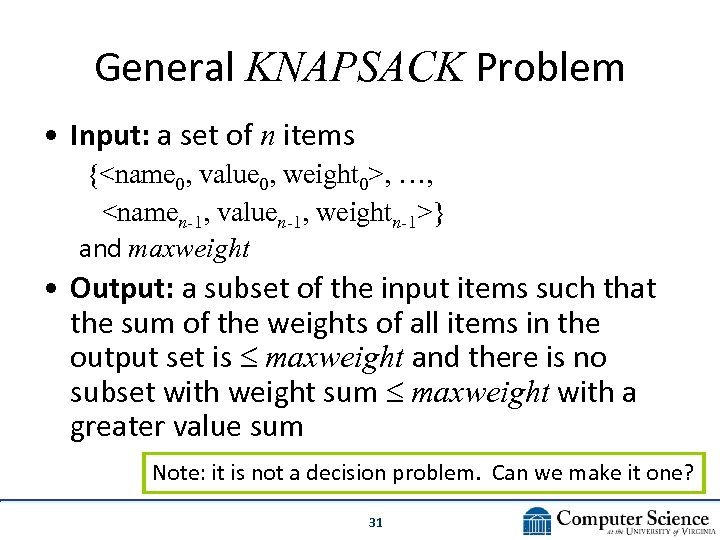 General KNAPSACK Problem • Input: a set of n items {
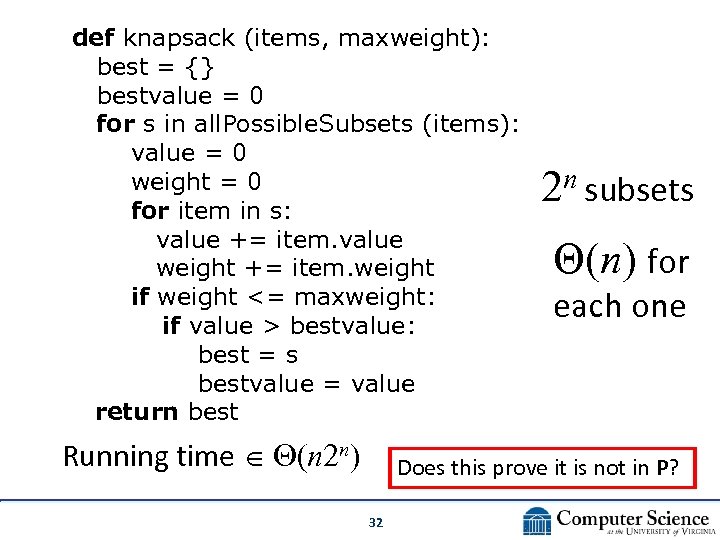 def knapsack (items, maxweight): best = {} bestvalue = 0 for s in all. Possible. Subsets (items): value = 0 weight = 0 for item in s: value += item. value weight += item. weight if weight <= maxweight: if value > bestvalue: best = s bestvalue = value return best Running time (n 2 n) n subsets 2 Θ(n) for each one Does this prove it is not in P? 32
 No! To prove it is not in P, we would need to show the best possible algorithm that solves it is not polynomial time. 33
 Is KNAPSACK NP-Complete? 34
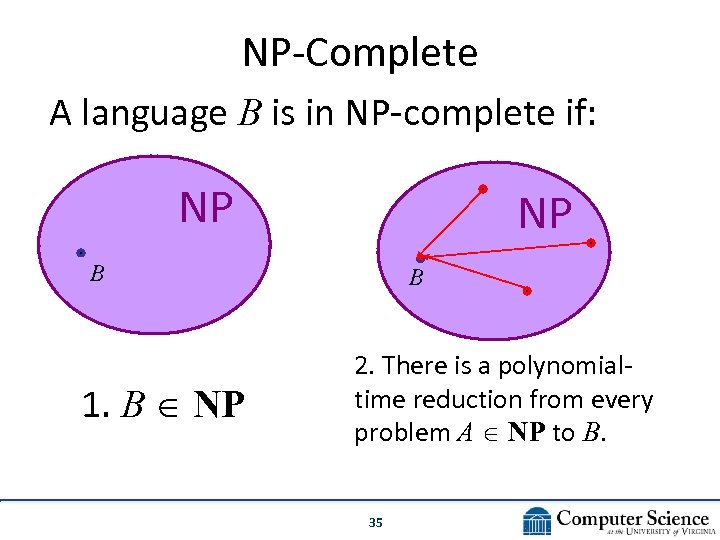 NP-Complete A language B is in NP-complete if: NP NP B 1. B NP B 2. There is a polynomialtime reduction from every problem A NP to B. 35
 KNAPSACK in NP • Certificate: subset of items • Test in P: add up the weights of those items, check it is less than maxweight For the non-decision problem: ask for certificates for all values 1, 2, …, maxweight. 36
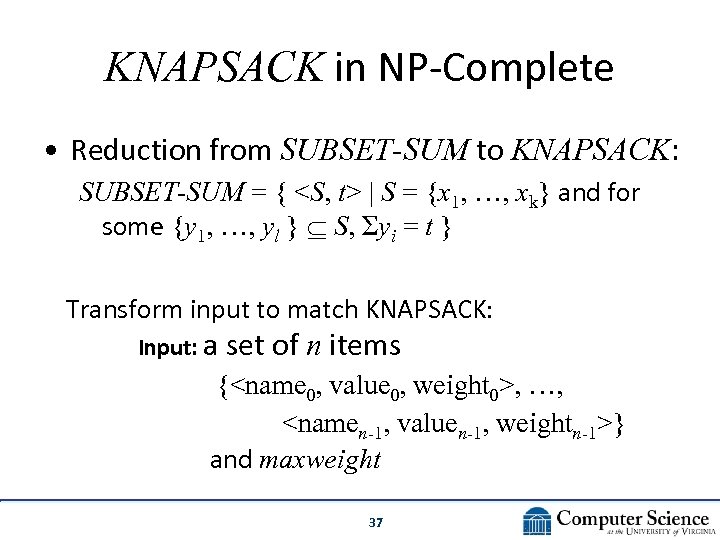 KNAPSACK in NP-Complete • Reduction from SUBSET-SUM to KNAPSACK: SUBSET-SUM = {
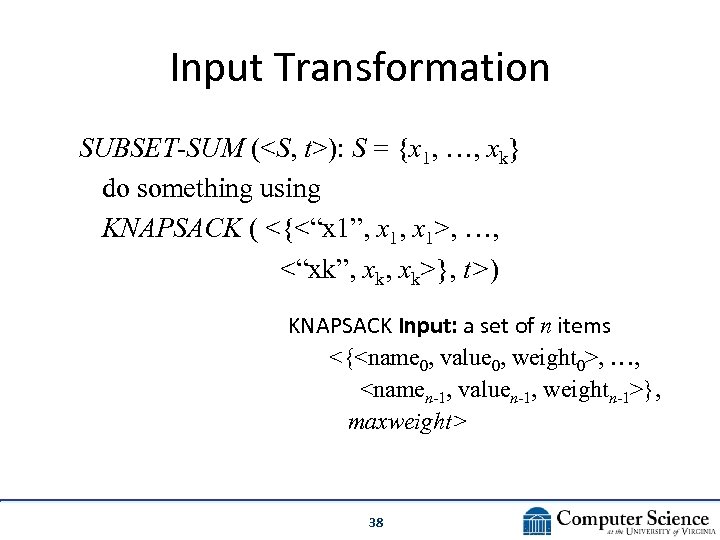 Input Transformation SUBSET-SUM (
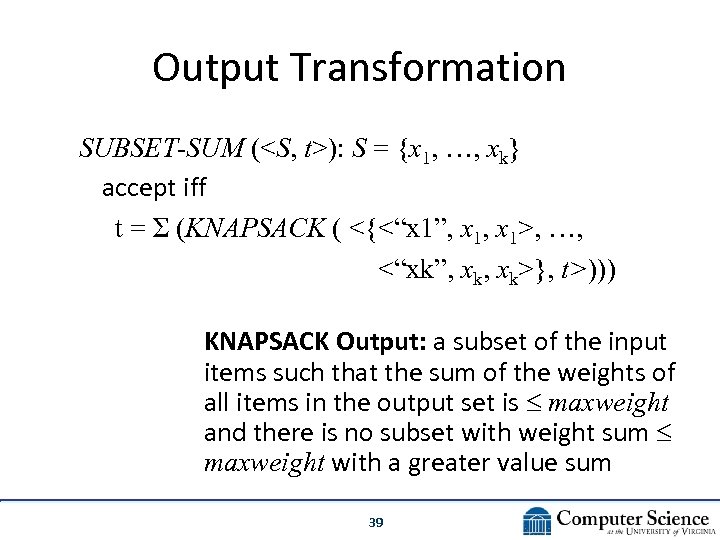 Output Transformation SUBSET-SUM (
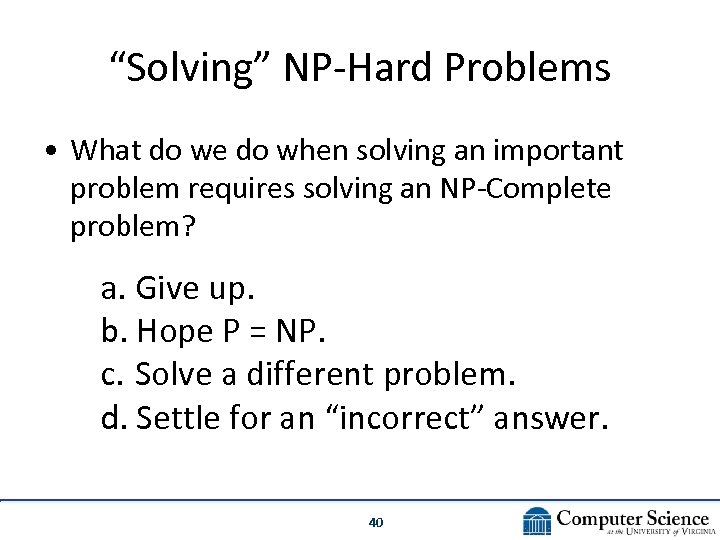 “Solving” NP-Hard Problems • What do we do when solving an important problem requires solving an NP-Complete problem? a. Give up. b. Hope P = NP. c. Solve a different problem. d. Settle for an “incorrect” answer. 40
 Approximation Algorithms Sometimes it is better to produce an incorrect answer quickly, than wait (longer than the lifetime of the universe) for a correct answer. A good approximation algorithm: 1. Runs in Polynomial Time 2. Produces answer within some known bound of best answer 41
 Greedy Algorithms • Make locally optimal decisions • For NP-Hard problems: cannot guarantee you find the best answer this way 42
![Greedy Knapsack Algorithm def knapsack_greedy (items, maxweight): result = [] weight = 0 while](https://present5.com/presentation/2d5698e57769c65950df97a558cff82d/image-43.jpg "Greedy Knapsack Algorithm def knapsack_greedy (items, maxweight): result = [] weight = 0 while") Greedy Knapsack Algorithm def knapsack_greedy (items, maxweight): result = [] weight = 0 while True: # try to add the best item weightleft = maxweight - weight bestitem = None for item in items: if item. weight <= weightleft and (bestitem == None or item. value > bestitem. value): bestitem = item if bestitem == None: break else: result. append (bestitem) weight += bestitem. weight return result 43 Running Time (n 2)
Greedy Knapsack Algorithm def knapsack_greedy (items, maxweight): result = [] weight = 0 while True: # try to add the best item weightleft = maxweight - weight bestitem = None for item in items: if item. weight <= weightleft and (bestitem == None or item. value > bestitem. value): bestitem = item if bestitem == None: break else: result. append (bestitem) weight += bestitem. weight return result 43 Running Time (n 2)
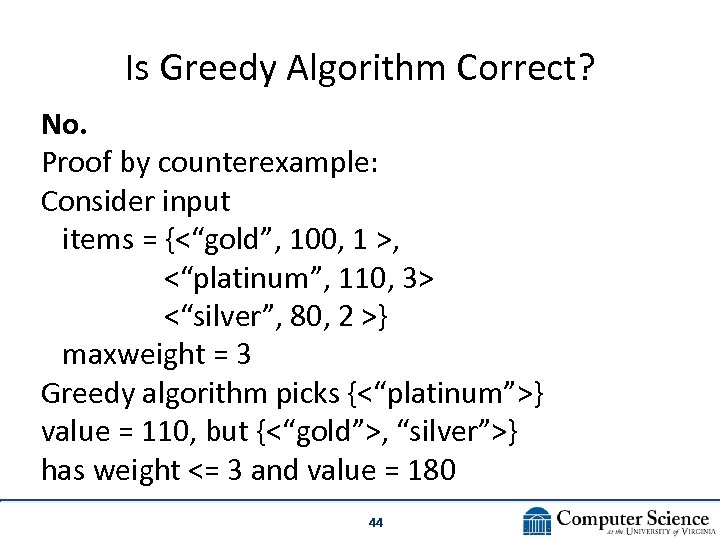 Is Greedy Algorithm Correct? No. Proof by counterexample: Consider input items = {<“gold”, 100, 1 >, <“platinum”, 110, 3> <“silver”, 80, 2 >} maxweight = 3 Greedy algorithm picks {<“platinum”>} value = 110, but {<“gold”>, “silver”>} has weight <= 3 and value = 180 44
 The Moral Life is (NP-) Hard, but probably not (NP-)Complete… Thursday: Karsten Nohl will talk about interesting theory problems in breaking cryptosystems 45