 Скачать презентацию Class 14 Altruism and Attribution Theory Do
3d09f795a4888c7490f16ed278a9d9d9.ppt
- Количество слайдов: 32



Class 14: Altruism and Attribution Theory
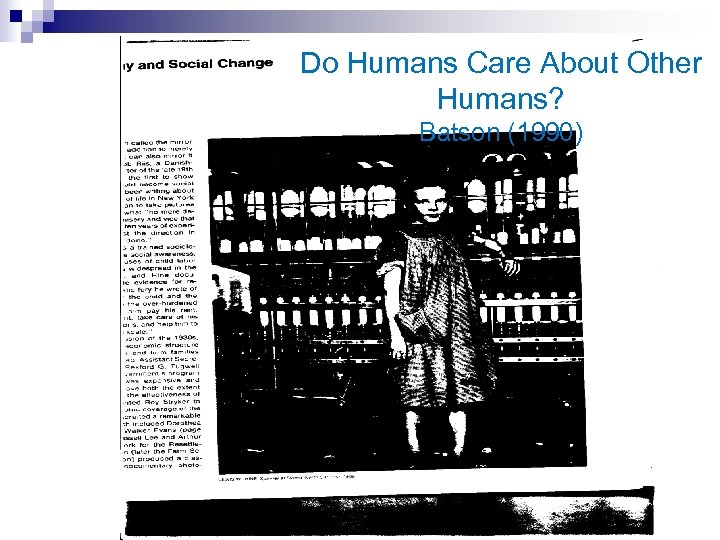
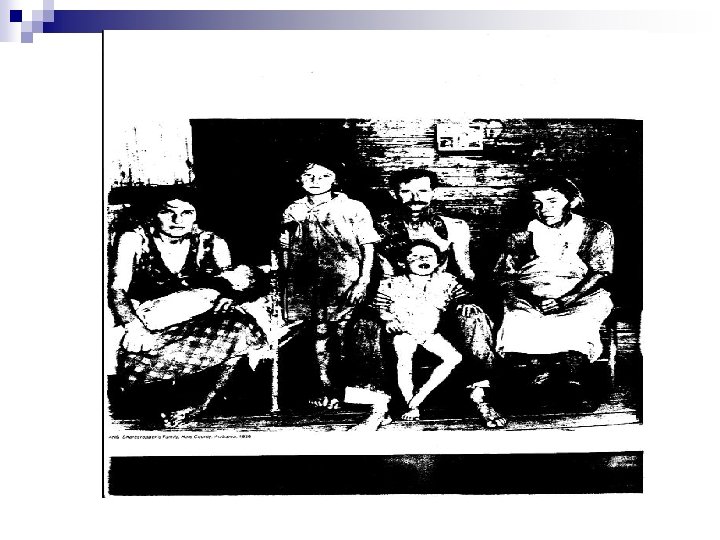
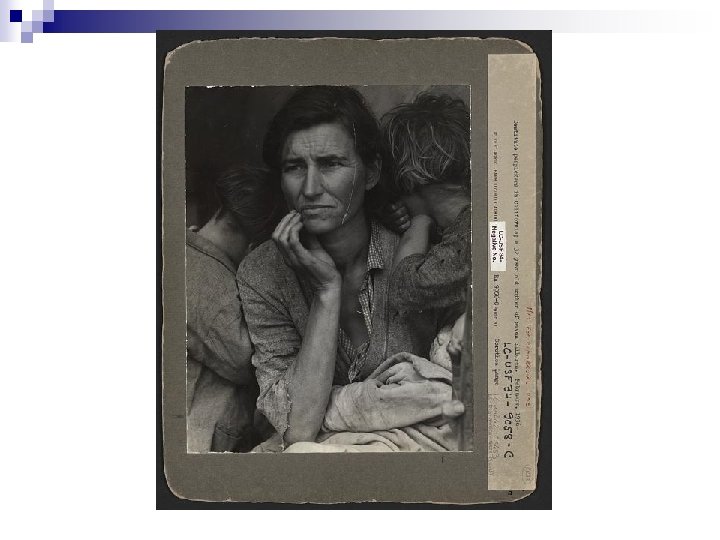
Do Humans Care About Other Humans? Batson (1990)
Acts of Selfless (? ) Heroism The “fifth man” in Air Florida crash Polish Concentration Camp Guard Question: What motivates this behavior?
Why Do People Help Others? Altruistic explanation -- Caring Egoistic explanations Negative state relief: Stop personal discomfort Avoid social/self punishments: Shame, guilt Seek social/self rewards: Honor, pride
A “Selfishness Bias” in Psychology? Freud: Behavior based on pleasure principle Skinner: Behavior based on pleasure principle Modern Self Theorists in Social Psychology: 1. Totalitarian ego: false uniqueness, false representativeness 2. Self affirmation 3. Self esteem 4. Self monitoring 5. Self efficacy 6. Downward social comparison
The “Selfish Gene” Theory Fundamental goal of life-forms – pass on genes Who will pass on genes? Those who survive Therefore behaviors that promote survival are “adaptive” and are “selected in” Behaviors that jeopardize survival are maladaptive and are “selected out” Who is more likely to survive, the selfless helper or the selfish non-helper?
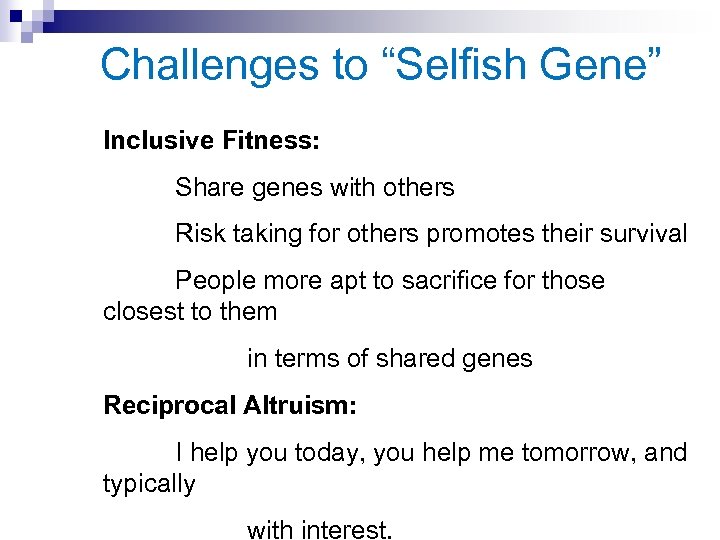
Challenges to “Selfish Gene” Inclusive Fitness: Share genes with others Risk taking for others promotes their survival People more apt to sacrifice for those closest to them in terms of shared genes Reciprocal Altruism: I help you today, you help me tomorrow, and typically with interest.
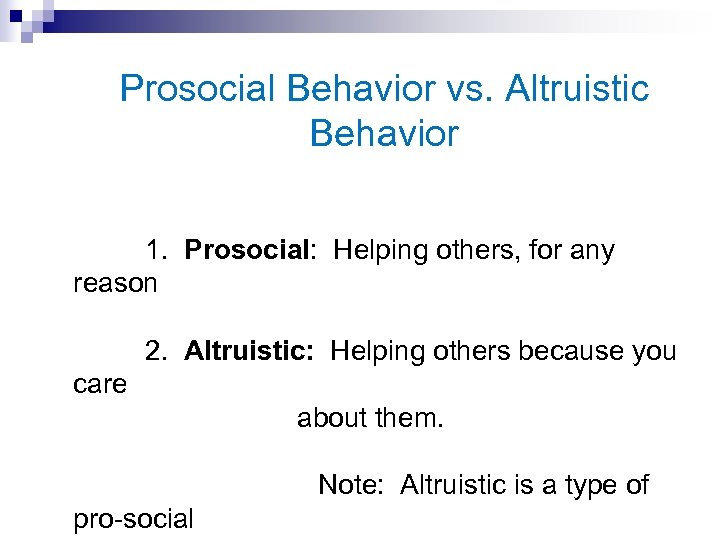
Prosocial Behavior vs. Altruistic Behavior 1. Prosocial: Helping others, for any reason 2. Altruistic: Helping others because you care about them. Note: Altruistic is a type of pro-social
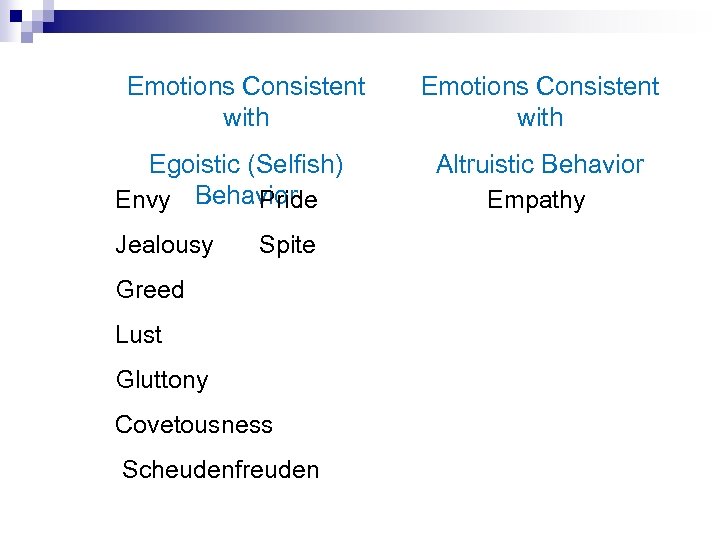
Emotions Consistent with Egoistic (Selfish) Envy Behavior Pride Jealousy Spite Greed Lust Gluttony Covetousness Scheudenfreuden Emotions Consistent with Altruistic Behavior Empathy
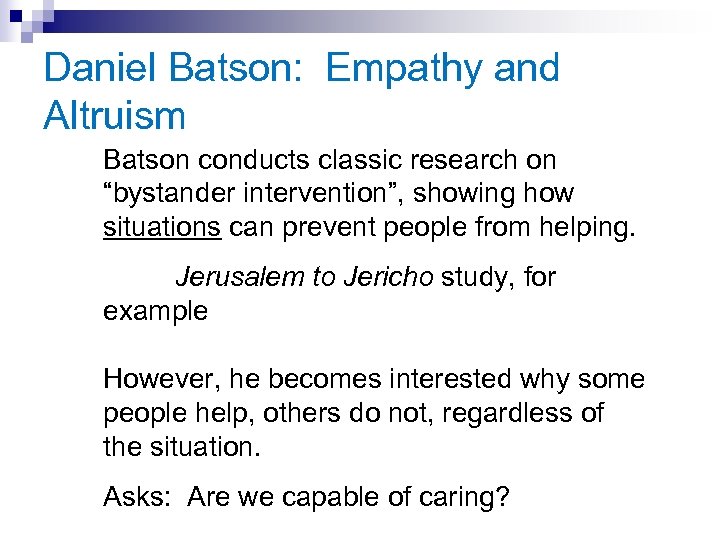
Daniel Batson: Empathy and Altruism Batson conducts classic research on “bystander intervention”, showing how situations can prevent people from helping. Jerusalem to Jericho study, for example However, he becomes interested why some people help, others do not, regardless of the situation. Asks: Are we capable of caring?
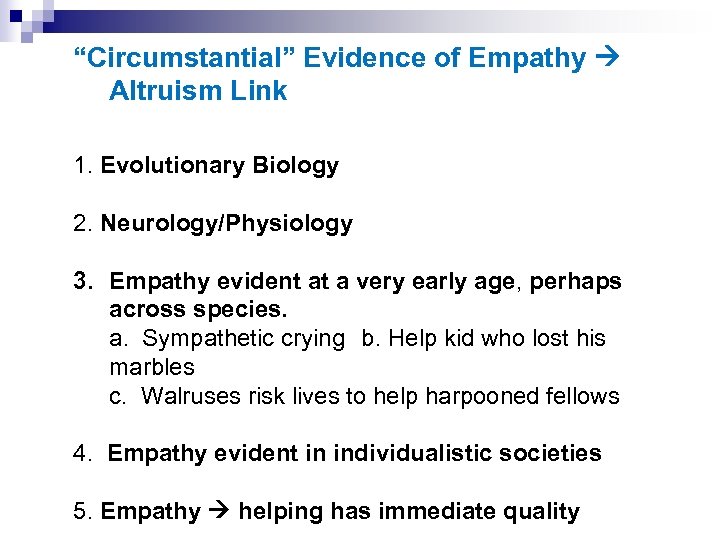
“Circumstantial” Evidence of Empathy Altruism Link 1. Evolutionary Biology 2. Neurology/Physiology 3. Empathy evident at a very early age, perhaps across species. a. Sympathetic crying b. Help kid who lost his marbles c. Walruses risk lives to help harpooned fellows 4. Empathy evident in individualistic societies 5. Empathy helping has immediate quality
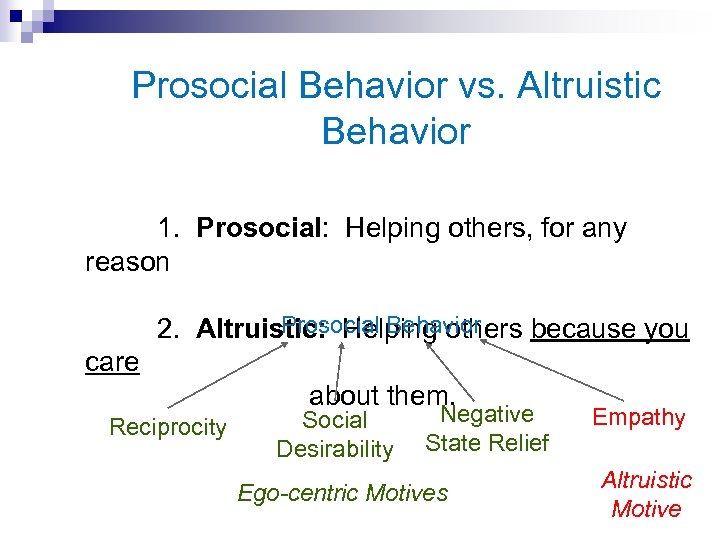
Prosocial Behavior vs. Altruistic Behavior 1. Prosocial: Helping others, for any reason Prosocial Behavior 2. Altruistic: Helping others because you care about them. Reciprocity Social Desirability Negative State Relief Ego-centric Motives Empathy Altruistic Motive
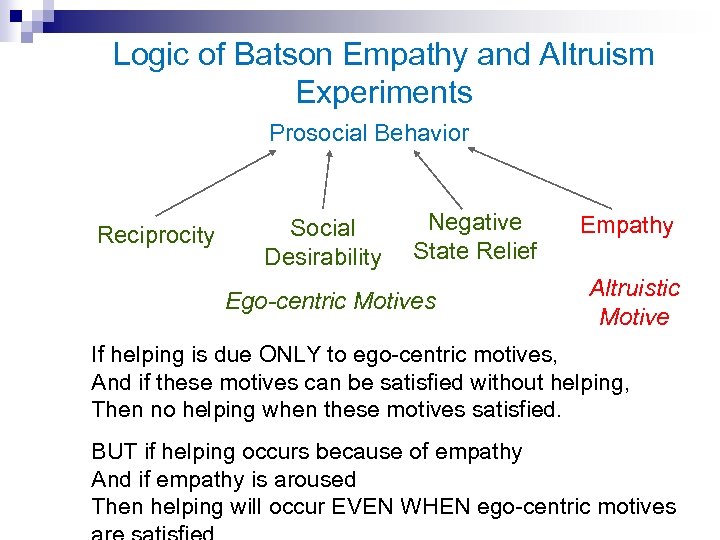
Logic of Batson Empathy and Altruism Experiments Prosocial Behavior Reciprocity Social Desirability Negative State Relief Ego-centric Motives Empathy Altruistic Motive If helping is due ONLY to ego-centric motives, And if these motives can be satisfied without helping, Then no helping when these motives satisfied. BUT if helping occurs because of empathy And if empathy is aroused Then helping will occur EVEN WHEN ego-centric motives
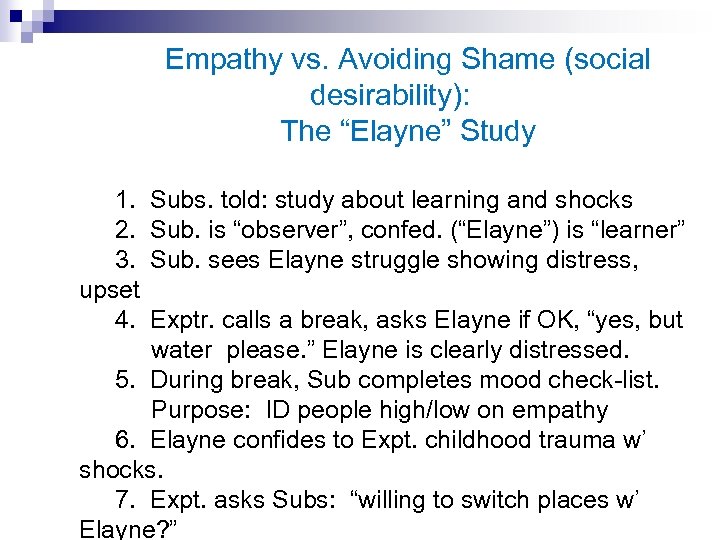
Empathy vs. Avoiding Shame (social desirability): The “Elayne” Study 1. Subs. told: study about learning and shocks 2. Sub. is “observer”, confed. (“Elayne”) is “learner” 3. Sub. sees Elayne struggle showing distress, upset 4. Exptr. calls a break, asks Elayne if OK, “yes, but water please. ” Elayne is clearly distressed. 5. During break, Sub completes mood check-list. Purpose: ID people high/low on empathy 6. Elayne confides to Expt. childhood trauma w’ shocks. 7. Expt. asks Subs: “willing to switch places w’ Elayne? ”
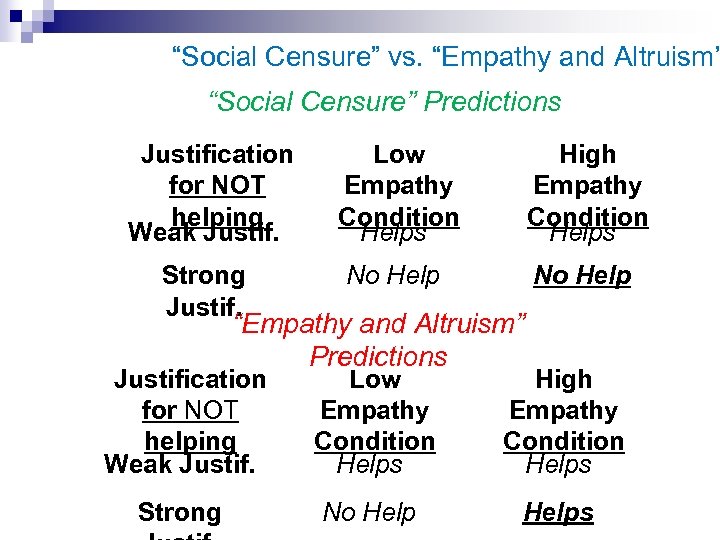
“Social Censure” vs. “Empathy and Altruism” “Social Censure” Predictions Justification for NOT helping Weak Justif. Low Empathy Condition Helps High Empathy Condition Helps Strong Justif. No Help “Empathy and Altruism” Predictions Justification for NOT helping Weak Justif. Low Empathy Condition Helps High Empathy Condition Helps Strong No Helps
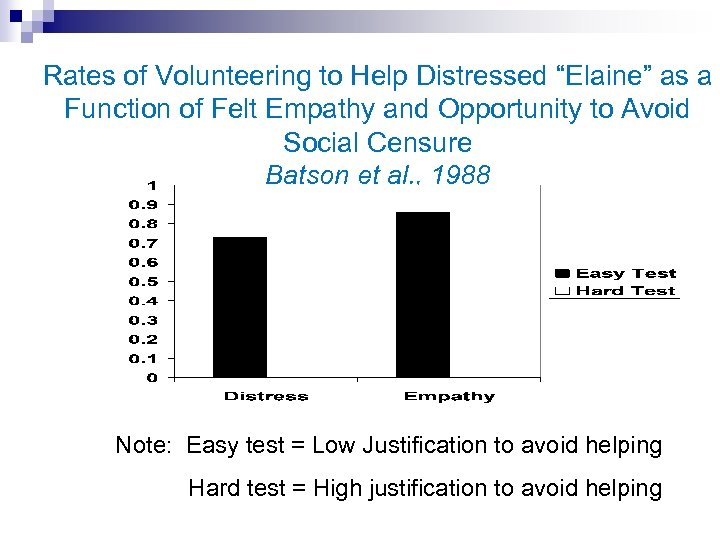
Rates of Volunteering to Help Distressed “Elaine” as a Function of Felt Empathy and Opportunity to Avoid Social Censure Batson et al. , 1988 Note: Easy test = Low Justification to avoid helping Hard test = High justification to avoid helping
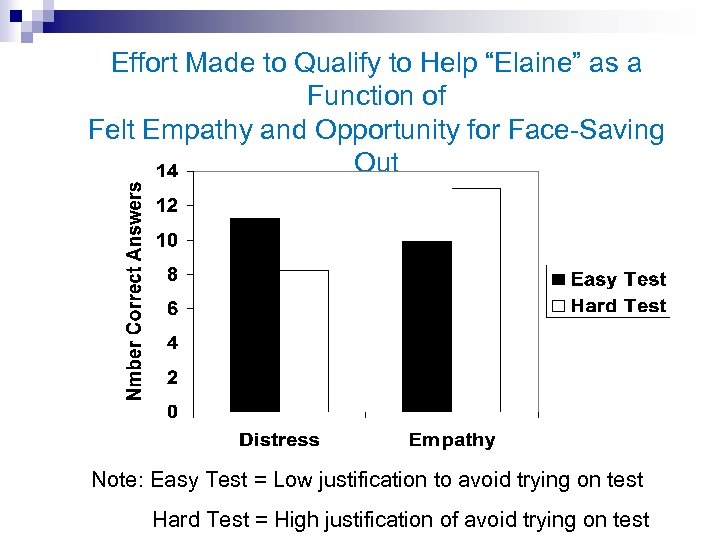
Effort Made to Qualify to Help “Elaine” as a Function of Felt Empathy and Opportunity for Face-Saving Out Batson, et al. , 1988 Note: Easy Test = Low justification to avoid trying on test Hard Test = High justification of avoid trying on test
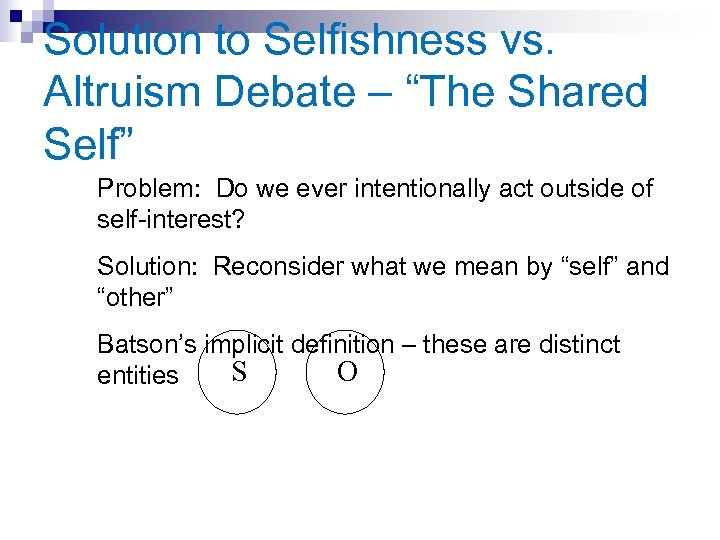
Solution to Selfishness vs. Altruism Debate – “The Shared Self” Problem: Do we ever intentionally act outside of self-interest? Solution: Reconsider what we mean by “self” and “other” Batson’s implicit definition – these are distinct S O entities
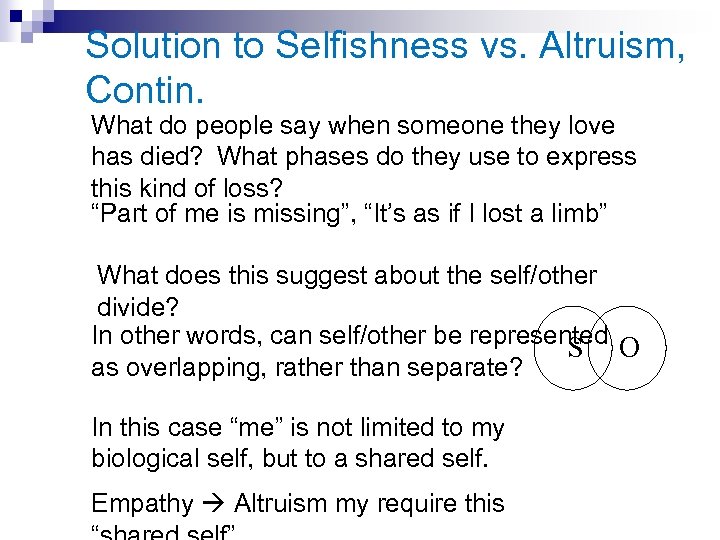
Solution to Selfishness vs. Altruism, Contin. What do people say when someone they love has died? What phases do they use to express this kind of loss? “Part of me is missing”, “It’s as if I lost a limb” What does this suggest about the self/other divide? In other words, can self/other be represented O S as overlapping, rather than separate? In this case “me” is not limited to my biological self, but to a shared self. Empathy Altruism my require this
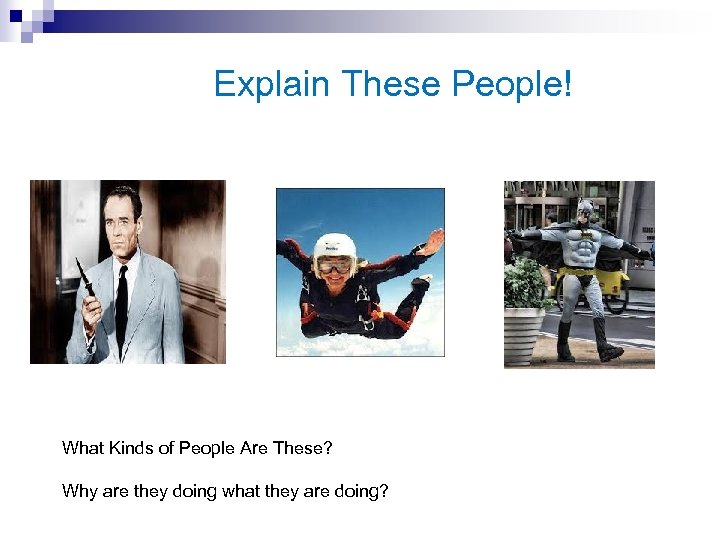
Explain These People! What Kinds of People Are These? Why are they doing what they are doing?
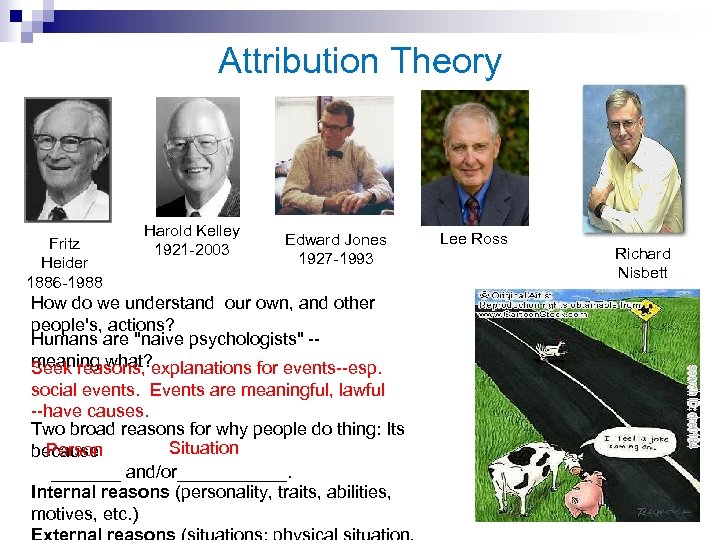
Attribution Theory Fritz Heider 1886 -1988 Harold Kelley 1921 -2003 Edward Jones 1927 -1993 How do we understand our own, and other people's, actions? Humans are "naive psychologists" -- meaning what? Seek reasons, explanations for events--esp. social events. Events are meaningful, lawful --have causes. Two broad reasons for why people do thing: Its Situation Person because _______ and/or______. Internal reasons (personality, traits, abilities, motives, etc. ) Lee Ross Richard Nisbett
The Adventures of Arnie: An Attribution Arnie and Abigail are at Coney Island on a date. Arnie is not very athletic Mystery or energetic. Arnie sees and old lady trip and fall; he rushes to help her. WHY? Is this behavior "Arnie specific" or situational? Your best guess. Abigail tells Arnie he is too much a boyscout and ditches him. Arnies sees a 650 lb man unable to rise from his beach chair; no one is around, yet Arnie helps him. WHY How would you know if this was "Arnie specific" or situational? Your best guess If action was "all about Arnie" what is it about Arnie that explains his behavior? What information you would need to make a better judgment?
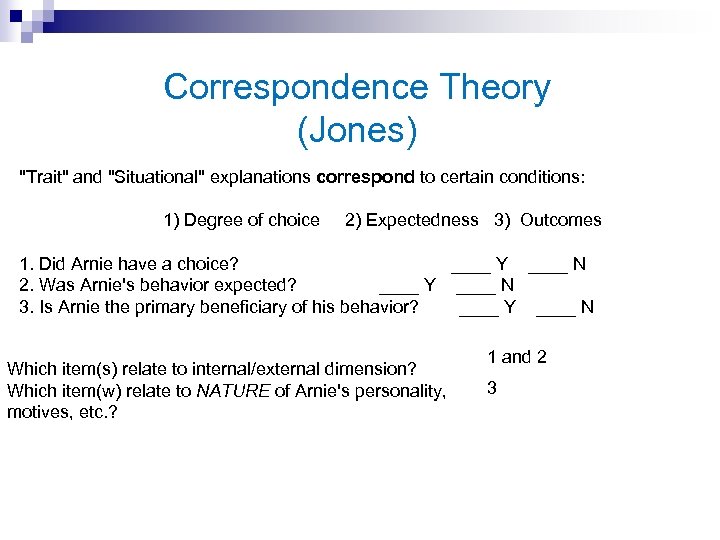
Correspondence Theory (Jones) "Trait" and "Situational" explanations correspond to certain conditions: 1) Degree of choice 2) Expectedness 3) Outcomes 1. Did Arnie have a choice? ____ Y ____ N 2. Was Arnie's behavior expected? ____ Y ____ N 3. Is Arnie the primary beneficiary of his behavior? ____ Y ____ N Which item(s) relate to internal/external dimension? Which item(w) relate to NATURE of Arnie's personality, motives, etc. ? 1 and 2 3
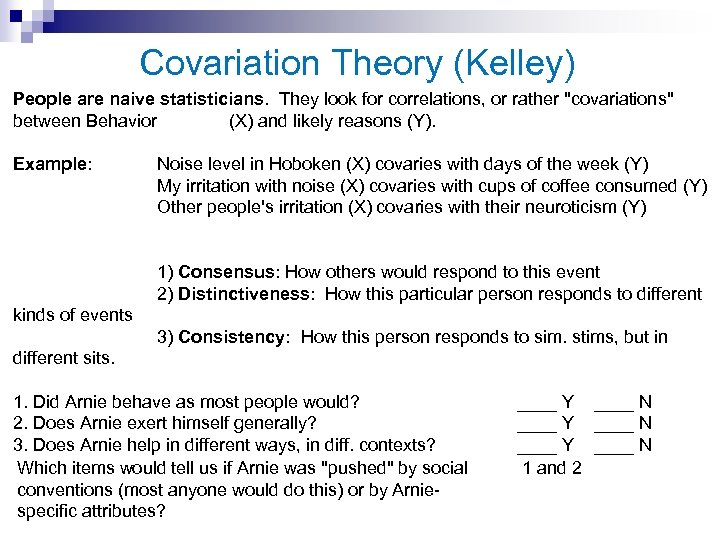
Covariation Theory (Kelley) People are naive statisticians. They look for correlations, or rather "covariations" between Behavior (X) and likely reasons (Y). Example: Noise level in Hoboken (X) covaries with days of the week (Y) My irritation with noise (X) covaries with cups of coffee consumed (Y) Other people's irritation (X) covaries with their neuroticism (Y) 1) Consensus: How others would respond to this event 2) Distinctiveness: How this particular person responds to different kinds of events 3) Consistency: How this person responds to sim. stims, but in different sits. 1. Did Arnie behave as most people would? 2. Does Arnie exert himself generally? 3. Does Arnie help in different ways, in diff. contexts? Which items would tell us if Arnie was "pushed" by social conventions (most anyone would do this) or by Arniespecific attributes? ____ Y ____ N 1 and 2
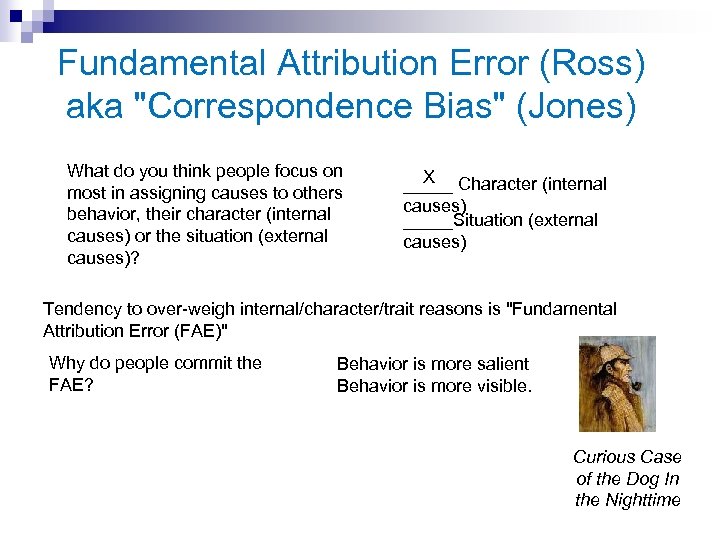
Fundamental Attribution Error (Ross) aka "Correspondence Bias" (Jones) What do you think people focus on most in assigning causes to others behavior, their character (internal causes) or the situation (external causes)? X _____ Character (internal causes) _____Situation (external causes) Tendency to over-weigh internal/character/trait reasons is "Fundamental Attribution Error (FAE)" Why do people commit the FAE? Behavior is more salient Behavior is more visible. Curious Case of the Dog In the Nighttime
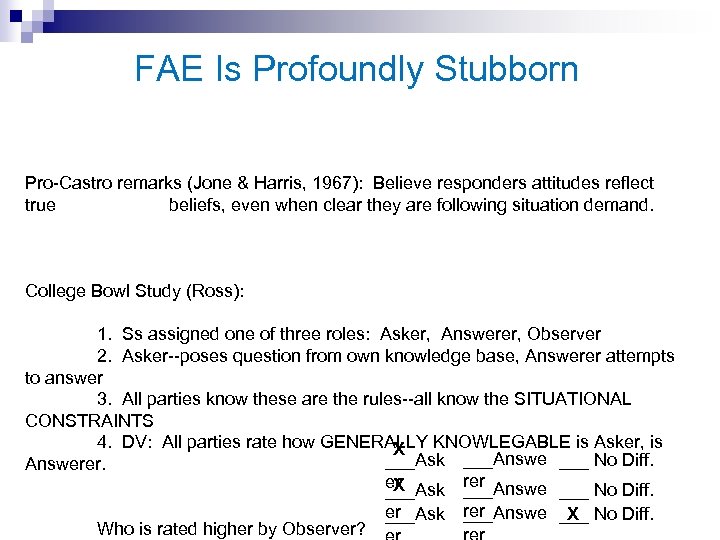
FAE Is Profoundly Stubborn Pro-Castro remarks (Jone & Harris, 1967): Believe responders attitudes reflect true beliefs, even when clear they are following situation demand. College Bowl Study (Ross): 1. Ss assigned one of three roles: Asker, Answerer, Observer 2. Asker--poses question from own knowledge base, Answerer attempts to answer 3. All parties know these are the rules--all know the SITUATIONAL CONSTRAINTS 4. DV: All parties rate how GENERALLY KNOWLEGABLE is Asker, is X ___Ask ___Answe ___ No Diff. Answerer. rer er X ___Ask ___Answe ___ No Diff. rer er ___Ask ___Answe ___ No Diff. X Who is rated higher by Observer?
Egocentric Attributional Biases: False Concensus People tend to see own choices as normal and normative (i. e. , as how others would act). "EAT AT JOE'S" STUDY (Ross, Greene & House, 1977) Ss asked to wear sandwich-board advertising "Eat At Joe's" around campus. DVs: Subject agree/disagrees to do so. Ss estimate likelihood others make same choice as self Ss make trait judgments about those who chose same/different from self
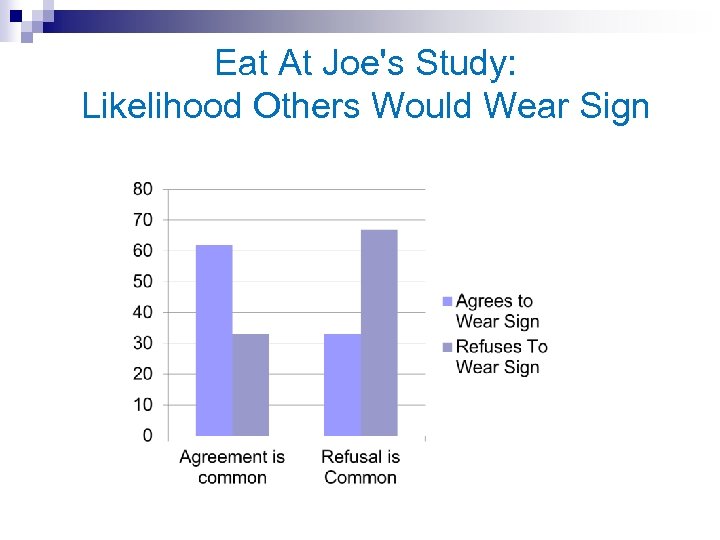
Eat At Joe's Study: Likelihood Others Would Wear Sign
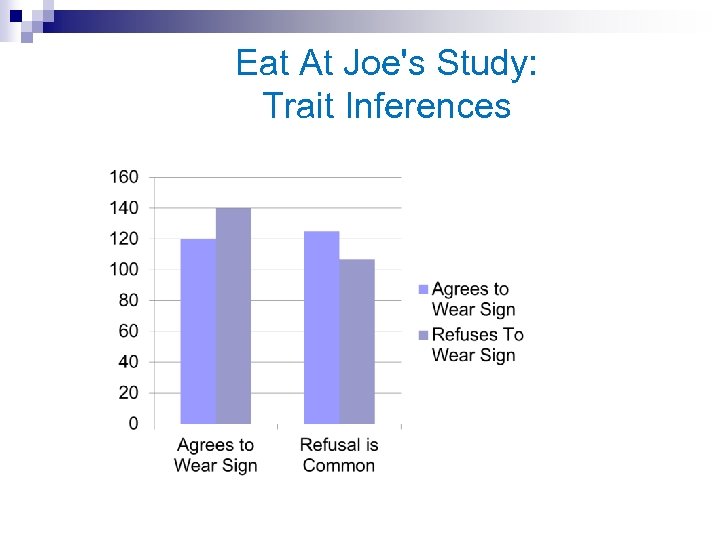
Eat At Joe's Study: Trait Inferences
Hilarious Social Psychology Joke for the Day How many social psychologists does it take to screw in a lightbulb? Depends on the situation.
Скачать презентацию Class 14 Altruism and Attribution Theory Do
3d09f795a4888c7490f16ed278a9d9d9.ppt