


 Скачать презентацию Clare Family Learning Project National Literacy Awareness Week
c6cb08f9547a5f68880d252c3aecd28d.ppt
- Количество слайдов: 14
 Clare Family Learning Project National Literacy Awareness Week National Library of Ireland, Dublin Mary Flanagan Family Learning Co-ordinator 23 rd September 2009 The County Clare VEC Clare Adult Basic Education Service is funded by the Department of Education and Science with assistance from the European Social Fund as part of the National Development Plan 2007 -2013.
 Parental involvement in a child’s literacy practices is a more powerful force than other family background variables, such as social class, family size and level of parental education (Flouri and Buchanan 2004)
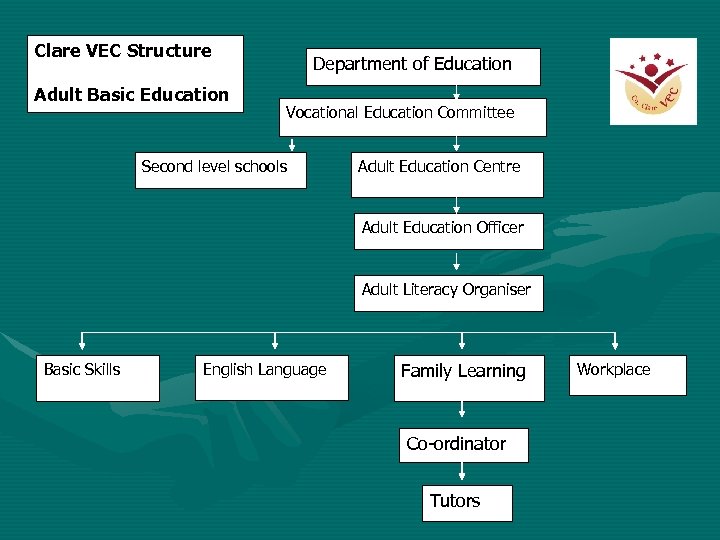 Clare VEC Structure Adult Basic Education Department of Education Vocational Education Committee Second level schools Adult Education Centre Adult Education Officer Adult Literacy Organiser Basic Skills English Language Family Learning Co-ordinator Tutors Workplace
 What is family learning? Family learning is an umbrella term which describes a wide variety of educational intervention programmes that have an intergenerational focus in their design and delivery
 Family learning: • identifies the home as a learning place • recognises the role of parents’ as natural teachers in the home • emphasises intergenerational teaching and learning • builds links between home, school and community • encourages parents to become lifelong learners
 Family learning • Programme types include parent only models, parent-child models, models including the wider family circle • Locations include adult education centres, schools, libraries, community centres etc.
 A simple formula for family learning Create a positive learning environment Start where the learners are at/build on their experience Guide parents to identify and develop opportunities for learning in and around the home Support parents to develop strategies for extending their children’s literacy and numeracy skills Foster parents’ own interest in lifelong learning
 Family learning is for all ages • Early years • Primary school • Second level • Lifelong learning
 Innovative programmes: • • • Weekend Action for Dads and Kids Family Stories in a Box Traveller Life booklet South Pole Adventures (school initiative) Games, Gadgets and Machines Growing Together – gardening Getting Active Family Cookery Fun Science
 Family learning benefits parents: • positive attitude to their children’s schooling • progression onto other learning options • more confident in coming to class • increased interest, willingness and ability to learn • increased confidence through small successes - gives hope • wider social networks and friendships
 Family learning benefits children • • • increased school attendance children stay in school longer increased chance of achievement in school greater cognitive competence positive influences on reading achievement and attentiveness in the classroom • greater social and emotional development
 Recommendations for success with family learning: • • work in collaboration with schools/other partners aim to nurture both parents’ and children’s learning use experienced and well trained tutors anticipate and address barriers (e. g. times, locations, childcare) create a relaxed and friendly atmosphere build on existing knowledge (yours and theirs!) use interesting and relevant topics focus on practical activities
 Partnership in family learning involves: • • Adult education services Schools Libraries Community groups Social services Health Promotion Unit Mental Health Association Local contacts, e. g. through area network meetings
 Work in progress • Developing family learning programme outlines for publication • Family learning national/international tutor training in October 2009 (full) • Member of European Family Learning Network • National quarterly family learning newsletter www. clarefamilylearning. org • DVD and guide available on request