


 Скачать презентацию Civil Society and the Governance of Education in
d1a9a731f3212f28d1761b5e1379f49d.ppt
- Количество слайдов: 13
 Civil Society and the Governance of Education in the Context of SWAps: Kenya & Tanzania Malini Sivasubramaniam Megan Haggerty OISE/University of Toronto October 2, 2006 Africa-Canada Forum
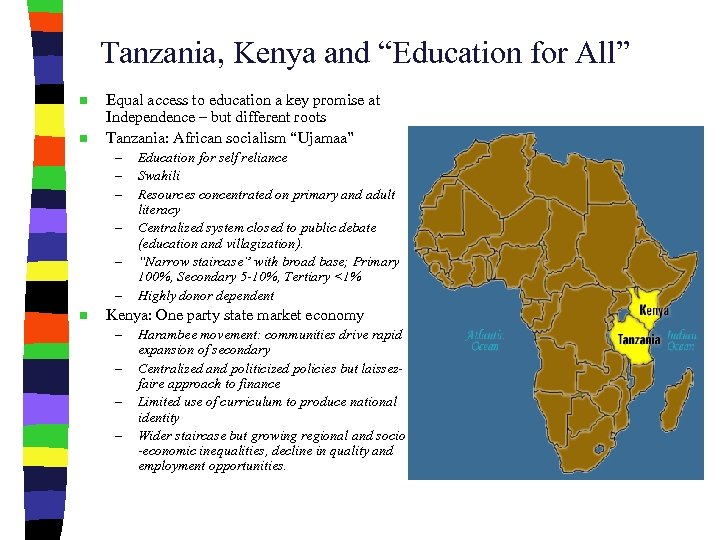 Tanzania, Kenya and “Education for All” n n Equal access to education a key promise at Independence – but different roots Tanzania: African socialism “Ujamaa” – – – n Education for self reliance Swahili Resources concentrated on primary and adult literacy Centralized system closed to public debate (education and villagization). “Narrow staircase” with broad base; Primary 100%, Secondary 5 -10%, Tertiary <1% Highly donor dependent Kenya: One party state market economy – – Harambee movement: communities drive rapid expansion of secondary Centralized and politicized policies but laissezfaire approach to finance Limited use of curriculum to produce national identity Wider staircase but growing regional and socio -economic inequalities, decline in quality and employment opportunities.
 Crisis, Adjustment, Change n Economic crisis, globalization, and structural adjustment n Political mismanagement/poor governance n In education sector – Demand outpaces resources and opportunity formal employment – Financing burden steadily shifted on to parents – cost sharing – From Universal Primary Education (UP) in 1971, 1974 and 1978 (Kenya) and 1978 (Tanzania) to a deterioration in both Quality and Access. (Tanzania dropped to 70% enrollment by 1990; Kenya dropped to 86. 9% by 1998) n From the late 1980 s: – structural reform/economic liberalization - limited aid. – education sector reforms focus on privatization, cost-sharing, containment of dissatisfaction through decentralization. n n In mid 1990 s: political liberalization Late 1990 s: – New governments promise EFA; abolish user fees – New donor resources for EFA and transnational advocacy “rights” – Continuing dilemmas = equality, demand, dependency.
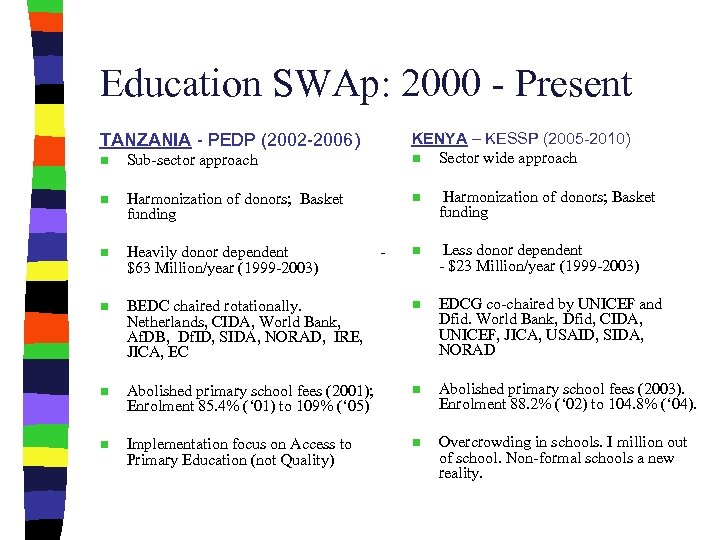 Education SWAp: 2000 - Present TANZANIA - PEDP (2002 -2006) n Sub-sector approach n Harmonization of donors; Basket funding n Heavily donor dependent $63 Million/year (1999 -2003) n KENYA – KESSP (2005 -2010) n Sector wide approach n Harmonization of donors; Basket funding n Less donor dependent - $23 Million/year (1999 -2003) BEDC chaired rotationally. Netherlands, CIDA, World Bank, Af. DB, Df. ID, SIDA, NORAD, IRE, JICA, EC n EDCG co-chaired by UNICEF and Dfid. World Bank, Dfid, CIDA, UNICEF, JICA, USAID, SIDA, NORAD n Abolished primary school fees (2001); Enrolment 85. 4% (‘ 01) to 109% (‘ 05) n Abolished primary school fees (2003). Enrolment 88. 2% (‘ 02) to 104. 8% (‘ 04). n Implementation focus on Access to Primary Education (not Quality) n Overcrowding in schools. I million out of school. Non-formal schools a new reality. -
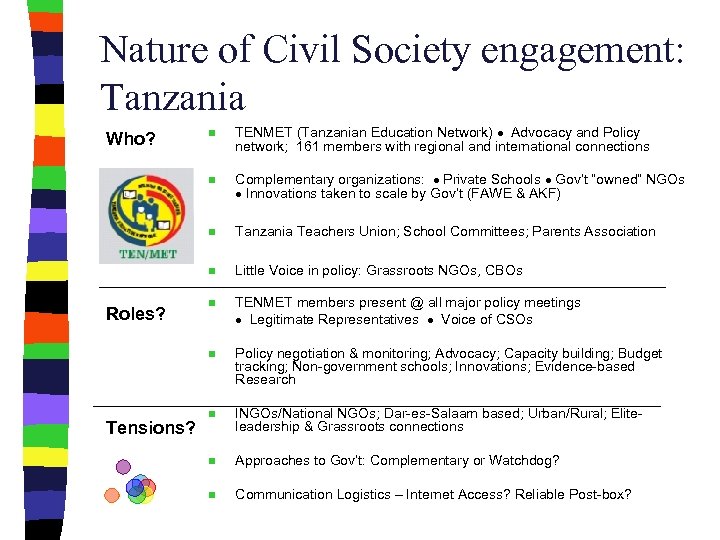 Nature of Civil Society engagement: Tanzania Complementary organizations: Private Schools Gov’t “owned” NGOs Innovations taken to scale by Gov’t (FAWE & AKF) Tanzania Teachers Union; School Committees; Parents Association n Little Voice in policy: Grassroots NGOs, CBOs n TENMET members present @ all major policy meetings Legitimate Representatives Voice of CSOs n Tensions? TENMET (Tanzanian Education Network) Advocacy and Policy network; 161 members with regional and international connections n Roles? n n Who? Policy negotiation & monitoring; Advocacy; Capacity building; Budget tracking; Non-government schools; Innovations; Evidence-based Research n INGOs/National NGOs; Dar-es-Salaam based; Urban/Rural; Eliteleadership & Grassroots connections n Approaches to Gov’t: Complementary or Watchdog? n Communication Logistics – Internet Access? Reliable Post-box?
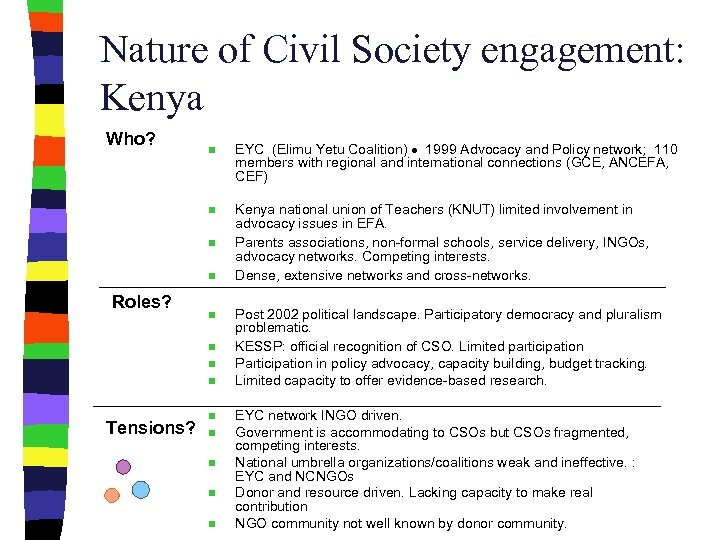 Nature of Civil Society engagement: Kenya Who? n EYC (Elimu Yetu Coalition) 1999 Advocacy and Policy network; 110 members with regional and international connections (GCE, ANCEFA, CEF) n Kenya national union of Teachers (KNUT) limited involvement in advocacy issues in EFA. Parents associations, non-formal schools, service delivery, INGOs, advocacy networks. Competing interests. Dense, extensive networks and cross-networks. n n Roles? n n Tensions? n n n Post 2002 political landscape. Participatory democracy and pluralism problematic. KESSP: official recognition of CSO. Limited participation Participation in policy advocacy, capacity building, budget tracking. Limited capacity to offer evidence-based research. EYC network INGO driven. Government is accommodating to CSOs but CSOs fragmented, competing interests. National umbrella organizations/coalitions weak and ineffective. : EYC and NCNGOs Donor and resource driven. Lacking capacity to make real contribution NGO community not well known by donor community.
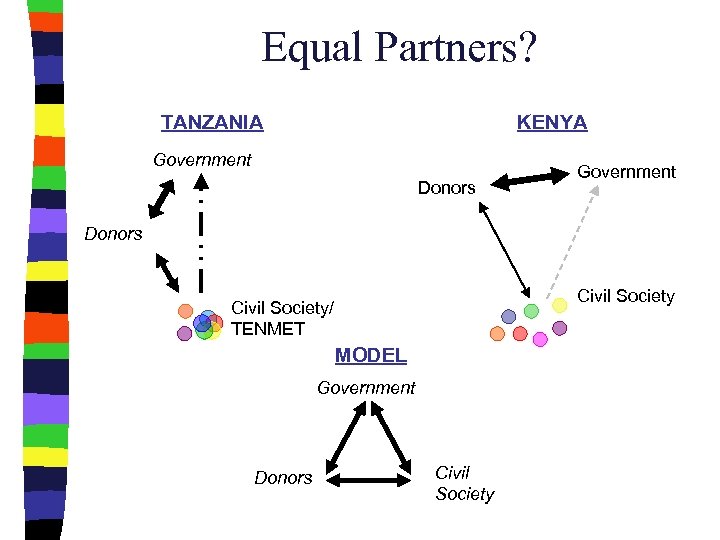 Equal Partners? TANZANIA KENYA Government Donors Civil Society/ TENMET MODEL Government Donors Civil Society
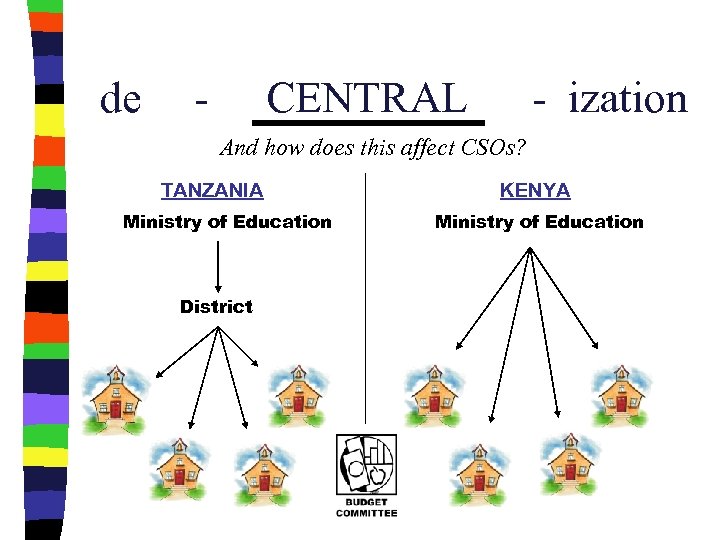 de - CENTRAL - ization And how does this affect CSOs? TANZANIA Ministry of Education District KENYA Ministry of Education
 How is SWAp affecting CSOs In Kenya? n SWAps heightens and centralizes power of government. Govt and CSO competing for funds (cordial/ineffective/divide and rule)? n All CSO activities should be harmonized with KESSP. n Do NGOs want their resources harmonized or pooled with the government? Larger NGOs see link to government (i. e. , money represented as part of KESSP) as ensuring sustainability. Smaller NGOs more hesitant to have their money reflected/disclosed as part of KESSP. n SWAPS appear to be removing CSO leverage. n Competing interests among civil society. E. G. Churches advocating for government to return running and ownership of schools to FBOs. Harmonization and pooling among INGOs and NGOs difficult.
 How is SWAp affecting CSOs? Tanzania n SWAPS appear to be increasing CSO leverage. – Opportunity to bring forward issues to the policy table / United front – Role of the Opposition? n Contentious Space / Government Resistance – Sees NGOs “proper” role as complementary – Attempt to limit public criticism and control input (Haki Elimu & ESR saga) – CSOs input not seen as important as donors n Select Donor support (morally and financially) – Concentrated into few NGOs, TENMET related – Primary Education concentration n Challenges – As speed of policy increases, CSO input decreases – Affect of Sub-sector to Sector support, OR Direct Budget Support
 SUMMARY n IN KENYA SWAps heightens and centralizes power of government. Govt and CSO competing for funds (cordial/ineffective/divide and rule). IN TANZANIA, SWAps has created space for NGO/civil society participation even though government resistant. n TENMET a more cohesive network of CSOs. EYC fragmented and INGO driven. Why is Tanzania a strong network, not Kenya? – Timing of UPE, user fees – Who do donors meet regularly? Donors get to know those represented at meetings. – Coalesce against Gov’t vs. Pull the rug out n Decentralization takes very different forms in Kenya and Tanzania.
 QUESTIONS n Should donors pool, harmonize and channel all their funds through government? n Do CSOs/INGOs want their resources harmonized or pooled with the government? What form of harmonization should there be between INGOs? n “Any donor organization that does not have a balanced portfolio will fail” (CSO 33, Kenya) & “Don’t put your eggs all in one basket” (CSO 14, Tanzania) n How does SWAPs change the way CSOs should operate in a sector? – Programming, Advocacy, Cooperation changes