


 Скачать презентацию Civil Rights Movement Key Domestic Changes of
45e1e92e5b8f3f702dc3523b5978395d.ppt
- Количество слайдов: 23
 Civil Rights Movement & Key Domestic Changes of the Post-WWII U. S. Short-Answer and Multiple-Choice Review Guide U. S. II 9 a-d; 8 d
 Use the answer bank below to complete the shortanswer questions on the following slides. Then answer the multiple-choice questions. • Civil Rights Movement • Freedom Riders • ERA (Equal Rights • Voting Rights Act of Amendment) 1965 • Montgomery bus boycott • segregation • NAACP • Brown v. Board of • Booker T. Washington Education • Title IX • sit-ins • Plessy v. Ferguson • W. E. B. Du. Bois • Rosa Parks • women • Dr. Martin Luther King, • President Harry S Truman Jr. • National Organization of • Civil Rights Act of 1964 U. S. II 9 a, b; 8 d Women (NOW)
 #1 • Which Supreme Court case ruled that school segregation was illegal? • Which Supreme Court decision did this overturn? U. S. II 9 a, b; 8 d
 #2 • What legislation was passed in 1972 to increase equality for women’s athletics? U. S. II 9 a, b; 8 d
 #3 • Which law outlawed certain practices in the South such as poll taxes and literacy tests? U. S. II 9 a, b; 8 d
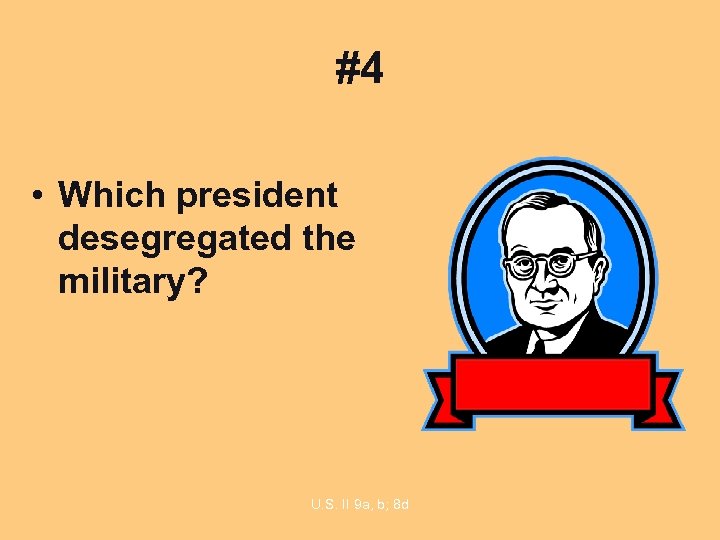 #4 • Which president desegregated the military? U. S. II 9 a, b; 8 d
 #5 • What vocabulary word means, “to divide groups based on race”? U. S. II 9 a, b; 8 d
 #6 • In 1966, which women’s organization was created to fight for equal pay for equal work? U. S. II 9 a, b; 8 d
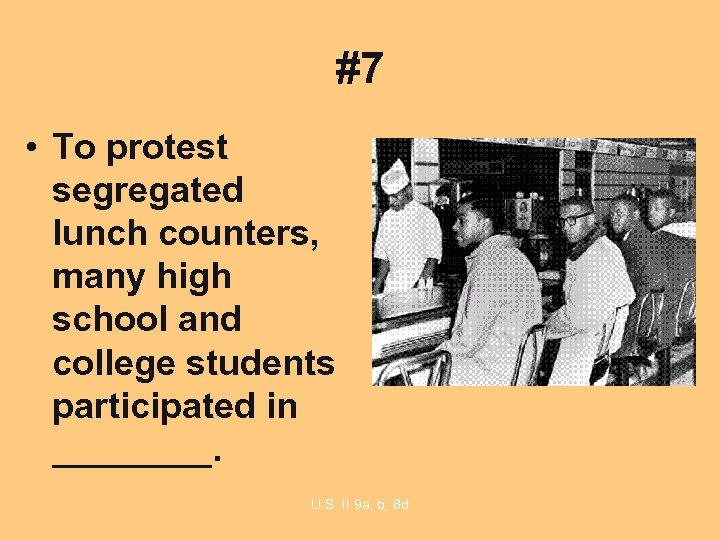 #7 • To protest segregated lunch counters, many high school and college students participated in ____. U. S. II 9 a, b; 8 d
 #8 • What legislation outlawed the segregation of restaurants, hotels, and other public facilities? U. S. II 9 a, b; 8 d
 #9 • Who refused to give up her seat to a white passenger and was arrested and fined? (She is sometimes called the Mother of the Civil Rights Movement. ) • What did the African American community do to protest the woman’s arrest? U. S. II 9 a, b; 8 d
 #10 • ________ boarded Greyhound buses to protest segregated travel. U. S. II 9 a, b; 8 d
 #11 • Which amendment was designed to ban discrimination based on gender? (It failed to get enough support to pass. ) U. S. II 9 a, b; 8 d
 #12 • Which organization was formed in 1909 to advance the rights and equality of African Americans? (W. E. B. Du. Bois was one of the early founders of this organization. ) U. S. II 9 a, b; 8 d
 #13 • Which leader supported full and immediate social, civil, and political rights for African Americans? • Which leader believed equality for African Americans could be achieved through vocational training? U. S. II 9 a, b; 8 d
 #14 • Which civil rights leader supported non-violent resistance? U. S. II 9 a, b; 8 d
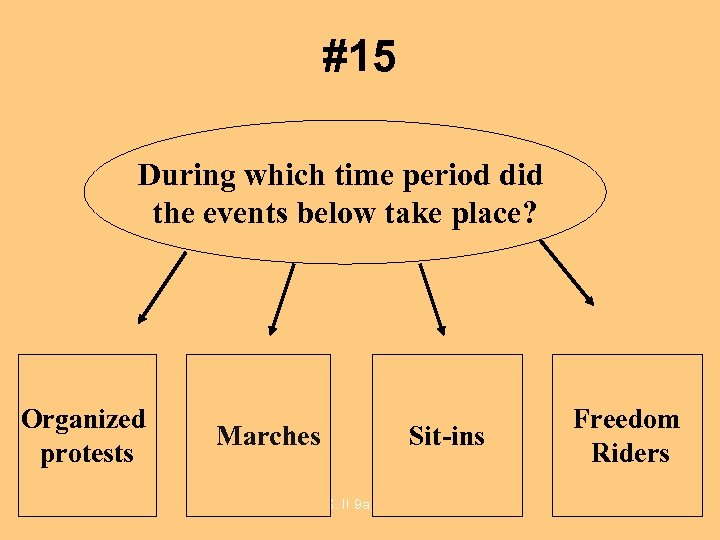 #15 During which time period did the events below take place? Organized protests Marches U. S. II 9 a, b; 8 d Sit-ins Freedom Riders
 1. What type of civil disobedience did African Americans use in 1961 to end segregation in the South? A B C D Jim Crow segregation sit-ins riots March on Washington U. S. II 9 a, b; 8 d Adapted from Va. Dept. of Ed.
 2. What 1896 Supreme Court decision legalized Jim Crow segregation in the South? A B C D Plessy v Ferguson Gideon v Wainwright Dred Scott v Sanford Brown v Board of Education U. S. II 9 a, b; 8 d Adapted from Va. Dept. of Ed.
 3. What was the result of the Supreme Court decision in Brown v. Board of Education? A B C D equal voting rights integration of all public facilities desegregation of public schools abolition of the poll tax U. S. II 9 a, b; 8 d Adapted from Va. Dept. of Ed.
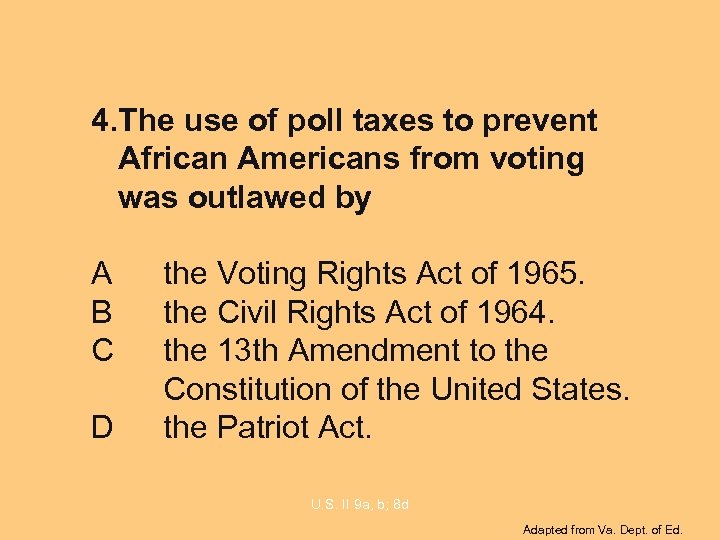 4. The use of poll taxes to prevent African Americans from voting was outlawed by A B C D the Voting Rights Act of 1965. the Civil Rights Act of 1964. the 13 th Amendment to the Constitution of the United States. the Patriot Act. U. S. II 9 a, b; 8 d Adapted from Va. Dept. of Ed.
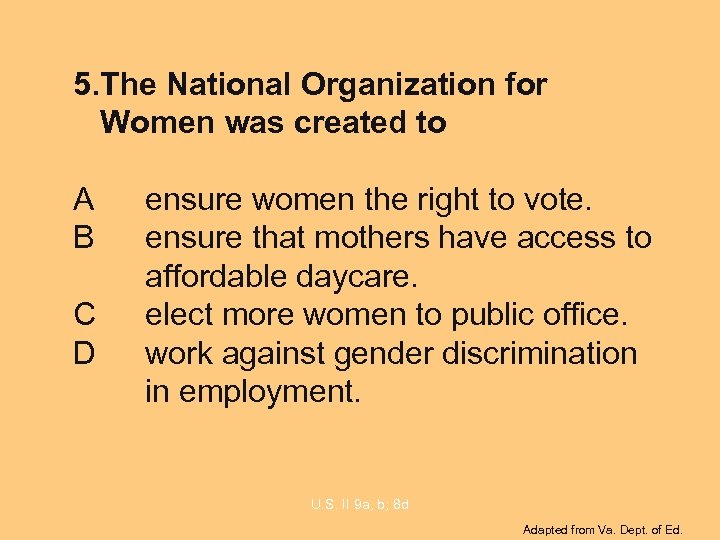 5. The National Organization for Women was created to A B C D ensure women the right to vote. ensure that mothers have access to affordable daycare. elect more women to public office. work against gender discrimination in employment. U. S. II 9 a, b; 8 d Adapted from Va. Dept. of Ed.
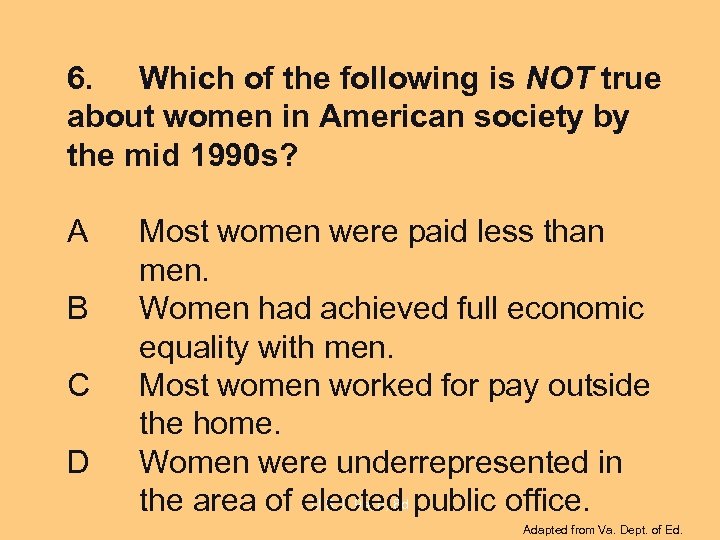 6. Which of the following is NOT true about women in American society by the mid 1990 s? A B C D Most women were paid less than men. Women had achieved full economic equality with men. Most women worked for pay outside the home. Women were underrepresented in U. S. II 9 a, b; 8 d the area of elected public office. Adapted from Va. Dept. of Ed.