


 Скачать презентацию Civil Rights in the USA 1865 -1992 African
5f002e49e94072ea7637605fcb5d6a19.ppt
- Количество слайдов: 45
 Civil Rights in the USA 1865 -1992 African Americans
 1865 -1877 Reconstruction Period • 1865: emancipation proclamation- freedom to slaves • Military victory for the north • Struggle between President Andrew Johnson and Congress • Congress help more with AA Civil Rights
 Congress help AA most during Reconstruction • 14 th Amendment 1868: all AA gain citizenship and equal protection under the law • 15 th Amendment 1870: forbade denial of vote due to race • Civil Rights Act 1866: included AA in full citizens of USA and legal equality • 1867 Military Reconstruction Act: south divided into military districts, states had to accept changes from reconstruction • Radical Republicans most responsible for changes • Congressmen Stevens and Sumners thought blacks played a vital part in society • President AJ wanted to readmit southern states • He used presidential right to veto (reject proposal) but overridden by 2/3 of Congress
 • AA gained personal freedom to marry, travel and express their religious faith • 700000 black eligible to vote • Northern blacks took advantage of opportunities in politics • 1870 22 blacks elected to Congress
 Freedman’s Bureau • Although AA got vote still problems with homeless and unemployed • 1865 Freedmans Bureau set up by federal government • Provided education for black children • Supported adults financially • Traditional curriculum train black lawyers, scientists and teachers • But no long term impact it was closed in 1872 due to decline of radical Republicanism • Sign that North beginning to lose enthusiasm • 1890 65% AA children still unable to write compared to 15% white children
 • AA also lacked land hence sharecropping used • Many AA living in poverty and in practice few Civil Rights • Employment discouraged as might threaten white employment • Blacks ill-equipped to deal with Southern white resentment • Federal support for education ended in 1872
 White Reaction to AA Freedom • Southern politicians regain political control over their states 1870 • Many thought it impossible to see AA as equal • AA gained rights in theory but not in practice • Reconstruction ended 1877 states rights imposed which meant AA rights limited • AA rights removed ultimately by Supreme Court • 1873: Slaughterhouse Case- supreme court decided rights of citizens stay under state control hence AA rights limited
 AA Rights Limited • Black codes set up in 1865/66 conveys southern white attitude towards AA • However acts nullified by military control in south • But black codes still a threat to rights • Blacks couldn’t give evidence in court against a white neither serve on jury • Many southern whites wanted to keep races apart • Though segregation not in practice until 1880 s many aspects still apparent • 1865 - Ku Klux Klan (KKK) set up to enforce separation through terror • Carried out violent atrocities
 Failure of Reconstruction • Weakness of southern Republicans contrasted with opposition from most southern whites • In North loss of interest in welfare of blacks • End reconstruction to avoid dangers of reigniting civil war conflict • Hardly any Federal Government intervention hence AA rights lost towards 1877
 1877 -1915 AA lost rather than gain rights • After reconstruction AA rights lost • Growing racism • By 1900 90% of AA lived in South mainly to seek employment • Workers generally excluded by racist employers • Even in north AA poor housing, low level of education and low employment opportunities
 AA rights diminished • Jim Crow segregation developed rapidly between 1887 -1891 • After 1891 segregation laws formally extend to cover public places • Whites in southern society believed blacks were naturally underclass • Supreme Court did not rock southerners segregation laws • Supreme Court attitude shown by 1896 Plessy V Ferguson separate but equal • Racial segregation of railway constitutional and acted as legal precedent for segregation in all forms
 • 15 th amendment 1870 meant AA not discriminated against vote • Therefore Southern state governments imposed additional requirements for AA to get vote eg: v only home owners allowed vote v Literary tests v Grandfather clauses franchise to adult male providing their fathers had voted before reconstruction • By 1910 AA chance to vote mostly eliminated in south • Supreme Court case 1898 Mississippi V Williams poll tax and other similar devices constitutional and did not breach 15 th amendment • Voting rights for AA severely hindered
 • Democrat President Cleveland did not question white supremacy • President Woodrow Wilson made all black advisers in federal government dismiss and departments of government became segregated • Not only law used to segregate AA • Lynching took place AA tortured, beaten murdered by hanging • Cases that were brought to court not effective as all white jury discriminate blacks • Black men accused of raping white women claims heightened and AA severely punished
 Booker T. Washington • Rather than focussing on desegregation he argued AA should attain skills first • Formed 1881 Tuskegee Institution emphasis on literacy numeracy skills • 1895 Atlanta Speech: AA should focus on education and employment opportunities • President Roosevelt met with Washington • But some AA opposed his views for he was giving into white supremacy • He focused on working within system rather than change system
 Niagara Movement 1905 • Washington criticised by Du Bois and Trotter • They found Niagara movement 1905 campaign to restore voting rights and abolish segregation • Had an academic approch to civil rights hence working people did not relate to them • Lacked money and achieved little • But it did outline clear principles in belief of black equality and equal education/employment opportunities
 1909 NAACP (National Association for the Advancement of Colored people) • Wanted many white people to join aswell • Aims to investigate racism and take legal action • Adopted a constitutional approach to lawsuits • 1 st time Supreme Court ruling backed their case: 1915 Guinn V US grandfather clauses outlawed
 Conclusion 1877 -1915 • • No AA in Congress by 1915 Segregation laws formalised Violence towards AA Extremely difficult to challenge white political domination BUT… • By the end of this period civil rights protest movement begin to develop with NAACP
 1915 -41 Presidents, Congress, Supreme Court gave limited support to AA Civil Rights • In south severe inequality towards AA, hence migration to north accelerated • Over 350, 000 AA serve in 1 st World War • Half were sent to France due to segregating them • However this broadened their horizons on the question of racial equality • Stimulated campaign for more equality • But 1919 white soldiers returned to find jobs taken by AA • Tension and social unrest • Ghettos begin to rapidly form • Unofficial segregation moves north • Desperate poverty for blacks
 • 1920 s became known as Jazz age • Outpour of writers, poets, musicians and painters from black society • Harlem Renaissance movement of artistic talent • Black middle class developed more educational opportunities, more black businesses • Developments in 1920 mainly for black men
 Marcus Garvey • Universal Negro Improvement Association (UNIA) 1914 improving lives of black not just economical side • Encouraged AA to have pride in themselves and their culture • 1917 his movement made substantial progress • He purchased 4 ships investment opportunity for black Black Star Line • But he lacked political strategy • Developments ran into economical problems • Left USA in 1925 • But his ideas anticipated many of later ideas of Black Power movement
 NAACP continued to be important • It focussed on Civil Rights rather than social conditions • Membership rapid after 1915 1920 90000 members • 1930 decline to 50000 as had bureaucratic outlook was also run by middle class AA not appealing to lower class
 • Revival of Ku Klux Klan 1915 increase in resentment towards blacks • 1925 5 million members compared to 1921 100000 members • Majority of white southerners did not support black civil rights • Depression of 1930’s meant white southerners attitude for racial equality stalled • Presidents showed limited interest in AA civil Rights • Eg : Hoover no friend to AA civil rights • White southern democrats held leading positions in Congress so was difficult for AA support
 • Roosevelt’s new deal 1935 30% AA families on relief compared to 10% white • Fair application of policy towards them • NAACP turned to courts • Some court cases significant • 1923 Moore V Dempsey failed to uphold death sentence of 12 AA • But not full impact as it was a lengthy journey • 1938 Gaines V Canada separate but equal must be equal • But Plessy V Ferguson still not challenged • Supreme Court mainly unhelpful to AA civil rights cause
 Conclusion: AA Rights by 1941 • Educational inequalities • Little action by Congress, Presidents and Supreme Court • AA still excluded from vote • System of states rights helped maintain segregation in south stronger than ever • BUT… • NAACP showing sign of progress though slow
 1941 -65 Supreme Court, Martin Luther King and President L. Johnson most important factors in AA Civil Rights • WW 2 AA migration to North increased • Segregation of AA in US army • 100000 AA servicemen sent to England where they experienced life in an equal society • It was ironic for WW 2 they were fighting against Nazi racism yet AA targeted with racism • Congress were unlikely to change its views for it had Democrat majorities • AA needed powerful persuasive President in order for reform
 • NAACP accused of communism after 1945 but still mounted legal challenges • By 1953 20 states adopted Roosevelts fair employment regulations • Court case 1954 Brown V Board of Education Supreme Court ruled that black girl allowed to attend her local school (all white one) • It acted as legal precedent and produced major change • Washington and Baltimore began to integrate schools • By 1957 less than 12% schools in south integrated • Though Brown case limited immediate impact it was a turning point
 • With the Brown case decision the Warren Court ended vice-like grip of Plesy V Fergusson • More liberal verdicts were to follow • Vital role of NAACP without its effort to bring supreme court cases in the 1 st place legal foundations would not have been laid • After Brown case White Citizens Councils 1955 set up to maintain segregation • President Eisenhower very racist 1956 when governor in Texas brought out local troops to prevent integration, President E did nothing
 • Little Rock 1957 troops bar entry of 9 AA children to high school, only occasion when Eisenhower used federal intervention to impose Brown ruling • But 2 Civil Rights Act 1957/1960 very weak hardly any impact • But Civil Rights now had a successful campaign and NAACP popular with tactics/achievements
 • Separation on public transport most resented form of segregation Montgomery Bus Boycott • 1955 Rosa Parks thrown of buss for refusing to give up her seat gave birth to a new phase in civil rights • 1 st effective boycott • Impressive display of unity among AA • AA showed they could make a stand, cooperate without violence • 1956 Browder V Gayle case segregation on buses unconstitutional • Victory in south for AA
 • Great black leader also emerged: Martin Luther King • Good leadership appealing to many AA • 1960/1961 Sit in and Freedom Rides • 4 AA students stage sit in at white only refreshment counter • Number of protestors grew rapidly • As a result Student Non-Violent Coordinating Committee (SNCC) formed forced a response from authorities • Cracks beginning to appear in segregation system: 1961 810 towns in South desegregated
 • Freedom rides increased white support for AA civil rights • Black and whites to sit in interstate buses and remain in their places as bus entered south • Received publicity Birmingham Protest 1963 • King and SCLC chose Birmingham for protest as it was largely segregated • Eugene Bull Connor police chief encouraged violence against protestors • Bull overreacted police dogs and water canons used on protestors • Over reaction created publicity • Eventually white Birmingham business decided that desegregation better than chaos • President Kennedy realized federal action was needed
 Washington March 1963 • King had stated waiting was no longer an option • Therefore Mrach was organised directed at the heart of federal government • Unlike previous campaigns took place in capital • March culminated Kings ‘I have a dream…’ speech • 250000 people marched
 Civil Rights Act 1964/ Voting Rights 1965 • Kennedy preparing Civil Rights Bill but then assassinated • President L. Johnson very effective as long experience in Congress and Southern background • He got together a coalition of Republicans and Democrats • Civil Rights Act Passed no discrimination, fair employment • Johnson also promised voting rights passed in summer 1965
 Conclusion 1941 -65 • 1955 -1960 s TURNING POINT RADICAL CHANGE!!!!!!!!!!!! • Outstanding leadership of King • Success of NAACP legal tactics • Federal Government intervention helped • Media publicity meant public sympathy
 Civil Rights 1960 -92 Black civil rights extended fully but AA still in poverty • 1960 s rapid achievement of civil rights • However life still hard for AA due to poverty, employment, housing and education • Black pupils leaving school with few qualifications which hindered job opportunities • 1 in 3 AA had income below $5000 • For most these problems mainly in Northern ghettos
 Malcolm X • Blacks in north wanted focus on social problems rather than voting rights etc like King and SCLC • Christian non-violent aspect did not appeal to all cultures • By 1960 black leader Malcolm X member of Nation Of Islam • He didn’t agree with non violent approach • Rejected idea of integration with whites as he felt this would never happen • After being dismissed by NOI he travelled to Africa and Asia seeing many white muslims • he came round to the idea of cooperating with King • But assassinated in 1965 from members of NOI • His ideas were enormously influential in next few years
 • King started realising civil rights movement must address social and economical problems • 1966 King had more pessimistic views • 1966 less support from President L. Johnson and Congress due to Vietnam War • No major civil rights legislation apart from Fair Housing Act of 1968 no racial discrimination in terms of rent/property
 Black Power Ideas developing • Malcolm X views became more popular • AA demanded radical social change especially in housing and education • 1965 -68 widespread violence in AA communities • King also addressed that economic change was needed he moved towards socialist views • After he was assassinated 1968 his non violent views were ignored • Civil rights movement now divided, leaderless and confused
 Black Panthers • Emerged in 1966 • Led by Huey Newton and Bobby Seale • They wanted to end white capitalist control and demands were economic • Blank Panthers attracted members from SNCC showed just how broken civil rights campaign was • They developed Ten Point programme: • Eg-full employment to all • Education • Fair juries • An approach reminiscent to Marcus Garveys ideas that black should be proud of culture
 • Richard Nixon president after Johnson • He took firm action against black panthers • Encouraged a policy of affirmative action affirm rights of AA to have equal opportunities • 1969 Nixon tackle discrimination in construction industry • Increase in black workers from 1 to 12% • Congress backed Equal Oppurtunity Act 1972 • Supreme Court Griggs V Duke Power Company 1971 high school diploma/intelligence test fro blacks was unreasonable • This showed the validity of affirmative action
 • Desegregation of schools implemented by bussing • Bussing was mandatory transporting of children to areas outside their locality to achieve race mix in school • Radical way to force integration • Those who preferred neighbourhood schools opposed bussing • NAACP undertook further legal action • Milliken V Bradley 1974 stopped bussing unless deliberate segregation
 • President Gerald Ford limited change 1974 -77 • President Reagan 1980 his views on civil rights historically negative • He appointed fewer blacks to federal administration than any President since Eisenhower • Reagan was forced to accept change because of a more liberal Congress • 1983 Congress made Kings birthday a public holiday but Reagan was reluctant
 • After 1965 Voting Act dramatic increase in black vote • Increasing number of AA elected to public office • Voting Rights Act meant AA could control their own localities • Political involvement did not mean it improved conditions for AA • By 1980 Jesse Jackson leader of civil rights movement • He highlighted importance of black vote
 • Many AA taking economic and political advantage of opportunities • Such as becoming civil servants, bankers, lawyers and teachers • By 1980 40% AA families succeeded in acquiring middle class lifestyle • But another 30% in deeper poverty • Rodney King Affair Rodney King stopped by police for drunken driving, severely beaten by police • Horrific incident caught on camera • Yet the policeman was acquitted by all white jury • This led to protests with 50 killings and 2000 injured • Illustrates traditional views towards AA civil rights still existed as 20 th century was coming to an end
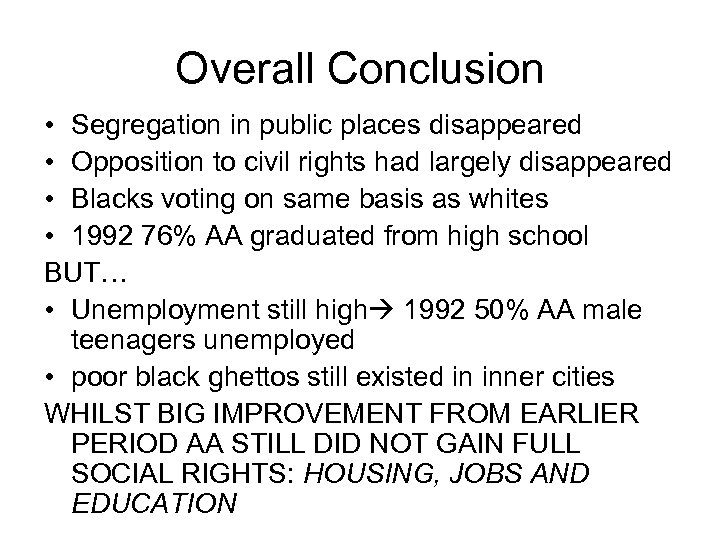 Overall Conclusion • Segregation in public places disappeared • Opposition to civil rights had largely disappeared • Blacks voting on same basis as whites • 1992 76% AA graduated from high school BUT… • Unemployment still high 1992 50% AA male teenagers unemployed • poor black ghettos still existed in inner cities WHILST BIG IMPROVEMENT FROM EARLIER PERIOD AA STILL DID NOT GAIN FULL SOCIAL RIGHTS: HOUSING, JOBS AND EDUCATION