Скачать презентацию CIVIL PARTNERS PARENTING AND THE LAW IS JOINT
62c0e54b26442fa735715ebbdf39da87.ppt
- Количество слайдов: 32
 CIVIL PARTNERS, PARENTING AND THE LAW: IS JOINT ADOPTION THE SOLUTION? Fergus Ryan, Department of Law Dublin Institute of Technology
 Purpose of Paper l l To address the legal position of children being parented by civil partners and other same-sex couples To consider the scope for improving the recognition of ‘social’ or ‘de facto’ parents through adoption and guardianship law reform, with due regard to the obligations and rights of biological parents
 Guiding Principles l l There is no “right to adopt” as such, either under Irish or international law The best interests of the child are the paramount consideration in adoption: a child-focussed approach is required The child’s relationships with all of the people involved in parenting should be valued and facilitated in a manner that promotes the best interests of the child The law should help foster stability and security for the child in the environment in which he or she is being lawfully raised
 Parenting by same-sex couples l l l Not an abstract issue Children are already being raised by samesex couples Census 2011 – 230 same-sex couples raising children together (mostly lesbian couples) (out of 4, 042 same-sex couples) Possibly many other lone LGBT parents USA – 110, 000+ same-sex couples with children (Williams Institute, 2012)
 Pathways to Parenting l LGB parenting already a growing reality: l l l Children born as a result of a prior heterosexual relationship of one of the partners Children born to lesbian couples following donor insemination (formal or informal) Surrogacy Adoption by one of the civil partners/cohabitants as a sole adopter Fostering
 Best interests of child? l l Whether a particular parenting arrangement is in the best interests of a child will depend on the particular circumstances – lots of variables Evidence – family form and parental sexual orientation and gender do not significantly affect outcomes for children American Psychiatric Association (2004) – no evidence of disadvantage to children parented by same-sex couples in terms of emotional or psychological development US National Longitudinal Lesbian Family Study (2012): l l “no difference in psychological wellbeing between children in planned lesbian families and those in heterosexual two-parent families”. Absence of male role models did not affect psychological wellbeing in teens
 Best interests of child? l l l The quality of family process and relationships are more important determinants of wellbeing than the form a family takes (e. g. Fahey et al. (2012), Growing Up in Ireland) Notably, same sex couples are allowed to foster together in Ireland Barry Andrews TD, Minister for Children (2010): l “Gay men and lesbians make very good parents…. The argument that same-sex couples cannot be good parents is contrary to the case”.
 Civil Partnership l l l Civil Partnership and Certain Rights and Obligations of Cohabitants Act 2010 New status, available to same-sex couples only Since 2011, 965 couples have entered into civil partnerships in Ireland Substantially similar to marriage in most respects as regards the relationship between the civil partners The Act, however, largely side-steps the legal implications of parenting by same-sex couples (partners’ relationship is ‘ring-fenced’)
 Parenting rights and obligations l l Guardianship – the right to make major decisions about a child’s upbringing: education, religion, adoption, travel, medical treatment Guardianship is generally confined to the biological parents of the child: l l Where parents are married to each other – father and mother are joint and equal guardians Where parents are not married to each other: l l Mother is automatically a guardian Father is not automatically a guardian but may become a guardian by court order or by statutory declaration made jointly by the father and mother
 Parenting Rights and Obligations l A person who is not a biological parent may only acquire guardianship: l l (a) by adoption (b) by will or court order on the death of an existing guardian (c) by court order on the removal of an existing guardian (a mother or marital father cannot be removed as guardians) There is effectively no mechanism in Irish law whereby a parent and their civil partner or samesex cohabitant may simultaneously share guardianship obligations and rights in respect of a child
 Impact for ‘non-biological parents’ l l l Arguably, the failure to address the legal aspects of co-parenting by civil partners relieves one of the civil partners of obligations that would in fact be quite beneficial to the child and the State to recognise. The non-biological parent: l has no obligations and few rights in respect of the child (e. g. can be excluded from important decisions relating to the child) l is not obliged to maintain the child (except in the case of a spouse of a parent who, knowing she is not a parent of the child, treats the child as a child of her family) l may not seek custody, veto an adoption, or prevent the removal of the child from the jurisdiction The child may not make a claim against the non-biological parent’s estate either on intestacy or under s. 117 of the Succession Act 1965 (though the latter may provide for the former in her will, she is under no obligation to do so)
 Some limited recognition l The non-biological parent if in a position of loco parentis in respect of the child may: l l Seek access (visitation rights) in respect of the child Obtain barring and safety orders for the child’s protection and Take parental leave to care for the child. The relationship between a person and the child of her civil partner is also recognised for tax and social welfare purposes, and in relation to ethical conflicts of interest
 JMc. D v. PL and BM (2009) l l Illustrates the precarious legal position of same sex couples parenting a child Involved a dispute between a lesbian couple and a man who assisted them in starting a family by donating his sperm Despite initially agreeing that he would have contact with but would otherwise play no part in parenting the child, the father sought access and guardianship in respect of the child This was refused in the High Court on the basis that either order would disrupt the de facto family life of the couple and the child, which Hedigan J ruled was protected under Article 8 of the ECHR
 Supreme Court l Reversed the High Court ruling, and granted the father access but not guardianship l l Ruled that the High Court had erred in regarding the couple as a de facto family with either constitutional or convention rights - couple enjoyed no legal recognition in Irish law (the case was decided pre-civil partnership) Partner of mother had no constitutional and few legal rights in respect of the child Ruled that the High Court had placed excessive emphasis on the child’s relationship with the couple, and had not sufficiently considered the benefit to the child of having contact with its father Decision reflects a largely biologically-focussed approach to parenting and family formation
 ‘Settled and loving’ home l There is nonetheless some suggestion that the Supreme Court recognised the couple’s role and contribution in raising the child: l Denham J: “…the circumstances of the case show that the respondents have lived together for years in a loving relationship and that they provide a settled and loving home for the child. These factors are critical and of importance in assessing the welfare of the child. ”
 Adoption: Overview l l ‘Stranger’ adoption quite rare in Ireland Most children adopted by people already related to them or to a parent e. g. parent and new spouse (step-parent) Number of children available for adoption in Ireland low Many ‘sending’ Hague Convention states do not permit same-sex adoption
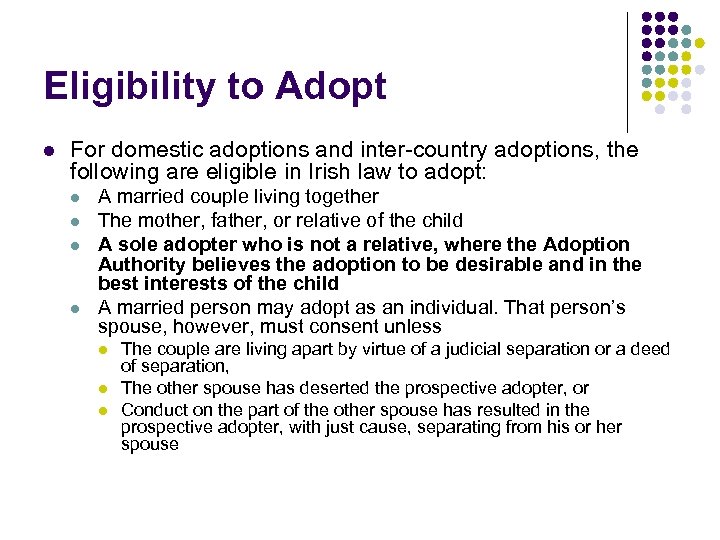 Eligibility to Adopt l For domestic adoptions and inter-country adoptions, the following are eligible in Irish law to adopt: l l A married couple living together The mother, father, or relative of the child A sole adopter who is not a relative, where the Adoption Authority believes the adoption to be desirable and in the best interests of the child A married person may adopt as an individual. That person’s spouse, however, must consent unless l l l The couple are living apart by virtue of a judicial separation or a deed of separation, The other spouse has deserted the prospective adopter, or Conduct on the part of the other spouse has resulted in the prospective adopter, with just cause, separating from his or her spouse
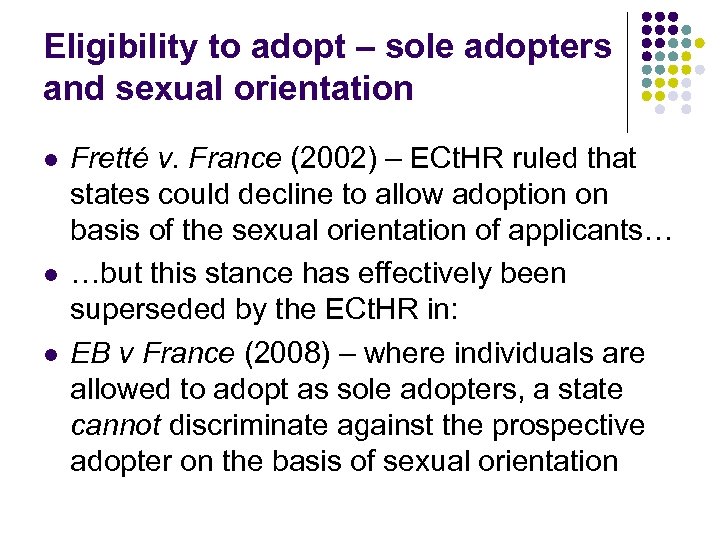 Eligibility to adopt – sole adopters and sexual orientation l l l Fretté v. France (2002) – ECt. HR ruled that states could decline to allow adoption on basis of the sexual orientation of applicants… …but this stance has effectively been superseded by the ECt. HR in: EB v France (2008) – where individuals are allowed to adopt as sole adopters, a state cannot discriminate against the prospective adopter on the basis of sexual orientation
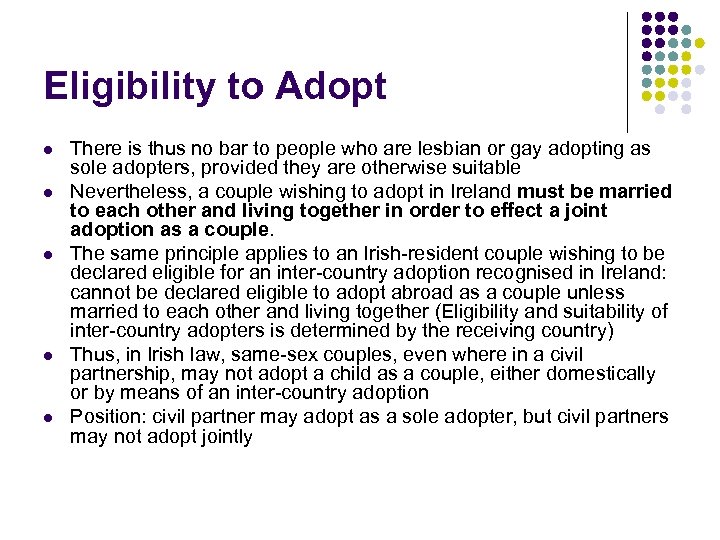 Eligibility to Adopt l l l There is thus no bar to people who are lesbian or gay adopting as sole adopters, provided they are otherwise suitable Nevertheless, a couple wishing to adopt in Ireland must be married to each other and living together in order to effect a joint adoption as a couple. The same principle applies to an Irish-resident couple wishing to be declared eligible for an inter-country adoption recognised in Ireland: cannot be declared eligible to adopt abroad as a couple unless married to each other and living together (Eligibility and suitability of inter-country adopters is determined by the receiving country) Thus, in Irish law, same-sex couples, even where in a civil partnership, may not adopt a child as a couple, either domestically or by means of an inter-country adoption Position: civil partner may adopt as a sole adopter, but civil partners may not adopt jointly
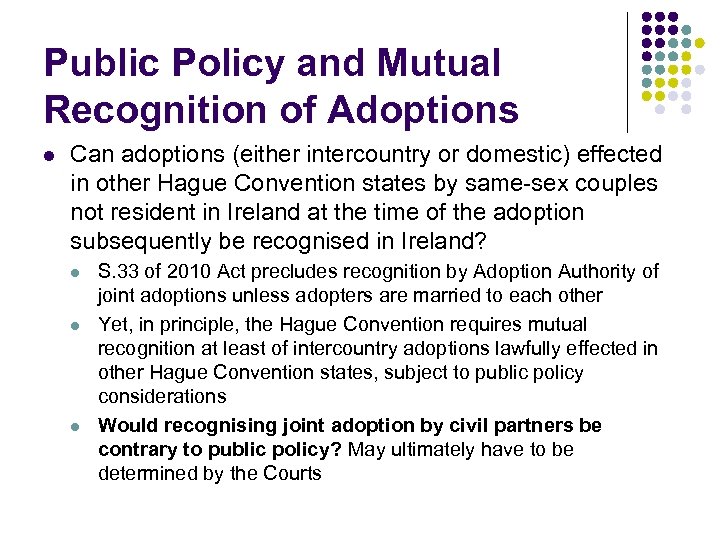 Public Policy and Mutual Recognition of Adoptions l Can adoptions (either intercountry or domestic) effected in other Hague Convention states by same-sex couples not resident in Ireland at the time of the adoption subsequently be recognised in Ireland? l l l S. 33 of 2010 Act precludes recognition by Adoption Authority of joint adoptions unless adopters are married to each other Yet, in principle, the Hague Convention requires mutual recognition at least of intercountry adoptions lawfully effected in other Hague Convention states, subject to public policy considerations Would recognising joint adoption by civil partners be contrary to public policy? May ultimately have to be determined by the Courts
 Civil Partners and Adoption: England Wales l l In England Wales, since 2002, it has been possible for unmarried couples “living as partners in an enduring family relationship” to adopt jointly (Adoption and Children Act 2002) Includes same-sex couples and civil partners, who may also adopt jointly
 Civil Partners and Adoption: Northern Ireland l Secondary legislation in Northern Ireland, however, imposed restrictions on adoptions in that jurisdiction: l l l Article 14 Adoption (NI) Order 1987 precluded unmarried couples from adopting as a couple (but not as sole adopters) Article 15 Adoption (NI) Order 1987 (as amended by the Civil Partnership Act 2004) precluded civil partners from adopting either individually or as a couple Hence, in NI, until recently, while a person in a same-sex relationship could adopt on their own, a civil partner could not, even as a sole adopter
 P and Others (2008) l l The House of Lords concluded (4 -1) that Northern Irish law, in preventing unmarried couples from adopting jointly, infringed the European Convention on Human Rights (Art. 14 read alongside Art. 8) Unjustified discrimination on the basis of marital status Lord Hoffmann - ban potentially prevented adoption in cases where it might clearly be in the child’s best interest to be adopted Thus, notwithstanding the Adoption Order, the House ruled that an unmarried couple could adopt jointly (effectively the House ruled that the relevant provision could be ignored as it was subordinate legislation that was incompatible with the Convention and with the Human Rights Act 1998)
 P and Others (2008) l l l Some of the judges observed that when assessing suitability of particular adopters to adopt, the fact that they were unmarried may reasonably be considered in assessing the likely stability of the relationship. (See, e. g. , Lord Hoffmann and Baroness Hale). But the House concluded that one cannot thus assume that all unmarried couples will be unsuitable as adopters (Lord Hoffman) Thus, the fact that a couple have not married cannot be instrumental in denying eligibility Where couple otherwise are in a committed and stable relationship and the adoption would otherwise be in a child’s best interests – should not be prevented by arbitrary eligibility criteria Key criterion – best interests of child, rather than status of adopters
 NIHRC Application (2012) l l Northern Ireland High Court, following P and Others, affirmed that the ban in NI on unmarried couples adopting together infringed the Convention. Treacy J also ruled that Article 15 of the Adoption Order, banning civil partners in Northern Ireland from adopting either together or separately, infringed the Convention Court effectively ruled that the restrictions no longer applied Notably, in P and Others, some of the Lords had queried the blanket ban on civil partners, Baroness Hale suggesting that it was: l “…difficult to see how this could survive a challenge under article 14 of the European Convention, which takes a particularly firm line against discrimination on the ground of sexual orientation. ”
 Is joint adoption the solution? l l l Provides a more stable foundation for family life: respects the integrity and unity of families Child acquires rights in respect of both parents Greater stability for child Both may make decisions in respect of the child Adoption terminates any pre-existing rights and obligations of biological parents – adopters assume full parental rights and obligations with no risk of interference from others
 Is joint adoption the solution? l l l Complications with adoption: not a straightforward remedy: Time consuming/bureaucratically complex Not well suited to situations where a couple are seeking to formalise relationship with one of the couple’s children Adoption can be blocked by mother, guardians or persons with charge of or control over the child immediately before placement Must meet suitability requirements Pending the implementation of the children’s rights amendment) child born inside marriage generally cannot be adopted
 Is joint adoption the solution? l l l Joint adoption for civil partners would be a welcome step In many cases, however, allowing the civil partners and spouses of parents to acquire guardianship would provide a simpler, less intrusive mechanism where one of the civil partners/spouses is the parent of the relevant child Extending guardianship – confers parental responsibility without affecting existing guardians
 Guardianship Reform l l Law Reform Commission Report on the Legal Aspects of Family Relationships (LRC 1012010) Proposed allowing civil partner or spouse of a parent to be given parental responsibility (guardianship): l l By written agreement with the other guardians By court order if in best interests of the child
 Possible reform? l l l Statements from Minister for Justice and Equality appear to favour reform to recognise same-sex parenting (June and November 2012) See also the Labour Party Guardianship of Children Bill 2010: Persons in loco parentis in respect of a child would have the right to apply for guardianship and custody Suggests that there is an impetus for guardianship law reform that may not exist in respect of joint adoption for civil partners.
 Conclusions l l l l Need for greater recognition and support for de facto parenting relationships (not just by partners of parents) Compelling case to allow civil partners to adopt jointly Illogical to allow child be raised by couple only of whom has parental responsibility Nonetheless, extension of guardianship may provide a simpler, more effective route to joint parental responsibility These are complex and intricate issues that require consideration of a complex matrix of relationships Need for proper regulation of assisted human reproduction and provision for parenting resulting from such arrangements Need to ensure, to the greatest extent possible, stability and security for the child in the environment in which he or she is being lawfully raised