


 Скачать презентацию Civil-Military Cooperation in Homeland Security and Emergency Preparedness
d6bd96b2bbbdba2e51c7fd751f531d34.ppt
- Количество слайдов: 68
 Civil-Military Cooperation in Homeland Security and Emergency Preparedness Presentation to the 2004 EUCOM Partnership for Peace Environmental Conference Bucharest, Romania 30 May – 4 June 2004
 Overview § Homeland Security § Emergency Preparedness and Response § National Response Planning and Plans § National Response Assets § Northern Command Joint Interagency Coordination § Priorities and Challenges June 2004
 The Birth of the Department of Homeland Security § September 11, 2001: Terrorists attack America § October 8, 2001: President George W. Bush creates White House Office of Homeland Security § June 2002: President Bush introduces to Congress his proposal for a new Department § November 2002: Congress passes the Homeland Security Bill § November 25, 2002: President Bush signs the Homeland Security Act into law § January 24, 2003: The Department of Homeland Security is born § March 1, 2003: Majority of the affected agencies join the new Department of Homeland Security June 2004
 Purpose § Homeland security functions traditionally have been dispersed among dozens of Federal agencies and thousands of first responder groups across America. § DHS streamlines and centralizes Federal actions into one cohesive unit. It provides one point of contact for State and local groups and the private sector. § The result is a better prepared America. June 2004
 Department of Homeland Security Mission § Prevent terrorist attacks within the United States § Reduce America’s vulnerability to terrorism § Minimize the damage from potential attacks and natural disasters June 2004
 U. S. Department of Homeland Security Organization § Combined 22 Federal agencies into four policy directorates: • Border and Transportation Security • Emergency Preparedness and Response • Information Analysis and Infrastructure Protection • Science and Technology § Management Directorate § U. S. Coast Guard § U. S. Secret Service June 2004
 HSPD-5: Management of Domestic Incidents HSPD-5 Objectives: § Single comprehensive national approach § Prevention, Preparedness, Response and Recovery § Ensure all levels of government and private sector work together § Horizontal and vertical integration § Effective communications § Integrate crisis and consequence management § DHS Secretary as the principal Federal official for domestic incident management June 2004
 HSPD-5 Implementation Develop and administer: § National Incident Management System (NIMS) § Core set of concepts, principles and terminology for incident command multi-agency coordination § National Response Plan (NRP) § All-discipline, all-hazards plan § Initial National Response Plan (INRP) created as an interim plan until the publication of the full NRP June 2004
 Emergency Preparedness and Response. Federal Emergency Management Agency (FEMA) § Office of National Security Coordination § Mitigation and Insurance Programs § Preparedness Division § Response Division § Recovery Division June 2004
 Federal Emergency Management Agency Mission § Coordinate and support Federal, State, and local readiness and response efforts for all disasters, including acts of terrorism § Provide disaster preparedness educational programs for communities and citizens, including expansion of the Community Emergency Response Team (CERT) Program § Expand enhance current capabilities of the Strategic National Stockpile pharmaceuticals and critical medical equipment § Improve readiness and enhance capabilities of the National Disaster Medical System (NDMS) teams § Collaborating with other Federal training institutions, provide training curriculum standardization and single portal for accessing the programs June 2004
 FEMA’s Emergency Mission § Prepare for and lead Federal Government’s Response to Emergencies and Major disasters, Natural or Man-made to: § Save lives § Protect property § Ensure that basic human needs are met June 2004
 FEMA’s Emergency Responsibilities § Respond to requests for Federal assistance to supplement State and local response efforts § Provide central emergency coordination among Federal agencies § Apply the President’s authority to: § Issue a Presidential emergency declaration § Mobilize Federal resources § Redirect Federal resources to emergency response June 2004
 Disaster Response Authorities § Robert T. Stafford Disaster and Emergency Assistance Act § Homeland Security Act of 2002 § Defense Against Weapons of Mass Destruction Act of 1996 § Public Health Security and Bioterrorism Preparedness and Response Act of 2002 § Homeland Security Presidential Directive 5 § Executive Orders 12148, 12472, 12656 June 2004
 Disaster Response Process June 2004
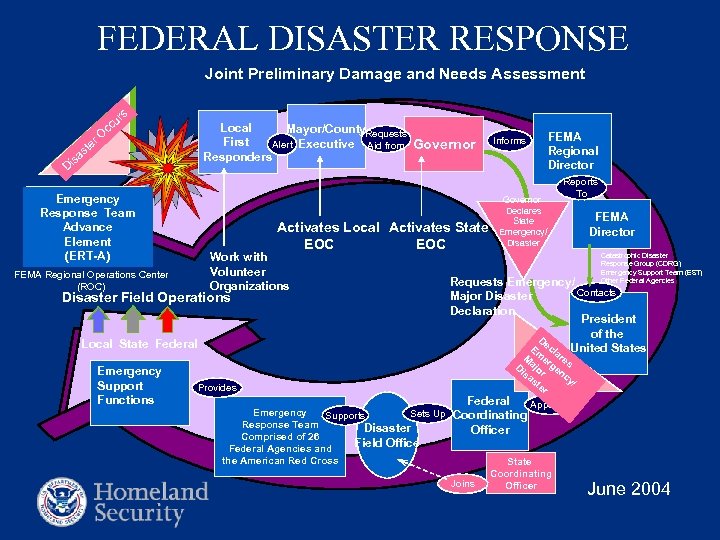 FEDERAL DISASTER RESPONSE Joint Preliminary Damage and Needs Assessment rs u cc Local Mayor/County. Requests First Alert Executive Aid from Governor Responders O er t as s Di Emergency Response Team Advance Element (ERT-A) Activates Local Activates State EOC Work with Volunteer Organizations FEMA Regional Operations Center (ROC) Disaster Field Operations Local State Federal Emergency Support Functions FEMA Regional Director Governor Declares State Emergency/ Disaster Reports To FEMA Director Catastrophic Disaster Response Group (CDRG) Emergency Support Team (EST) Other Federal Agencies Requests Emergency/ Contacts Major Disaster Declaration President of the D Em ecla United States M e re Di ajo rge s nc sa r y/ st er Provides Emergency Sets Up Supports Response Team Disaster Comprised of 26 Field Office Federal Agencies and the American Red Cross Informs Federal Appoints Coordinating Officer Joins State Coordinating Officer June 2004
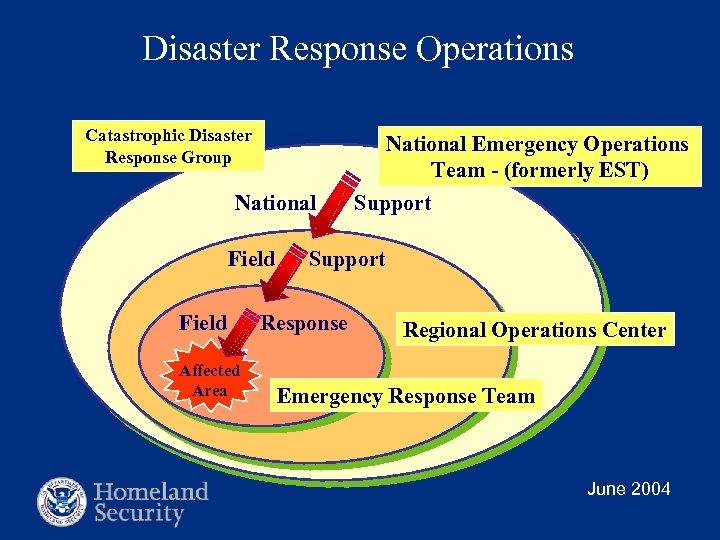 Disaster Response Operations Catastrophic Disaster Response Group National Field Affected Area National Emergency Operations Team - (formerly EST) Support Response Regional Operations Center Emergency Response Team June 2004
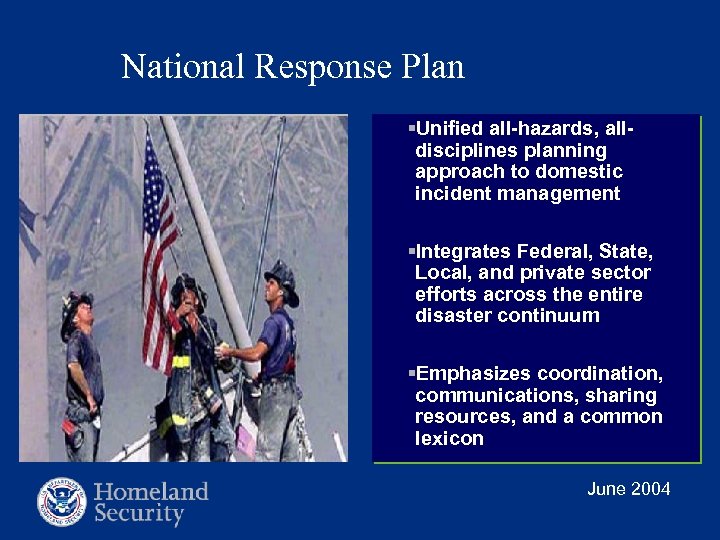 National Response Plan §Unified all-hazards, alldisciplines planning approach to domestic incident management §Integrates Federal, State, Local, and private sector efforts across the entire disaster continuum §Emphasizes coordination, communications, sharing resources, and a common lexicon June 2004
 National Response Plan § Emergency Support Function structure will remain in the NRP § Senior FEMA personnel assigned to DHS’s NRP and NIMS development § Standard operating procedures are being modified to bring all Federal field level response assets (ERT, DEST, NDMS, USAR, NIRT, MERS) under a unified command to fully integrate State and local responders to accomplish critical mission objectives § Operational teams are being trained in ICS to ensure they can operate in accordance with the spirit of HSPD-5 June 2004
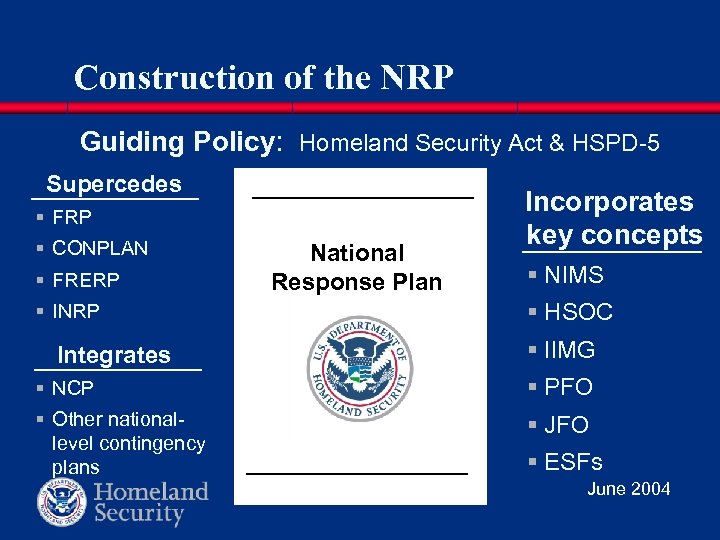 Construction of the NRP Guiding Policy: Homeland Security Act & HSPD-5 Supercedes § FRP § CONPLAN § FRERP § INRP Integrates National Response Plan Incorporates key concepts § NIMS § HSOC § IIMG § NCP § PFO § Other nationallevel contingency plans § JFO § ESFs June 2004
 NRP Incidents of National Significance Incidents which require DHS operational coordination and/or resource coordination. Includes: § Credible threats, indications or acts of terrorism within the United States § Major disasters or emergencies (as defined by the Stafford Act) § Catastrophic incidents § Unique situations that may require DHS to aid in coordination of incident management… June 2004
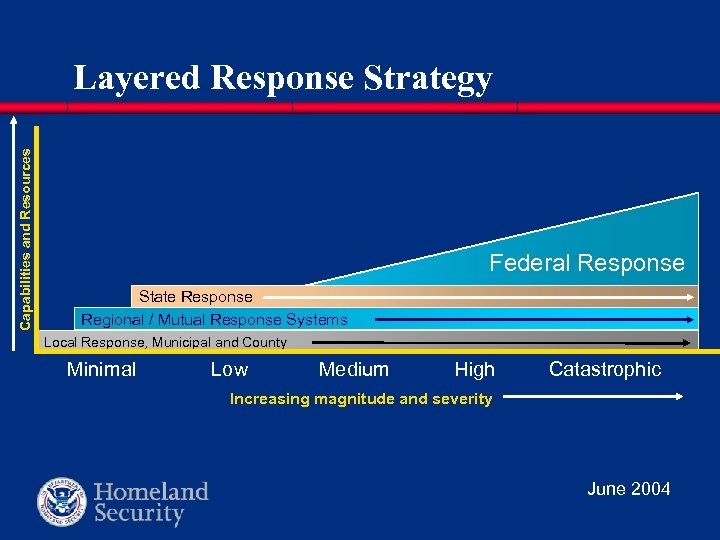 Capabilities and Resources Layered Response Strategy Federal Response State Response Regional / Mutual Response Systems Local Response, Municipal and County Minimal Low Medium High Catastrophic Increasing magnitude and severity June 2004
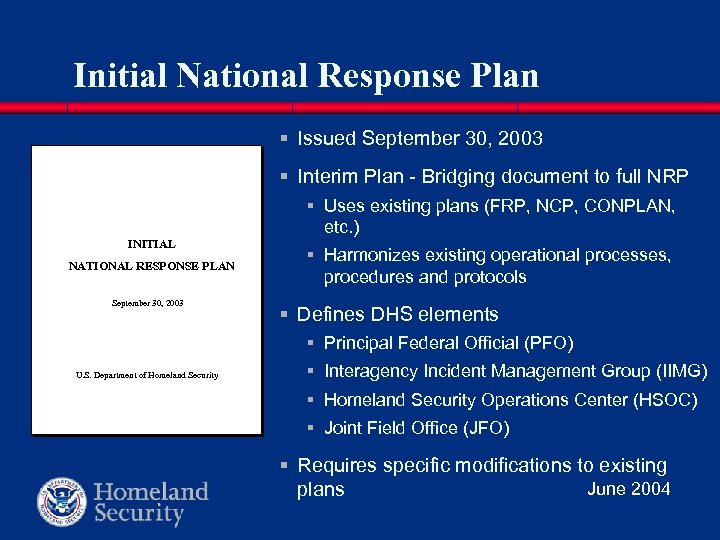 Initial National Response Plan § Issued September 30, 2003 § Interim Plan - Bridging document to full NRP § Uses existing plans (FRP, NCP, CONPLAN, etc. ) INITIAL NATIONAL RESPONSE PLAN September 30, 2003 § Harmonizes existing operational processes, procedures and protocols § Defines DHS elements § Principal Federal Official (PFO) U. S. Department of Homeland Security § Interagency Incident Management Group (IIMG) § Homeland Security Operations Center (HSOC) § Joint Field Office (JFO) § Requires specific modifications to existing June 2004 plans
 Initial National Response Components § Homeland Security Operations Center § Primary national-level hub for communications and info pertaining to domestic incident management § Interagency Incident Management Group § Facilitates national-level operational coordination, course of action determination and policy recommendations § Principal Federal Official § Represents the DHS Secretary locally in an overall coordination role § Other agency officials retain authorities § Joint Field Office § Integrates Federal, state and local incident management entities whenever possible § Coordination point for Joint Operations Center (law enforcement) and Disaster Field Office (response and recovery) activities June 2004
 Federal Response Plan • The Federal Response Plan is a signed agreement among 26 Departments and Agencies and the American Red Cross § Provides the mechanism through Emergency Support Functions to augment efforts of State and local governments overwhelmed by emergencies or major disasters § Uses mission assignment process to deliver assistance to State and local entities § Implemented on average more than 60 times each year Will be integrated with National Response Plan and National Incident Management System § June 2004
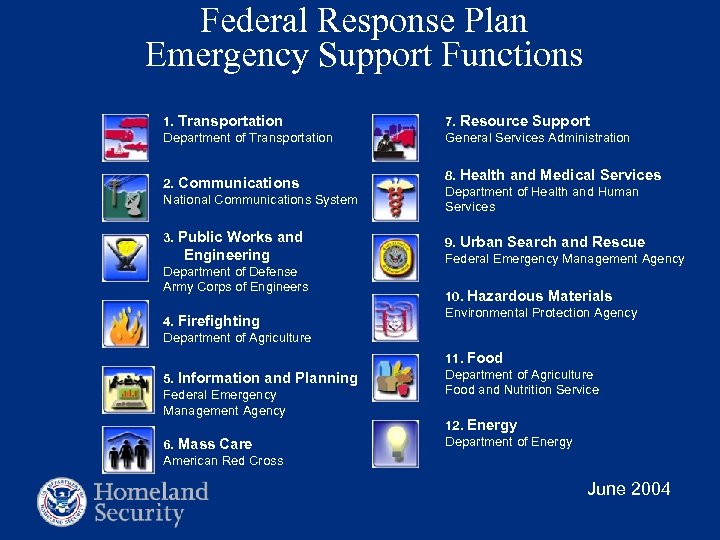 Federal Response Plan Emergency Support Functions 1. Transportation Department of Transportation 7. Resource Support General Services Administration 2. Communications National Communications System 8. Health and Medical Services Department of Health and Human Services 3. Public Works and Engineering Department of Defense Army Corps of Engineers 4. Firefighting Department of Agriculture 5. Information and Planning Federal Emergency Management Agency 6. Mass Care American Red Cross 9. Urban Search and Rescue Federal Emergency Management Agency 10. Hazardous Materials Environmental Protection Agency 11. Food Department of Agriculture Food and Nutrition Service 12. Energy Department of Energy June 2004
 US Army Corps of Engineers and Emergency Support Function (ESF) # 3 § Department of Defense is lead federal agency for ESF # 3 § USACE is the Do. D Agent § Typical Mission Areas: § Ice and water § Emergency power § Temporary roofing and temporary housing § Engineering technical assistance § Debris clearance and removal § Contracting June 2004
 Incident Command System § Incident Command System- a flexible system that can be applied to a wide variety of emergency and non-emergency situations § Addresses multi-agency response to complex incidents using: § common command structure § standard terminology § standardized/integrated communications § coordination of resources § development of consolidated Incident Action Plans § identification of designated facilities § Incident Action Plans address proper use of resources, appropriate strategies and tactics, safety considerations, cost controls June 2004
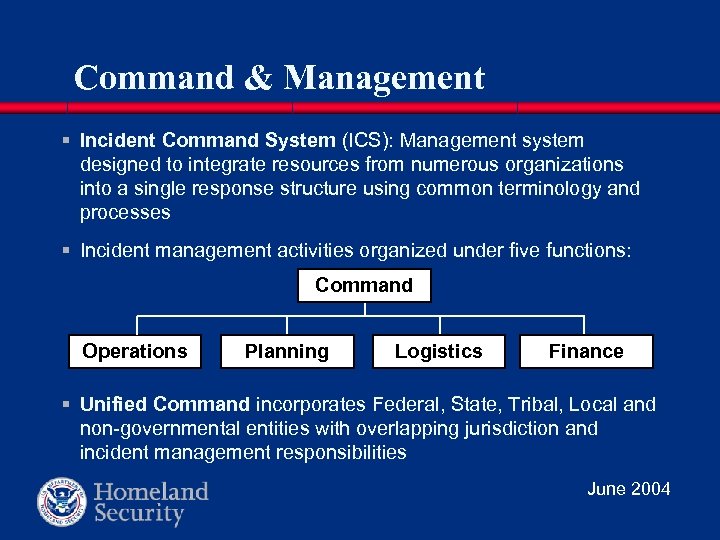 Command & Management § Incident Command System (ICS): Management system designed to integrate resources from numerous organizations into a single response structure using common terminology and processes § Incident management activities organized under five functions: Command Operations Planning Logistics Finance § Unified Command incorporates Federal, State, Tribal, Local and non-governmental entities with overlapping jurisdiction and incident management responsibilities June 2004
 Key National Disaster Response Assets June 2004
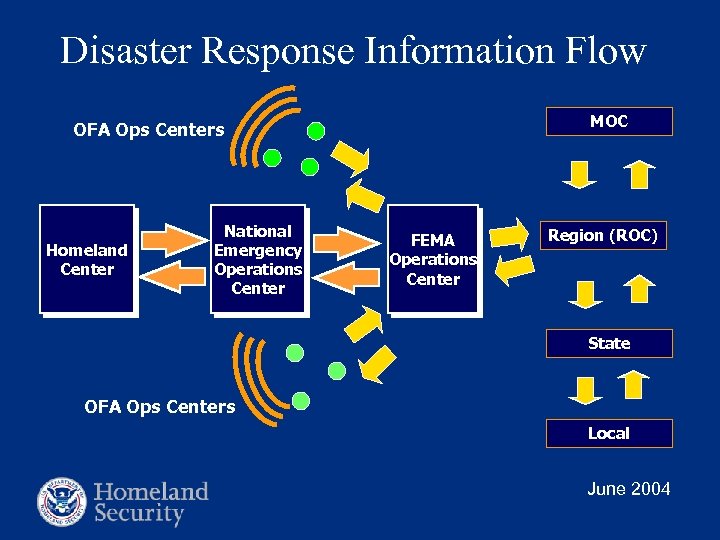 Disaster Response Information Flow MOC OFA Ops Centers Homeland Center National Emergency Operations Center FEMA Operations Center Region (ROC) State OFA Ops Centers Local June 2004
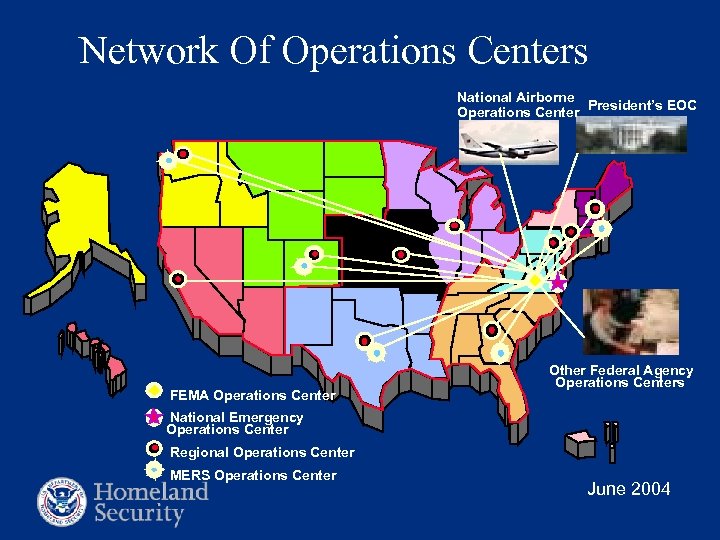 Network Of Operations Centers National Airborne Operations Center President’s EOC FEMA Operations Center Other Federal Agency Operations Centers National Emergency Operations Center Regional Operations Center MERS Operations Center June 2004
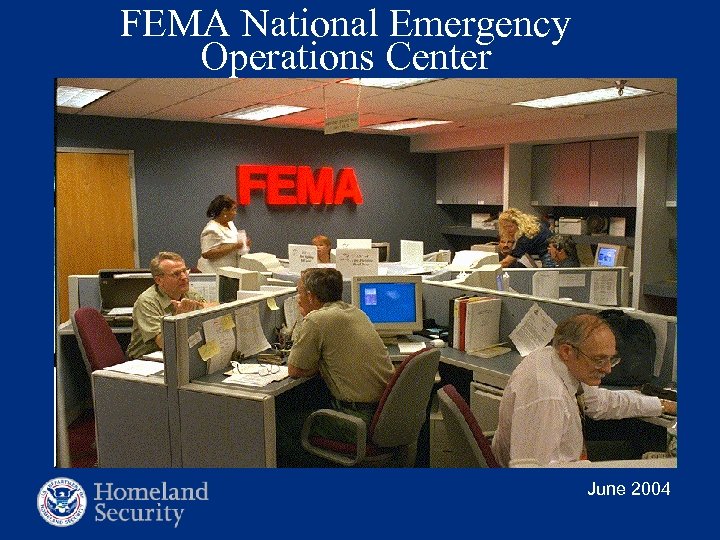 FEMA National Emergency Operations Center June 2004
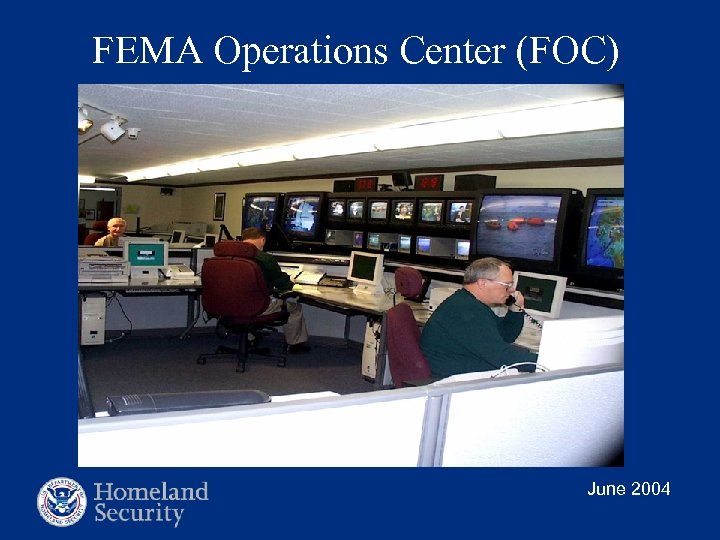 FEMA Operations Center (FOC) June 2004
 FEMA Operations Center Notifications §Emergency Teams § § § § Domestic Emergency Support Team (DEST) Joint Operations Center (JOC) National Emergency Operations Team (NEOT) National Emergency Response Team (ERT-N) Emergency Response Team (National Capital Region) Hurricane Liaison Team (HLT) Urban Search & Rescue Task Forces (US&R) § State and Local Emergency Operations Centers § 26 Departments and Agencies June 2004
 Other National Response Assets § Mobile Emergency Response Support § Logistics Centers § National Disaster Medical System § Strategic National Stockpile* § Urban Search and Rescue Task Forces § Specialized Teams §Hurricane Liaison Team §Rapid Needs Assessment Team §Nuclear Incident Response Team** §Domestic Emergency Support Team *Owned by EP&R, managed by HHS/CDC **Owned by DOE, under the operational control of EP&R June 2004
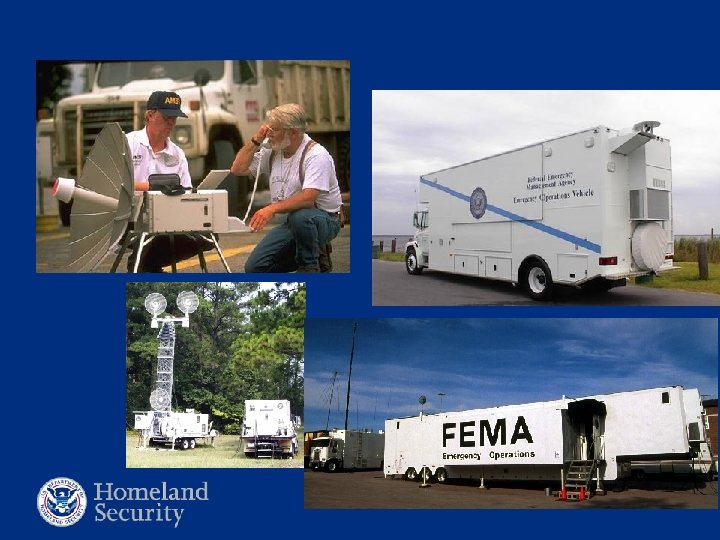
 Mobile Emergency Response Support (MERS) Mission § Provides mobile telecommunications, life support, logistics and operational support, and power generation required for the on-site management of disaster response activities § Consists of a flexible mix of resources designed to meet all hazards and national security emergency requirements § Provides support for Federal responders KU-Band Satellite HF/VHF/UHF Line of Sight (LOS) Landlines Self-contained power generation Video through Secondary Antenna 48 telephone lines Facsmile Secure Voice/Facsmile 2 Way Teleconferencing Full Broadcast for Television System June 2004
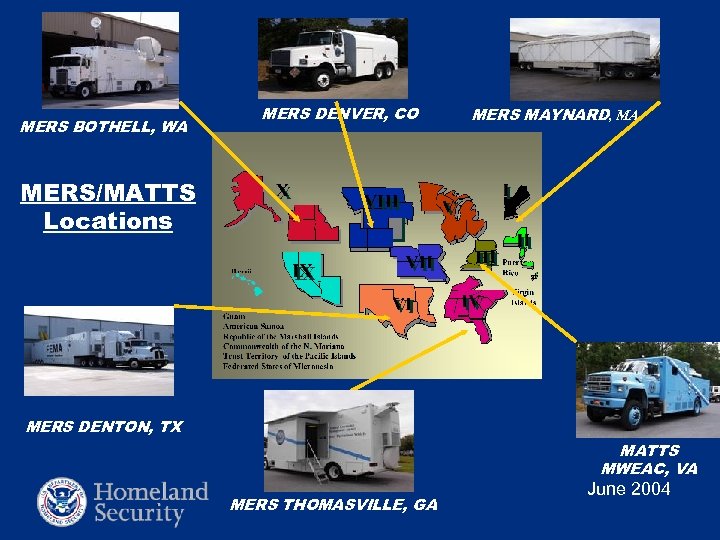 MERS BOTHELL, WA MERS DENVER, CO MERS MAYNARD, MA MERS/MATTS Locations MERS DENTON, TX MATTS MWEAC, VA MERS THOMASVILLE, GA June 2004
 June 2004
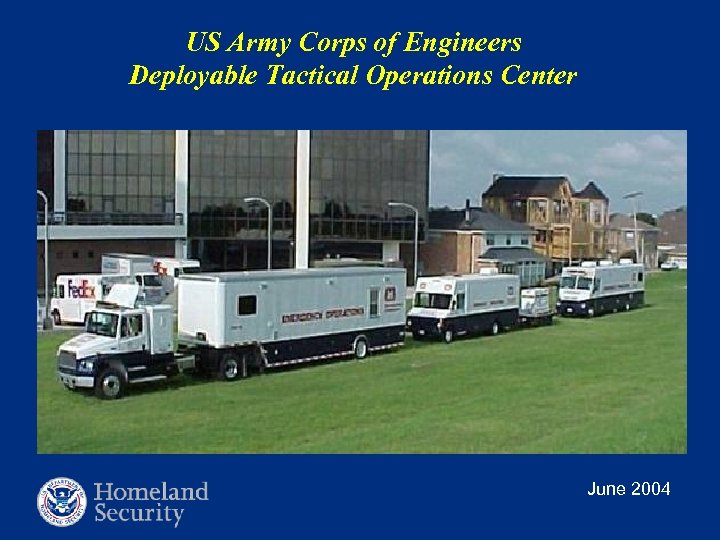 US Army Corps of Engineers Deployable Tactical Operations Center June 2004
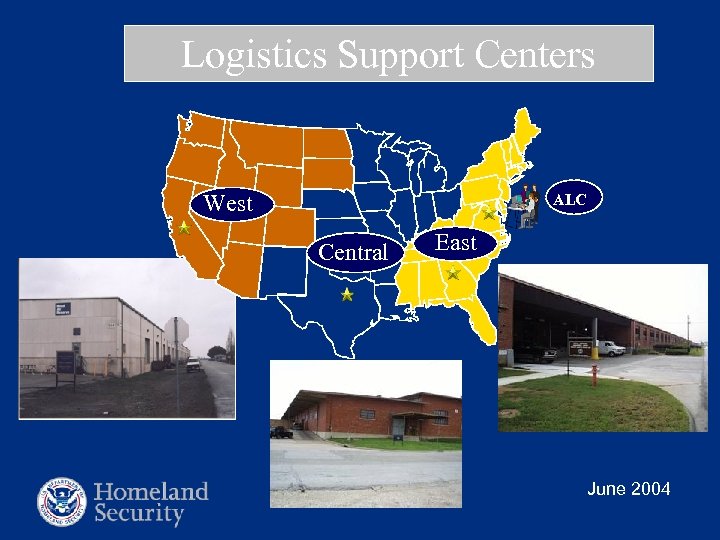 Logistics Support Centers West ALC Central East June 2004
 Logistics Support Centers Mission § Logistics Support Centers ensure readiness and “just in time” logistics support for disaster responders and victims through strategically located and stocked logistics centers and storage sites § Centers employ centralized transportation management in support of FEMA’s/DHS’s all-hazards mission § Centers are located in California, Texas, Georgia, Maryland, and Virginia and remote sites are located in Guam, Hawaii, and Puerto Rico June 2004
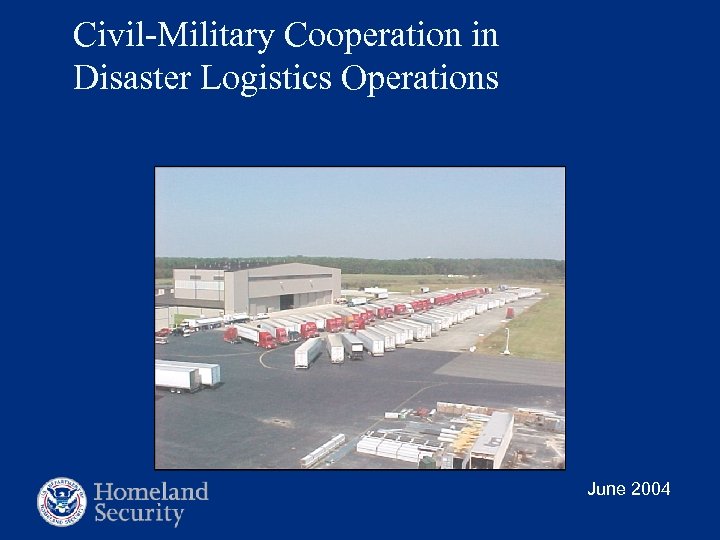 Civil-Military Cooperation in Disaster Logistics Operations June 2004
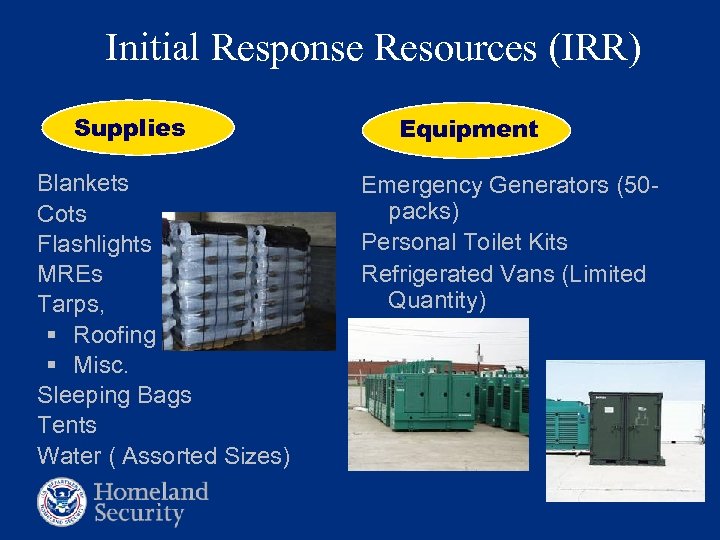 Initial Response Resources (IRR) Supplies Blankets Cots Flashlights MREs Tarps, § Roofing § Misc. Sleeping Bags Tents Water ( Assorted Sizes) Equipment Emergency Generators (50 packs) Personal Toilet Kits Refrigerated Vans (Limited Quantity) June 2004
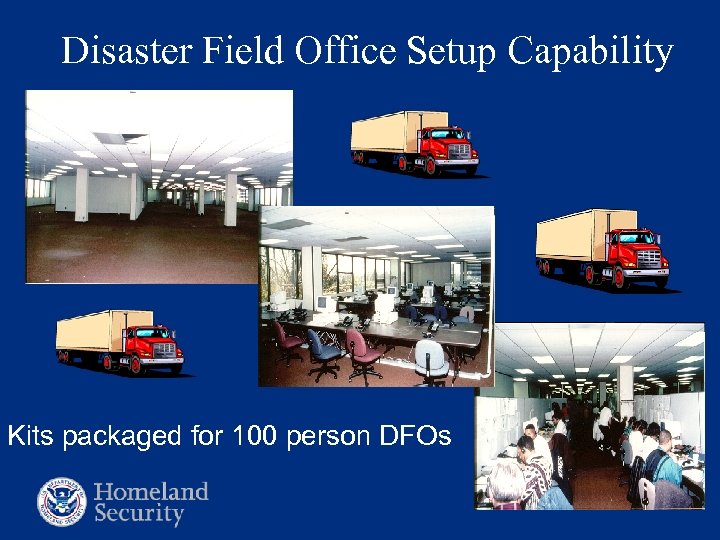 Disaster Field Office Setup Capability Kits packaged for 100 person DFOs June 2004
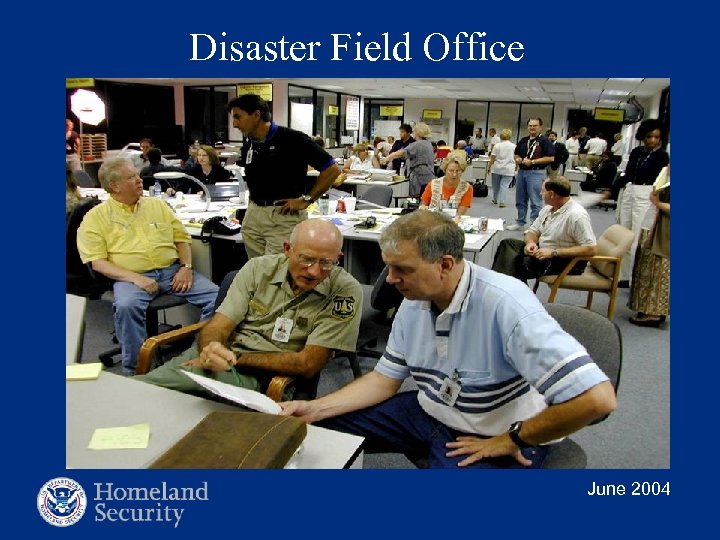 Disaster Field Office June 2004
 National Disaster Medical System (NDMS) DHS § VA DOD HHS FEMA NDMS—A nationwide Medical Response System and public / private sector partnership 108 NDMS Teams supplement State and local medical resources during disasters or major emergencies § Provide patient evacuation from disaster areas § Provide in-hospital medical care to disaster victims § Coordinate activities of regional medical emergency coordinators § Provide backup medical support to the military/ VA medical care systems during an overseas conventional conflict June 2004
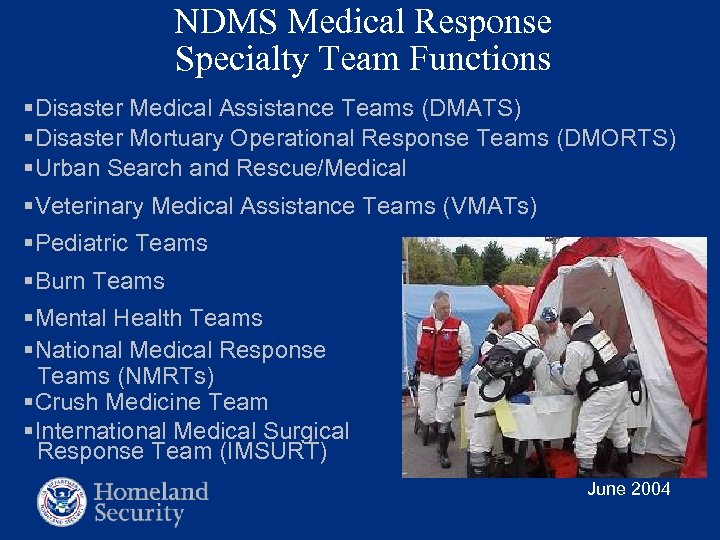 NDMS Medical Response Specialty Team Functions §Disaster Medical Assistance Teams (DMATS) §Disaster Mortuary Operational Response Teams (DMORTS) §Urban Search and Rescue/Medical §Veterinary Medical Assistance Teams (VMATs) §Pediatric Teams §Burn Teams §Mental Health Teams §National Medical Response Teams (NMRTs) §Crush Medicine Team §International Medical Surgical Response Team (IMSURT) June 2004
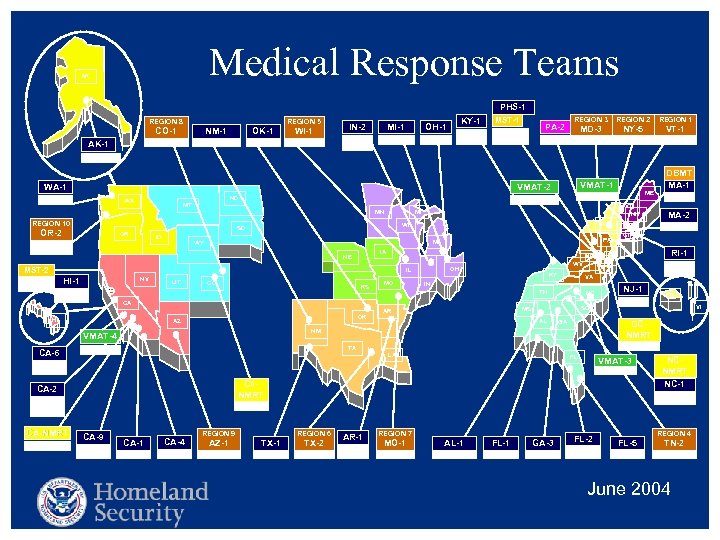 Medical Response Teams AK PHS-1 REGION 8 REGION 5 CO-1 OK-1 WI-1 BRUSH AK-1 NM-1 ALBUQUERQUE TULSA RACINE IN-2 MI-1 WESTLAND TOLEDO MST-1 FORT THOMAS OH-1 FORT WAYNE KY-1 ROCKVILLE, MD PA-2 REGION 3 REGION 2 MD-3 NY-5 VT-1 ABINGTON SYRACUSE BURLINGTON DERRY REGION 1 ANCHORAGE WA-1 ND WA MN OR-2 OR ID MI NY IA HI-1 WAILUKU, MAUI UT CO KS DC TN PR OK AZ AR AL GA DCNMRT NM TX Simi Valley, CA Washington DC LA FL VMAT-3 Raleigh, NC C 0 NMRT CA-2 SAN BERNARDIN O VI SC MS SAN FRANCISCO COMMERCE NJ-1 NC Trenton VMAT-4 CA-NMRT PROVIDEN CE VA IN CA HI CA-6 MO KY RI-1 DE WV OH IL NV CT RI NJ MD MST-2 MA-2 WORCESTER MA PA MI WY NE BOSTON VT NH WI SD ST. HELENS, OR ME Southwick, MA Columbia, MD MT REGION 10 Sacramento, CA VMAT-1 VMAT-2 SEATTLE DBMT MA-1 NCNMRT NC-1 WINSTONSALEM DENVER CA-9 LOS ANGELES CA-1 CA-4 SANTA ANA SAN DIEGO REGION 9 REGION 6 AZ-1 TX-2 CHANDLER EL PASO HUNTSVILLE AR-1 LITTLE ROCK REGION 7 MO-1 AL-1 FL-1 GA-3 RICHMOND BIRMINGHAM Pensacola Riverdale FL-2 PORT CHARLOTTE REGION 4 FL-5 TN-2 MIAMI KNOXVILLE June 2004
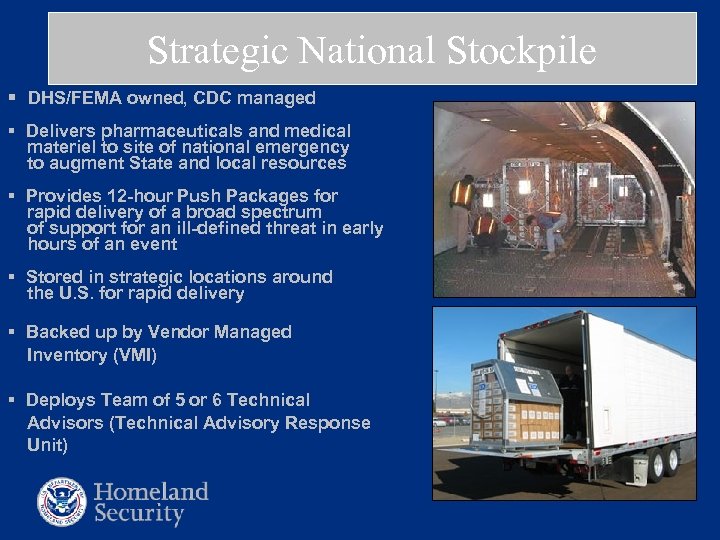 Strategic National Stockpile § DHS/FEMA owned, CDC managed § Delivers pharmaceuticals and medical materiel to site of national emergency to augment State and local resources § Provides 12 -hour Push Packages for rapid delivery of a broad spectrum of support for an ill-defined threat in early hours of an event § Stored in strategic locations around the U. S. for rapid delivery § Backed up by Vendor Managed Inventory (VMI) § Deploys Team of 5 or 6 Technical Advisors (Technical Advisory Response Unit) June 2004
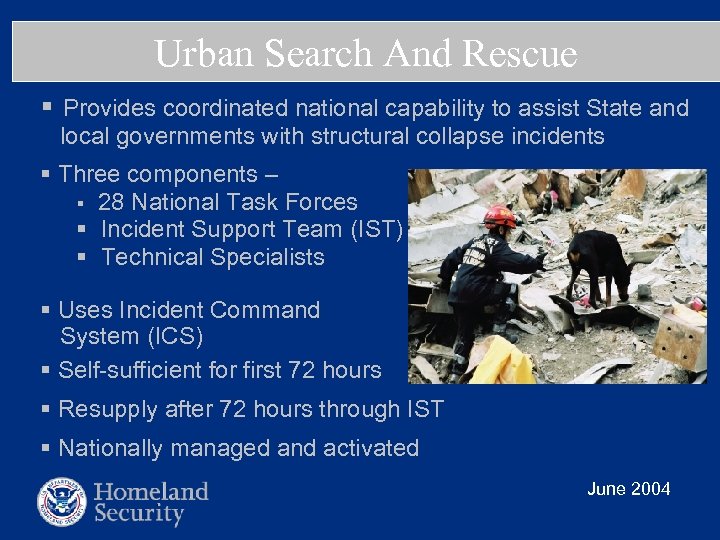 Urban Search And Rescue § Provides coordinated national capability to assist State and local governments with structural collapse incidents § Three components – § 28 National Task Forces § Incident Support Team (IST) § Technical Specialists § Uses Incident Command System (ICS) § Self-sufficient for first 72 hours § Resupply after 72 hours through IST § Nationally managed and activated June 2004
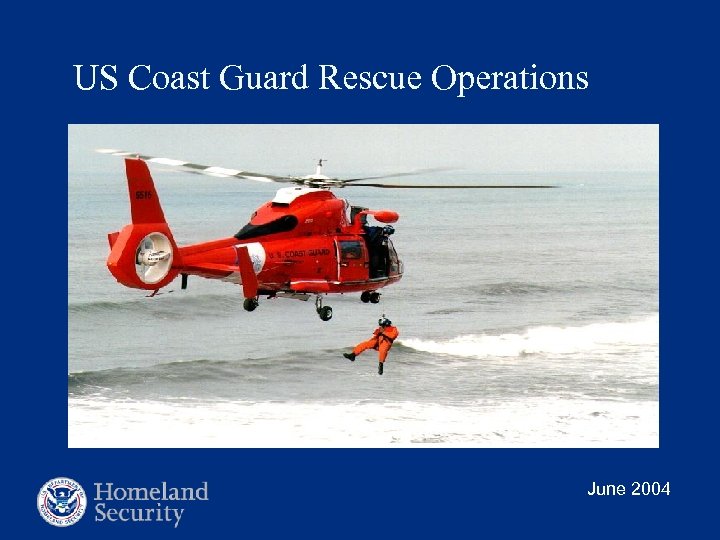 US Coast Guard Rescue Operations June 2004
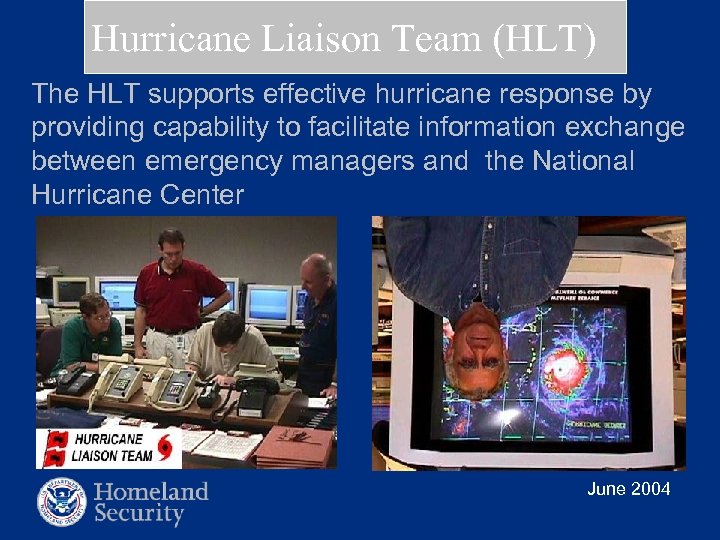 Hurricane Liaison Team (HLT) The HLT supports effective hurricane response by providing capability to facilitate information exchange between emergency managers and the National Hurricane Center June 2004
 Emergency Response Team (ERT) § Interagency field organization which enables agencies to coordinate their activities and provide the full range of Federal response and recovery assistance in situations that result in a Presidential declaration of a major disaster or emergency. § Composed of representatives of each ESF § Major organizational elements: § § Operations Logistics Information & Planning Administration June 2004
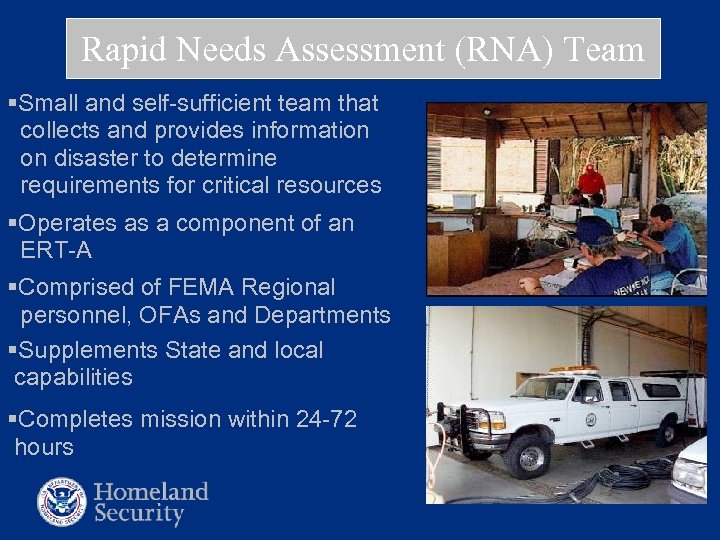 Rapid Needs Assessment (RNA) Team §Small and self-sufficient team that collects and provides information on disaster to determine requirements for critical resources §Operates as a component of an ERT-A §Comprised of FEMA Regional personnel, OFAs and Departments §Supplements State and local capabilities §Completes mission within 24 -72 hours June 2004
 Nuclear Incident Response Team (NIRT) § The NIRT Program is managed and staffed by the Department of Energy/National Nuclear Security Administration (DOE/NNSA) (Current operations are always classified at a minimum level of SECRET/NSI) § The Secretary of DHS has operational control of NIRT when deployed in response to actual or threatened terrorist acts, disasters, or other emergencies § Assets Include: § --Areal Measuring System § --Accident Response Group § --Federal Radiological Monitoring/Assessment Center § --National Atmospheric Release Advisory Capability § --Nuclear Emergency Support Team § --Radiological Assistance Program § --Radiation Emergency Assistance Center/Training Site June 2004
 Nuclear Incident Response Team § NIRT provides expert technical advice from the DOE complex in response to: §Nuclear weapons accidents and significant incidents §Radiological accidents §Lost or stolen radioactive material incidents §Acts of nuclear terrorism § Provides access to nuclear weapons design and production capabilities § Provides deployable capabilities, configured for a rapid response to any specific nuclear accident or incident June 2004
 US Northern Command’s Mission § Conduct operations to deter, prevent and defeat threats and aggression aimed at the United states, its territories, and interests within the assigned area of responsibility; § As directed by the President or Secretary of Defense, provide military assistance to civil authorities including consequence management operations. June 2004
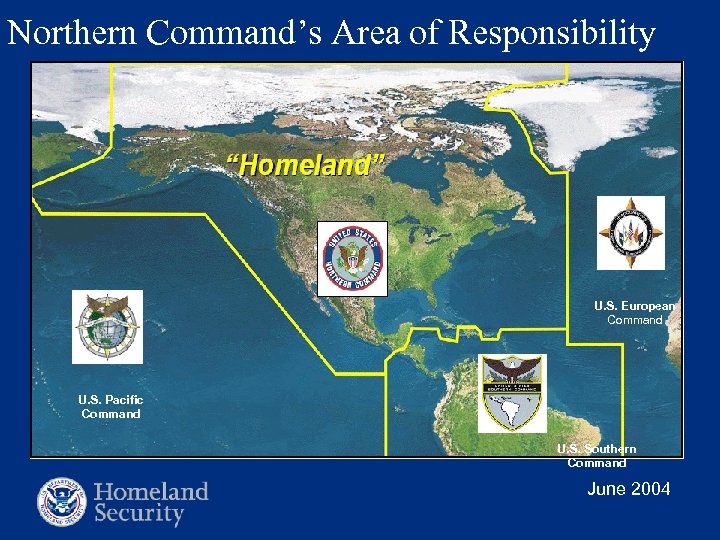 Northern Command’s Area of Responsibility U. S. European Command U. S. Pacific Command U. S. Southern Command June 2004
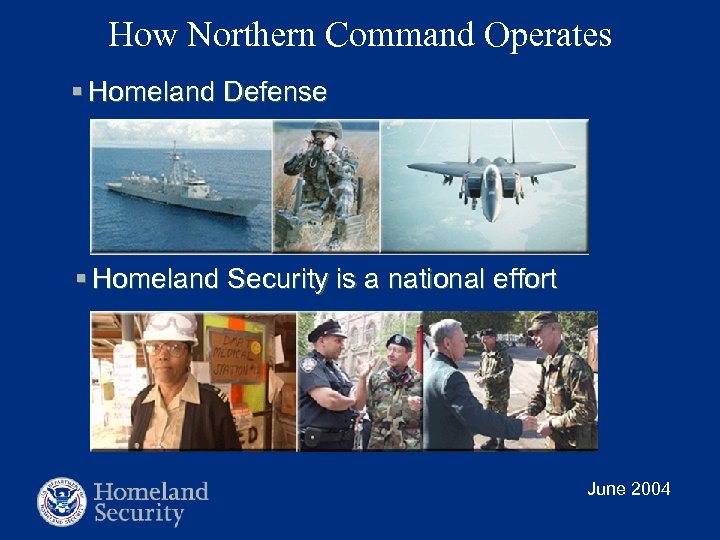 How Northern Command Operates § Homeland Defense § Homeland Security is a national effort June 2004
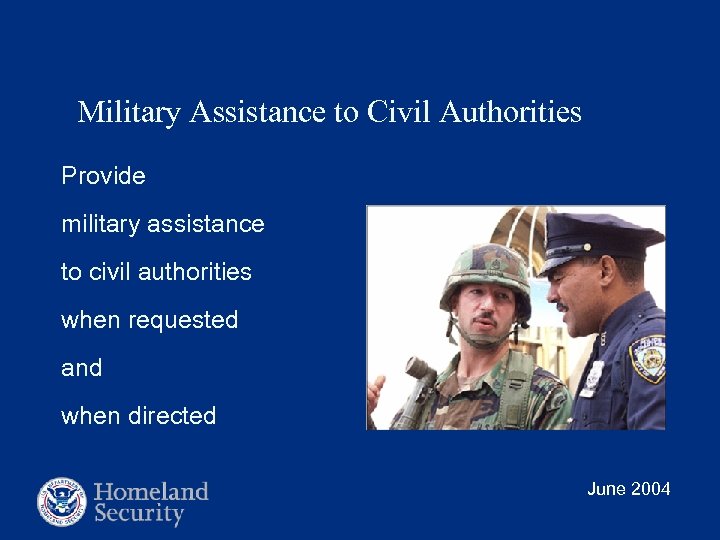 Military Assistance to Civil Authorities Provide military assistance to civil authorities when requested and when directed June 2004
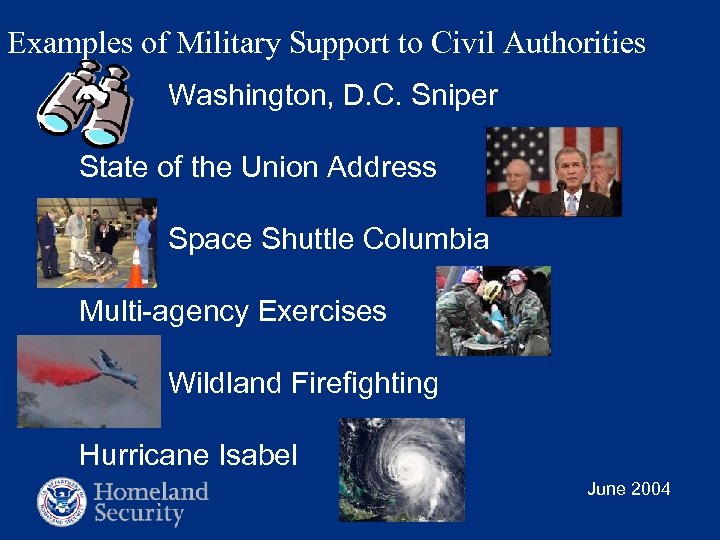 Examples of Military Support to Civil Authorities Washington, D. C. Sniper State of the Union Address Space Shuttle Columbia Multi-agency Exercises Wildland Firefighting Hurricane Isabel June 2004
 NC Joint Interagency Coordination Mission Statement Set the conditions for operational success by integrating and synchronizing activities with multiple national and international agencies and departments to ensure mutual understanding and unity of effort across the full spectrum of operations. Goals: • Provide timely, usable information and advice to the Commander, NORAD/USNORTHCOM and other Senior Decision-makers. − Information Sharing − Integration and Synchronization − Training and Exercising June 2004
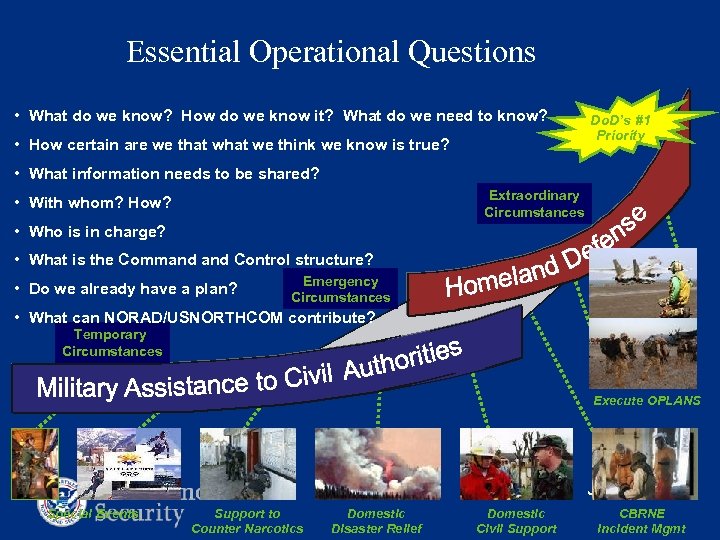 Essential Operational Questions • What do we know? How do we know it? What do we need to know? • How certain are we that we think we know is true? Do. D’s #1 Priority • What information needs to be shared? Extraordinary Circumstances • With whom? How? • Who is in charge? • What is the Command Control structure? • Do we already have a plan? Emergency Circumstances • What can NORAD/USNORTHCOM contribute? Temporary Circumstances Execute OPLANS June 2004 Special Events Support to Counter Narcotics Domestic Disaster Relief Domestic Civil Support CBRNE Incident Mgmt
 NC Joint Interagency Coordination Challenges • Development of a Common Operating Picture (COP) • Planning Interagency integration and mutual support for Do. D (e. g. Determined Promise and United Defense) and Non-Do. D training and exercises • Fully integrated and coordinated planning • Refinement of JIAC operational capabilities in line with the Assistant Secretary of Defense for Homeland Defense and Department of Homeland Security as USNORTHCOM moves beyond Full Operational Capability. June 2004
 US Northern Command’s Challenges § Missile Defense § Maritime Interception Operations § CONPLAN 2002 § Organizational Refinements § Relationships with Homeland Defense and Homeland Security Partners § Total Force Integration § Anti-Terrorism / Force Protection § Critical Infrastructure Protection § Theater Security Cooperation § Situational Awareness Improvements June 2004
 Current National Priorities § Implement Homeland Security Presidential Directive– 5 by integrating national disaster response teams and systems as a key component of the National Response Plan and National Incident Management System § Develop 4 fully functional, self-contained, rapid deployment Incident Management Teams § Develop the capability for 12 -hour arrival time anywhere in the U. S. by specialized disaster response teams § Develop capability to provide 24 -hour arrival time anywhere in the U. S. for needed equipment and commodities support June 2004
 Current National Priorities § Develop the capacity to provide emergency housing within 60 days for 100, 000 people following major disasters § Complete catastrophic and weapons of mass destruction plans for 25 of the nation’s highest risk jurisdictions, including tactical elements to ensure coordinated operations, logistics, and support § Work with State and local governments more proactively to improve disaster planning and response coordination, interaction, and understanding § Increase casualty evacuation capacity to 2, 000 patients per day using resources within the military, civilian and private sectors June 2004
 Questions?