 Скачать презентацию City Tour Tbilisi 35 lari Freedom Square
City Tour Tbilisi 35 lari.pptx
- Количество слайдов: 9



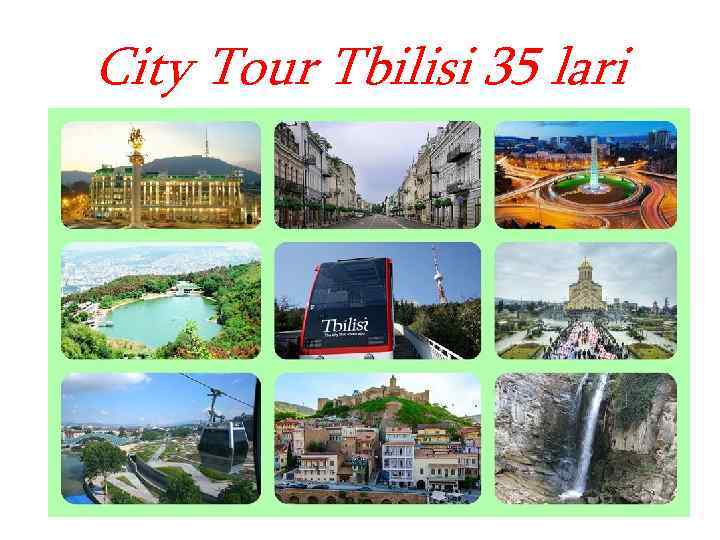
City Tour Tbilisi 35 lari
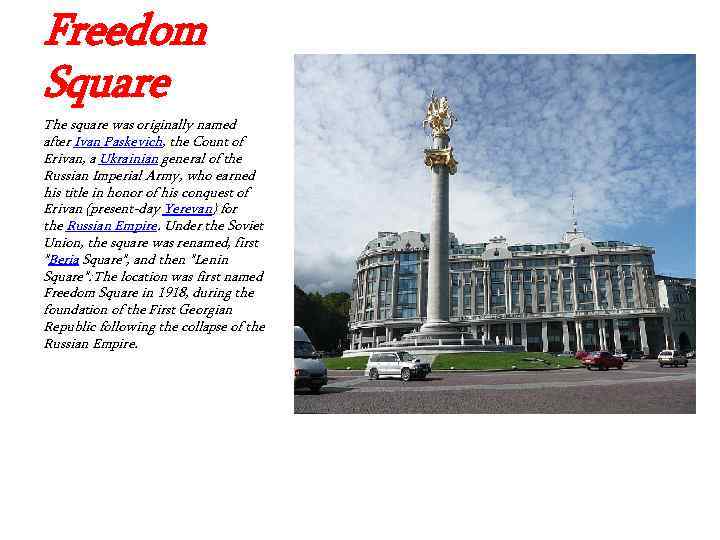
Freedom Square The square was originally named after Ivan Paskevich, the Count of Erivan, a Ukrainian general of the Russian Imperial Army, who earned his title in honor of his conquest of Erivan (present-day Yerevan) for the Russian Empire. Under the Soviet Union, the square was renamed, first "Beria Square", and then "Lenin Square". . The location was first named Freedom Square in 1918, during the foundation of the First Georgian Republic following the collapse of the Russian Empire.
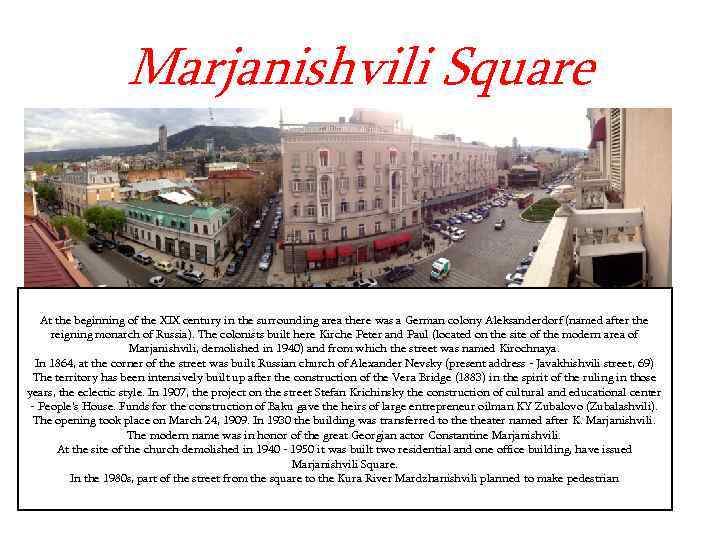
Marjanishvili Square At the beginning of the XIX century in the surrounding area there was a German colony Aleksanderdorf (named after the reigning monarch of Russia). The colonists built here Kirche Peter and Paul (located on the site of the modern area of Marjanishvili, demolished in 1940) and from which the street was named Kirochnaya. In 1864, at the corner of the street was built Russian church of Alexander Nevsky (present address - Javakhishvili street, 69) The territory has been intensively built up after the construction of the Vera Bridge (1883) in the spirit of the ruling in those years, the eclectic style. In 1907, the project on the street Stefan Krichinsky the construction of cultural and educational center - People's House. Funds for the construction of Baku gave the heirs of large entrepreneur oilman KY Zubalovo (Zubalashvili). The opening took place on March 24, 1909. In 1930 the building was transferred to theater named after K. Marjanishvili. The modern name was in honor of the great Georgian actor Constantine Marjanishvili. At the site of the church demolished in 1940 - 1950 it was built two residential and one office building, have issued Marjanishvili Square. In the 1980 s, part of the street from the square to the Kura River Mardzhanishvili planned to make pedestrian
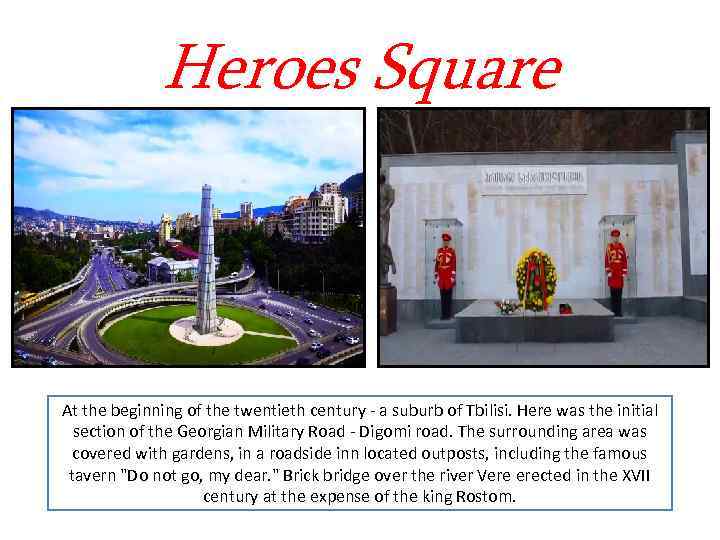
Heroes Square At the beginning of the twentieth century - a suburb of Tbilisi. Here was the initial section of the Georgian Military Road - Digomi road. The surrounding area was covered with gardens, in a roadside inn located outposts, including the famous tavern "Do not go, my dear. " Brick bridge over the river Vere erected in the XVII century at the expense of the king Rostom.
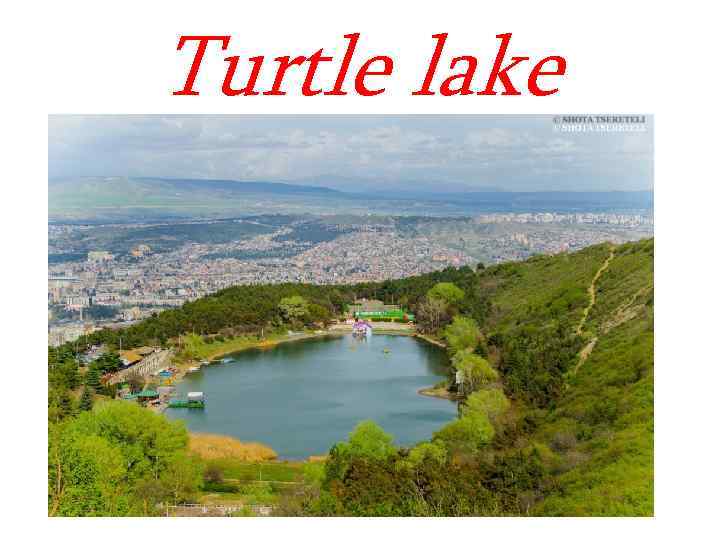
Turtle lake
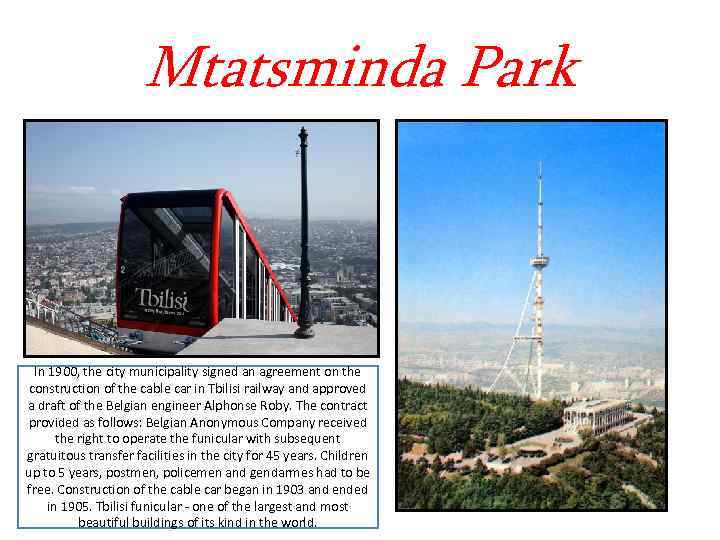
Mtatsminda Park In 1900, the city municipality signed an agreement on the construction of the cable car in Tbilisi railway and approved a draft of the Belgian engineer Alphonse Roby. The contract provided as follows: Belgian Anonymous Company received the right to operate the funicular with subsequent gratuitous transfer facilities in the city for 45 years. Children up to 5 years, postmen, policemen and gendarmes had to be free. Construction of the cable car began in 1903 and ended in 1905. Tbilisi funicular - one of the largest and most beautiful buildings of its kind in the world.
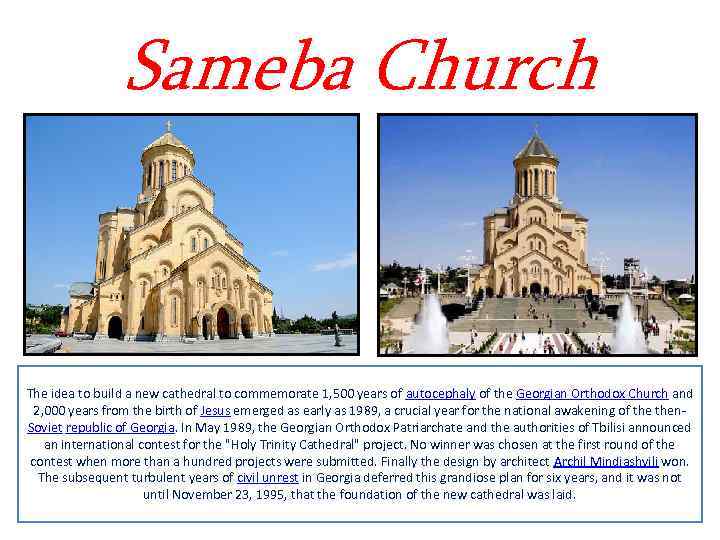
Sameba Church The idea to build a new cathedral to commemorate 1, 500 years of autocephaly of the Georgian Orthodox Church and 2, 000 years from the birth of Jesus emerged as early as 1989, a crucial year for the national awakening of then. Soviet republic of Georgia. In May 1989, the Georgian Orthodox Patriarchate and the authorities of Tbilisi announced an international contest for the "Holy Trinity Cathedral" project. No winner was chosen at the first round of the contest when more than a hundred projects were submitted. Finally the design by architect Archil Mindiashvili won. The subsequent turbulent years of civil unrest in Georgia deferred this grandiose plan for six years, and it was not until November 23, 1995, that the foundation of the new cathedral was laid.
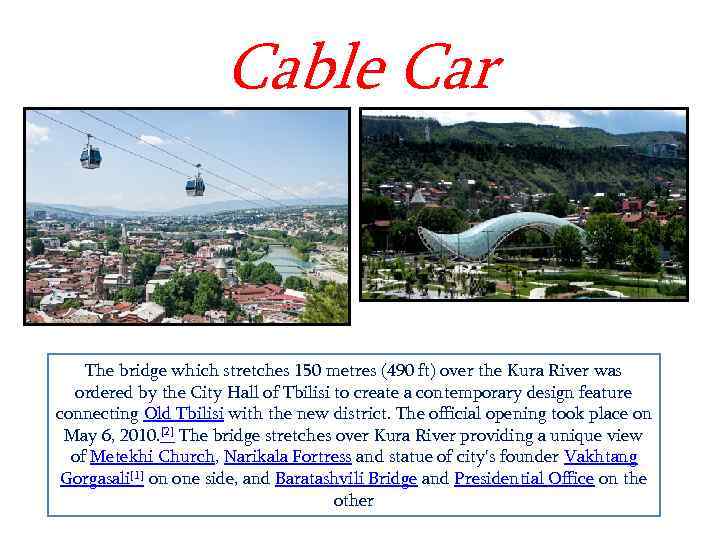
Cable Car The bridge which stretches 150 metres (490 ft) over the Kura River was ordered by the City Hall of Tbilisi to create a contemporary design feature connecting Old Tbilisi with the new district. The official opening took place on May 6, 2010. [2] The bridge stretches over Kura River providing a unique view of Metekhi Church, Narikala Fortress and statue of city's founder Vakhtang Gorgasali[1] on one side, and Baratashvili Bridge and Presidential Office on the other
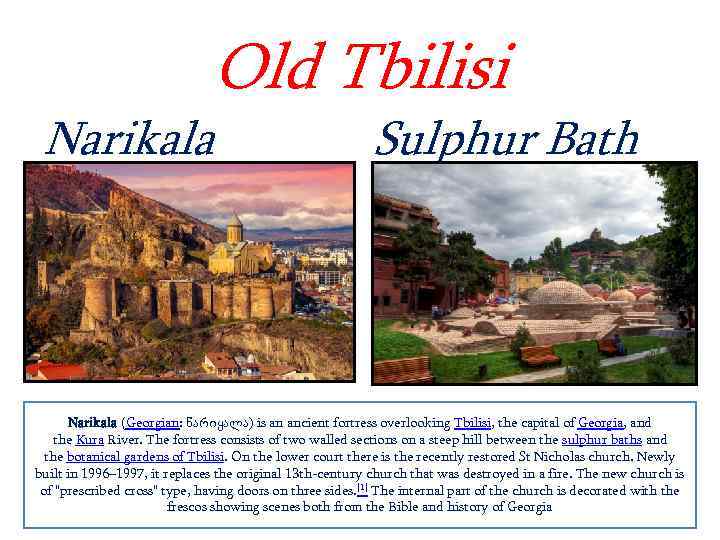
Narikala Old Tbilisi Sulphur Bath Narikala (Georgian: ნარიყალა) is an ancient fortress overlooking Tbilisi, the capital of Georgia, and the Kura River. The fortress consists of two walled sections on a steep hill between the sulphur baths and the botanical gardens of Tbilisi. On the lower court there is the recently restored St Nicholas church. Newly built in 1996– 1997, it replaces the original 13 th-century church that was destroyed in a fire. The new church is of "prescribed cross" type, having doors on three sides. [1] The internal part of the church is decorated with the frescos showing scenes both from the Bible and history of Georgia
Скачать презентацию City Tour Tbilisi 35 lari Freedom Square
City Tour Tbilisi 35 lari.pptx