 Скачать презентацию Citizen Participation USP 550 www Bowling Alone
95efed0091e78a743f3050320e47ed72.ppt
- Количество слайдов: 166



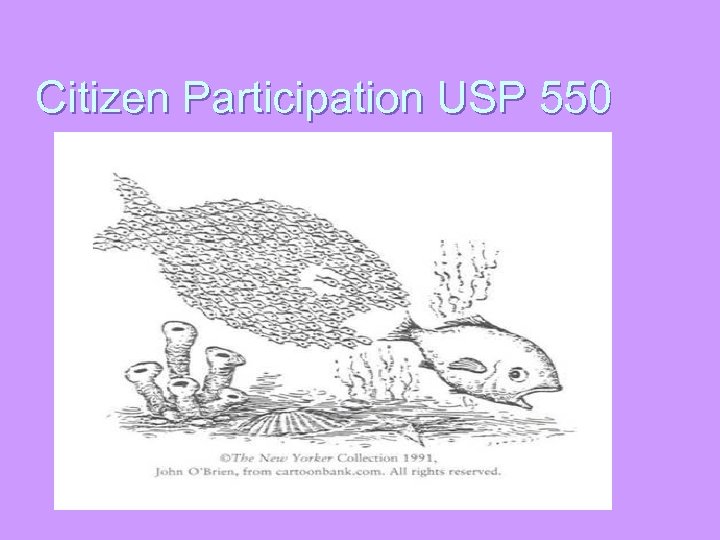
Citizen Participation USP 550
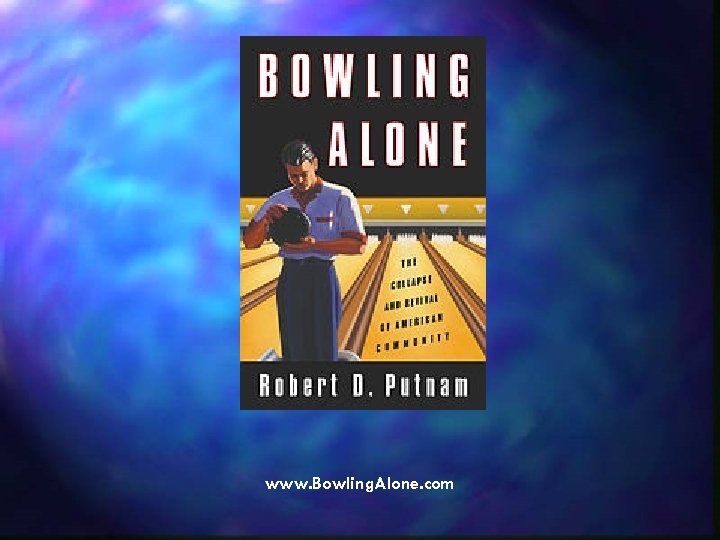
www. Bowling. Alone. com
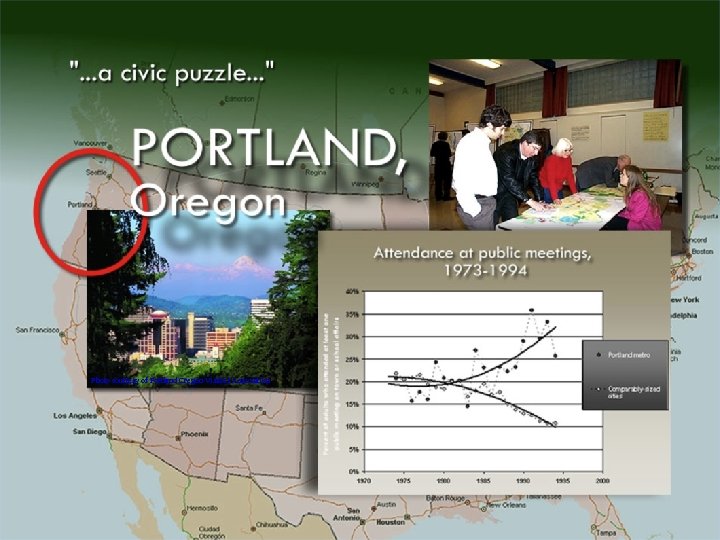
Photo courtesy of Portland Oregon Visitors Association
Civic Innovation: Symbiotic Relation Between Citizens and Leaders
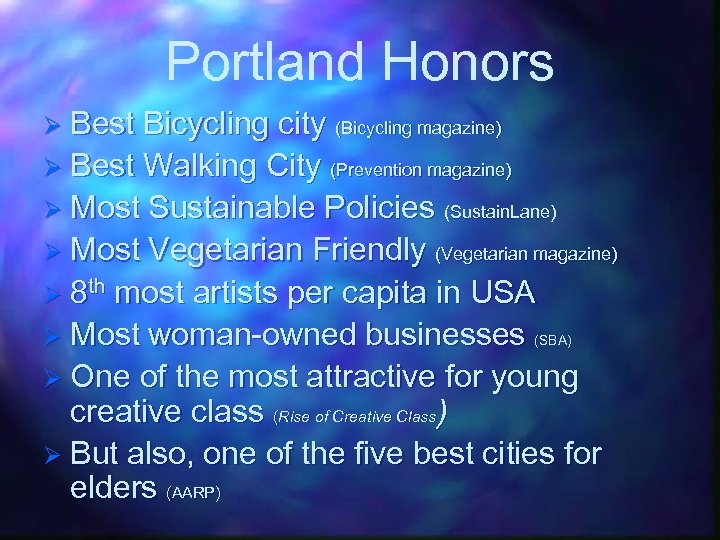
Portland Honors Ø Best Bicycling city (Bicycling magazine) Ø Best Walking City (Prevention magazine) Ø Most Sustainable Policies (Sustain. Lane) Ø Most Vegetarian Friendly (Vegetarian magazine) Ø 8 th most artists per capita in USA Ø Most woman-owned businesses (SBA) Ø One of the most attractive for young creative class (Rise of Creative Class) Ø But also, one of the five best cities for elders (AARP)
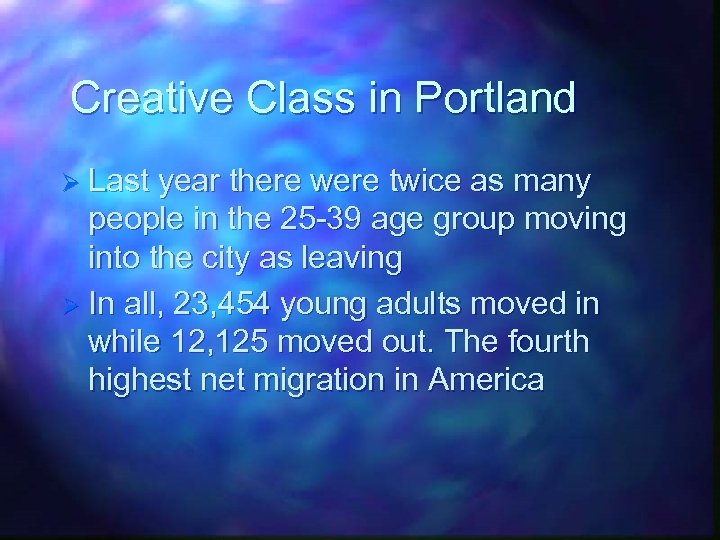
Creative Class in Portland Ø Last year there were twice as many people in the 25 -39 age group moving into the city as leaving Ø In all, 23, 454 young adults moved in while 12, 125 moved out. The fourth highest net migration in America
What lures the young creatives to Portland Ø Ø key attractors are Portland's livability, local recreation opportunities, the music and art scenes and other "consumption opportunities, " for instance, wellbrewed beer. A primary draw of college-educated 25 - to 34 -yearolds is other college educated 25 - to 34 -years-olds. Also mentioned are the city's neighborhoods, mass transit system, bike-friendliness and growth management policies. But the deciding factor is often a more intangible sense of political and social tolerance, intellectual diversity and entrepreneurial opportunity.
Portland’s Civic Story Ø Over 30 year period Portland created a civic story, in part myth, in part reality Ø It dictates civic behavior Ø Citizens expect to be involved Ø Bureaucrats and elected officials expect citizens to be involved.
Summary: Community Stories Ø Ø Ø Community stories are created based on the interaction between the place and its people But community stories are also co-opted by dominate cultural narratives A good community story is socially, environmentally, and economically sustainable Citizens need to feel they are a part of creating the story so that the cost of governance is lowered.
Working Together Ø Ø Ø De. Toqueville accurately predicted that America would face a crises. If people did not work together to solve problems then the government would need to create more and more rules, more and more bureaucracy. The most expensive governance involves governing individuals who only look out for themselves Many social and environmental problems can’t be solved without civic engagement
Community Problem Solving: hardware and software solutions
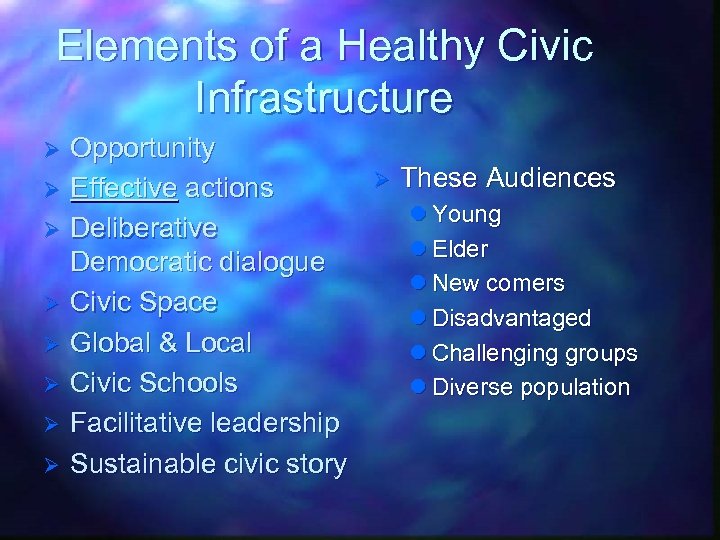
Elements of a Healthy Civic Infrastructure Ø Ø Ø Ø Opportunity Effective actions Deliberative Democratic dialogue Civic Space Global & Local Civic Schools Facilitative leadership Sustainable civic story Ø These Audiences l Young l Elder l New comers l Disadvantaged l Challenging groups l Diverse population
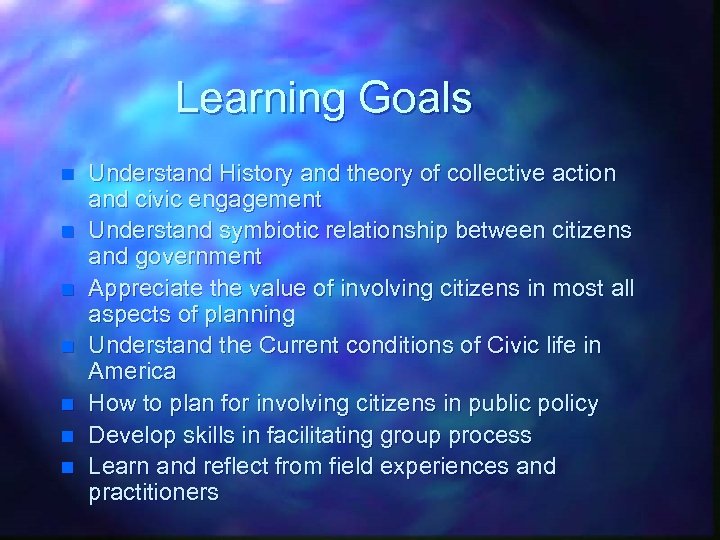
Learning Goals n n n n Understand History and theory of collective action and civic engagement Understand symbiotic relationship between citizens and government Appreciate the value of involving citizens in most all aspects of planning Understand the Current conditions of Civic life in America How to plan for involving citizens in public policy Develop skills in facilitating group process Learn and reflect from field experiences and practitioners
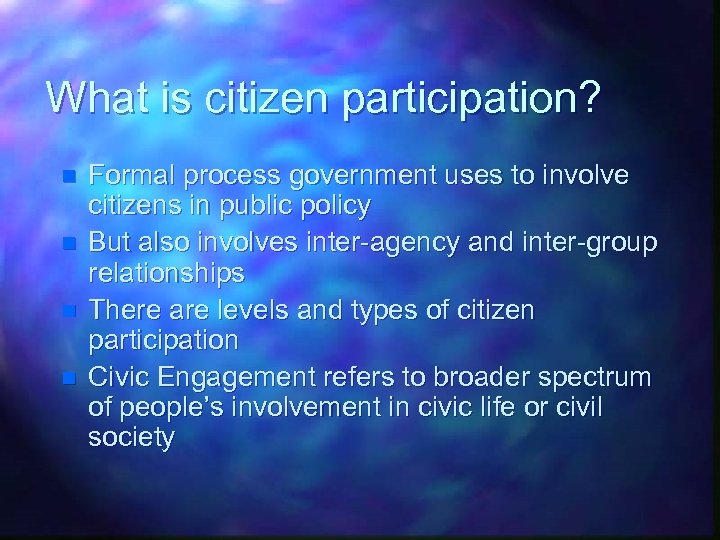
What is citizen participation? n n Formal process government uses to involve citizens in public policy But also involves inter-agency and inter-group relationships There are levels and types of citizen participation Civic Engagement refers to broader spectrum of people’s involvement in civic life or civil society
Bureaucratic view of Citizen Participation n n n n Improved Quality of decisions Minimizing Cost and delay Long Term Consensus Building Increased ease of implementation Avoiding “worst-case” confrontations Maintaining credibility and legitimacy Anticipating Public Concerns and Attitudes Because its required
Citizen Participation (Sherry Arnstein) n It is the redistribution of power that enables the havenot citizens, presently excluded from the political and economic processes, to be deliberately included in the future. It is the strategy by which the have-nots join in determining how information is shared, goals and policies are set, tax resources are allocated, programs are operated, and benefits like contracts and patronage are parceled out. In short, it is the means by which they can induce significant social reform which enables them to share in the benefits of the affluent society.
Summary Theoretical Writings n n n Sidney Tarrow: Social movements De. Tocqueville: Roots of American democracy Daniel Kemmis: Direct and Representative forms of democracy Jeffrey Berry: Growth of citizen interest groups Robert Putnam: Civic engagement and social capital Siranni and Friedland: Civic innovations Morris Fiorina: excesses of democracy Fischer: intractable problems and role of science Day: How to evaluate citizen participation Tauxe: Limits of rational planning process Beatley: Representation Innes: communicative planning theory

First Premise n Knowing Home
The Story of Portland Why is Portland where it is? n What is Portland’s civic story? n Where did the story come from? n Is the story created by insiders or outsiders? n Is the story sustainable? (socially, economically, environmentally) n
Knowing your home In group answer as many of questions as you can in ten minutes n Do musical chairs/groups, in new group come up with 10 characteristics of Portland culture n
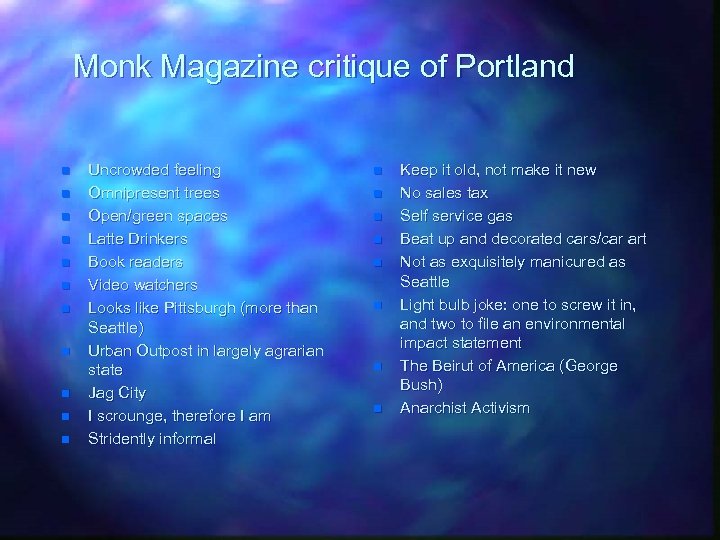
Monk Magazine critique of Portland n n n Uncrowded feeling Omnipresent trees Open/green spaces Latte Drinkers Book readers Video watchers Looks like Pittsburgh (more than Seattle) Urban Outpost in largely agrarian state Jag City I scrounge, therefore I am Stridently informal n n n n Keep it old, not make it new No sales tax Self service gas Beat up and decorated cars/car art Not as exquisitely manicured as Seattle Light bulb joke: one to screw it in, and two to file an environmental impact statement The Beirut of America (George Bush) Anarchist Activism
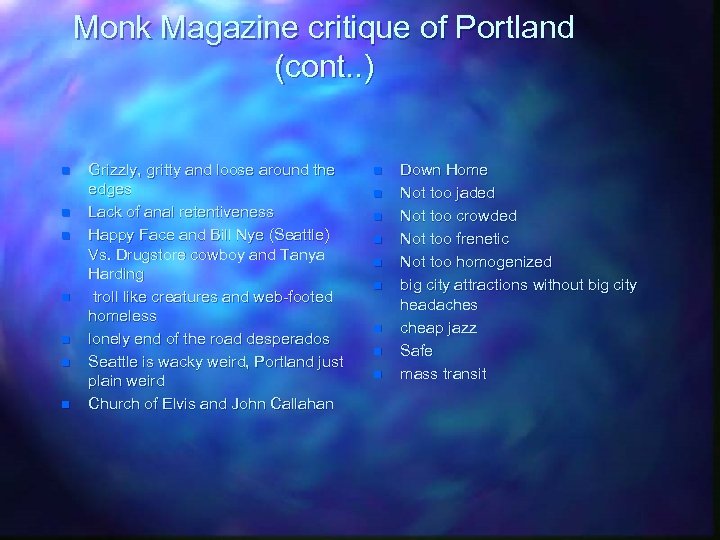
Monk Magazine critique of Portland (cont. . ) n n n n Grizzly, gritty and loose around the edges Lack of anal retentiveness Happy Face and Bill Nye (Seattle) Vs. Drugstore cowboy and Tanya Harding troll like creatures and web-footed homeless lonely end of the road desperados Seattle is wacky weird, Portland just plain weird Church of Elvis and John Callahan n n n n Down Home Not too jaded Not too crowded Not too frenetic Not too homogenized big city attractions without big city headaches cheap jazz Safe mass transit
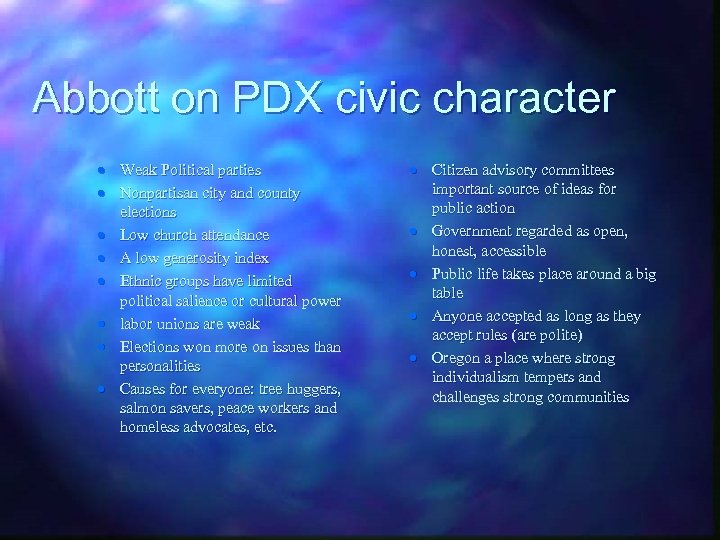
Abbott on PDX civic character · Weak Political parties · Nonpartisan city and county elections · Low church attendance · A low generosity index · Ethnic groups have limited political salience or cultural power · labor unions are weak · Elections won more on issues than personalities · Causes for everyone: tree huggers, salmon savers, peace workers and homeless advocates, etc. · Citizen advisory committees important source of ideas for public action · Government regarded as open, honest, accessible · Public life takes place around a big table · Anyone accepted as long as they accept rules (are polite) · Oregon a place where strong individualism tempers and challenges strong communities
Abbott Cont. . · The civic movement is fragile. It is continually under challenge-not from machine politics as in Boston or Chicago, but from the values of privatism. · With all its virtues, the Portland style tends to muffle radically dissenting voices who are unwilling to work on the “team. ” There is an inability to hear new ideas until they fit the mold.
Portland Neighborhoods n Neighborhood map
What forges the character of a neighborhood? n n n n Land Water Elevation Housing stock Transportation Jobs Income Martial/family status n n n Ethnicity Business & business district Schools Churches History

January 14, 2009
Housekeeping Reserve library material n Negotiating requirements of class n
What is citizen participation? n n Formal process government uses to involve citizens in public policy But also involves inter-agency and inter-group relationships There are levels and types of citizen participation Civic Engagement refers to broader spectrum of people’s involvement in civic life or civil society
Bureaucratic view of Citizen Participation n n n n Improved Quality of decisions Minimizing Cost and delay Long Term Consensus Building Increased ease of implementation Avoiding “worst-case” confrontations Maintaining credibility and legitimacy Anticipating Public Concerns and Attitudes Because its required
Citizen Participation (Sherry Arnstein) n It is the redistribution of power that enables the havenot citizens, presently excluded from the political and economic processes, to be deliberately included in the future. It is the strategy by which the have-nots join in determining how information is shared, goals and policies are set, tax resources are allocated, programs are operated, and benefits like contracts and patronage are parceled out. In short, it is the means by which they can induce significant social reform which enables them to share in the benefits of the affluent society.
Tarrow: Power in Movement
What is a Social Movement? n movements are collective challenges by people with common purposes and solidarity in sustained interaction with elites, opponents and authorities
Tarrow: Changes that Constitutes Modern Forms of Collective Action n n Modular character of the protest/collective actions Possibility of sustaining collective action Appearance of deliberate organizations for organizing Increased capacity of movements to spread State or elite incorporate or legitimize actions: such as right to public assembly
Development of Modular Actions n n n Older forms singular/isolated Barricades, Petitions, Strike Petition: Manchester Anti-slavery, 20% of city population American tea party: The boycott Barricades of the French revolution, Tocqueville’s description (p. 44)
Resource Theory of Social Movements n social movements form when ordinary citizens, encouraged by leaders, respond to changes in opportunities that lower the costs of collective action, reveal potential allies and show where elites and authorities are vulnerable
Case Study: Gay march on DC
De. Tocqueville’s America n n Viewing birth of democracy, wondering: As people can no longer be self sufficient where will they turn? If people turn to government then society will be more regulated and restrictive Importance of civic associations to keep a democracy innovative and not overprocedural

January 21
Summary Theoretical Writings n n n Sidney Tarrow: Social movements De. Tocqueville: Roots of American democracy Daniel Kemmis: Direct and Representative forms of democracy Jeffrey Berry: Growth of citizen interest groups Robert Putnam: Civic engagement and social capital Siranni and Friedland: Civic innovations Morris Fiorina: excesses of democracy Fischer: intractable problems and role of science Day: How to evaluate citizen participation Tauxe: Limits of rational planning process Beatley: Representation Innes: communicative planning theory
Kemmis: Character of American Democracy Tension between Federalist and Republican perspective on democracy n In America the individual rights are held higher than creating the common good n Concerned more to promote individual liberty than to secure public justice n To advance interests rather than to secure public good n
Interest Groups n Special-interest groups--also called pressure groups or lobbies --are collections of individuals who join together to pursue common interests and to influence public policy.
Institutional changes that Furthered Citizen Interest Groups n n n Growth of government itself until Reagan days Closer relation between government and nonprofit sector including advocacy groups “supply side” to interest group formation; not only do groups demand new programs but new programs demand new groups. New government agencies and laws that gave citizen groups tools (EPA and EIS/Clean air and Water Acts) Changes in court system that allowed public interest litigants to sue without direct economic causes. 30 Decentralization of congress in terms of increase in committees gave such groups wider access.
Post-materialist Values n n Those with postmaterialist values often ask that business be restricted in its pursuit of greater wealth in Silent Revolution, Inglehart contends that growing up under conditions of affluence has led to an increased sense of economic security in western democracies. So Europeans place a higher value on quality of life issues. Less concern about jobs, more about policy objectives.
Citizen Group Perspective on Role of Government n n n for corporations, trade associations, and professional associations, government’s primary duty is to nurture individual industries and maintain a growing economy For labor, government’s job is to improve workers’ standard of living for citizen groups, government should be doing more than helping people and corporations to make more money.
History of Citizen Participation Maximum feasible participation (60 s) n Environmental Impact Reviews (69) n Citizen Interest Groups n Public Meeting & Public Information laws n Rise of nonprofit sector n Rise of professional CP practitioners n
Diane Day Issues Pluralist-elitist debate (Jefferson-Madison) n Bureaucracy and democracy tension n Science and technology n Limits of rational system of planning n Difficulty of evaluating outcomes n
Bureaucracy and Democracy n That the interests of citizens are brought to the public table via the electoral system, and yet the actions that result from electoral dictates are carried out by bureaucrats working within a specialized, departmentalized bureaucracy.
Weber described the ideal bureaucracy designed to maximize values of: Efficiency n Routine n Hierarchical Authority n Expertise n Impersonality n
Tensions between Rational Planning and Democratic Values n n n Democratic forums inclusive while planning is selective Public gets excluded because of specialist language Democratic forums cumbersome, planning demands flexibility and speed Scientific knowledge alone can not determine values questions Planners in contradiction space: citizens demand flexibility and routine and equality
Understanding Putnam
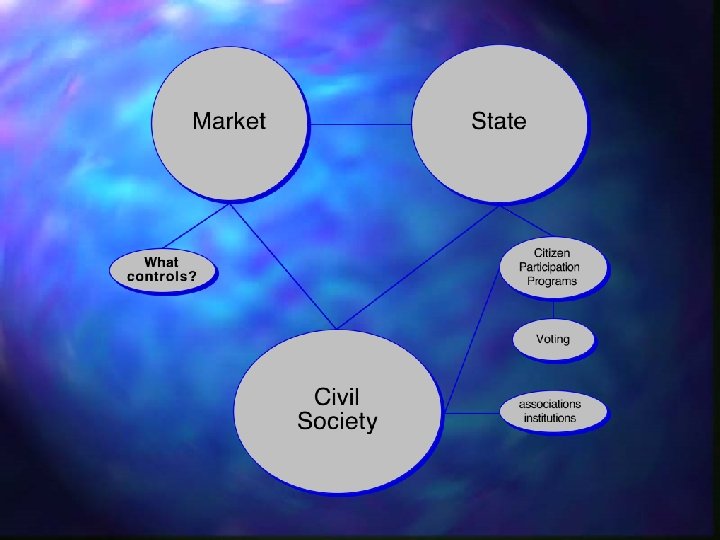
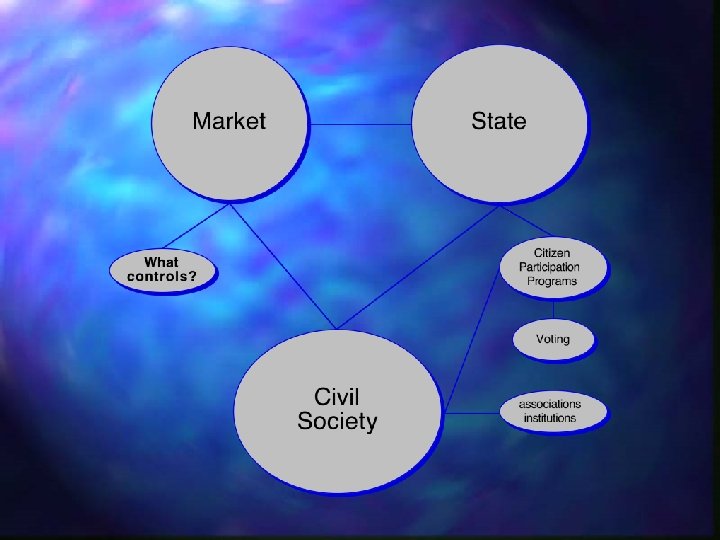
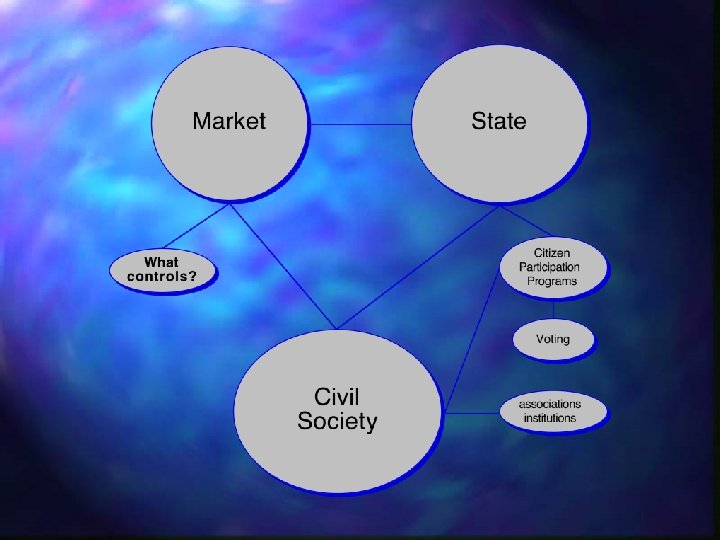
What is civil society? n Civil society is the domain that can potentially mediate between the state and private sectors and offer people a space for activity that is simultaneously voluntary and public. It is a space that unites the virtue of the private sector--liberty--with the virtue of the public sector--concern for the general good. That is, it is public without being coercive or bureaucratic and voluntary without being privatized or commercial.
What is social capital? n According to Coleman, social capital is not human capital, anymore than it is economic capital. "It is present, " he said, "and yet not tangible, in all social interactions. " Social capital, according to Coleman, "comes about through changes in the relations among persons that facilitate action. If physical capital is wholly tangible, being embodied in observable material form, and human capital is less tangible, being embodied in the skills and knowledge acquired by an individual, social capital is less tangible yet, for it exists in the relations among persons. "
What is social capital? Ø Ø If physical capital is wholly tangible, being embodied in observable material form, and human capital is less tangible, being embodied in the skills and knowledge acquired by an individual, social capital is less tangible yet, for it exists in the relations among persons. Example, a park that is safe in a neighborhood vs. having to secure it with police
Bourdieu’s: Inherited Social (class definition) n Bourdieu defined social capital as "the sum of the resources, actual or virtual, that accrue to an individual or group by virtue of possessing a durable network of more or less institutionalized relations of mutual acquaintance and recognition. "
Portes’ Immigrant Community Studies n n n Portes’ definition: those expectations for action within a collective that affect the economic goals and goal-seeking behavior of its members, even if these expectations are not oriented toward the economic sphere Four types of transactions value interjection: Culture norms Reciprocity transactions: chits Bounded solidarity: often created through adversity/external affects Enforceable trust: internal to community, more specific and enforceable (credit associations)
Strong and Weak Ties Difference between bridging (or inclusive) and bonding (or exclusive) social capital n Bonding capital constitutes a kind of sociological super-glue, whereas bridging social capital provides a sociological WD-40 n
Putnam’s definition n n Putnam defines social capital as "networks, norms, and trust-that enable participants to act together more effectively to pursue shared objectives. " The actions or objectives of social capital can be political, social or economic. ” One of Putnam's central premise is that one can assess the health of a civil society, the levels and types of civic engagement, by examining the social capital elements of the relationships between people.
Civic engagement and Trust n A society characterized by generalized reciprocity is more efficient than a distrustful society, for the same reason that money is more efficient than barter. if we don’t have to balance every exchange instantly, we can get a lot more accomplished. Trustworthiness lubricates social life. Frequent interaction among a diverse set of people tends to produce a norm of generalized reciprocity. Civic engagement and social capital entail mutual obligation and responsibility for action.
Factors Putnam noted at first Falling voting levels n Falling trust between individuals and government n Relationship between civic engagement and social capital n
Character of Today’s Civic Participation n n the more that activities depend on the actions of others, the greater the drop-off in participation. in other words cooperative forms of behavior have declined more rapidly than expressive forms of behavior (e. g. letter writing) There is more single issue blare and declining civility. In 1966, 66 percent of Americans rejected the view that “the people running the country don’t really care what happens to you; ” whereas in 1997, 57 percent of Americans endorsed that same view.
AVERAGE MEMBERSHIP RATE IN 32 NATIONAL CHAPTERBASED VOLUNTARY ASSOCIATIONS 1900 -1997 Mean membership rate for the 20 th century
ATTENDANCE AT PUBLIC MEETINGS ON LOCAL AFFAIRS COLLAPSES

ENTERTAINING AT HOME BECOMES RARER 1975 -1999 Average times entertained at home last year
FAMILY DINNERS BECOME LESS COMMON 1977 -1999 “Our whole family usually eats dinner together. ” (married respondents only)
FOUR DECADES OF DWINDLING TRUST-ADULTS AND TEENAGERS 1960 -1999 Percent Who say “most people can be trusted” instead of you can’t be too careful in dealing with people. ”
Putnam’s Assessment of social capital and civic engagement decline
Social connectedness n n n n n decline in social visiting More entertaining at home Less eating dinner together Less vacationing together Less watching TV together Less just sitting and talking Less attending religious services Less Sending greeting cards Card playing down
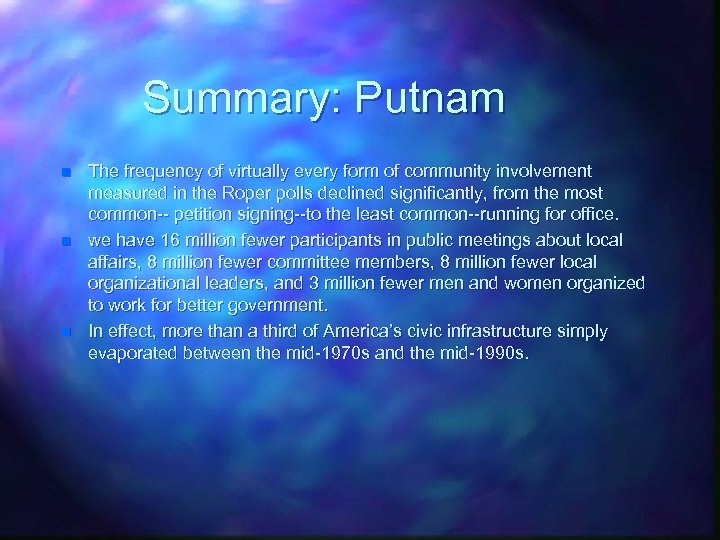
Summary: Putnam n n n The frequency of virtually every form of community involvement measured in the Roper polls declined significantly, from the most common-- petition signing--to the least common--running for office. we have 16 million fewer participants in public meetings about local affairs, 8 million fewer committee members, 8 million fewer local organizational leaders, and 3 million fewer men and women organized to work for better government. In effect, more than a third of America’s civic infrastructure simply evaporated between the mid-1970 s and the mid-1990 s.
Putnam’s Assessment of social capital and civic engagement decline

The Portland Exception
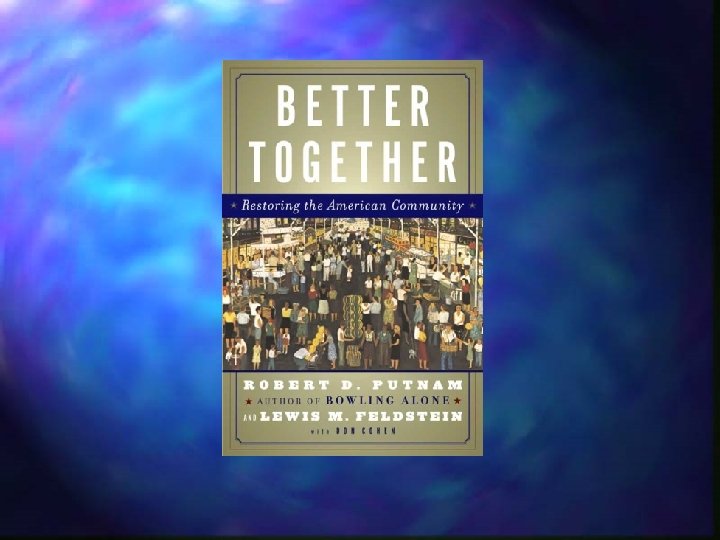
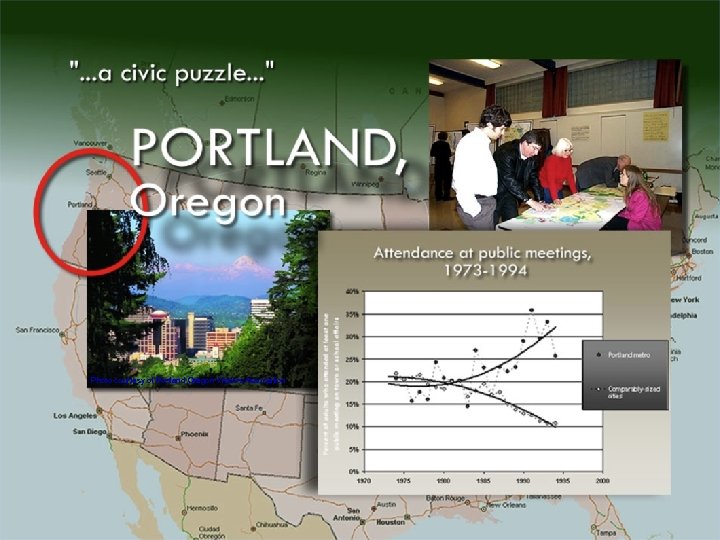
Photo courtesy of Portland Oregon Visitors Association
Extreme Voices: Fiorina n Citizen participation has increased but encouraged extreme voices and mistrust of government
His conclusion from case study n Civic engagement can be expected to have good consequences only if those engaged are representative of the interest and values of the larger community. That is true by definition if everyone is engaged, but when engagement is largely the domain of minority viewpoints, obvious problems of unrepresentativeness arise.
Idealism n n n today’s activism is more ideologically based, and players less likely to compromise values for material benefits as they were in the past because people had multiple memberships they were subject to cross-pressures that led them to moderate their stands Ordinary people not represented Extremists with uncompromising views bring their own issues to the table not the people’s those willing to compromise polices in order to control offices, jobs, and other tangible benefits have been replaced by those who are motivated largely by policy and ideological commitments.
What to do n n n More not less participation Town hall meetings too costly it is time to abandon the notion of political participation as part of human nature. It is not; it is an unnatural act So make the cost of participation less, rely on “swarm” intelligence Shown that ordinary people not any less informed than activists

January 28, 2009
Civic Innovation: Sirianni
Dialogue Innovations Appreciative inquiry n Beneficiary assessment n Citizen juries n National issue forums n Participatory action research n Participatory rural appraisal n Study circles n
Fischer n Role of science and technology in solving social problems
Science as Social Control n Foucalt argues that the language and vocabulary of science constructs a political universe. He contends that knowledge and power is built into the methodology of disciplines, and that instead of being a neutral force for discovering truth, science can be used to legitimate social control.
Examples of the types of problems that defy Easy Solutions n n n n n Quality, cost and accountability in education Quality, cost and accountability in health care Reduction and/or disposal of solid waste Crime and the related issues of drugs and guns Restructuring of the economy (and resulting unemployment) Public sector debt Deterioration of the infrastructure Welfare reform Clean Rivers
Community Problem Solving: hardware and software solutions
Participation Techniques for Resolving the conflicts n n Dispute Resolution and conflict management Co-production of Methods, data, and public policy Changing basic relation: Citizen and expert New contractual relations (Good neighbor agreements)
The Austin Plan Analysis n Three forms of Representation n Descriptive representative--the extent to which individual participation is descriptively similar to the larger groups they are intended to represent (demographic)
Forms of representation Cont. n Trustee representation--the assumption that participants will apply independent judgment, and act according to conscience, while also considering what they have learned during deliberations. (representing the common good, or extension of government, most federalist in approach. ) n Opinion representation--also referred to as “delegate” form of representation: The extent to which participant opinions are similar to those of the larger group), regardless of demographic, that they are in touch with the neighborhood and represent in effect an opinion poll of the neighborhood

Tauxe
Moralistic vs. Rational way of doing business (Tauxe) n while the technocratic rhetoric relied on the ideological power of the language of science, system, and expertise, the local rhetorical conventions relied on invocations of individualism--both the laissez-faire values of business and industry, and the rights of residents to resist the authority of planners, zoning ordinances, public utility commissioners, or anyone else interfering with the personal freedom in land use
Who won? Who lost? Bureaucratic style was a requisite tool n Local people who adapted fared better than those that didn’t n Does a more mobile and diverse society demand rationalistic planning methods? n
Tauxe asks: can planning be a truly community based process? To be so it must not only democratize formal institutions and procedures but also make room for nonbureaucratic discourse and organizational form. n Which leads to Communicative Planning theory n
Innes: Communicative Planning
Innes: Comunicative Planning Method n The communicative perspective represents a shift from a view widely held over at least the last 30 years, that the planner’s job is mainly to deliver unbiased, professional advice and analysis to elected officials and the public who in turn make decisions.
Issues in planning in practice Innes speaks to knowledge utilization n The planning process is not neat and tidy n Neutrality of science in doubt n NIMBY/Policy gridlock n “wicked problems” n
Communicative Planning Model Knowledge that is embedded in social structure n Co-producing intellectual capital n The Value of Many kinds of information n New forms of consensus (Bricolage) n Repeat after me: I will learn as much from those I am “serving” as from those I “serve” n
Bricolage n make creative and resourceful use of whatever materials are at hand

February 4, 2009
Introduction: Planning Process
Levels of decision making
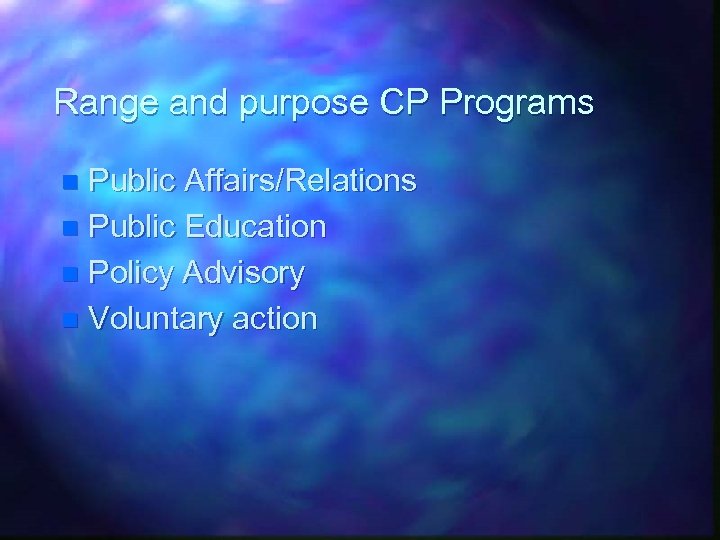
Range and purpose CP Programs Public Affairs/Relations n Public Education n Policy Advisory n Voluntary action n
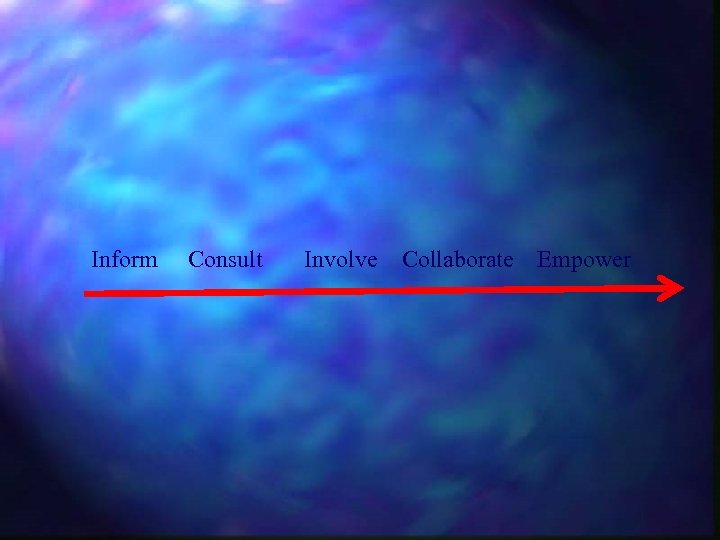
Inform Consult Involve Collaborate Empower
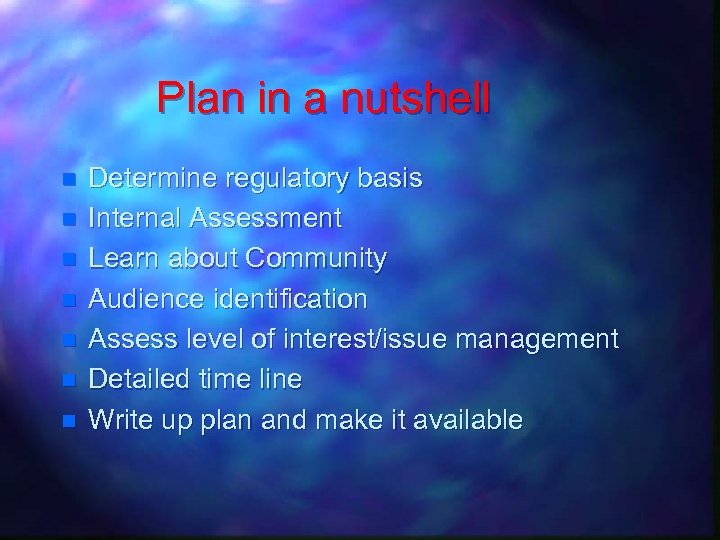
Plan in a nutshell n n n n Determine regulatory basis Internal Assessment Learn about Community Audience identification Assess level of interest/issue management Detailed time line Write up plan and make it available
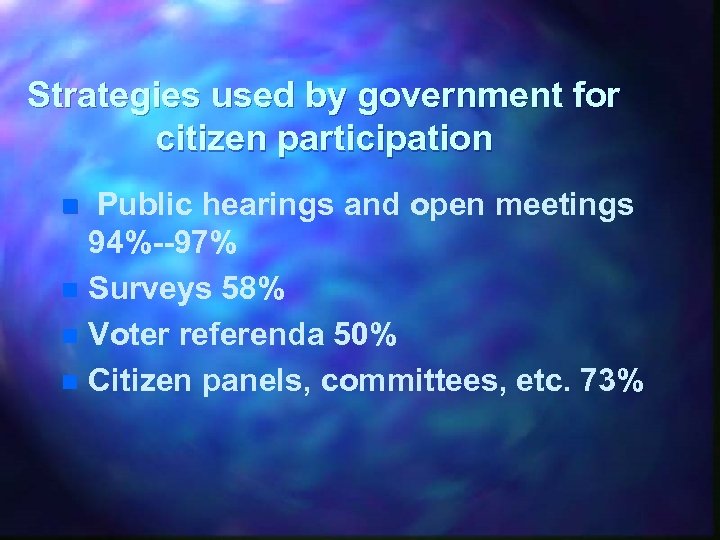
Strategies used by government for citizen participation Public hearings and open meetings 94%--97% n Surveys 58% n Voter referenda 50% n Citizen panels, committees, etc. 73% n
Interactive Exercise n When should the public be involved?
Identifying issues that require public participation n n n Desirability and feasibility The Decision will have a significant impact The Decision will affect some people more than others The decision will impact a vested interest or use The decision involves a subject which is already controversial Needs active support to implement the decision
When you’re not sure if public should be involved: n n n Check with others who have worked on similar issues Check with other nearby communities Ask the stakeholders Conduct Focus groups Design in checkpoints Don’t expect to be right all the time
Be familiar with: Regulations governing citizen participation n Existing working agreements n Culture of organization you work with n Expectations of citizens n History and culture of people you are working with n
Preliminary Questions before developing plan n n n Describe key affected individuals and groups How important is this issue likely to be to the key affected individuals How controversial do they think the issue will be? What kind of participation activities do they think would be appropriate? Level of probable public interest What are the issues that are likely to emerge?
The decision making process can affect the credibility of public participation: Too narrow a definition of the problem n A perception of advocacy or “selling” n Limited alternatives considered n Too little time allowed for public participation n Lack of visibility n
Make sure you have the resources to carry out the plan, including job roles n n n n Spokespersons Technical Experts Meeting facilitators Graphic Designers Public Relations Mailing list Managers Management (on board? ) Elected Officials (on board? )
Writing up the Plan n n n Assures that public participation is well thought through Makes sure that the plan is coordinated with all affected parts of the organization Integrated with Decision Making and Internal Coordination Allows for Management Review Allows for Public Review Provides Documentation
A plan should contain Sequential plan of activities n Issues management activities n Review Points n Budget and Staff Resources n Length of Public Participation Plans n
Information Product Guidelines n n n Who are you trying to reach? What is the message? Two levels: already involved and not Demonstrate how action makes a difference Use short declarative sentences Use conversational English (8 th grade level) Human scale comparisons rather than technical terms Limit length of material. Five double-spaced pages (1500 words) Link individual elements to broader goals Pretest public information products Use graphics and illustrations to support written content Make it clear when fuller documentation is available

February 11, 2009
Fears about Public Meetings (ODOT) n n n n Public wants control Misinformation/lack of information Technology fails/ or make bad presentation Conflicts between presenters leaders, no followers Disputes escalate, loose control of meeting Hostile audience (Frankenstein’s mom shows up) No one shows up Unable to accommodate wishes Look stupid or disorganized Public unwilling to deal with constraints Don’t achieve goals of meeting Fear of public speaking People will walk out There will be errors in data Other issues will surface (unsolvable ones)
Techniques for getting information to the public Briefings Exhibits and displays Feature stories Information Repositories Internet Mailings (key reports, etc. ) Media interviews/talk shows Media kits news conferences and media briefings Newsletters Newspaper inserts News releases Paid advertisements Panels Presentations Public Service Announcements Symposia
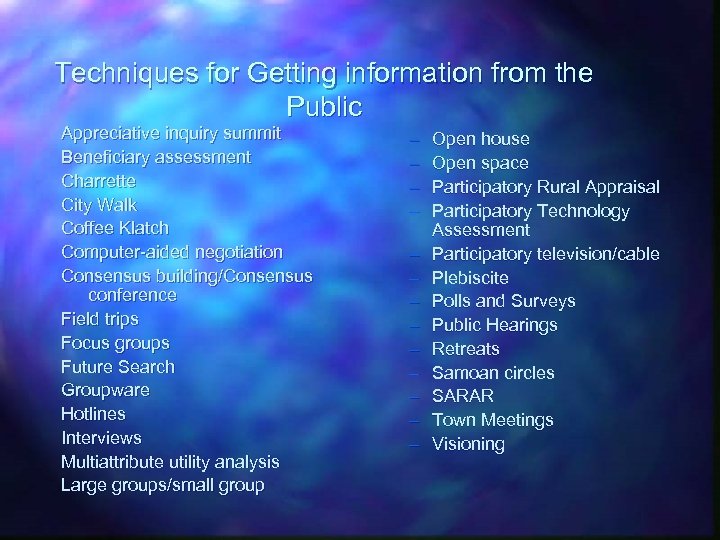
Techniques for Getting information from the Public Appreciative inquiry summit Beneficiary assessment Charrette City Walk Coffee Klatch Computer-aided negotiation Consensus building/Consensus conference Field trips Focus groups Future Search Groupware Hotlines Interviews Multiattribute utility analysis Large groups/small group – – – – Open house Open space Participatory Rural Appraisal Participatory Technology Assessment Participatory television/cable Plebiscite Polls and Surveys Public Hearings Retreats Samoan circles SARAR Town Meetings Visioning
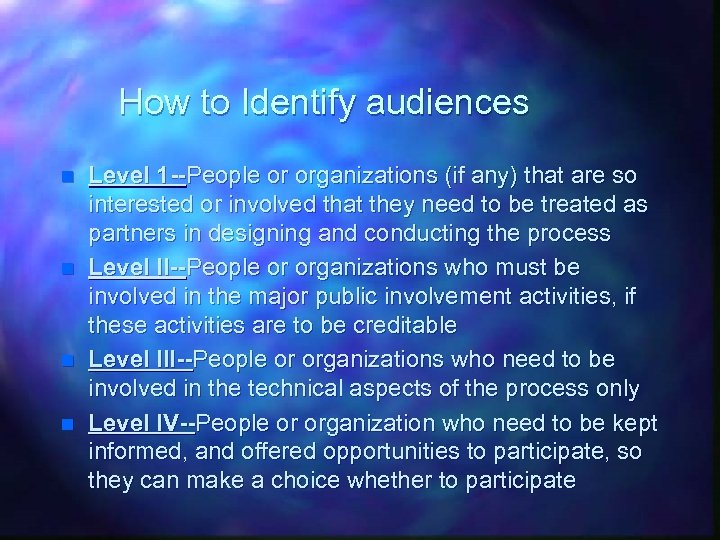
How to Identify audiences n n Level 1 --People or organizations (if any) that are so interested or involved that they need to be treated as partners in designing and conducting the process Level II--People or organizations who must be involved in the major public involvement activities, if these activities are to be creditable Level III--People or organizations who need to be involved in the technical aspects of the process only Level IV--People or organization who need to be kept informed, and offered opportunities to participate, so they can make a choice whether to participate
Exercise n Identifying audiences
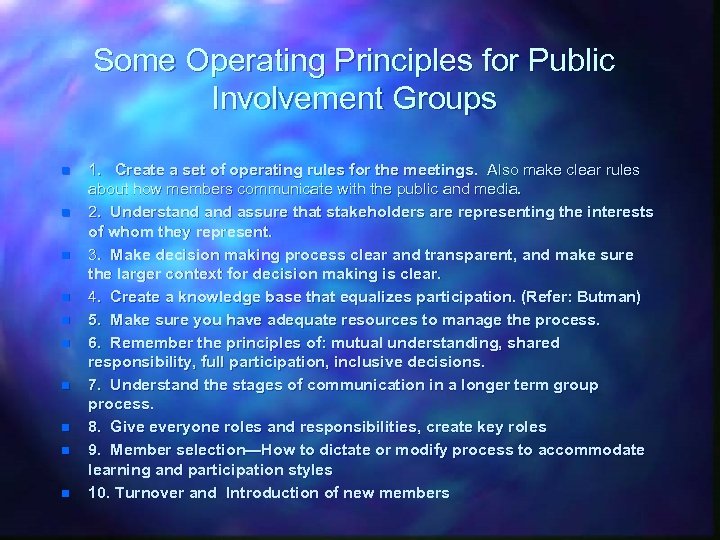
Some Operating Principles for Public Involvement Groups n n n n n 1. Create a set of operating rules for the meetings. Also make clear rules about how members communicate with the public and media. 2. Understand assure that stakeholders are representing the interests of whom they represent. 3. Make decision making process clear and transparent, and make sure the larger context for decision making is clear. 4. Create a knowledge base that equalizes participation. (Refer: Butman) 5. Make sure you have adequate resources to manage the process. 6. Remember the principles of: mutual understanding, shared responsibility, full participation, inclusive decisions. 7. Understand the stages of communication in a longer term group process. 8. Give everyone roles and responsibilities, create key roles 9. Member selection—How to dictate or modify process to accommodate learning and participation styles 10. Turnover and Introduction of new members
Hopes about public meetings (ODOT) n n n n Everyone will understand People will participate freely Cross section of public will show up Everyone will be truthful Solutions will be found Group will reach consensus No one will show up Leave with a positive feeling Issues that are important will surface Won’t be waste of time Ownership will be established Image of organization will improve There will be full house That staff will be able to be impartial listeners Get out alive
Some Operating Principles for Public Involvement Groups n n n n n 1. Create a set of operating rules for the meetings. Also make clear rules about how members communicate with the public and media. 2. Understand assure that stakeholders are representing the interests of whom they represent. 3. Make decision making process clear and transparent, and make sure the larger context for decision making is clear. 4. Create a knowledge base that equalizes participation. (Refer: Butman) 5. Make sure you have adequate resources to manage the process. 6. Remember the principles of: mutual understanding, shared responsibility, full participation, inclusive decisions. 7. Understand the stages of communication in a longer term group process. 8. Give everyone roles and responsibilities, create key roles 9. Member selection—How to dictate or modify process to accommodate learning and participation styles 10. Turnover and Introduction of new members
Facilitator's Guide Principles for Participatory decision making n Facilitation Fundamentals--skills necessary for any process n Facilitator Role n Steps for building sustainable agreements n
Participatory Decision-making core values Full participation n mutual understanding n inclusive solutions n shared responsibility n
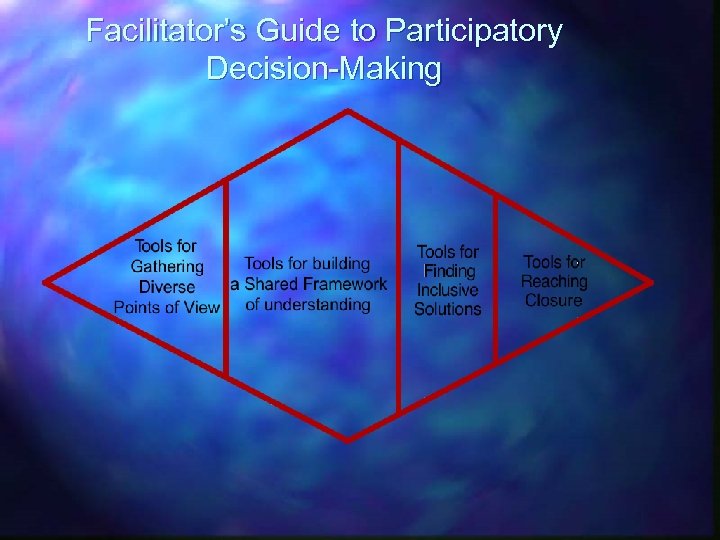
Facilitator’s Guide to Participatory Decision-Making
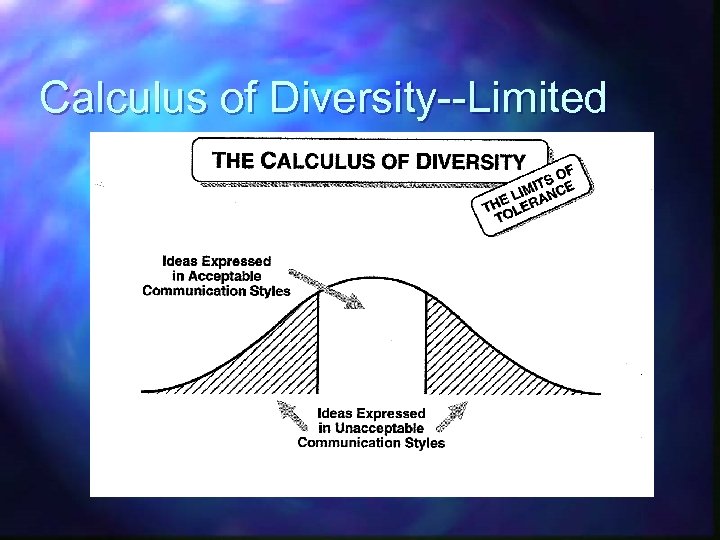
Calculus of Diversity--Limited
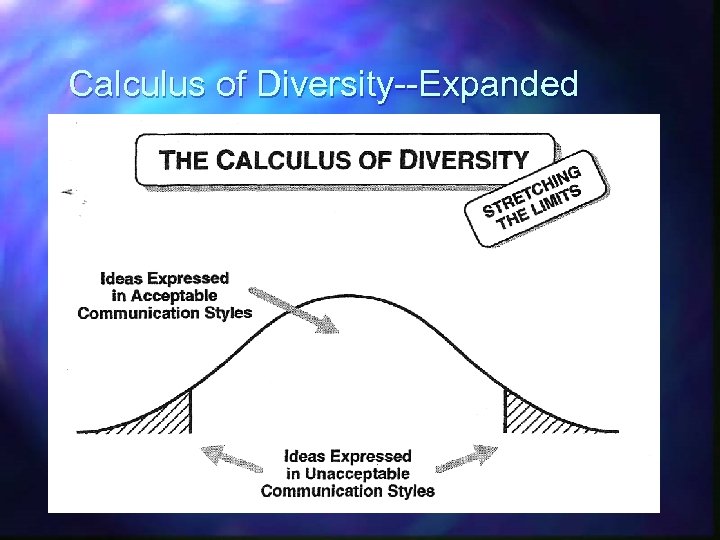
Calculus of Diversity--Expanded
Gathering Diverse Points of View (the Divergent Zone) n Surveying the territory: Collecting perspectives n Searching for alternatives: Generation of ideas n Raising difficult issues: speaking freely
Key to surveying Territory Divergence is OK n Resolution is not the goal n Goal is to Gather diverse points of view n Goal to get people to think outside the box and to not just represent their opinion or position n

February 18, 2009
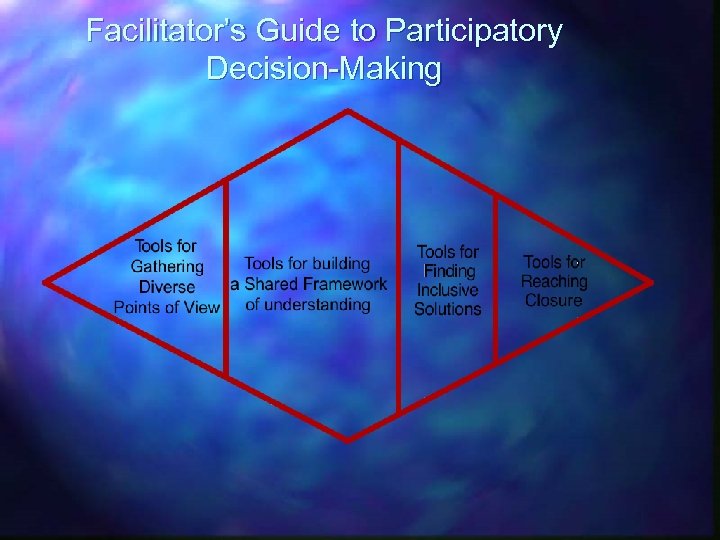
Facilitator’s Guide to Participatory Decision-Making
Building shared framework of understanding Enter the groan zone n Goal: create shared context n Goal: Strengthen relationships n
Creating Shared Context If I were you…. . Backing up from solutions to needs Meaningful themes (sub-text reasons) How will ____ impact our ____ Multiple time frames
Strengthening Relationships n Getting to Know each other – Anecdotes and mementos – Two truths and a lie – The support seat n Giving and receiving feedback – Observations and interpretations (one-to-one) – Appreciations – How do I come across?
Exercises: Mutual Understanding Pig Personality Profile n Learning differences n Other ice breakers and mutual framework building exercises n
Community Stories n n n Finding balance between traditional ways of doing things and the rationalistic system Influence of story on the way we live our lives Constructed social knowledge, made up of rational science and experiential knowledge Lowering the cost of governance and distributing costs of constructing/maintaining the commons and public sphere Assessing progress toward long term goals, e. g. sustainability (costs and benefits) Goal is to maintain or create an inhabitation pattern that is sustainable
Rappaport’s Narrative Analysis n Rappaport's proposes that society, community, and individual perspectives are embodied in three narrative typologies: n Dominate cultural narratives are those stories about persons, places and things that have consistent storyline and thematic content across individuals and settings. These narratives reflect societal views about people, places and things.
Rappaport’s Narrative Analysis n Community narratives are descriptive and historical accounts of life in a particular community which are accessible to community members. The presence of shared community narratives can be indicative of shared community experiences and identity. n Personal stories refer to personal accounts of one’s own life or observations.
Ten reasons why we'll always need a good story n 1. n 2. 3. 4. 5. 6. 7. 8. n n n n 9. 10. Stories first of all are a playground for language, an arena for exercising this extraordinary power. Second, stories create community. Stories help us to see through the eyes of other people. To show us the consequences of our actions. To educate our desires Stories help us dwell in place Stories help us dwell in time. Aware of time passing…we mourn things passing away, and we often fear the shape of things to come. Hence our need for the eighth power of stories, which is to help us deal with suffering, loss, and death. Stories teach us how to be human The wisest stories acknowledge the wonder and mystery of creation and that is the tenth power of stories.
The Role of Story in Building Community Ø Influence of story on the way we live our lives l Dominate cultural stories, community, and individual Ø The knowledge to over come rather than learning to work with (Columbia River) l Saving the strongest salmon Ø White Wolf in the Amazon l Shaman’s son and knowledge of the forest Ø Ø Sand Maps in the Australian outback Valuing experiential knowledge as well as scientific or technical l The story of Bob Benson Ø Beavergate
Broader Vision, Civic Story n “The role of sustainability in the city (Portland, Oregon) oozes out of every ounce of the city’s government operations, and affects the way the government is organized and functions. ”(Portney)
Portland’s Civic Story Ø Over 30 year period Portland created a civic story, in part myth, in part reality Ø It dictates civic behavior Ø Citizens expect to be involved Ø Bureaucrats and elected officials expect citizens to be involved.
Example of Community Story Exercise, Brisbane Australia Ø What is the Story? Ø Where did it come from? Ø If it is a good story how do you maintain it? Ø Is it sustainable (socially, economically, environmentally)
Developing Story skills n n n The art of learning: how to learn from stories and other forms of communication Ritual: setting deeper context for discussion Using story to get to know one another Community Strengths or assets Narrative analysis Practice Stories
Summary: Community Stories Ø Ø Ø Community stories are created based on the interaction between the place and its people But community stories are also co-opted by dominate cultural narratives A good community story is socially, environmentally, and economically sustainable Citizens need to feel they are a part of creating the story so that the cost of governance is lowered.
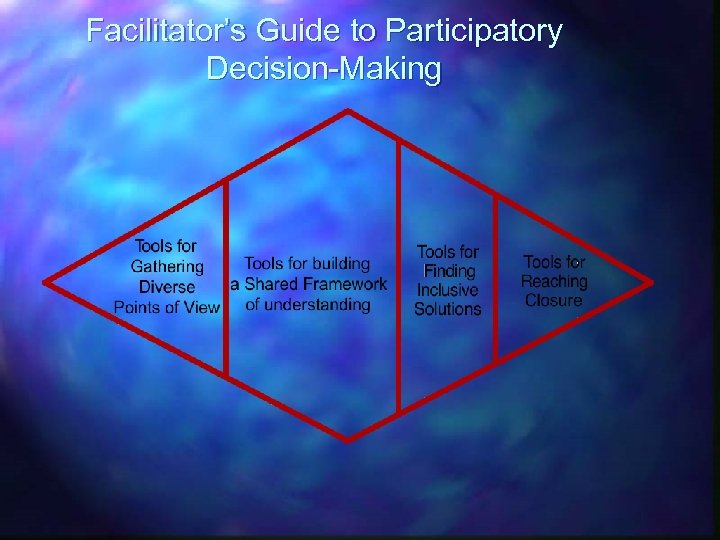
Facilitator’s Guide to Participatory Decision-Making
Developing Inclusive Decisions n Exploring Inclusive Principles – How can we do both (p. 187) – Develop your own group inclusivity process n Creative Reframing – Two ways of looking at a problem (p. 196) – Examples: removing restraints, catastrophizing n Strengthening good ideas – Again important to create agreed upon process – Examples: who does what, who else needs to evaluate?
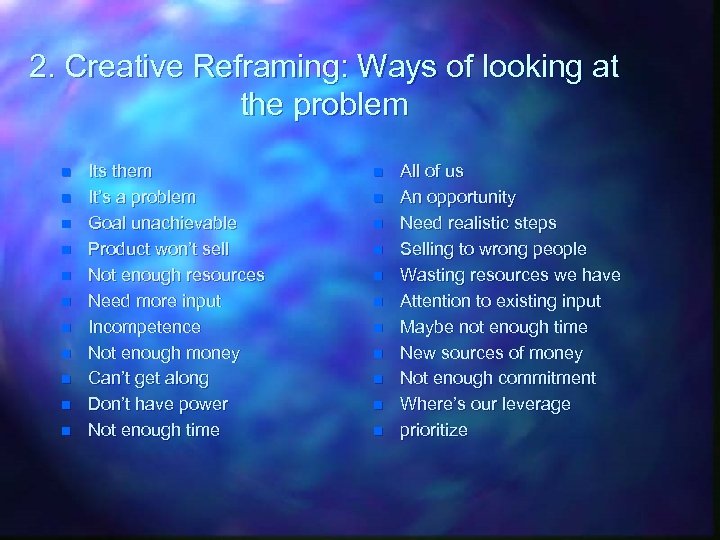
2. Creative Reframing: Ways of looking at the problem n n n Its them It’s a problem Goal unachievable Product won’t sell Not enough resources Need more input Incompetence Not enough money Can’t get along Don’t have power Not enough time n n n All of us An opportunity Need realistic steps Selling to wrong people Wasting resources we have Attention to existing input Maybe not enough time New sources of money Not enough commitment Where’s our leverage prioritize
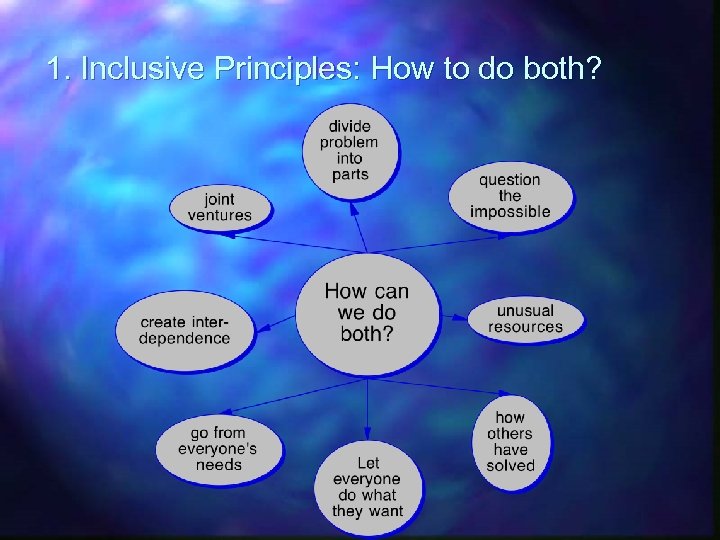
1. Inclusive Principles: How to do both?
Other Reframing What’s unchangeable about problem? n Key words n Reversing assumptions n Removing constraints n Recentering the cause n Catastrophizing n
3. Strengthening good ideas Clarifying evaluation criteria n Payoffs and risks n Can we really make this work? n Who else needs to evaluate the proposal? n Who does what by when? n
Reaching Closure
Decision making without rules n n n n n To whiner goes the spoil Put on next meeting agenda and nothing happens Decision made behind closed doors Certain people always get their way Meeting drags on and on Fixed positions stalemate the discussion Time runs out final thoughts become the decision some poor person given the task to decide Person with most stake gets their way
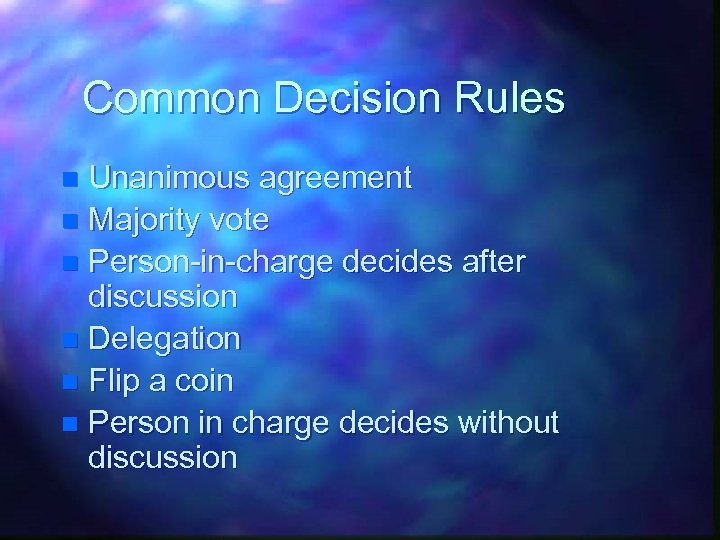
Common Decision Rules Unanimous agreement n Majority vote n Person-in-charge decides after discussion n Delegation n Flip a coin n Person in charge decides without discussion n
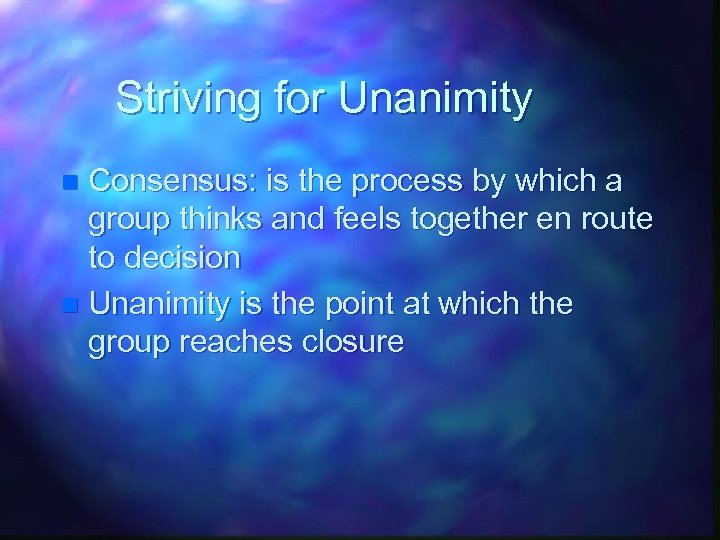
Striving for Unanimity Consensus: is the process by which a group thinks and feels together en route to decision n Unanimity is the point at which the group reaches closure n
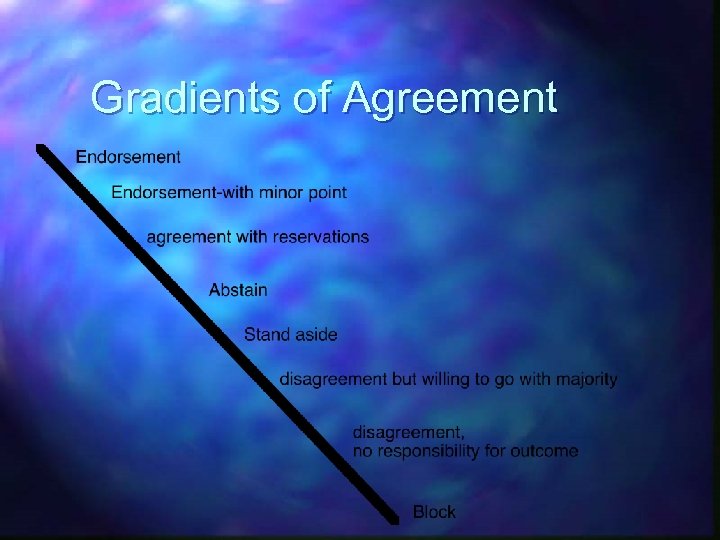
Gradients of Agreement

EXTRA SLIDES
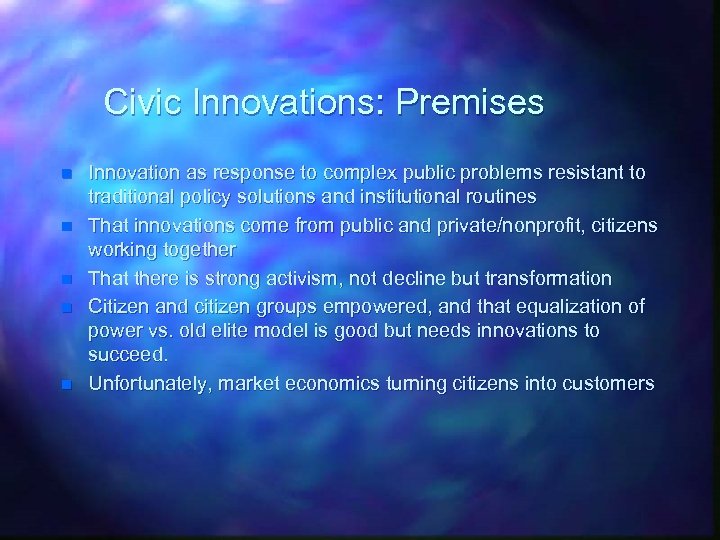
Civic Innovations: Premises n n n Innovation as response to complex public problems resistant to traditional policy solutions and institutional routines That innovations come from public and private/nonprofit, citizens working together That there is strong activism, not decline but transformation Citizen and citizen groups empowered, and that equalization of power vs. old elite model is good but needs innovations to succeed. Unfortunately, market economics turning citizens into customers
Deliberative Democracy Theories Policy Learning n Organizational Learning n Participatory Democratic Theory n
Examples Woburn Mass. Citizen science n Siting hazardous waste n Watershed health n
Summary Theoretical Writings n n n Sidney Tarrow: Social movements De. Tocqueville: Roots of American democracy Daniel Kemmis: Direct and Representative forms of democracy Jeffrey Berry: Growth of citizen interest groups Robert Putnam: Civic engagement and social capital Siranni and Friedland: Civic innovations Morris Fiorina: excesses of democracy Fischer: intractable problems and role of science Day: How to evaluate citizen participation Tauxe: Limits of rational planning process Beatley: Representation Innes: communicative planning theory
Скачать презентацию Citizen Participation USP 550 www Bowling Alone
95efed0091e78a743f3050320e47ed72.ppt