


 Скачать презентацию CITEL PCC I ITU Forum on Information and
7233e49f0ba60c46c50aebecf721c245.ppt
- Количество слайдов: 28
 CITEL (PCC. I)/ ITU Forum on Information and Communication Technology Service: Quality, Control and Surveillance (Cartagena de Indias, Colombia, 23 -24 September 2013) The importance of models and procedures for planning, monitoring and control in the provision of communications services Dr. -Ing. H. W. Gierlich Head of Telecom Division Colombia, 23 -24 September 2013
 Outline Introduction Communication Services – Underlying System configurations Planning: The ITU-T E-model (G. 107 & G. 108) Network Monitoring: P. 862, P. 863 & P. 563 Wideband – The new Challenge Summary Colombia, 23 -24 September 2013 2
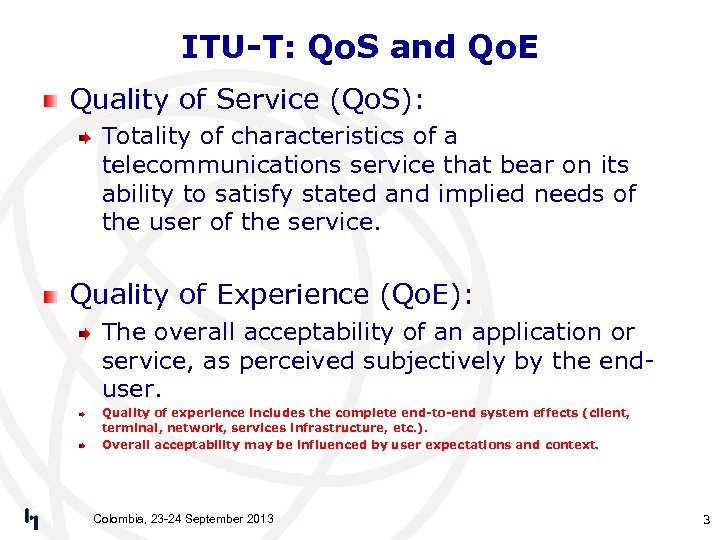 ITU-T: Qo. S and Qo. E Quality of Service (Qo. S): Totality of characteristics of a telecommunications service that bear on its ability to satisfy stated and implied needs of the user of the service. Quality of Experience (Qo. E): The overall acceptability of an application or service, as perceived subjectively by the enduser. Quality of experience includes the complete end-to-end system effects (client, terminal, network, services infrastructure, etc. ). Overall acceptability may be influenced by user expectations and context. Colombia, 23 -24 September 2013 3
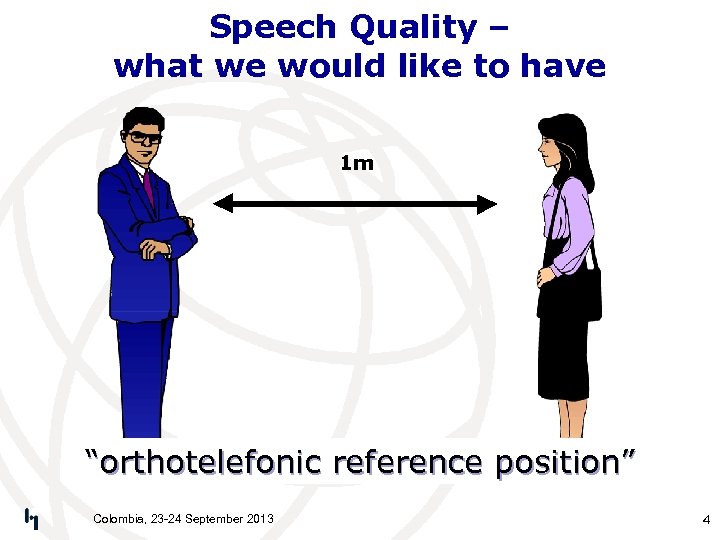 Speech Quality – what we would like to have 1 m “orthotelefonic reference position” Colombia, 23 -24 September 2013 4
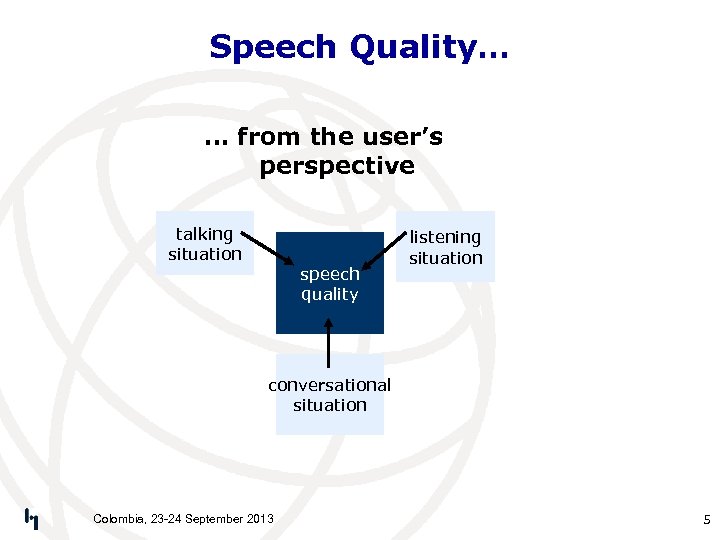 Speech Quality… … from the user’s perspective talking situation speech quality listening situation conversational situation Colombia, 23 -24 September 2013 5
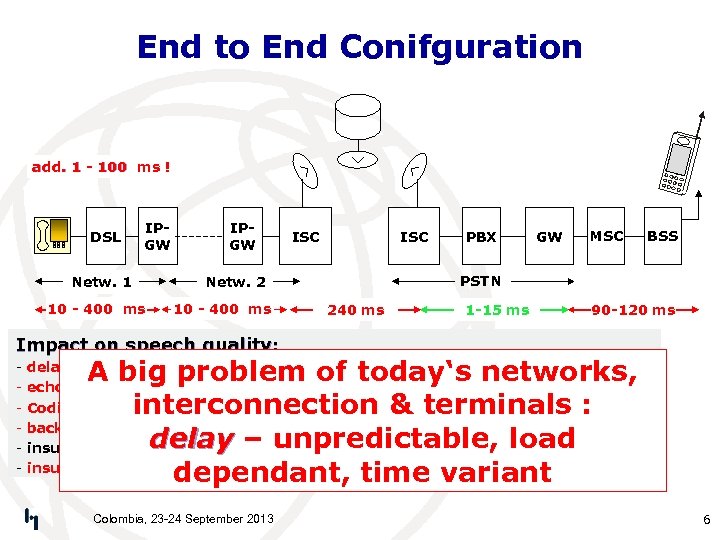 End to End Conifguration add. 1 - 100 ms ! DSL IPGW Netw. 1 10 - 400 ms IPGW ISC GW MSC BSS PSTN Netw. 2 10 - 400 ms PBX 240 ms 1 -15 ms 90 -120 ms Impact on speech quality: - A big problem of today‘s networks, interconnection & terminals : delay – unpredictable, load dependant, time variant delay now time variant echo much more dominant Coding distortion background noise problems insufficient quality of the analog network components (att. , noise, distortion…) insufficient quality of acoustical components Colombia, 23 -24 September 2013 6
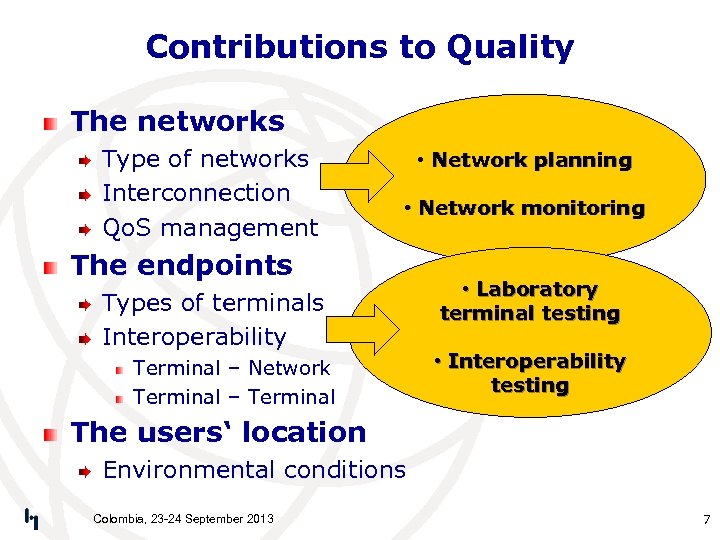 Contributions to Quality The networks Type of networks Interconnection Qo. S management • Network planning • Network monitoring The endpoints Types of terminals Interoperability Terminal – Network Terminal – Terminal • Laboratory terminal testing • Interoperability testing The users‘ location Environmental conditions Colombia, 23 -24 September 2013 7
 Outline Introduction Communication Services – Underlying System configurations Planning: The ITU-T E-model (G. 107 & G. 108) Network Monitoring: P. 862, P. 863 & P. 563 Wideband – The new Challenge Summary Colombia, 23 -24 September 2013 8
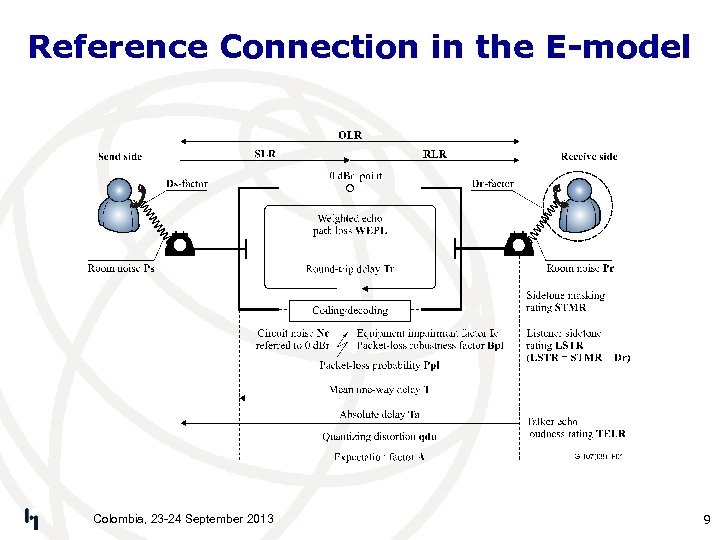 Reference Connection in the E-model Colombia, 23 -24 September 2013 9
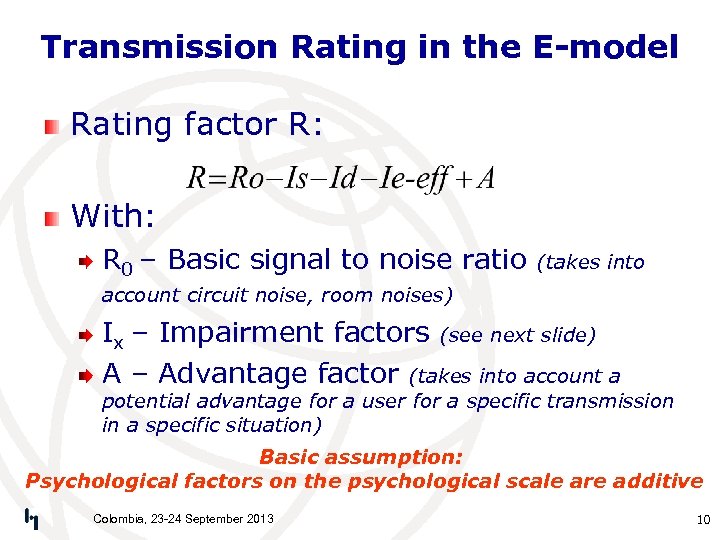 Transmission Rating in the E-model Rating factor R: With: R 0 – Basic signal to noise ratio (takes into account circuit noise, room noises) Ix – Impairment factors (see next slide) A – Advantage factor (takes into account a potential advantage for a user for a specific transmission in a specific situation) Basic assumption: Psychological factors on the psychological scale are additive Colombia, 23 -24 September 2013 10
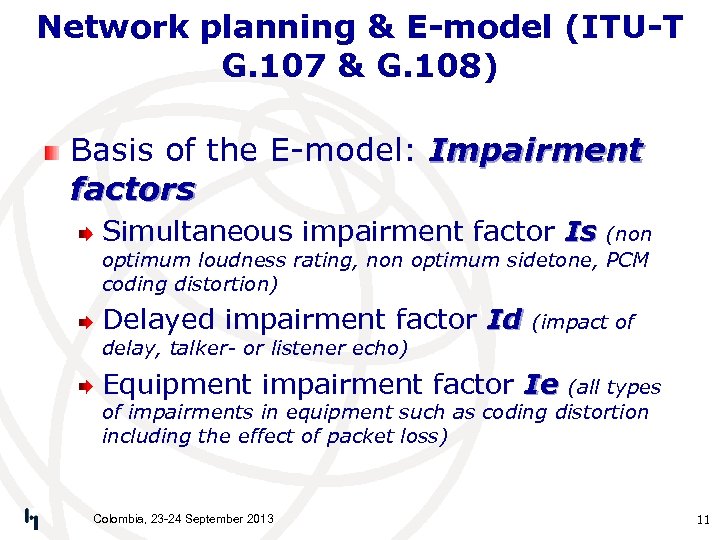 Network planning & E-model (ITU-T G. 107 & G. 108) Basis of the E-model: Impairment factors Simultaneous impairment factor Is (non optimum loudness rating, non optimum sidetone, PCM coding distortion) Delayed impairment factor Id (impact of delay, talker- or listener echo) Equipment impairment factor Ie (all types of impairments in equipment such as coding distortion including the effect of packet loss) Colombia, 23 -24 September 2013 11
 How to derive Ie? Ie is based on subjective tests and can be derived as follows: Equipment impairment factors for the most popular codecs in ITU-T G. 113 From subjective listening tests described in ITU-T P. 833 From objective models (e. g. ITU-T P. 863) following the procedure in ITU-T P. 834 Colombia, 23 -24 September 2013 12
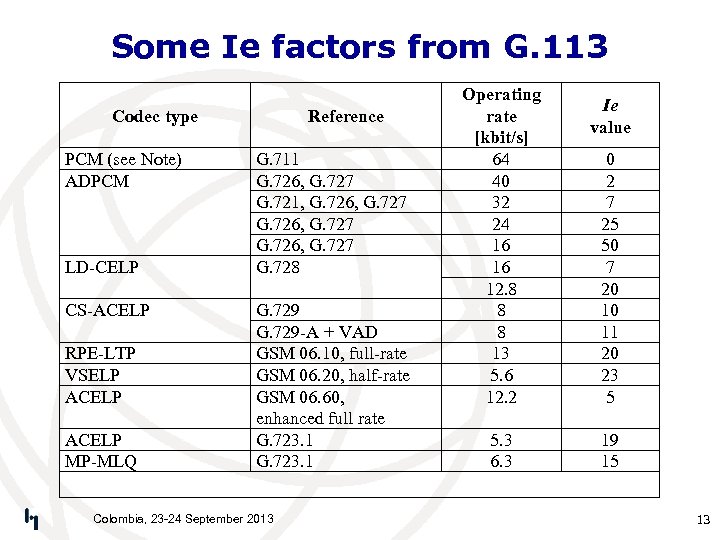 Some Ie factors from G. 113 Codec type PCM (see Note) ADPCM LD-CELP CS-ACELP RPE-LTP VSELP ACELP MP-MLQ Reference G. 711 G. 726, G. 727 G. 721, G. 726, G. 727 G. 728 G. 729 -A + VAD GSM 06. 10, full-rate GSM 06. 20, half-rate GSM 06. 60, enhanced full rate G. 723. 1 Colombia, 23 -24 September 2013 Operating rate [kbit/s] 64 40 32 24 16 16 12. 8 8 8 13 5. 6 12. 2 5. 3 6. 3 Ie value 0 2 7 25 50 7 20 10 11 20 23 5 19 15 13
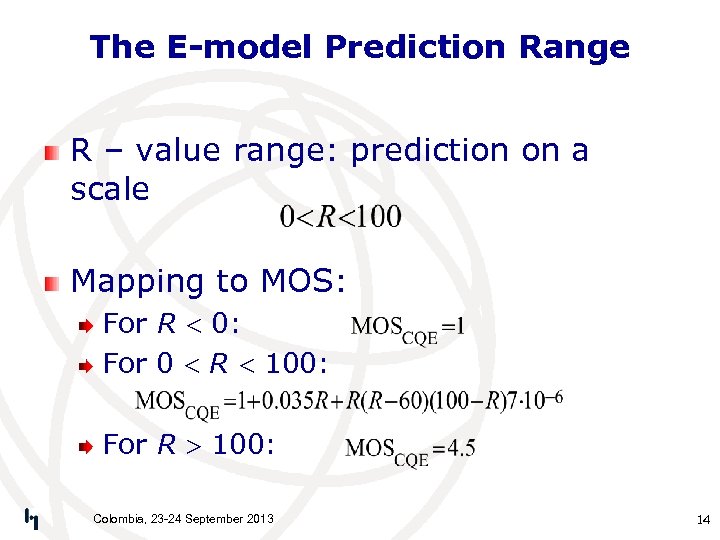 The E-model Prediction Range R – value range: prediction on a scale Mapping to MOS: For R 0: For 0 R 100: For R 100: Colombia, 23 -24 September 2013 14
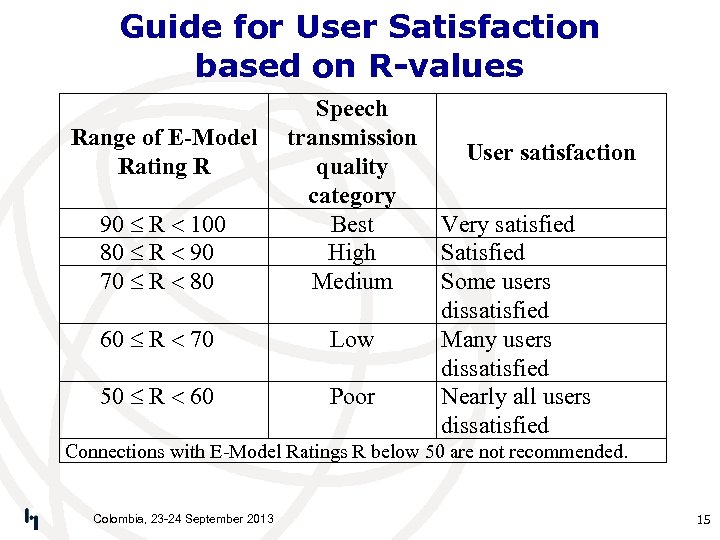 Guide for User Satisfaction based on R-values Range of E-Model Rating R 90 R 100 80 R 90 70 R 80 60 R 70 50 R 60 Speech transmission User satisfaction quality category Best Very satisfied High Satisfied Medium Some users dissatisfied Low Many users dissatisfied Poor Nearly all users dissatisfied Connections with E-Model Ratings R below 50 are not recommended. Colombia, 23 -24 September 2013 15
 Guide on Transmission Planning: ITU -T G. 108 Demonstrates the application of the E-model for end-to-end transmission planning in a wide range of networks Keep in mind: G. 107 and G. 108 are applicable for narrowband networks Colombia, 23 -24 September 2013 16
 Outline Introduction Communication Services – Underlying System configurations Planning: The ITU-T E-model (G. 107 & G. 108) Network Monitoring: P. 862, P. 863 & P. 563 Wideband – The new Challenge Summary Colombia, 23 -24 September 2013 17
 Networks & Network Monitoring Main network related impairments: Delay variation (jitter) Listening speech impairment due to Coding Transcoding Interconnection Packet loss/jitter Colombia, 23 -24 September 2013 18
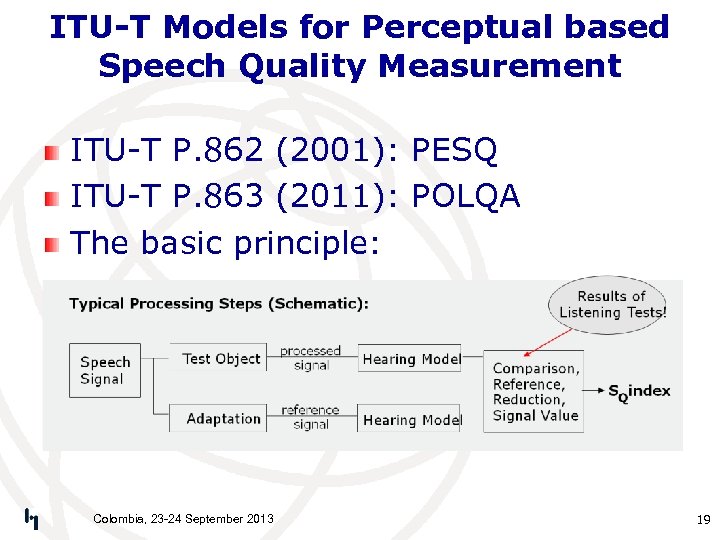 ITU-T Models for Perceptual based Speech Quality Measurement ITU-T P. 862 (2001): PESQ ITU-T P. 863 (2011): POLQA The basic principle: Colombia, 23 -24 September 2013 19
 Principle Intrusive test procedure Objective prediction of MOS (mean opinion score) as achieved in listening test subjectively Prediction on a MOS-scale: MOS MOS MOS 5 4 3 2 1 – – – excellent good fair poor bad Substitution of subjective tests for known codecs and impairments Colombia, 23 -24 September 2013 20
 Application Intrusive testing: Insertion of a reference speech sequence Acquiring the transmitted, distorted speech sequence Calculation of the speech quality by comparing to the reference Output: MOS LQOn – mean opinion score, objective, narrowband Colombia, 23 -24 September 2013 21
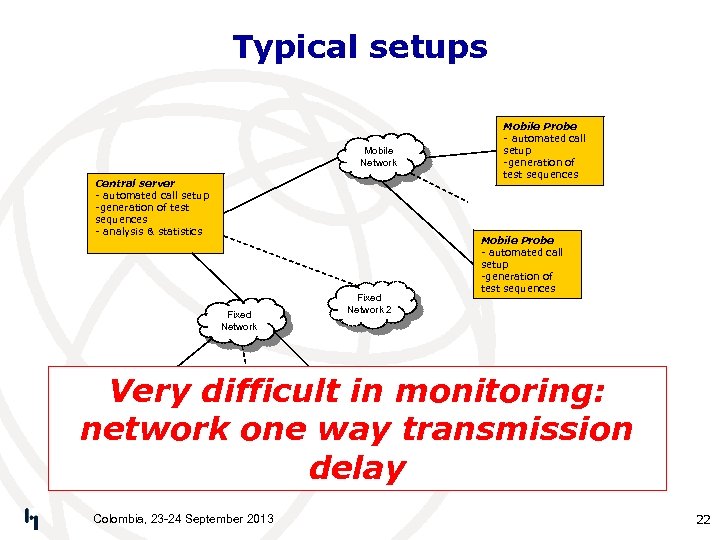 Typical setups Mobile Network Central server - automated call setup -generation of test sequences - analysis & statistics Fixed Network 2 Mobile Probe - automated call setup -generation of test sequences Very difficult in monitoring: network one way transmission delay Probe @ NTP - automated call setup -generation of test sequences Colombia, 23 -24 September 2013 Probe @ NTP - automated call setup -generation of test sequences 22
 Not Intrusive Testing - ITU-T P. 563 Listening speech quality prediction based on speech signal in a call No reference file insertion required Average listening speech quality prediction on statistical evaluation of a high number of calls on the same connection Not recommended for test on a call by call basis Much less reliable than intrusive testing based on P. 862 and P. 863 Colombia, 23 -24 September 2013 23
 The wideband challenge High quality expectation by the user Wideband must be significantly better in all quality aspects Significant contribution to quality by the terminals First attemt to certify high quality wideband speech transmission: GSMA Colombia, 23 -24 September 2013 24
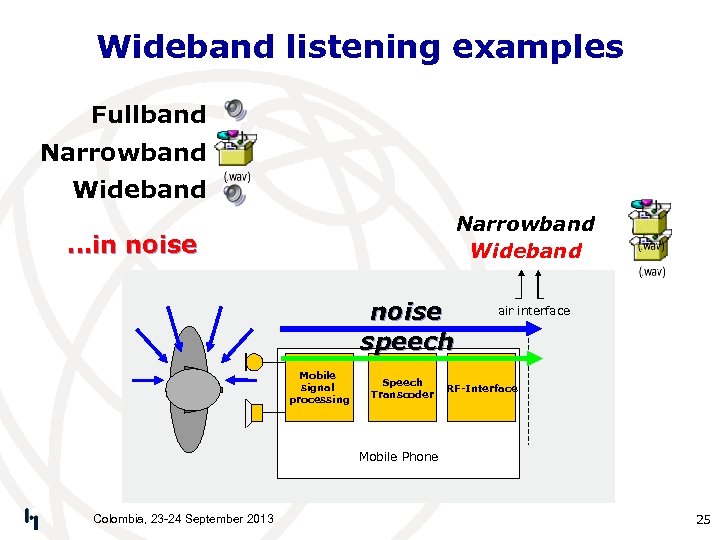 Wideband listening examples Fullband Narrowband Wideband …in noise speech Mobile signal processing Speech Transcoder air interface RF-Interface Mobile Phone Colombia, 23 -24 September 2013 25
 Wideband Network Planning – ITU-T G. 107. 1 The principle of the model is identical to the narrowband version G. 107 The model reflects the improvements in quality in wideband: Maximum R = 129 (instead of 100 for narrowband) Model provides new wideband R calculation mapping R to the range of 0 -100 All factors – R 0 and Impairment factors are adapted accordingly Colombia, 23 -24 September 2013 26
 Wideband Network Monitoring Setup as in narrowband Only intrusive testing available Network monitoring is based on ITUT P. 863 POLQA ITU-T P. 862 PESQ should not be used in wideband Colombia, 23 -24 September 2013 27
 Conclusions and Recommendations ITU-T provides models for planning and monitoring Network planning is essential for achieving high network Qo. S Network monitoring is essential to detect potential issues – e. g. changing radio conditions, changing network conditions (jitter, packet loss) Both is not sufficient to guarantee a good Qo. E – terminals play a major role for the overall speech quality Colombia, 23 -24 September 2013 28