


 Скачать презентацию CISM Does It Help or Not Rev KC
399eee992fe5d61f1f85d87c363ddd4c.ppt
- Количество слайдов: 65
 CISM: Does It Help or Not? Rev. KC Schuler, MDiv, BCC Supervising Chaplain Theda. Care (and ICISF Trained Trainer) kc. schuler@thedacare. org Most slides borrowed from ICISF: Group Crisis Response Training
 At the heart of any field of study or practice resides a basic vocabulary. Unfortunately, the field of crisis and disaster mental health intervention has been plagued by the lack of a standardized nomenclature. So, we will begin with a review of several key terms and concepts that will help clarifiy some of the issues and the materials later presented.
 Critical Incident Stress (CIS) is also known as Post Traumatic Stress (PTS), which is not the same as Post Traumatic Stress Disorder (PTSD).
 CIS/PTS is a normal response of normal people to an abnormal event. CIS/PTS reactions may look similar to some symptoms of PTSD. If the CIS/PTS does not get resolved, it may turn into the disorder (PTSD). Only a trained, Mental Health professional can diagnose PTSD.
 Definitions n n CRITICAL INCIDENTS are unusually challenging events that have the potential to create significant human DISTRESS and can overwhelm one’s usual coping mechanisms. In other words, and abnormal event that evokes a normal response (CIS/PTS) to that abnormal event
 Definitions n The psychological DISTRESS in response to critical incidents such as emergencies, disasters, traumatic events, terrorism, or catastrophes is called a PSYCHOLOGICAL CRISIS (Everly & Mitchell, 1999)
 Psychological Crisis An acute RESPONSE to a trauma, disaster, or other critical incident wherein: 1. Psychological homeostasis (balance) is disrupted (increased stress) 2. One’s usual coping mechanisms have failed 3. There is evidence of significant distress, impairment, dysfunction (PTS/CIS) (adapted from Caplan, 1964, Preventive Psychiatry)
 IMPORTANT! Crisis intervention targets the RESPONSE, not the EVENT, per se. Thus, crisis intervention and disaster mental health interventions must be predicated upon assessment of need.
 Crisis Intervention (CI) n An active, short-term, supportive, helping process. n Acute intervention designed to mitigate the crisis response (CIS/PTS). n NOT psychotherapy or a substitute for psychotherapy.
 Crisis Intervention (CI) Goals: 1. Stabilization 2. Symptom reduction 3. Return to adaptive functioning, or 4. Facilitation of access to continued care (adapted from Caplan, 1964, Preventive Psychiatry)
 Crisis Intervention (CI): Lessons Learned From The Military n Salmon (1919, NY Med J) “Nothing could be more striking than the comparison between the cases treated near the front and those treated far behind the lines…As soon as treatment near the front became possible, symptoms disappeared…with the result that sixty percent with a diagnosis of psychoneurosis were returned to duty from the field hospital” (p. 994).
 Principles of Crisis Intervention (CI): (Most Were Developed By The Military) n n n n Proximity Immediacy Expectancy Innovation Brevity Simplicity Pragmatism
 Crisis Intervention: Leadership Communication n Intentional or unintentional communication: 1. Compassion: Deep awareness of the suffering of another coupled with the wish to relieve it 2. Disdain: To regard or treat with contempt; despise 3. Indifference: Having no particular interest or concern; apathetic The American Heritage® Dictionary of the English Language, Fourth Edition Copyright © 2006 by Houghton Mifflin Company.
 The Need in EMS? n n n Incidence of Posttraumatic Stress with EMS in urban setting (NYC) (9. 3%) met the strict DSM-III-R criteria for PTSD Another (10%) had the required number and combination of symptoms for PTSD, but these symptoms had not persisted for the 1 month required by the DSM-III-R criteria. Thus, a total of 19. 3% of subjects who completed the survey were shown to be suffering from PTSD symptoms. Development of Posttraumatic Stress Disorder in Urban Emergency Medical Service Workers , Medscape Psychiatry & Mental Health e. Journal 2(5), 1997. © 1997 Medscape
 The Need in EMS? (cont. ) n The interaction between age and several other factors, however, was significant, including: n Study participants between the ages of 18 and 24 who graduated from a rural high school were nearly 3 times as likely to have PTSD as those from urban or suburban high schools n The prevalence of PTSD increased significantly with the total number of previous medical emergency work jobs Development of Posttraumatic Stress Disorder in Urban Emergency Medical Service Workers , Medscape Psychiatry & Mental Health e. Journal 2(5), 1997. © 1997 Medscape
 Review for Canadian Armed Forces Ritchie, P. (2002) n n n Literature suggests value in “debriefing” CISD (“debriefing”) should only use group format CISD should be offered as part of a larger integrated intervention system (CISM) n n n Participation is Voluntary and involves informed consent CISD contraindicated if basic physiological, shelter, & safety needs not met Positive outcome may be other than prevention of PTSD (provides information, support, may increase cohesion, positively viewed)
 Lessons Learned From Community Mental Health n Early Psychological Intervention may reduce the need for more intensive psych services. (Langsley, Machotka, & Flomenhaft, 1971, Am J Psyc; Decker, & Stubblebine, 1972, Am J Psyc) n Early Psychological Intervention may mitigate acute distress. (Bordow & Porritt, 1979, Soc Sci & Med; Bunn & Clarke, 1979, Br. J Med. Psychol; Campfield & Hills, 2001, JTS; Flannery & Everly, 2004, Aggression & Violent Beh. )
 Lessons Learned From Community Mental Health n Early psychological Intervention may reduce Et. OH use. (Deahl, et al, 2000, Br J Med Psychol; Boscarino, et al. , 2005)
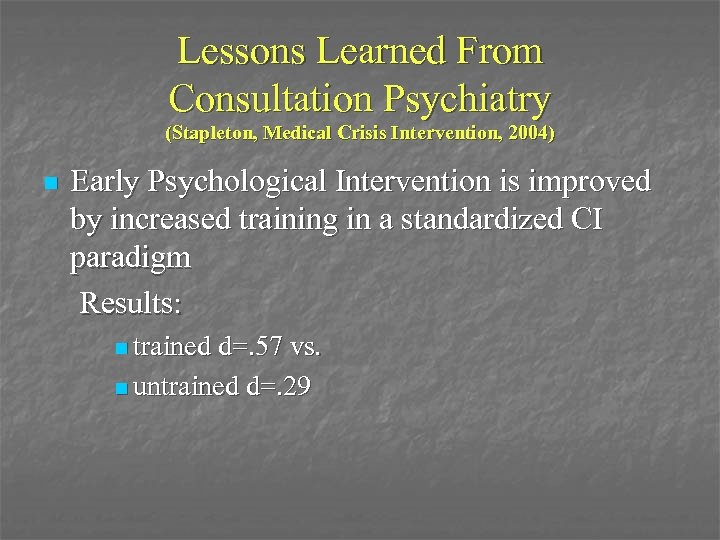 Lessons Learned From Consultation Psychiatry (Stapleton, Medical Crisis Intervention, 2004) n Early Psychological Intervention is improved by increased training in a standardized CI paradigm Results: n trained d=. 57 vs. n untrained d=. 29
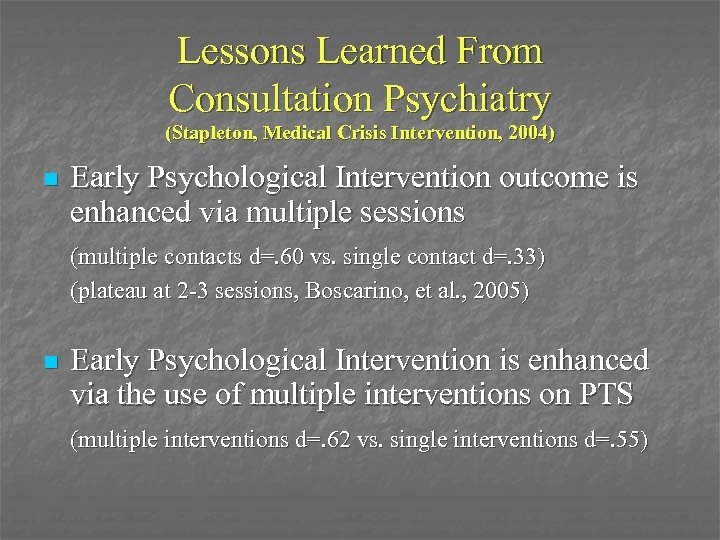 Lessons Learned From Consultation Psychiatry (Stapleton, Medical Crisis Intervention, 2004) n Early Psychological Intervention outcome is enhanced via multiple sessions (multiple contacts d=. 60 vs. single contact d=. 33) (plateau at 2 -3 sessions, Boscarino, et al. , 2005) n Early Psychological Intervention is enhanced via the use of multiple interventions on PTS (multiple interventions d=. 62 vs. single interventions d=. 55)
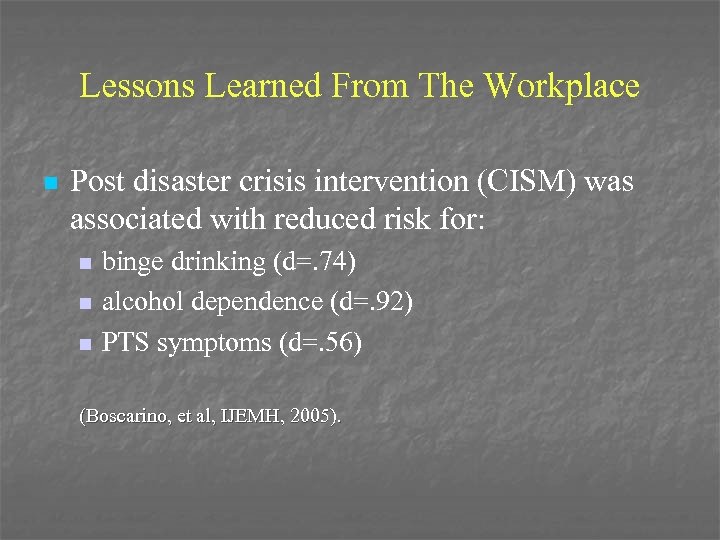 Lessons Learned From The Workplace n Post disaster crisis intervention (CISM) was associated with reduced risk for: n n n binge drinking (d=. 74) alcohol dependence (d=. 92) PTS symptoms (d=. 56) (Boscarino, et al, IJEMH, 2005).
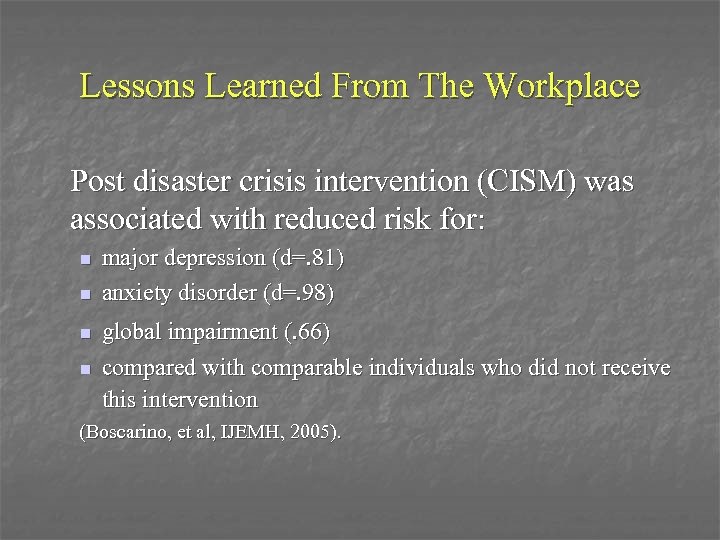 Lessons Learned From The Workplace Post disaster crisis intervention (CISM) was associated with reduced risk for: n n major depression (d=. 81) anxiety disorder (d=. 98) global impairment (. 66) compared with comparable individuals who did not receive this intervention (Boscarino, et al, IJEMH, 2005).
 “There is now emerging evidence that prompt delivery of brief, acute phase services in the first weeks after an event can lead to sustained reduction in morbidity years later, reducing the burden of secondary functional impairment, presumed daily average life years lost (DALYS), and costs to both the individual and the public” (p. 15). Schreiber, M. (Summer, 2005). Psy. START rapid mental health triage and incident command system. The Dialogue: A Quarterly Technical Assistance Bulletin on Disaster Behavioral Health, 14 -15.
 Value Added of Crisis Intervention: Screening & Increasing Access To Care n n Only 11% of victims of violent crime responded to institutional invitations to express attitudes regarding crime & punishment Less than 7% of sexual assault victims chose to utilize free psychotherapy within walking distance of their home (Rose, et al. , Psychological Medicine, 1999). n Formal mental health utilization post 9/11 increased only ~3% in civilians and emergency personnel even though prevalence of PTSD estimated at 7 -20% and depression at ~9% (see Johns Hopkins Center for Public Health Preparedness -- JHCPHP, 2005)
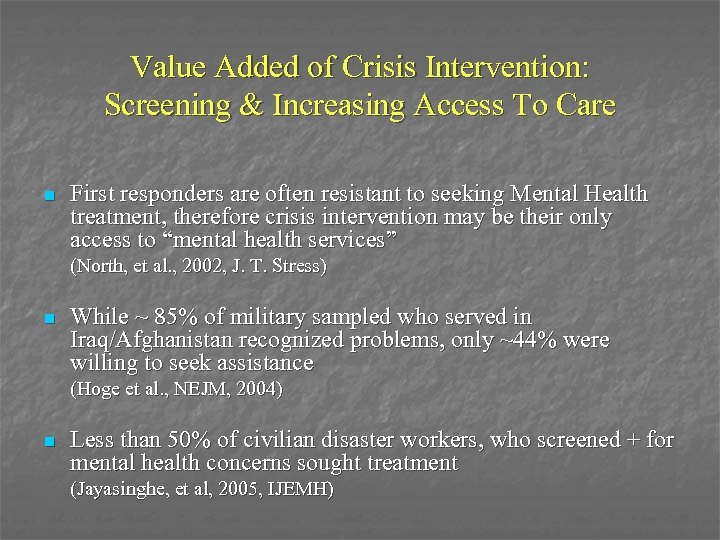 Value Added of Crisis Intervention: Screening & Increasing Access To Care n First responders are often resistant to seeking Mental Health treatment, therefore crisis intervention may be their only access to “mental health services” (North, et al. , 2002, J. T. Stress) n While ~ 85% of military sampled who served in Iraq/Afghanistan recognized problems, only ~44% were willing to seek assistance (Hoge et al. , NEJM, 2004) n Less than 50% of civilian disaster workers, who screened + for mental health concerns sought treatment (Jayasinghe, et al, 2005, IJEMH)
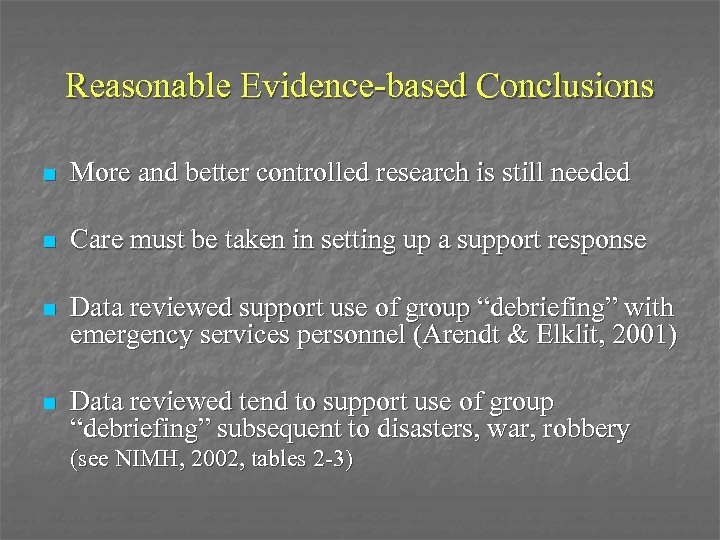 Reasonable Evidence-based Conclusions n More and better controlled research is still needed n Care must be taken in setting up a support response n Data reviewed support use of group “debriefing” with emergency services personnel (Arendt & Elklit, 2001) n Data reviewed tend to support use of group “debriefing” subsequent to disasters, war, robbery (see NIMH, 2002, tables 2 -3)
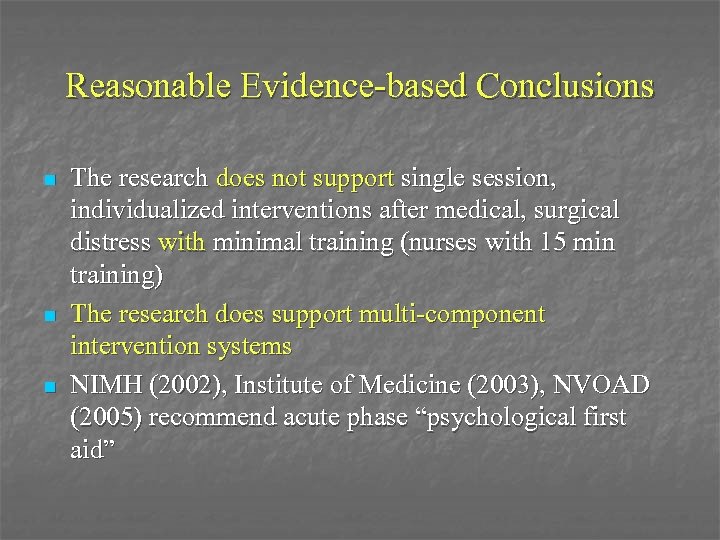 Reasonable Evidence-based Conclusions n n n The research does not support single session, individualized interventions after medical, surgical distress with minimal training (nurses with 15 min training) The research does support multi-component intervention systems NIMH (2002), Institute of Medicine (2003), NVOAD (2005) recommend acute phase “psychological first aid”
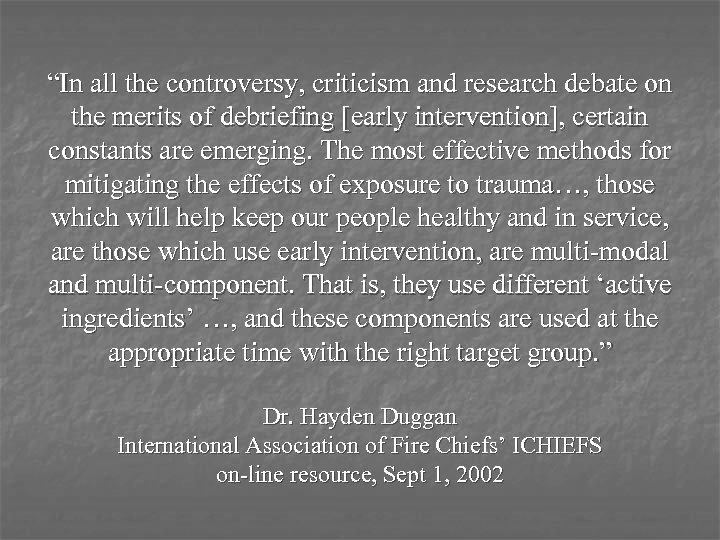 “In all the controversy, criticism and research debate on the merits of debriefing [early intervention], certain constants are emerging. The most effective methods for mitigating the effects of exposure to trauma…, those which will help keep our people healthy and in service, are those which use early intervention, are multi-modal and multi-component. That is, they use different ‘active ingredients’ …, and these components are used at the appropriate time with the right target group. ” Dr. Hayden Duggan International Association of Fire Chiefs’ ICHIEFS on-line resource, Sept 1, 2002
 Acceptance of Psychological Debriefings (PD) “Since PD is fully accepted as standard practice for emergency services personnel and well-received by group members and organizations, it is hard to find fault in its application in a mass disaster such as the terrorist attacks…on september 11, 2001. ” (Litz, et al. , Clin. Psyc. 2002)
 Crisis Intervention (CI): Key Points n Crisis Intervention is not intended to be the practice of psychiatry, psychology, social work, nor counseling, per se, it is simply psychological/emotional first aid n Consistent with NIMH guidelines and Federal “crisis counseling” models, crisis intervention may be practiced by mental health clinicians, as well as, medical personnel, clergy, & community volunteers (although we believe mental health guidance, supervision, or oversight is essential) n AGAIN, Crisis intervention does not appear to “prevent” PTSD in primary victims.
 Resistance, Resilience, & Recovery n In the present context, the term Resistance refers to the ability of an individual, a group, an organization, or even an entire population, to literally resist manifestations of clinical distress, impairment, or dysfunction associated with critical incidents, terrorism, and even mass disasters.
 Resistance, Resilience, & Recovery n Resistance may be thought of as a form of psychological/ behavioral immunity to distress and dysfunction. n Pre-incident training/preparation may be best way to build resistance
 Resistance, Resilience, & Recovery n In the present context, the term Resilience refers to the ability of an individual, a group, an organization, or even an entire population, to rapidly and effectively rebound from psychological and/or behavioral perturbations associated with critical incidents, terrorism, and even mass disasters.
 Resistance, Resilience, & Recovery n Resilience is an ordinary, not extraordinary response associated with: q q n Capacity to make and follow out realistic plans Positive view of self, strength, and abilities Communication and problem solving skills Capacity to manage strong feelings Crisis and disaster mental health intervention may be the best way to enhance natural Resiliency, in addition to pre-incident preparation.
 Resistance, Resilience, & Recovery n n The term Recovery refers to the ability of an individual, a group, an organization, or even an entire population, to literally recover the ability to adaptively function, both psychologically and behaviorally, in the wake of a significant clinical distress, impairment, or dysfunction (PTS/CIS) subsequent to critical incidents, terrorism, and even mass disasters. Crisis intervention, Treatment, and rehabilitation speeds Recovery.
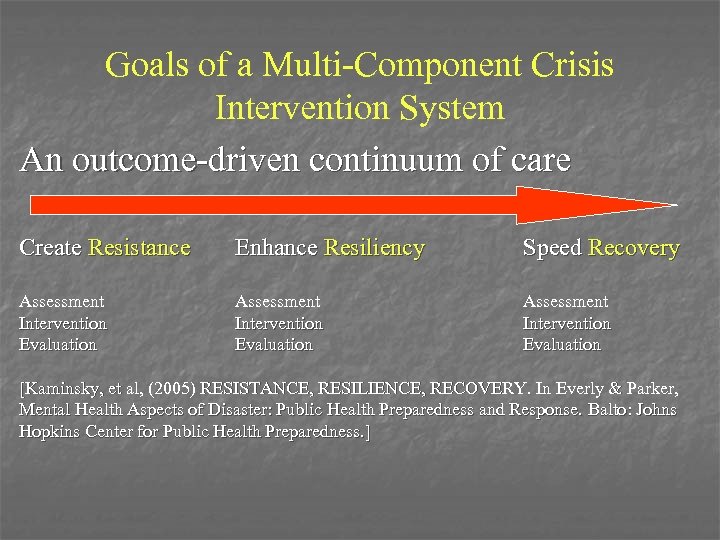 Goals of a Multi-Component Crisis Intervention System An outcome-driven continuum of care Create Resistance Enhance Resiliency Speed Recovery Assessment Intervention Evaluation [Kaminsky, et al, (2005) RESISTANCE, RESILIENCE, RECOVERY. In Everly & Parker, Mental Health Aspects of Disaster: Public Health Preparedness and Response. Balto: Johns Hopkins Center for Public Health Preparedness. ]
 CISM is a strategic intervention system. It possesses numerous tactical interventions of which CISD is one.
 The challenge in crisis intervention is not only developing TACTICAL skills in the “core intervention competencies, ” but is in knowing when to best STRATEGICALLY employ the most appropriate intervention for the situation.
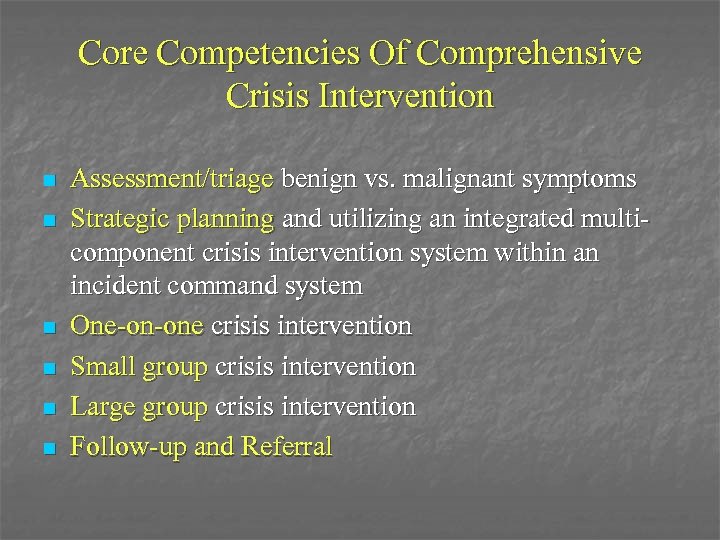 Core Competencies Of Comprehensive Crisis Intervention n n n Assessment/triage benign vs. malignant symptoms Strategic planning and utilizing an integrated multicomponent crisis intervention system within an incident command system One-on-one crisis intervention Small group crisis intervention Large group crisis intervention Follow-up and Referral
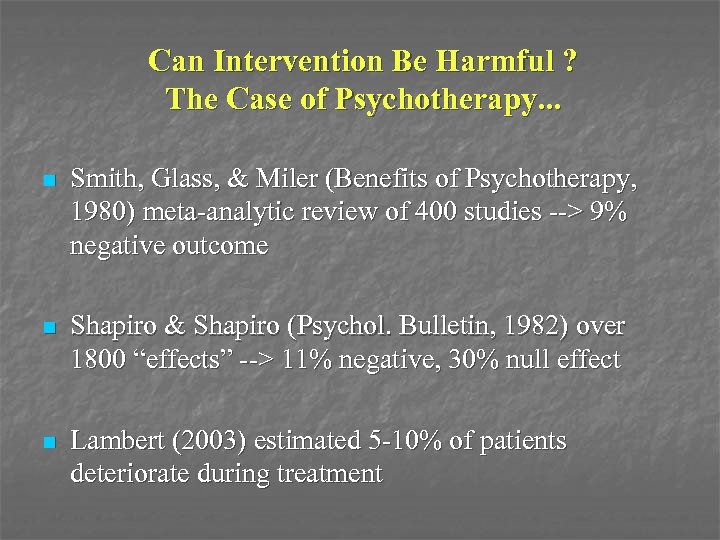 Can Intervention Be Harmful ? The Case of Psychotherapy. . . n Smith, Glass, & Miler (Benefits of Psychotherapy, 1980) meta-analytic review of 400 studies --> 9% negative outcome n Shapiro & Shapiro (Psychol. Bulletin, 1982) over 1800 “effects” --> 11% negative, 30% null effect n Lambert (2003) estimated 5 -10% of patients deteriorate during treatment
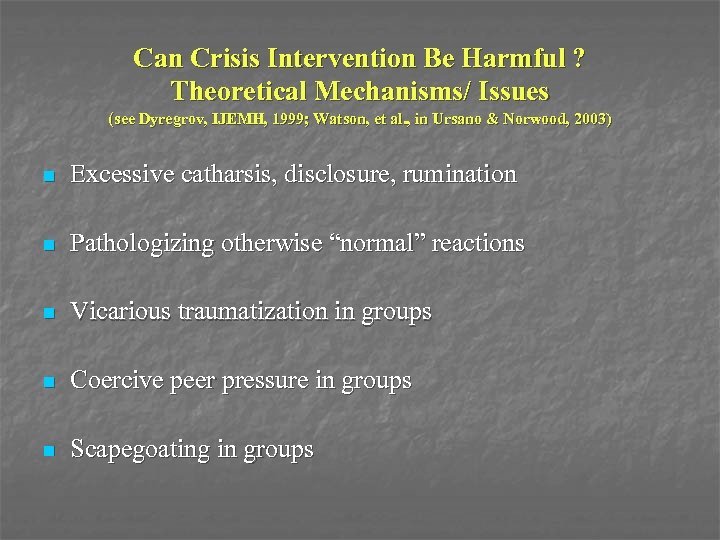 Can Crisis Intervention Be Harmful ? Theoretical Mechanisms/ Issues (see Dyregrov, IJEMH, 1999; Watson, et al. , in Ursano & Norwood, 2003) n Excessive catharsis, disclosure, rumination n Pathologizing otherwise “normal” reactions n Vicarious traumatization in groups n Coercive peer pressure in groups n Scapegoating in groups
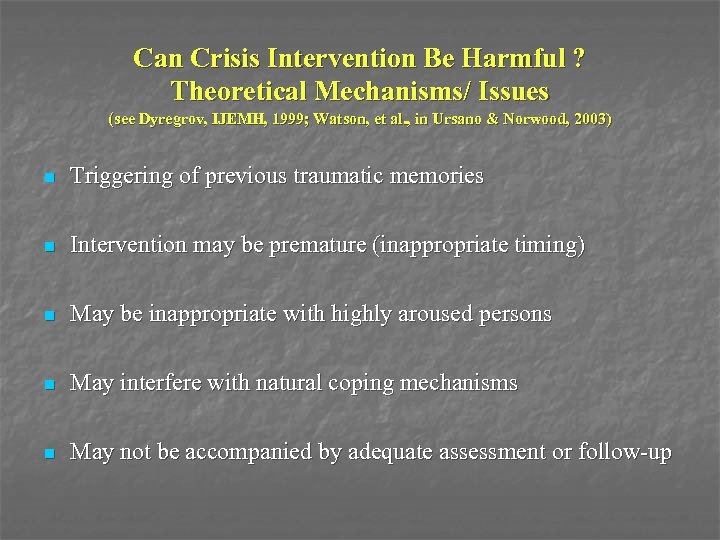 Can Crisis Intervention Be Harmful ? Theoretical Mechanisms/ Issues (see Dyregrov, IJEMH, 1999; Watson, et al. , in Ursano & Norwood, 2003) n Triggering of previous traumatic memories n Intervention may be premature (inappropriate timing) n May be inappropriate with highly aroused persons n May interfere with natural coping mechanisms n May not be accompanied by adequate assessment or follow-up
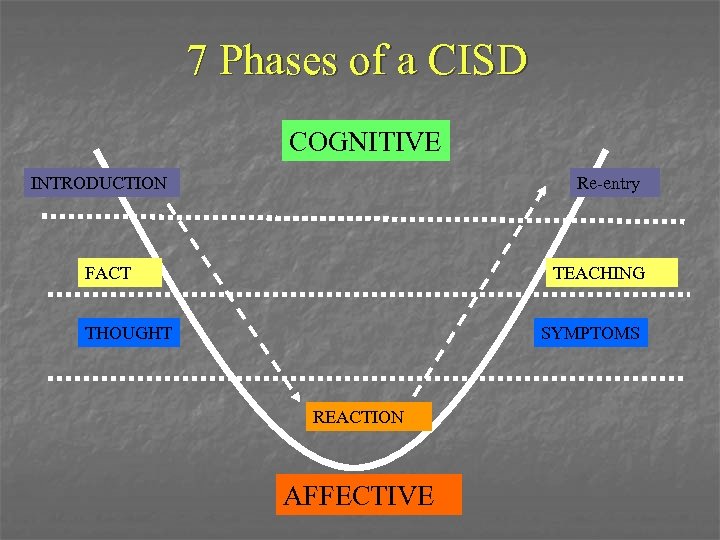 7 Phases of a CISD COGNITIVE INTRODUCTION Re-entry FACT TEACHING THOUGHT SYMPTOMS REACTION AFFECTIVE
 Reducing Risk of Adverse Reactions n Keep CISD within the multi-component context of CISM: CISD should never be a stand alone intervention. It should only be used when it is part of a package of interventions which includes follow-up services.
 Reducing Risk of Adverse Reactions n The group CISD process should never be used for individuals since it was designed for groups n CISD should not be used to achieve psychotherapeutic outcome: CISD is not psychotherapy nor a substitute for psychotherapy
 Reviews which have been critical of small group “debriefing” cite 3 primary concerns: n Traumatic story-telling may traumatize other participants n Probing into affective domain with those who experience numbing & avoidance may trigger pathognomonic retraumatization (Watson, et al. , 2003, in Trauma & Disaster; Stokes, 2002, Cautions & Contraindications for Debriefings) (North, 2003, in Trauma & Disaster; Stokes, 2002) n Inappropriate timing for hyper-aroused individuals (NIMH, 2002)
 To address concerns related to group “debriefing” n Maintain/facilitate an educational and story-telling format (Shalev, et al. , 2003, Terrorism & Disaster) n Utilize homogeneous groups so as to prevent traumatization from “new” information (similar levels of exposure and function: n n n do not include bystanders, etc. with professionals Judgement call about mixing professions (Fire, EMS, Law Enforcement) note: ICISF discourages mixing Avoid delving into the affective aspects with groups that are experiencing heightened arousal, avoidance, or numbing (North, 2003; Stokes, 2002)
 To address concerns related to group “debriefing” n Unless the magnitude of impairment is such that the individual represents a threat to self or others, crisis intervention should be voluntary. n The interventionist must be careful not to interfere with natural recovery or adaptive compensatory mechanisms. n The CISD has not ended until the majority of the group has returned to the cognitive domain – and/or may require individual referrals to higher level of care
 Summary Risks vs. Benefits of CISM n n n The risk of adverse outcome is associated with all human intervention and helping practices including medicine, surgery, and counseling. Improper, inadequate training would appear the greatest risk factor associated with crisis intervention, as well as those practices just mentioned. Thus, training and supervision may be the best way to reduce the risk of adverse outcome, rather than simply calling for an end to such helping practices.
 Effectiveness Of Peer Support Personnel References n Peer Support Personnel are essential in the CISM process n n n Authentic Normalization Rapport Clarification of protocol/process Etc. Truax & Carkhuff, 1967, Toward Effective Counseling n Durlak, 1979, Psychological Bulletin n Hattie, Sharpley, Rogers, 1984, Psychological Bulletin
 Important CISD Considerations & Ground Rules n n n n n Strict Confidentiality agreed upon by participants and team Timing is important Location and physical environment appropriate Closed circle format Participation voluntary No notes, recording devices No breaks (Try to limit breaks until after group is finished) Not operational critique, not investigation Not a “blame” session Not therapy, nor substitute for treatment
 Qu es ti o ns ?
 Additional Information and More Slides • International Critical Incident Stress Foundation http: //www. icisf. org/articles/ • Crisis Intervention and Critical Incident Stress Management: A Defense of the Field http: //www. icisf. org/articles/Acrobat%20 Documents/CISM_Defense_of_Fiel d. pdf • National Organization for Victim Assistance NOVA http: //www. trynova. org
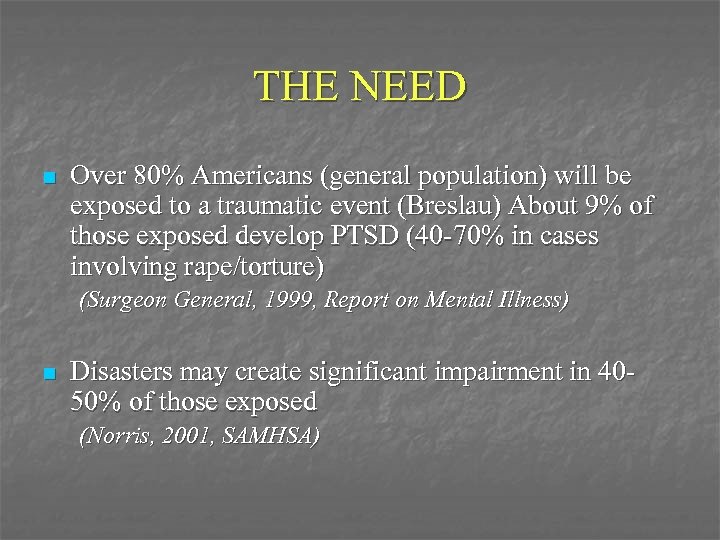 THE NEED n Over 80% Americans (general population) will be exposed to a traumatic event (Breslau) About 9% of those exposed develop PTSD (40 -70% in cases involving rape/torture) (Surgeon General, 1999, Report on Mental Illness) n Disasters may create significant impairment in 4050% of those exposed (Norris, 2001, SAMHSA)
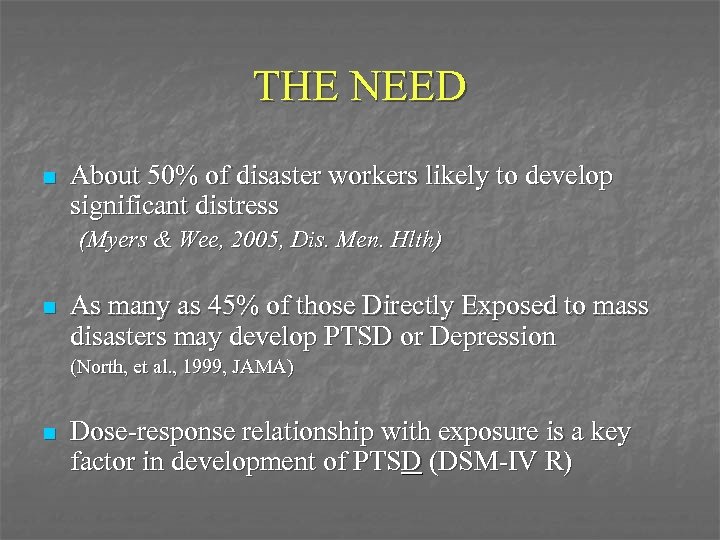 THE NEED n About 50% of disaster workers likely to develop significant distress (Myers & Wee, 2005, Dis. Men. Hlth) n As many as 45% of those Directly Exposed to mass disasters may develop PTSD or Depression (North, et al. , 1999, JAMA) n Dose-response relationship with exposure is a key factor in development of PTSD (DSM-IV R)
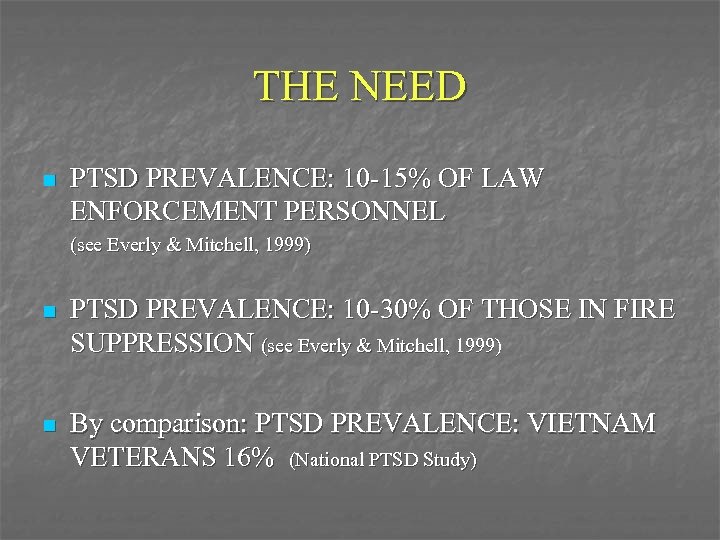 THE NEED n PTSD PREVALENCE: 10 -15% OF LAW ENFORCEMENT PERSONNEL (see Everly & Mitchell, 1999) n PTSD PREVALENCE: 10 -30% OF THOSE IN FIRE SUPPRESSION (see Everly & Mitchell, 1999) n By comparison: PTSD PREVALENCE: VIETNAM VETERANS 16% (National PTSD Study)
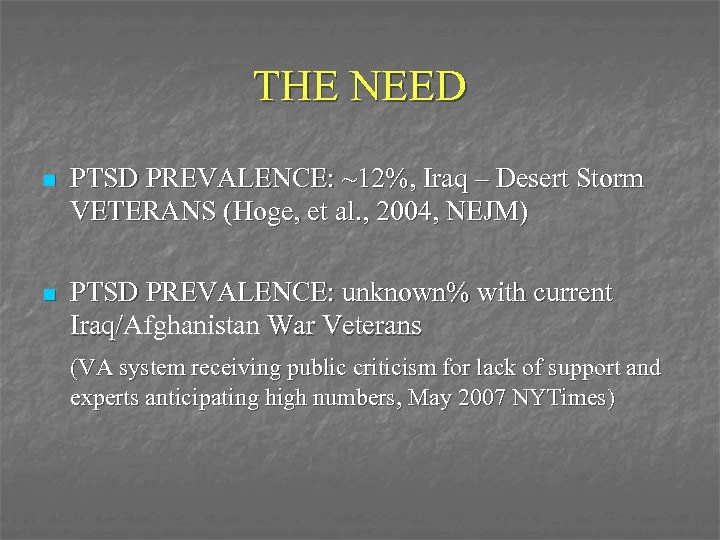 THE NEED n PTSD PREVALENCE: ~12%, Iraq – Desert Storm VETERANS (Hoge, et al. , 2004, NEJM) n PTSD PREVALENCE: unknown% with current Iraq/Afghanistan War Veterans Iraq/ (VA system receiving public criticism for lack of support and experts anticipating high numbers, May 2007 NYTimes)
 By way of background… The National Volunteer Organizations Active in Disaster (NVOAD) represents a consortium of non-governmental agencies providing disaster relief. NVOAD member organizations represent the largest group of non-governmental providers of disaster mental health services in North America.
 NVOAD Consensus Points (2005) n n n Early Psychological Intervention (EPI) is valued EPI is a multi-component system to meet the needs of those impacted Specialized training in early psychological intervention is necessary
 NVOAD Consensus Points (2005) n n EPI is one point on a continuum of psychological care. This spectrum ranges from pre-incident preparedness to postincident psychotherapy -- when needed Cooperation, communication, coordination and collaboration are essential to the delivery of EPI
 NVOAD Interventions (2005) n n n n Pre-incident preparation Incident assessment and strategic planning Risk and crisis communication Acute psychological assessment and triage Crisis intervention with large groups Crisis intervention with small groups Crisis intervention with individuals, face-toface and hotlines
 NVOAD Interventions (2005) n n Crisis planning and intervention with communities Crisis planning and intervention with organizations Psychological first aid (PFA) Facilitating of access to appropriate levels of care when needed
 NVOAD Interventions (2005) n n Assisting special and diverse populations Spiritual assessment and care n n n All NVOAD recognize need for spiritual care Self care and family care including safety and security Post incident evaluation and training based on lessons learned
 Employee Assistance Professional’s Association Disaster Response Task Force (EAPA, 2002) n n EAPS should develop workplace disaster plans Plans should consist of a continuum of interventions, including: Pre-Incident Training/Coordination (early CISM intervention training, resiliency training, risk assessment, policy development) Acute response protocols
 Employee Assistance Professional’s Association Disaster Response Task Force (EAPA, 2002) n Plans should consist of a continuum of interventions including: n Post-Incident Response (defusing, CISD, crisis management briefings, assessment/ referral, self-care) Follow-up (supervisory briefings, assessment, training) Post-Incident Review and Plan Reformulation n n