


 Скачать презентацию Cinelink Sarajevo film festival July 13 th 2012
6f872d26717b28567585645472742ee2.ppt
- Количество слайдов: 39
 Cinelink, Sarajevo film festival July 13 th, 2012 Introducing the CNC Eric GARANDEAU, President
 Introducing the CNC I. About CNC II. CNC Today III. Resources IV. Impact on film Funding V. Attendance & Digital Screens VI. Cinémathèque on line VII. World Cinema Support VIII. « Le jour le plus Court »
 I. About CNC Why should the government care? Cinema : a specific industry, and much more • The cultural need to harbour a free & dynamic production industry… – Cinema as a vector of cultural identity – WWII propaganda: State-controlled cinema at its worse • … confronted with a “casino economy”… – Costly production – High risk entailed – Low average yield for producers • … and a national industry fraught with weaknesses. . – Fragmented production base – Narrow market, compared to the US • … entailing market failures & structural credit crunch – Hard time for newcomers & daring creators
 I. About CNC 3 major assumptions, leading to the creation of CNC : • Need for rules and public support – To compensate for market failures • Reallocating added-value is the key – Imposing forced saving upon producers: the supports account mechanism (“compte de soutien automatique”) – Infusing solidarity among producers: selective support schemes – Ensuring adequate return for producers: solidarity across the value-chain through regulated funding (“financements encadrés”) • Taxes and/or compulsory production investments imposed on downstream sectors (exhibitors, video, TV. . ) • In return for exclusive exploitation of works within specific timeframes (“chronologie des médias”) • Legitimate decision-making is of the essence – Providing the right forum for debate: fair representation of stakeholders – Committee-based decision-making / Public arbitration as a last resort
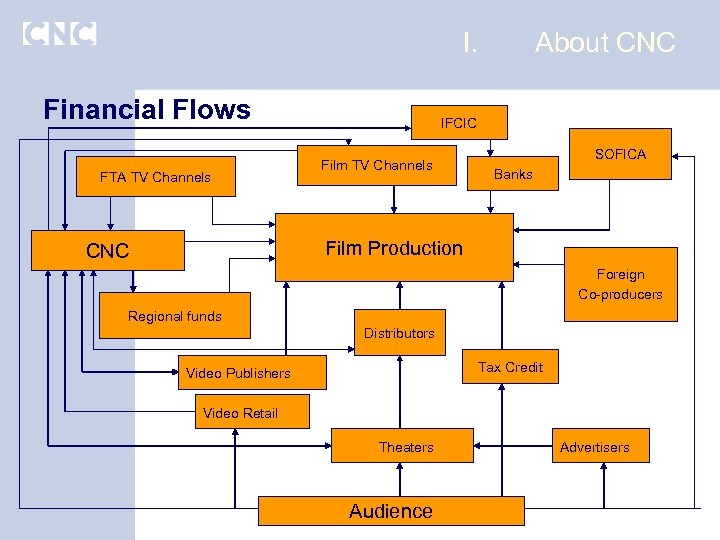 I. Financial Flows FTA TV Channels About CNC IFCIC Film TV Channels SOFICA Banks Film Production CNC Foreign Co-producers Regional funds Distributors Tax Credit Video Publishers Video Retail Theaters Audience Advertisers
 II. CNC Today • Created in 1946, last streamlined in July 2009 • A fully-fledged agency: autonomous public body (both legally & financially) exercising the full spectrum of public policies on behalf of the Government • Competent within the full scope of animated image (cinema, audiovisual works, cross-media, video-games) • Exclusively funded through taxes directly levied on the revenues derided by private operators from the exploitation of audiovisual works Exception : tax breaks • Committee-based decision making
 II. CNC Today Missions: 1. 2. 3. 4. 5. 6. Regulation (design, implementation & control) Financial support (creation & circulation of works) Film heritage policy Supervision of professional training Education of the younger audiences International negotiations & co-operation
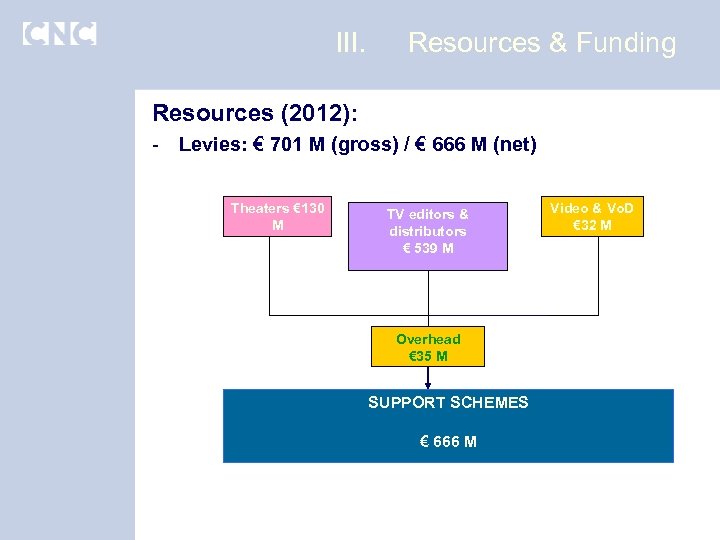 III. Resources & Funding Resources (2012): - Levies: € 701 M (gross) / € 666 M (net) Theaters € 130 M TV editors & distributors € 539 M Overhead € 35 M SUPPORT SCHEMES € 666 M Video & Vo. D € 32 M
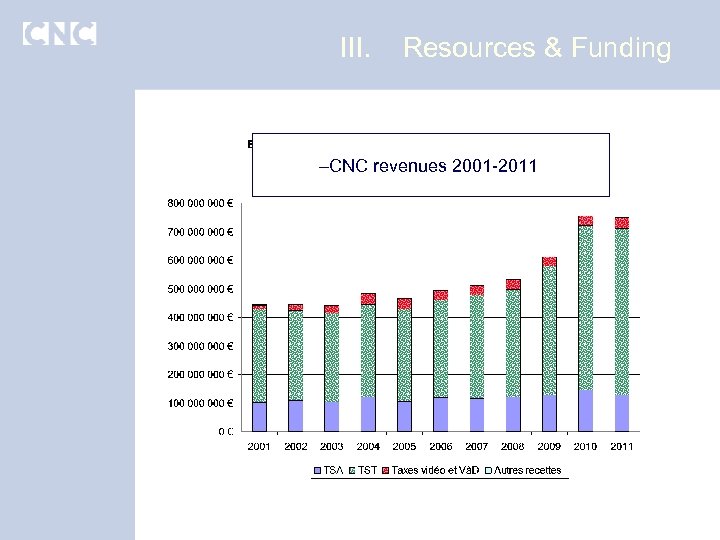 III. Resources & Funding –CNC revenues 2001 -2011
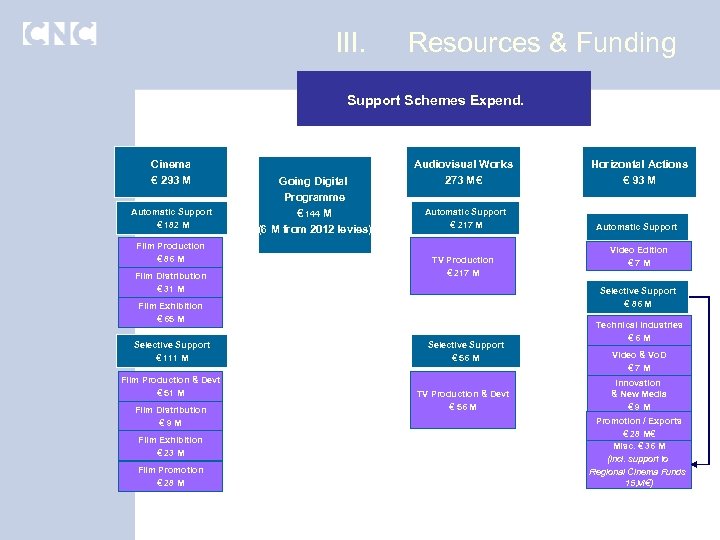 III. Resources & Funding Support Schemes Expend. Cinema € 293 M Automatic Support € 182 M Film Production € 86 M Film Distribution € 31 M Going Digital Programme € 144 M (6 M from 2012 levies) Audiovisual Works 273 M€ Horizontal Actions € 93 M Automatic Support € 217 M Automatic Support TV Production € 217 M Selective Support € 86 M Film Exhibition € 65 M Selective Support € 111 M Film Production & Devt € 51 M Film Distribution € 9 M Film Exhibition € 23 M Film Promotion € 28 M Video Edition € 7 M Selective Support € 56 M TV Production & Devt € 56 M Technical Industries € 6 M Video & Vo. D € 7 M Innovation & New Media € 9 M Promotion / Exports € 28 M€ Misc. € 36 M (incl. support to Regional Cinema Funds 15, M€)
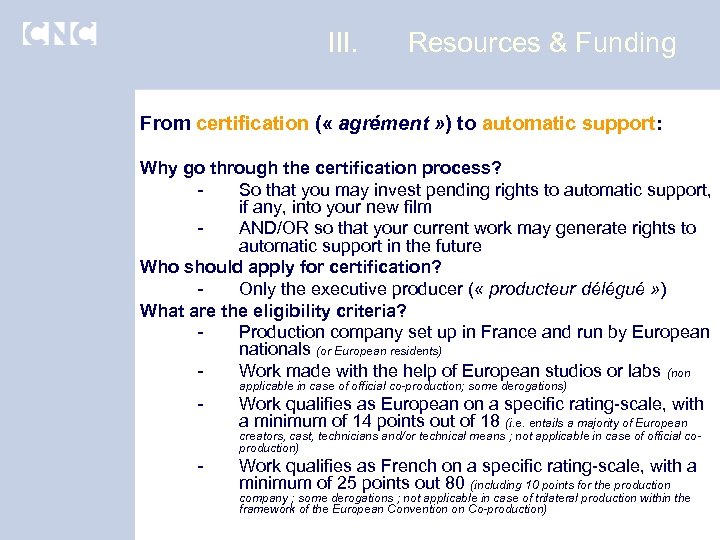 III. Resources & Funding From certification ( « agrément » ) to automatic support: Why go through the certification process? So that you may invest pending rights to automatic support, if any, into your new film AND/OR so that your current work may generate rights to automatic support in the future Who should apply for certification? Only the executive producer ( « producteur délégué » ) What are the eligibility criteria? Production company set up in France and run by European nationals (or European residents) Work made with the help of European studios or labs (non applicable in case of official co-production; some derogations) - Work qualifies as European on a specific rating-scale, with a minimum of 14 points out of 18 (i. e. entails a majority of European creators, cast, technicians and/or technical means ; not applicable in case of official coproduction) - Work qualifies as French on a specific rating-scale, with a minimum of 25 points out 80 (including 10 points for the production company ; some derogations ; not applicable in case of trilateral production within the framework of the European Convention on Co-production)
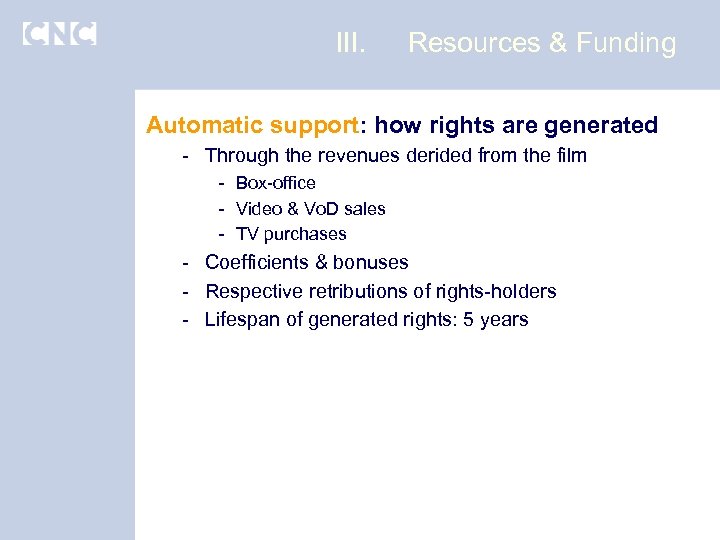 III. Resources & Funding Automatic support: how rights are generated - Through the revenues derided from the film - Box-office - Video & Vo. D sales - TV purchases - Coefficients & bonuses - Respective retributions of rights-holders - Lifespan of generated rights: 5 years
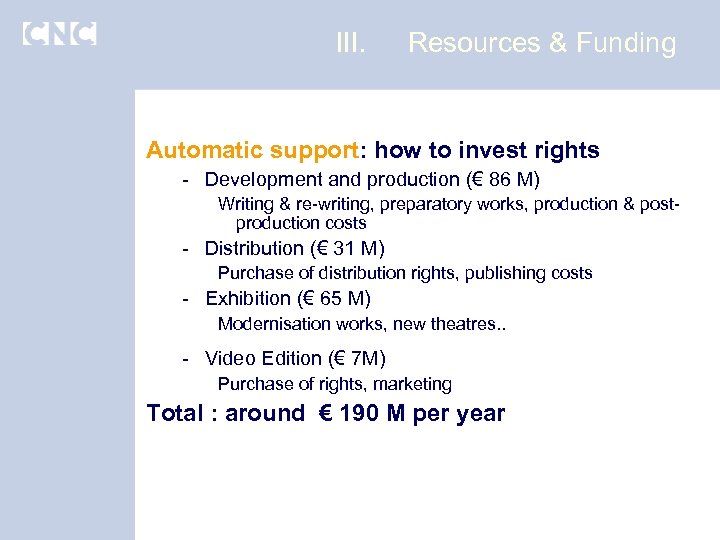 III. Resources & Funding Automatic support: how to invest rights - Development and production (€ 86 M) Writing & re-writing, preparatory works, production & postproduction costs - Distribution (€ 31 M) Purchase of distribution rights, publishing costs - Exhibition (€ 65 M) Modernisation works, new theatres. . - Video Edition (€ 7 M) Purchase of rights, marketing Total : around € 190 M per year
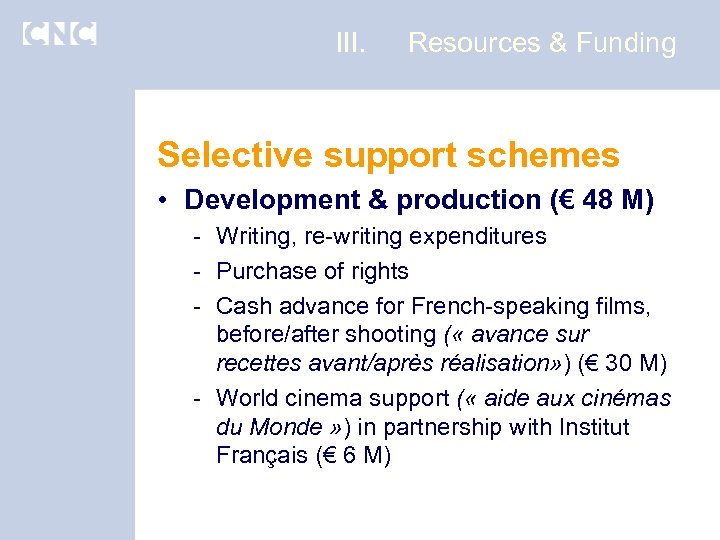 III. Resources & Funding Selective support schemes • Development & production (€ 48 M) - Writing, re-writing expenditures - Purchase of rights - Cash advance for French-speaking films, before/after shooting ( « avance sur recettes avant/après réalisation» ) (€ 30 M) - World cinema support ( « aide aux cinémas du Monde » ) in partnership with Institut Français (€ 6 M)
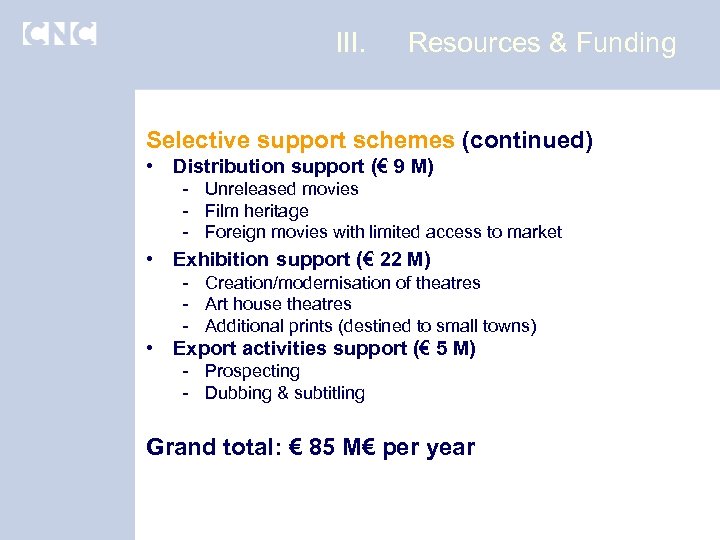 III. Resources & Funding Selective support schemes (continued) • Distribution support (€ 9 M) - Unreleased movies - Film heritage - Foreign movies with limited access to market • Exhibition support (€ 22 M) - Creation/modernisation of theatres - Art house theatres - Additional prints (destined to small towns) • Export activities support (€ 5 M) - Prospecting - Dubbing & subtitling Grand total: € 85 M€ per year
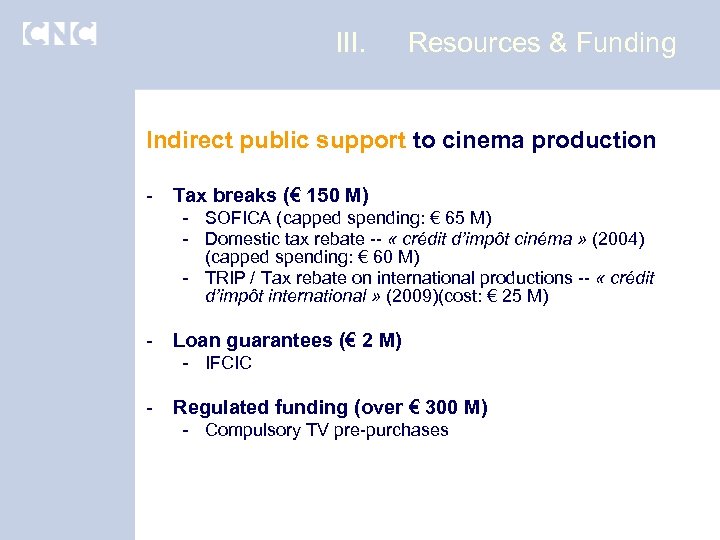 III. Resources & Funding Indirect public support to cinema production - Tax breaks (€ 150 M) - SOFICA (capped spending: € 65 M) - Domestic tax rebate -- « crédit d’impôt cinéma » (2004) (capped spending: € 60 M) - TRIP / Tax rebate on international productions -- « crédit d’impôt international » (2009)(cost: € 25 M) - Loan guarantees (€ 2 M) - IFCIC - Regulated funding (over € 300 M) - Compulsory TV pre-purchases
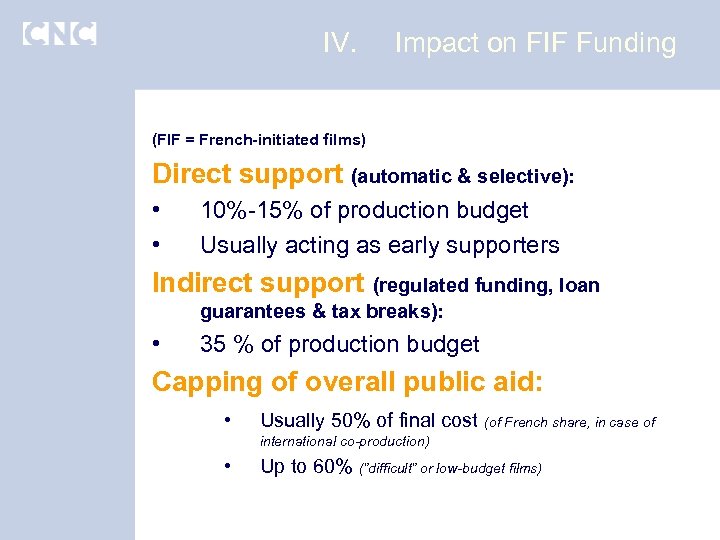 IV. Impact on FIF Funding (FIF = French-initiated films) Direct support (automatic & selective): • • 10%-15% of production budget Usually acting as early supporters Indirect support (regulated funding, loan guarantees & tax breaks): • 35 % of production budget Capping of overall public aid: • Usually 50% of final cost (of French share, in case of international co-production) • Up to 60% (”difficult” or low-budget films)
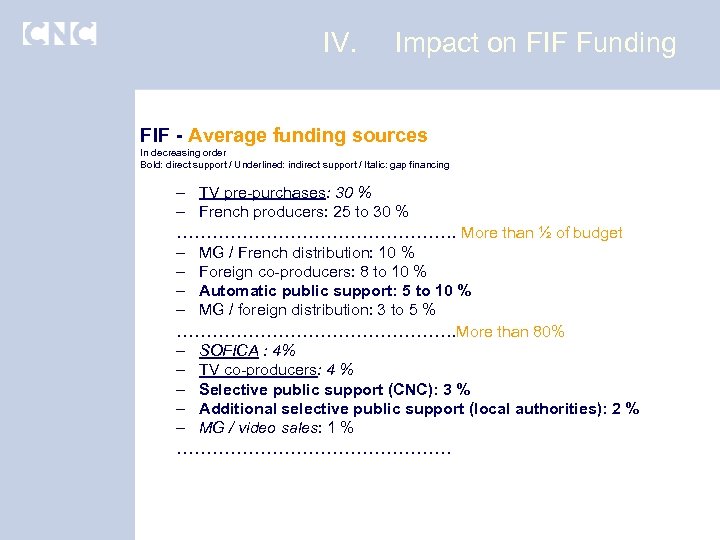 IV. Impact on FIF Funding FIF - Average funding sources In decreasing order Bold: direct support / Underlined: indirect support / Italic: gap financing – TV pre-purchases: 30 % – French producers: 25 to 30 % ……………………. . More than ½ of budget – – MG / French distribution: 10 % Foreign co-producers: 8 to 10 % Automatic public support: 5 to 10 % MG / foreign distribution: 3 to 5 % ……………………. . More than 80% – SOFICA : 4% – TV co-producers: 4 % – Selective public support (CNC): 3 % – Additional selective public support (local authorities): 2 % – MG / video sales: 1 % …………………….
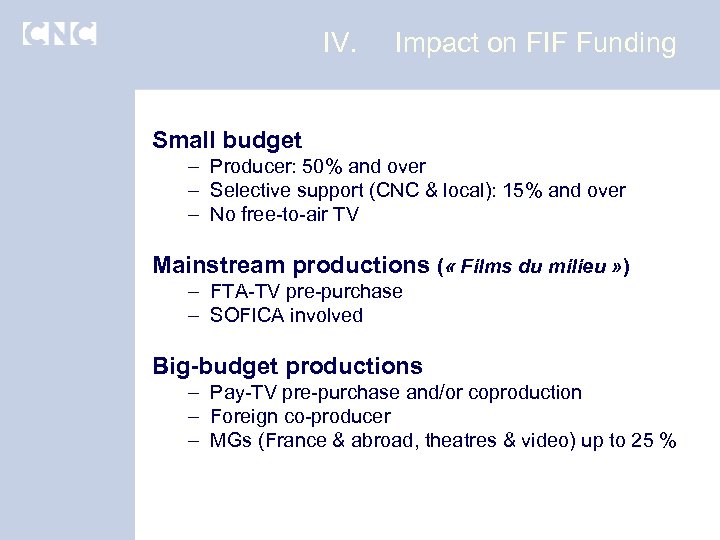 IV. Impact on FIF Funding Small budget – Producer: 50% and over – Selective support (CNC & local): 15% and over – No free-to-air TV Mainstream productions ( « Films du milieu » ) – FTA-TV pre-purchase – SOFICA involved Big-budget productions – Pay-TV pre-purchase and/or coproduction – Foreign co-producer – MGs (France & abroad, theatres & video) up to 25 %
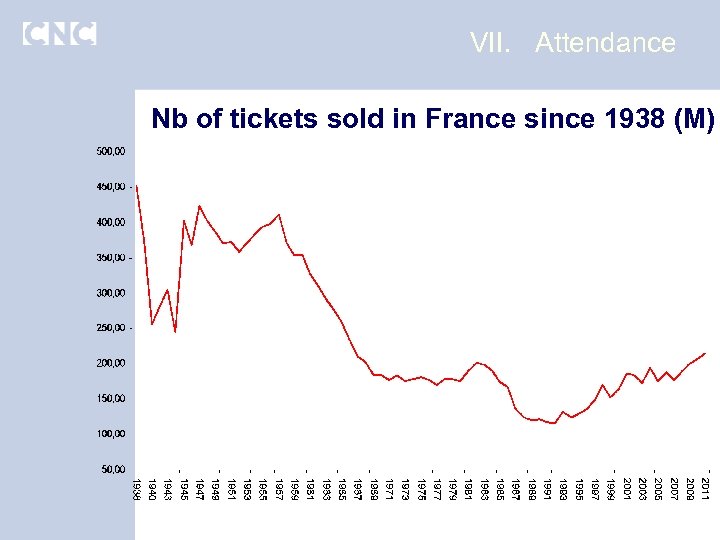 VII. Attendance Nb of tickets sold in France since 1938 (M)
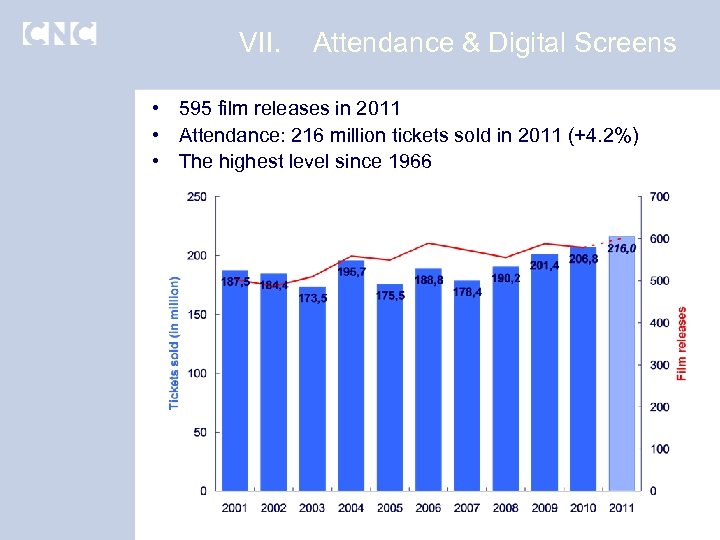 VII. Attendance & Digital Screens • 595 film releases in 2011 • Attendance: 216 million tickets sold in 2011 (+4. 2%) • The highest level since 1966
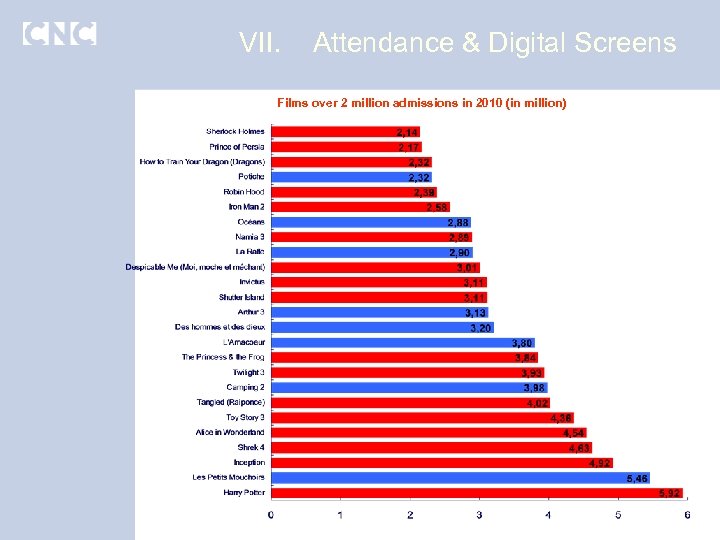 VII. Attendance & Digital Screens Films over 2 million admissions in 2010 (in million)
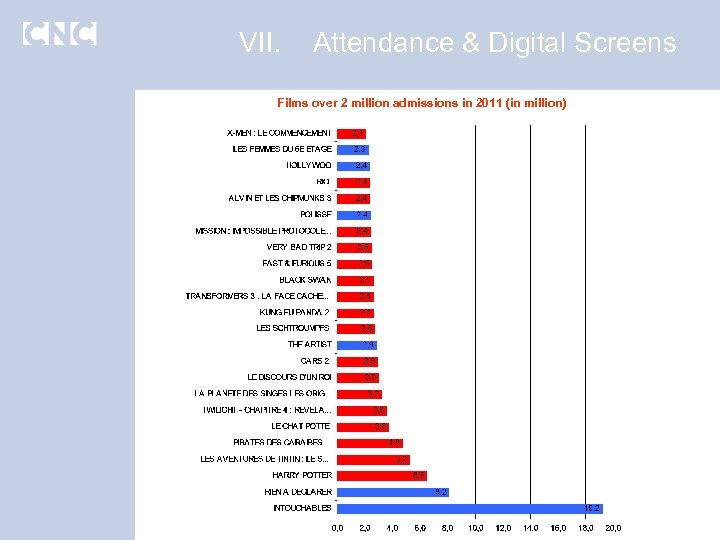 VII. Attendance & Digital Screens Films over 2 million admissions in 2011 (in million)
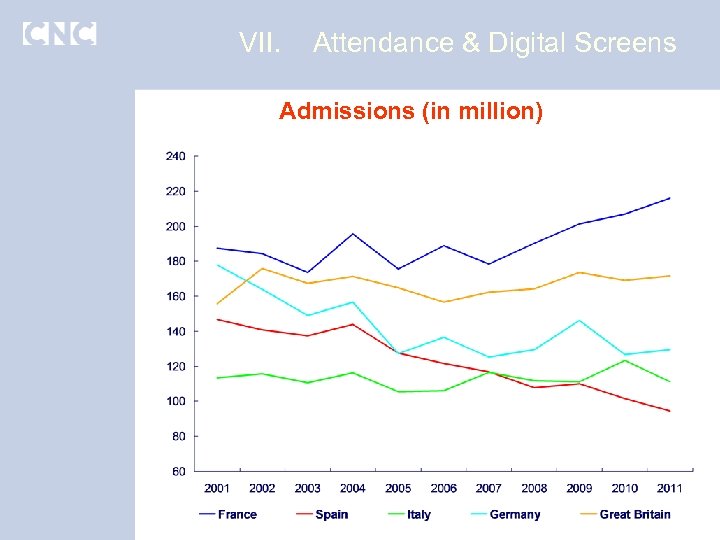 VII. Attendance & Digital Screens Admissions (in million)
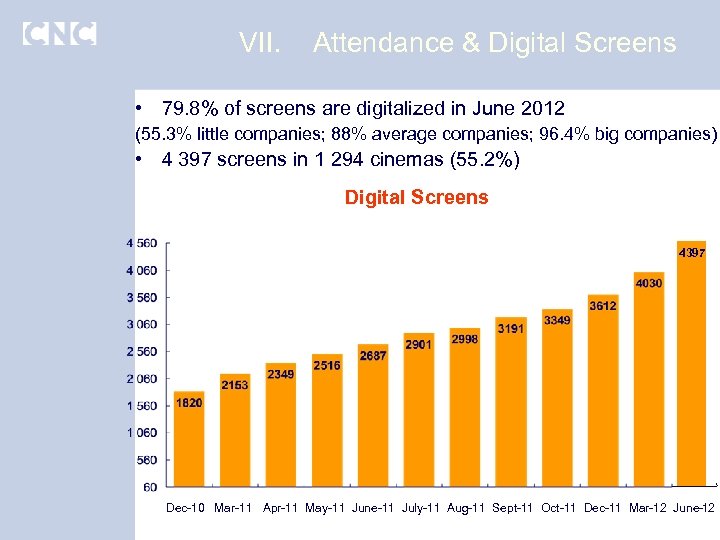 VII. Attendance & Digital Screens • 79. 8% of screens are digitalized in June 2012 (55. 3% little companies; 88% average companies; 96. 4% big companies) • 4 397 screens in 1 294 cinemas (55. 2%) Digital Screens 4397 Dec-10 Mar-11 Apr-11 May-11 June-11 July-11 Aug-11 Sept-11 Oct-11 Dec-11 Mar-12 June-12
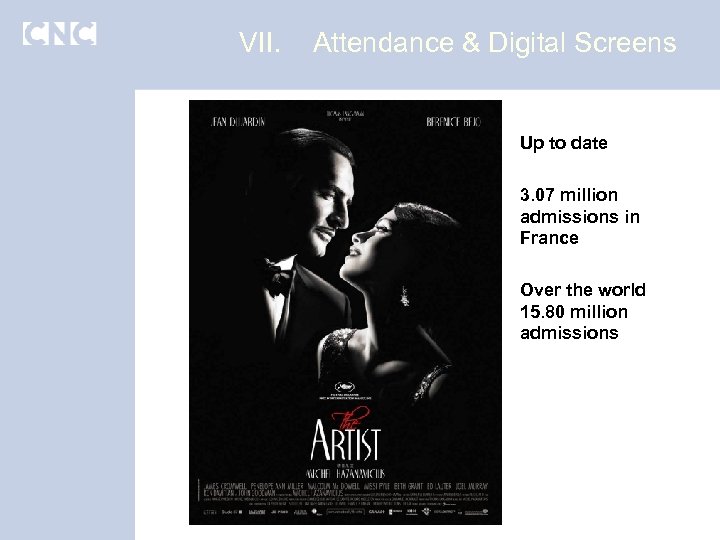 VII. Attendance & Digital Screens Up to date 3. 07 million admissions in France Over the world 15. 80 million admissions
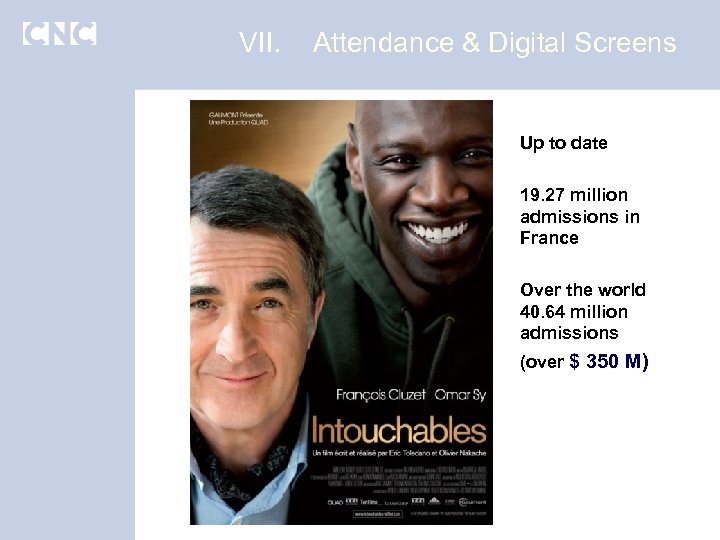 VII. Attendance & Digital Screens Up to date 19. 27 million admissions in France Over the world 40. 64 million admissions (over $ 350 M)
 VI. Cinémathèque on line The digital revolution and cinematographic heritage • The restoration and digitalization of heritage films is part of this revolution. Financial aid is being set up: the CNC’s subsidies will in priority be granted for the most fragile films. The subsidies from the ‘Great Loan’ will go to the most financially viable films. • The works will, at minimum, be digitalized in 2 K format, to ensure that they can be shown in cinemas and on all mediums. • This revolution will enable a whole host of forgotten works to be screened, screened again and given new life. A Journey of Discovery Bucking Broadway - Restoration
 VI. Cinémathèque on line A platform of references • This offer must be organised as reference points are becoming necessary for the general public. The transmission of this heritage must be accompanied by the transmission of technical and cultural knowledge, and contextual keys. A Journey of Discovery The Lumiere Project - Identification • The project for a ‘platform of references’ for heritage cinema which the CNC has undertaken with the Cinémathèque Française is part of this action. This project also involves several film libraries in the regions and is open to institutions which may be interested.
 VI. Cinémathèque on line The digital revolution and cinematographic heritage 1) A a professional tool for managing film, and non film collections 2) A collaborative tool for each institution with its own partners www. cnc-aff. fr : Films yet to be identified
 VI. Cinémathèque on line The digital revolution and cinematographic heritage 3) A general public interface enabling : • The enhancement of collections – Documentary data : A Journey of Discovery Cléopâtre – editorialisation (journey, body…) : A Journey of Discovery A Look at Pierre Coulibeuf – Online exhibitions : www. cinematheque. fr : Exposition virtuelle Albatros • The visualisation of films or extracts in the public domain A Journey of Discovery Tourisme
 V. World Cinema Support Context • Set up in 1984, the Fonds Sud, managed conjointly by the French Ministry of Culture and the French Ministry of Foreign Affairs, contributed to over 500 projects originated from 70 countries, (in Africa, Latin America, Asia and Eastern Europe) for a total of € 55 M. (ex : Apichatpong Weerasethakul’s “Uncle Boonmee”, Palme d’or at Cannes in 2010) • Created in 1999, the Aid to Foreign Language Films, run by the CNC, provided over € 14 million to finance nearly 120 films (mostly from experienced European directors ) (ex : Nanni Moretti’s “Habemus Papam”, Cannes 2011) • In 2011, the CNC and The Institut Français decided to create an expanded and unique system for providing aid to cinema around the world and encouraging coproductions with France. • Since April 2012, the new scheme, Aide aux cinémas du monde (World cinema support), has taken over from Fonds Sud and Aid to Foreign Language Films.
 V. World Cinema Support Objectives • Offer a unique entry point, accessible to artists worldwide, that is adapted to the needs of each filmmaker, while substantially increasing the financial means available to them in order to enable coproduction projects. • Create possibilities of collaboration between foreign filmmakers worldwide and professionals in the French industry, and to facilitate and encourage such associations, in order to coproduce works that promote cultural diversity. • Contribute to the ratification of the Convention of Unesco dated October 20, 2005, which an increasingly large number of countries support, concerning the protection and promotion of the diversity of cultural expression.
 V. World Cinema Support Features • Projects selected by a committee of professionals, according to the degree of artistic excellence, the ability to present a different viewpoint and the level of fragility of their professional base. • In order to pay a particular attention young filmmakers, the committee is made up of two sub-committees (collèges”) : one for 1 st and 2 nd feature films, one for more confirmed film directors. • Priority granted to films from Sub-Saharian Africa, least developed countries, “priority solidarity zone”, countries having ratified the UNESCO Convention and countries having signed a coproduction agreement with France. • The aid may not exceed 50% of the financing provided by the French coproducer (or 80% for coproductions with low resources countries). The maximum aid amount is 250, 000 Euros (50 000 Euros for postproduction). For films over € 2. 5 million, the producers are requested to seek the approval of the CNC.
 V. World Cinema Support Management • The scheme is run conjointly by the Institut français and the CNC, • The total budget of the fund reaches € 6 million in 2012 – nearly twice the amount previously reserved for Fonds Sud (€ 2. 1 million) and the Aid to Foreign Language Films (AFLE) (€ 1. 1 million). • Applications must be filed by the producer established in France (exception : for a list of 73 developing countries, a foreign producer may apply ; the coproduction contract with a French company is only required when the aid is granted). • Four or five sessions take place every year.
 VIII. « Le jour le plus Court »
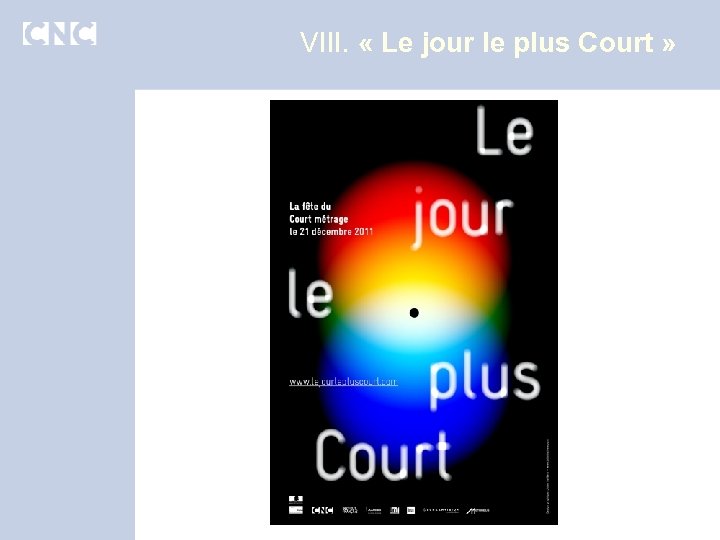
 VIII. « Le jour le plus Court » A participatory film festival initiated by the CNC. Over the whole of French territory and internationally On all screens A Tribute to Short Films Takes place the shortest day of the year ! (21 December)
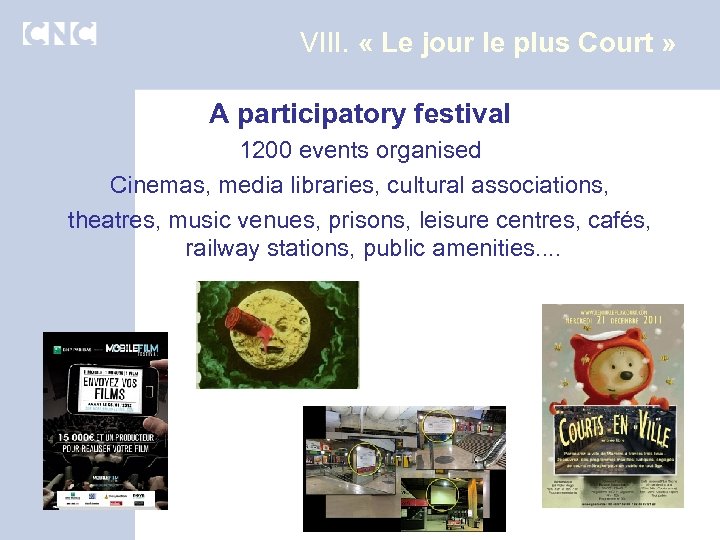 VIII. « Le jour le plus Court » A participatory festival 1200 events organised Cinemas, media libraries, cultural associations, theatres, music venues, prisons, leisure centres, cafés, railway stations, public amenities. .
 VIII. « Le jour le plus Court » An important festival Short films are the talent pool of French cinema, an area of exceptional creativity, but are screened far too rarely : Only 1% of cinema programmes are short film programmes The festival’s goal is therefore to durably increase the visibility of short films Second edition on Friday December 21, 2012