 Скачать презентацию CIM Synbody Technology International Biotechnology Symposium Bio-Asia 2015
CIM Synbody Technology.pptx
- Количество слайдов: 45



CIM Synbody Technology International Biotechnology Symposium Bio-Asia 2015 Inaugural RAACC Workshop Stephen Albert Johnston Center for Innovations in Medicine ASU Stephen. johnston@asu. edu
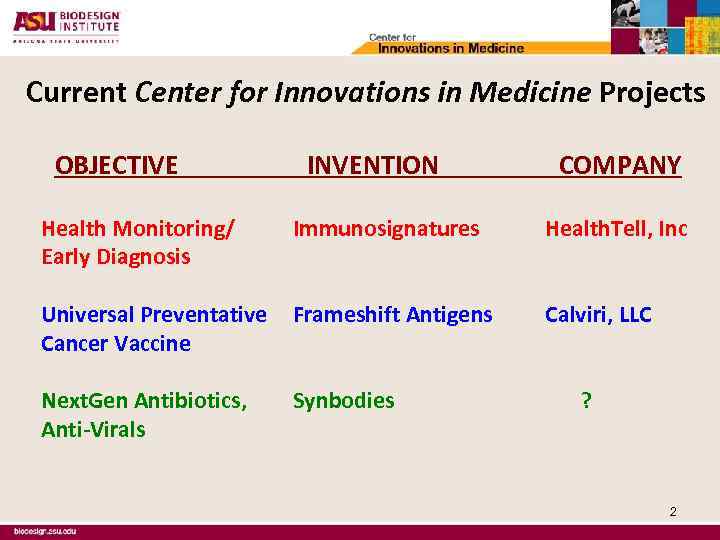
Current Center for Innovations in Medicine Projects OBJECTIVE INVENTION COMPANY Health Monitoring/ Early Diagnosis Immunosignatures Health. Tell, Inc Universal Preventative Cancer Vaccine Frameshift Antigens Calviri, LLC Next. Gen Antibiotics, Anti-Virals Synbodies ? 2
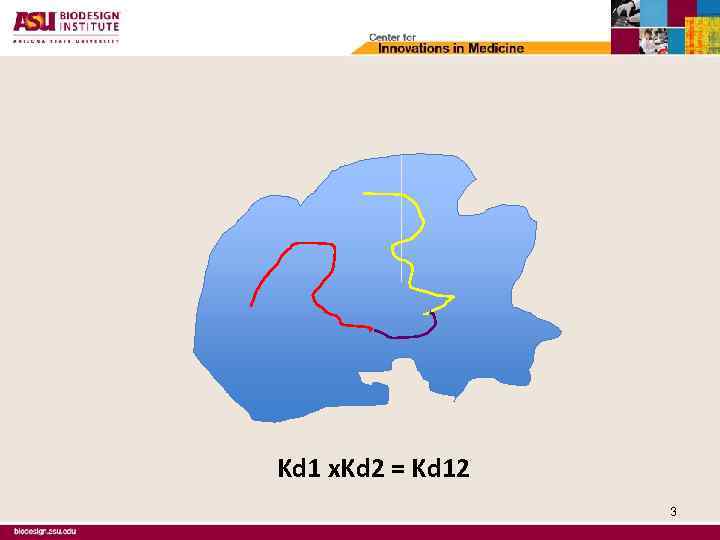
Kd 1 x. Kd 2 = Kd 12 3
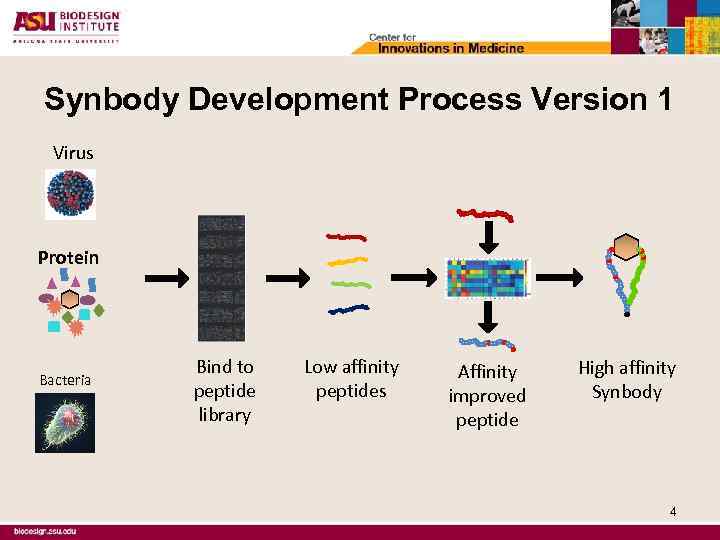
Synbody Development Process Version 1 Virus Protein Bacteria Bind to peptide library Low affinity peptides Affinity improved peptide High affinity Synbody 4
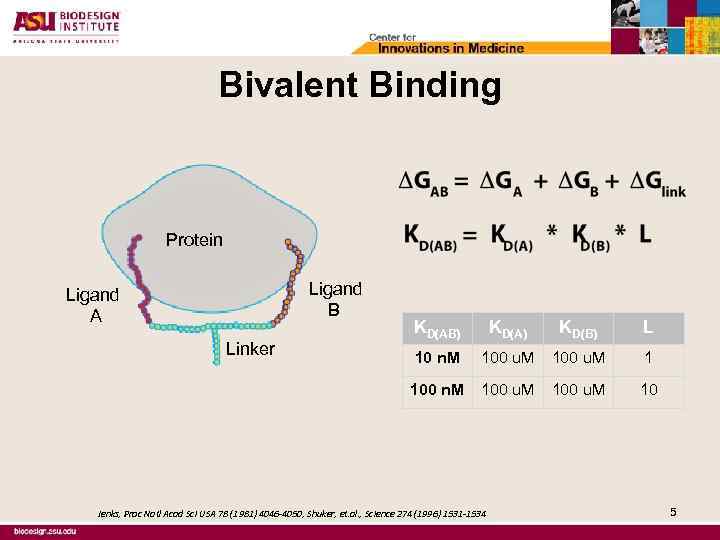
Bivalent Binding Protein Ligand B Ligand A KD(A) KD(B) L 10 n. M 100 u. M 1 100 n. M Linker KD(AB) 100 u. M 10 Jenks, Proc Natl Acad Sci USA 78 (1981) 4046 -4050, Shuker, et. al. , Science 274 (1996) 1531 -1534 5
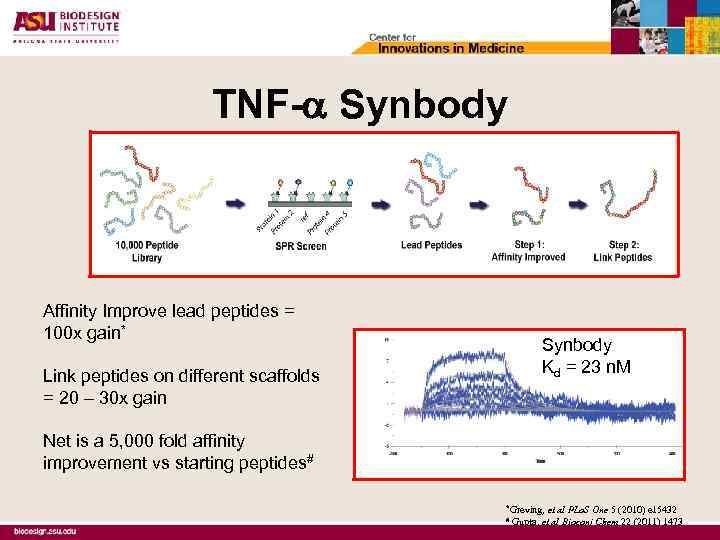
TNF-a Synbody Affinity Improve lead peptides = 100 x gain* Synbody Kd = 23 n. M Link peptides on different scaffolds = 20 – 30 x gain Net is a 5, 000 fold affinity improvement vs starting peptides# *Greving, # et al PLo. S One 5 (2010) e 15432 Gupta, et al Bioconj Chem 22 (2011) 1473
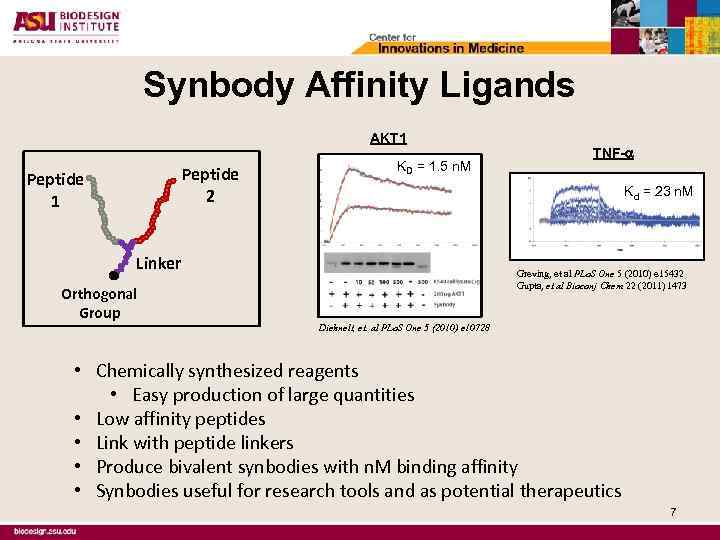
Synbody Affinity Ligands AKT 1 Peptide 2 Peptide 1 KD = 1. 5 n. M Kd = 23 n. M Linker Orthogonal Group TNF-a Greving, et al PLo. S One 5 (2010) e 15432 Gupta, et al Bioconj Chem 22 (2011) 1473 Diehnelt, et. al PLo. S One 5 (2010) e 10728 • Chemically synthesized reagents • Easy production of large quantities • Low affinity peptides • Link with peptide linkers • Produce bivalent synbodies with n. M binding affinity • Synbodies useful for research tools and as potential therapeutics 7
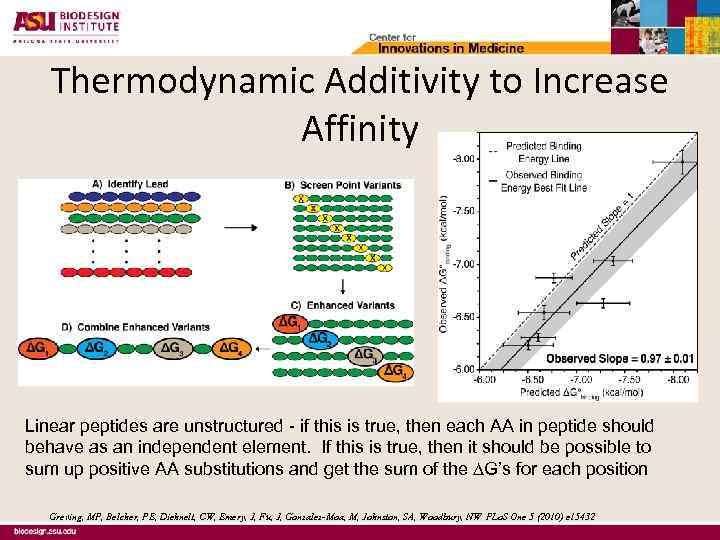
Thermodynamic Additivity to Increase Affinity Linear peptides are unstructured - if this is true, then each AA in peptide should behave as an independent element. If this is true, then it should be possible to sum up positive AA substitutions and get the sum of the DG’s for each position Greving, MP, Belcher, PE, Diehnelt, CW, Emery, J, Fu, J, Gonzalez-Moa, M, Johnston, SA, Woodbury, NW PLo. S One 5 (2010) e 15432
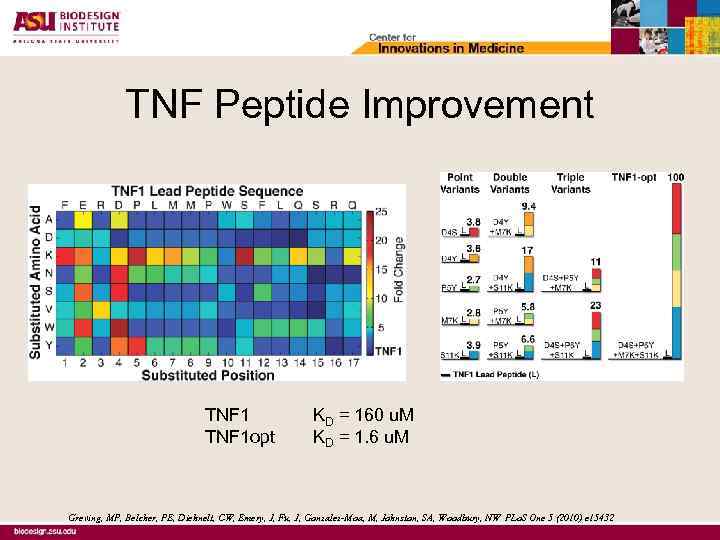
TNF Peptide Improvement TNF 1 opt KD = 160 u. M KD = 1. 6 u. M Greving, MP, Belcher, PE, Diehnelt, CW, Emery, J, Fu, J, Gonzalez-Moa, M, Johnston, SA, Woodbury, NW PLo. S One 5 (2010) e 15432
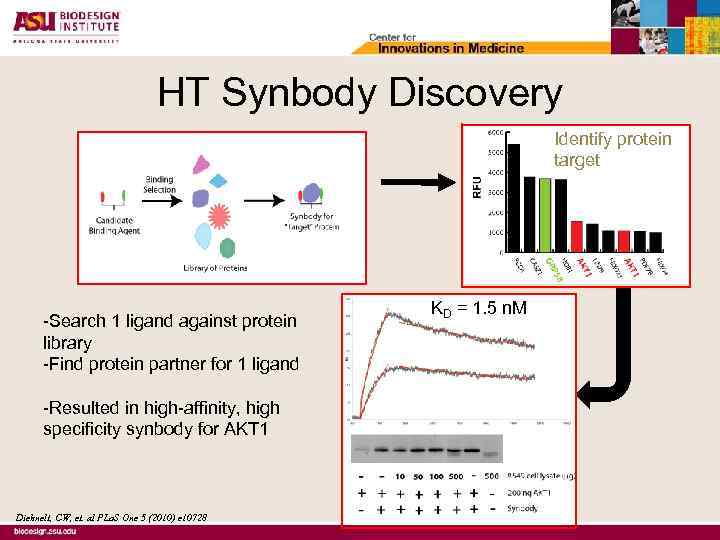
HT Synbody Discovery Identify protein target -Search 1 ligand against protein library -Find protein partner for 1 ligand -Resulted in high-affinity, high specificity synbody for AKT 1 Diehnelt, CW, et. al PLo. S One 5 (2010) e 10728 KD = 1. 5 n. M
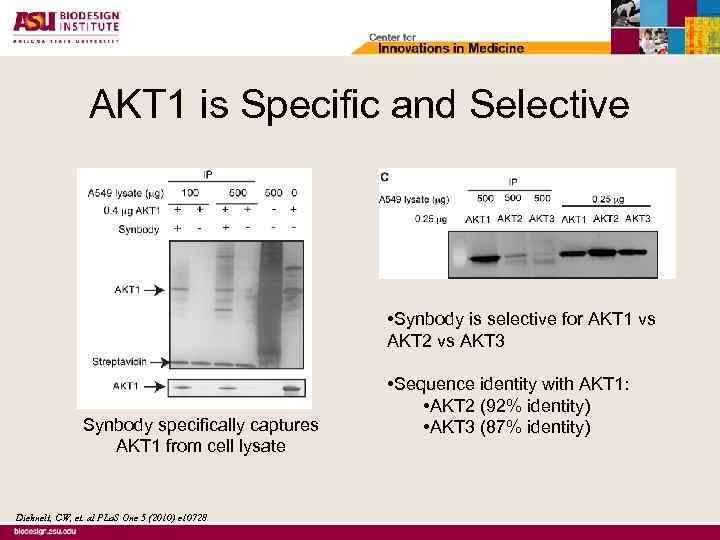
AKT 1 is Specific and Selective • Synbody is selective for AKT 1 vs AKT 2 vs AKT 3 Synbody specifically captures AKT 1 from cell lysate Diehnelt, CW, et. al PLo. S One 5 (2010) e 10728 • Sequence identity with AKT 1: • AKT 2 (92% identity) • AKT 3 (87% identity)
Synbodies for Viruses • Norovirus – Enrichment and Detection • Influenza – Therapeutic 12
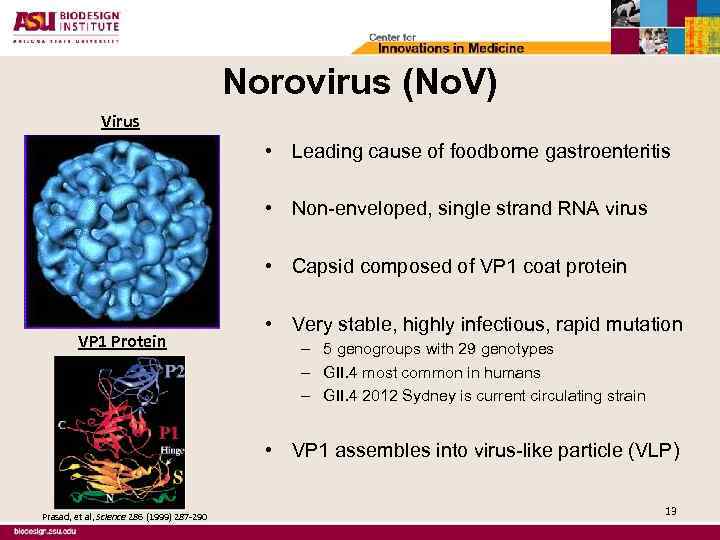
Norovirus (No. V) Virus • Leading cause of foodborne gastroenteritis • Non-enveloped, single strand RNA virus • Capsid composed of VP 1 coat protein VP 1 Protein • Very stable, highly infectious, rapid mutation – 5 genogroups with 29 genotypes – GII. 4 most common in humans – GII. 4 2012 Sydney is current circulating strain • VP 1 assembles into virus-like particle (VLP) Prasad, et al, Science 286 (1999) 287 -290 13
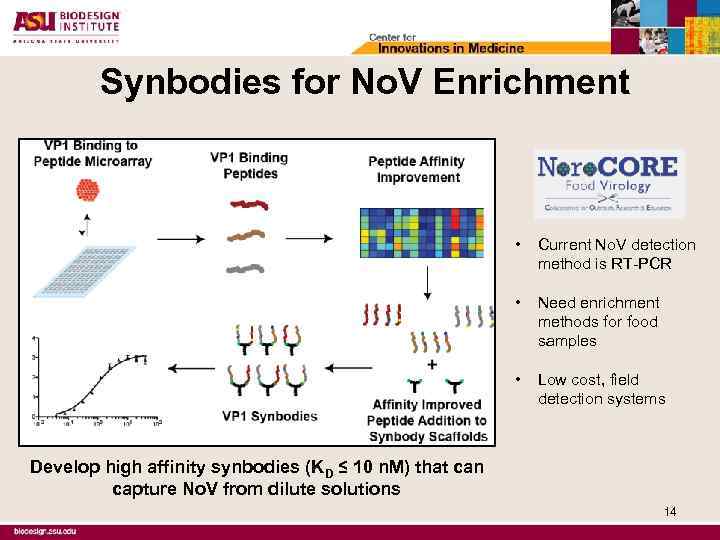
Synbodies for No. V Enrichment • Current No. V detection method is RT-PCR • Need enrichment methods for food samples • Low cost, field detection systems Develop high affinity synbodies (KD ≤ 10 n. M) that can capture No. V from dilute solutions 14
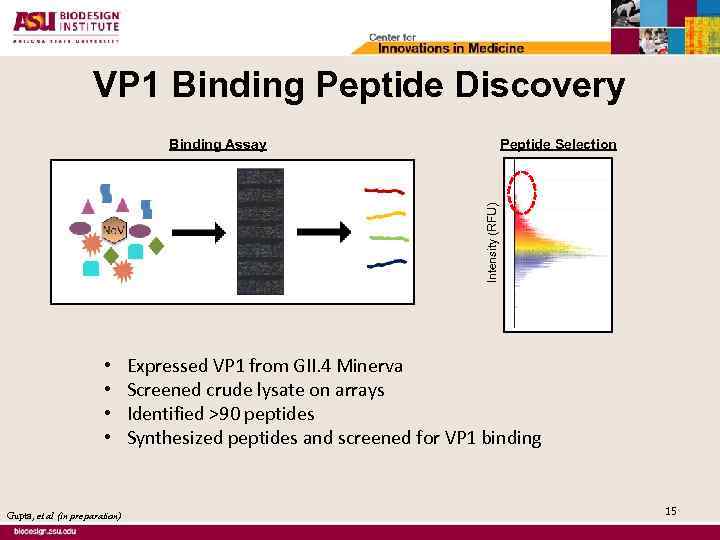
VP 1 Binding Peptide Discovery Peptide Selection Intensity (RFU) Binding Assay • • Gupta, et al (in preparation) Expressed VP 1 from GII. 4 Minerva Screened crude lysate on arrays Identified >90 peptides Synthesized peptides and screened for VP 1 binding 15
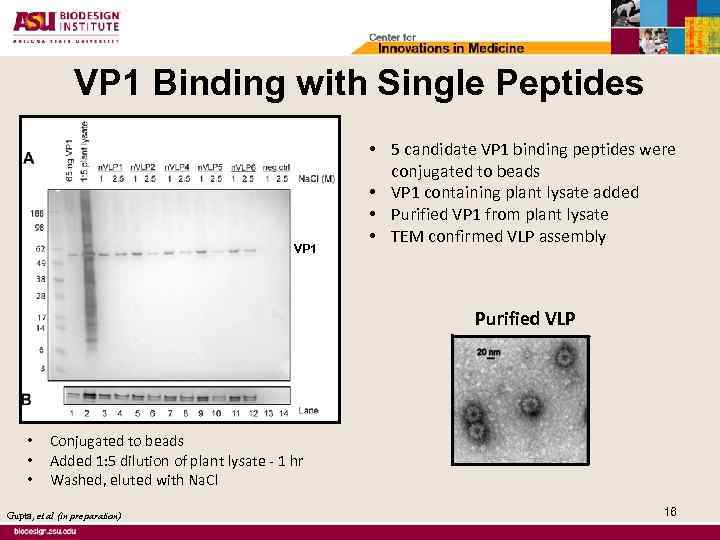
VP 1 Binding with Single Peptides VP 1 • 5 candidate VP 1 binding peptides were conjugated to beads • VP 1 containing plant lysate added • Purified VP 1 from plant lysate • TEM confirmed VLP assembly Purified VLP • • • Conjugated to beads Added 1: 5 dilution of plant lysate - 1 hr Washed, eluted with Na. Cl Gupta, et al (in preparation) 16
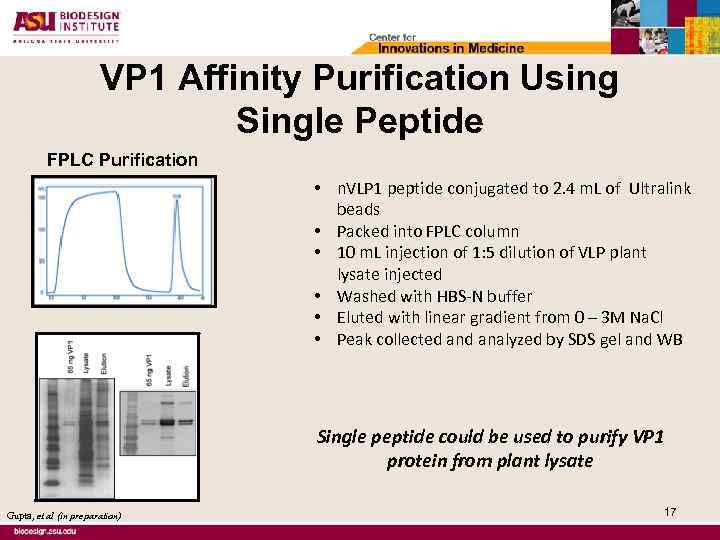
VP 1 Affinity Purification Using Single Peptide FPLC Purification • n. VLP 1 peptide conjugated to 2. 4 m. L of Ultralink beads • Packed into FPLC column • 10 m. L injection of 1: 5 dilution of VLP plant lysate injected • Washed with HBS-N buffer • Eluted with linear gradient from 0 – 3 M Na. Cl • Peak collected analyzed by SDS gel and WB Single peptide could be used to purify VP 1 protein from plant lysate Gupta, et al (in preparation) 17
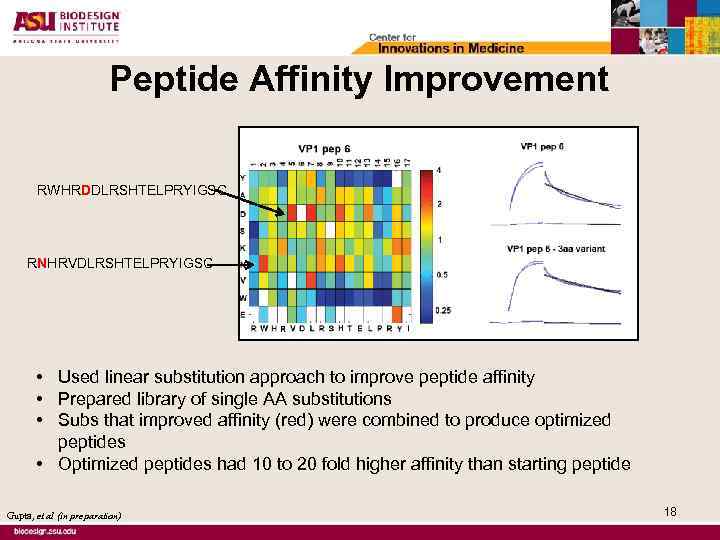
Peptide Affinity Improvement RWHRDDLRSHTELPRYIGSC RNHRVDLRSHTELPRYIGSC • Used linear substitution approach to improve peptide affinity • Prepared library of single AA substitutions • Subs that improved affinity (red) were combined to produce optimized peptides • Optimized peptides had 10 to 20 fold higher affinity than starting peptide Gupta, et al (in preparation) 18
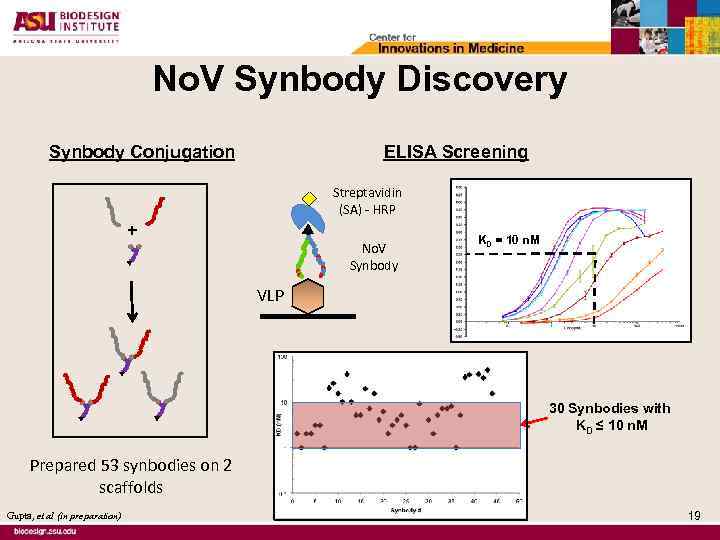
No. V Synbody Discovery Synbody Conjugation ELISA Screening Streptavidin (SA) - HRP + No. V Synbody KD = 10 n. M VLP 30 Synbodies with KD ≤ 10 n. M Prepared 53 synbodies on 2 scaffolds Gupta, et al (in preparation) 19
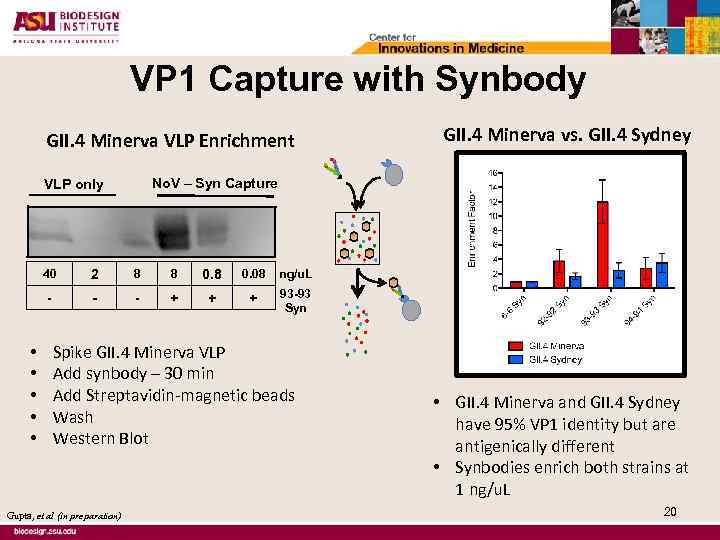
VP 1 Capture with Synbody GII. 4 Minerva VLP Enrichment No. V – Syn Capture VLP only 40 2 8 8 0. 08 ng/u. L - • • • GII. 4 Minerva vs. GII. 4 Sydney - - + + + 93 -93 Syn Spike GII. 4 Minerva VLP Add synbody – 30 min Add Streptavidin-magnetic beads Wash Western Blot Gupta, et al (in preparation) • GII. 4 Minerva and GII. 4 Sydney have 95% VP 1 identity but are antigenically different • Synbodies enrich both strains at 1 ng/u. L 20
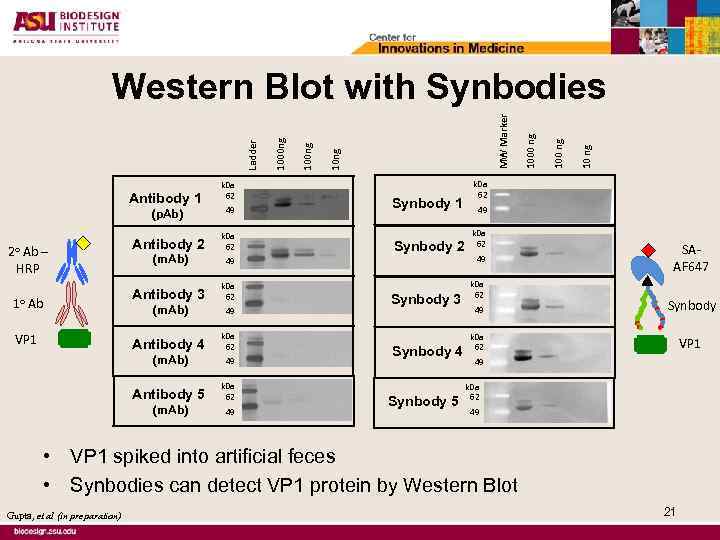
Antibody 1 k. Da 62 Synbody 1 (m. Ab) 49 49 Antibody 3 k. Da 62 (m. Ab) 49 k. Da 62 49 Antibody 5 k. Da 62 (m. Ab) VP 1 k. Da 62 (m. Ab) 1 o Ab Antibody 2 Antibody 4 Ab – HRP 49 Synbody 3 Synbody 4 Synbody 5 10 ng 49 49 Synbody 2 100 ng k. Da 62 (p. Ab) 2 o 1000 ng MW Marker 10 ng 1000 ng Ladder Western Blot with Synbodies k. Da 62 SAAF 647 49 Synbody k. Da 62 VP 1 49 k. Da 62 49 • VP 1 spiked into artificial feces • Synbodies can detect VP 1 protein by Western Blot Gupta, et al (in preparation) 21
No. V Synbody Summary • Developed multiple synbodies for GII. 4 Minerva Norovirus • Some synbodies cross-react with other strains • Synbodies can enrich VLP from dilute solutions • Working on capture of No. V from dilute solutions followed by RT-PCR detection 22
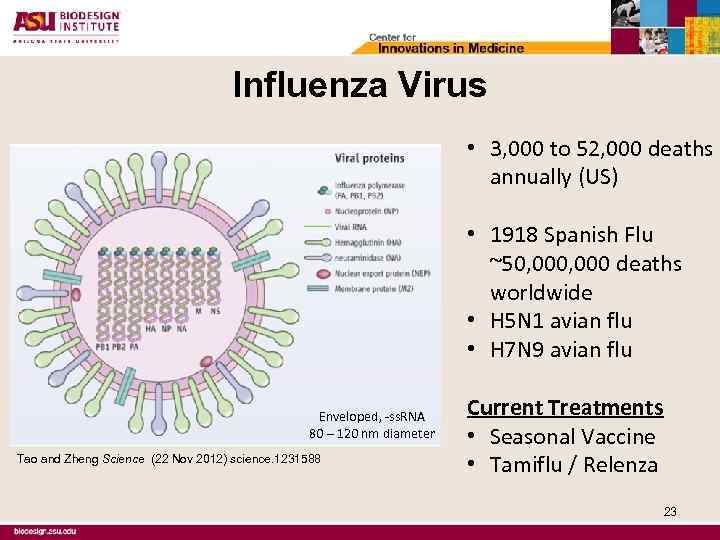
Influenza Virus • 3, 000 to 52, 000 deaths annually (US) • 1918 Spanish Flu ~50, 000 deaths worldwide • H 5 N 1 avian flu • H 7 N 9 avian flu Enveloped, -ss. RNA 80 – 120 nm diameter Tao and Zheng Science (22 Nov 2012) science. 1231588 Current Treatments • Seasonal Vaccine • Tamiflu / Relenza 23
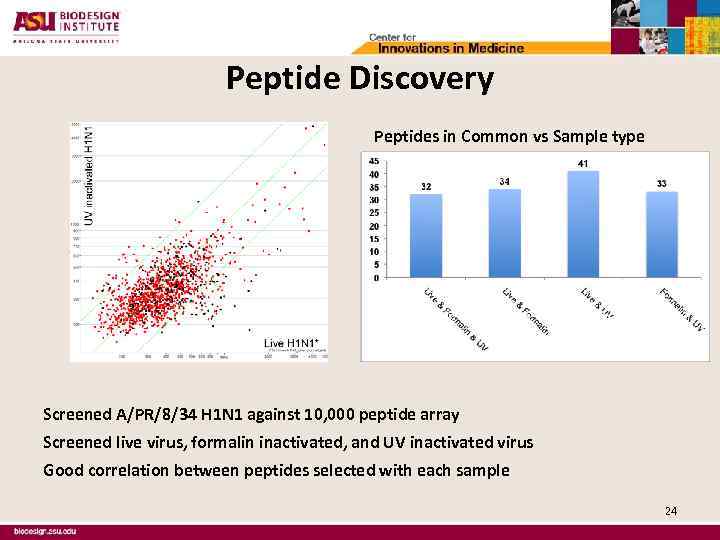
Peptide Discovery Peptides in Common vs Sample type Screened A/PR/8/34 H 1 N 1 against 10, 000 peptide array Screened live virus, formalin inactivated, and UV inactivated virus Good correlation between peptides selected with each sample 24
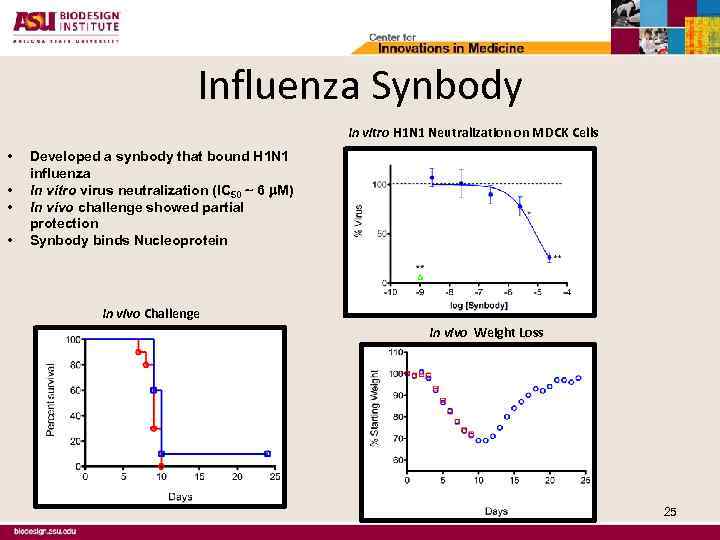
Influenza Synbody In vitro H 1 N 1 Neutralization on MDCK Cells • • Developed a synbody that bound H 1 N 1 influenza In vitro virus neutralization (IC 50 ~ 6 m. M) In vivo challenge showed partial protection Synbody binds Nucleoprotein In vivo Challenge In vivo Weight Loss 25
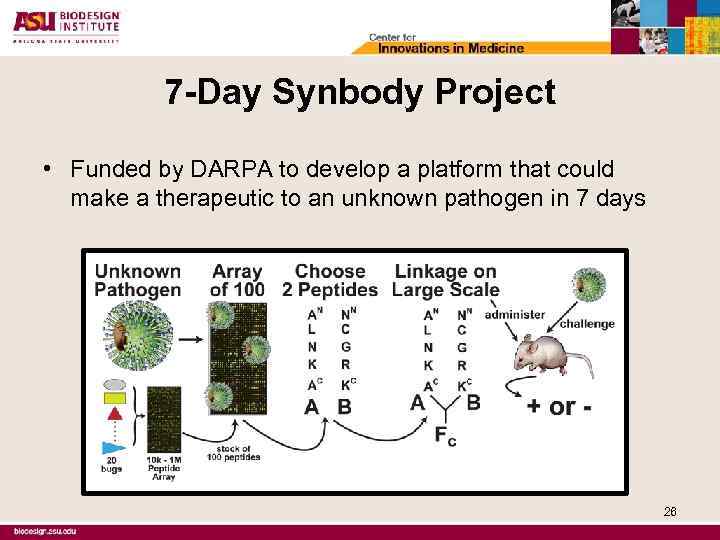
7 -Day Synbody Project • Funded by DARPA to develop a platform that could make a therapeutic to an unknown pathogen in 7 days 26
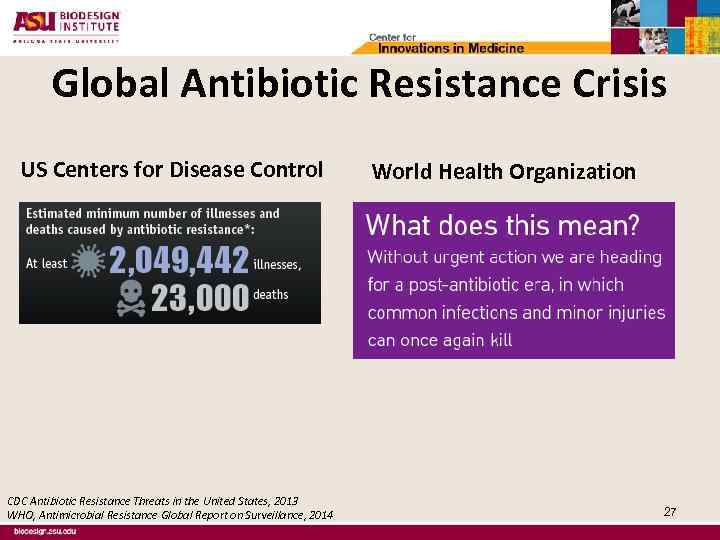
Global Antibiotic Resistance Crisis US Centers for Disease Control CDC Antibiotic Resistance Threats in the United States, 2013 WHO, Antimicrobial Resistance Global Report on Surveillance, 2014 World Health Organization 27
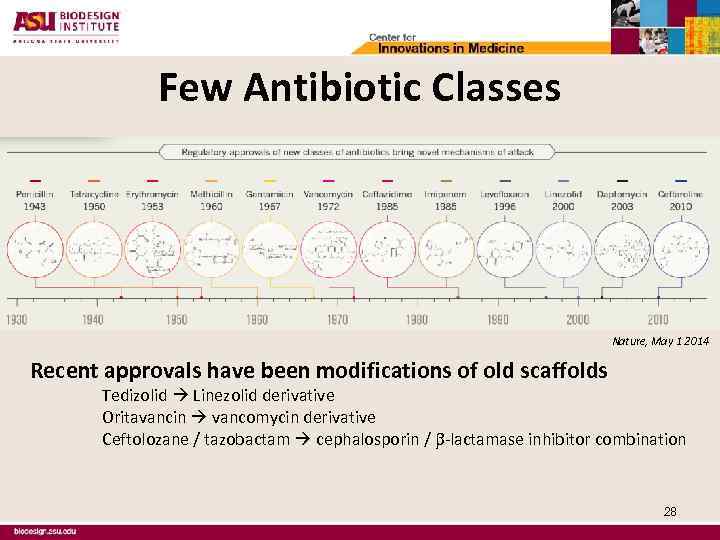
Few Antibiotic Classes Nature, May 1 2014 Recent approvals have been modifications of old scaffolds Tedizolid Linezolid derivative Oritavancin vancomycin derivative Ceftolozane / tazobactam cephalosporin / b-lactamase inhibitor combination 28
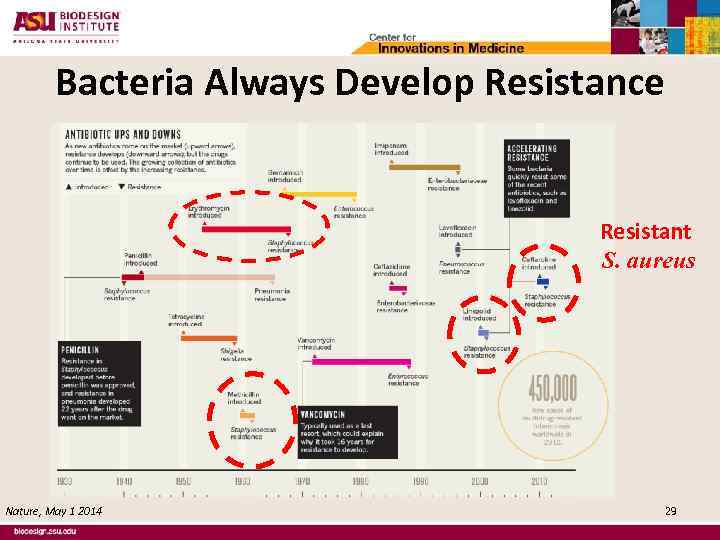
Bacteria Always Develop Resistance Resistant S. aureus Nature, May 1 2014 29
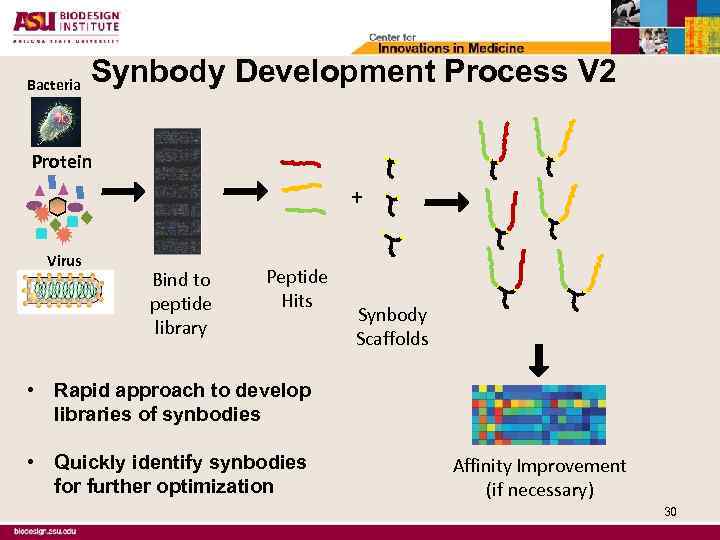
Bacteria Synbody Development Process V 2 Protein + Virus Bind to peptide library Peptide Hits Synbody Scaffolds • Rapid approach to develop libraries of synbodies • Quickly identify synbodies for further optimization Affinity Improvement (if necessary) 30
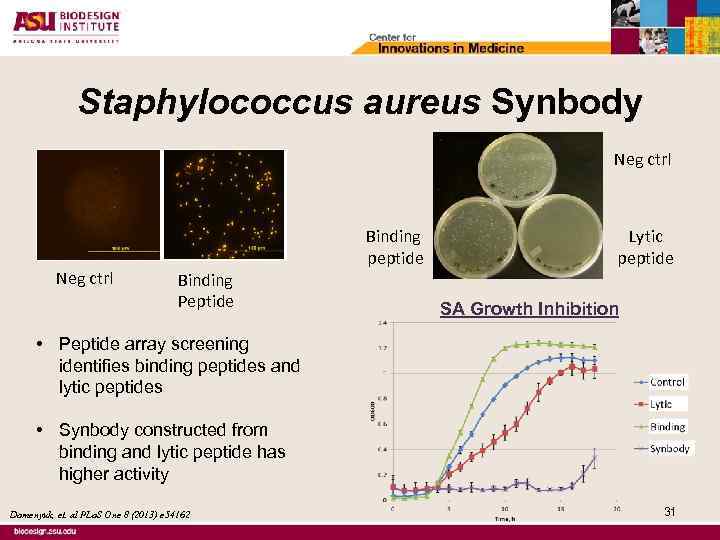
Staphylococcus aureus Synbody Neg ctrl Binding Peptide Binding peptide Lytic peptide SA Growth Inhibition • Peptide array screening identifies binding peptides and lytic peptides • Synbody constructed from binding and lytic peptide has higher activity Domenyuk, et. al PLo. S One 8 (2013) e 54162 31
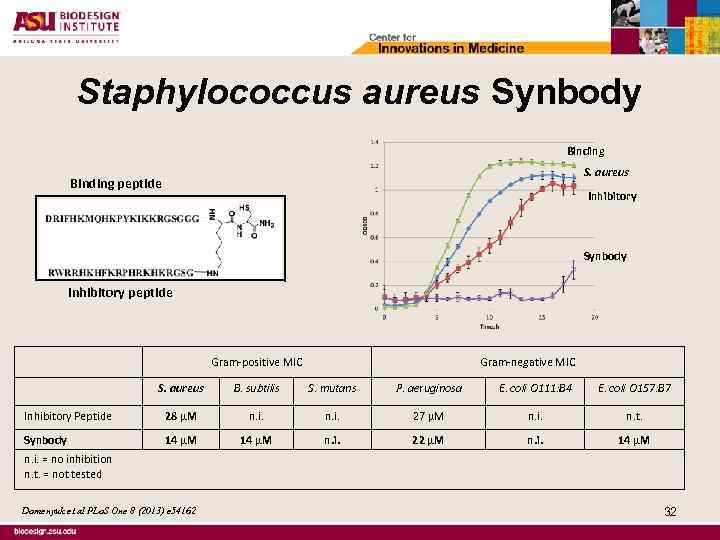
Staphylococcus aureus Synbody Binding S. aureus Binding peptide Inhibitory Synbody Inhibitory peptide Gram-positive MIC Gram-negative MIC S. aureus B. subtilis S. mutans P. aeruginosa E. coli O 111: B 4 E. coli O 157: B 7 Inhibitory Peptide 28 μM n. i. 27 μM n. i. n. t. Synbody 14 μM n. i. 22 μM n. i. 14 μM n. i. = no inhibition n. t. = not tested Domenyuk et al PLo. S One 8 (2013) e 54162 32
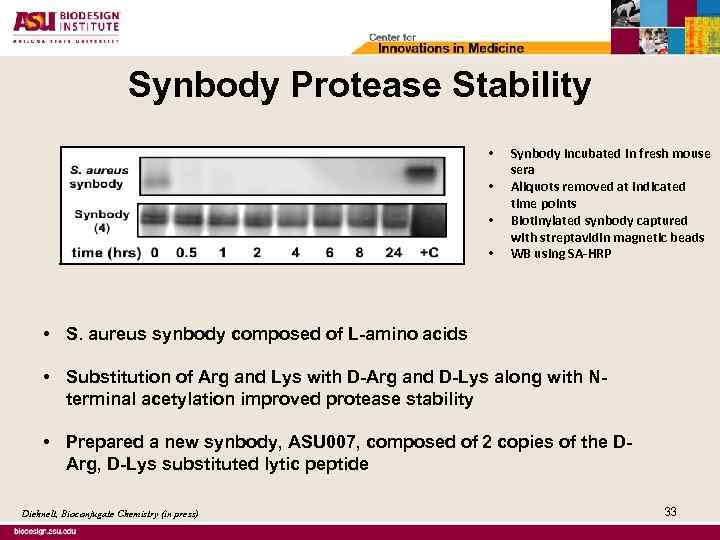
Synbody Protease Stability • • Synbody incubated in fresh mouse sera Aliquots removed at indicated time points Biotinylated synbody captured with streptavidin magnetic beads WB using SA-HRP • S. aureus synbody composed of L-amino acids • Substitution of Arg and Lys with D-Arg and D-Lys along with Nterminal acetylation improved protease stability • Prepared a new synbody, ASU 007, composed of 2 copies of the DArg, D-Lys substituted lytic peptide Diehnelt, Bioconjugate Chemistry (in press) 33
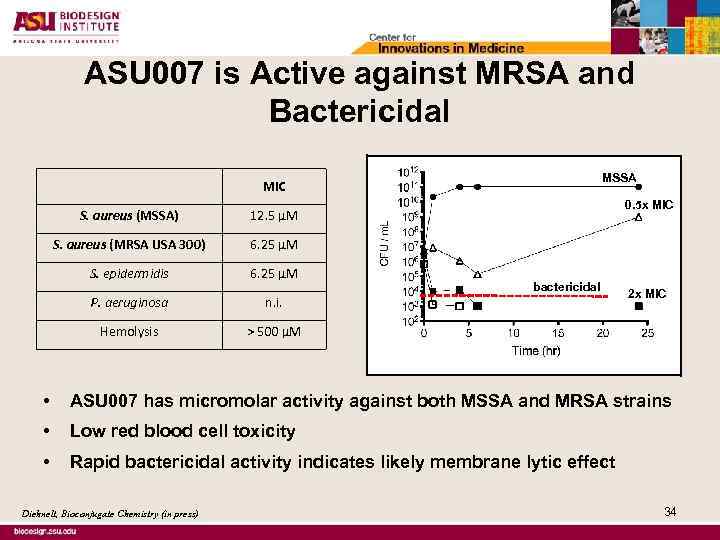
ASU 007 is Active against MRSA and Bactericidal MSSA MIC S. aureus (MSSA) S. aureus (MRSA USA 300) 6. 25 μM S. epidermidis 6. 25 μM P. aeruginosa n. i. Hemolysis 0. 5 x MIC 12. 5 μM > 500 μM bactericidal 2 x MIC • ASU 007 has micromolar activity against both MSSA and MRSA strains • Low red blood cell toxicity • Rapid bactericidal activity indicates likely membrane lytic effect Diehnelt, Bioconjugate Chemistry (in press) 34
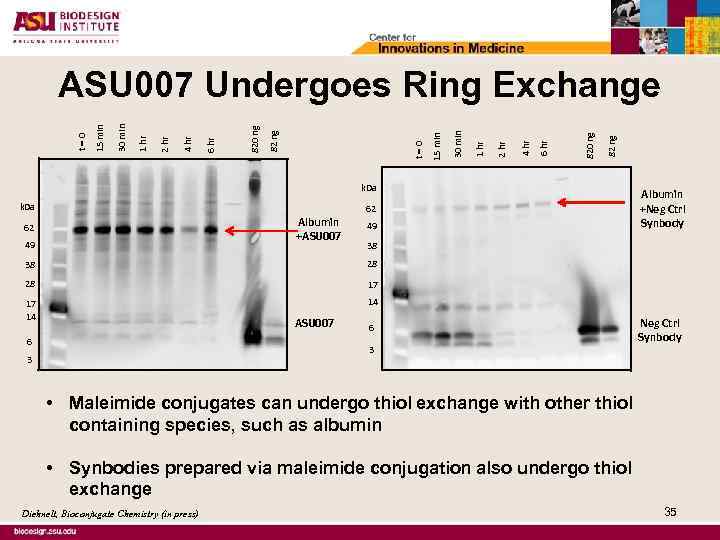
82 ng 820 ng 6 hr 4 hr 2 hr 1 hr 30 min 15 min t=0 ASU 007 Undergoes Ring Exchange k. Da Albumin +ASU 007 62 49 Albumin +Neg Ctrl Synbody 38 38 28 28 17 17 14 14 ASU 007 6 6 3 3 Neg Ctrl Synbody • Maleimide conjugates can undergo thiol exchange with other thiol containing species, such as albumin • Synbodies prepared via maleimide conjugation also undergo thiol exchange Diehnelt, Bioconjugate Chemistry (in press) 35
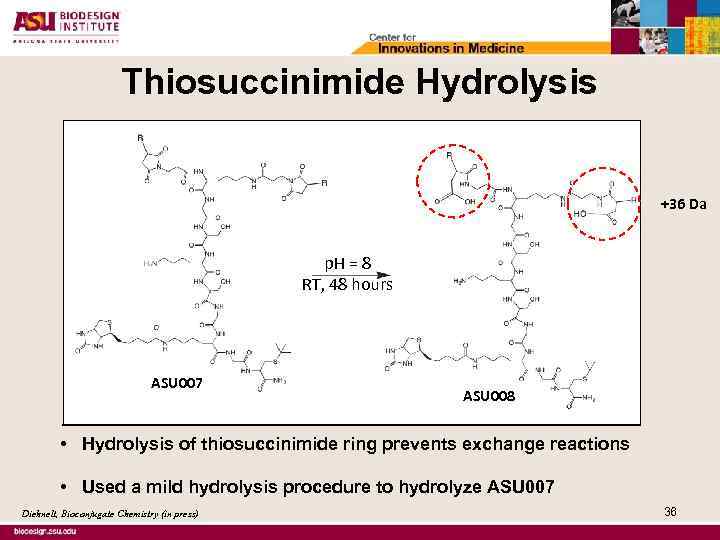
Thiosuccinimide Hydrolysis +36 Da p. H = 8 RT, 48 hours ASU 007 ASU 008 • Hydrolysis of thiosuccinimide ring prevents exchange reactions • Used a mild hydrolysis procedure to hydrolyze ASU 007 Diehnelt, Bioconjugate Chemistry (in press) 36
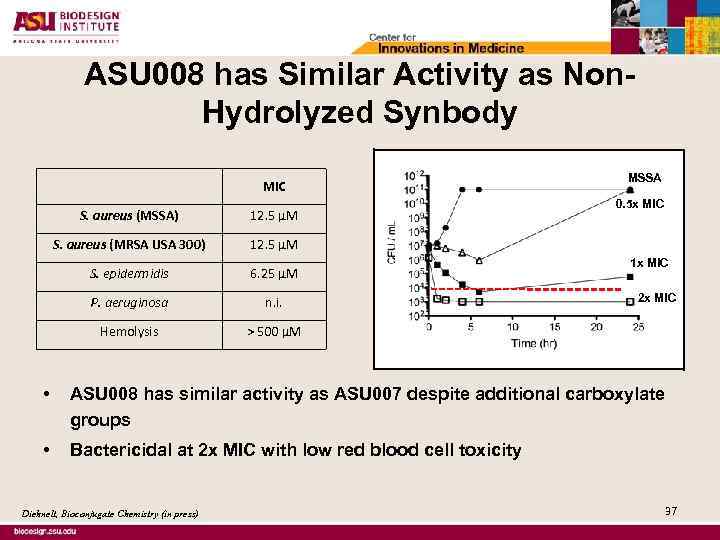
ASU 008 has Similar Activity as Non. Hydrolyzed Synbody MIC S. aureus (MSSA) 12. 5 μM S. aureus (MRSA USA 300) 6. 25 μM P. aeruginosa n. i. Hemolysis 0. 5 x MIC 12. 5 μM S. epidermidis MSSA > 500 μM 1 x MIC 2 x MIC • ASU 008 has similar activity as ASU 007 despite additional carboxylate groups • Bactericidal at 2 x MIC with low red blood cell toxicity Diehnelt, Bioconjugate Chemistry (in press) 37
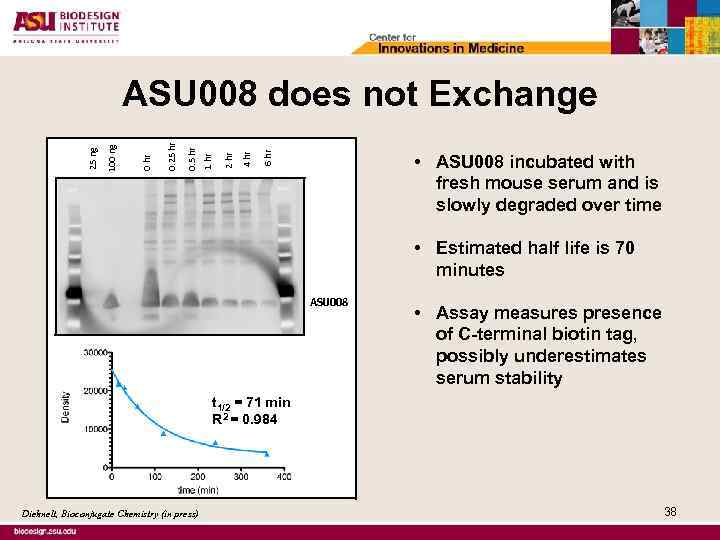
6 hr 4 hr 2 hr 1 hr 0. 5 hr 0. 25 hr 0 hr 100 ng 25 ng ASU 008 does not Exchange • ASU 008 incubated with fresh mouse serum and is slowly degraded over time • Estimated half life is 70 minutes ASU 008 • Assay measures presence of C-terminal biotin tag, possibly underestimates serum stability t 1/2 = 71 min R 2 = 0. 984 Diehnelt, Bioconjugate Chemistry (in press) 38
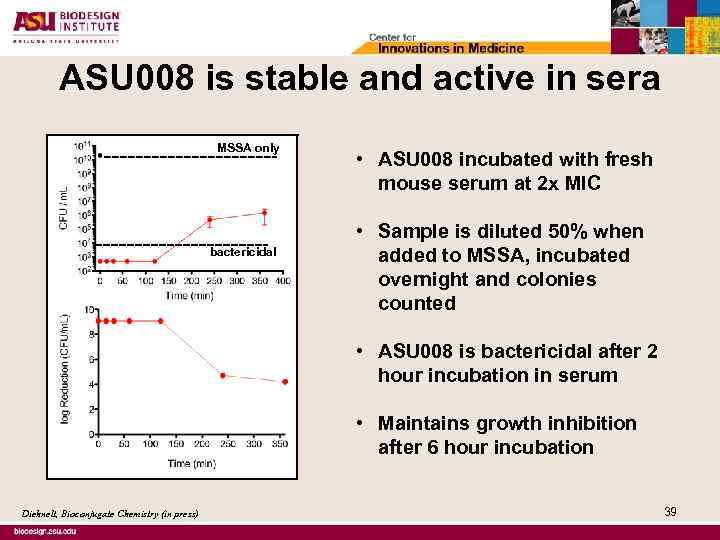
ASU 008 is stable and active in sera MSSA only bactericidal • ASU 008 incubated with fresh mouse serum at 2 x MIC • Sample is diluted 50% when added to MSSA, incubated overnight and colonies counted • ASU 008 is bactericidal after 2 hour incubation in serum • Maintains growth inhibition after 6 hour incubation Diehnelt, Bioconjugate Chemistry (in press) 39
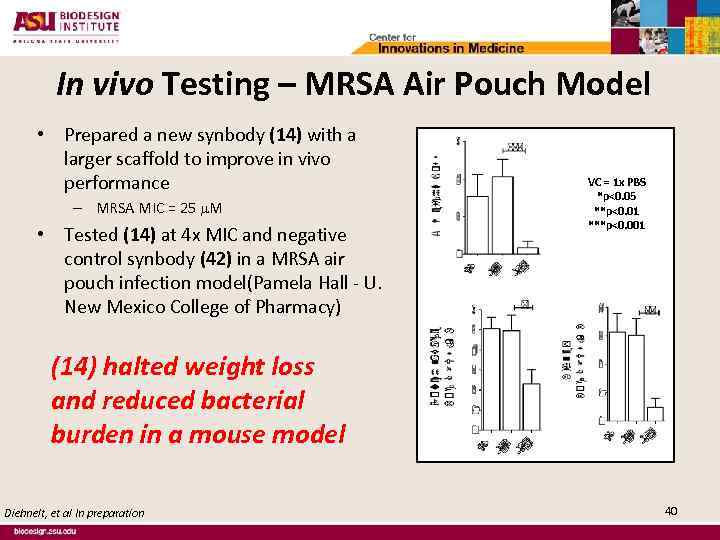
In vivo Testing – MRSA Air Pouch Model • Prepared a new synbody (14) with a larger scaffold to improve in vivo performance – MRSA MIC = 25 m. M • Tested (14) at 4 x MIC and negative control synbody (42) in a MRSA air pouch infection model(Pamela Hall - U. New Mexico College of Pharmacy) VC = 1 x PBS *p<0. 05 **p<0. 01 ***p<0. 001 (14) halted weight loss and reduced bacterial burden in a mouse model Diehnelt, et al In preparation 40
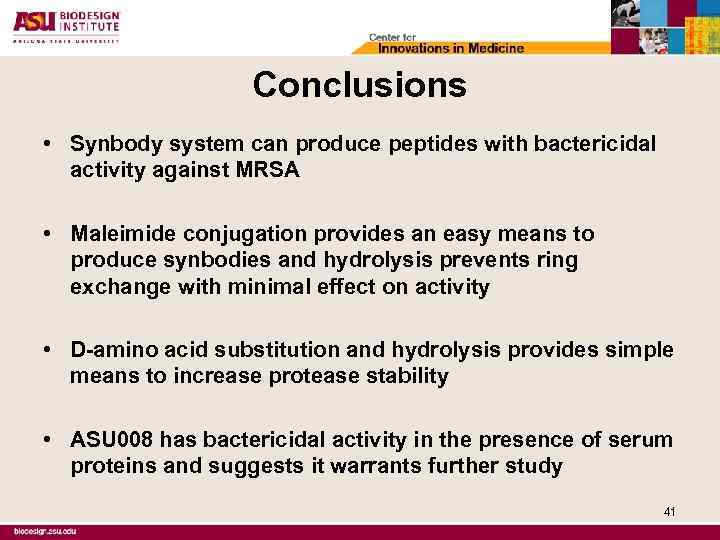
Conclusions • Synbody system can produce peptides with bactericidal activity against MRSA • Maleimide conjugation provides an easy means to produce synbodies and hydrolysis prevents ring exchange with minimal effect on activity • D-amino acid substitution and hydrolysis provides simple means to increase protease stability • ASU 008 has bactericidal activity in the presence of serum proteins and suggests it warrants further study 41
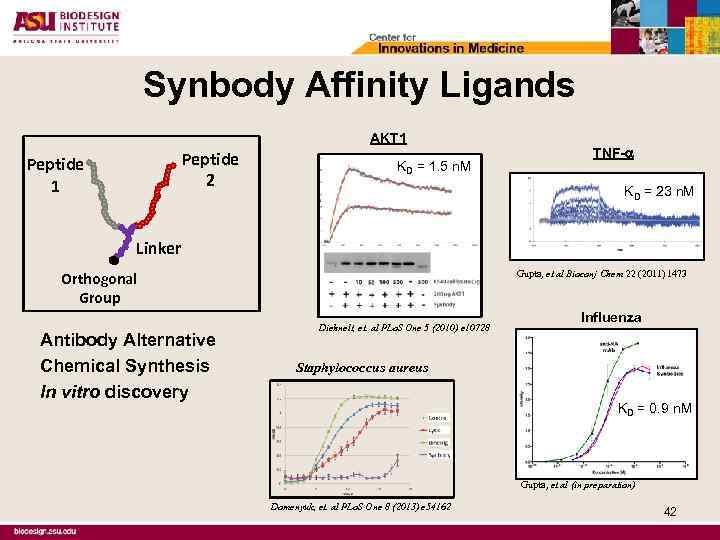
Synbody Affinity Ligands AKT 1 Peptide 2 Peptide 1 KD = 1. 5 n. M TNF-a KD = 23 n. M Linker Gupta, et al Bioconj Chem 22 (2011) 1473 Orthogonal Group Antibody Alternative Chemical Synthesis In vitro discovery Diehnelt, et. al PLo. S One 5 (2010) e 10728 Influenza Staphylococcus aureus KD = 0. 9 n. M Gupta, et al (in preparation) Domenyuk, et. al PLo. S One 8 (2013) e 54162 42
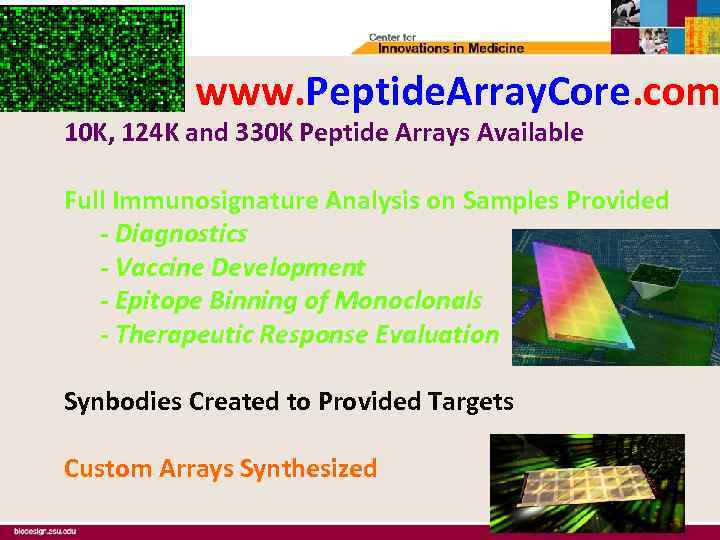
www. Peptide. Array. Core. com 10 K, 124 K and 330 K Peptide Arrays Available Full Immunosignature Analysis on Samples Provided - Diagnostics - Vaccine Development - Epitope Binning of Monoclonals - Therapeutic Response Evaluation Synbodies Created to Provided Targets Custom Arrays Synthesized

Russian-American Collaboration Altai State University Barnaul Regional Cancer Centers Professor Andrei Chapoval, Director
Acknowledgements • • Chris Diehnelt John Lainson Andrey Loskutov Valeriy Domenyuk Nidhi Gupta Bart Legutki Phillip Stafford Zhan-Gong Zhao CIDV Aurelie Crabbe Cheryl Nickerson University of New Mexico Pamela Hall Seth Daly Funding • DARPA • New Antibiotics for Superbugs – Crowdfunding • Funds to SAJ 45
Скачать презентацию CIM Synbody Technology International Biotechnology Symposium Bio-Asia 2015
CIM Synbody Technology.pptx