 Скачать презентацию CICERO History Beyond The Textbook The Age of
cf6d2413c25d3d54b1f4a35ddcd89d2d.ppt
- Количество слайдов: 42



CICERO History Beyond The Textbook The Age of Exploration 500 – 1609 CICERO © 2007
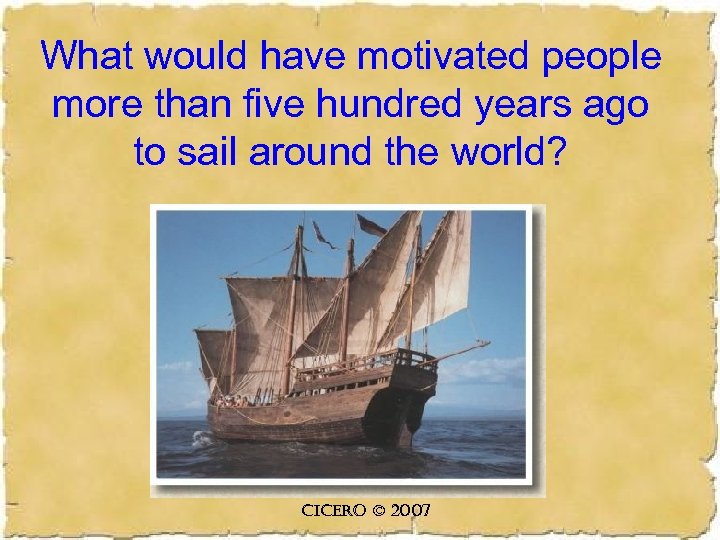
What would have motivated people more than five hundred years ago to sail around the world? CICERO © 2007
The Three Gs! • Gold – They wanted to get rich! • God – They wanted to spread Christianity! • Glory – They wanted to become famous! CICERO © 2007
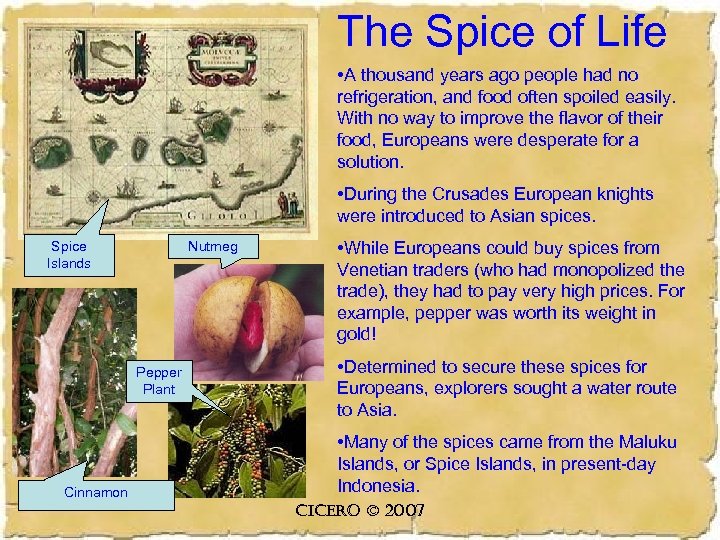
The Spice of Life • A thousand years ago people had no refrigeration, and food often spoiled easily. With no way to improve the flavor of their food, Europeans were desperate for a solution. • During the Crusades European knights were introduced to Asian spices. Spice Islands Nutmeg Pepper Plant Cinnamon • While Europeans could buy spices from Venetian traders (who had monopolized the trade), they had to pay very high prices. For example, pepper was worth its weight in gold! • Determined to secure these spices for Europeans, explorers sought a water route to Asia. • Many of the spices came from the Maluku Islands, or Spice Islands, in present-day Indonesia. CICERO © 2007
TOOLS OF THE TRADE How did early explorers find their way? CICERO © 2007
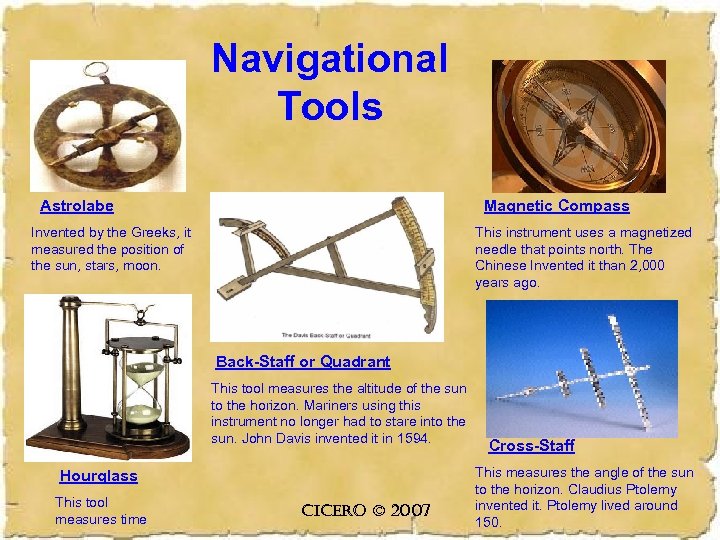
Navigational Tools Astrolabe Magnetic Compass Invented by the Greeks, it measured the position of the sun, stars, moon. This instrument uses a magnetized needle that points north. The Chinese Invented it than 2, 000 years ago. Back-Staff or Quadrant This tool measures the altitude of the sun to the horizon. Mariners using this instrument no longer had to stare into the sun. John Davis invented it in 1594. Hourglass This tool measures time CICERO © 2007 Cross-Staff This measures the angle of the sun to the horizon. Claudius Ptolemy invented it. Ptolemy lived around 150.
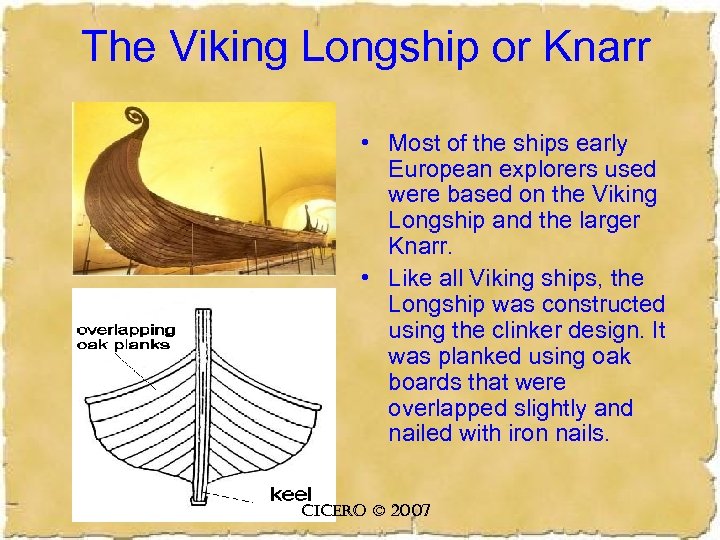
The Viking Longship or Knarr • Most of the ships early European explorers used were based on the Viking Longship and the larger Knarr. • Like all Viking ships, the Longship was constructed using the clinker design. It was planked using oak boards that were overlapped slightly and nailed with iron nails. CICERO © 2007
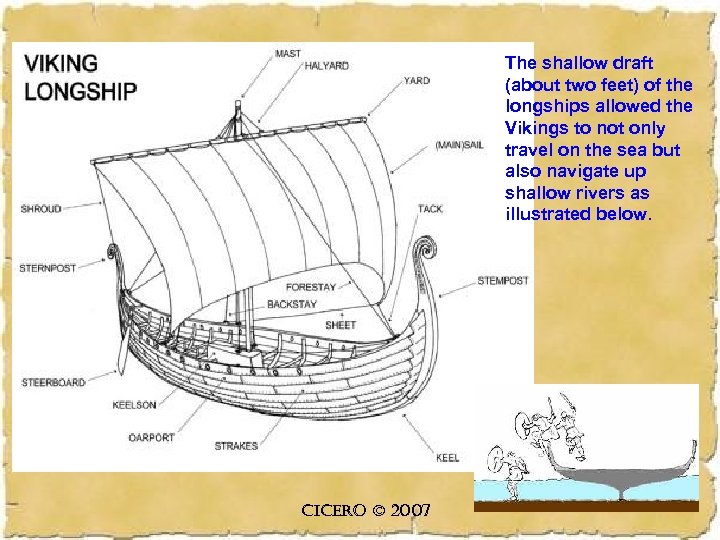
The shallow draft (about two feet) of the longships allowed the Vikings to not only travel on the sea but also navigate up shallow rivers as illustrated below. CICERO © 2007
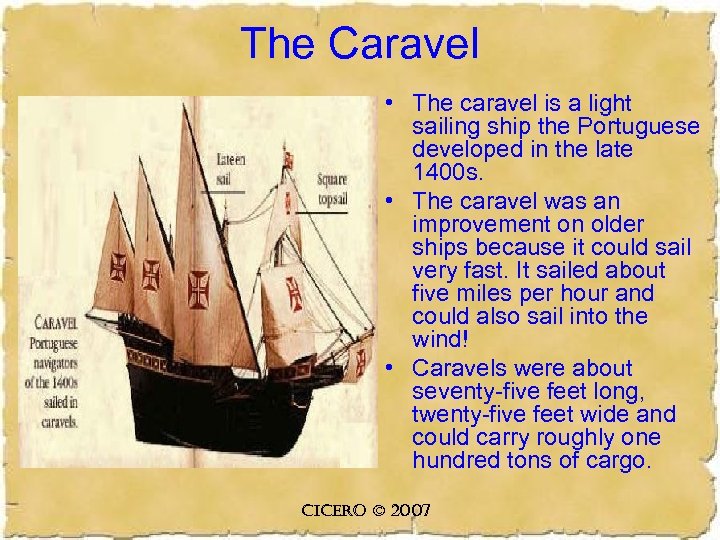
The Caravel • The caravel is a light sailing ship the Portuguese developed in the late 1400 s. • The caravel was an improvement on older ships because it could sail very fast. It sailed about five miles per hour and could also sail into the wind! • Caravels were about seventy-five feet long, twenty-five feet wide and could carry roughly one hundred tons of cargo. CICERO © 2007
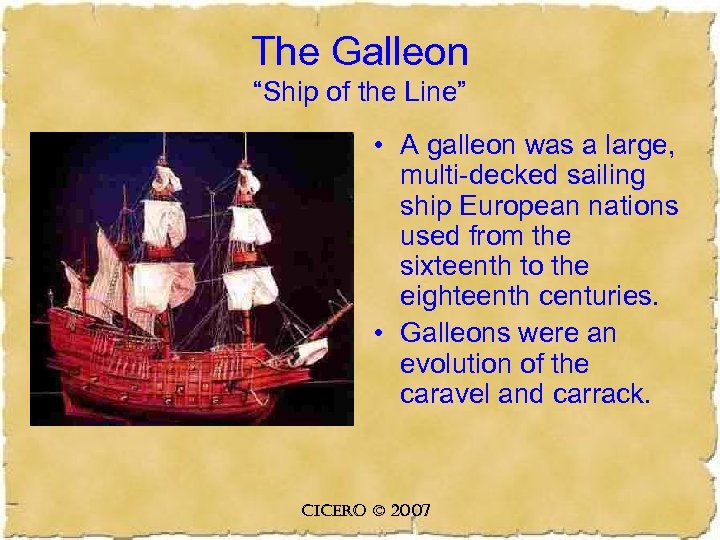
The Galleon “Ship of the Line” • A galleon was a large, multi-decked sailing ship European nations used from the sixteenth to the eighteenth centuries. • Galleons were an evolution of the caravel and carrack. CICERO © 2007
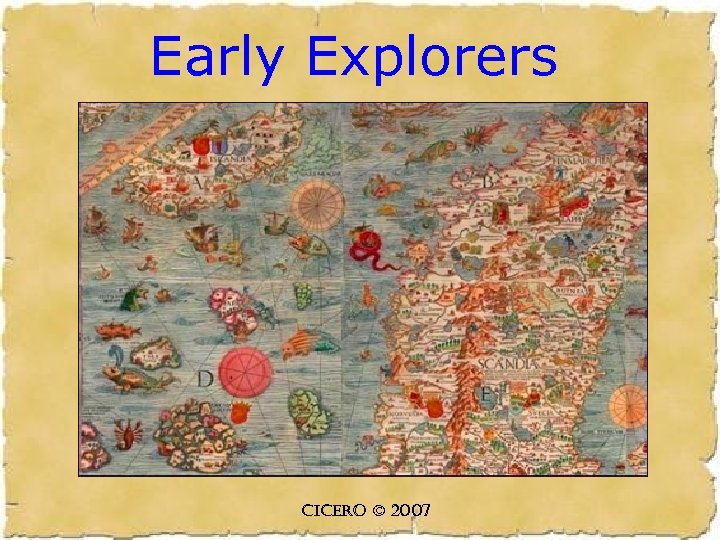
Early Explorers CICERO © 2007
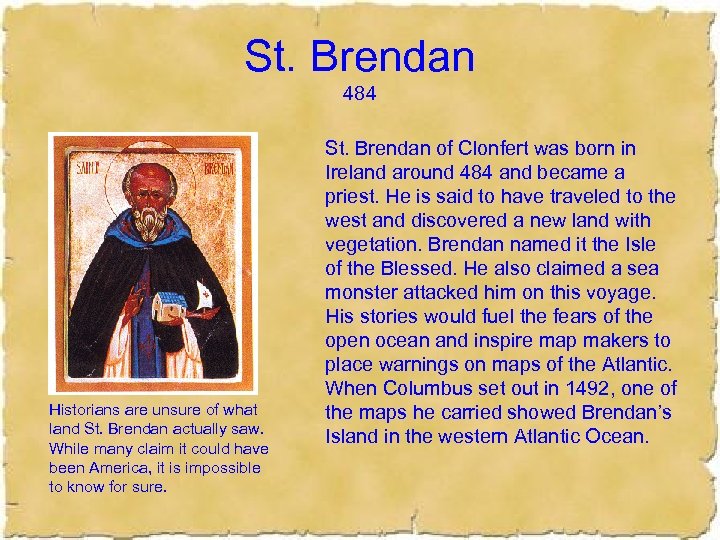
St. Brendan 484 Historians are unsure of what land St. Brendan actually saw. While many claim it could have been America, it is impossible to know for sure. St. Brendan of Clonfert was born in Ireland around 484 and became a priest. He is said to have traveled to the west and discovered a new land with vegetation. Brendan named it the Isle of the Blessed. He also claimed a sea monster attacked him on this voyage. His stories would fuel the fears of the open ocean and inspire map makers to place warnings on maps of the Atlantic. When Columbus set out in 1492, one of the maps he carried showed Brendan’s Island in the western Atlantic Ocean.
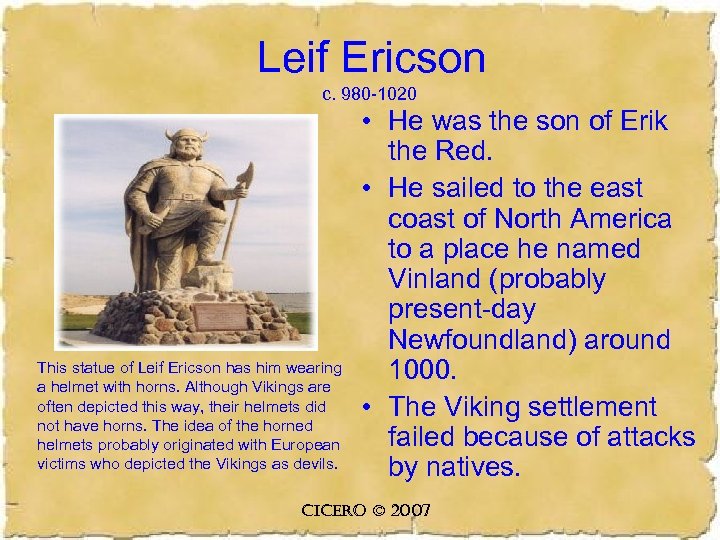
Leif Ericson c. 980 -1020 This statue of Leif Ericson has him wearing a helmet with horns. Although Vikings are often depicted this way, their helmets did not have horns. The idea of the horned helmets probably originated with European victims who depicted the Vikings as devils. • He was the son of Erik the Red. • He sailed to the east coast of North America to a place he named Vinland (probably present-day Newfoundland) around 1000. • The Viking settlement failed because of attacks by natives. CICERO © 2007
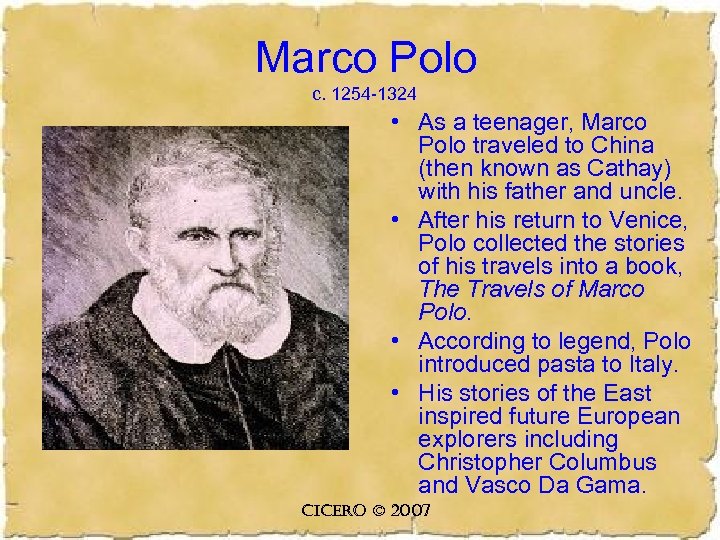
Marco Polo c. 1254 -1324 • As a teenager, Marco Polo traveled to China (then known as Cathay) with his father and uncle. • After his return to Venice, Polo collected the stories of his travels into a book, The Travels of Marco Polo. • According to legend, Polo introduced pasta to Italy. • His stories of the East inspired future European explorers including Christopher Columbus and Vasco Da Gama. CICERO © 2007
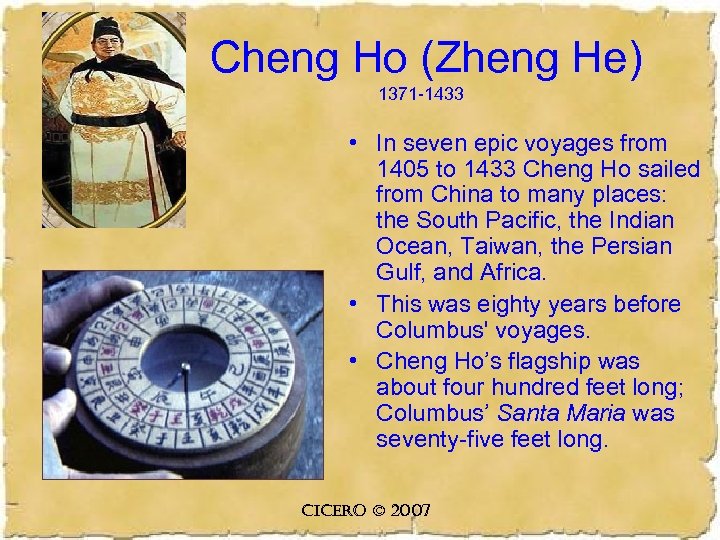
Cheng Ho (Zheng He) 1371 -1433 • In seven epic voyages from 1405 to 1433 Cheng Ho sailed from China to many places: the South Pacific, the Indian Ocean, Taiwan, the Persian Gulf, and Africa. • This was eighty years before Columbus' voyages. • Cheng Ho’s flagship was about four hundred feet long; Columbus’ Santa Maria was seventy-five feet long. CICERO © 2007
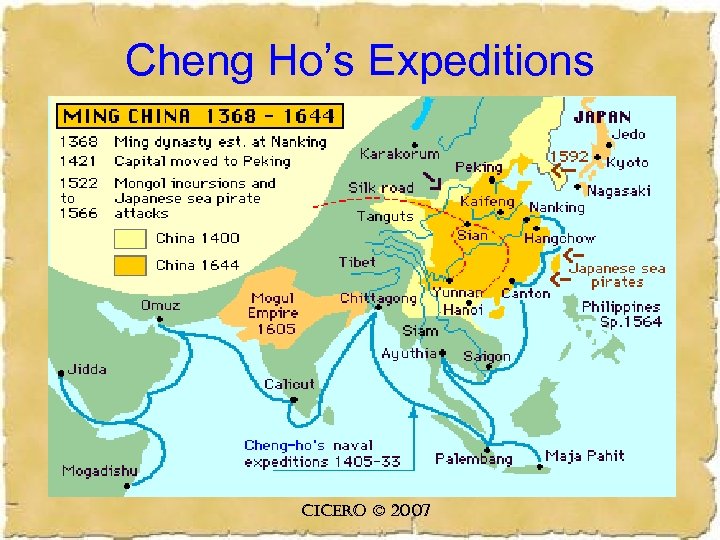
Cheng Ho’s Expeditions CICERO © 2007
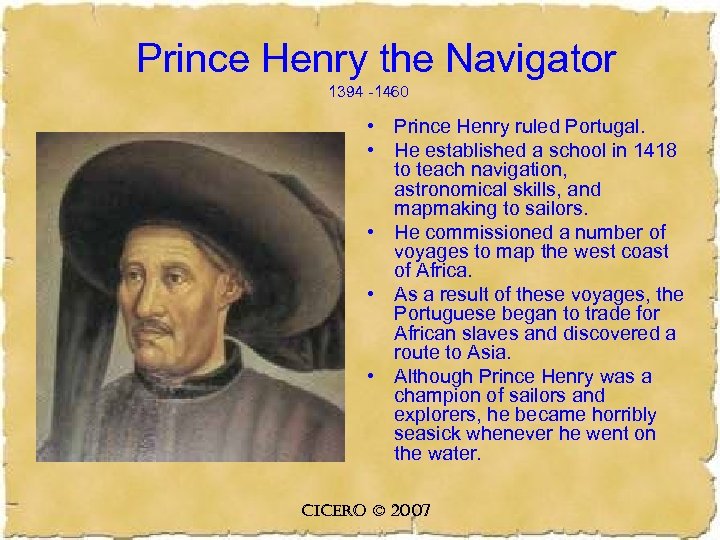
Prince Henry the Navigator 1394 -1460 • Prince Henry ruled Portugal. • He established a school in 1418 to teach navigation, astronomical skills, and mapmaking to sailors. • He commissioned a number of voyages to map the west coast of Africa. • As a result of these voyages, the Portuguese began to trade for African slaves and discovered a route to Asia. • Although Prince Henry was a champion of sailors and explorers, he became horribly seasick whenever he went on the water. CICERO © 2007
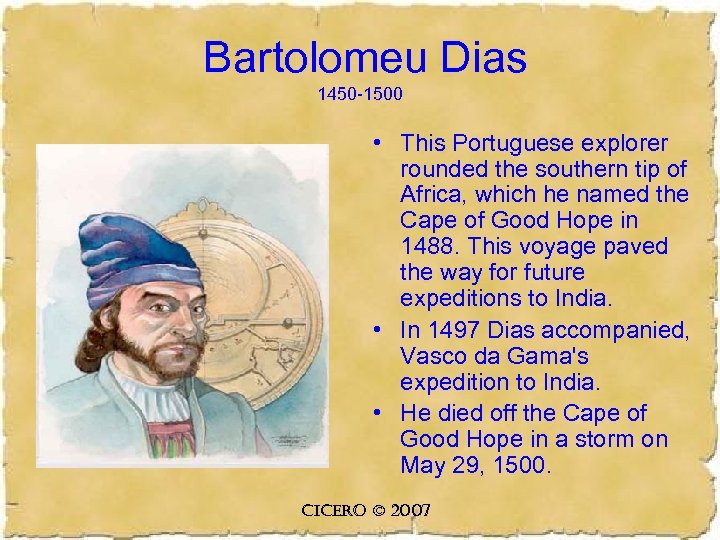
Bartolomeu Dias 1450 -1500 • This Portuguese explorer rounded the southern tip of Africa, which he named the Cape of Good Hope in 1488. This voyage paved the way for future expeditions to India. • In 1497 Dias accompanied, Vasco da Gama's expedition to India. • He died off the Cape of Good Hope in a storm on May 29, 1500. CICERO © 2007
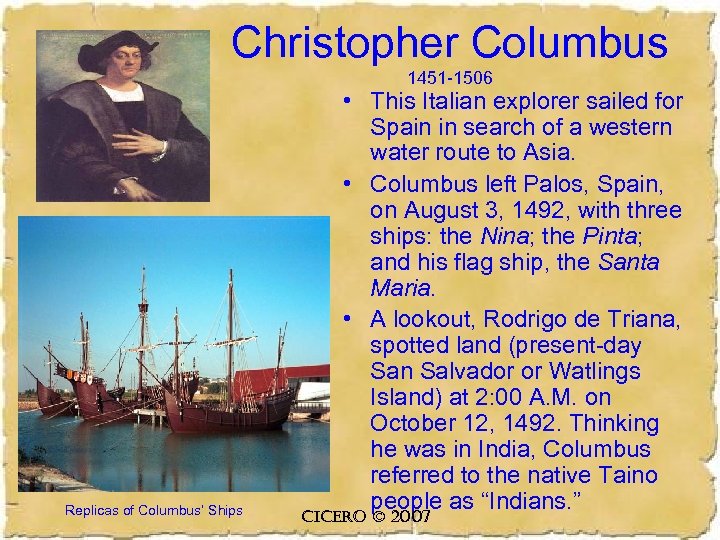
Christopher Columbus 1451 -1506 Replicas of Columbus’ Ships • This Italian explorer sailed for Spain in search of a western water route to Asia. • Columbus left Palos, Spain, on August 3, 1492, with three ships: the Nina; the Pinta; and his flag ship, the Santa Maria. • A lookout, Rodrigo de Triana, spotted land (present-day San Salvador or Watlings Island) at 2: 00 A. M. on October 12, 1492. Thinking he was in India, Columbus referred to the native Taino people as “Indians. ” CICERO © 2007
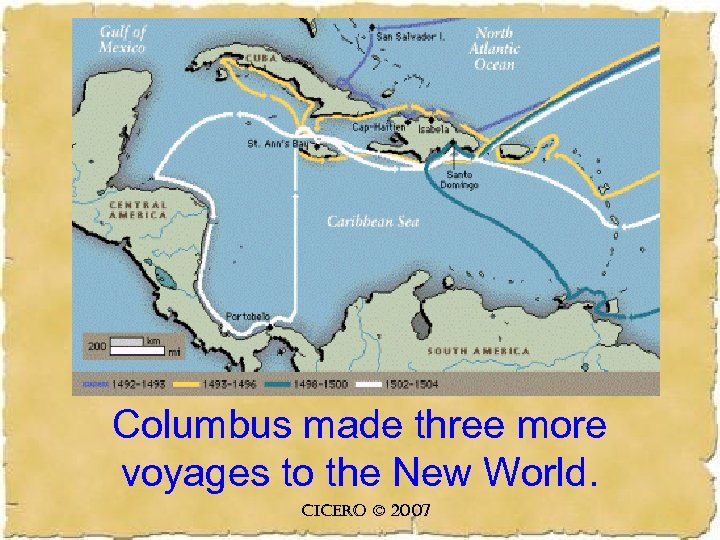
Columbus made three more voyages to the New World. CICERO © 2007
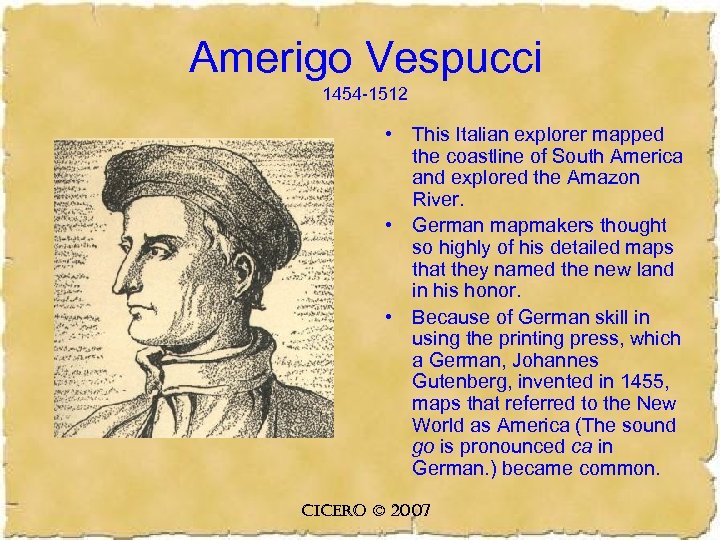
Amerigo Vespucci 1454 -1512 • This Italian explorer mapped the coastline of South America and explored the Amazon River. • German mapmakers thought so highly of his detailed maps that they named the new land in his honor. • Because of German skill in using the printing press, which a German, Johannes Gutenberg, invented in 1455, maps that referred to the New World as America (The sound go is pronounced ca in German. ) became common. CICERO © 2007
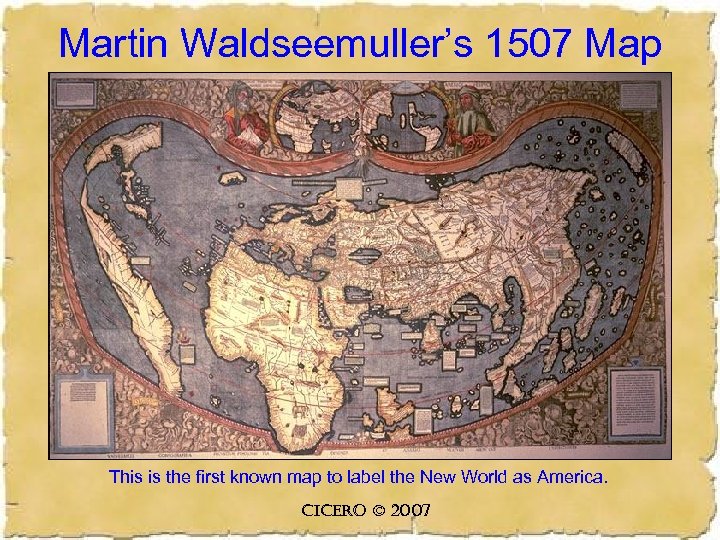
Martin Waldseemuller’s 1507 Map This is the first known map to label the New World as America. CICERO © 2007
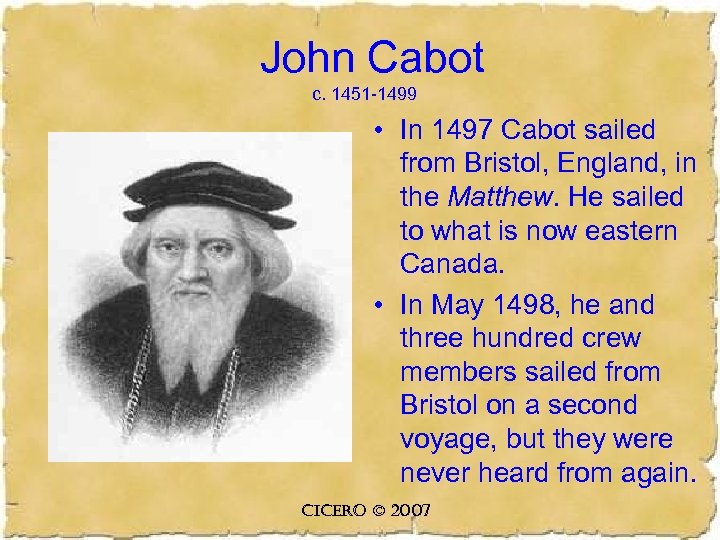
John Cabot c. 1451 -1499 • In 1497 Cabot sailed from Bristol, England, in the Matthew. He sailed to what is now eastern Canada. • In May 1498, he and three hundred crew members sailed from Bristol on a second voyage, but they were never heard from again. CICERO © 2007
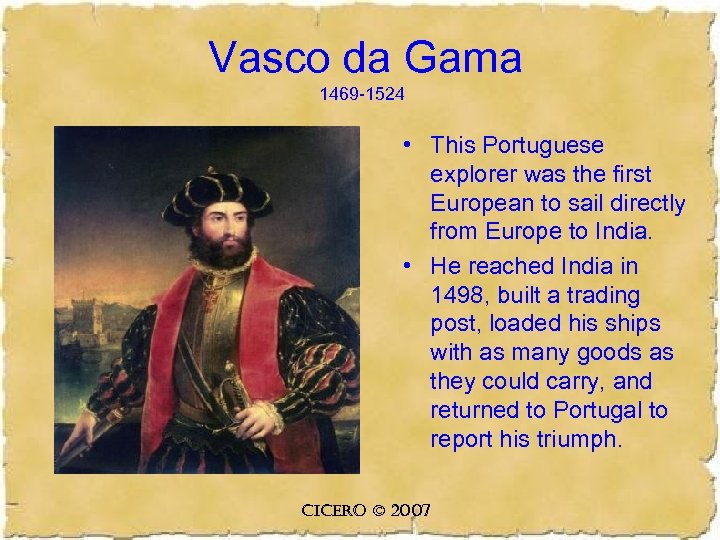
Vasco da Gama 1469 -1524 • This Portuguese explorer was the first European to sail directly from Europe to India. • He reached India in 1498, built a trading post, loaded his ships with as many goods as they could carry, and returned to Portugal to report his triumph. CICERO © 2007
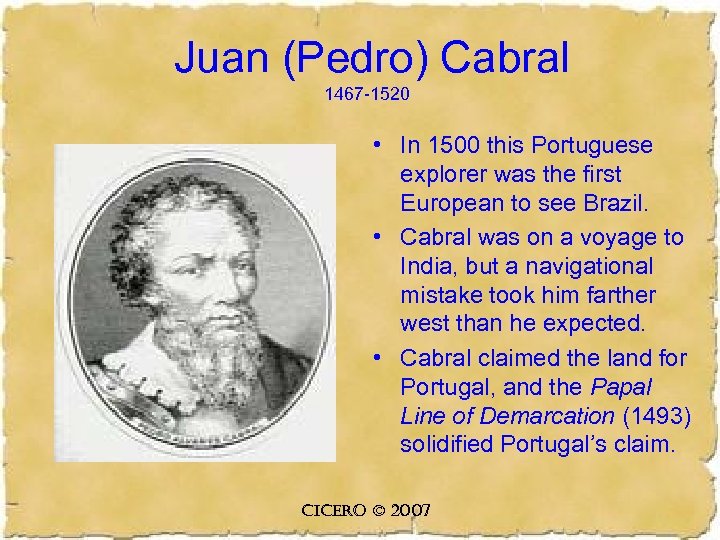
Juan (Pedro) Cabral 1467 -1520 • In 1500 this Portuguese explorer was the first European to see Brazil. • Cabral was on a voyage to India, but a navigational mistake took him farther west than he expected. • Cabral claimed the land for Portugal, and the Papal Line of Demarcation (1493) solidified Portugal’s claim. CICERO © 2007
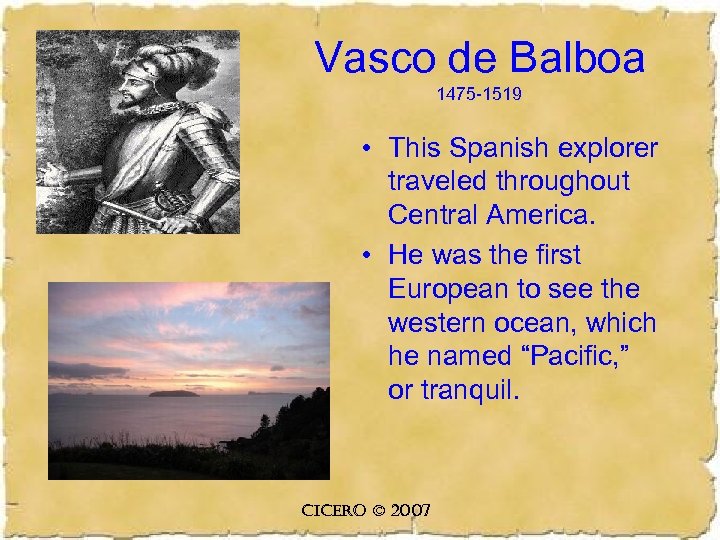
Vasco de Balboa 1475 -1519 • This Spanish explorer traveled throughout Central America. • He was the first European to see the western ocean, which he named “Pacific, ” or tranquil. CICERO © 2007
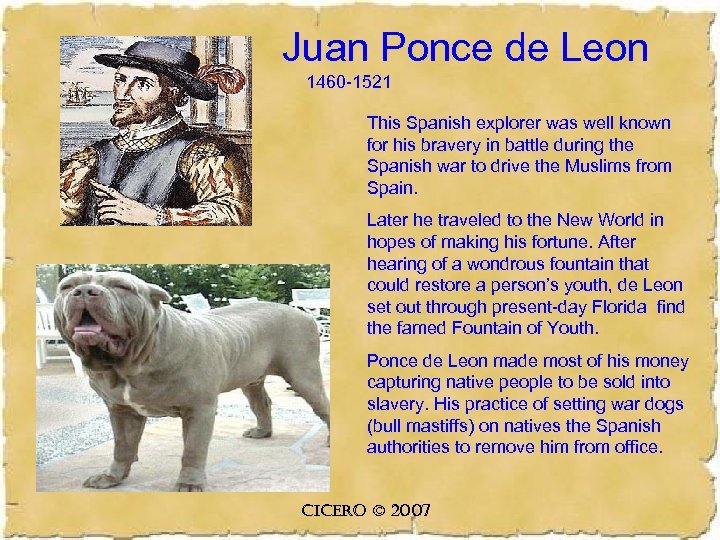
Juan Ponce de Leon 1460 -1521 This Spanish explorer was well known for his bravery in battle during the Spanish war to drive the Muslims from Spain. Later he traveled to the New World in hopes of making his fortune. After hearing of a wondrous fountain that could restore a person’s youth, de Leon set out through present-day Florida find the famed Fountain of Youth. Ponce de Leon made most of his money capturing native people to be sold into slavery. His practice of setting war dogs (bull mastiffs) on natives the Spanish authorities to remove him from office. CICERO © 2007
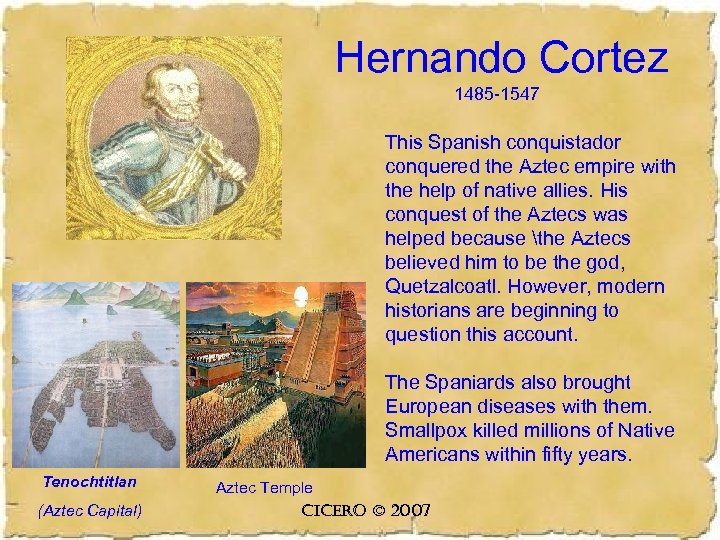
Hernando Cortez 1485 -1547 This Spanish conquistador conquered the Aztec empire with the help of native allies. His conquest of the Aztecs was helped because the Aztecs believed him to be the god, Quetzalcoatl. However, modern historians are beginning to question this account. The Spaniards also brought European diseases with them. Smallpox killed millions of Native Americans within fifty years. Tenochtitlan (Aztec Capital) Aztec Temple CICERO © 2007
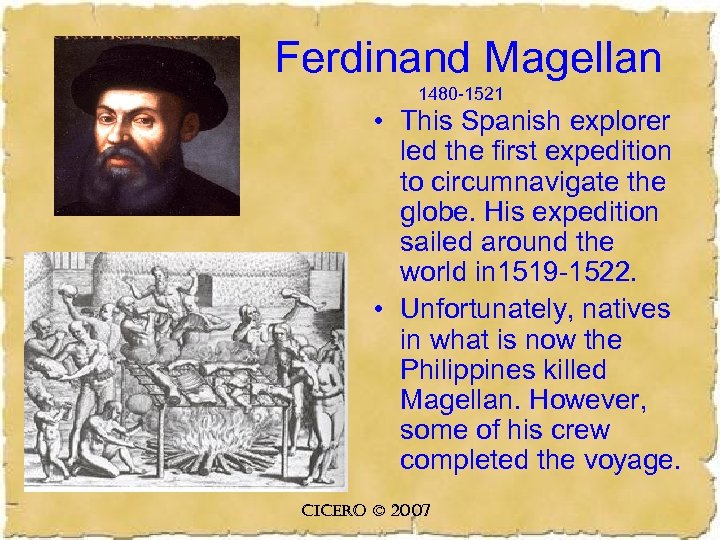
Ferdinand Magellan 1480 -1521 • This Spanish explorer led the first expedition to circumnavigate the globe. His expedition sailed around the world in 1519 -1522. • Unfortunately, natives in what is now the Philippines killed Magellan. However, some of his crew completed the voyage. CICERO © 2007
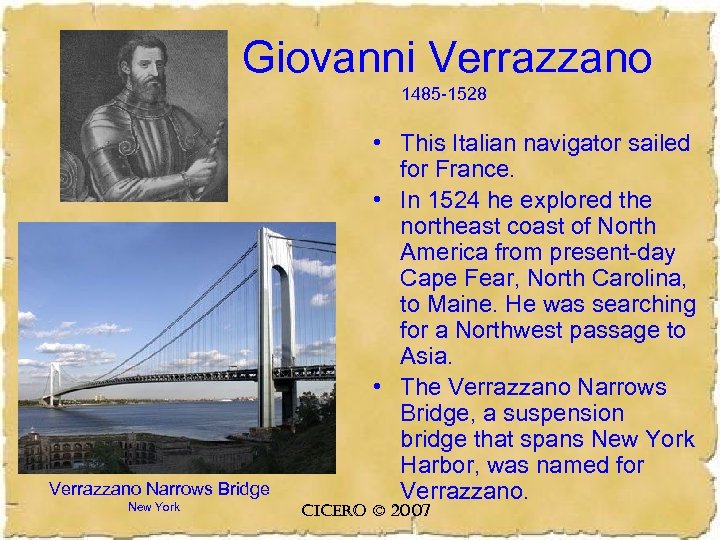
Giovanni Verrazzano 1485 -1528 Verrazzano Narrows Bridge New York • This Italian navigator sailed for France. • In 1524 he explored the northeast coast of North America from present-day Cape Fear, North Carolina, to Maine. He was searching for a Northwest passage to Asia. • The Verrazzano Narrows Bridge, a suspension bridge that spans New York Harbor, was named for Verrazzano. CICERO © 2007
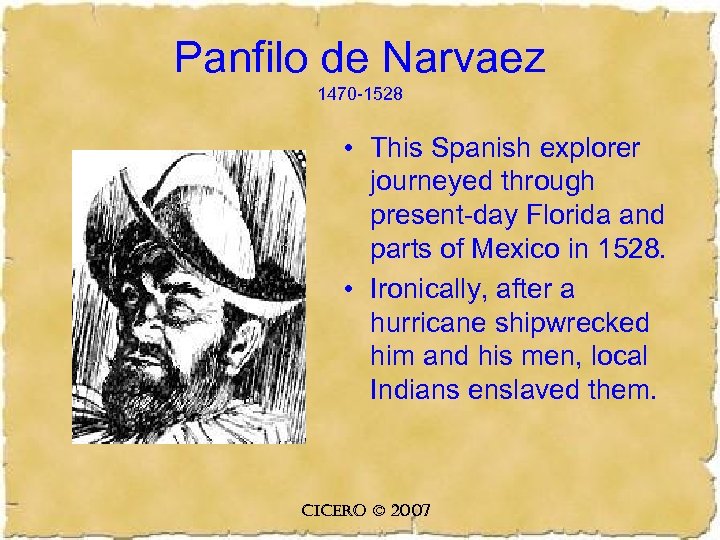
Panfilo de Narvaez 1470 -1528 • This Spanish explorer journeyed through present-day Florida and parts of Mexico in 1528. • Ironically, after a hurricane shipwrecked him and his men, local Indians enslaved them. CICERO © 2007
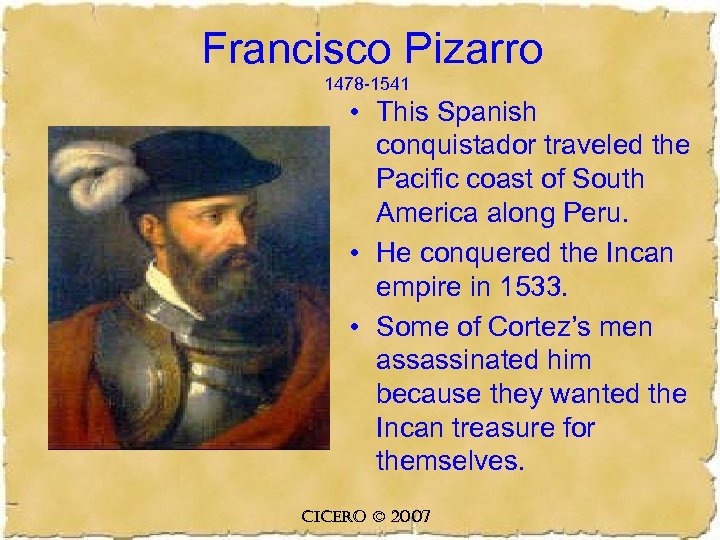
Francisco Pizarro 1478 -1541 • This Spanish conquistador traveled the Pacific coast of South America along Peru. • He conquered the Incan empire in 1533. • Some of Cortez’s men assassinated him because they wanted the Incan treasure for themselves. CICERO © 2007
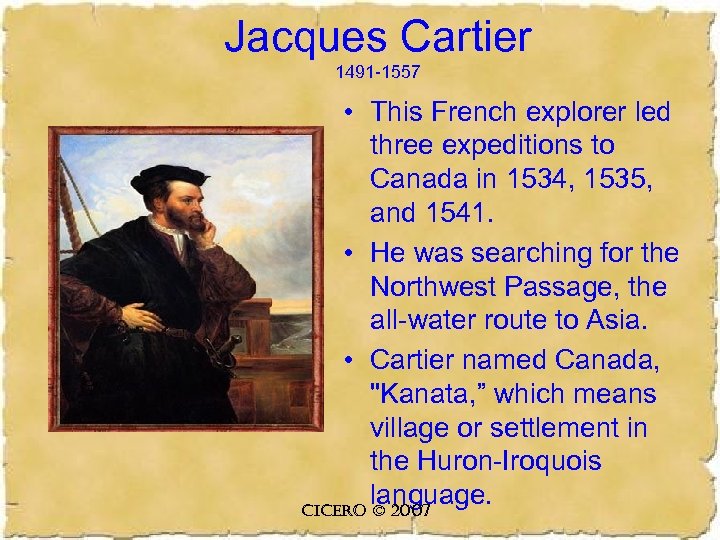
Jacques Cartier 1491 -1557 • This French explorer led three expeditions to Canada in 1534, 1535, and 1541. • He was searching for the Northwest Passage, the all-water route to Asia. • Cartier named Canada, "Kanata, ” which means village or settlement in the Huron-Iroquois language. CICERO © 2007
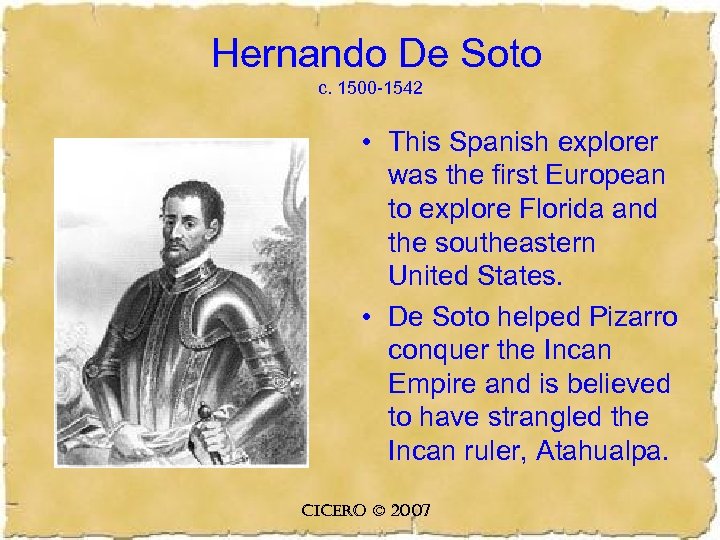
Hernando De Soto c. 1500 -1542 • This Spanish explorer was the first European to explore Florida and the southeastern United States. • De Soto helped Pizarro conquer the Incan Empire and is believed to have strangled the Incan ruler, Atahualpa. CICERO © 2007
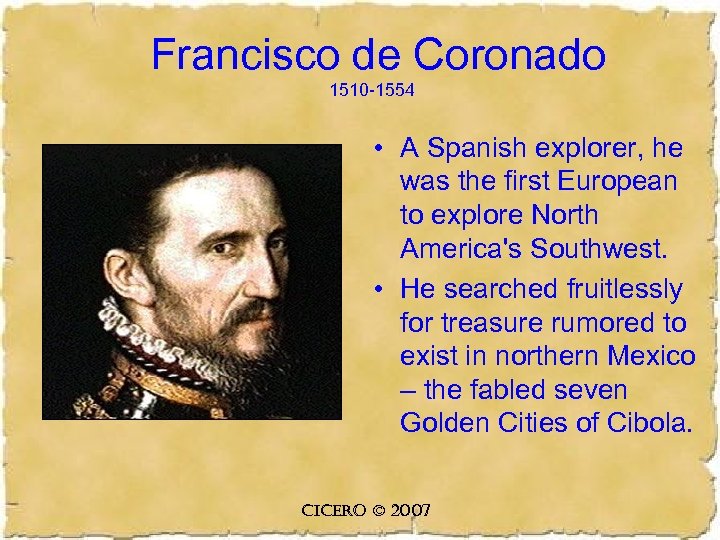
Francisco de Coronado 1510 -1554 • A Spanish explorer, he was the first European to explore North America's Southwest. • He searched fruitlessly for treasure rumored to exist in northern Mexico – the fabled seven Golden Cities of Cibola. CICERO © 2007
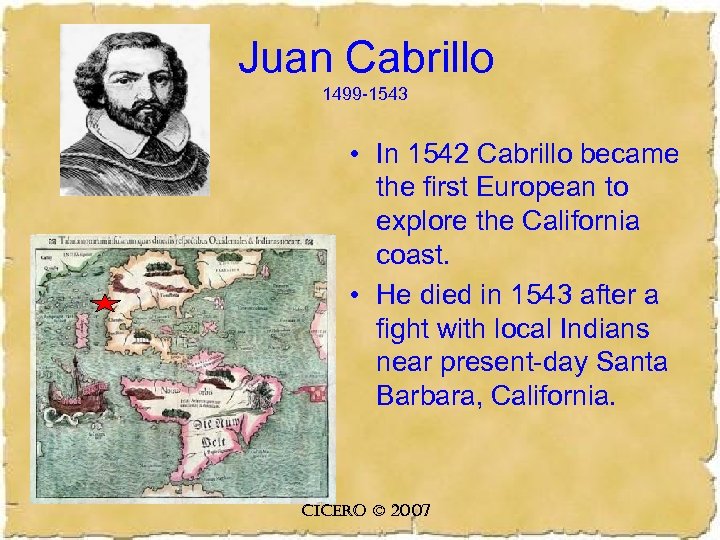
Juan Cabrillo 1499 -1543 • In 1542 Cabrillo became the first European to explore the California coast. • He died in 1543 after a fight with local Indians near present-day Santa Barbara, California. CICERO © 2007
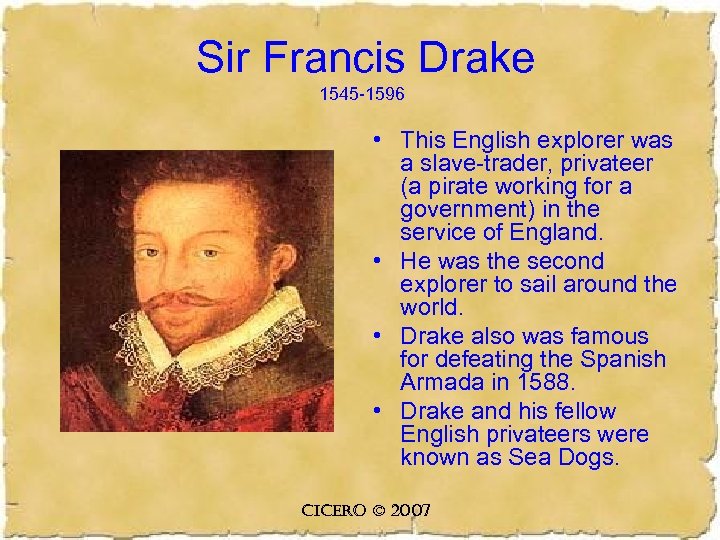
Sir Francis Drake 1545 -1596 • This English explorer was a slave-trader, privateer (a pirate working for a government) in the service of England. • He was the second explorer to sail around the world. • Drake also was famous for defeating the Spanish Armada in 1588. • Drake and his fellow English privateers were known as Sea Dogs. CICERO © 2007
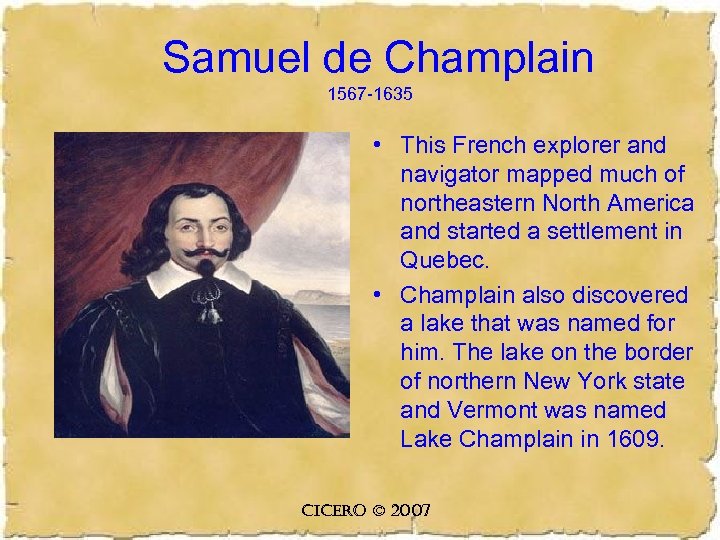
Samuel de Champlain 1567 -1635 • This French explorer and navigator mapped much of northeastern North America and started a settlement in Quebec. • Champlain also discovered a lake that was named for him. The lake on the border of northern New York state and Vermont was named Lake Champlain in 1609. CICERO © 2007
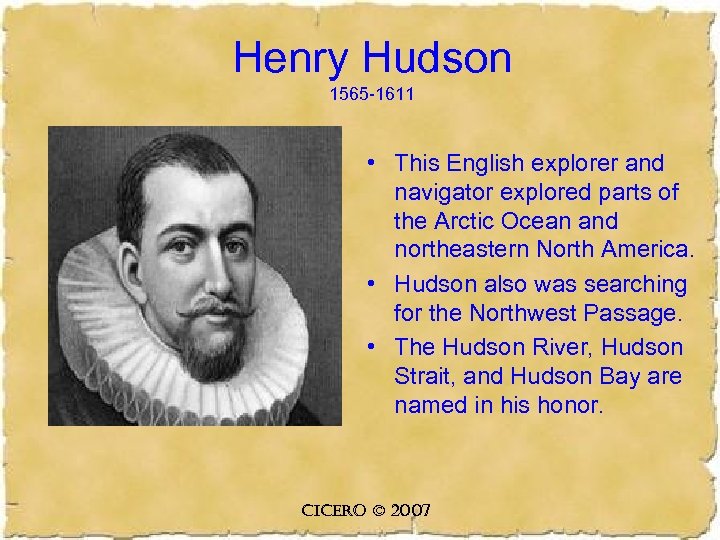
Henry Hudson 1565 -1611 • This English explorer and navigator explored parts of the Arctic Ocean and northeastern North America. • Hudson also was searching for the Northwest Passage. • The Hudson River, Hudson Strait, and Hudson Bay are named in his honor. CICERO © 2007
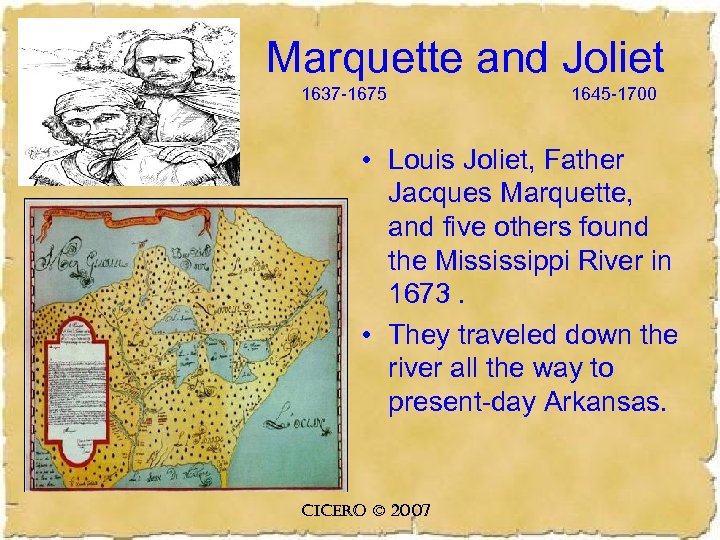
Marquette and Joliet 1637 -1675 1645 -1700 • Louis Joliet, Father Jacques Marquette, and five others found the Mississippi River in 1673. • They traveled down the river all the way to present-day Arkansas. CICERO © 2007
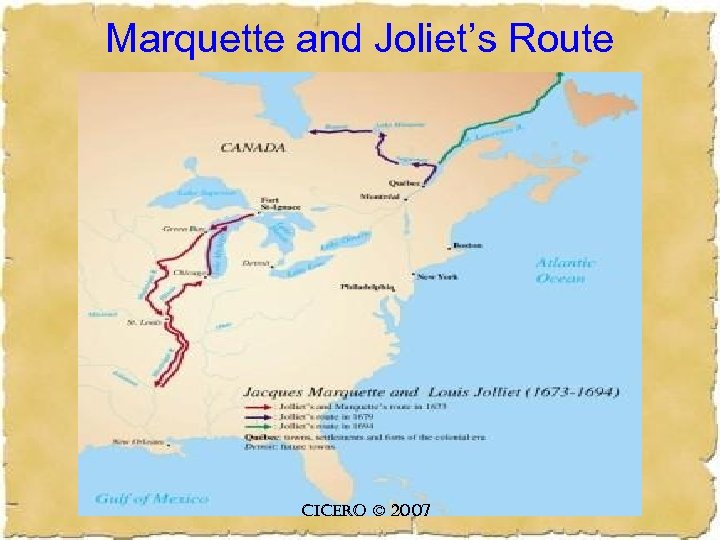
Marquette and Joliet’s Route CICERO © 2007
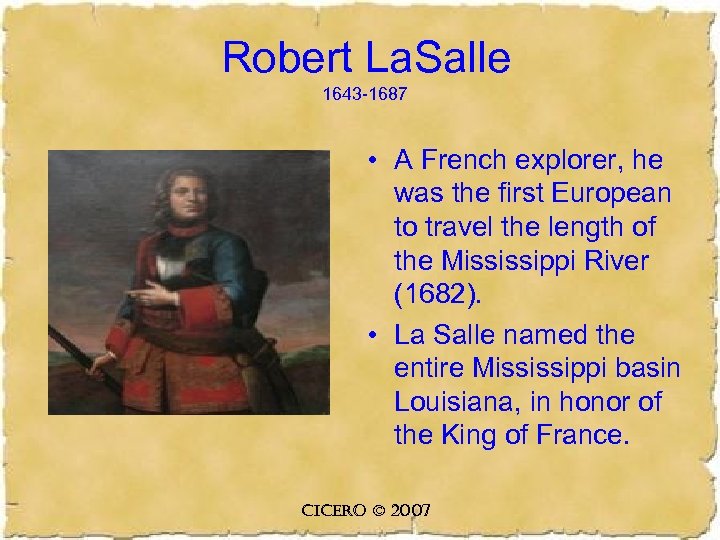
Robert La. Salle 1643 -1687 • A French explorer, he was the first European to travel the length of the Mississippi River (1682). • La Salle named the entire Mississippi basin Louisiana, in honor of the King of France. CICERO © 2007
Скачать презентацию CICERO History Beyond The Textbook The Age of
cf6d2413c25d3d54b1f4a35ddcd89d2d.ppt