


 Скачать презентацию CI I ci there is used to
1fbc83bbcd2f3ff59fe43dbb5756d2bf.ppt
- Количество слайдов: 5
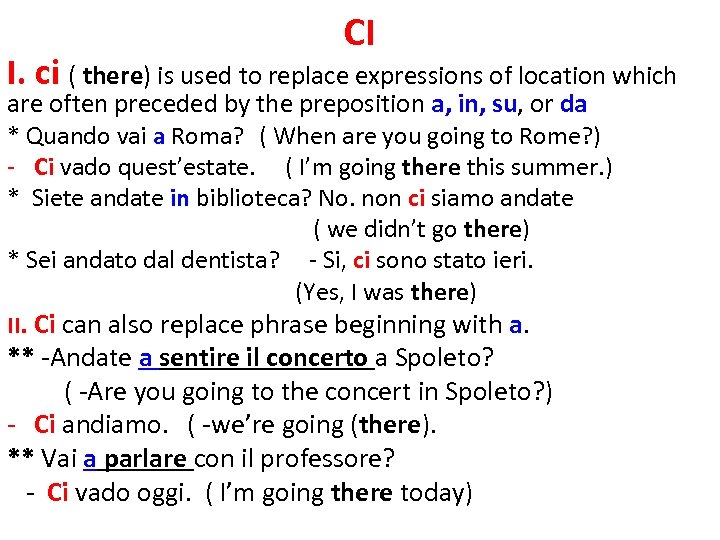 CI I. ci ( there) is used to replace expressions of location which are often preceded by the preposition a, in, su, or da * Quando vai a Roma? ( When are you going to Rome? ) - Ci vado quest’estate. ( I’m going there this summer. ) * Siete andate in biblioteca? No. non ci siamo andate ( we didn’t go there) * Sei andato dal dentista? - Si, ci sono stato ieri. (Yes, I was there) II. Ci can also replace phrase beginning with a. ** -Andate a sentire il concerto a Spoleto? ( -Are you going to the concert in Spoleto? ) - Ci andiamo. ( -we’re going (there). ** Vai a parlare con il professore? - Ci vado oggi. ( I’m going there today)
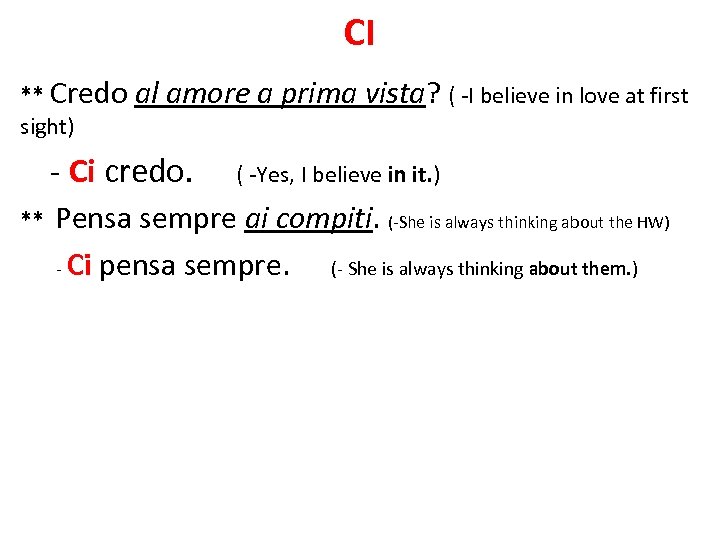 CI ** Credo sight) al amore a prima vista? ( -I believe in love at first - Ci credo. ** ( -Yes, I believe in it. ) Pensa sempre ai compiti. (-She is always thinking about the HW) - Ci pensa sempre. (- She is always thinking about them. )
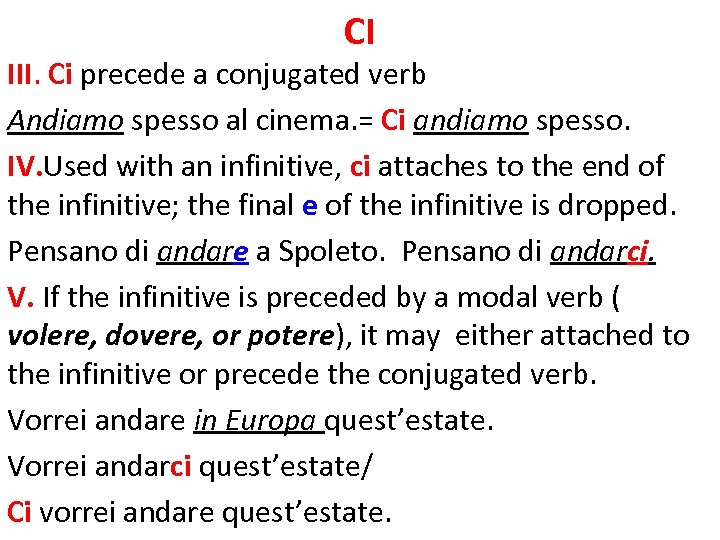 CI III. Ci precede a conjugated verb Andiamo spesso al cinema. = Ci andiamo spesso. IV. Used with an infinitive, ci attaches to the end of the infinitive; the final e of the infinitive is dropped. Pensano di andare a Spoleto. Pensano di andarci. V. If the infinitive is preceded by a modal verb ( volere, dovere, or potere), it may either attached to the infinitive or precede the conjugated verb. Vorrei andare in Europa quest’estate. Vorrei andarci quest’estate/ Ci vorrei andare quest’estate.
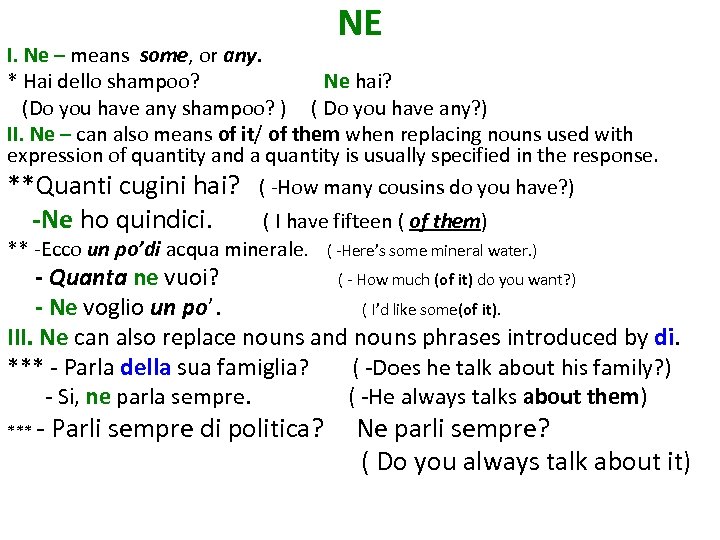 NE I. Ne – means some, or any. * Hai dello shampoo? Ne hai? (Do you have any shampoo? ) ( Do you have any? ) II. Ne – can also means of it/ of them when replacing nouns used with expression of quantity and a quantity is usually specified in the response. **Quanti cugini hai? ( -How many cousins do you have? ) -Ne ho quindici. ( I have fifteen ( of them) ** -Ecco un po’di acqua minerale. ( -Here’s some mineral water. ) - Quanta ne vuoi? ( - How much (of it) do you want? ) - Ne voglio un po’. ( I’d like some(of it). III. Ne can also replace nouns and nouns phrases introduced by di. *** - Parla della sua famiglia? ( -Does he talk about his family? ) - Si, ne parla sempre. ( -He always talks about them) *** - Parli sempre di politica? Ne parli sempre? ( Do you always talk about it)
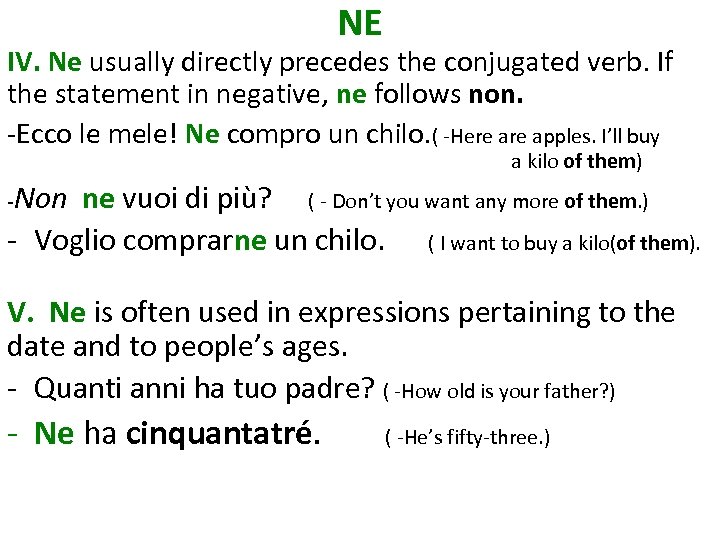 NE IV. Ne usually directly precedes the conjugated verb. If the statement in negative, ne follows non. -Ecco le mele! Ne compro un chilo. ( -Here apples. I’ll buy a kilo of them) -Non ne vuoi di più? ( - Don’t you want any more of them. ) - Voglio comprarne un chilo. ( I want to buy a kilo(of them). V. Ne is often used in expressions pertaining to the date and to people’s ages. - Quanti anni ha tuo padre? ( -How old is your father? ) - Ne ha cinquantatré. ( -He’s fifty-three. )