 Скачать презентацию Church Planting Survivability and Health Study 2007 Best
6081eb694564b4bc9b18935de9892924.ppt
- Количество слайдов: 99



Church Planting Survivability and Health Study 2007 Best Practices Ed Stetzer Church Planting Survivability and Health Study 2007 Compiled by the Center for Missional Research, NAMB. Phillip Connor
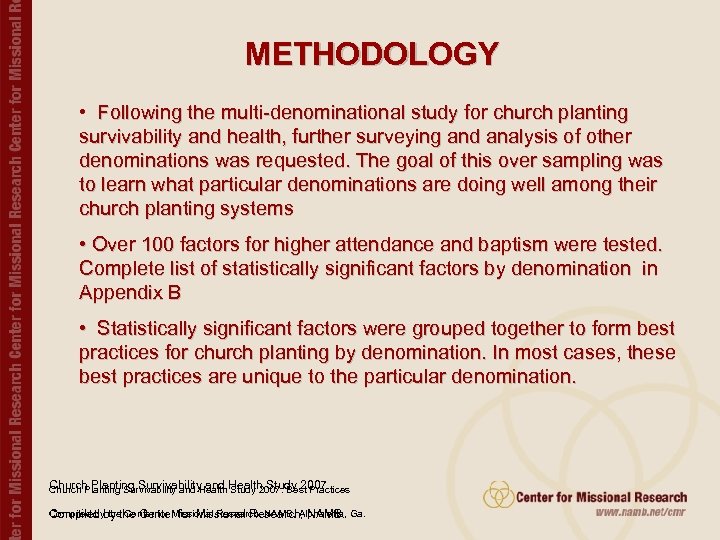
METHODOLOGY • Following the multi-denominational study for church planting survivability and health, further surveying and analysis of other denominations was requested. The goal of this over sampling was to learn what particular denominations are doing well among their church planting systems • Over 100 factors for higher attendance and baptism were tested. Complete list of statistically significant factors by denomination in Appendix B • Statistically significant factors were grouped together to form best practices for church planting by denomination. In most cases, these best practices are unique to the particular denomination. Church Planting Survivability and Health Study 2007: Best Practices Compiled by the Center for Missional Research, NAMB, Alpharetta, Ga. Compiled by the Center for Missional Research, NAMB.
THIS PRESENTATION CONTAINS: • Data prepared by the Center for Missional Research studying multiple practices by different denominations. • Presentation slides shared at the National New Church Conference by denominational leaders who were found to have statistically significant results in this study. Church Planting Survivability and Health Study 2007 Compiled by the Center for Missional Research, NAMB.
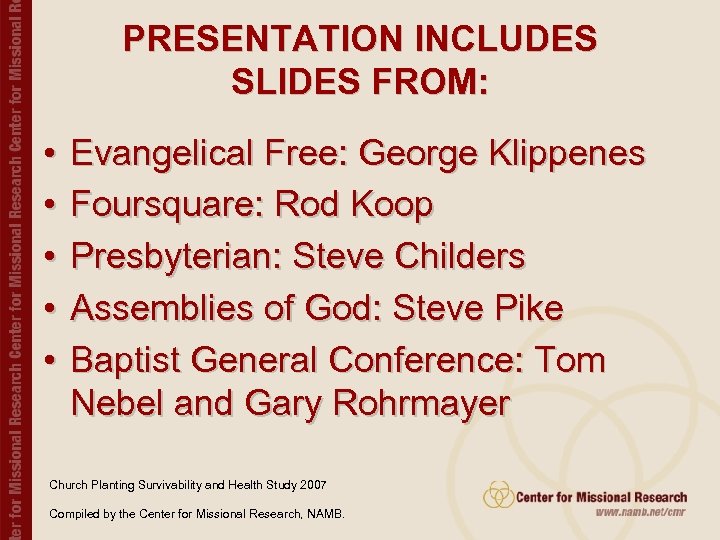
PRESENTATION INCLUDES SLIDES FROM: • • • Evangelical Free: George Klippenes Foursquare: Rod Koop Presbyterian: Steve Childers Assemblies of God: Steve Pike Baptist General Conference: Tom Nebel and Gary Rohrmayer Church Planting Survivability and Health Study 2007 Compiled by the Center for Missional Research, NAMB.
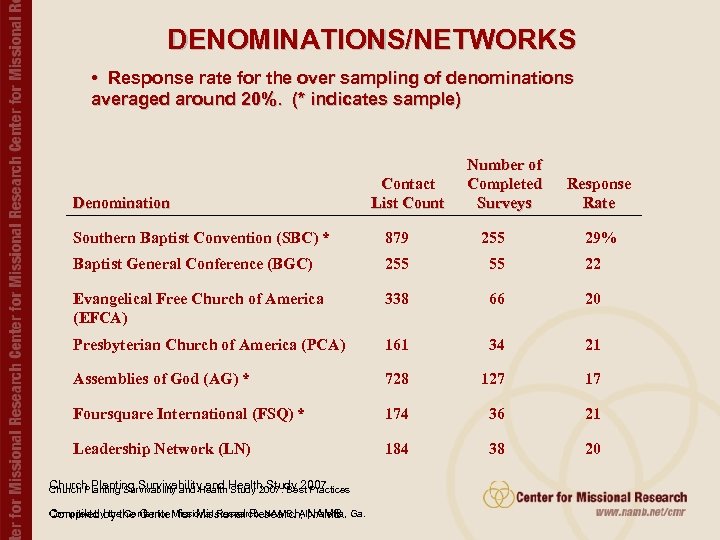
DENOMINATIONS/NETWORKS • Response rate for the over sampling of denominations averaged around 20%. (* indicates sample) Denomination Contact List Count Number of Completed Surveys Response Rate Southern Baptist Convention (SBC) * 879 255 Baptist General Conference (BGC) 255 55 22 Evangelical Free Church of America (EFCA) 338 66 20 Presbyterian Church of America (PCA) 161 34 21 Assemblies of God (AG) * 728 127 17 Foursquare International (FSQ) * 174 36 21 Leadership Network (LN) 184 38 20 Church Planting Survivability and Health Study 2007: Best Practices Compiled by the Center for Missional Research, NAMB, Alpharetta, Ga. Compiled by the Center for Missional Research, NAMB. 29%
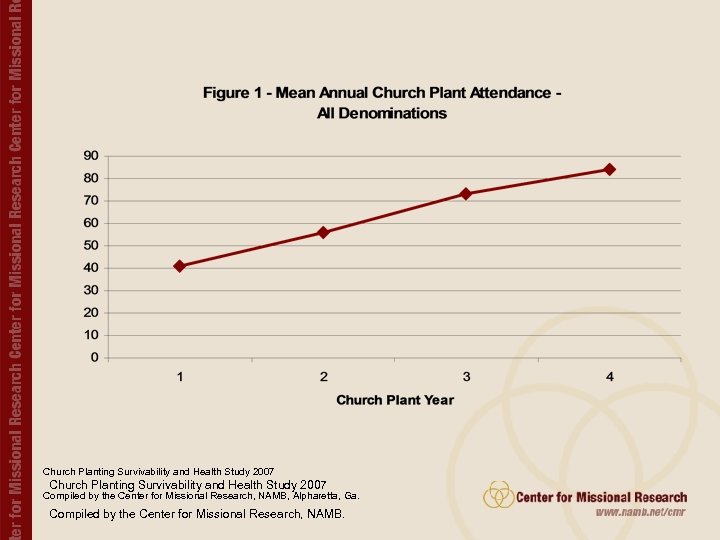
Church Planting Survivability and Health Study 2007 Compiled by the Center for Missional Research, NAMB, Alpharetta, Ga. Compiled by the Center for Missional Research, NAMB.
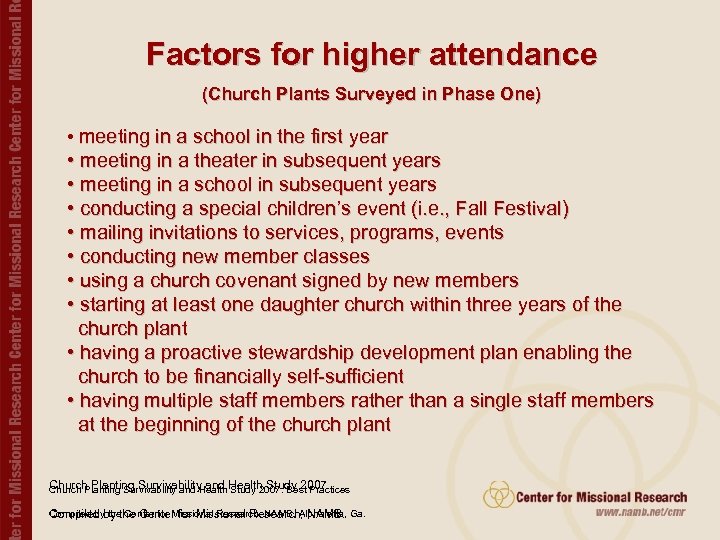
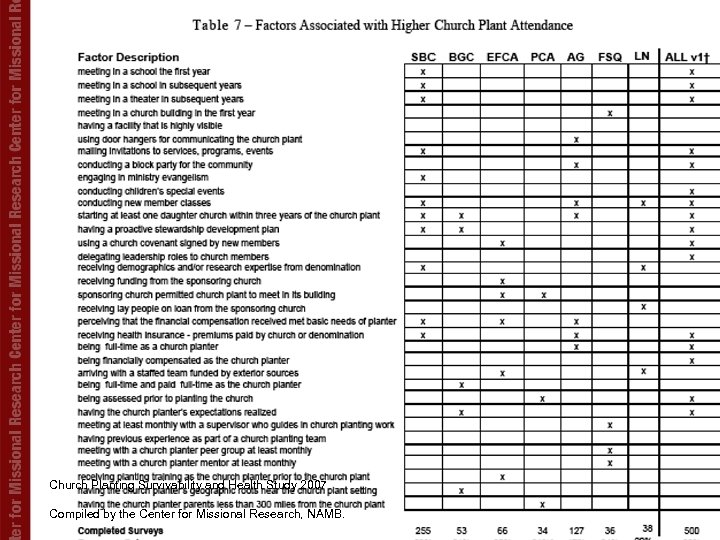
Factors for higher attendance (Church Plants Surveyed in Phase One) • meeting in a school in the first year • meeting in a theater in subsequent years • meeting in a school in subsequent years • conducting a special children’s event (i. e. , Fall Festival) • mailing invitations to services, programs, events • conducting new member classes • using a church covenant signed by new members • starting at least one daughter church within three years of the church plant • having a proactive stewardship development plan enabling the church to be financially self-sufficient • having multiple staff members rather than a single staff members at the beginning of the church plant Church Planting Survivability and Health Study 2007: Best Practices Compiled by the Center for Missional Research, NAMB, Alpharetta, Ga. Compiled by the Center for Missional Research, NAMB.
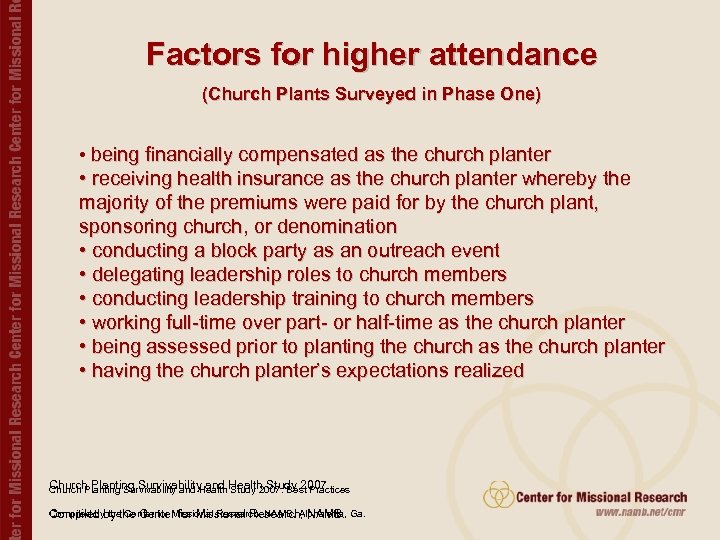
Factors for higher attendance (Church Plants Surveyed in Phase One) • being financially compensated as the church planter • receiving health insurance as the church planter whereby the majority of the premiums were paid for by the church plant, sponsoring church, or denomination • conducting a block party as an outreach event • delegating leadership roles to church members • conducting leadership training to church members • working full-time over part- or half-time as the church planter • being assessed prior to planting the church as the church planter • having the church planter’s expectations realized Church Planting Survivability and Health Study 2007: Best Practices Compiled by the Center for Missional Research, NAMB, Alpharetta, Ga. Compiled by the Center for Missional Research, NAMB.
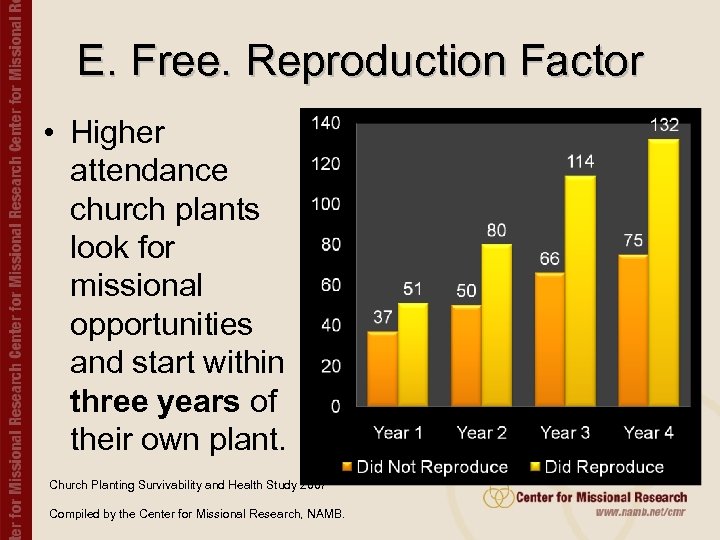
E. Free. Reproduction Factor • Higher attendance church plants look for missional opportunities and start within three years of their own plant. Church Planting Survivability and Health Study 2007 Compiled by the Center for Missional Research, NAMB.
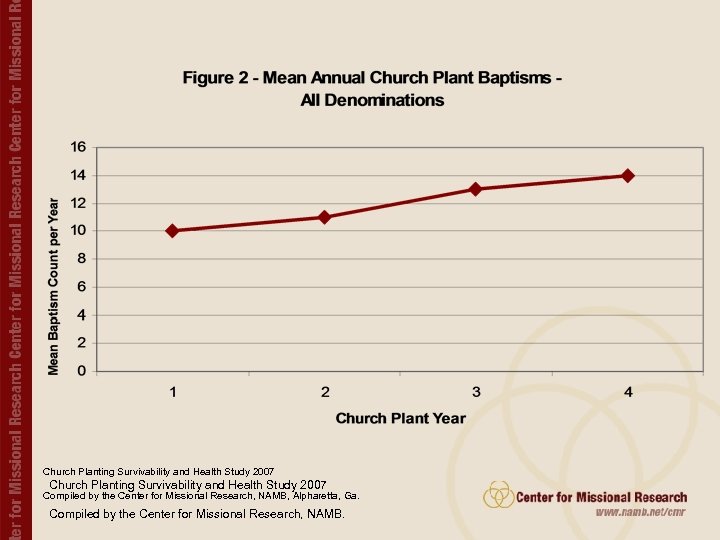
Church Planting Survivability and Health Study 2007 Compiled by the Center for Missional Research, NAMB, Alpharetta, Ga. Compiled by the Center for Missional Research, NAMB.
Factors for higher baptisms (Church Plants Surveyed in Phase One) • engaging in ministry evangelism (i. e. , food banks, shelter, drug/alcohol recovery) • starting at least one daughter church within three years of the church plant • having a proactive stewardship development plan enabling the church to be financially self-sufficient • conducting a mid-week children’s program • conducting a children’s special event (i. e. , Fall Festival) • sending out mailers for invitation to services and church events Church Planting Survivability and Health Study 2007: Best Practices Compiled by the Center for Missional Research, NAMB, Alpharetta, Ga. Compiled by the Center for Missional Research, NAMB.
Factors for higher baptisms (Church Plants Surveyed in Phase One) • conducting a block party as an outreach activity • conducting a new member class for new church members • conducting leadership training for church members • receiving church planting training in terms of a boot camp or basic training by the church planter • working full-time over part-time as the church planter • being assessed prior to the beginning of the church plant as the church planter • delegating leadership roles to church members Church Planting Survivability and Health Study 2007: Best Practices Compiled by the Center for Missional Research, NAMB, Alpharetta, Ga. Compiled by the Center for Missional Research, NAMB.
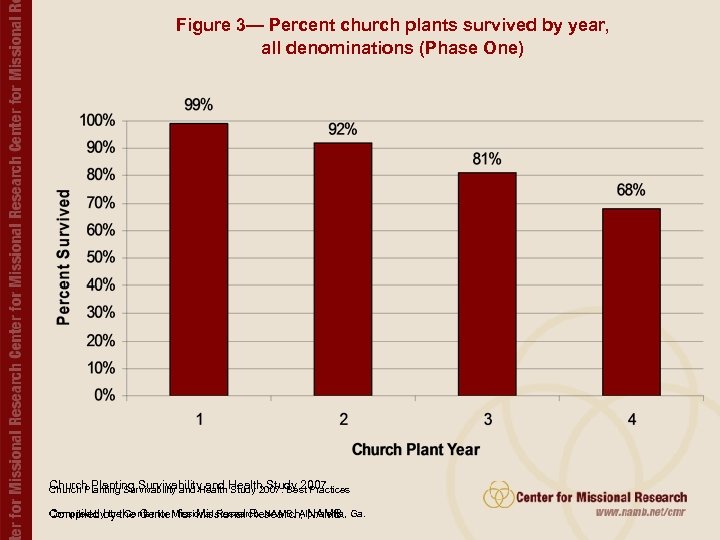
Figure 3— Percent church plants survived by year, all denominations (Phase One) Church Planting Survivability and Health Study 2007: Best Practices Compiled by the Center for Missional Research, NAMB, Alpharetta, Ga. Compiled by the Center for Missional Research, NAMB.
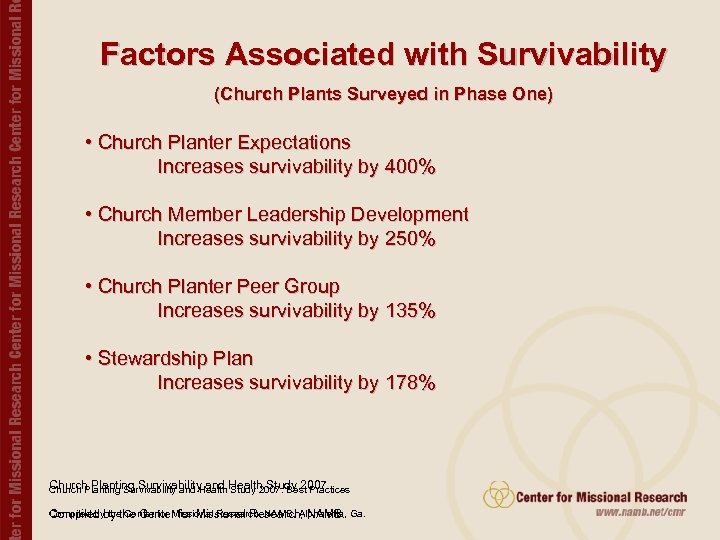
Factors Associated with Survivability (Church Plants Surveyed in Phase One) • Church Planter Expectations Increases survivability by 400% • Church Member Leadership Development Increases survivability by 250% • Church Planter Peer Group Increases survivability by 135% • Stewardship Plan Increases survivability by 178% Church Planting Survivability and Health Study 2007: Best Practices Compiled by the Center for Missional Research, NAMB, Alpharetta, Ga. Compiled by the Center for Missional Research, NAMB.
Church Planting Survivability and Health Study 2007 What Can We Learn and How Can We Learn it? Ed Stetzer Church Planting Survivability and Health Study 2007 Compiled by the Center for Missional Research, NAMB. Phillip Connor
Church Planting Survivability and Health Study 2007 Compiled by the Center for Missional Research, NAMB.
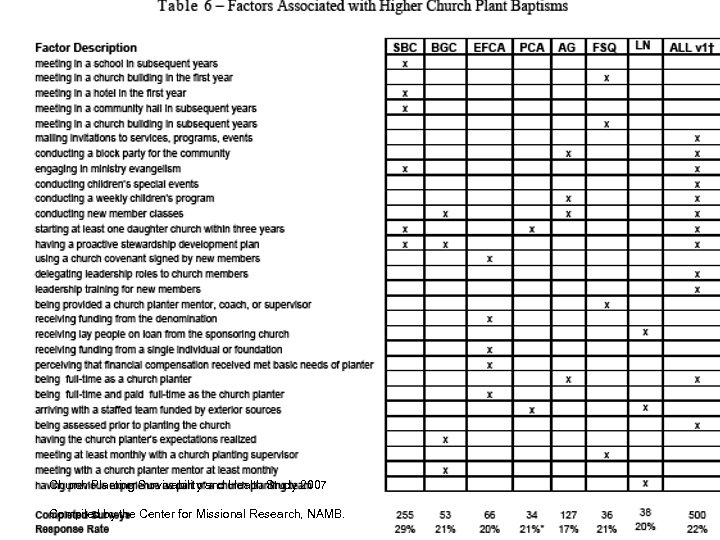
Church Planting Survivability and Health Study 2007 Compiled by the Center for Missional Research, NAMB.
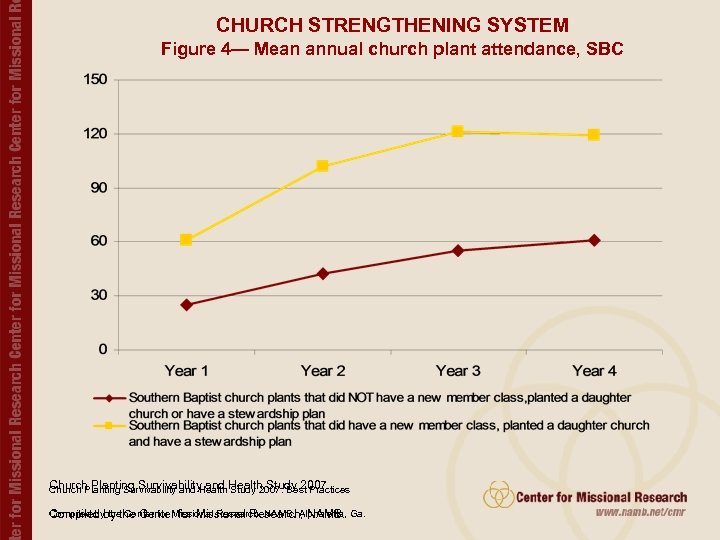
CHURCH STRENGTHENING SYSTEM Figure 4— Mean annual church plant attendance, SBC Church Planting Survivability and Health Study 2007: Best Practices Compiled by the Center for Missional Research, NAMB, Alpharetta, Ga. Compiled by the Center for Missional Research, NAMB.
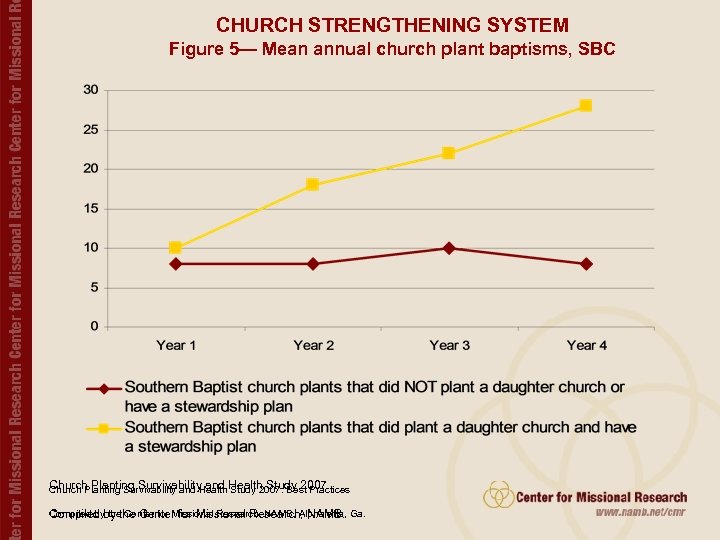
CHURCH STRENGTHENING SYSTEM Figure 5— Mean annual church plant baptisms, SBC Church Planting Survivability and Health Study 2007: Best Practices Compiled by the Center for Missional Research, NAMB, Alpharetta, Ga. Compiled by the Center for Missional Research, NAMB.
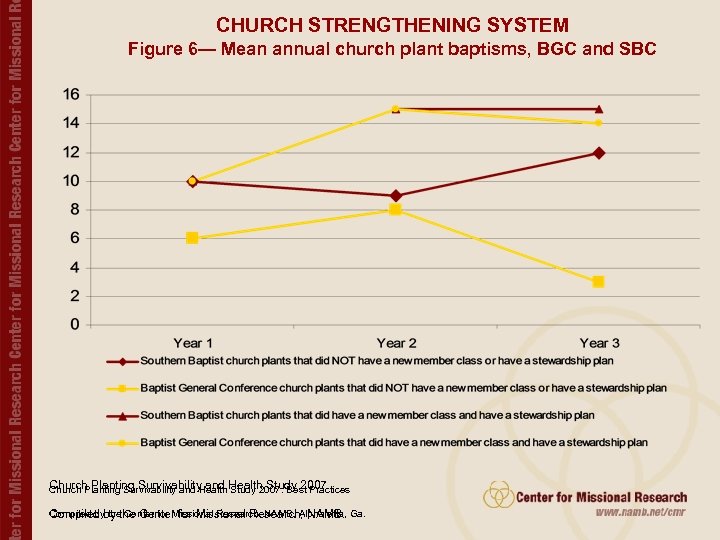
CHURCH STRENGTHENING SYSTEM Figure 6— Mean annual church plant baptisms, BGC and SBC Church Planting Survivability and Health Study 2007: Best Practices Compiled by the Center for Missional Research, NAMB, Alpharetta, Ga. Compiled by the Center for Missional Research, NAMB.
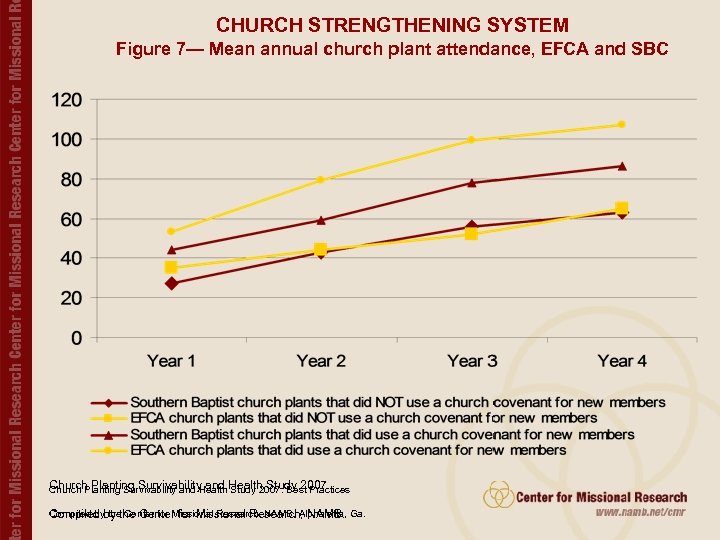
CHURCH STRENGTHENING SYSTEM Figure 7— Mean annual church plant attendance, EFCA and SBC Church Planting Survivability and Health Study 2007: Best Practices Compiled by the Center for Missional Research, NAMB, Alpharetta, Ga. Compiled by the Center for Missional Research, NAMB.
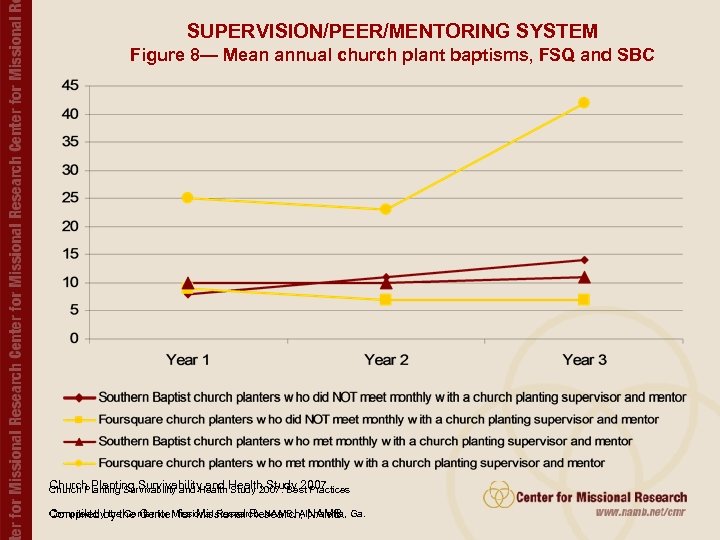
SUPERVISION/PEER/MENTORING SYSTEM Figure 8— Mean annual church plant baptisms, FSQ and SBC Church Planting Survivability and Health Study 2007: Best Practices Compiled by the Center for Missional Research, NAMB, Alpharetta, Ga. Compiled by the Center for Missional Research, NAMB.
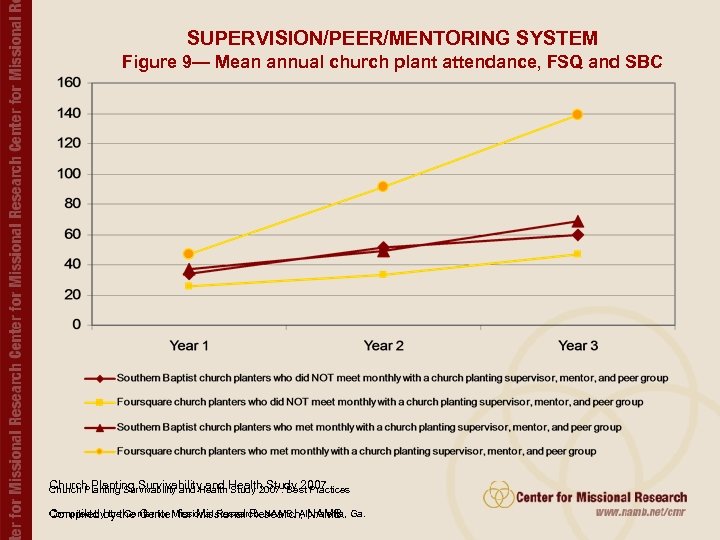
SUPERVISION/PEER/MENTORING SYSTEM Figure 9— Mean annual church plant attendance, FSQ and SBC Church Planting Survivability and Health Study 2007: Best Practices Compiled by the Center for Missional Research, NAMB, Alpharetta, Ga. Compiled by the Center for Missional Research, NAMB.
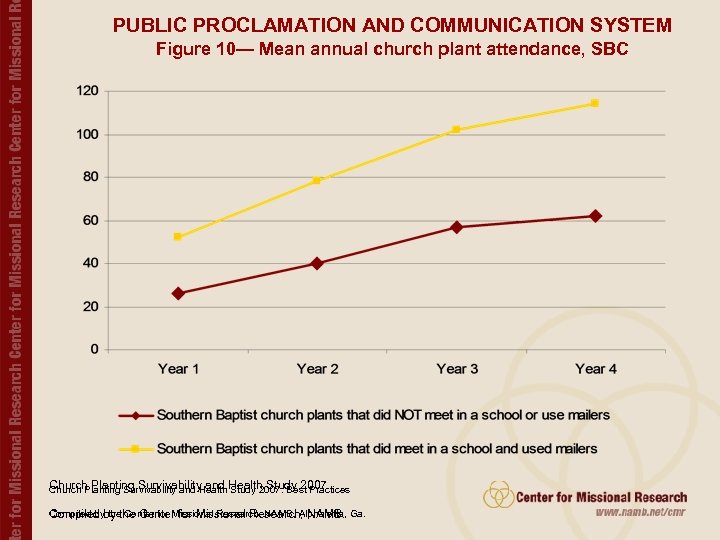
PUBLIC PROCLAMATION AND COMMUNICATION SYSTEM Figure 10— Mean annual church plant attendance, SBC Church Planting Survivability and Health Study 2007: Best Practices Compiled by the Center for Missional Research, NAMB, Alpharetta, Ga. Compiled by the Center for Missional Research, NAMB.
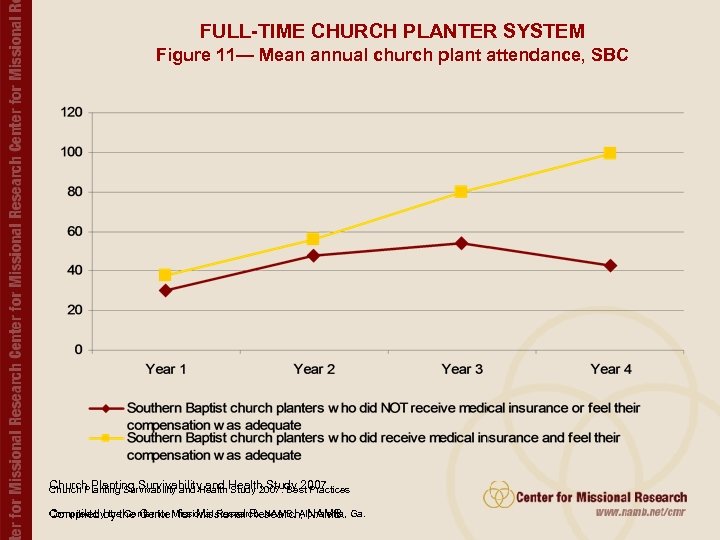
FULL-TIME CHURCH PLANTER SYSTEM Figure 11— Mean annual church plant attendance, SBC Church Planting Survivability and Health Study 2007: Best Practices Compiled by the Center for Missional Research, NAMB, Alpharetta, Ga. Compiled by the Center for Missional Research, NAMB.
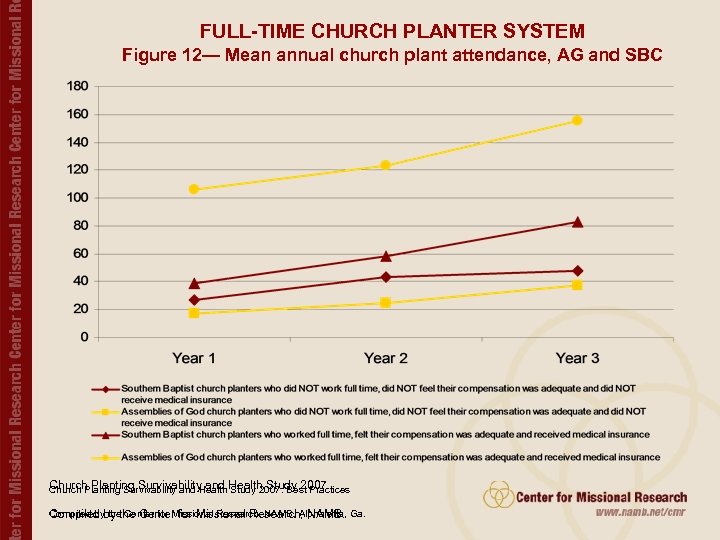
FULL-TIME CHURCH PLANTER SYSTEM Figure 12— Mean annual church plant attendance, AG and SBC Church Planting Survivability and Health Study 2007: Best Practices Compiled by the Center for Missional Research, NAMB, Alpharetta, Ga. Compiled by the Center for Missional Research, NAMB.
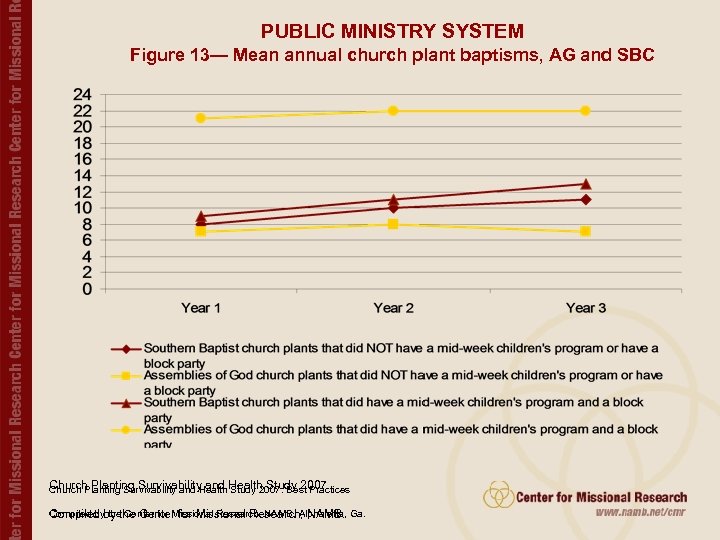
PUBLIC MINISTRY SYSTEM Figure 13— Mean annual church plant baptisms, AG and SBC Church Planting Survivability and Health Study 2007: Best Practices Compiled by the Center for Missional Research, NAMB, Alpharetta, Ga. Compiled by the Center for Missional Research, NAMB.
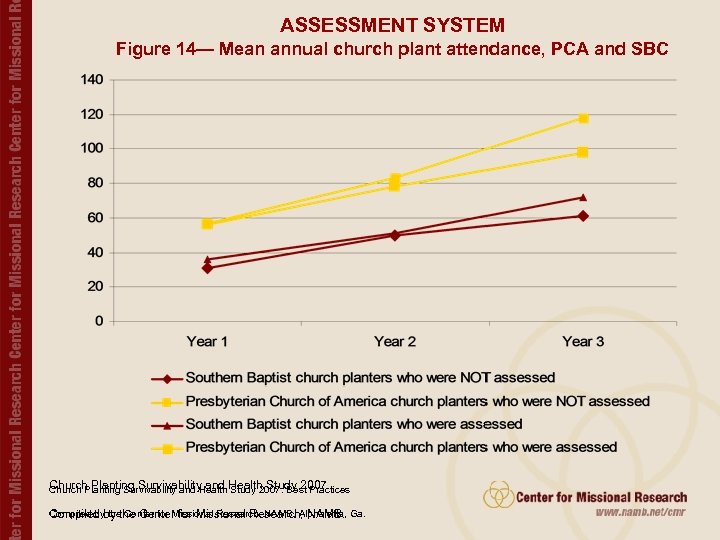
ASSESSMENT SYSTEM Figure 14— Mean annual church plant attendance, PCA and SBC Church Planting Survivability and Health Study 2007: Best Practices Compiled by the Center for Missional Research, NAMB, Alpharetta, Ga. Compiled by the Center for Missional Research, NAMB.
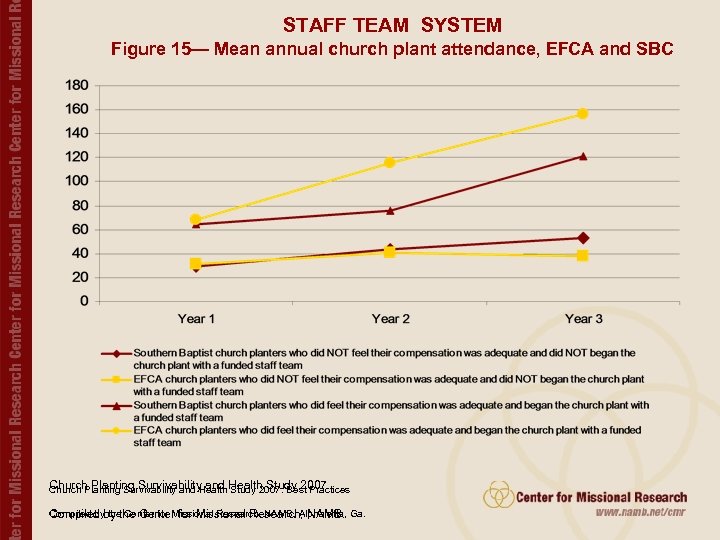
STAFF TEAM SYSTEM Figure 15— Mean annual church plant attendance, EFCA and SBC Church Planting Survivability and Health Study 2007: Best Practices Compiled by the Center for Missional Research, NAMB, Alpharetta, Ga. Compiled by the Center for Missional Research, NAMB.
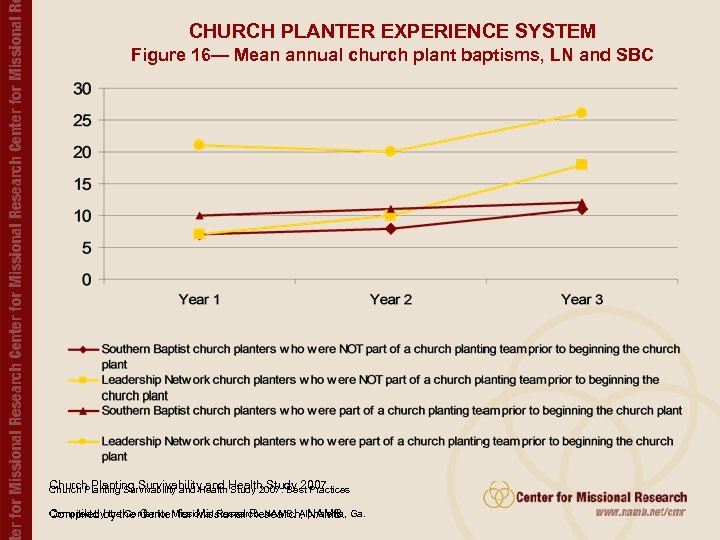
CHURCH PLANTER EXPERIENCE SYSTEM Figure 16— Mean annual church plant baptisms, LN and SBC Church Planting Survivability and Health Study 2007: Best Practices Compiled by the Center for Missional Research, NAMB, Alpharetta, Ga. Compiled by the Center for Missional Research, NAMB.
Creating a Culture of Generosity BGC Presentation Church Planting Survivability and Health Study 2007 Compiled by the Center for Missional Research, NAMB.
Fear and Neglect of Money Issues • Convictions you must have – God blesses generosity. – It’s not about what the church needs, it’s about what the Lord wants. – A tithe is an appropriate standard to challenge people toward. Church Planting Survivability and Health Study 2007 Compiled by the Center for Missional Research, NAMB.
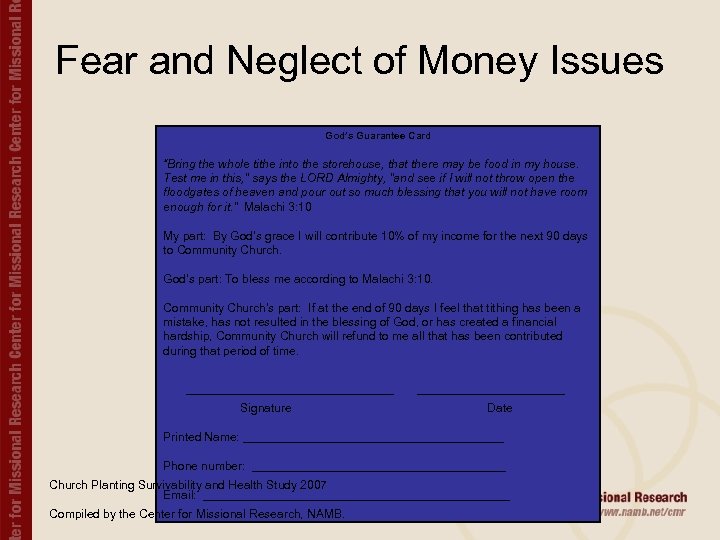
Fear and Neglect of Money Issues God’s Guarantee Card “Bring the whole tithe into the storehouse, that there may be food in my house. Test me in this, " says the LORD Almighty, "and see if I will not throw open the floodgates of heaven and pour out so much blessing that you will not have room enough for it. ” Malachi 3: 10 My part: By God’s grace I will contribute 10% of my income for the next 90 days to Community Church. God’s part: To bless me according to Malachi 3: 10. Community Church’s part: If at the end of 90 days I feel that tithing has been a mistake, has not resulted in the blessing of God, or has created a financial hardship, Community Church will refund to me all that has been contributed during that period of time. -------------------------- ------------------Signature Date Printed Name: ____________________ Phone number: ___________________ Church Planting Survivability and Health Study 2007 Email: _______________________ Compiled by the Center for Missional Research, NAMB.
Fear and Neglect of Money Issues • Delivery Options – Sermon series (annually) – Membership classes – Small groups – Leadership retreats – Leadership meetings Church Planting Survivability and Health Study 2007 Compiled by the Center for Missional Research, NAMB.
Evangelical Free Church George Klippenes Church Planting Survivability and Health Study 2007 Compiled by the Center for Missional Research, NAMB.
Our EFCA Mission • The Evangelical Free Church exists to glorify God by multiplying healthy churches among all people. Church Planting Survivability and Health Study 2007 Compiled by the Center for Missional Research, NAMB.
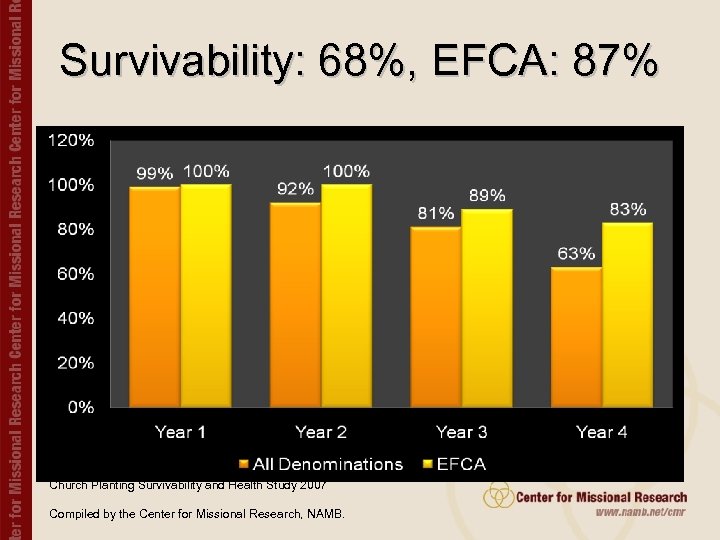
Survivability: 68%, EFCA: 87% Church Planting Survivability and Health Study 2007 Compiled by the Center for Missional Research, NAMB.
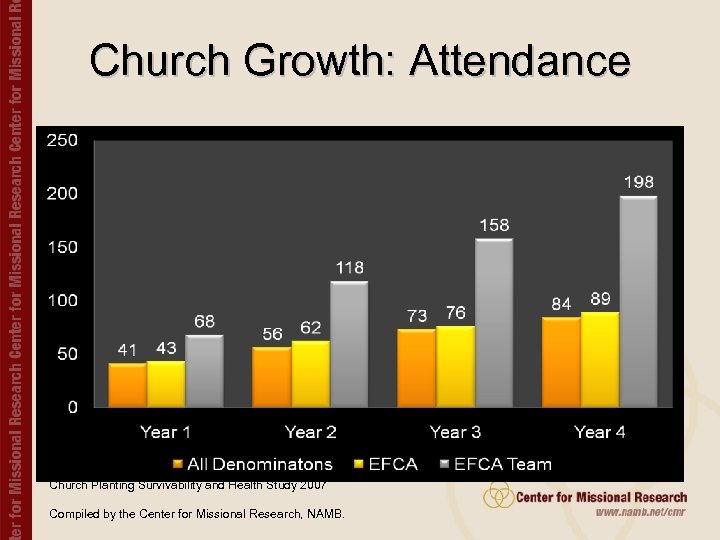
Church Growth: Attendance Church Planting Survivability and Health Study 2007 Compiled by the Center for Missional Research, NAMB.
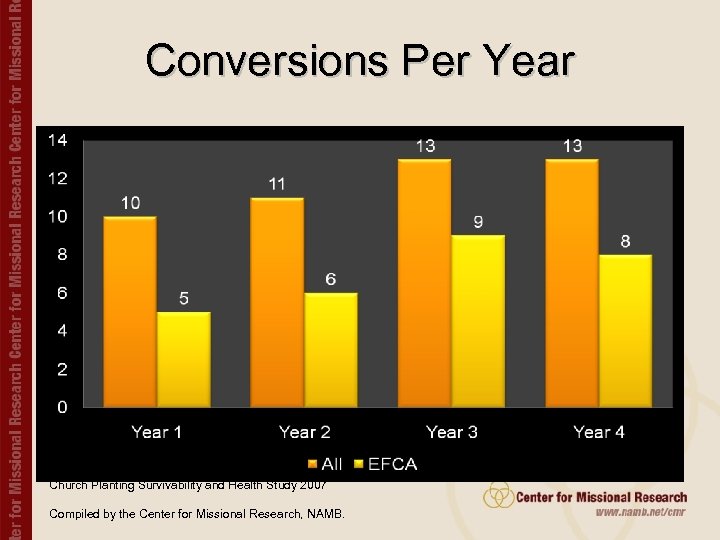
Conversions Per Year Church Planting Survivability and Health Study 2007 Compiled by the Center for Missional Research, NAMB.
EFCA Vision • The EFCA church planting vision is to mobilize a church planting movement in the United States where every healthy EFCA church will reproduce at least two daughter churches and no EFCA church planter will be left alone. Church Planting Survivability and Health Study 2007 Compiled by the Center for Missional Research, NAMB.
Reproducing Vision • Reproducing Reality: Sterile Churches • Reproducing Clinics: Blow up CP Myths – – Hurt mother church Enough churches Large church Most plants fail • Reproducing Vision: Plant two – One daughter church to replace itself. – One daughter church to advance the kingdom. Church Planting Survivability and Health Study 2007 – Reproduction normal & natural outflow of health. Compiled by the Center for Missional Research, NAMB.
Planter Vision • Planter reality: Stranded – No Planter Left Alone • EFCA System: ACTS – Assessment – Coaching – Training – Supporting Church Planting Survivability and Health Study 2007 Compiled by the Center for Missional Research, NAMB. ACTS
EFCA Boot. Camp 1. 2. 3. 4. 5. 6. 7. Built on a life-cycle model Built on a 4 R model Principle centered Trainers are practitioners Church Growth 101: 100, 200, Repro. ABC Integration Relentless refinement Church Planting Survivability and Health Study 2007 Compiled by the Center for Missional Research, NAMB.
EFCA Assessment 1. Self Assessment: On line – Planter Profile, MBTI, Di. SC, Spiritual Gifts 2. Modified Behavioral Interview – Certified Assessment Team 3. District Placement – Drill down on doctrine, marriage, chemistry Church Planting Survivability and Health Study 2007 Compiled by the Center for Missional Research, NAMB.
Holistic: ABC Integration • Assess: For Potential • Train: For Content • Coach: For Implementation Church Planting Survivability and Health Study 2007 Compiled by the Center for Missional Research, NAMB.
2007 Study • EFCA Planters – Coach: 94% – Peer Network: 53% – Boot. Camp: 87% – Other training: 100% – Assessment: 90% (my guess) • We work hard on our support systems! Church Planting Survivability and Health Study 2007 Compiled by the Center for Missional Research, NAMB.
EFCA and Funding Show Me The Money! Church Planting Survivability and Health Study 2007 Compiled by the Center for Missional Research, NAMB.
Fourth Question 1. Assessment: Is he a planter? 2. Training: Does he have a good plan? 3. Coaching: Does he have someone to help him stay on target, on time, and in balance? 4. Funding: Does he have adequate funding to be successful? Church Planting Survivability and Health Study 2007 Compiled by the Center for Missional Research, NAMB.
ABC-D Integration • Assessment – Vision caster- People gatherer- Fund raiser • Boot. Camp Training: Proposal – Good proposal: Realistic funding projections • Coaching – Know planters want to skip fund raising. • Development: – When ABC is in place, we can confidently invest in planters. Church Planting Survivability and Health Study 2007 Compiled by the Center for Missional Research, NAMB.
EFCA Resources • National: Revolving Fund (CPRF) – Very small: $250, 000 – Large estate gift: 10 -12 year process • 18 Districts: All over the map – Some districts have CPRF: Road kill – Some districts have no money – Most districts in-between Church Planting Survivability and Health Study 2007 Compiled by the Center for Missional Research, NAMB.
Revolving Principle • Encouraging districts to develop CPRF – Not a grant, but an investment – We invest in you – You tithe back to the CPRF – You invest in the next generation Church Planting Survivability and Health Study 2007 Compiled by the Center for Missional Research, NAMB.
Funding Models • Adolescent: Full Support • Pure Pioneer: Missionary Support • Combination: 90% of EFCA plants – Planter, Area Churches, District, National Church Planting Survivability and Health Study 2007 Compiled by the Center for Missional Research, NAMB.
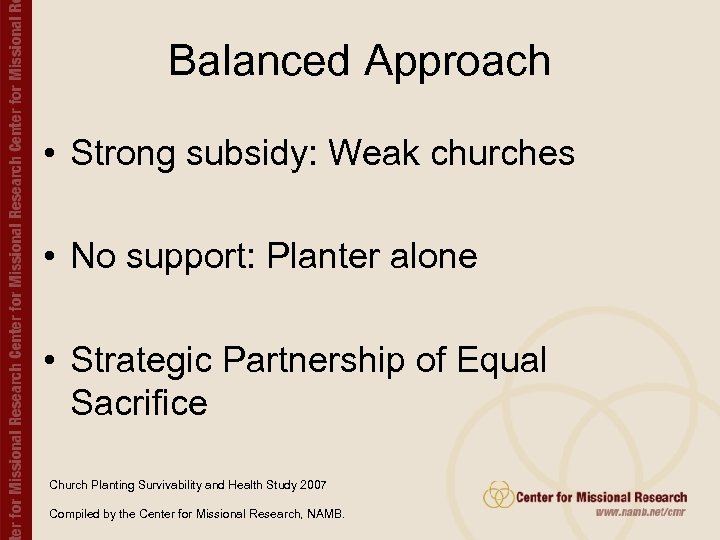
Balanced Approach • Strong subsidy: Weak churches • No support: Planter alone • Strategic Partnership of Equal Sacrifice Church Planting Survivability and Health Study 2007 Compiled by the Center for Missional Research, NAMB.
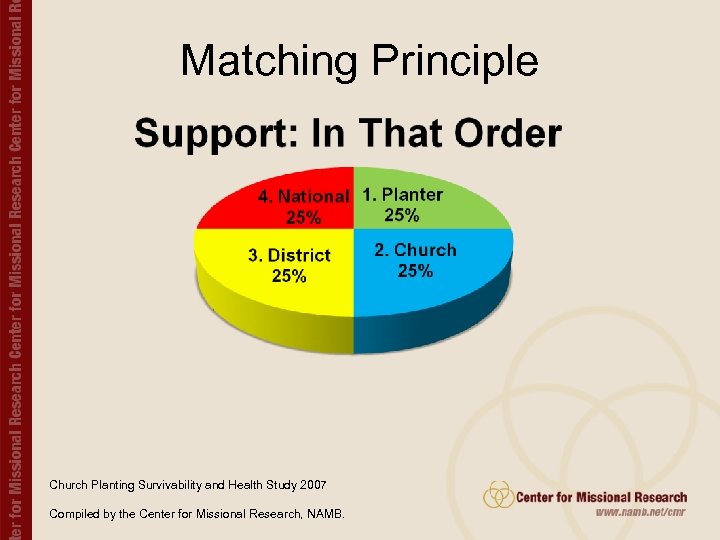
Matching Principle Church Planting Survivability and Health Study 2007 Compiled by the Center for Missional Research, NAMB.
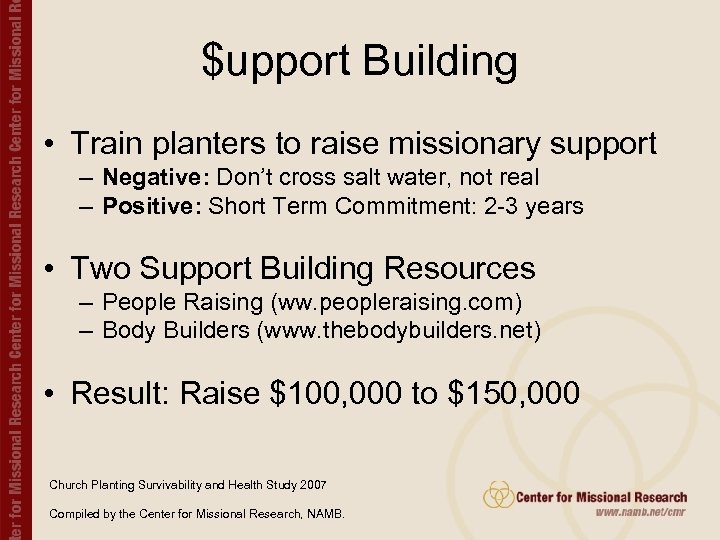
$upport Building • Train planters to raise missionary support – Negative: Don’t cross salt water, not real – Positive: Short Term Commitment: 2 -3 years • Two Support Building Resources – People Raising (ww. peopleraising. com) – Body Builders (www. thebodybuilders. net) • Result: Raise $100, 000 to $150, 000 Church Planting Survivability and Health Study 2007 Compiled by the Center for Missional Research, NAMB.
$upport Building • Credibility – Many of our district leaders raise support • Best Practice – GLD: Use former missionary to coach Church Planting Survivability and Health Study 2007 Compiled by the Center for Missional Research, NAMB.
2007 Study Sponsoring Churches • Districts recruit sponsoring churches – EFCA Plants: 53% had parent church – Parent Church: 88% provided funding – Parent Church: 38% loaned lay people • We do have some very generous existing churches. Church Planting Survivability and Health Study 2007 Compiled by the Center for Missional Research, NAMB.
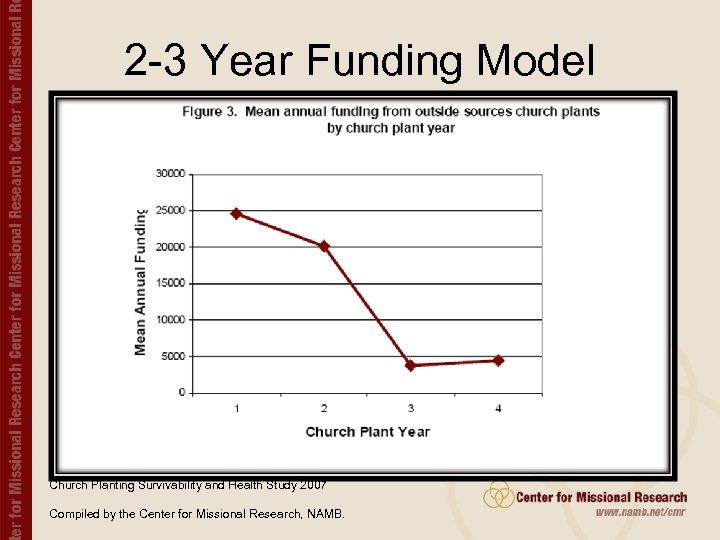
2 -3 Year Funding Model Church Planting Survivability and Health Study 2007 Compiled by the Center for Missional Research, NAMB.
Generosity DNA • Boot. Camp Training – You are responsible for the generosity DNA • Grand Opening: Tithe • Fair Share: 1% District, 1% National – 8% Church Planting, 1: 8 Missions Church Planting Survivability and Health Study 2007 Compiled by the Center for Missional Research, NAMB.
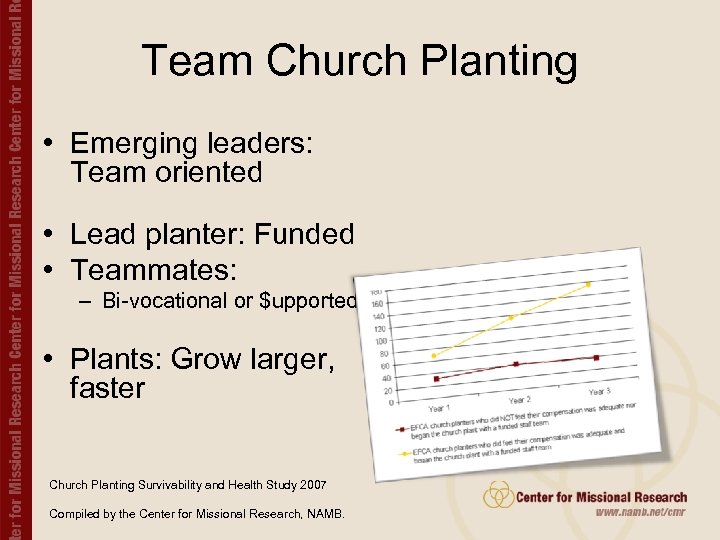
Team Church Planting • Emerging leaders: Team oriented • Lead planter: Funded • Teammates: – Bi-vocational or $upported • Plants: Grow larger, faster Church Planting Survivability and Health Study 2007 Compiled by the Center for Missional Research, NAMB.
Foursquare Church Multiplication Best Practices Rod Koop Church Planting Survivability and Health Study 2007 Compiled by the Center for Missional Research, NAMB.
Coaching • Duration – funded for 18 months • Timing – assigned as early as assessment debrief, no later than the start of training • Tools – coaches have access to both the assessment and the church planter’s proposal Church Planting Survivability and Health Study 2007 Compiled by the Center for Missional Research, NAMB.
Coaching • Training – 1 hour, 12 minute DVD and 16 page booklet – using the G. R. O. W. model • Reporting – mandatory, monthly online report that speaks to a planter’s personal life, family life and ministry life (in that order) – ongoing coach/planter support & training informed by the quality of monthly reports Church Planting Survivability and Health Study 2007 Compiled by the Center for Missional Research, NAMB.
Funding • $20, 000 per plant, or 5 churches for $100, 000 • Extraordinary funding available for proven, fruitful leaders or breakthrough opportunities, to a high of $60, 000 for a single plant Church Planting Survivability and Health Study 2007 Compiled by the Center for Missional Research, NAMB.
Process versus Event Church Multiplication systems are crucial for success. But unless they are process rather than event oriented, they will not work. We value relationships more than we do systems. Our processes work best through relationships. Church Planting Survivability and Health Study 2007 Compiled by the Center for Missional Research, NAMB.
Flexibility Question • “In order to be fair, you must treat everyone _____. ” – Dad, 52 years at Rockwell, said “the same” – Russ, 40 years old and a disaster relief construction manager, said “differently”. • Both claimed to be right, saying mutiny would happen in the workplace if they did otherwise Church Planting Survivability and Health Study 2007 Compiled by the Center for Missional Research, NAMB.
Flexibility Question • But both were right in their context • The question is…what is right in yours? • Our process and funding theology comes from the Parable of the Talents • You must be ready to live in ambiguity, and have a high comfort level with conflict Church Planting Survivability and Health Study 2007 Compiled by the Center for Missional Research, NAMB.
Flexibility Question • Fulfilling objectives and outcomes for assessment, training and coaching is required for funding • Flexibility allows us to accomplish this in many different ways • Flexibility equals TRUST in the Field. Trust comes through relationship Church Planting Survivability and Health Study 2007 Compiled by the Center for Missional Research, NAMB.
Coaching • Objectives – to provide personal, family and ministry support – help the planter stay on track, avoiding pitfalls – to accelerate the progress of the church plant – to be the planter’s best advocate in navigating organizational culture Church Planting Survivability and Health Study 2007 Compiled by the Center for Missional Research, NAMB.
Coaching A business-like session… or flexibility in Relationship • Examples – Diane Thomas – Takes a cohort of planters to multiple site visits, looking closely at one another’s ministries – Pete Akins – Does phone call and email coaching appointments, then takes the planters into Zion National Park for an annual weekend canyoneering and hiking trip Church Planting Survivability and Health Study 2007 Compiled by the Center for Missional Research, NAMB.
Global Church Advancement (GCA) Training Systems (Presbyterian) Advancing Church Planting Movements Through Kingdom Partnerships Steve Childers Church Planting Survivability and Health Study 2007 Compiled by the Center for Missional Research, NAMB.
A Church Planting Movement A Movement is a work of God’s Spirit that produces indigenous, healthy, growing, reproducing Gospel-Centered Churches that result in the spiritual, social and cultural transformation of a community. Church Planting Survivability and Health Study 2007 Compiled by the Center for Missional Research, NAMB.
The Tactical Approach An intentional, multi-year process that equips leaders to develop the Essential Components necessary for a Church Planting Network Church Planting Survivability and Health Study 2007 Compiled by the Center for Missional Research, NAMB.
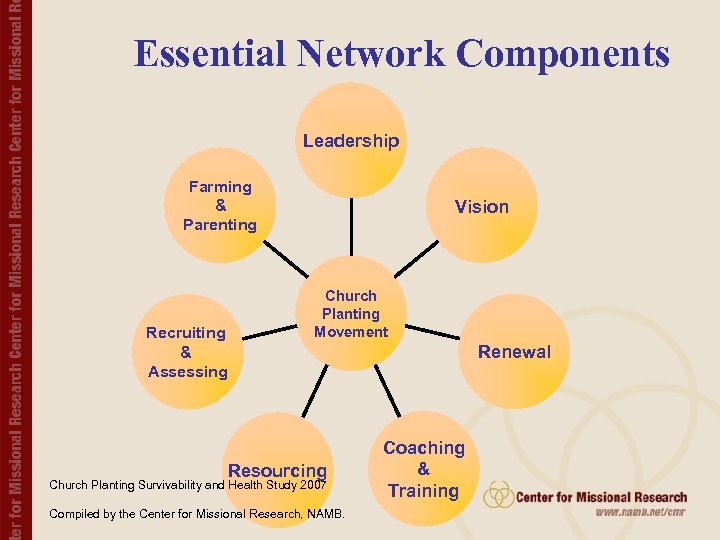
Essential Network Components Leadership Farming & Parenting Recruiting & Assessing Vision Church Planting Movement Renewal Resourcing Church Planting Survivability and Health Study 2007 Compiled by the Center for Missional Research, NAMB. Coaching & Training
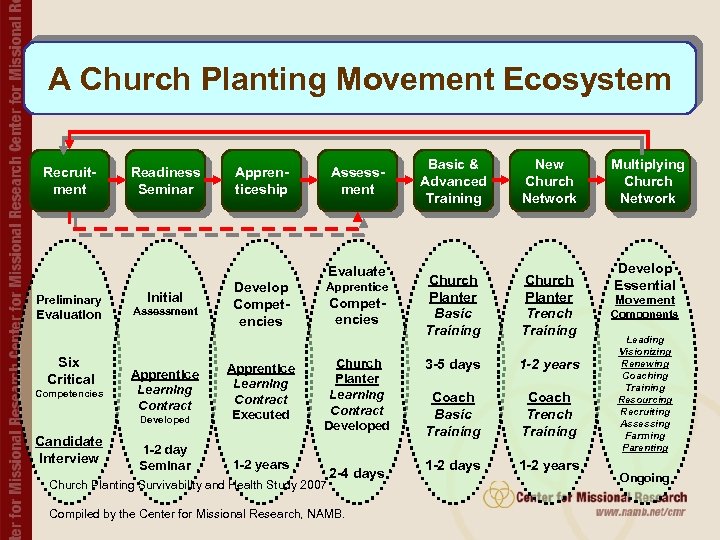
A Church Planting Movement Ecosystem Recruitment Preliminary Evaluation Six Critical Readiness Seminar Initial Assessment Apprenticeship Develop Competencies Developed Competencies Candidate Interview Apprentice Learning Contract Executed 1 -2 day Seminar Assessment Evaluate Apprentice Competencies Church Planter Learning Contract Developed 1 -2 years Apprentice Learning Contract Church Planting Survivability and Health Study 2007 2 -4 days Compiled by the Center for Missional Research, NAMB. Basic & Advanced Training New Church Network Church Planter Basic Training Church Planter Trench Training 3 -5 days 1 -2 years Coach Basic Training Coach Trench Training 1 -2 days 1 -2 years Multiplying Church Network Develop Essential Movement Components Leading Visionizing Renewing Coaching Training Resourcing Recruiting Assessing Farming Parenting Ongoing
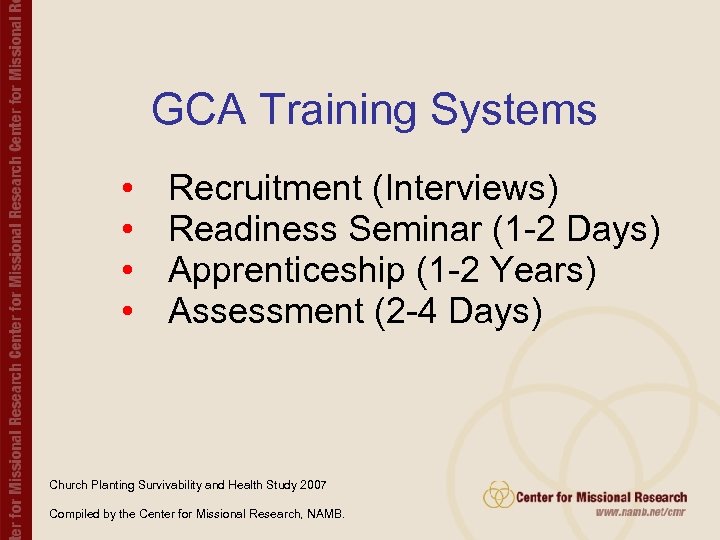
GCA Training Systems • • Recruitment (Interviews) Readiness Seminar (1 -2 Days) Apprenticeship (1 -2 Years) Assessment (2 -4 Days) Church Planting Survivability and Health Study 2007 Compiled by the Center for Missional Research, NAMB.
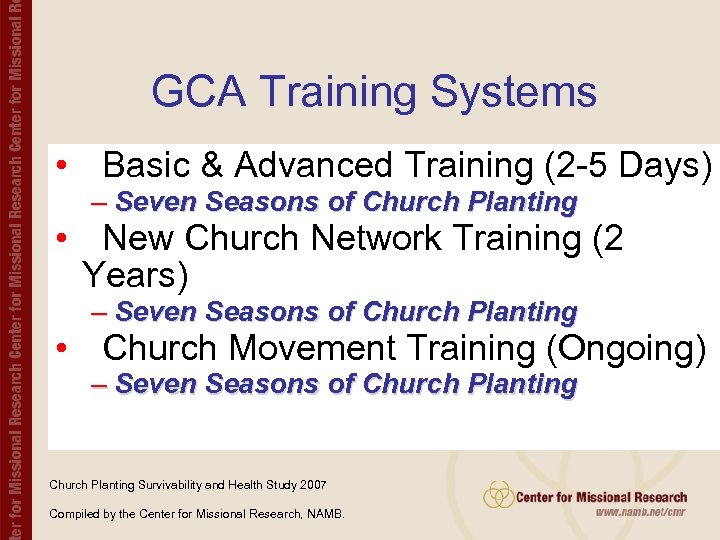
GCA Training Systems • Basic & Advanced Training (2 -5 Days) – Seven Seasons of Church Planting • New Church Network Training (2 Years) – Seven Seasons of Church Planting • Church Movement Training (Ongoing) – Seven Seasons of Church Planting Survivability and Health Study 2007 Compiled by the Center for Missional Research, NAMB.
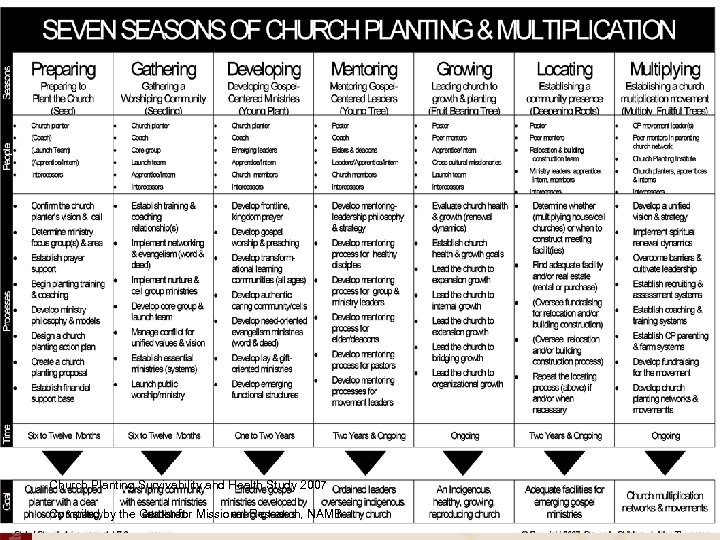
Church Planting Survivability and Health Study 2007 Compiled by the Center for Missional Research, NAMB.
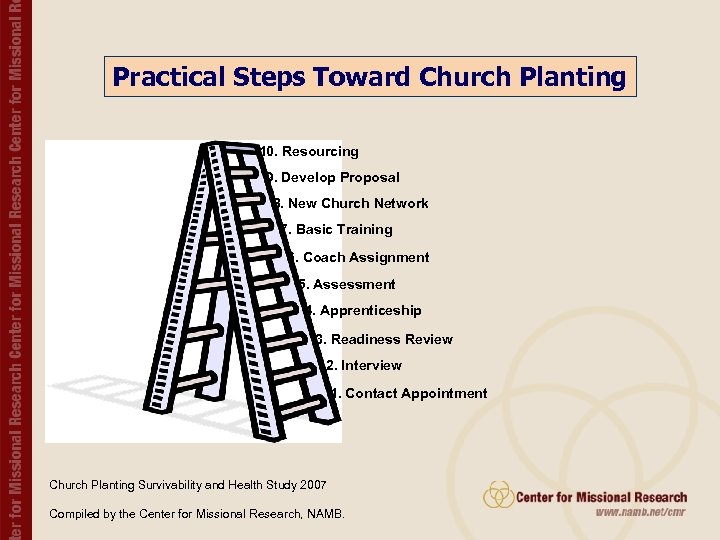
Practical Steps Toward Church Planting 10. Resourcing 9. Develop Proposal 8. New Church Network 7. Basic Training 6. Coach Assignment 5. Assessment 4. Apprenticeship 3. Readiness Review 2. Interview 1. Contact Appointment Church Planting Survivability and Health Study 2007 Compiled by the Center for Missional Research, NAMB.
Church Planter Assessment A Closer Look Church Planting Survivability and Health Study 2007 Compiled by the Center for Missional Research, NAMB.
History of Planter Assessments • • • 1980’s—Tom Graham, Charles Ridley 1990’s—Allen Thompson—Ph. D Study Developed Planter “Competencies” Church Planting Survivability and Health Study 2007 Compiled by the Center for Missional Research, NAMB.
Planter Competency Categories • • Personal (Character) Professional (Ministry Skills) Inter-Personal (People Skills) Theological (Knowledge) – Denominational Responsibility Church Planting Survivability and Health Study 2007 Compiled by the Center for Missional Research, NAMB.
Key Church Planter Competencies • • • Spiritual Vitality Calling Leadership Evangelism Preaching Family Life Church Planting Survivability and Health Study 2007 Compiled by the Center for Missional Research, NAMB.
Planter Assessment Process • Derived Information – Application – References (360 Degree Assessment) – Sermon Tape – Instruments (CP Profile, DISC, etc. ) Church Planting Survivability and Health Study 2007 Compiled by the Center for Missional Research, NAMB.
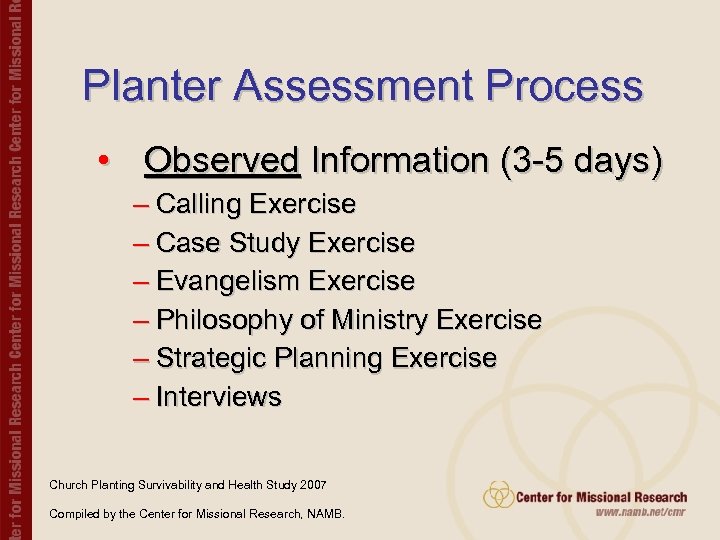
Planter Assessment Process • Observed Information (3 -5 days) – Calling Exercise – Case Study Exercise – Evangelism Exercise – Philosophy of Ministry Exercise – Strategic Planning Exercise – Interviews Church Planting Survivability and Health Study 2007 Compiled by the Center for Missional Research, NAMB.
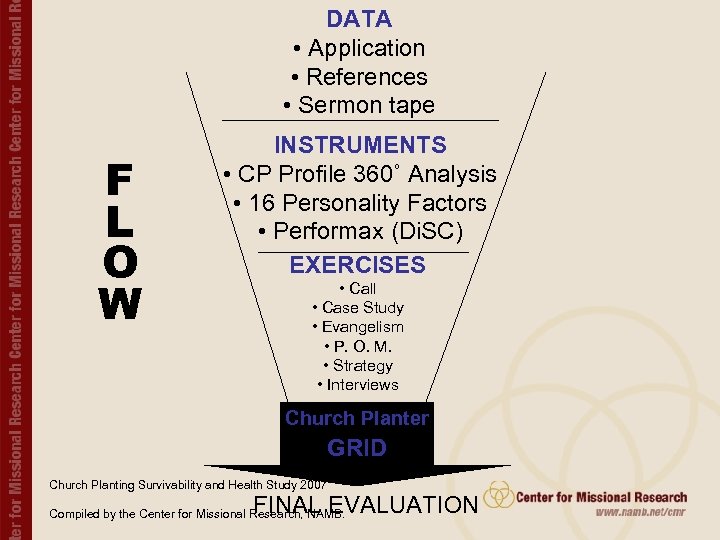
DATA • Application • References • Sermon tape F L O W INSTRUMENTS • CP Profile 360˚ Analysis • 16 Personality Factors • Performax (Di. SC) EXERCISES • Call • Case Study • Evangelism • P. O. M. • Strategy • Interviews Church Planter GRID Church Planting Survivability and Health Study 2007 FINAL EVALUATION Compiled by the Center for Missional Research, NAMB.
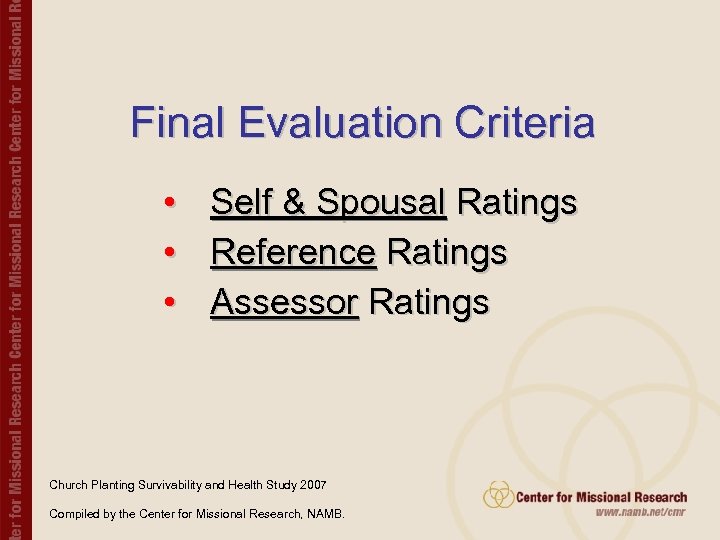
Final Evaluation Criteria • Self & Spousal Ratings • Reference Ratings • Assessor Ratings Church Planting Survivability and Health Study 2007 Compiled by the Center for Missional Research, NAMB.
Assemblies of God Church Planting Steven M. Pike National Church Planting Director Church Planting Survivability and Health Study 2007 Compiled by the Center for Missional Research, NAMB.
Church Planting Boot. Camp • • • What Does God Want To Do? Who Am I? What Am I Called To Do? Who Will Do It With Me? How Will We Do It? How Will We Evaluate Our Progress? Church Planting Survivability and Health Study 2007 Compiled by the Center for Missional Research, NAMB.
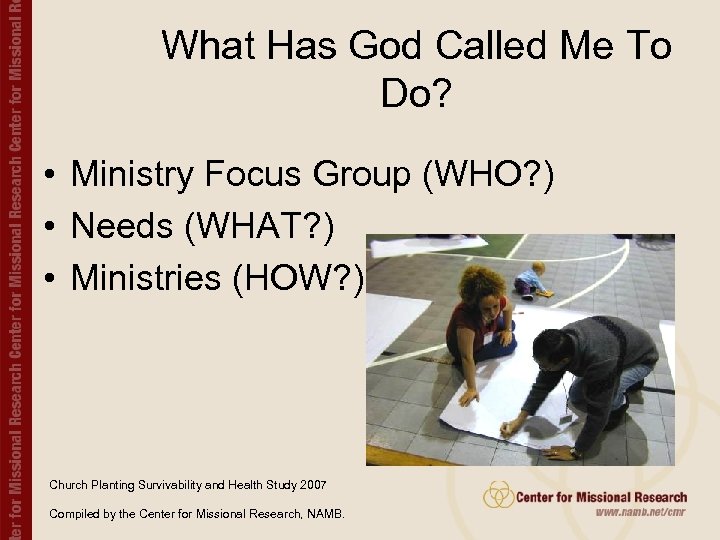
What Has God Called Me To Do? • Ministry Focus Group (WHO? ) • Needs (WHAT? ) • Ministries (HOW? ) Church Planting Survivability and Health Study 2007 Compiled by the Center for Missional Research, NAMB.
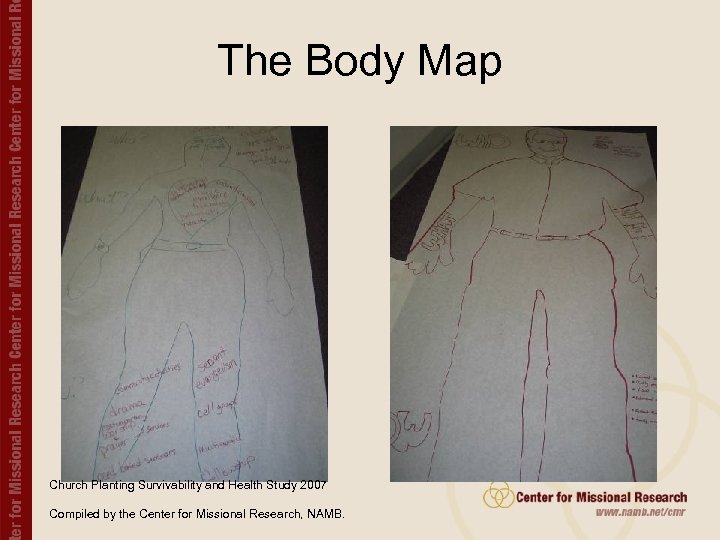
The Body Map Church Planting Survivability and Health Study 2007 Compiled by the Center for Missional Research, NAMB.
Ministry Focus Group (Who? ) • Ethnicity; language; cultural descriptors • Socio-economic traits • Age; gender; family distinctives Church Planting Survivability and Health Study 2007 Compiled by the Center for Missional Research, NAMB.
Ministry Focus Group (Who? ) • Community size • Commonly held values • Hopes and fears Church Planting Survivability and Health Study 2007 Compiled by the Center for Missional Research, NAMB.
Ministry Focus Group (Who? ) • Examples: working poor; blue collar workers; families of prisoners; college students; stressed out suburbanites; up and outers; first generation emigrants from Central America; hopes for a brighter economic future for their children; etc. Church Planting Survivability and Health Study 2007 Compiled by the Center for Missional Research, NAMB.
Needs/Assets (What? ) • • • Spiritual Emotional Cognitive (Intellect) Physical Social Church Planting Survivability and Health Study 2007 Compiled by the Center for Missional Research, NAMB.
Needs/Assets (What? ) • “Needs” examples: want to find purpose in their life; desire for intimacy in their relationships but afraid of it; healthy lives for their family; improved economic status; Looking for someone who cares; Secure a better future for their children, etc. Church Planting Survivability and Health Study 2007 Compiled by the Center for Missional Research, NAMB.
Needs/Assets (What? ) • “Assets” examples: Healthy community service agencies (shelters, youth homes, etc. ), business clubs (Rotary, Lion’s, etc. ), Cultural attributes (museums, performing arts, zoo’s, etc. ), Schools (public, private, etc. ) Church Planting Survivability and Health Study 2007 Compiled by the Center for Missional Research, NAMB.
Ministries (How? ) • • • Big Brothers Car care on Saturdays Twilight Dinners Tutoring Daycare English as a second language classes Soup kitchen Exploring God groups Job search service Bible studies Church Planting Survivability and Health Study 2007 Compiled by the Center for Missional Research, NAMB.
Church Planting Survivability and Health Study 2007 Best Practices Ed Stetzer Church Planting Survivability and Health Study 2007 Compiled by the Center for Missional Research, NAMB. Phillip Connor
Скачать презентацию Church Planting Survivability and Health Study 2007 Best
6081eb694564b4bc9b18935de9892924.ppt