 Скачать презентацию Chuldum Ai-Suu gr 241 The subjective infinitive
the subjective with the infinitive.pptx
- Количество слайдов: 21



Chuldum Ai-Suu, gr. 241
The subjective infinitive construction Infinitive + N (common case)/ pronoun ( nominative case)
The peculiarity In between the subject and the infinitive there is a part of the predicate expressed by a finite verb which grammatically indicates subjectpredicate relations. However, Semantically this finite verb cannot serve as the predicate of the subject, as it denotes some comment, or estimate, or judgement, or conclusion, or attitude to the action or state expressed by the infinitive.
The subjective infinitive construction is used with a limited number of finite verbs either in the passive or in the active voice:
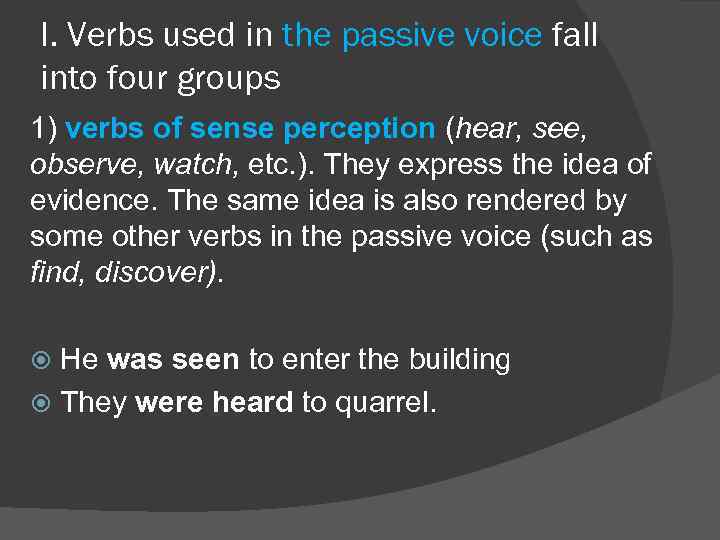
I. Verbs used in the passive voice fall into four groups 1) verbs of sense perception (hear, see, observe, watch, etc. ). They express the idea of evidence. The same idea is also rendered by some other verbs in the passive voice (such as find, discover). He was seen to enter the building They were heard to quarrel.
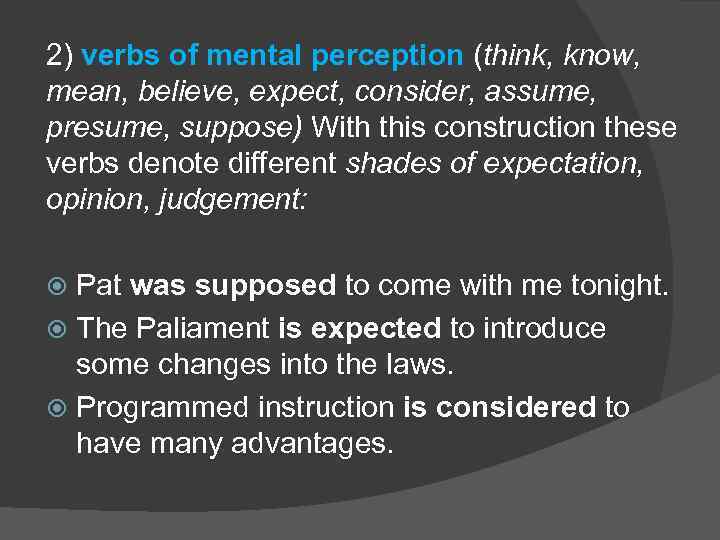
2) verbs of mental perception (think, know, mean, believe, expect, consider, assume, presume, suppose) With this construction these verbs denote different shades of expectation, opinion, judgement: Pat was supposed to come with me tonight. The Paliament is expected to introduce some changes into the laws. Programmed instruction is considered to have many advantages.
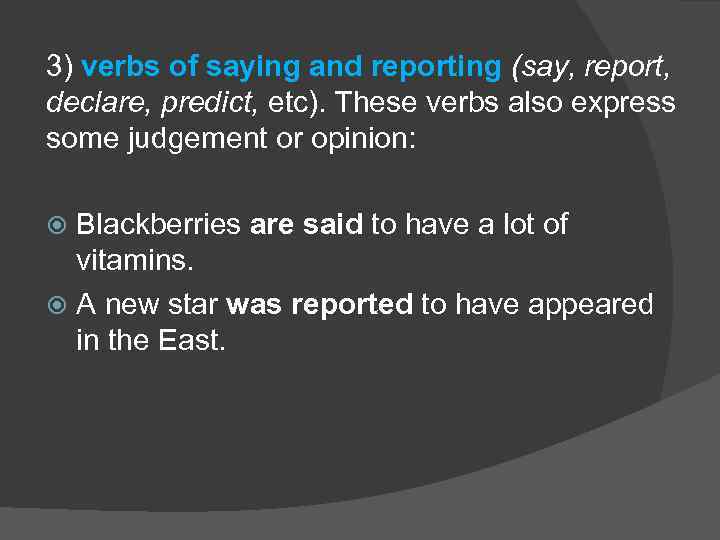
3) verbs of saying and reporting (say, report, declare, predict, etc). These verbs also express some judgement or opinion: Blackberries are said to have a lot of vitamins. A new star was reported to have appeared in the East.
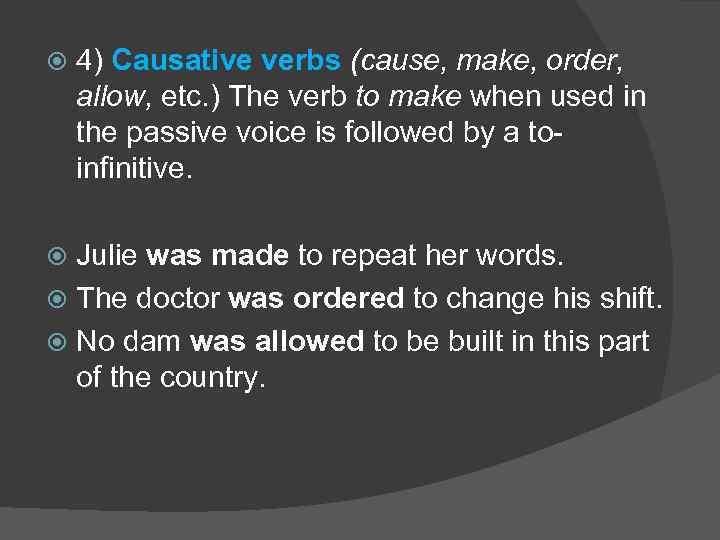
4) Causative verbs (cause, make, order, allow, etc. ) The verb to make when used in the passive voice is followed by a toinfinitive. Julie was made to repeat her words. The doctor was ordered to change his shift. No dam was allowed to be built in this part of the country.
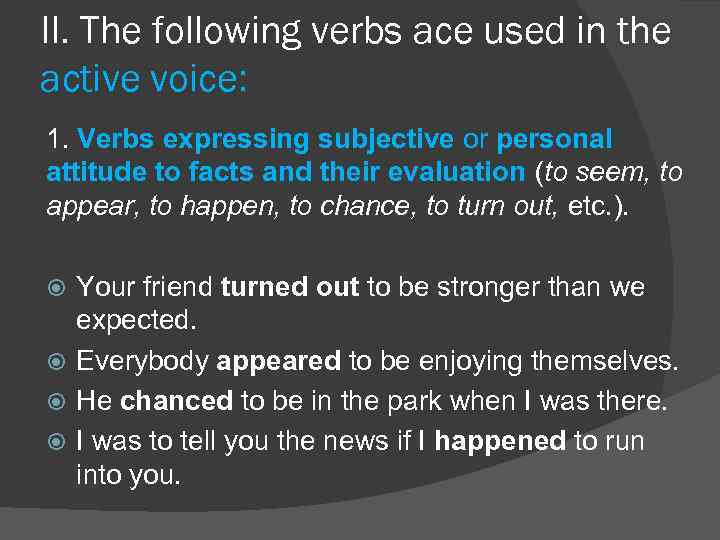
II. The following verbs ace used in the active voice: 1. Verbs expressing subjective or personal attitude to facts and their evaluation (to seem, to appear, to happen, to chance, to turn out, etc. ). Your friend turned out to be stronger than we expected. Everybody appeared to be enjoying themselves. He chanced to be in the park when I was there. I was to tell you the news if I happened to run into you.
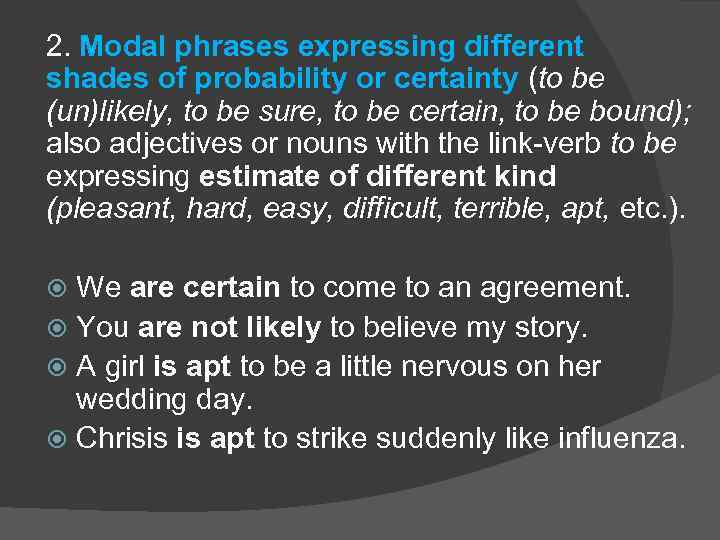
2. Modal phrases expressing different shades of probability or certainty (to be (un)likely, to be sure, to be certain, to be bound); also adjectives or nouns with the link-verb to be expressing estimate of different kind (pleasant, hard, easy, difficult, terrible, apt, etc. ). We are certain to come to an agreement. You are not likely to believe my story. A girl is apt to be a little nervous on her wedding day. Chrisis is apt to strike suddenly like influenza.

These constructions structurally belong to the same type of subjective predicative constructions, but semantically they are different from those with verbal parts, because the second part of the predicate being a noun or an adjective denotes a new quality or state acquired as a result of the action or denote judgement, opinion of the quality. Because of its meaning the nominal part is sometimes called a subjective predicative. The door was painted green. Suddenly the door was flung open.
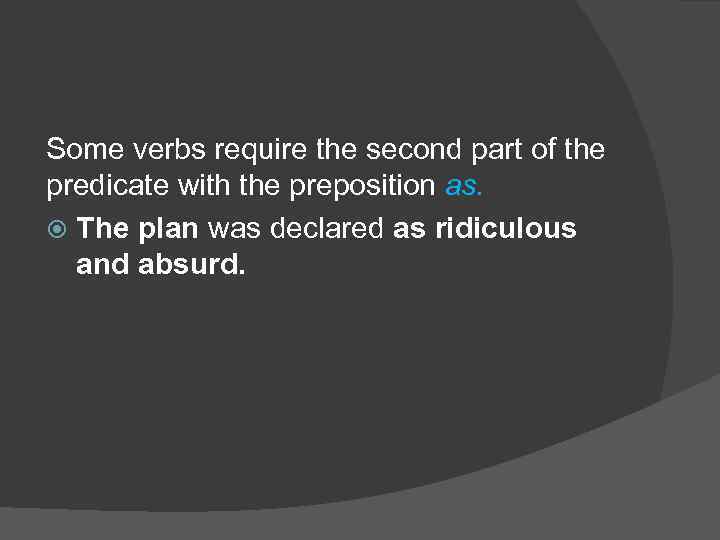
Some verbs require the second part of the predicate with the preposition as. The plan was declared as ridiculous and absurd.
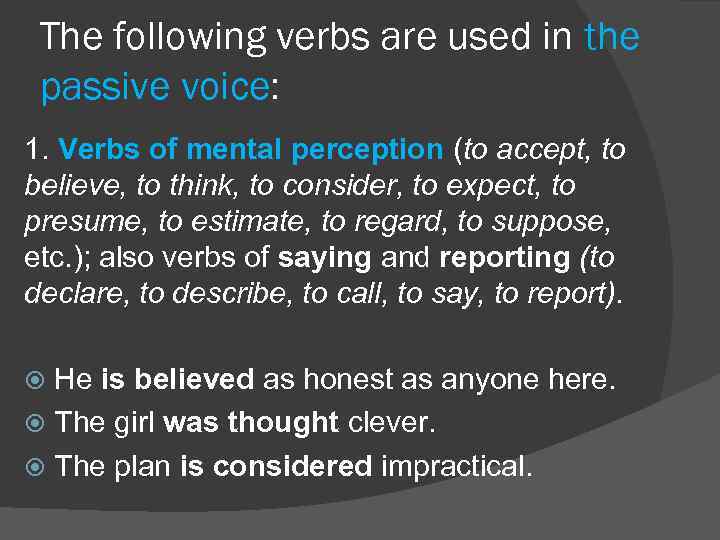
The following verbs are used in the passive voice: 1. Verbs of mental perception (to accept, to believe, to think, to consider, to expect, to presume, to estimate, to regard, to suppose, etc. ); also verbs of saying and reporting (to declare, to describe, to call, to say, to report). He is believed as honest as anyone here. The girl was thought clever. The plan is considered impractical.
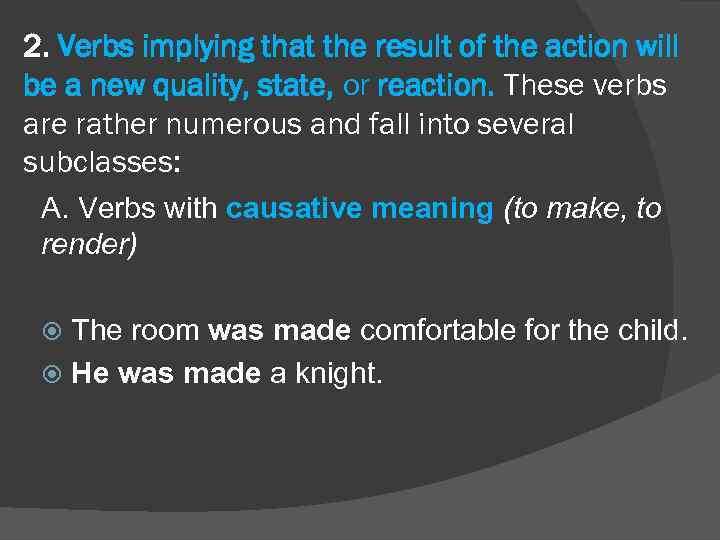
2. Verbs implying that the result of the action will be a new quality, state, or reaction. These verbs are rather numerous and fall into several subclasses: A. Verbs with causative meaning (to make, to render) The room was made comfortable for the child. He was made a knight.
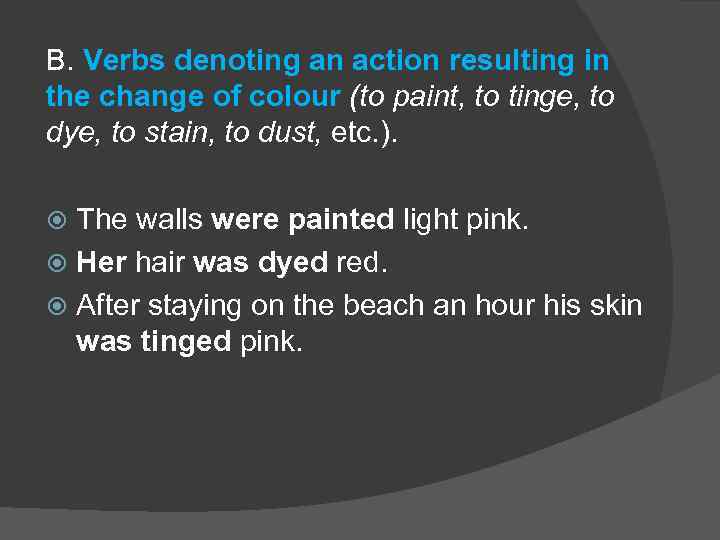
B. Verbs denoting an action resulting in the change of colour (to paint, to tinge, to dye, to stain, to dust, etc. ). The walls were painted light pink. Her hair was dyed red. After staying on the beach an hour his skin was tinged pink.
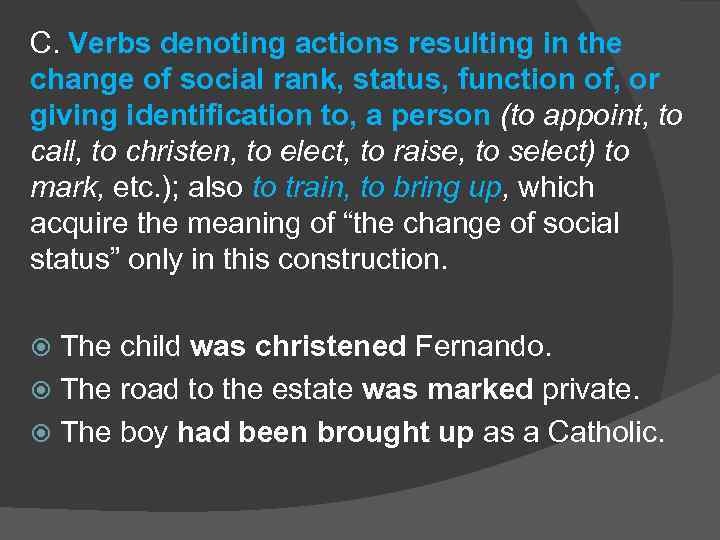
С. Verbs denoting actions resulting in the change of social rank, status, function of, or giving identification to, a person (to appoint, to call, to christen, to elect, to raise, to select) to mark, etc. ); also to train, to bring up, which acquire the meaning of “the change of social status” only in this construction. The child was christened Fernando. The road to the estate was marked private. The boy had been brought up as a Catholic.
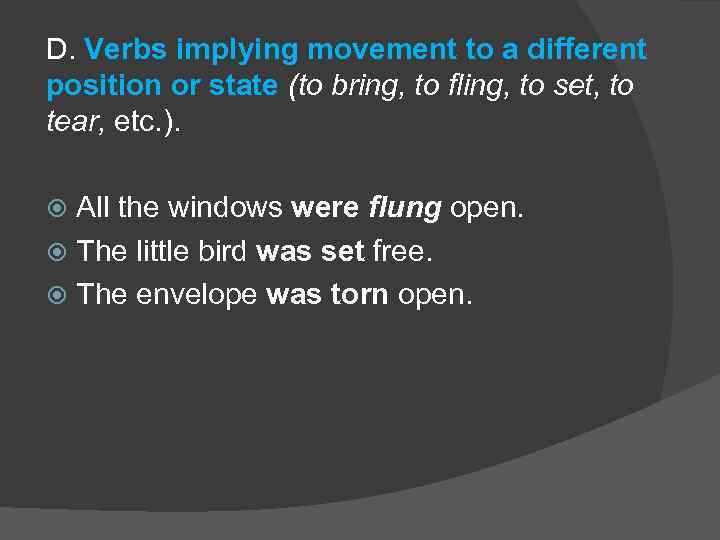
D. Verbs implying movement to a different position or state (to bring, to fling, to set, to tear, etc. ). All the windows were flung open. The little bird was set free. The envelope was torn open.
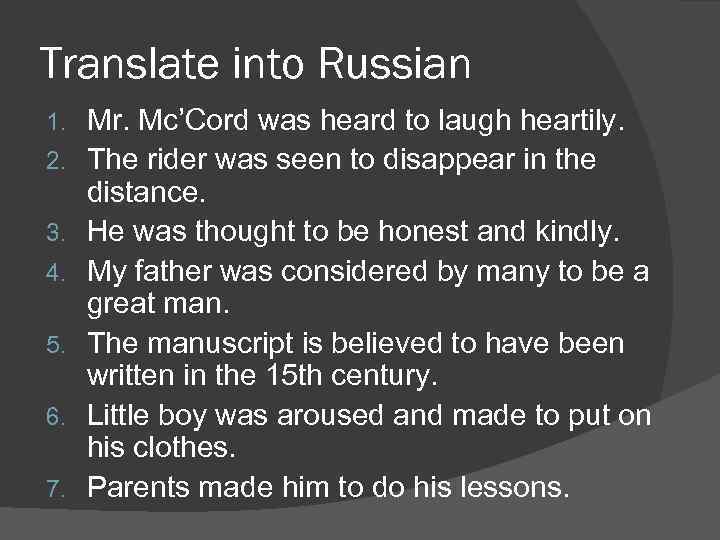
Translate into Russian 1. 2. 3. 4. 5. 6. 7. Mr. Mc’Cord was heard to laugh heartily. The rider was seen to disappear in the distance. He was thought to be honest and kindly. My father was considered by many to be a great man. The manuscript is believed to have been written in the 15 th century. Little boy was aroused and made to put on his clothes. Parents made him to do his lessons.
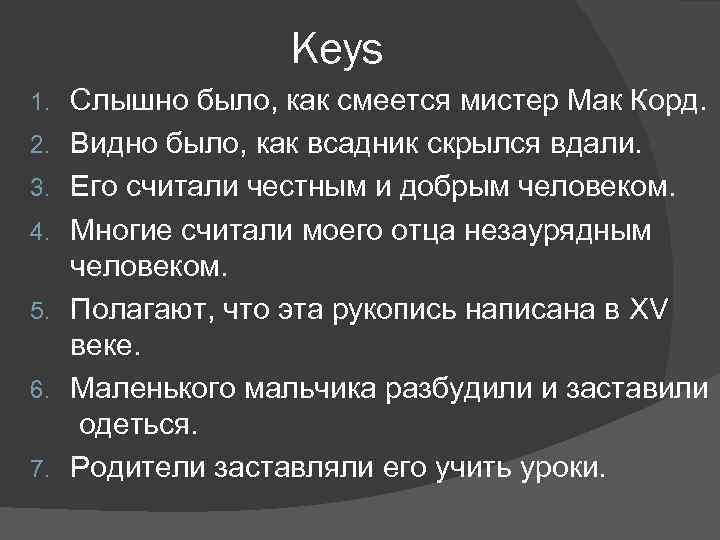
Keys 1. 2. 3. 4. 5. 6. 7. Слышно было, как смеется мистер Мак Корд. Видно было, как всадник скрылся вдали. Его считали честным и добрым человеком. Многие считали моего отца незаурядным человеком. Полагают, что эта рукопись написана в XV веке. Маленького мальчика разбудили и заставили одеться. Родители заставляли его учить уроки.

THANK FOR YOUR ATTENTION
Скачать презентацию Chuldum Ai-Suu gr 241 The subjective infinitive
the subjective with the infinitive.pptx