

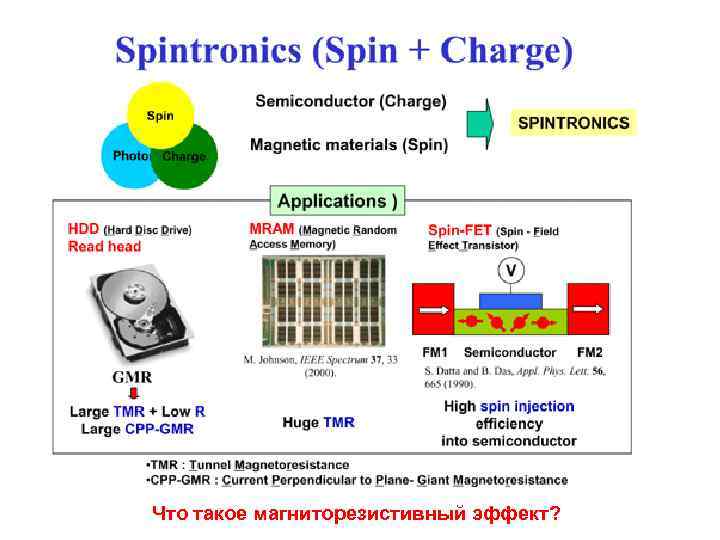
Что такое магниторезистивный эффект?


 Скачать презентацию Что такое магниторезистивный эффект?
0002 Материалы в НС.ppt
- Количество слайдов: 18
Что такое магниторезистивный эффект? 1
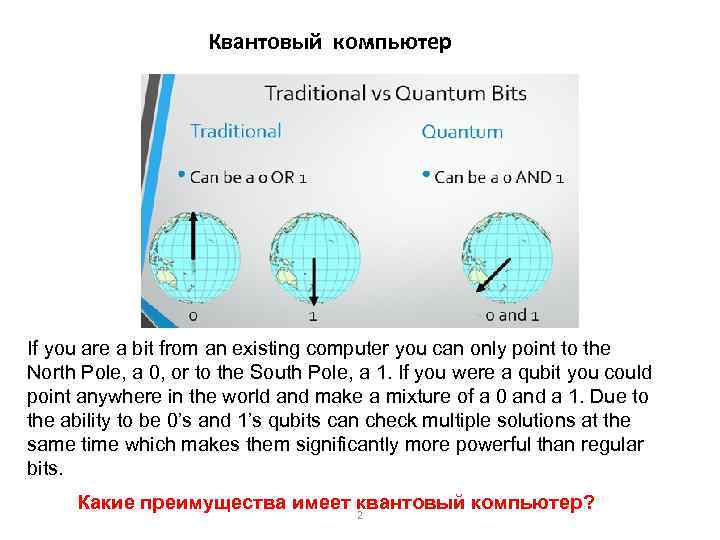
Квантовый компьютер If you are a bit from an existing computer you can only point to the North Pole, a 0, or to the South Pole, a 1. If you were a qubit you could point anywhere in the world and make a mixture of a 0 and a 1. Due to the ability to be 0’s and 1’s qubits can check multiple solutions at the same time which makes them significantly more powerful than regular bits. Какие преимущества имеет квантовый компьютер? 2
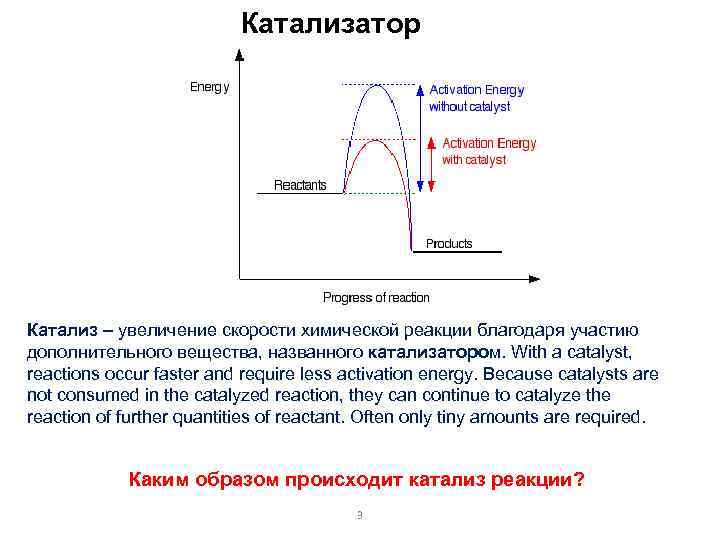
Катализатор Катализ – увеличение скорости химической реакции благодаря участию дополнительного вещества, названного катализатором. With a catalyst, reactions occur faster and require less activation energy. Because catalysts are not consumed in the catalyzed reaction, they can continue to catalyze the reaction of further quantities of reactant. Often only tiny amounts are required. Каким образом происходит катализ реакции? 3
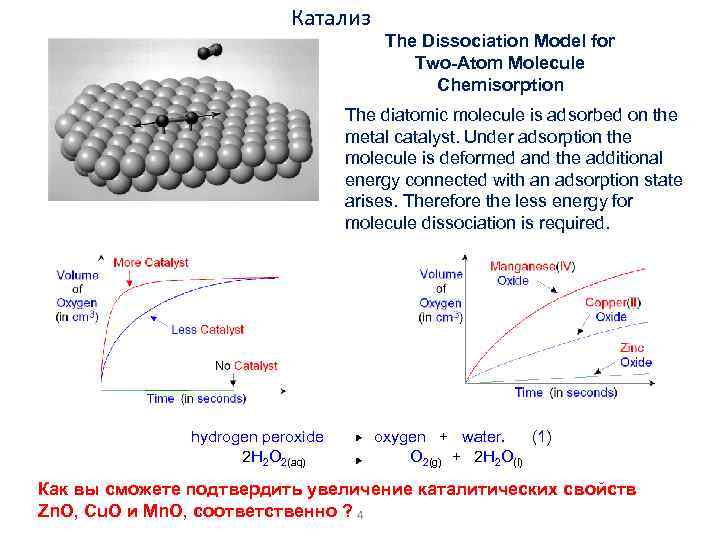
Катализ The Dissociation Model for Two-Atom Molecule Chemisorption The diatomic molecule is adsorbed on the metal catalyst. Under adsorption the molecule is deformed and the additional energy connected with an adsorption state arises. Therefore the less energy for molecule dissociation is required. hydrogen peroxide oxygen + water. (1) 2 H 2 O 2(aq) O 2(g) + 2 H 2 O(l) Как вы сможете подтвердить увеличение каталитических свойств Zn. O, Cu. O и Mn. O, соответственно ? 4
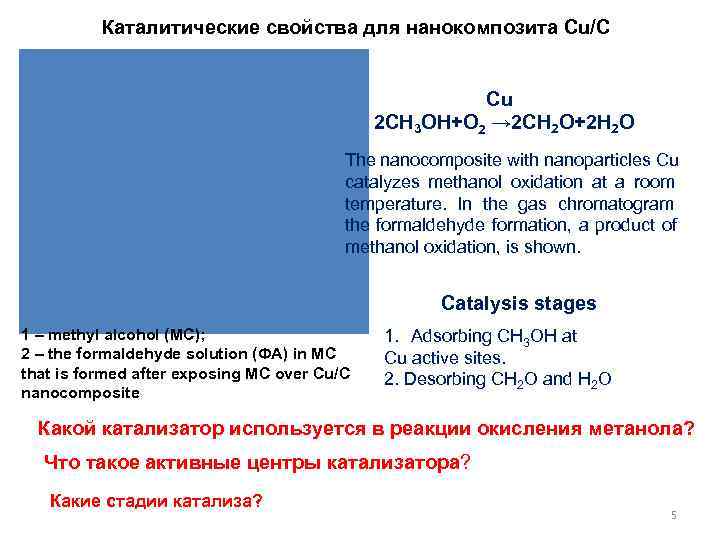
Каталитические свойства для нанокомпозита Cu/C Cu 2 CH 3 OH+О 2 → 2 CH 2 O+2 H 2 О The nanocomposite with nanoparticles Cu catalyzes methanol oxidation at a room temperature. In the gas chromatogram the formaldehyde formation, a product of methanol oxidation, is shown. Catalysis stages 1 – methyl alcohol (МC); 1. Adsorbing CH 3 OH at 2 – the formaldehyde solution (ФА) in МC Cu active sites. that is formed after exposing МC over Cu/C 2. Desorbing CH 2 O and H 2 О nanocomposite Какой катализатор используется в реакции окисления метанола? Что такое активные центры катализатора? Какие стадии катализа? 5
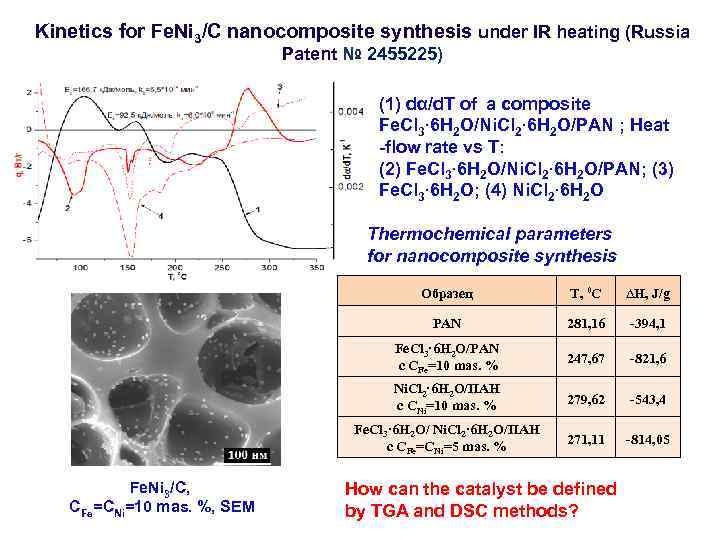
Kinetics for Fe. Ni 3/C nanocomposite synthesis under IR heating (Russia Patent № 2455225) (1) dα/d. T of a composite Fe. Cl 3· 6 H 2 O/Ni. Cl 2· 6 H 2 O/PAN ; Heat -flow rate vs T: (2) Fe. Cl 3· 6 H 2 O/Ni. Cl 2· 6 H 2 O/PAN; (3) Fe. Cl 3· 6 H 2 O; (4) Ni. Cl 2· 6 H 2 O Thermochemical parameters for nanocomposite synthesis Образец Т, 0 С ∆H, J/g PAN 281, 16 -394, 1 Fe. Cl 3· 6 H 2 O/PAN c CFe=10 mas. % 247, 67 -821, 6 Ni. Cl 2· 6 H 2 O/ПАН c CNi=10 mas. % 279, 62 -543, 4 Fe. Cl 3· 6 H 2 O/ Ni. Cl 2· 6 H 2 O/ПАН c CFe=CNi=5 mas. % 271, 11 -814, 05 Fe. Ni 3/C, How can the catalyst be defined CFe=CNi=10 mas. %, SEM by TGA and DSC methods?
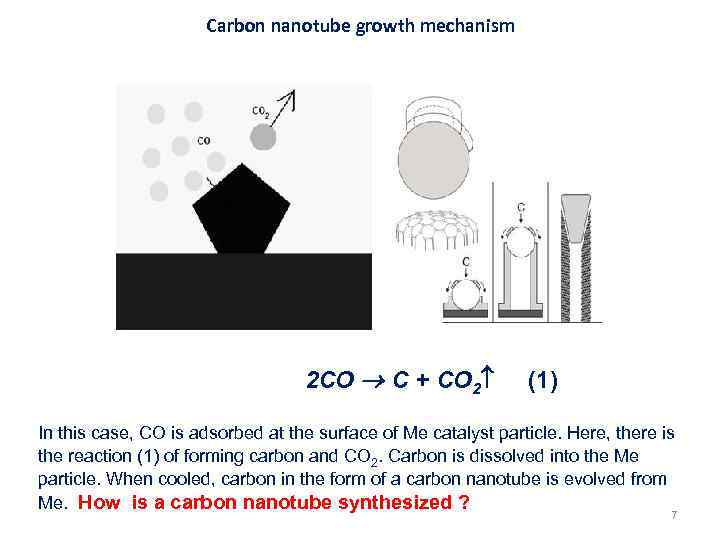
Carbon nanotube growth mechanism 2 CO C + CO 2 (1) In this case, CO is adsorbed at the surface of Me catalyst particle. Here, there is the reaction (1) of forming carbon and CO 2. Carbon is dissolved into the Me particle. When cooled, carbon in the form of a carbon nanotube is evolved from Me. How is a carbon nanotube synthesized ? 7
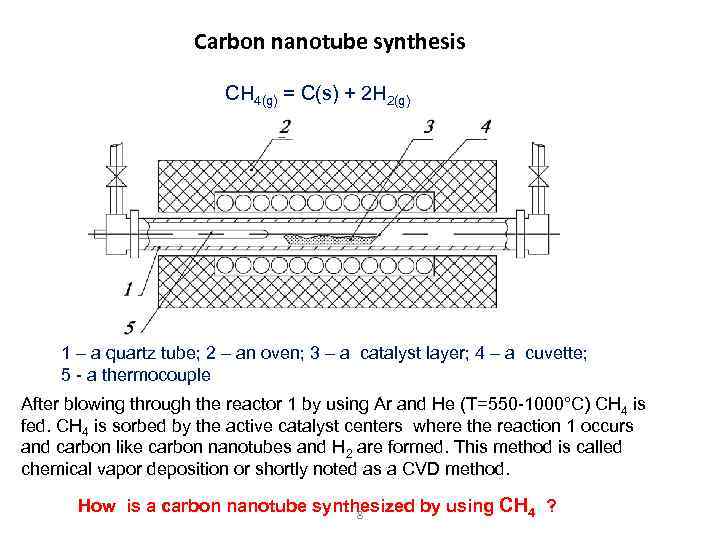
Carbon nanotube synthesis CH 4(g) = C(s) + 2 H 2(g) 1 – a quartz tube; 2 – an oven; 3 – a catalyst layer; 4 – a cuvette; 5 - a thermocouple After blowing through the reactor 1 by using Ar and He (T=550 -1000°С) CH 4 is fed. CH 4 is sorbed by the active catalyst centers where the reaction 1 occurs and carbon like carbon nanotubes and H 2 are formed. This method is called chemical vapor deposition or shortly noted as a CVD method. How is a carbon nanotube synthesized by using CH 4 ? 8
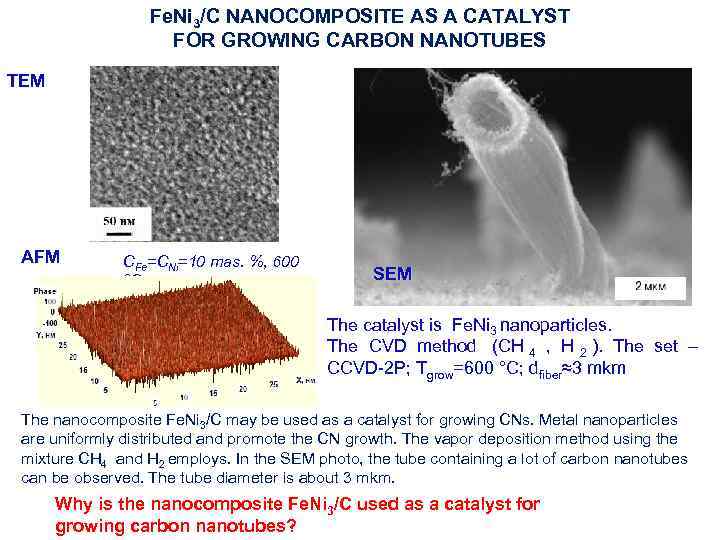
Fe. Ni 3/C NANOCOMPOSITE AS A CATALYST FOR GROWING CARBON NANOTUBES TEM АF М СFe=СNi=10 mas. %, 600 °С SEМ The catalyst is Fe. Ni 3 nanoparticles. The CVD method (CH 4 , H 2 ). The set – CCVD-2 P; Тgrow=600 °С; dfiber≈3 mkm The nanocomposite Fe. Ni 3/C may be used as a catalyst for growing CNs. Metal nanoparticles are uniformly distributed and promote the CN growth. The vapor deposition method using the mixture CH 4 and H 2 employs. In the SEM photo, the tube containing a lot of carbon nanotubes can be observed. The tube diameter is about 3 mkm. Why is the nanocomposite Fe. Ni 3/C used as a catalyst for growing carbon nanotubes?
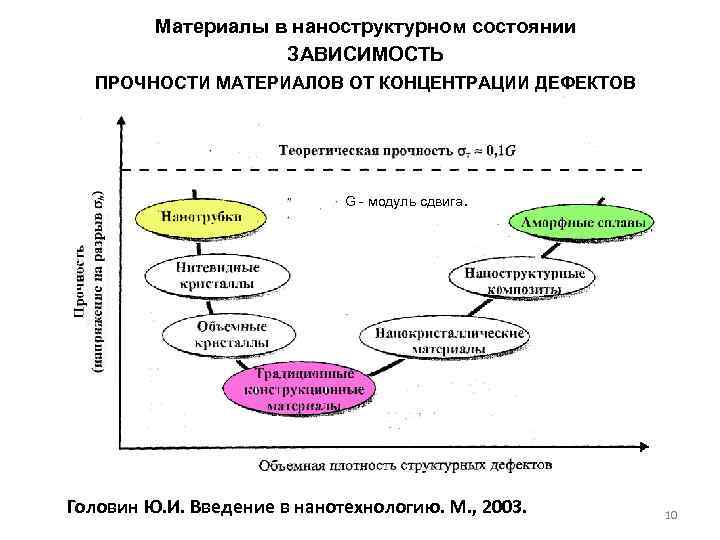
Материалы в наноструктурном состоянии ЗАВИСИМОСТЬ ПРОЧНОСТИ МАТЕРИАЛОВ ОТ КОНЦЕНТРАЦИИ ДЕФЕКТОВ G - модуль сдвига. Головин Ю. И. Введение в нанотехнологию. М. , 2003. 10
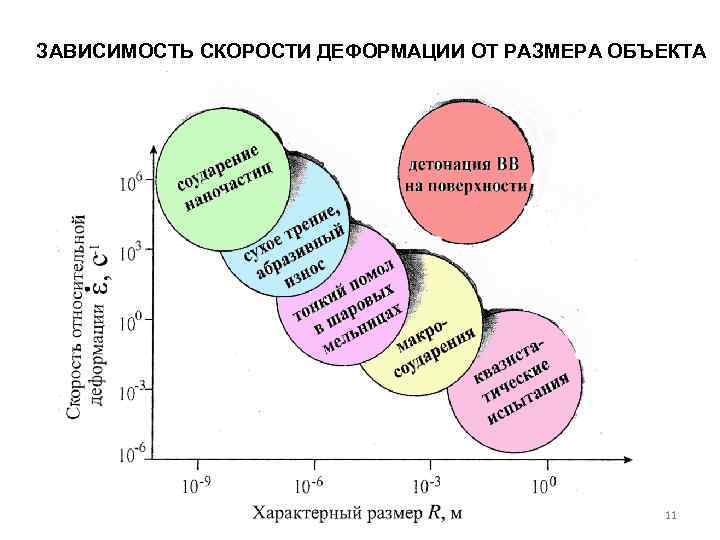
ЗАВИСИМОСТЬ СКОРОСТИ ДЕФОРМАЦИИ ОТ РАЗМЕРА ОБЪЕКТА 11
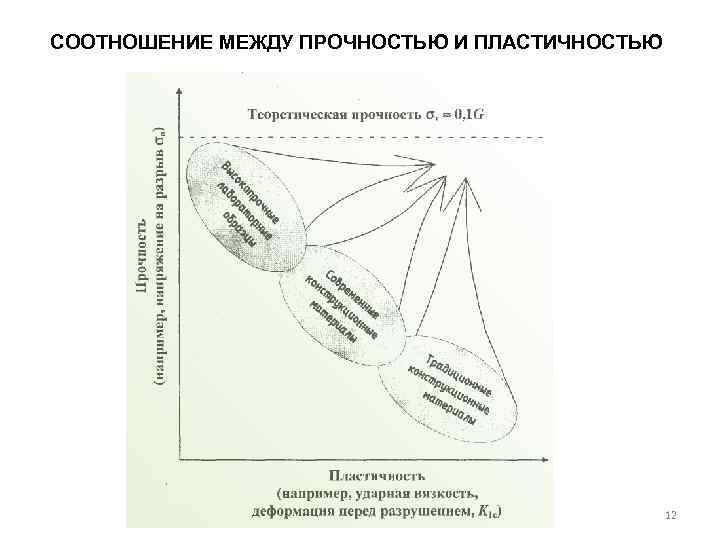
СООТНОШЕНИЕ МЕЖДУ ПРОЧНОСТЬЮ И ПЛАСТИЧНОСТЬЮ 12
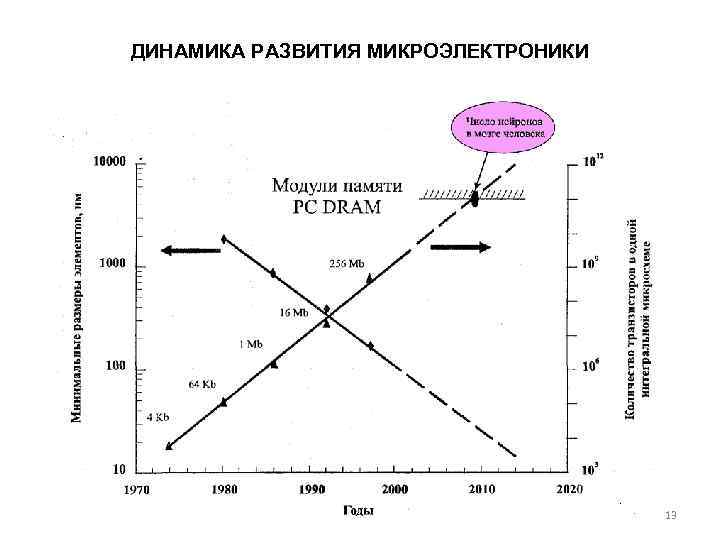
ДИНАМИКА РАЗВИТИЯ МИКРОЭЛЕКТРОНИКИ 13
СКАНИРУЮЩИЙ ТУННЕЛЬНЫЙ МИКРОСКОП 14
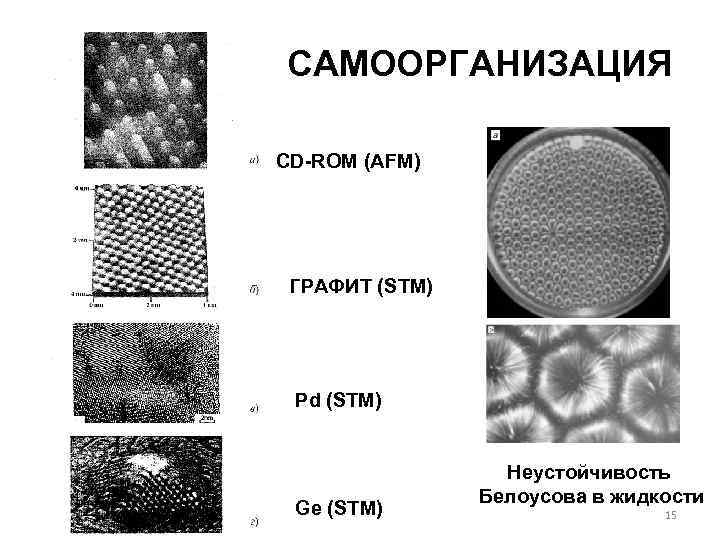
САМООРГАНИЗАЦИЯ CD-ROM (AFM) ГРАФИТ (STM) Pd (STM) Неустойчивость Белоусова в жидкости Ge (STM) 15
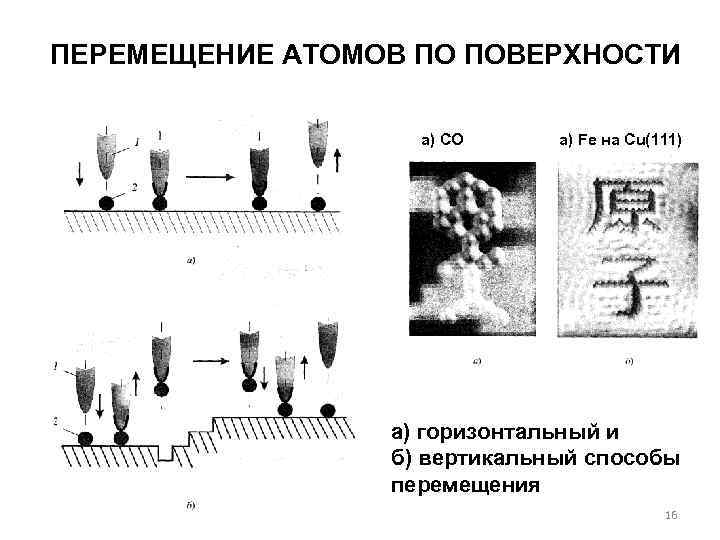
ПЕРЕМЕЩЕНИЕ АТОМОВ ПО ПОВЕРХНОСТИ а) СО а) Fe на Cu(111) а) горизонтальный и б) вертикальный способы перемещения 16
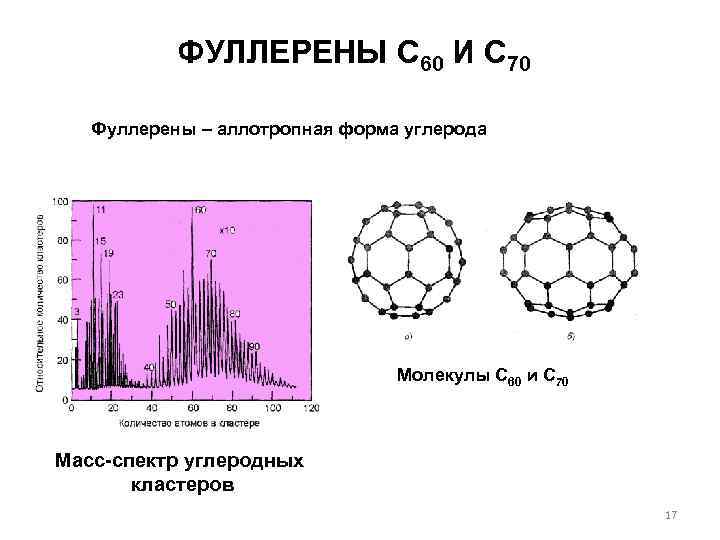
ФУЛЛЕРЕНЫ С 60 И С 70 Фуллерены – аллотропная форма углерода Молекулы С 60 и С 70 Масс-спектр углеродных кластеров 17
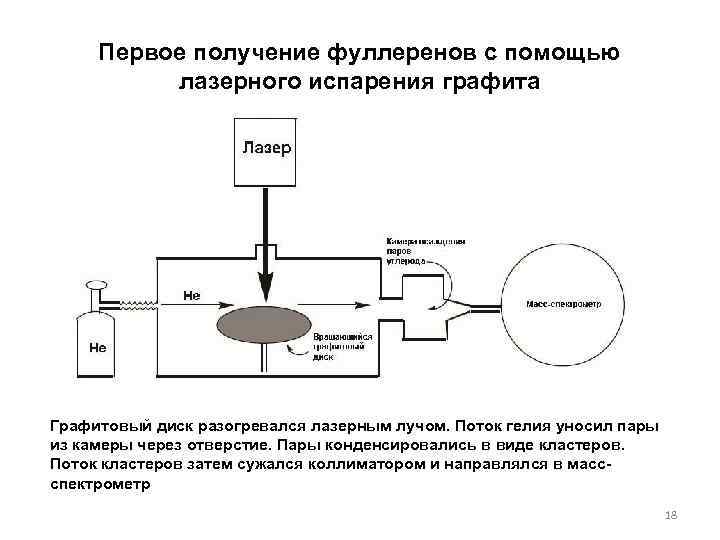
Первое получение фуллеренов с помощью лазерного испарения графита Графитовый диск разогревался лазерным лучом. Поток гелия уносил пары из камеры через отверстие. Пары конденсировались в виде кластеров. Поток кластеров затем сужался коллиматором и направлялся в масс- спектрометр 18