


 Скачать презентацию Chronic Kidney Disease is Common and Expensive and
c517925b988b8f0f9a343e34e8f872d9.ppt
- Количество слайдов: 14
 Chronic Kidney Disease is Common and Expensive and Interacts with Diabetes and Cardiovascular Disease in the Dually-Enrolled Population Funded in part by a grant from Roche Laboratories Thomas J. Arneson, MD, MPH David T. Gilbertson, Ph. D Stephen C. Dunning, MGIS James P. Ebben, BS Allan J. Collins, MD, FACP November 5, 2007 APHA Annual Meeting
 Chronic Kidney Disease (CKD) in the U. S. • 9% Prevalence in adult population • Fewer than 1 in 5 aware they have it * • Primary complications: – Cardiovascular disease – Progression to End-Stage Renal Disease (ESRD) • Early detection and appropriate management of CKD can reduce CV complications and delay progression to ESRD * Coresh, J Am Soc Nephrol. 2005; 16: 180 -188. 2
 Medicare/Medicaid Dually. Enrolled Population • 17% of the Medicare population; 28% of Medicare costs (1997) • 15% of the Medicaid population; 41% of Medicaid costs (2002) • States pay a portion of Medicaid costs • High burden of chronic disease • CKD absent from most descriptions of chronic disease burden 3
 Study objective Analyze the prevalence and Medicare costs for patients diagnosed with each of the following diseases, including study of patients carrying more than one of the diagnoses: CKD, diabetes (DM), congestive heart failure (CHF), and ESRD. 4
 Methods: Data sources and cohorts Data source: 2004 Medicare 5% sample Medicare cohort: – Part A and part B coverage throughout 2004 – Survived entire year – Not enrolled in Medicare Advantage Dually-Enrolled cohort: – As above, plus: – State buy-in of Part B premium all 12 months 5
 Methods: Determining disease status • CKD, DM, CHF diagnosis based on presence of 1+ inpt/SNF/HH claim or 2+ physician/supplier or hospital outpatient claims • ESRD status determined from Medicare ESRD registry 6
 Methods: Calculating counts and costs • Counts of persons with each diagnosis and with multiple diagnoses computed • Total Medicare costs calculated for each patient 7
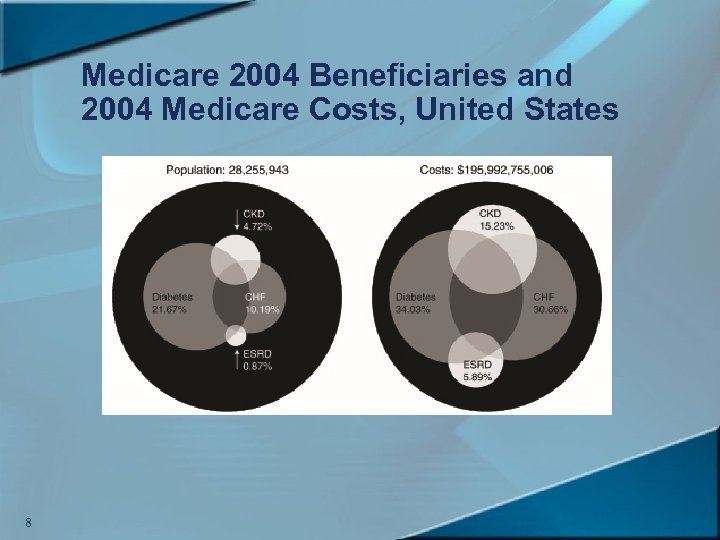 Medicare 2004 Beneficiaries and 2004 Medicare Costs, United States 8
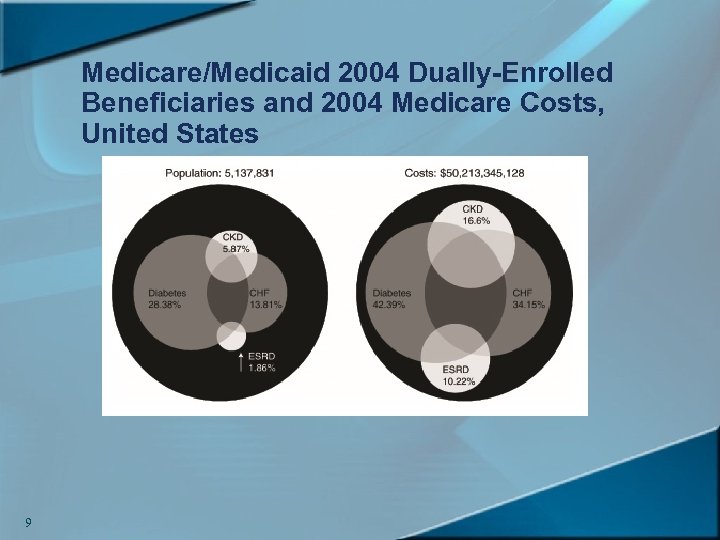 Medicare/Medicaid 2004 Dually-Enrolled Beneficiaries and 2004 Medicare Costs, United States 9
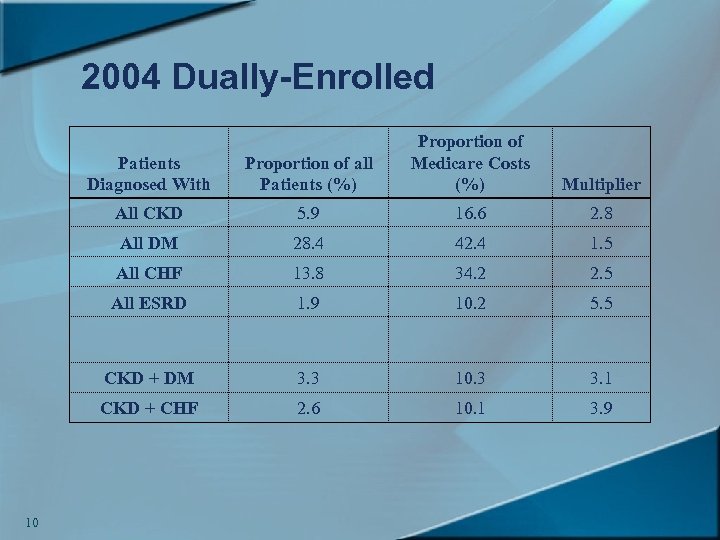 2004 Dually-Enrolled Patients Diagnosed With All CKD 5. 9 16. 6 2. 8 All DM 28. 4 42. 4 1. 5 All CHF 13. 8 34. 2 2. 5 All ESRD 1. 9 10. 2 5. 5 CKD + DM 3. 3 10. 3 3. 1 CKD + CHF 10 Proportion of all Patients (%) Proportion of Medicare Costs (%) 2. 6 10. 1 3. 9 Multiplier
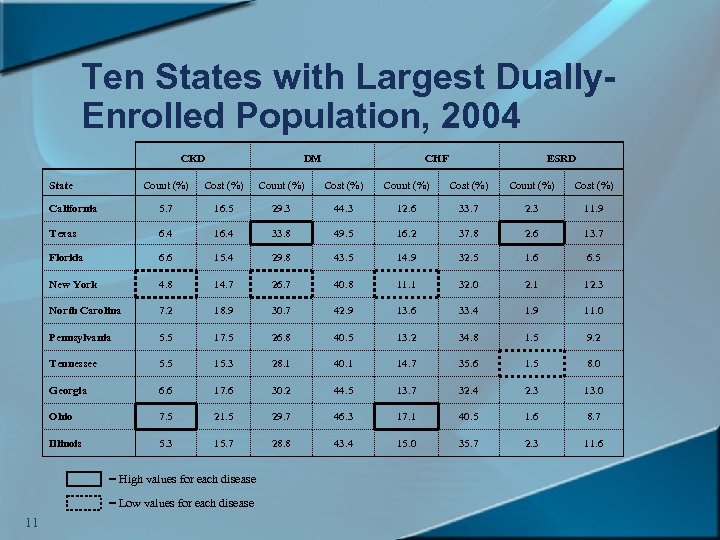 Ten States with Largest Dually. Enrolled Population, 2004 CKD State DM CHF ESRD Count (%) Cost (%) California 5. 7 16. 5 29. 3 44. 3 12. 6 33. 7 2. 3 11. 9 Texas 6. 4 16. 4 33. 8 49. 5 16. 2 37. 8 2. 6 13. 7 Florida 6. 6 15. 4 29. 8 43. 5 14. 9 32. 5 1. 6 6. 5 New York 4. 8 14. 7 26. 7 40. 8 11. 1 32. 0 2. 1 12. 3 North Carolina 7. 2 18. 9 30. 7 42. 9 13. 6 33. 4 1. 9 11. 0 Pennsylvania 5. 5 17. 5 26. 8 40. 5 13. 2 34. 8 1. 5 9. 2 Tennessee 5. 5 15. 3 28. 1 40. 1 14. 7 35. 6 1. 5 8. 0 Georgia 6. 6 17. 6 30. 2 44. 5 13. 7 32. 4 2. 3 13. 0 Ohio 7. 5 21. 5 29. 7 46. 3 17. 1 40. 5 1. 6 8. 7 Illinois 5. 3 15. 7 28. 8 43. 4 15. 0 35. 7 2. 3 11. 6 = High values for each disease = Low values for each disease 11
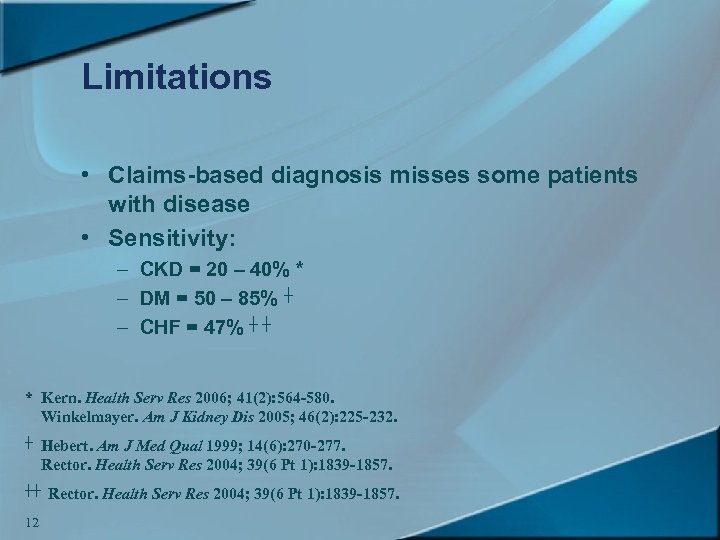 Limitations • Claims-based diagnosis misses some patients with disease • Sensitivity: – CKD = 20 – 40% * – DM = 50 – 85% ┼ – CHF = 47% ┼ ┼ * Kern. Health Serv Res 2006; 41(2): 564 -580. Winkelmayer. Am J Kidney Dis 2005; 46(2): 225 -232. ┼ Hebert. Am J Med Qual 1999; 14(6): 270 -277. Rector. Health Serv Res 2004; 39(6 Pt 1): 1839 -1857. ┼┼ 12 Rector. Health Serv Res 2004; 39(6 Pt 1): 1839 -1857.
 Limitations • State buy-in of Part B premium required all 12 months – Additional 12% had <12 months buy-in • Patients who developed ESRD during 2004 excluded so full year of costs available – Resulted in 13% undercount 13
 Conclusions • CKD is an important chronic disease in the dually-enrolled population • CKD is highly interactive with DM and with CHF • Cost of care for CKD patients disproportionately high • State variation in counts and costs of duallyenrolled patients with CKD, DM, CHF, and ESRD • Enhanced focus on CKD is merited 14