


 Скачать презентацию Christopher D Sapp Indiana University Universität Wien
733f006e161e86af819f6645d80f1c1a.ppt
- Количество слайдов: 33
 Christopher D. Sapp Indiana University / Universität Wien 2 February, 2006 Focus and verb order in Early New High German: Historical and contemporary evidence
 Outline 1. Introduction 2. Focus and verb order in Early New High German 3. Supporting evidence: Modern Standard German 4. Supporting evidence: contemporary dialects 5. Conclusions 2 February, 2006 Christopher D. Sapp, Focus and verb order in Early New High German
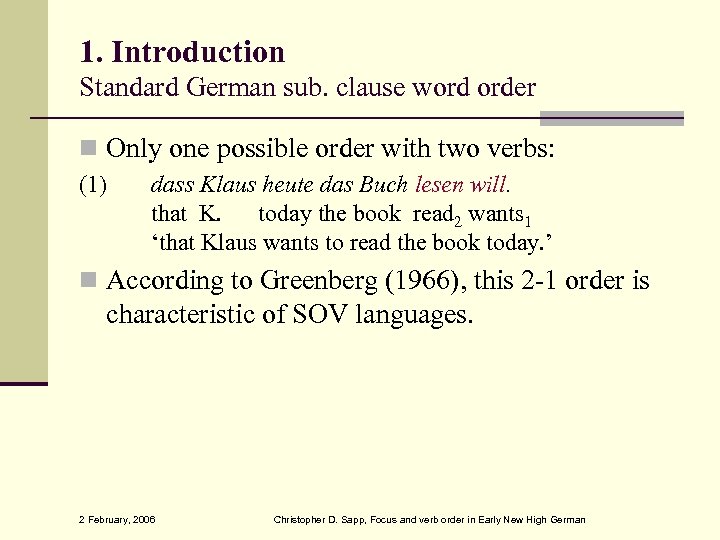 1. Introduction Standard German sub. clause word order Only one possible order with two verbs: (1) dass Klaus heute das Buch lesen will. that K. today the book read 2 wants 1 ‘that Klaus wants to read the book today. ’ According to Greenberg (1966), this 2 -1 order is characteristic of SOV languages. 2 February, 2006 Christopher D. Sapp, Focus and verb order in Early New High German
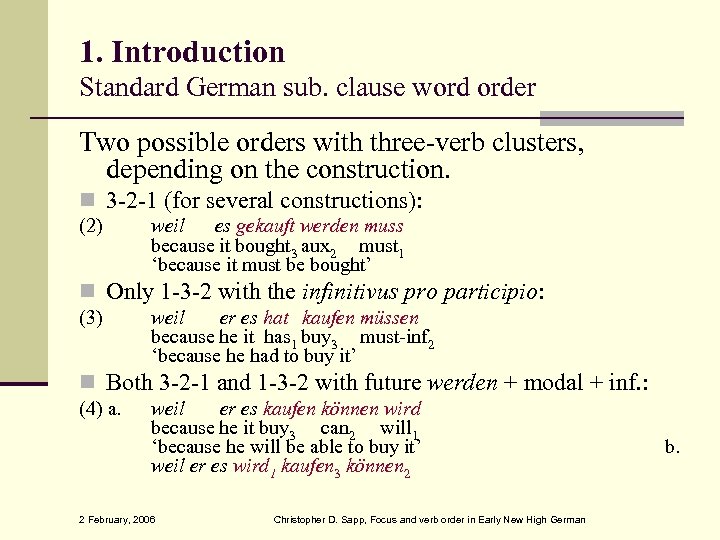 1. Introduction Standard German sub. clause word order Two possible orders with three-verb clusters, depending on the construction. 3 -2 -1 (for several constructions): (2) weil es gekauft werden muss because it bought 3 aux 2 must 1 ‘because it must be bought’ Only 1 -3 -2 with the infinitivus pro participio: (3) weil er es hat kaufen müssen because he it has 1 buy 3 must-inf 2 ‘because he had to buy it’ Both 3 -2 -1 and 1 -3 -2 with future werden + modal + inf. : (4) a. weil er es kaufen können wird because he it buy 3 can 2 will 1 ‘because he will be able to buy it’ weil er es wird 1 kaufen 3 können 2 2 February, 2006 Christopher D. Sapp, Focus and verb order in Early New High German b.
 Outline 1. Introduction 2. Focus and verb order in Early New High German 3. Focus and verb order in Modern Standard German 4. Focus and verb order in contemporary dialects 5. Conclusions 2 February, 2006 Christopher D. Sapp, Focus and verb order in Early New High German
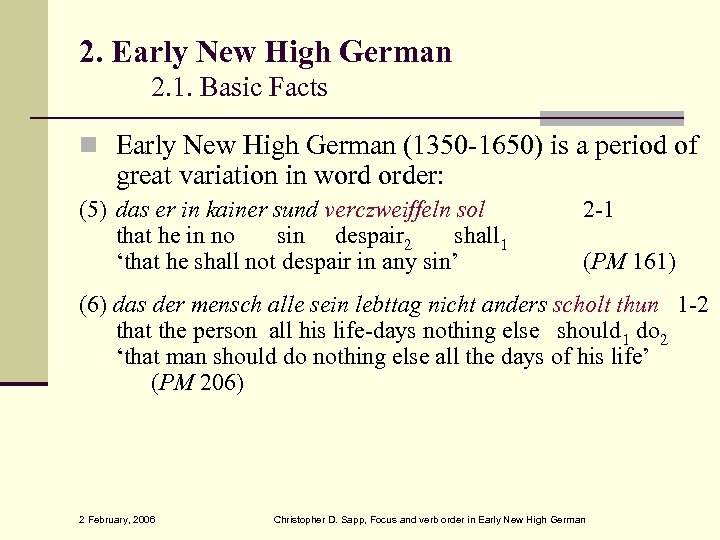 2. Early New High German 2. 1. Basic Facts Early New High German (1350 -1650) is a period of great variation in word order: (5) das er in kainer sund verczweiffeln sol that he in no sin despair 2 shall 1 ‘that he shall not despair in any sin’ 2 -1 (PM 161) (6) das der mensch alle sein lebttag nicht anders scholt thun 1 -2 that the person all his life-days nothing else should 1 do 2 ‘that man should do nothing else all the days of his life’ (PM 206) 2 February, 2006 Christopher D. Sapp, Focus and verb order in Early New High German
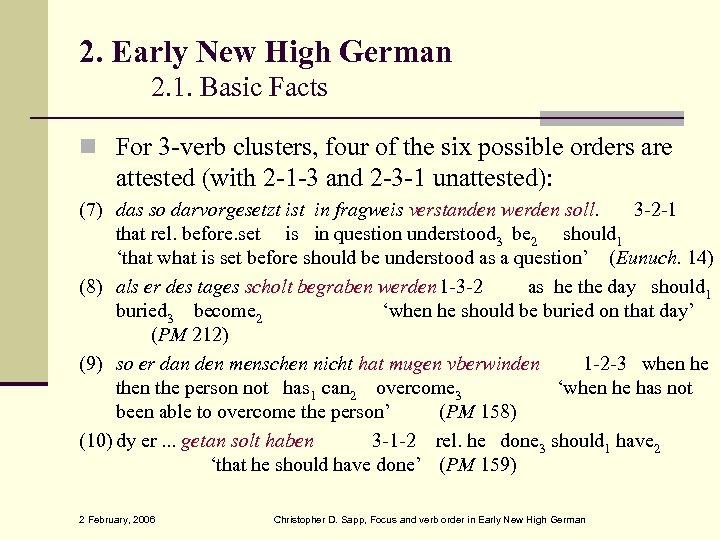 2. Early New High German 2. 1. Basic Facts For 3 -verb clusters, four of the six possible orders are attested (with 2 -1 -3 and 2 -3 -1 unattested): (7) das so darvorgesetzt ist in fragweis verstanden werden soll. 3 -2 -1 that rel. before. set is in question understood 3 be 2 should 1 ‘that what is set before should be understood as a question’ (Eunuch. 14) (8) als er des tages scholt begraben werden 1 -3 -2 as he the day should 1 buried 3 become 2 ‘when he should be buried on that day’ (PM 212) (9) so er dan den menschen nicht hat mugen vberwinden 1 -2 -3 when he then the person not has 1 can 2 overcome 3 ‘when he has not been able to overcome the person’ (PM 158) (10) dy er. . . getan solt haben 3 -1 -2 rel. he done 3 should 1 have 2 ‘that he should have done’ (PM 159) 2 February, 2006 Christopher D. Sapp, Focus and verb order in Early New High German
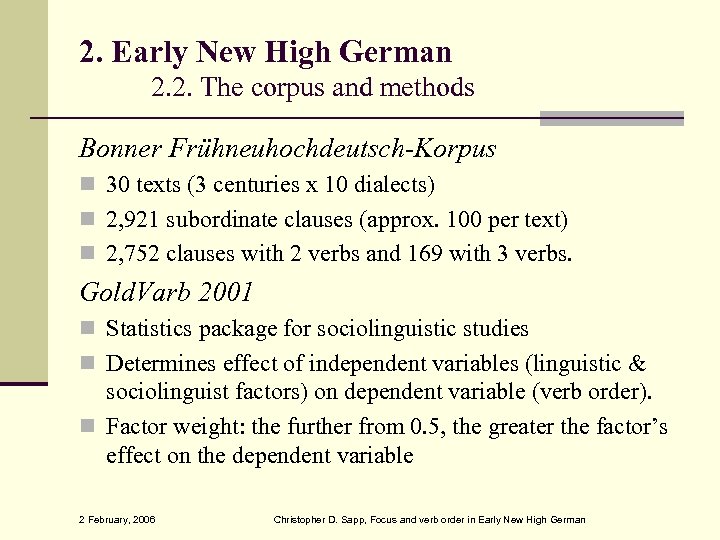 2. Early New High German 2. 2. The corpus and methods Bonner Frühneuhochdeutsch-Korpus 30 texts (3 centuries x 10 dialects) 2, 921 subordinate clauses (approx. 100 per text) 2, 752 clauses with 2 verbs and 169 with 3 verbs. Gold. Varb 2001 Statistics package for sociolinguistic studies Determines effect of independent variables (linguistic & sociolinguist factors) on dependent variable (verb order). Factor weight: the further from 0. 5, the greater the factor’s effect on the dependent variable 2 February, 2006 Christopher D. Sapp, Focus and verb order in Early New High German
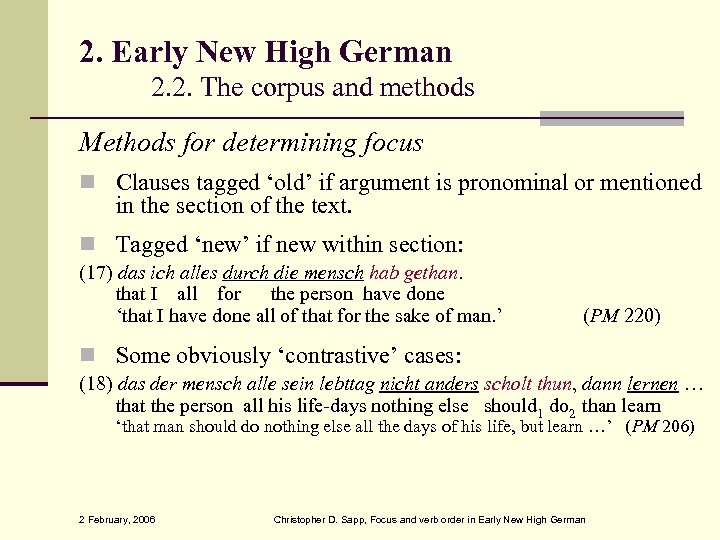 2. Early New High German 2. 2. The corpus and methods Methods for determining focus Clauses tagged ‘old’ if argument is pronominal or mentioned in the section of the text. Tagged ‘new’ if new within section: (17) das ich alles durch die mensch hab gethan. that I all for the person have done ‘that I have done all of that for the sake of man. ’ (PM 220) Some obviously ‘contrastive’ cases: (18) das der mensch alle sein lebttag nicht anders scholt thun, dann lernen … that the person all his life-days nothing else should 1 do 2 than learn ‘that man should do nothing else all the days of his life, but learn …’ (PM 206) 2 February, 2006 Christopher D. Sapp, Focus and verb order in Early New High German
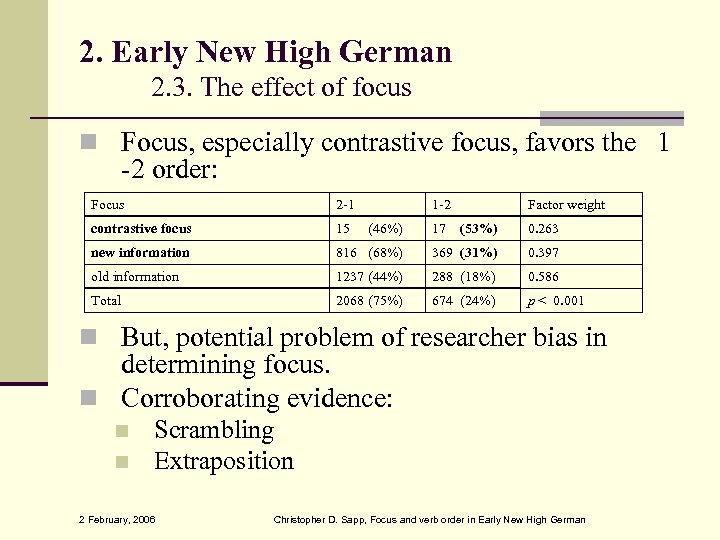 2. Early New High German 2. 3. The effect of focus Focus, especially contrastive focus, favors the 1 -2 order: Focus 2 -1 1 -2 Factor weight contrastive focus 15 (46%) 17 (53%) 0. 263 new information 816 (68%) 369 (31%) 0. 397 old information 1237 (44%) 288 (18%) 0. 586 Total 2068 (75%) 674 (24%) p < 0. 001 But, potential problem of researcher bias in determining focus. Corroborating evidence: Scrambling Extraposition 2 February, 2006 Christopher D. Sapp, Focus and verb order in Early New High German
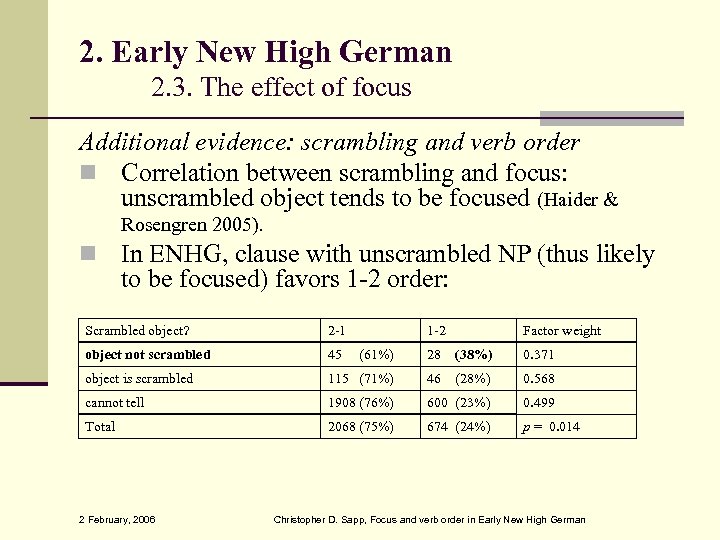 2. Early New High German 2. 3. The effect of focus Additional evidence: scrambling and verb order Correlation between scrambling and focus: unscrambled object tends to be focused (Haider & Rosengren 2005). In ENHG, clause with unscrambled NP (thus likely to be focused) favors 1 -2 order: Scrambled object? 2 -1 1 -2 Factor weight object not scrambled 45 28 (38%) 0. 371 object is scrambled 115 (71%) 46 (28%) 0. 568 cannot tell 1908 (76%) 600 (23%) 0. 499 Total 2068 (75%) 674 (24%) p = 0. 014 2 February, 2006 (61%) Christopher D. Sapp, Focus and verb order in Early New High German
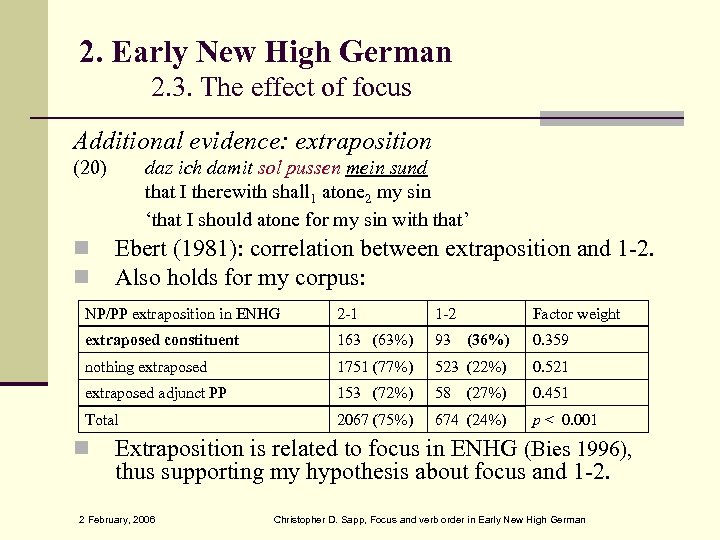 2. Early New High German 2. 3. The effect of focus Additional evidence: extraposition (20) daz ich damit sol pussen mein sund that I therewith shall 1 atone 2 my sin ‘that I should atone for my sin with that’ Ebert (1981): correlation between extraposition and 1 -2. Also holds for my corpus: NP/PP extraposition in ENHG 2 -1 1 -2 Factor weight extraposed constituent 163 (63%) 93 (36%) 0. 359 nothing extraposed 1751 (77%) 523 (22%) 0. 521 extraposed adjunct PP 153 (72%) 58 0. 451 Total 2067 (75%) 674 (24%) (27%) p < 0. 001 Extraposition is related to focus in ENHG (Bies 1996), thus supporting my hypothesis about focus and 1 -2. 2 February, 2006 Christopher D. Sapp, Focus and verb order in Early New High German
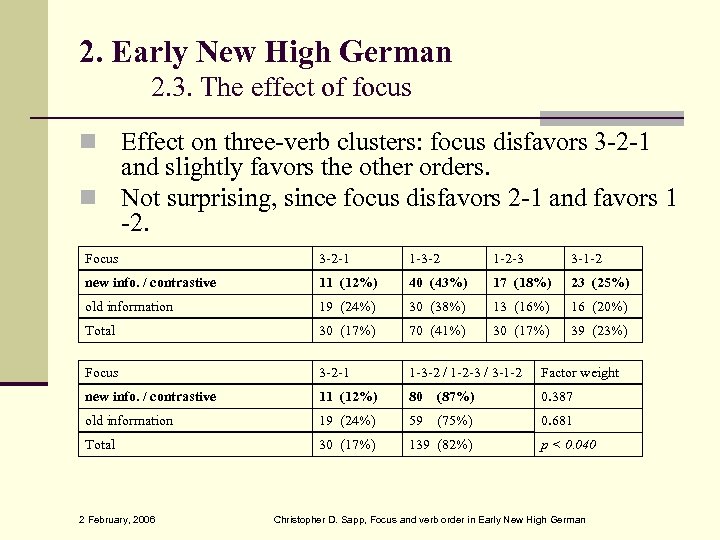 2. Early New High German 2. 3. The effect of focus Effect on three-verb clusters: focus disfavors 3 -2 -1 and slightly favors the other orders. Not surprising, since focus disfavors 2 -1 and favors 1 -2. Focus 3 -2 -1 1 -3 -2 1 -2 -3 3 -1 -2 new info. / contrastive 11 (12%) 40 (43%) 17 (18%) 23 (25%) old information 19 (24%) 30 (38%) 13 (16%) 16 (20%) Total 30 (17%) 70 (41%) 30 (17%) 39 (23%) Focus 3 -2 -1 1 -3 -2 / 1 -2 -3 / 3 -1 -2 Factor weight new info. / contrastive 11 (12%) 80 (87%) 0. 387 old information 19 (24%) 59 (75%) 0. 681 Total 30 (17%) 139 (82%) 2 February, 2006 p < 0. 040 Christopher D. Sapp, Focus and verb order in Early New High German
 Outline 1. Introduction 2. Focus and verb order in Early New High German 3. Supporting evidence: Modern Standard German 4. Supporting evidence: contemporary dialects 5. Conclusions 2 February, 2006 Christopher D. Sapp, Focus and verb order in Early New High German
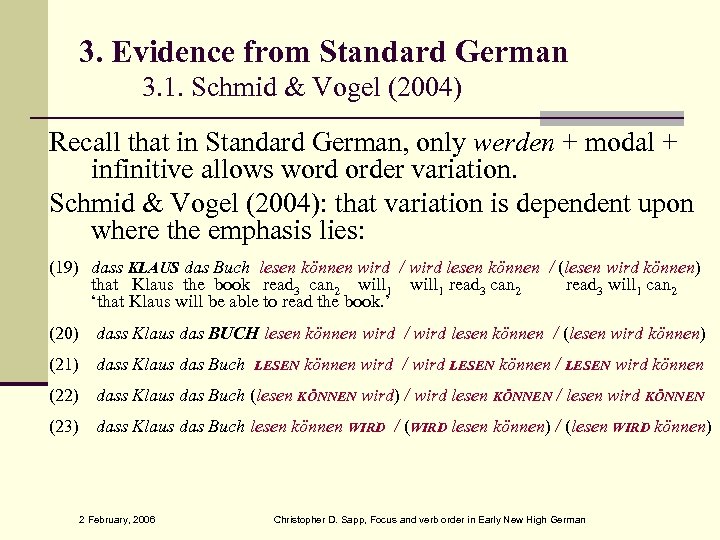 3. Evidence from Standard German 3. 1. Schmid & Vogel (2004) Recall that in Standard German, only werden + modal + infinitive allows word order variation. Schmid & Vogel (2004): that variation is dependent upon where the emphasis lies: (19) dass KLAUS das Buch lesen können wird / wird lesen können / (lesen wird können) that Klaus the book read 3 can 2 will 1 read 3 can 2 read 3 will 1 can 2 ‘that Klaus will be able to read the book. ’ (20) dass Klaus das BUCH lesen können wird / wird lesen können / (lesen wird können) (21) dass Klaus das Buch LESEN können wird / wird LESEN können / LESEN wird können (22) dass Klaus das Buch (lesen KÖNNEN wird) / wird lesen KÖNNEN / lesen wird KÖNNEN (23) dass Klaus das Buch lesen können WIRD / (WIRD lesen können) / (lesen WIRD können) 2 February, 2006 Christopher D. Sapp, Focus and verb order in Early New High German
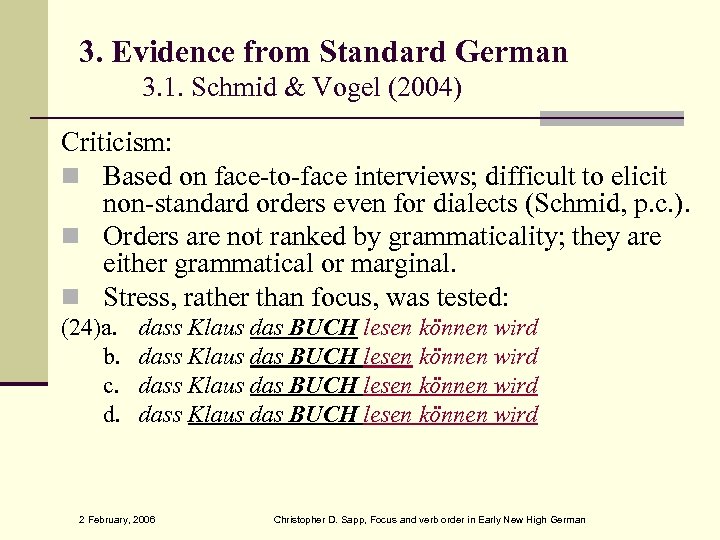 3. Evidence from Standard German 3. 1. Schmid & Vogel (2004) Criticism: Based on face-to-face interviews; difficult to elicit non-standard orders even for dialects (Schmid, p. c. ). Orders are not ranked by grammaticality; they are either grammatical or marginal. Stress, rather than focus, was tested: (24)a. b. c. d. dass Klaus das BUCH lesen können wird 2 February, 2006 Christopher D. Sapp, Focus and verb order in Early New High German
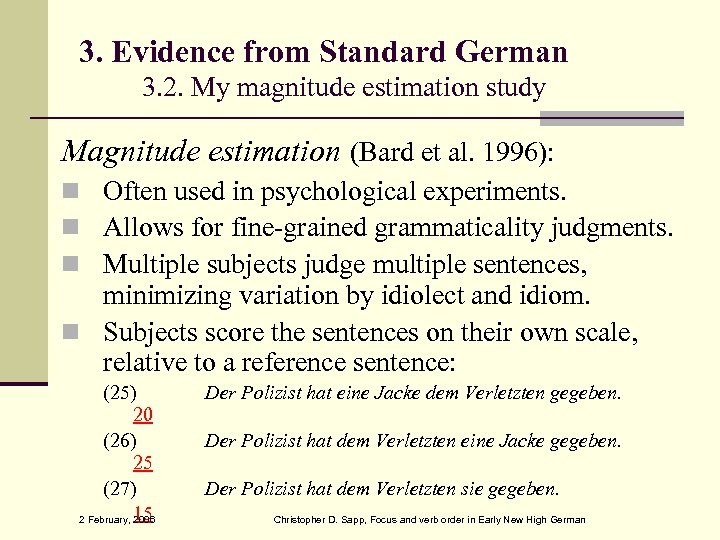 3. Evidence from Standard German 3. 2. My magnitude estimation study Magnitude estimation (Bard et al. 1996): Often used in psychological experiments. Allows for fine-grained grammaticality judgments. Multiple subjects judge multiple sentences, minimizing variation by idiolect and idiom. Subjects score the sentences on their own scale, relative to a reference sentence: (25) 20 (26) 25 (27) 15 2 February, 2006 Der Polizist hat eine Jacke dem Verletzten gegeben. Der Polizist hat dem Verletzten eine Jacke gegeben. Der Polizist hat dem Verletzten sie gegeben. Christopher D. Sapp, Focus and verb order in Early New High German
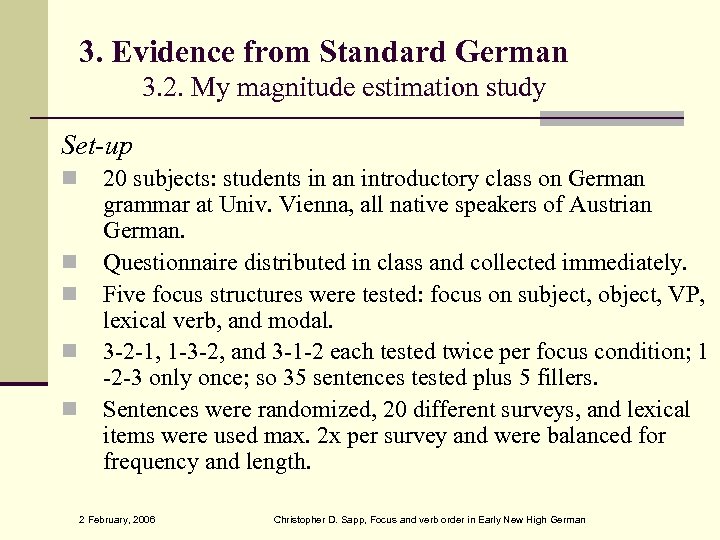 3. Evidence from Standard German 3. 2. My magnitude estimation study Set-up 20 subjects: students in an introductory class on German grammar at Univ. Vienna, all native speakers of Austrian German. Questionnaire distributed in class and collected immediately. Five focus structures were tested: focus on subject, object, VP, lexical verb, and modal. 3 -2 -1, 1 -3 -2, and 3 -1 -2 each tested twice per focus condition; 1 -2 -3 only once; so 35 sentences tested plus 5 fillers. Sentences were randomized, 20 different surveys, and lexical items were used max. 2 x per survey and were balanced for frequency and length. 2 February, 2006 Christopher D. Sapp, Focus and verb order in Early New High German
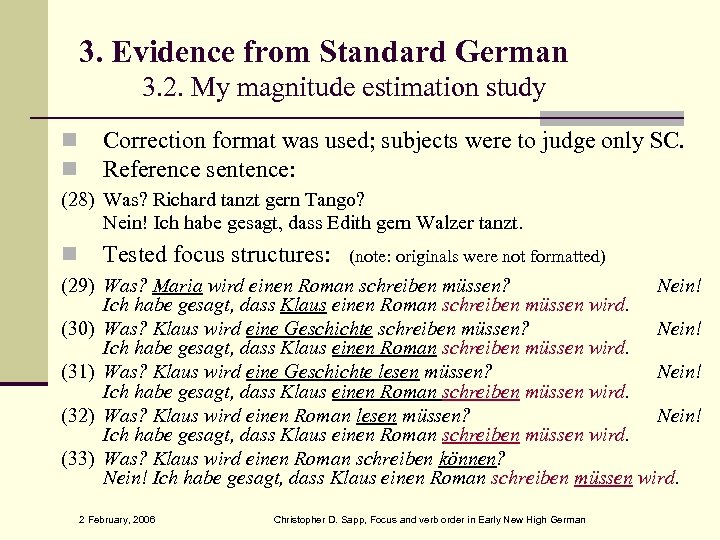 3. Evidence from Standard German 3. 2. My magnitude estimation study Correction format was used; subjects were to judge only SC. Reference sentence: (28) Was? Richard tanzt gern Tango? Nein! Ich habe gesagt, dass Edith gern Walzer tanzt. Tested focus structures: (note: originals were not formatted) (29) Was? Maria wird einen Roman schreiben müssen? Nein! Ich habe gesagt, dass Klaus einen Roman schreiben müssen wird. (30) Was? Klaus wird eine Geschichte schreiben müssen? Nein! Ich habe gesagt, dass Klaus einen Roman schreiben müssen wird. (31) Was? Klaus wird eine Geschichte lesen müssen? Nein! Ich habe gesagt, dass Klaus einen Roman schreiben müssen wird. (32) Was? Klaus wird einen Roman lesen müssen? Nein! Ich habe gesagt, dass Klaus einen Roman schreiben müssen wird. (33) Was? Klaus wird einen Roman schreiben können? Nein! Ich habe gesagt, dass Klaus einen Roman schreiben müssen wird. 2 February, 2006 Christopher D. Sapp, Focus and verb order in Early New High German
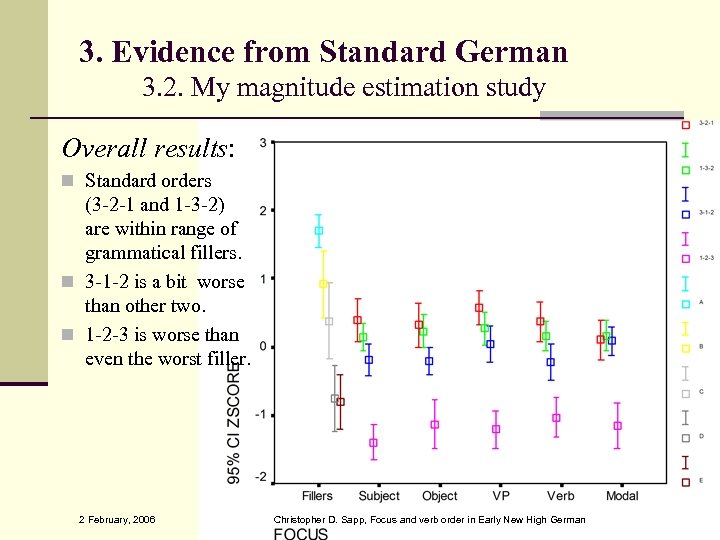 3. Evidence from Standard German 3. 2. My magnitude estimation study Overall results: Standard orders (3 -2 -1 and 1 -3 -2) are within range of grammatical fillers. 3 -1 -2 is a bit worse than other two. 1 -2 -3 is worse than even the worst filler. 2 February, 2006 Christopher D. Sapp, Focus and verb order in Early New High German
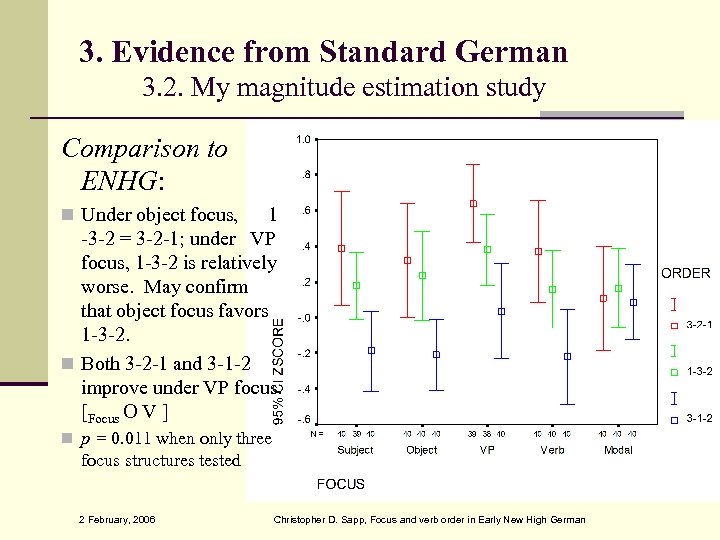 3. Evidence from Standard German 3. 2. My magnitude estimation study Comparison to ENHG: Under object focus, 1 -3 -2 = 3 -2 -1; under VP focus, 1 -3 -2 is relatively worse. May confirm that object focus favors 1 -3 -2. Both 3 -2 -1 and 3 -1 -2 improve under VP focus. [Focus O V ] p = 0. 011 when only three focus structures tested 2 February, 2006 Christopher D. Sapp, Focus and verb order in Early New High German
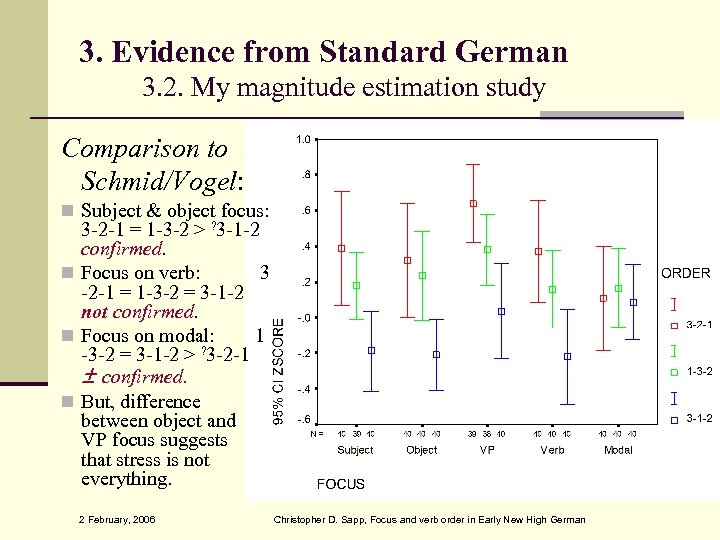 3. Evidence from Standard German 3. 2. My magnitude estimation study Comparison to Schmid/Vogel: Subject & object focus: 3 -2 -1 = 1 -3 -2 > ? 3 -1 -2 confirmed. Focus on verb: 3 -2 -1 = 1 -3 -2 = 3 -1 -2 not confirmed. Focus on modal: 1 ? 3 -2 -1 -3 -2 = 3 -1 -2 > ± confirmed. But, difference between object and VP focus suggests that stress is not everything. 2 February, 2006 Christopher D. Sapp, Focus and verb order in Early New High German
 Outline 1. Introduction 2. Focus and verb order in Early New High German 3. Supporting evidence: Modern Standard German 4. Supporting evidence: contemporary dialects 5. Conclusions 2 February, 2006 Christopher D. Sapp, Focus and verb order in Early New High German
 4. Evidence from contemporary dialects 4. 1. Previous studies In Standard German, only one possible order with 2 verbs: (34) Ich glaube, dass Klaus gestern das Buch gelesen hat. I believe that K. yesterday the book read 2 has 1 ‘I think that Klaus (has) read the book yesterday. ’ Many dialects allow variation, as in ENHG. Swabian: (35)a. b. I glaub, dass der Glaus geschdern des Buach glese had. I think that the Klaus yesterday the book read 2 has 1 I glaub, dass der Glaus geschdern des Buach had glese. I think that the Klaus yesterday the book has 1 read 2 However, these dialects usually prefer the Standard order (see Steil 1989). 2 February, 2006 Christopher D. Sapp, Focus and verb order in Early New High German
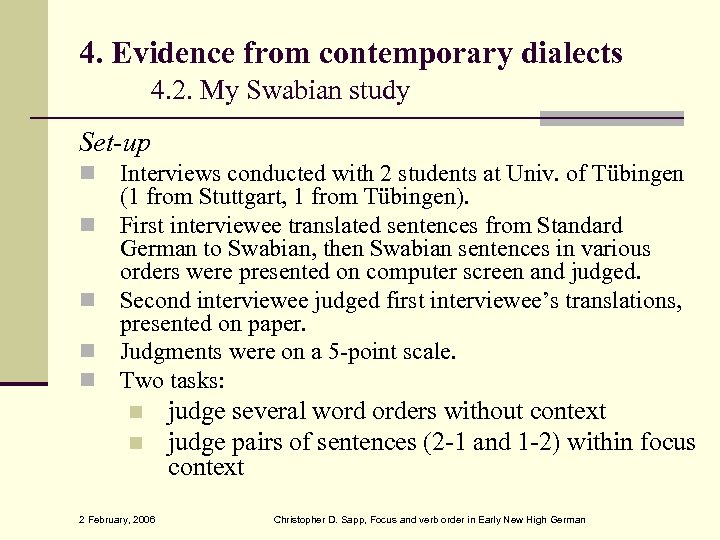 4. Evidence from contemporary dialects 4. 2. My Swabian study Set-up Interviews conducted with 2 students at Univ. of Tübingen (1 from Stuttgart, 1 from Tübingen). First interviewee translated sentences from Standard German to Swabian, then Swabian sentences in various orders were presented on computer screen and judged. Second interviewee judged first interviewee’s translations, presented on paper. Judgments were on a 5 -point scale. Two tasks: 2 February, 2006 judge several word orders without context judge pairs of sentences (2 -1 and 1 -2) within focus context Christopher D. Sapp, Focus and verb order in Early New High German
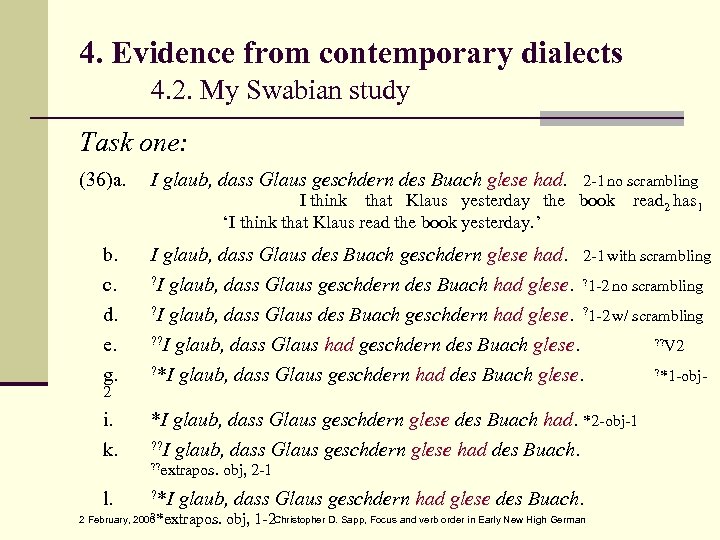 4. Evidence from contemporary dialects 4. 2. My Swabian study Task one: (36)a. I glaub, dass Glaus geschdern des Buach glese had. 2 -1 no scrambling I think that Klaus yesterday the book ‘I think that Klaus read the book yesterday. ’ read 2 has 1 b. c. d. e. g. I glaub, dass Glaus des Buach geschdern glese had. 2 -1 with scrambling ? I glaub, dass Glaus geschdern des Buach had glese. ? 1 -2 no scrambling ? I glaub, dass Glaus des Buach geschdern had glese. ? 1 -2 w/ scrambling ? ? I glaub, dass Glaus had geschdern des Buach glese. ? ? V 2 ? *I glaub, dass Glaus geschdern had des Buach glese. ? *1 -obj- i. k. *I glaub, dass Glaus geschdern glese des Buach had. *2 -obj-1 ? ? I glaub, dass Glaus geschdern glese had des Buach. 2 ? ? extrapos. l. ? *I obj, 2 -1 glaub, dass Glaus geschdern had glese des Buach. ? 2 February, 2006 *extrapos. obj, 1 -2 Christopher D. Sapp, Focus and verb order in Early New High German
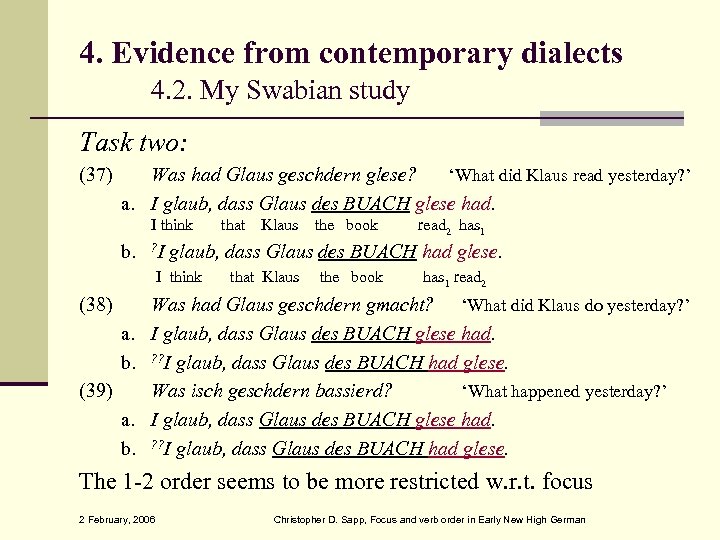 4. Evidence from contemporary dialects 4. 2. My Swabian study Task two: (37) Was had Glaus geschdern glese? ‘What did Klaus read yesterday? ’ a. I glaub, dass Glaus des BUACH glese had. I think b. ? I a. b. (39) a. b. Klaus the book read 2 has 1 glaub, dass Glaus des BUACH had glese. I think (38) that Klaus the book has 1 read 2 Was had Glaus geschdern gmacht? ‘What did Klaus do yesterday? ’ I glaub, dass Glaus des BUACH glese had. ? ? I glaub, dass Glaus des BUACH had glese. Was isch geschdern bassierd? ‘What happened yesterday? ’ I glaub, dass Glaus des BUACH glese had. ? ? I glaub, dass Glaus des BUACH had glese. The 1 -2 order seems to be more restricted w. r. t. focus 2 February, 2006 Christopher D. Sapp, Focus and verb order in Early New High German
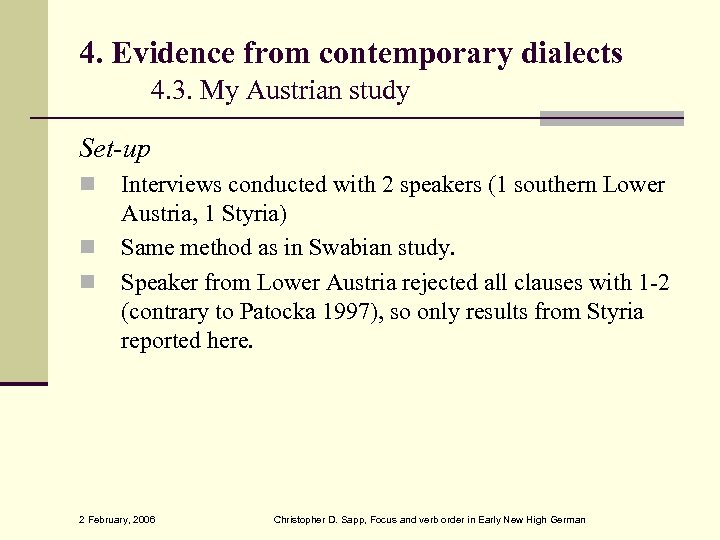 4. Evidence from contemporary dialects 4. 3. My Austrian study Set-up Interviews conducted with 2 speakers (1 southern Lower Austria, 1 Styria) Same method as in Swabian study. Speaker from Lower Austria rejected all clauses with 1 -2 (contrary to Patocka 1997), so only results from Styria reported here. 2 February, 2006 Christopher D. Sapp, Focus and verb order in Early New High German
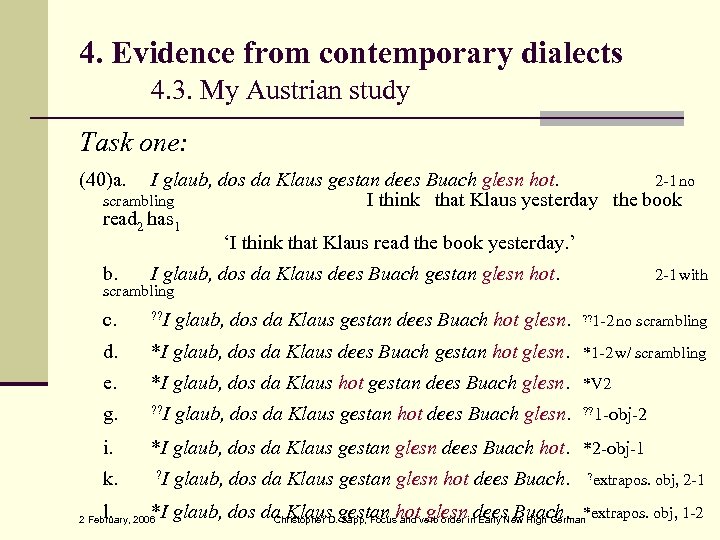 4. Evidence from contemporary dialects 4. 3. My Austrian study Task one: (40)a. I glaub, dos da Klaus gestan dees Buach glesn hot. 2 -1 no scrambling I think that Klaus yesterday the book read 2 has 1 ‘I think that Klaus read the book yesterday. ’ b. I glaub, dos da Klaus dees Buach gestan glesn hot. c. ? ? I d. *I glaub, dos da Klaus dees Buach gestan hot glesn. *1 -2 w/ scrambling e. *I glaub, dos da Klaus hot gestan dees Buach glesn. *V 2 g. ? ? I ? ? 1 -obj-2 i. *I glaub, dos da Klaus gestan glesn dees Buach hot. *2 -obj-1 2 -1 with scrambling k. l. ? I glaub, dos da Klaus gestan dees Buach hot glesn. glaub, dos da Klaus gestan hot dees Buach glesn. glaub, dos da Klaus gestan glesn hot dees Buach. ? ? 1 -2 no scrambling ? extrapos. obj, 2 -1 *I glaub, dos da Klaus gestan hotverb order indees Buach. *extrapos. obj, 1 -2 Christopher D. Sapp, Focus and glesn Early New High German 2 February, 2006
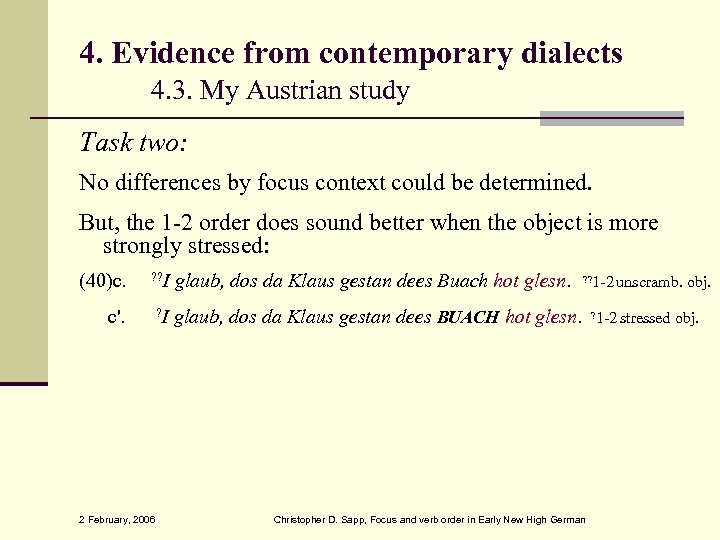 4. Evidence from contemporary dialects 4. 3. My Austrian study Task two: No differences by focus context could be determined. But, the 1 -2 order does sound better when the object is more strongly stressed: (40)c. ? ? I c'. ? I 2 February, 2006 glaub, dos da Klaus gestan dees Buach hot glesn. ? ? 1 -2 unscramb. glaub, dos da Klaus gestan dees BUACH hot glesn. Christopher D. Sapp, Focus and verb order in Early New High German ? 1 -2 stressed obj.
 Outline 1. Introduction 2. Focus and verb order in Early New High German 3. Supporting evidence: Modern Standard German 4. Supporting evidence: contemporary dialects 5. Conclusions 2 February, 2006 Christopher D. Sapp, Focus and verb order in Early New High German
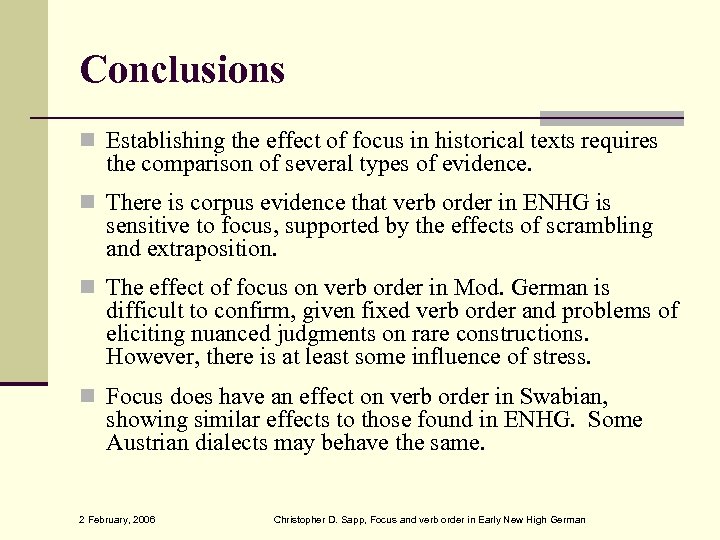 Conclusions Establishing the effect of focus in historical texts requires the comparison of several types of evidence. There is corpus evidence that verb order in ENHG is sensitive to focus, supported by the effects of scrambling and extraposition. The effect of focus on verb order in Mod. German is difficult to confirm, given fixed verb order and problems of eliciting nuanced judgments on rare constructions. However, there is at least some influence of stress. Focus does have an effect on verb order in Swabian, showing similar effects to those found in ENHG. Some Austrian dialects may behave the same. 2 February, 2006 Christopher D. Sapp, Focus and verb order in Early New High German
 References Bard, E. , D. Robertson, & A. Sorace. 1996. Magnitude estimation of linguistic acceptability. Language 72: 32– 68. Bies, A. 1996. Syntax and Discourse Factors in Early New High German: Evidence for Verb-final Word Order. M. A. Thesis, U. Penn. , Philadelphia. Haider, H. & I. Rosengren. 2003. Scrambling: Nontriggered Chain Formation in OV Languages. Journal of Germanic Linguistics 15: 203 -267. Das Bonner Frühneuhochdeutsch-Korpus, Institut für Kommunikationsforschung und Phonetik/ Universität Bonn. www. ikp. uni-bonn. de/dt/forsch/fnhd/ Ebert, R. P. 1981. Social and stylistic variation in the order of auxiliary and non-finite verb in dependent clauses in Early New High German. Beiträge zur Geschichte der deutschen Sprache und Literatur 103: 204 -237. Patocka, F. 1997. Satzgliedstellung in den bairischen Dialekten Österreichs. Frankfurt am Main: Lang. Robinson, J. , H. Lawrence & S. Tagliamonte. Gold. Varb 2001: A multivariate analysis application for windows. www. york. ac. uk/depts/lang/webstuff/goldvarb Schmid, T. & R. Vogel. 2004. Dialectal Variation in German 3 -Verb Clusters: A Surface-Oriented Optimality Theoretic Account. Journal of Comparative Germanic Linguistics 7: 235 -274. Steil, C. 1989. Untersuchungen zum Verbalkomplex im Schwäbischen. M. A. Thesis, Eberhard-Karls-Universität Tübingen.