 Скачать презентацию Christopher Columbus Prepared Radzhibaeva Alina 1 G-5
Christofer Columbus Radzhibaeva Alina 1G-5.pptx
- Количество слайдов: 5



Christopher Columbus Prepared: Radzhibaeva Alina 1 G-5
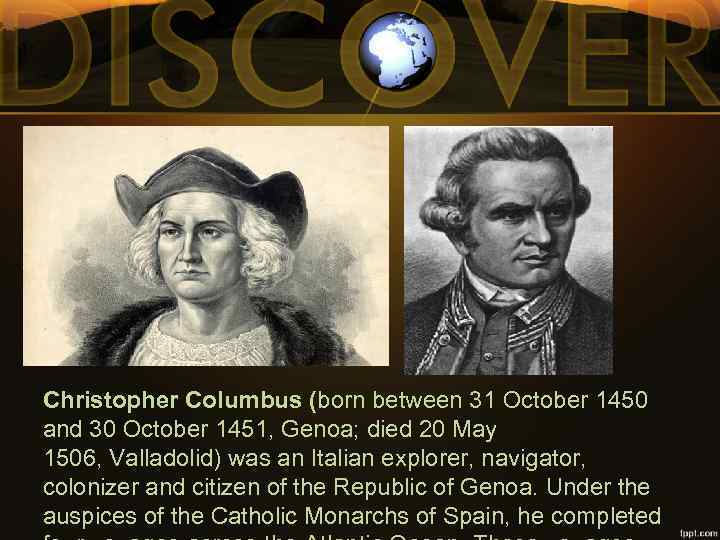
Christopher Columbus (born between 31 October 1450 and 30 October 1451, Genoa; died 20 May 1506, Valladolid) was an Italian explorer, navigator, colonizer and citizen of the Republic of Genoa. Under the auspices of the Catholic Monarchs of Spain, he completed
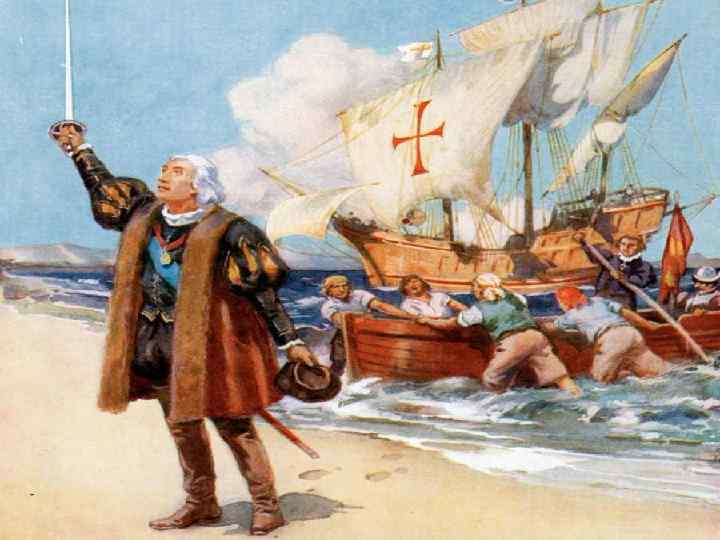
INFORMATION ABOUT CHRISTOFER • In the context of emerging Western imperialism and economic competition between European kingdoms through the establishment of trade routes and colonies, Columbus' proposal to reach the East Indies by sailing westward eventually received the support of the Spanish Crown, which saw in it a chance to enter the spice trades with Asia through a new westward route. During his first voyage in 1492, instead of arriving at Japan as he had intended, Columbus reached the New World, landing on an island in the Bahamas archipelago that he named "San Salvador". Over the course of three more voyages, Columbus visited the Greater and Lesser Antilles, as well as the Caribbean coast of Venezuela Crown of Castle. • Though Columbus was not the first European explorer to reach the Americas (having been preceded by the Norse expedition led by Leif Ericson in the 11 th century), his voyages led to the
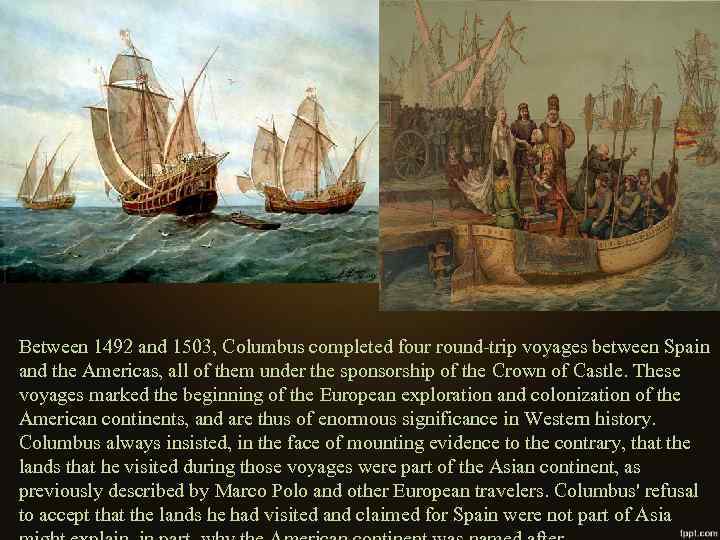
Between 1492 and 1503, Columbus completed four round-trip voyages between Spain and the Americas, all of them under the sponsorship of the Crown of Castle. These voyages marked the beginning of the European exploration and colonization of the American continents, and are thus of enormous significance in Western history. Columbus always insisted, in the face of mounting evidence to the contrary, that the lands that he visited during those voyages were part of the Asian continent, as previously described by Marco Polo and other European travelers. Columbus' refusal to accept that the lands he had visited and claimed for Spain were not part of Asia
 Скачать презентацию Christopher Columbus Prepared Radzhibaeva Alina 1 G-5
Christofer Columbus Radzhibaeva Alina 1G-5.pptx