

Christmas Christmas The history: There are very few


 Скачать презентацию Christmas Christmas The history: There are very few
39042-christmas.ppt
- Количество слайдов: 8
Christmas
Christmas The history: There are very few people in the world today who do not know what the Christmas holiday is all about. Christmas, as we know it today, is the celebration of the birth of Jesus Christ, which happened over 2000 years ago. The word “Christmas” translates to “Mass Of Christ”. However, we can all be sure that the celebration of the Christmas holiday did not start right away. So how did the actual celebration of the Christmas holiday begin? Believe it or not, many of the traditions that we observe during the Christmas holiday season began way before the birth of Christ. Exchanging gifts, decorating trees, and the burning of the Yule log were all winter traditions that began before Christ was born, but were eventually incorporated into the holiday that became known as Christmas, and became part of Christmas history. Over 4000 years ago, the Mesopotamians celebrated each new year with a 12-day festival, called Zagmuth. The Mesopotamians, who believed in many gods, held this festival in support of their chief god, Marduk, because they believed that he battled the monsters of chaos at the beginning of each winter. It is from this festival that the 12 days of Christmas is believed to have originated. The ancient Romans held a celebration each year in honor of their god Saturn. The festival, which they called Saturnalia, began in the middle of December and lasted until the first of January. The Romans decorated their homes with garlands, as well as trees upon which they hung candles. During the festival the citizens of Rome would visit each other’s homes and hold great feasts. One of the theories of how the tradition of the giving of Christmas gifts came about was from the Roman practice of exchanging gifts between family and neighbors during the festival of Saturnalia to promote good luck. NEXT
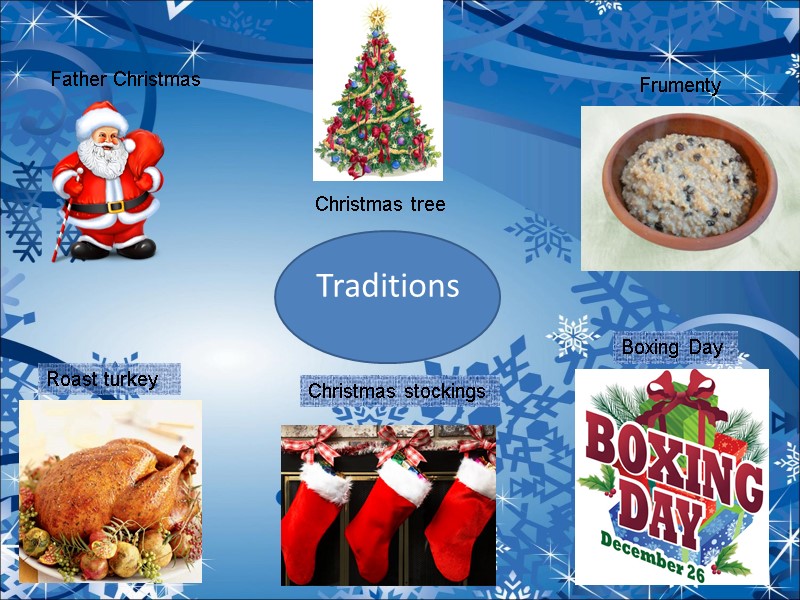
Father Christmas Roast turkey Frumenty Boxing Day Christmas stockings Traditions Christmas tree
Christmas tree The Christmas tree actually predates Christianity by centuries! Ancient Romans decorated trees with small pieces of metal during Saturnalia, their winter festival in honor of Saturnus, the god of agriculture. There is much evidence to suggest that December 25th was chosen as the day to celebrate Christ's birth in order to take over the holiday from the pagans. (Most historians place the birth of Christ as in the spring or summer; shepherds don't watch over their flocks in the fields in the dead of winter! Historians believe the Emperor Constantine did this around the year 390 to combine Christmas with the Saturn and Mithras celebrations and also with the cult of Sol Invictus, a form of Sunday worship that had come to Rome from Syria a century before). Middle Ages During the middle ages, an evergreen was decorated with apples and called the Paradise tree, as a symbol of the feast of Adam and Eve and was held on December 24th each year. The modern Christmas trees appeared in the middle 1500's. The trees were sold at local markets and set up in homes without any ornaments in the Strassbourg area of Alsace in 1531, which was then a part of Germany. Back
Father christmas The earliest English examples of the personification of Christmas are apparently those in carols of the 15th century.[citation needed] The manuscript Bodelian Library MS Arch. Selden b. 26, which dates from circa 1458 AD,[11] contains an anonymous Christmas carol (f. 8) which begins with the lyrics: Goday, goday, my lord Sire Christëmas, goday! Goday, Sire Christëmas, our king, for ev'ry man, both old and ying, is glad and blithe of your coming; Goday! Similarly, a carol attributed to Richard Smert (c. 1400–c. 1479[12]) in British Additional MS 5665 (ff. 8v-9v),[11] begins in dialog form: Nowell, nowell, nowell, nowell Who is there that singeth so: Nowell, nowell, nowell? I am here, Sire Christësmas. Welcome, my lord, Sire Christëmas! Welcome to us all, both more and less! Come near, Nowell. Back
Frumenty Frumenty is a thick wheat porridge that was traditionally served with venison. It was often made with meat broth or almond milk instead of regular milk, depending on whether it was to be served on a meat or meatless day. 1 cup cracked wheat 2 cups water 2/3 cup milk 2 egg yolks 1/2 tsp. salt pinch saffron Traditional method: Bring water to a boil and add wheat. Return to a full boil, reduce heat, cover, and simmer for about 15 minutes or until water is absorbed and wheat is tender. In a separate bowl mix egg yolks and milk. Add to wheat along with remaining ingredients and stir well. Serve hot - sprinkle with sugar and/or cinnamon if desired. Back
Boxing Day A ‘Christmas Box’ in Britain is a name for a Christmas present. Boxing Day was a day off for servants and when they received a ‘Christmas Box’ from the master. The servants would also go home to give ‘Christmas Boxes’ to their families. A box to collect money for the poor was placed in Churches on Christmas day then opened the next day. Great sailing ships when setting sail would have a sealed box containing money on board for good luck.If the voyage were a success the box was given to a priest, opened at Christmas and the contents given to the poor. Back
Christmas stockings There was a kindly nobleman whose wife had died of an illness leaving the nobleman and his three daughters in despair. After losing all his money in useless and bad inventions the family had to move into a peasant's cottage, where the daughters did their own cooking, sewing and cleaning. When it came time for the daughters to marry, the father became even more depressed as his daughters could not marry without dowries, money and property given to the new husband's family. One night after the daughters had washed out their clothing they hung their stockings over the fireplace to dry. That night Saint Nicholas, knowing the despair of the father, stopped by the nobleman's house. Looking in the window Saint Nicholas saw that the family had gone to bed. He also noticed the daughters stockings. Inspiration struck Saint Nicholas and he took three small bags of gold from his pouch and threw them one by one down the chimney and they landed in the stockings. The next morning when the daughters awoke they found their stockings contained enough gold for them to get married. The nobleman was able to see his three daughters marry and he lived a long and happy life. Children all over the world continue the tradition of hanging Christmas stockings. In some countries children have similar customs, in France the children place their shoes by the fireplace, a tradition dating back to when children wore wooden peasant shoes. Back