 Скачать презентацию Christian Ministry 2 Using Your Bible Week 4
b057522dccf76ea18214d6a54786990d.ppt
- Количество слайдов: 57





Christian Ministry 2 Using Your Bible Week 4 - Interpreting the Bible Put your homework in the basket. Pick up a new packet for Week 4.
Opener • Recall and share with someone close to you one point that stuck out for you in Reading the Bible with Heart & Mind. • Recall the four steps to the VPI argument
Can the Bible be understood? • Common misconceptions: • “We should rely on the clergy/experts to tell us what the Bible means. " • "People have always disagreed about the meaning of the Bible. That’s why there are so many different denominations. ”
Can the Bible be understood? • Common misconceptions: • "The Bible has been used to justify everything you can think of. You can make it mean anything you want it to mean. " • "That's just your interpretation. It's impossible to determine the original author's meaning, rather, as we read it, we create our own meaning for the text. "
Can the Bible be understood? • Thoughts on the following HC scenario. . . • Someone says, “What this passage means to me is. . . ” • Someone else says, “That's great. But I got a different meaning (and goes on to share something contradictory). ” • Everyone concludes: "Praise God for all the great insight we're getting!"
Biblical Perspicuity • Definition: the Bible is understandable with regard to its main message. • Note: everything in the Bible is NOT equally clear!! (2 Peter 3: 15, 16)
Biblical Perspicuity • Main message IS clear! • John 20: 31, “…but these have been written so that you may believe that Jesus is the Christ, the Son of God; and that believing you may have life in His name. ”
Biblical Perspicuity • Main message IS clear! • 2 Tim. 3: 14, 15, “You, however, continue in the things you have learned and become convinced of, knowing from whom you have learned them, 15 and that from childhood you have known the sacred writings which are able to give you the wisdom that leads to salvation through faith which is in Christ Jesus. ”
Biblical Perspicuity • Main message IS clear! • Quote from R. C. Sproul, Knowing Scripture
Responses to attacks on perspicuity 1. “The Bible is so complicated. Who could understand it? ” • Response: If a loving God has recorded a vital message for humans, he would communicate it in such a way that we can understand that message • Note: This is a presuppositional defense • Quote from James Sire, Scripture Twisting. . .
Responses to attacks on perspicuity 2. "If it's so easy to interpret, why are there so many denominations? " • Response: Wherever the Bible has been the final authority, Christians have agreed on the main message. • “If that’s the case, then why do ‘Christian’ groups disagree on essential doctrines? " Response: Because another authority has replaced God's Word. •
Responses to attacks on perspicuity 2. "If it's so easy to interpret, why are there so many denominations? " • Examples of Replacements: • Religious Tradition: Rabbinic “oral law” (Mark 7: 513) • Sacred Tradition in the Catholic Church • Quote from the Second Vatican Council. . . • New “scriptures”
Responses to attacks on perspicuity 2. "If it's so easy to interpret, why are there so many denominations? " • Examples of Replacements: • "KEYS" TO BIBLICAL INTERPRETATION: • SKEWED TRANSLATIONS OF THE BIBLE: • ALIEN PRESUPPOSITIONS:
Responses to attacks on perspicuity 3. "We're too far removed in time and culture from the original authors. Therefore, we could never understand what they intended. ” • Response: We read other pieces of ancient literature like the Iliad or the Tao Te Ching with much less skepticism about our ability to understand them. If we approach the Bible like we would approach any other piece of literature, we find that its main message is indeed understandable.
Responses to attacks on perspicuity 3. "We're too far removed in time and culture from the original authors. Therefore, we could never understand what they intended. ” • Consider: “Go to the store and buy 10 lbs of potatoes. ” • Could it mean: "Go to the Himalayan Mountains and meditate on your navel? "
Responses to attacks on perspicuity 3. "We're too far removed in time and culture from the original authors. Therefore, we could never understand what they intended. ” • Now consider: “He who believes in the Son has eternal life; but he who does not obey the Son shall not see life, but the wrath of God abides on him. ” • Could it mean: “It doesn’t matter what religion you believe because everyone goes to heaven? ”
Responses to attacks on perspicuity • So we affirm that the Bible is essentially clear. Its main themes and teachings can be understood by the average reader today.
Reflection • In your conversations with Bible skeptics, have you heard any of the responses that we just covered? How did you respond? If you could have that converation over again, how might you respond differently?
Interpreting and Applying • We truly are separated from the original authors and readers of the Bible in many ways: by time, language, culture, geography. . .
Interpreting and Applying • Accentuated by two factors: • The reader’s “grid” - our own experiences and prior understanding that we bring to the text • The nature of Scripture: Books of the Bible were written to specific groups of people at specific times in history. • Quote from John Stott. . .
Grammatico-Historical Hermeneutics • “Hermeneutics” is the art and science of interpreting texts. • Grammatico-Historical hermeneutics is a method of interpretation that takes into account common rules of GRAMMAR and SYNTAX and the author’s HISTORICAL context.
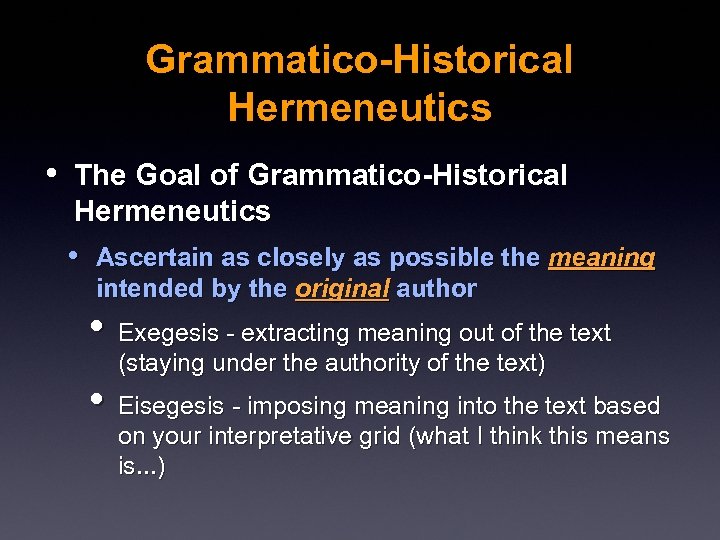
Grammatico-Historical Hermeneutics • The Goal of Grammatico-Historical Hermeneutics • Ascertain as closely as possible the meaning intended by the original author • Exegesis - extracting meaning out of the text (staying under the authority of the text) • Eisegesis - imposing meaning into the text based on your interpretative grid (what I think this means is. . . )
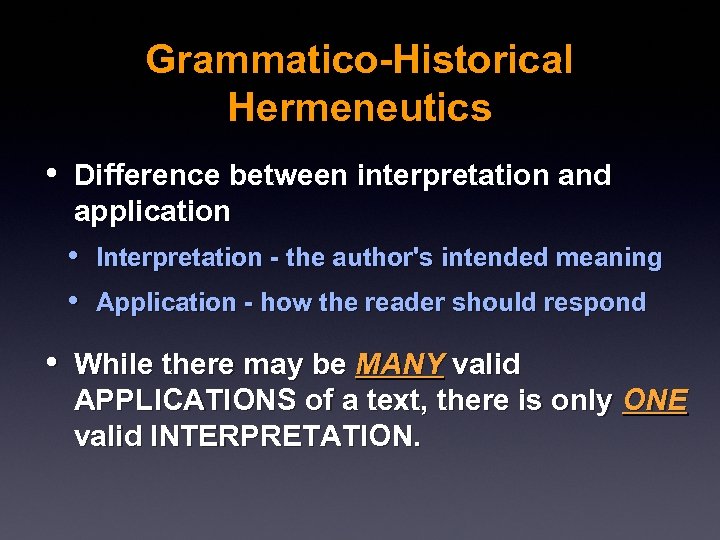
Grammatico-Historical Hermeneutics • Difference between interpretation and application • Interpretation - the author's intended meaning • Application - how the reader should respond • While there may be MANY valid APPLICATIONS of a text, there is only ONE valid INTERPRETATION.
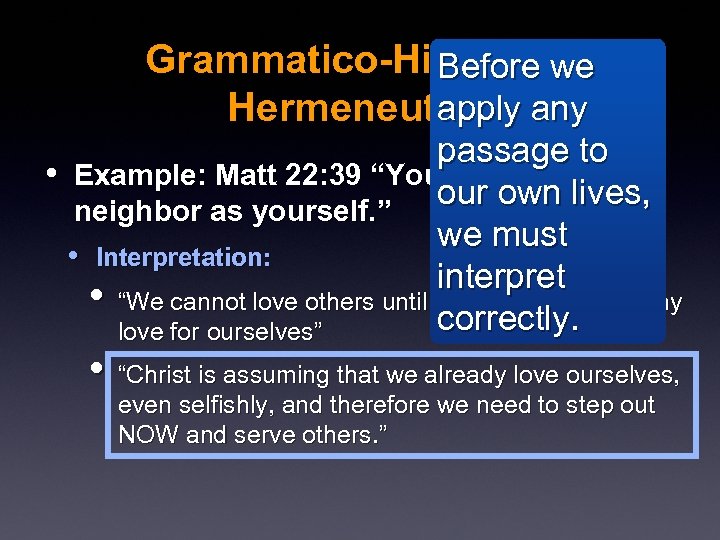
Grammatico-Historical Before we apply Hermeneutics any passage to • Example: Matt 22: 39 “You shall love your own lives, neighbor as yourself. ” we must • Interpretation: interpret • “We cannot love others until we first have a healthy correctly. love for ourselves” • “Christ is assuming that we already love ourselves, even selfishly, and therefore we need to step out NOW and serve others. ”
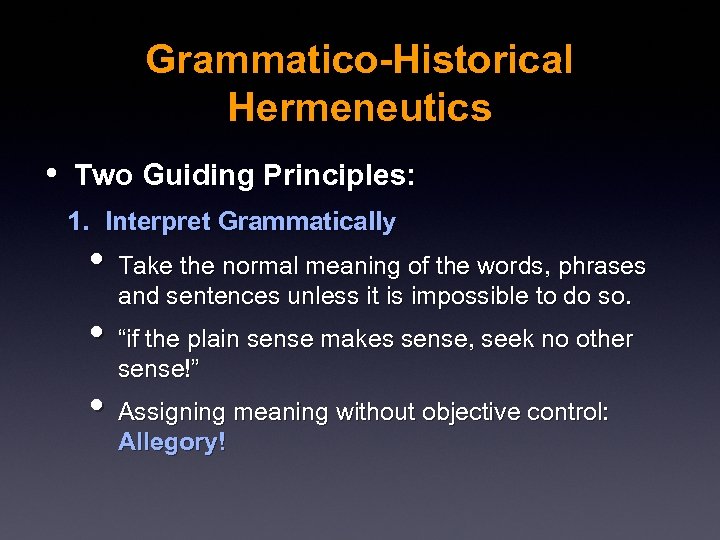
Grammatico-Historical Hermeneutics • Two Guiding Principles: 1. Interpret Grammatically • Take the normal meaning of the words, phrases and sentences unless it is impossible to do so. • “if the plain sense makes sense, seek no other sense!” • Assigning meaning without objective control: Allegory!
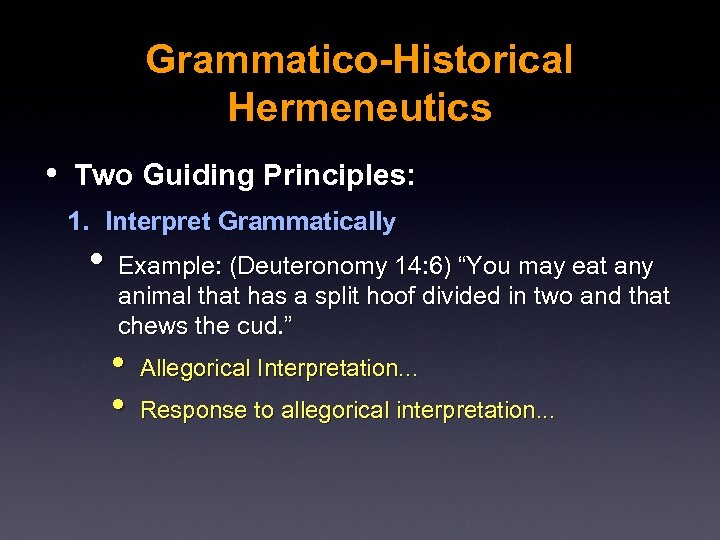
Grammatico-Historical Hermeneutics • Two Guiding Principles: 1. Interpret Grammatically • Example: (Deuteronomy 14: 6) “You may eat any animal that has a split hoof divided in two and that chews the cud. ” • Allegorical Interpretation. . . • Response to allegorical interpretation. . .
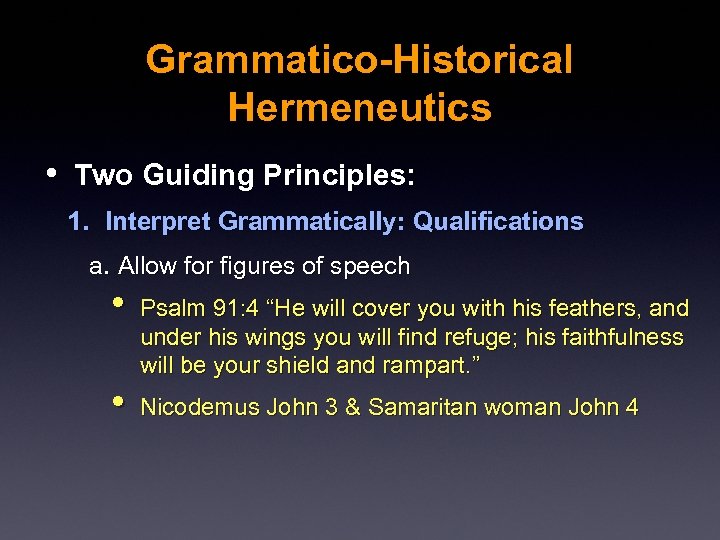
Grammatico-Historical Hermeneutics • Two Guiding Principles: 1. Interpret Grammatically: Qualifications a. Allow for figures of speech • Psalm 91: 4 “He will cover you with his feathers, and under his wings you will find refuge; his faithfulness will be your shield and rampart. ” • Nicodemus John 3 & Samaritan woman John 4
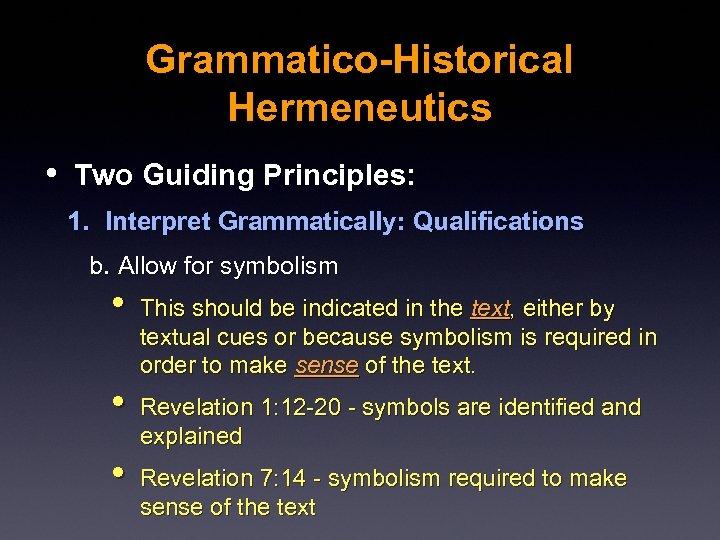
Grammatico-Historical Hermeneutics • Two Guiding Principles: 1. Interpret Grammatically: Qualifications b. Allow for symbolism • This should be indicated in the text, either by textual cues or because symbolism is required in order to make sense of the text. • Revelation 1: 12 -20 - symbols are identified and explained • Revelation 7: 14 - symbolism required to make sense of the text
Grammatico-Historical Hermeneutics • Two Guiding Principles: 2. Interpret Historically • Take into account the historical background of the author and the recipients • Not interested at first in the question, "What does it mean to me? " but rather, "What did it mean to the original audience? " • Must consider the SITUATION, STYLE, & CULTURE
Grammatico-Historical Hermeneutics • Two Guiding Principles: 2. Interpret Historically • Situation - Who wrote to whom? What was the occasion that prompted the writing? • Style - The type of literature (genre) being used. • Proverbs 22: 6. . . • Proverbs 15: 1. . . • Romans 8: 1. . .
Grammatico-Historical Hermeneutics • Two Guiding Principles: 2. Interpret Historically • Situation - Who wrote to whom? What was the occasion that prompted the writing? • Style - The type of literature (genre) being used. • Which genres are used in the Bible? • Narrative, Epistle, Parable,
Grammatico-Historical Hermeneutics • Two Guiding Principles: 2. Interpret Historically • Culture - The customs, prejudices and beliefs during biblical times. • Jewish attitudes towards Samaritans in the parable of the Good Samaritan (Luke 10: 25 -37). • The significance of monetary values (300 Denarii in John 12: 3 -5; 50, 000 Drachma in Acts 19: 19)
Grammatico-Historical Hermeneutics • Two Guiding Principles: 2. Interpret Historically • Culture - The customs, prejudices and beliefs during biblical times. • 1 Corinthians 11: 4 -6 – Short hair was typical of Aphrodite priestess-prostitutes; shaven heads were typical of convicted adulteresses (v. 5)
Grammatico-Historical Hermeneutics • Two Guiding Principles: 2. Interpret Historically • Helpful Resources • IVP Bible Background Commentary, OT • IVP Bible Background Commentary, NT • www. biblos. com • Logos Bible Study Software
Four rules for critical interpretation 1. Interpret in light of the context of the passage • Never view a passage in isolation from its surroundings. The context should be considered the most important kind of evidence in the interpretation of a passage.
Four rules for critical interpretation 1. Interpret in light of the context of the passage • (Matthew 16: 28) "Truly I say to you, there are some of those who are standing here who shall not taste death until they see the Son of Man coming in His kingdom. " • The “doubter” in James 1: 6 -8. . .
Four rules for critical interpretation 2. Interpret in light of progressive revelation • consider all of God’s Word up to the current text • Heb. 1: 1, 2. . . • Heb 8: 13. . .
Four rules for critical interpretation 2. Interpret in light of progressive revelation • While God's purpose for man has never changed, his strategy in accomplishing that purpose has changed. He has dealt with man under different "covenants, " or "dispensations. " Therefore, it is important to ask, "Under which program was this written? "
Four rules for critical interpretation 2. Interpret in light of progressive revelation • Primary applicaton is to the peple operating under that program, but not necessarily to others [OT rituals] • Secondary applications may be made for other programs based on principles that have universal application • Compare Exodus 20: 8 -10 with Colossians 2: 16 -17
Four rules for critical interpretation 2. Interpret in light of progressive revelation • Other examples: • Theocracy was commanded in the Old Testament, but [submitting to] secular government is affirmed in the New Testament (Rom. 13: 1 -7; Mt. 22: 21) • Mal. 3: 7 -12 - The practice of tithes should be seen in context of the Old Testament (see Num. 18: 2124; Deut. 14: 22 -29)
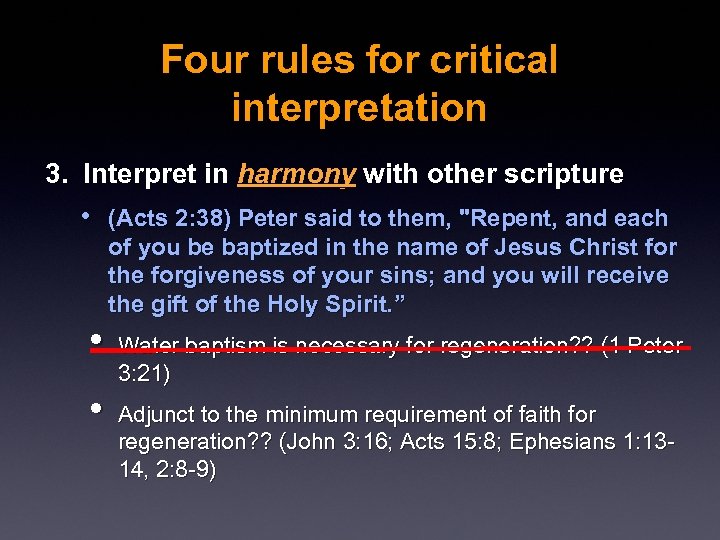
Four rules for critical interpretation 3. Interpret in harmony with other scripture • (Acts 2: 38) Peter said to them, "Repent, and each • • of you be baptized in the name of Jesus Christ for the forgiveness of your sins; and you will receive the gift of the Holy Spirit. ” Water baptism is necessary for regeneration? ? (1 Peter 3: 21) Adjunct to the minimum requirement of faith for regeneration? ? (John 3: 16; Acts 15: 8; Ephesians 1: 1314, 2: 8 -9)
Four rules for critical interpretation 4. Interpret the unclear in light of the clear. • Every major, essential truth is taught clearly and many times. Never build a doctrine on an unclear passage. • (1 Cor. 15: 29) "Otherwise, what will those do who are baptized for the dead? If the dead are not raised at all, why then are they baptized for them? "
God’s part and man’s part in interpretation – 2 implications 1. Rely on the illumination of the Holy Spirit • 1 Cor 2: 14 -16. . . • 1 John 2: 27. . . • Psalm 119: 18. . . • Quote from Whitefield. . .
God’s part and man’s part in interpretation – 2 implications 2. Diligently study the Word • 2 Timothy 2: 15*. . . • “Be diligent” implies there are obstacles and difficulties involved • “Ashamed” implies good interpretation IS achievable 2. “Handing accurately” implies there is a proper interpretation
God’s part and man’s part in interpretation – 2 implications 2. Diligently study the Word • Example from DA Carson. . . • Discussion: Why is claiming “God revealed it to me” an insufficient defense for the interpretation we have chosen?
God’s part and man’s part in interpretation – 2 implications 2. Diligently study the Word • We are commanded many places in the Bible to use our minds and weigh out the truth. . . • “Judge for yourselves” (1 Cor 10: 15; 11: 13) • “Test the spirits” (1 John 4: 1) • Mature Christians have “trained themselves to discern good and evil” by “constant use” of the Word. (Hebrews 5: 14)
Striking the right balance • Apostle Paul and Prophet Daniel modeled depending on God for understanding AND careful study of the Word: • Daniel 10: 2. . . • 2 Timothy 2: 7*. . .
Summary • Bible interpretation is for all believers • We will use the grammatico-historical hermeneutic • Employ the four rules for critical interpretation • Requires both diligence in study and dependence on the Spirit to teach us
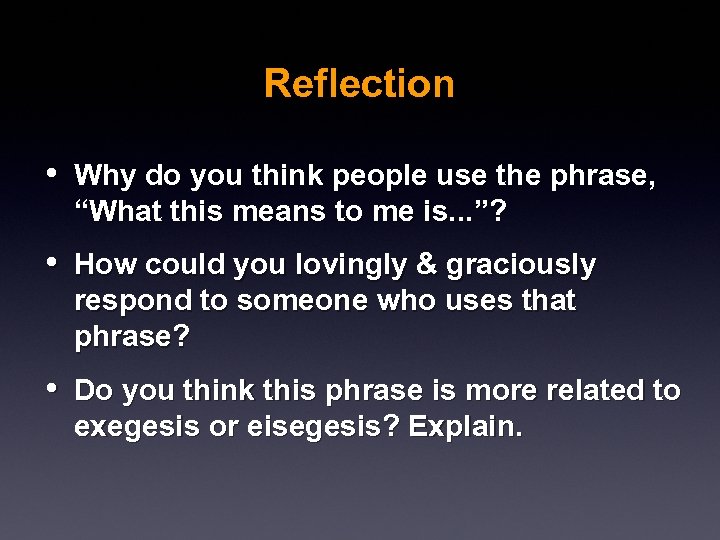
Reflection • Why do you think people use the phrase, “What this means to me is. . . ”? • How could you lovingly & graciously respond to someone who uses that phrase? • Do you think this phrase is more related to exegesis or eisegesis? Explain.

Questions?
Next Week • Using the Grammatical-Historical Hermeneutic on the Epistles
Memory Verses • Please note: the last page of your notes gives a description of the verses, not the actual wording of the verses • 2 Timothy 2: 7* • 2 Timothy 2: 15*
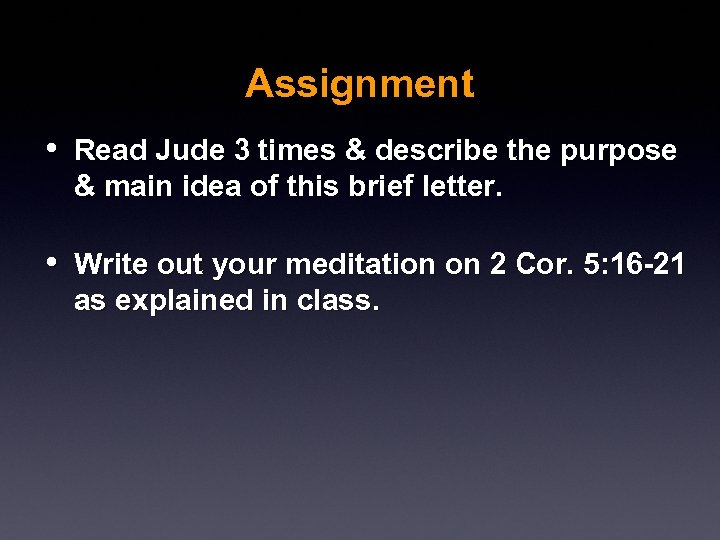
Assignment • Read Jude 3 times & describe the purpose & main idea of this brief letter. • Write out your meditation on 2 Cor. 5: 16 -21 as explained in class.

Corporate Prayer
 Скачать презентацию Christian Ministry 2 Using Your Bible Week 4
b057522dccf76ea18214d6a54786990d.ppt