 Скачать презентацию Choosing Antimicrobials in Special Situations Additional considerations
a7362e1997740857cafdad7deb916bd2.ppt
- Количество слайдов: 10




Choosing Antimicrobials in Special Situations
Additional considerations in making a final antibiotic selection • Site of action – (Will the antibiotic penetrate into the site of infection and be active there? ) • Cidal vs. Static activity – (When is a cidal antimicrobial required? ) • Sodium load – (Will the sodium content of the antibiotic contribute to fluid overload and circulatory impairment? ) • Ease of administration – (Can the number of IVs be minimized for home therapy? Or can oral drugs be substituted? ) • Microbial ecology of the institution and the community – (Will the use of certain agents contribute to resistance in the larger community? )
Other important considerations (not discussed in this presentation) • Covering the spectrum with the minimal number of drugs” – See “Principles of Antimicrobial Therapy • Allergies – See “Antibiotic Allergies & Adverse Effects” • Renal dysfunction – See “Adjustments for Renal & Hepatic Failure” • Hepatic dysfunction – See “Adjustments for Renal & Hepatic Failure”
Site of Action: CNS penetration • Reliable – high-dose 3 rd generation cephalosporins – high-dose penicillins – trimethoprim-sulfa – metronidazole – chloramphenicol – quinolones • Variable: vancomycin, (linezolid) • Poor – aminoglycosides – macrolides and clindamycin – tetracyclines – early generation cephalosporins – daptomycin
Other site-of-action issues • Abscesses – Aminoglycosides are inactive at the low p. H found in abscesses • Lungs – Daptomycin is ineffective in pneumonia because the drug partitions in the surfactant layer instead of the bacterial membrane • Prostate – Beta-lactams penetrate poorly. penetrate reasonably well. Fluoroquinolones • Urine – Drugs excreted primarily by the liver do not achieve high concentrations in high (e. g. , ceftriaxone, nafcillin, clindamycin)
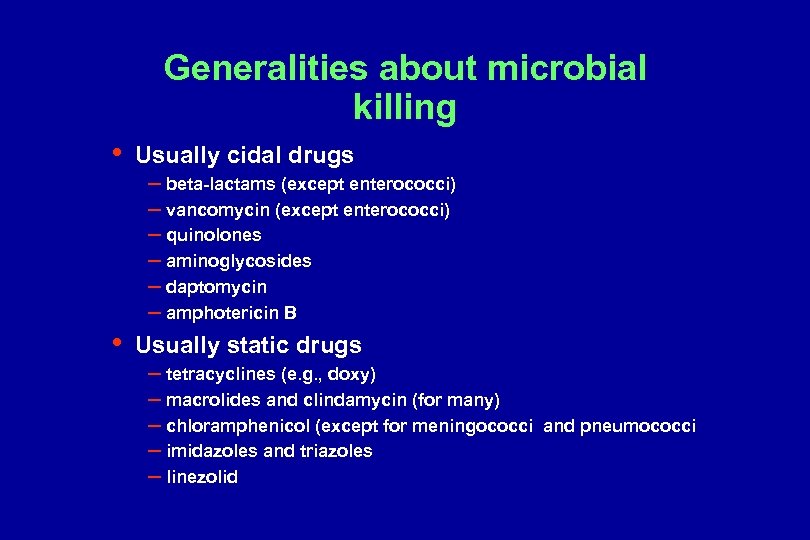
Generalities about microbial killing • • Usually cidal drugs – beta-lactams (except enterococci) – vancomycin (except enterococci) – quinolones – aminoglycosides – daptomycin – amphotericin B Usually static drugs – tetracyclines (e. g. , doxy) – macrolides and clindamycin (for many) – chloramphenicol (except for meningococci – imidazoles and triazoles – linezolid and pneumococci
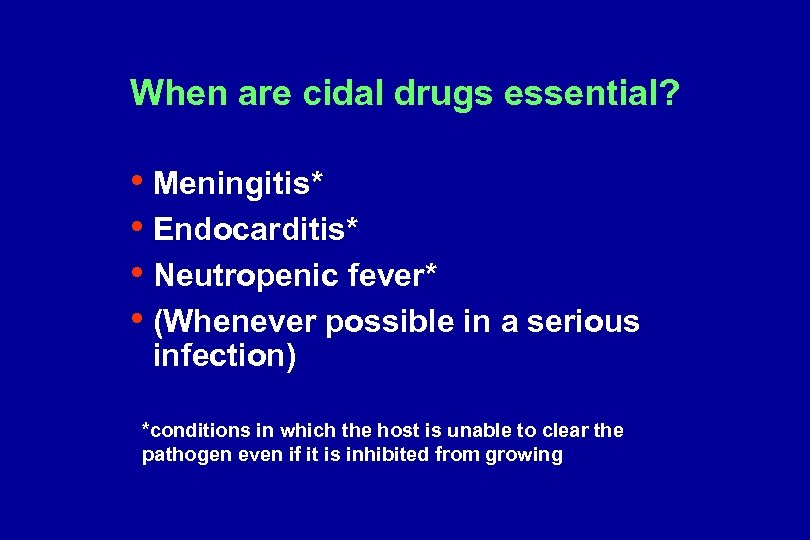
When are cidal drugs essential? • Meningitis* • Endocarditis* • Neutropenic fever* • (Whenever possible in a serious infection) *conditions in which the host is unable to clear the pathogen even if it is inhibited from growing
Sodium content of commonly used antimicrobials (from the Cleveland Clinic web site)
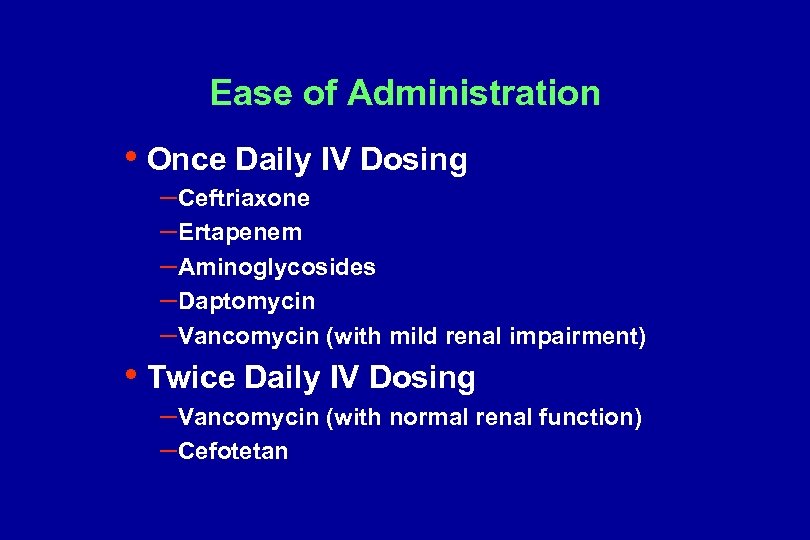
Ease of Administration • Once Daily IV Dosing – Ceftriaxone – Ertapenem – Aminoglycosides – Daptomycin – Vancomycin (with mild renal impairment) • Twice Daily IV Dosing – Vancomycin (with normal renal function) – Cefotetan

Antibiotics with excellent oral bioavailability (may be substituted for IV equivalents) • Linezolid • Metronidazole • Fluconazole • Fluoroquinolones • Trimethoprim-sulfamethoxasole
Скачать презентацию Choosing Antimicrobials in Special Situations Additional considerations
a7362e1997740857cafdad7deb916bd2.ppt