


 Скачать презентацию Choosing an APD-Licensed Home A Guide for Families
b6d7addfa71bb8fc948d2c30b18a0c7e.ppt
- Количество слайдов: 22
 Choosing an APD-Licensed Home: A Guide for Families, Guardians and Individuals with Developmental Disabilities Charlie Crist, Governor Jim De. Beaugrine, Director
 Choosing and Living in an APD-Licensed Home House Hunting 101 Finding the right home for yourself or a person with a developmental disability is a very important process and one that requires careful thought and planning. However, there are things you can do right away to help make this process easier and save you some time and aggravation.
 Choosing and Living in an APD-Licensed Home We’re from the government and we’re here to help you… (Seriously, we really mean it!) Staff in your local Agency for Persons with Disabilities (APD) office are very familiar with all of the licensed homes in your area and should be the first stop for you and your support coordinator in your search for the home that can best meet your needs. You can get the telephone number of your local APD office from your support coordinator or by visiting our website at http: //apd. myflorida. com/ Please consider these people as an important resource to help you match your specific needs with the right provider!
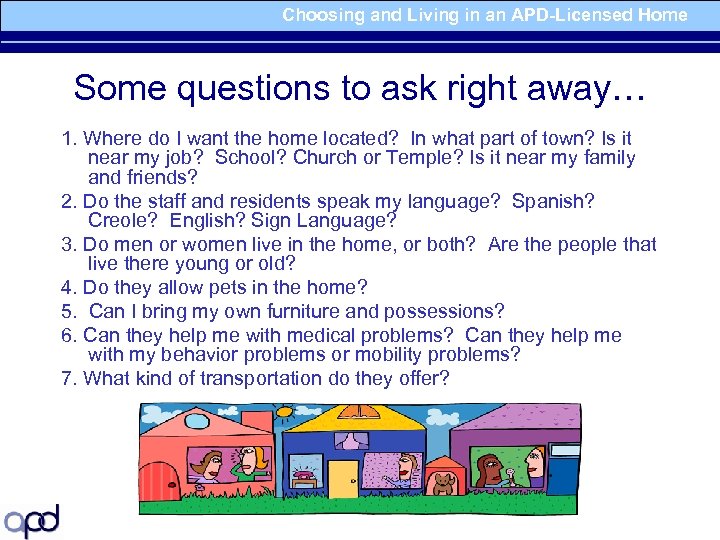 Choosing and Living in an APD-Licensed Home Some questions to ask right away… 1. Where do I want the home located? In what part of town? Is it near my job? School? Church or Temple? Is it near my family and friends? 2. Do the staff and residents speak my language? Spanish? Creole? English? Sign Language? 3. Do men or women live in the home, or both? Are the people that live there young or old? 4. Do they allow pets in the home? 5. Can I bring my own furniture and possessions? 6. Can they help me with medical problems? Can they help me with my behavior problems or mobility problems? 7. What kind of transportation do they offer?
 Choosing and Living in an APD-Licensed Home • • It is a really good idea to write down your questions including the things that are most important to you in a home and then be sure to ask those questions as you visit homes. • Your support coordinator and APD staff will be able to provide you with names of several homes that may meet your needs. • Make sure to visit each one of those homes and use your list of questions. Staff at the home should be able to answer your questions completely and honestly!
 Choosing and Living in an APD-Licensed Home Tips for Visiting Potential Homes • Once you have located several homes that might fit your needs, you should plan on visiting them with your support coordinator. • Try to visit the home in the late afternoon when other residents are home from school, work or their day activity so that you can meet everybody. • Visit the same home at different times of the day (which will allow you to meet more of the home’s staff) and stay as long as possible. • In most homes, bedrooms are shared so you will want to meet potential roommates as well as house mates.
 Choosing and Living in an APD-Licensed Home First impressions…. As soon as you approach a home you can begin to determine if quality is present! • Does the home look like other homes in the neighborhood? • Is the home nicely painted, decorated, and landscaped? • Are there an acceptable number of cars in the front yard and driveway? If the answer to any of these questions is “no”, there may be cause for concern.
 Choosing and Living in an APD-Licensed Home Look for quality as soon as you walk in the door! • Observe to see if the staff are friendly and helpful. Are other individuals living in the home friendly as well? • Ask for a tour of the home. The tour should include all living areas and staff areas. You may visit the rooms of other individuals if invited and staff should be observed to respect the privacy of the people who live in the home. Always remember that the home does not belong to the staff but to the individuals who live there!!!
 Choosing and Living in an APD-Licensed Home As you tour the home, look around carefully and ask yourself these questions: • Does the home smell nice? • Is the home in good repair? (Look for things like broken furnishings, broken doors, broken windows, holes in walls, burned out light bulbs, and appliances that do not work) • Is the home clean and nicely decorated? • Is it a comfortable temperature? Does the air conditioner/heat work?
 Choosing and Living in an APD-Licensed Home More things to look for…. • Ask to use the bathroom! Are there enough supplies such as towels, soap and toilet paper? • Is the home accessible for wheelchairs and walkers? • Do the number of staff appear to be enough to meet the needs of the individuals who live in the home? (Generally, there should be one staff member present for every three individuals while all of the individuals are awake and in the home).
 Choosing and Living in an APD-Licensed Home What about the food? ? ? Ask to see a copy of the week’s menu. Are the meals varied and do they look appetizing to you? Do they serve enough healthy and nutritious food (including fresh fruit and vegetables)?
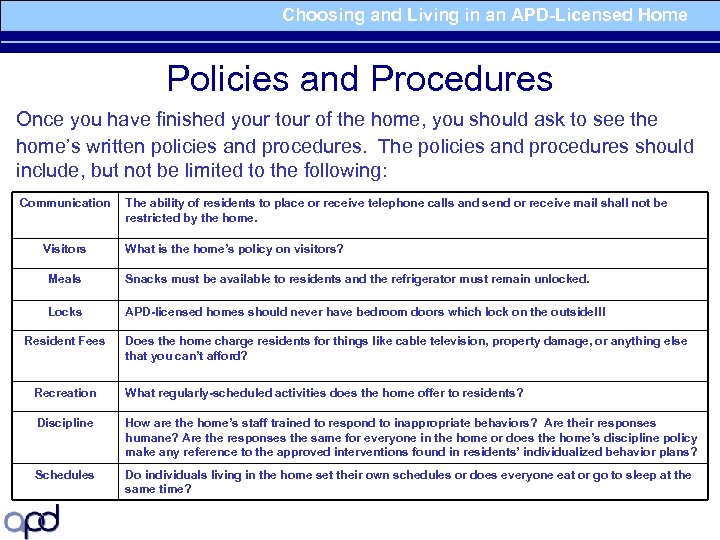 Choosing and Living in an APD-Licensed Home Policies and Procedures Once you have finished your tour of the home, you should ask to see the home’s written policies and procedures. The policies and procedures should include, but not be limited to the following: Communication Visitors The ability of residents to place or receive telephone calls and send or receive mail shall not be restricted by the home. What is the home’s policy on visitors? Meals Snacks must be available to residents and the refrigerator must remain unlocked. Locks APD-licensed homes should never have bedroom doors which lock on the outside!!! Resident Fees Does the home charge residents for things like cable television, property damage, or anything else that you can’t afford? Recreation What regularly-scheduled activities does the home offer to residents? Discipline How are the home’s staff trained to respond to inappropriate behaviors? Are their responses humane? Are the responses the same for everyone in the home or does the home’s discipline policy make any reference to the approved interventions found in residents’ individualized behavior plans? Schedules Do individuals living in the home set their own schedules or does everyone eat or go to sleep at the same time?
 Choosing and Living in an APD-Licensed Home Playing by the “Rules” Most APD-licensed homes have a set of “house rules” which you should definitely find out about before deciding to move into the home. These rules can deal with anything that goes on in the home and can address things like smoking, choosing and changing roommates, mealtimes, community outings, telephone usage, and sexual activity between residents. House rules should always be developed in accordance with the wishes and input of the residents of the home whenever possible. However, if you have a question about any of the rules you see (and whether or not they are ok for the home to have), please contact your support coordinator or local APD office.
 Choosing and Living in an APD-Licensed Home • These are just some of the important policies and procedures that you will want to ask about during your visit to the home. • Make sure you ask about any other things that are important to you. • You should also ask to see the home’s license that is issued by the Agency for Persons with Disabilities. It should have an expiration date that has not yet passed.
 Choosing and Living in an APD-Licensed Home Sweet Home? One of the most important things to look for is whether or not the home has what is called a “home-like” or “family-like” atmosphere. Some good signs you may observe are: • • Generally positive interactions between staff and residents Residents and staff appear to be happy Staff and residents eat together Bedrooms are personalized and reflect the interests/hobbies of the people that live in the home Pictures of residents are displayed in the home Staff and residents take frequent vacations/trips together Staff have been working in the home for a long time and/or seem to know and respond to individual resident needs in an effective manner When the television or music was turned on, the shows or music were chosen by the residents
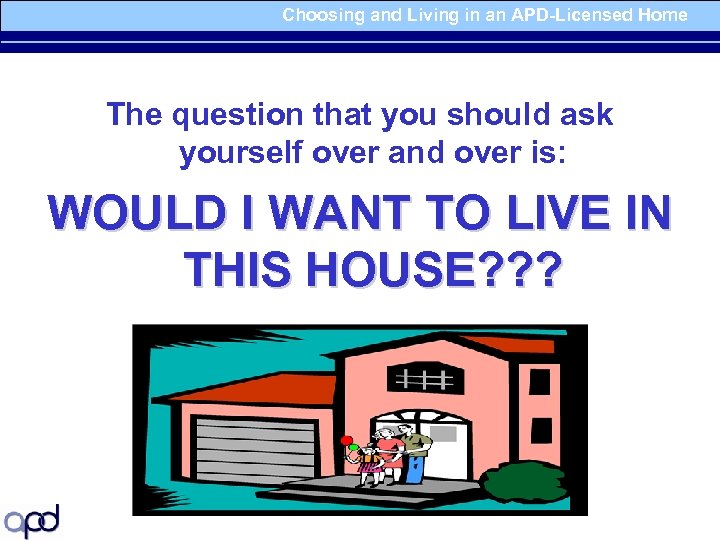 Choosing and Living in an APD-Licensed Home The question that you should ask yourself over and over is: WOULD I WANT TO LIVE IN THIS HOUSE? ? ?
 Choosing and Living in an APD-Licensed Home After the tour… • When your tour of the home is over, remember to thank the staff and/or operators of the home for their time! • Individuals with developmental disabilities may want to schedule a second visit during a meal or even set up a time to spend the night or weekend at the home in the near future as well. • Let the home operators know that you will let them know your decision (through your support coordinator) soon.
 Choosing and Living in an APD-Licensed Home When you narrow your choices down to one or two homes, you should request information about the homes from APD and any other agencies that monitor those homes. For example, the following information is available to the public, upon request, from your local APD office: • Recent monthly monitoring reports and Notices of Noncompliance • Delmarva quality reviews • Any recent administrative complaints or other disciplinary action taken by APD against the home
 Choosing and Living in an APD-Licensed Home Making sure that all services… continue to roll right along! The operators of some homes may provide other Medicaid waiver services such as Adult Day Training or companion services. Keep in mind that APD clients have the right to choose each service provider so, if you already have a provider for those services, you may keep them!
 Choosing and Living in an APD-Licensed Home Moving Day… Moving into a new home is an exciting and stressful time for anyone. However, if you have a developmental disability, it is even more important that services you are already receiving (such as nursing and behavioral services) are in place immediately to prevent any undue stress or disruption in care. A time for the admission should be arranged that is mutually convenient for everyone. The support coordinator should be present at any new admission and should be able to present all of the required documentation to the staff of the home at the time of admission. An admission documentation checklist is typically provided to the home’s operator (to be completed prior to admission and forwarded to APD staff) to make sure the move goes as smoothly as possible.
 Choosing and Living in an APD-Licensed Home Post-Admission Issues of Concern • If you are the parent, guardian or advocate for a person that has been admitted into an APD-licensed home, you are encouraged to visit the home at various times of the day and week to make sure things are going smoothly. • Regular visits will allow you to get to know the staff of the home better and will let those staff know that this person has someone who is willing to advocate on their behalf for quality care and services. Research indicates that individuals with developmental disabilities who have such individuals involved in their lives are less likely to experience abuse, neglect, or exploitation. • After admission, you may become aware of some issue in a home that gives you cause for concern regarding the training, treatment, safety or health of those individuals who live in the home. You should report any concerns to the home’s manager (or your local APD office if you feel more comfortable doing so).
 Choosing and Living in an APD-Licensed Home What should you do about other concerns you may have? For other quality-related concerns, Please talk with the manager of the home. If the issue(s) cannot be fixed to your satisfaction, please contact your local APD office for assistance. You can get the telephone number of your local APD office from your support coordinator or by visiting our website at http: //apd. myflorida. com/ Remember: APD has over 1, 500 licensed homes throughout Florida so there is simply no reason to stay in a home that cannot meet your needs. You have the right to choose where (and with whom) you want to live!