


 Скачать презентацию CHOLANGIOCARCINOMA KLATSKIN TUMOUR TR 84 YRS FEMALE
8ee7c7d13248cc4fa86e61114e343ade.ppt
- Количество слайдов: 24
 CHOLANGIOCARCINOMA (KLATSKIN TUMOUR)
 TR, 84 YRS FEMALE, BGOSTEOARTHRITIS n n n Admitted with painless obstructive jaundice Her symptoms were- jaundice, weight loss, anorexia, RUQ discomfort, heart burn, and changes in stool and urine colour. She was clinically jaundiced with a non tender palpable gallbladder.
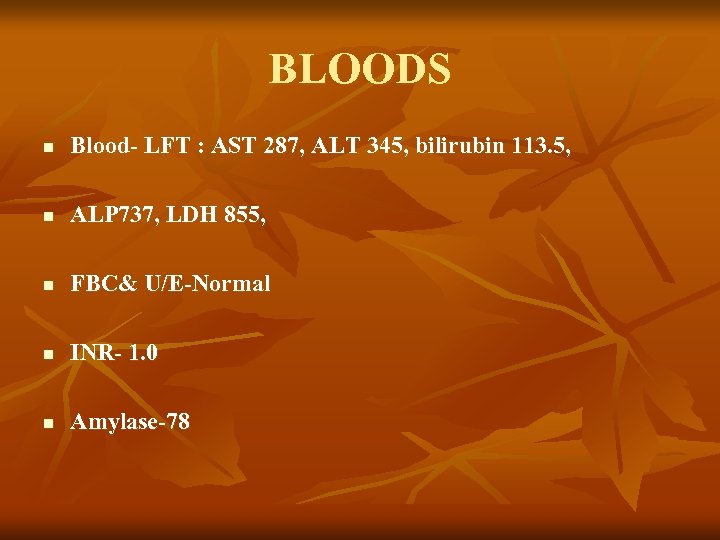 BLOODS n Blood- LFT : AST 287, ALT 345, bilirubin 113. 5, n ALP 737, LDH 855, n FBC& U/E-Normal n INR- 1. 0 n Amylase-78
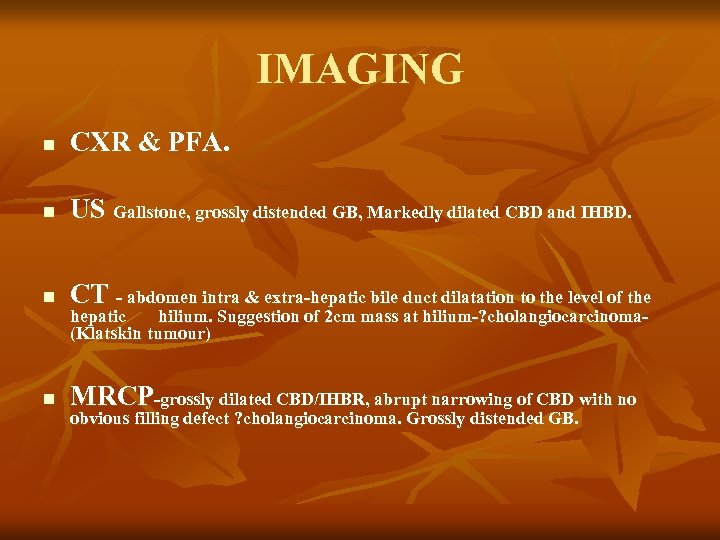 IMAGING n CXR & PFA. n US Gallstone, grossly distended GB, Markedly dilated CBD and IHBD. n CT - abdomen intra & extra-hepatic bile duct dilatation to the level of the n MRCP-grossly dilated CBD/IHBR, abrupt narrowing of CBD with no hepatic hilium. Suggestion of 2 cm mass at hilium-? cholangiocarcinoma(Klatskin tumour) obvious filling defect ? cholangiocarcinoma. Grossly distended GB.
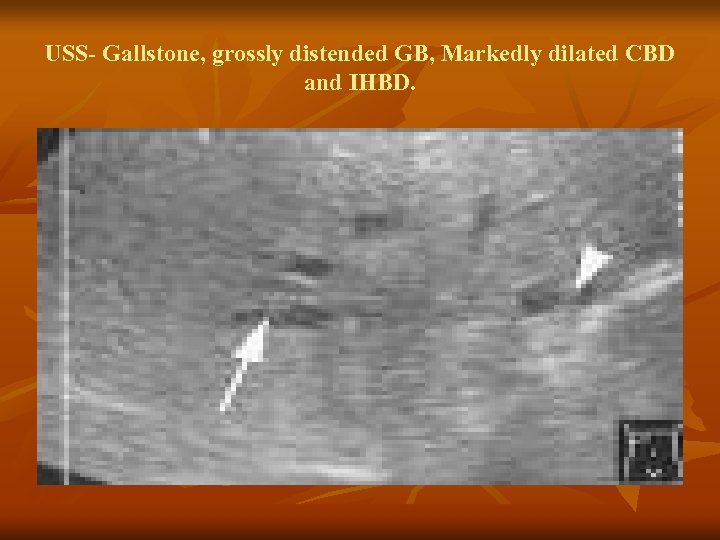 USS- Gallstone, grossly distended GB, Markedly dilated CBD and IHBD.
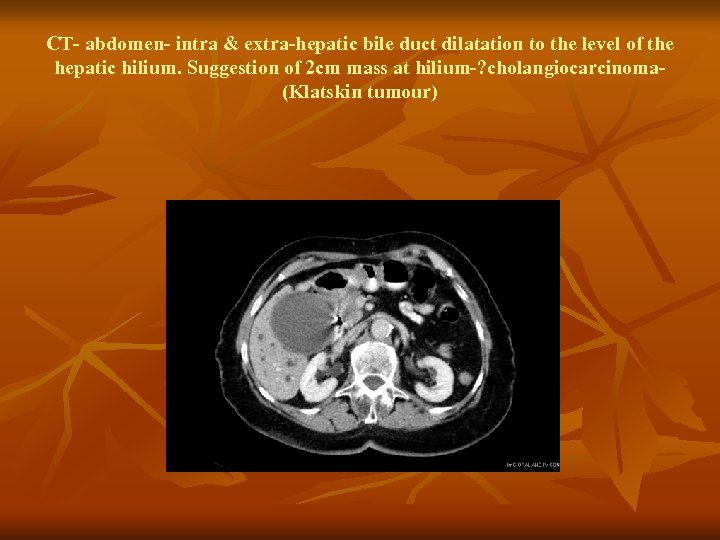 CT- abdomen- intra & extra-hepatic bile duct dilatation to the level of the hepatic hilium. Suggestion of 2 cm mass at hilium-? cholangiocarcinoma(Klatskin tumour)
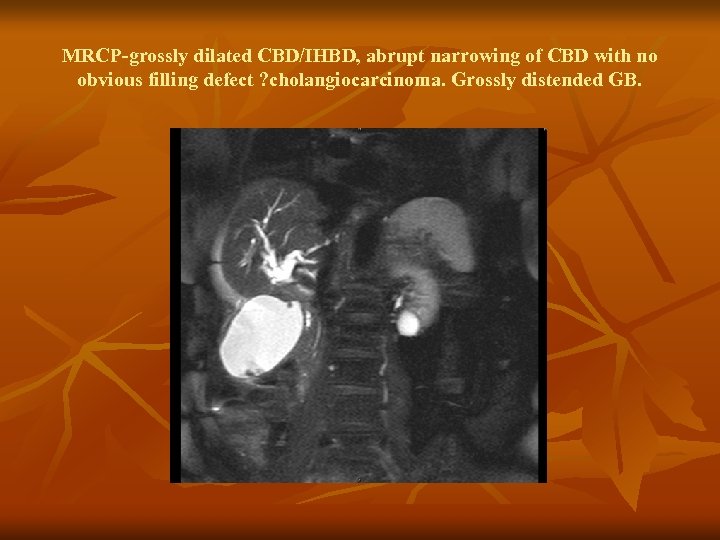 MRCP-grossly dilated CBD/IHBD, abrupt narrowing of CBD with no obvious filling defect ? cholangiocarcinoma. Grossly distended GB.
 ENDOSCOPIC RETROGRADE CHOLANGIOPANCREATOGRAPHY(ERCP). Performed twice- unsuccessful on both occassions.
 PERCUTANEOUS TRANSHEPATIC CHOLANGIOGRAPHY (PTC) n PTC was successfully performed with the placement of a metal stent with good resultbiliary decompression and relieve of her obstructive symptoms.
 KLATSKIN TUMOUR (KT) n n n BG- Bile duct tumours recognized for over a century. Musser first reported 18 cases of primary extrahepatic biliary cancer. Sako and colleagues found 570 cases while reviewing literature from 1935 -1954. Malignancy of the intrahepatic bile duct was described later by Altmeir (1957). Gerald Klatskin described cancer of the hepatic duct bifurcation in 1965 following a review of 13 cases. KT tumours are generally small, sharply localized and seldom metastasizing.
 Epidemiology n n n Tumours of bile duct are rare-2% of all cancers found at autopsy. Malignant tumours more common than benign adenomas and papillomas. Cholangiocarcinoma most common malignancy of bile ducts, >50%Holland et at… 2007. More common in Israel, Japan and American indians Annual incidence of bile duct Ca in USA is 1/100, 000 people. Autopsy studies show and incidence of 0. 01 -0. 46%. 4, 000 new cases reported annually in USA. England Wales - 2. 8/100, 000 females & 2/100, 000 males.
 ETIOLOGY n Risk factors for bile duct cancer include: n Ulcerative colitis n Primary sclerosing cholangitis-10 -30% n n Parasitic infestations: Liver fluke common in Far Eastintrahepatic CC accounts for 20% of primary liver tumour. Opisthorchis viverrini-found in. Thailand, and West Malaysia.
 ETIOLOGY n n n Toxic chemicals-thorium dioxide (thorotrast), radionuclides, carcinogens-arsenic, nitrosamines Congenital fibrosis or cysts-cogenital hepatic fibrosis, cystic dilatation, choledochal cyst, polycystic liver Drugs: methyldopa, isoniazide, OCP. Gallstones and hepatolithiasis-decrease incidence >10 years post cholecystectomy. Biliary cirrhosis and typhoid carriers.
 PATHOPHYSIOLOGY n Bile duct tumours cause bile duct obstruction - biliary stasis and alteration of liver function tests n Prolonged obstruction then leads to- n Hepatocellular dysfunction, renal dysfunction n Progressive malnutrition, Pruritus, coagulopathy n Cholangitis- esp if previous endoscopic, percutaneous or surgical biliary interventions have been performed.
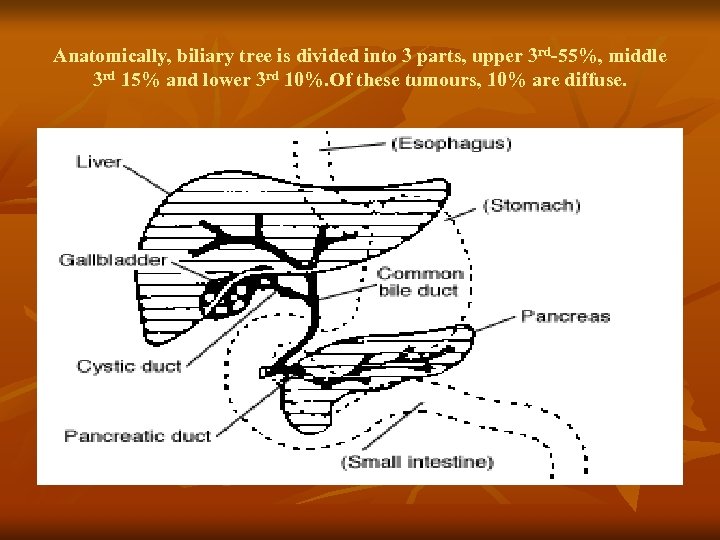 Anatomically, biliary tree is divided into 3 parts, upper 3 rd-55%, middle 3 rd 15% and lower 3 rd 10%. Of these tumours, 10% are diffuse.
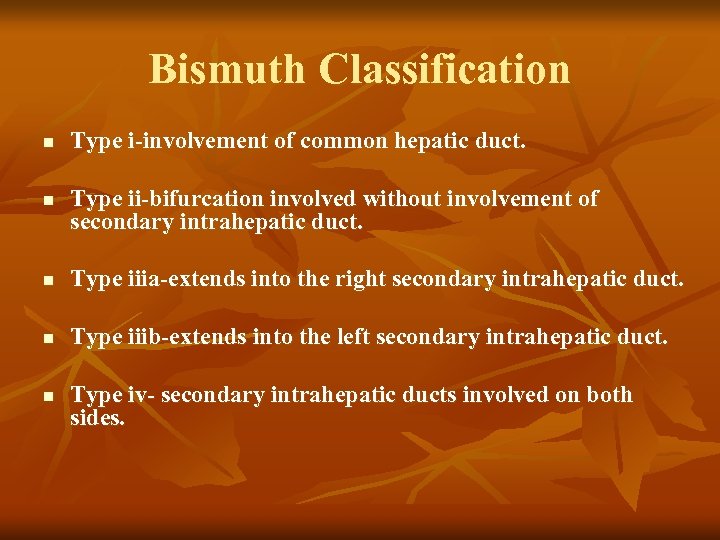 Bismuth Classification n n Type i-involvement of common hepatic duct. Type ii-bifurcation involved without involvement of secondary intrahepatic duct. n Type iiia-extends into the right secondary intrahepatic duct. n Type iiib-extends into the left secondary intrahepatic duct. n Type iv- secondary intrahepatic ducts involved on both sides.
 PRESENTATION n CC seen in advanced unresectable stage n Early diagnosis unusual n n Typically elderly- average 60 -65 years though Klatskin slightly younger age group Abnormal LFTs / Jaundice-90% Abdominal pain / Weight loss- in (30 -50%) of cases -Patel et al 2006 Pruritus seen in 66% of patients
 PRESENTATION n n Fever- 20% Diarrhoea, anorexia, changes in urine & stool colour and weight loss. n Liver may be enlarged and smooth-25 -40% n Distended and non tender gallbladder 10% n Epigastric tenderness.
 DIAGNOSIS n n History / physical examination Labouratory-CEA and CA 19. 9 –sensitivity of 66% and a specificity of 100% in diagnosing CC in pt with PSC. Imaging-tumours are generally small-USS/ CT may fail to show the lesion. Cholangiography via a transhepatic or endoscopic approach reqired to define biliary anatomy and extent of the lesion.
 DIAGNOSIS n n Cholangiographic appearance of Klatskin tumour is characteristic. PTC preferred over ERCP for demonstrating ductal anatomy-PTC-almost 100% sensitivity & specificity. MRCP non-invasive and now more available. Histology –a well defferentiated adenocarcinoma-short annular constricting lesion 75%, diffusely infiltrating with long strictures 15%& intraluminal polypoid mass-3 -5%
 TREATMENT n n n Management challenging with relatively poor prognosis. Surgery continues to be the mainstay of therapy with 5 year survival of 10 -40%. Complete resection with negative histologic margins –long term survival. Yang WL et at. . 2007 reported in a study of 185 cases (1972 -2006) a median survival of 37 months following radical resection, 17 months for palliative resection and death within 1. 5 years if no resection. Hepatic resection- a critical component of operative approach.
 TREATMENT n n n Adjuvant chemoradiotherapy-no benefit. Liver transplant for unresectable tumour remains controversial, tumour recurrence >90%. Advances in interventional Radiology and endoscopyfacilitate non surgical option. Benefit of external beam radiotherapy for palliation of proximal CC uncertain. Photodynamic therapy a new palliative treatment modality for failed stent. Thomas Zoepf et al concluded in a series in 2008 -offers similar survival time as incomplete resection.
 CONCLUSION n n n Klatskin tumour is tumour of bile duct bifurcation. Diagnosis can be quite challenging as presentation is in an advanced stage with nonspecific symptoms. Surgery offers the only hope of cure.
 n THANK YOU!