


 Скачать презентацию Chinese Investment in Europe and European Investment in
1c39496b82d9d67b7e1365c21b449f43.ppt
- Количество слайдов: 49
 Chinese Investment in Europe and European Investment in China: Trends, Risks and Opportunities Prof. Ivana Casaburi Director, ESADE China Europe Club, ESADEgeo Associate Professor, Department of Marketing Management, ESADE Business School 1
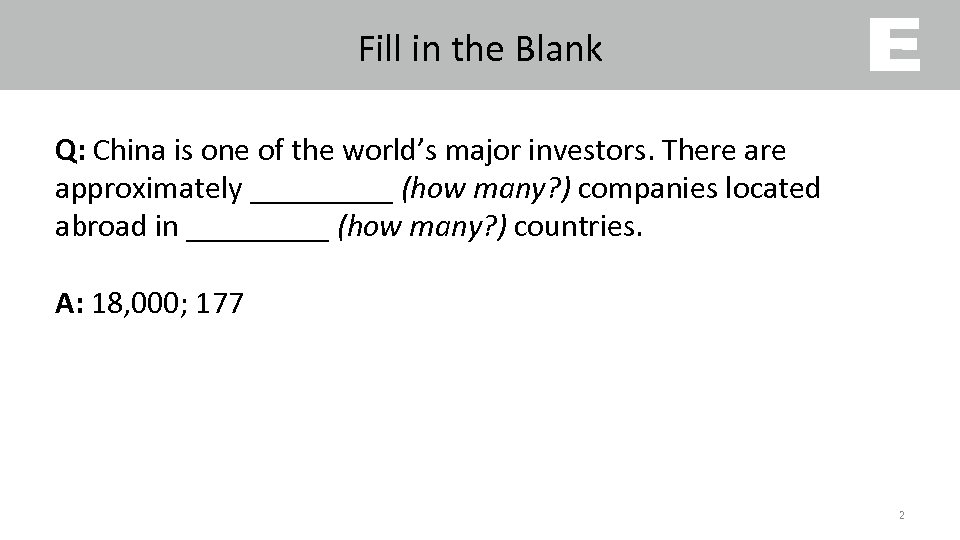 Fill in the Blank Q: China is one of the world’s major investors. There approximately _____ (how many? ) companies located abroad in _____ (how many? ) countries. A: 18, 000; 177 2
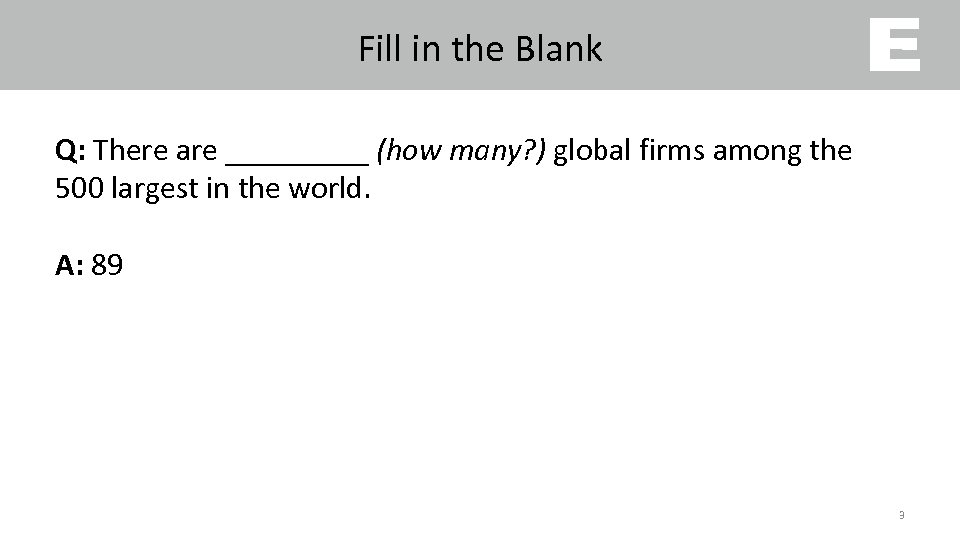 Fill in the Blank Q: There are _____ (how many? ) global firms among the 500 largest in the world. A: 89 3
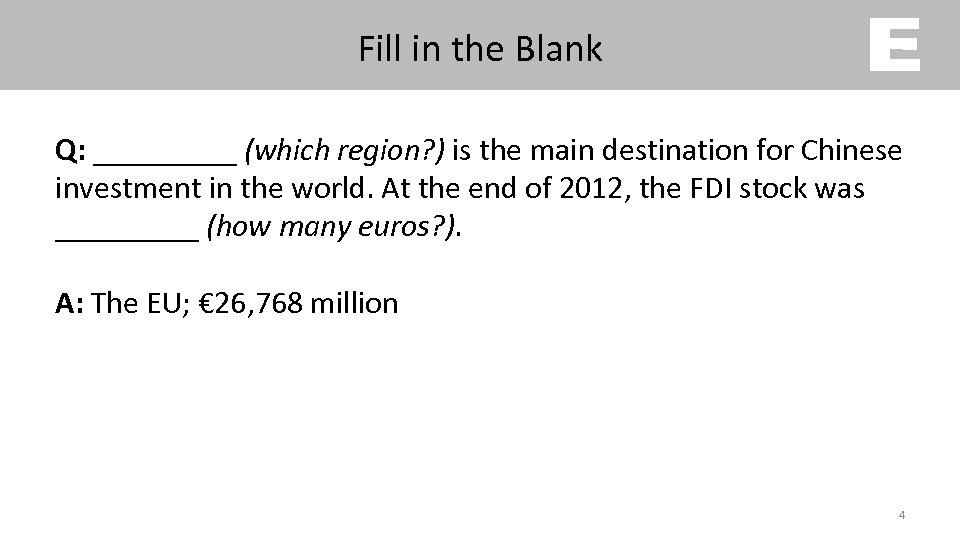 Fill in the Blank Q: _____ (which region? ) is the main destination for Chinese investment in the world. At the end of 2012, the FDI stock was _____ (how many euros? ). A: The EU; € 26, 768 million 4
 Fill in the Blank Q: _____ (what percentage? ) of Chinese FDI in Europe is concentrated in six countries. The six countries are: _____ (which countries? ). A: 73. 3%; Luxembourg, France, the UK, Germany, Sweden, and the Netherlands 5
 Lesson Road Map 1. The internationalization of Chinese companies and their presence in Europe • • China’s position in the world & its current economic strategy Chinese companies in the world Chinese companies in Europe General characteristics of Chinese investment 2. The renewed allure of China for European firms • The arrival of European firms into China • New difficulties for European firms in China • Business opportunities for European firms in China’s new economic climate 6
 1. THE INTERNATIONALIZATION OF CHINESE COMPANIES AND THEIR PRESENCE IN EUROPE 7
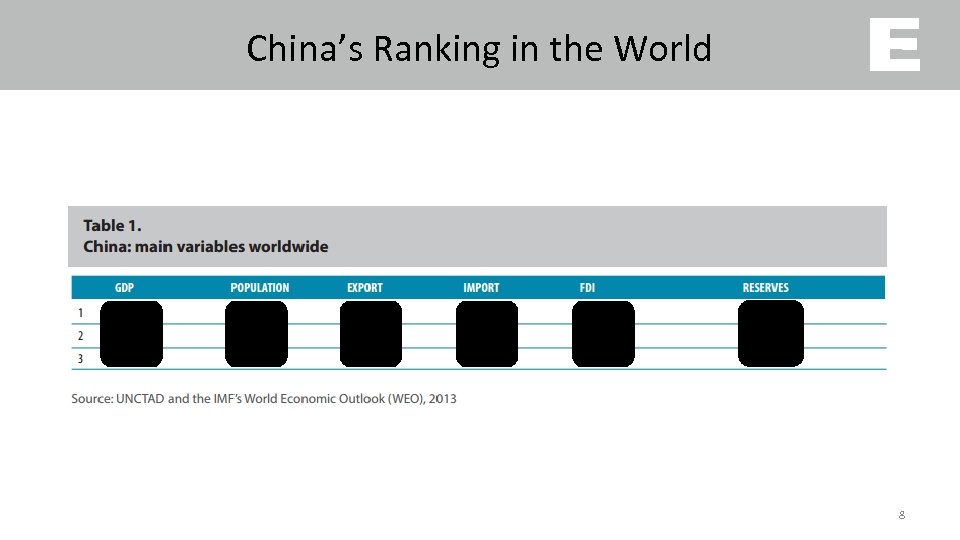 China’s Ranking in the World 8
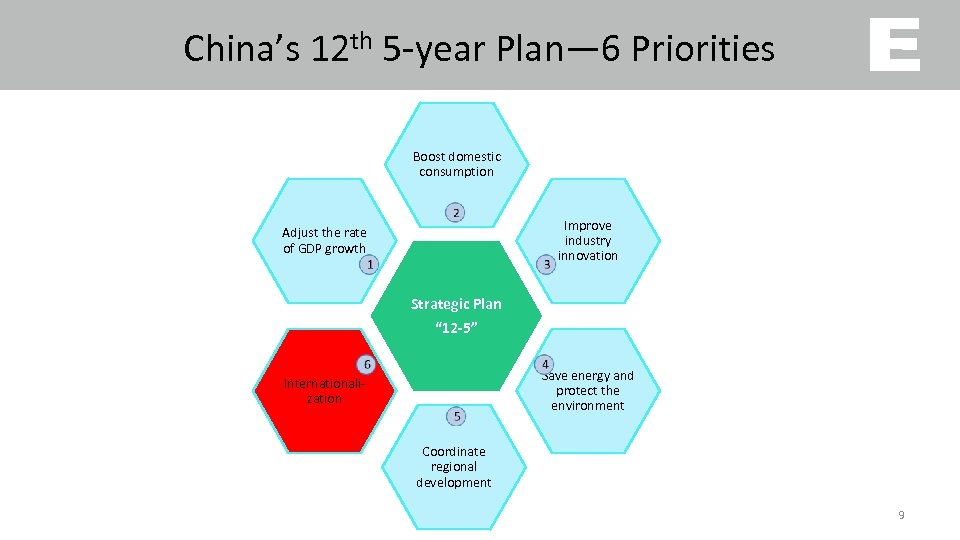 China’s 12 th 5 -year Plan— 6 Priorities Boost domestic consumption Improve industry innovation Adjust the rate of GDP growth Strategic Plan “ 12 -5” Save energy and protect the environment Internationalization Coordinate regional development 9
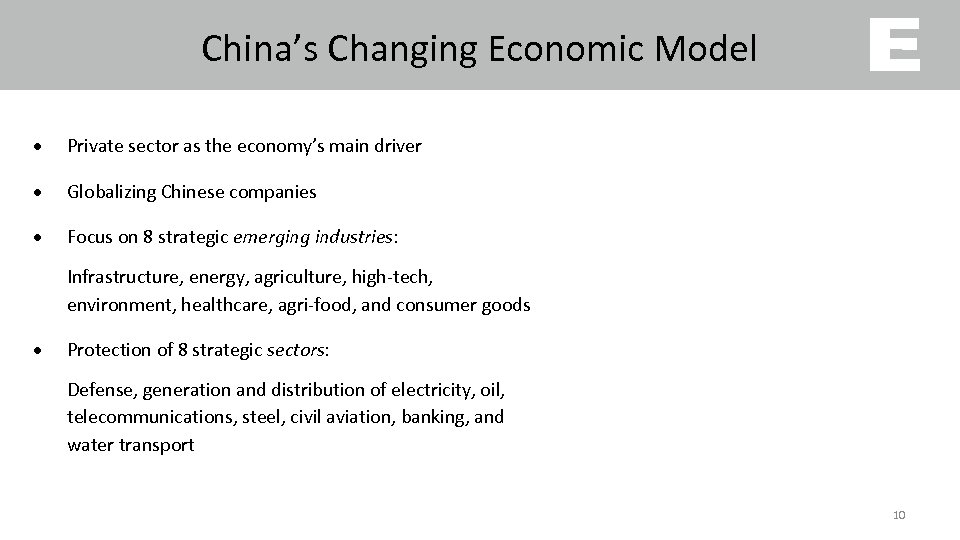 China’s Changing Economic Model Private sector as the economy’s main driver Globalizing Chinese companies Focus on 8 strategic emerging industries: Infrastructure, energy, agriculture, high-tech, environment, healthcare, agri-food, and consumer goods Protection of 8 strategic sectors: Defense, generation and distribution of electricity, oil, telecommunications, steel, civil aviation, banking, and water transport 10
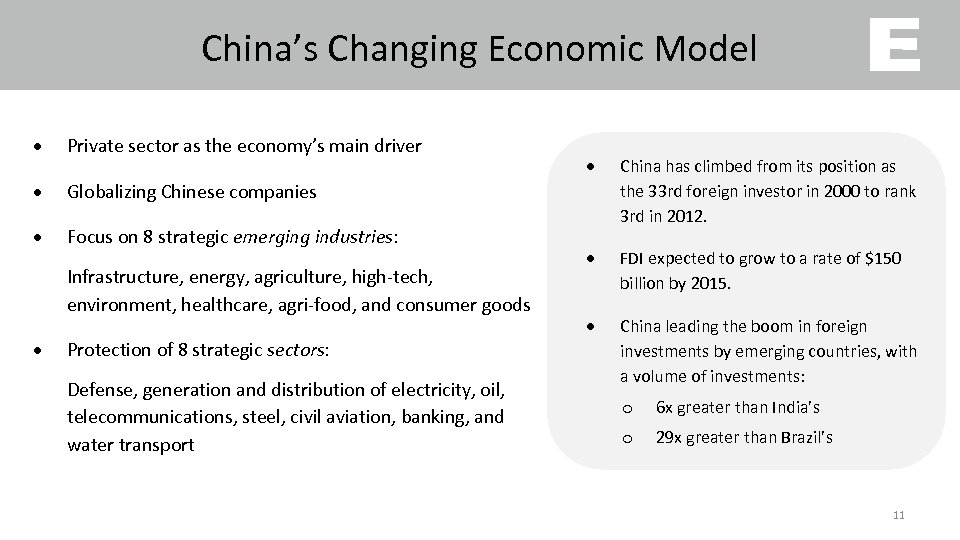 China’s Changing Economic Model Private sector as the economy’s main driver Globalizing Chinese companies Focus on 8 strategic emerging industries: Infrastructure, energy, agriculture, high-tech, environment, healthcare, agri-food, and consumer goods Protection of 8 strategic sectors: Defense, generation and distribution of electricity, oil, telecommunications, steel, civil aviation, banking, and water transport China has climbed from its position as the 33 rd foreign investor in 2000 to rank 3 rd in 2012. FDI expected to grow to a rate of $150 billion by 2015. China leading the boom in foreign investments by emerging countries, with a volume of investments: o 6 x greater than India’s o 29 x greater than Brazil’s 11
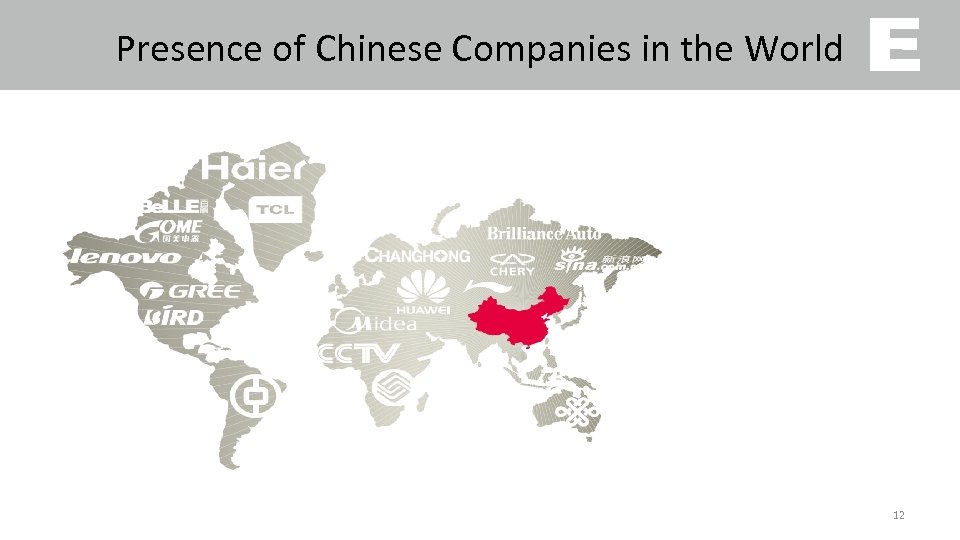 Presence of Chinese Companies in the World 12
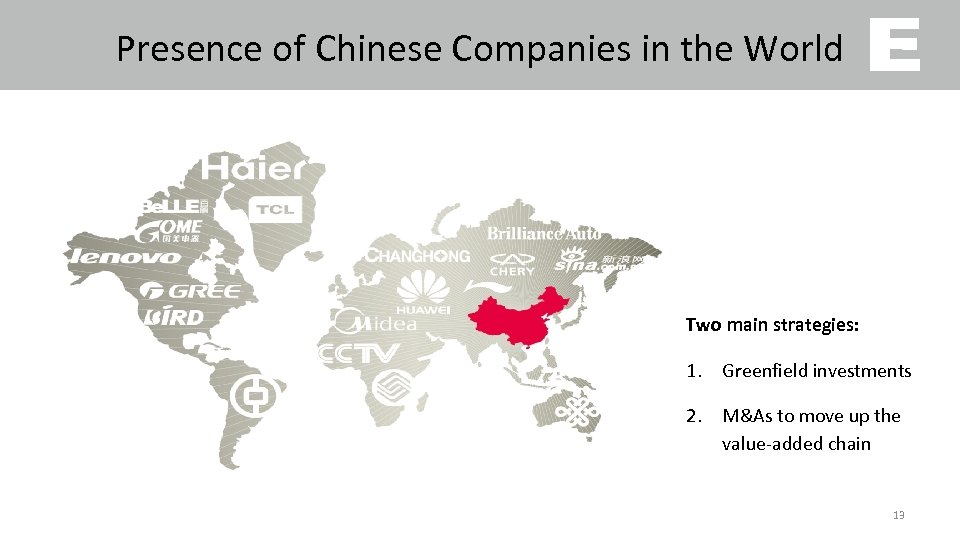 Presence of Chinese Companies in the World Two main strategies: 1. Greenfield investments 2. M&As to move up the value-added chain 13
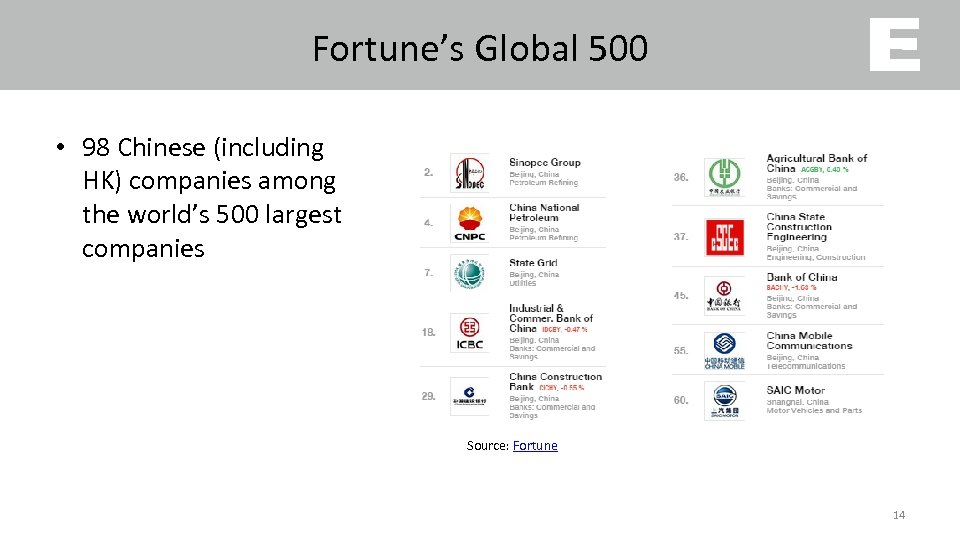 Fortune’s Global 500 • 98 Chinese (including HK) companies among the world’s 500 largest companies Source: Fortune 14
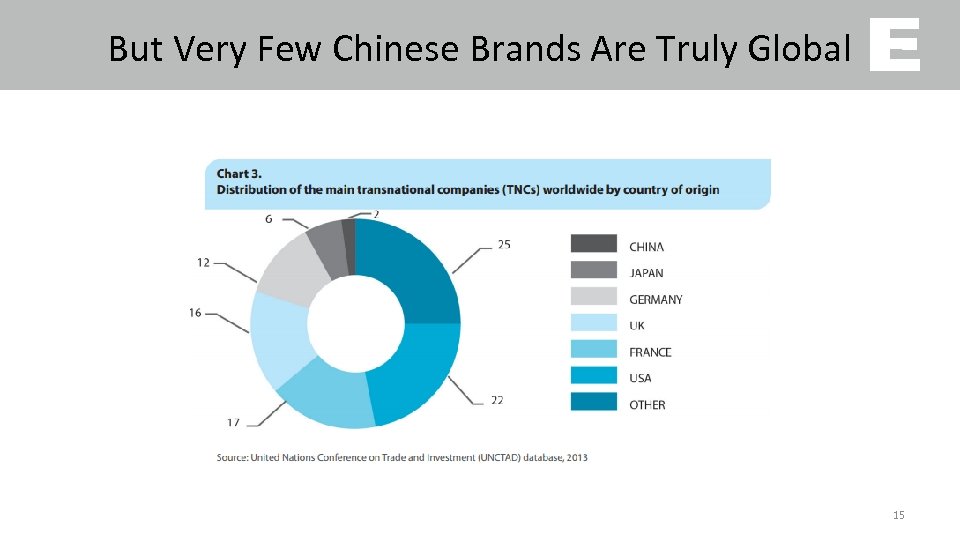 But Very Few Chinese Brands Are Truly Global 15
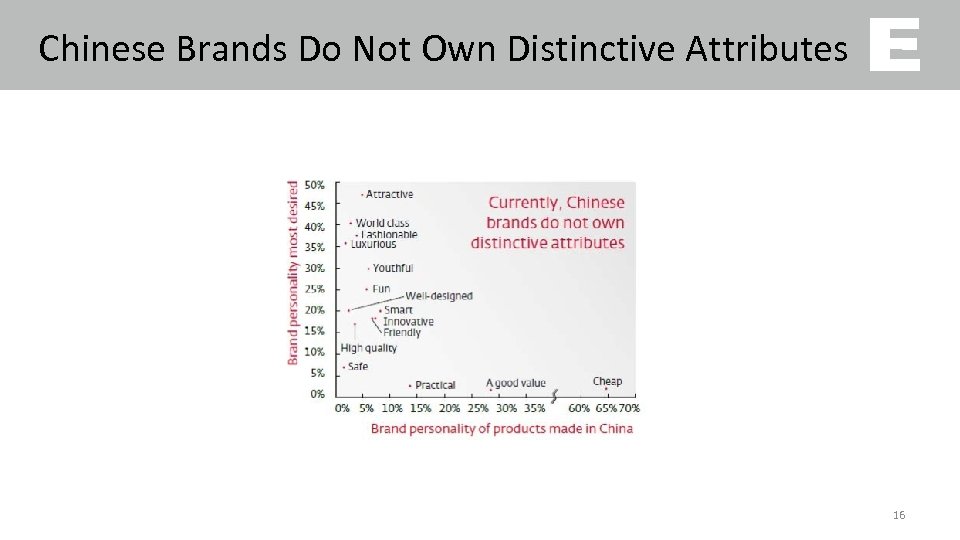 Chinese Brands Do Not Own Distinctive Attributes 16
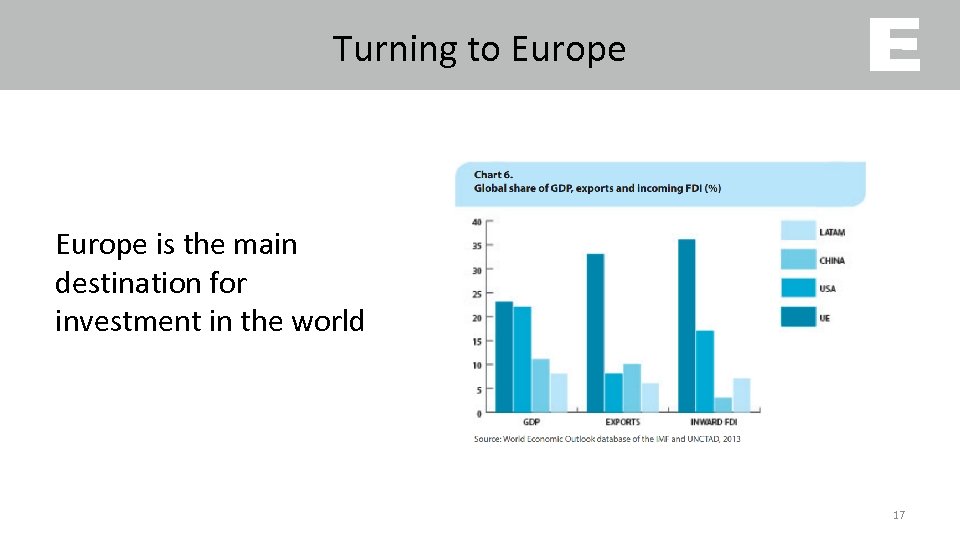 Turning to Europe is the main destination for investment in the world 17
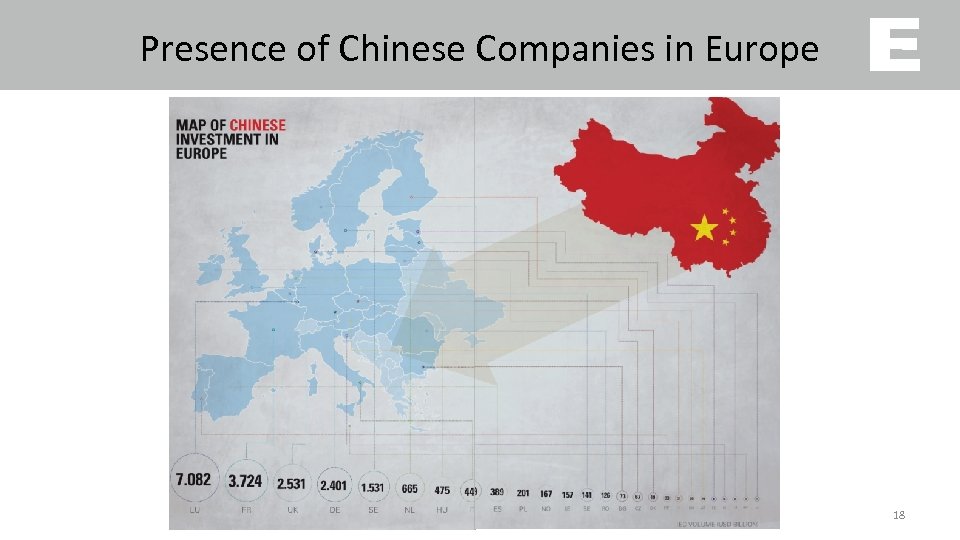 Presence of Chinese Companies in Europe 18
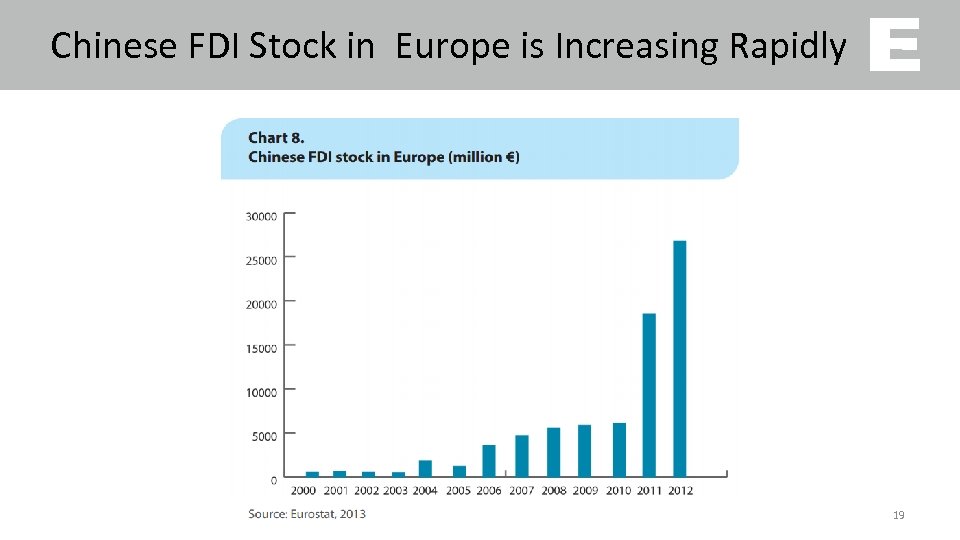 Chinese FDI Stock in Europe is Increasing Rapidly 19
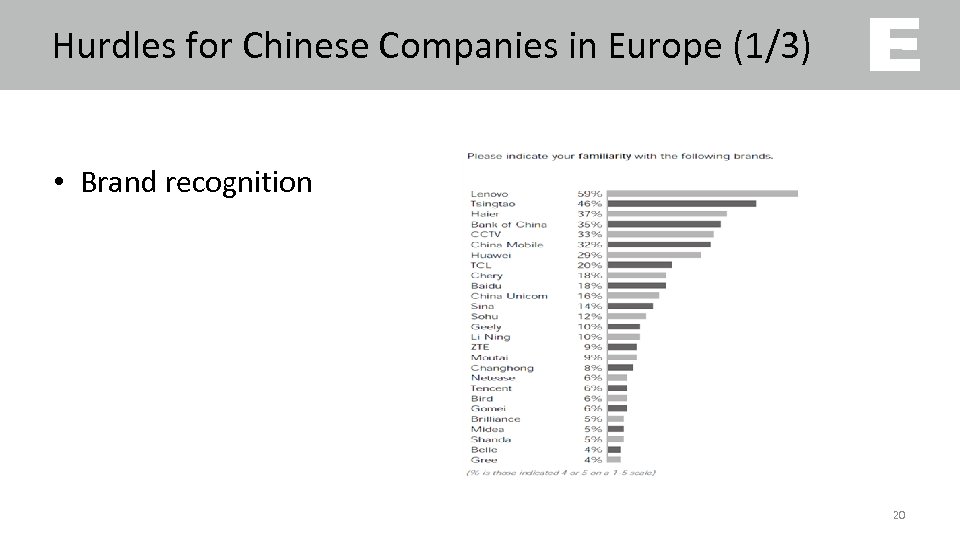 Hurdles for Chinese Companies in Europe (1/3) • Brand recognition 20
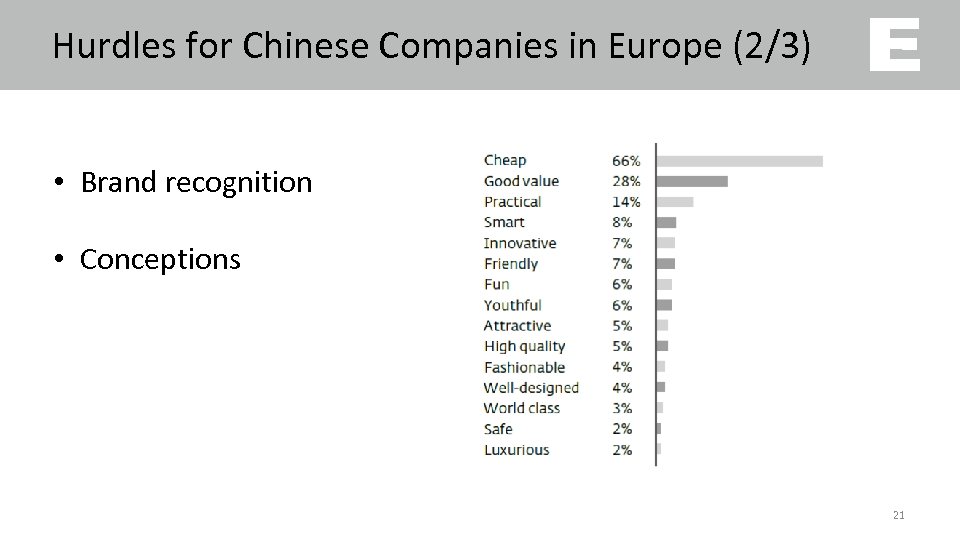 Hurdles for Chinese Companies in Europe (2/3) • Brand recognition • Conceptions 21
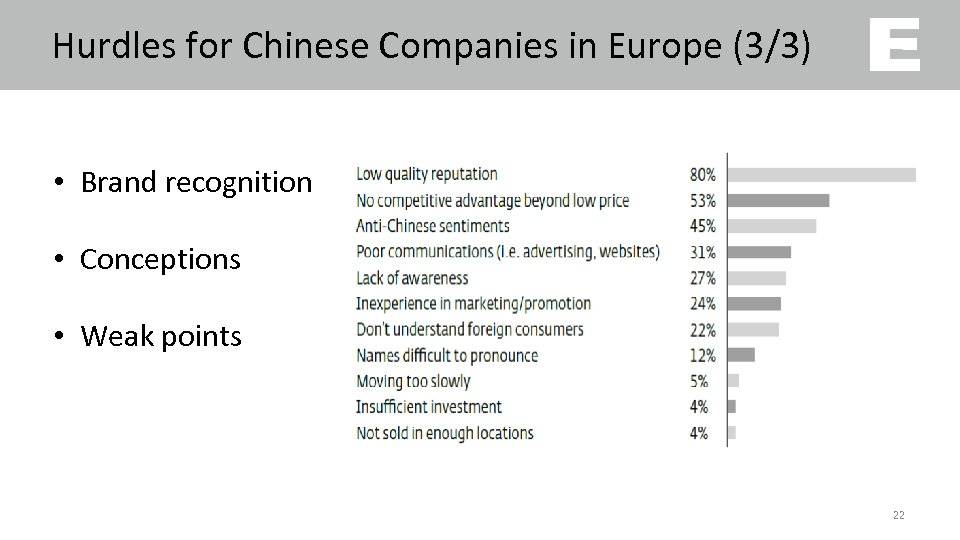 Hurdles for Chinese Companies in Europe (3/3) • Brand recognition • Conceptions • Weak points 22
 Characteristics of Chinese Investment Abroad 1) What are the characteristics of Chinese companies that invest abroad? 2) Why are Chinese companies investing abroad? 3) Where do Chinese companies want to sell? 4) Where are Chinese companies investing? 5) What are the challenges and opportunities for Chinese companies that internationalize? 23
 1) What Are The Characteristics of Chinese Companies That Invest Abroad? 24
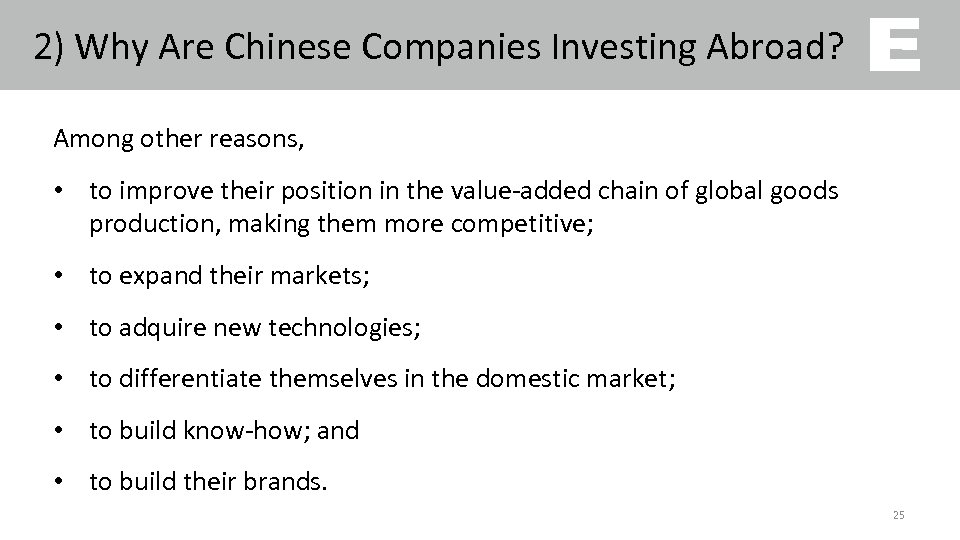 2) Why Are Chinese Companies Investing Abroad? Among other reasons, • to improve their position in the value-added chain of global goods production, making them more competitive; • to expand their markets; • to adquire new technologies; • to differentiate themselves in the domestic market; • to build know-how; and • to build their brands. 25
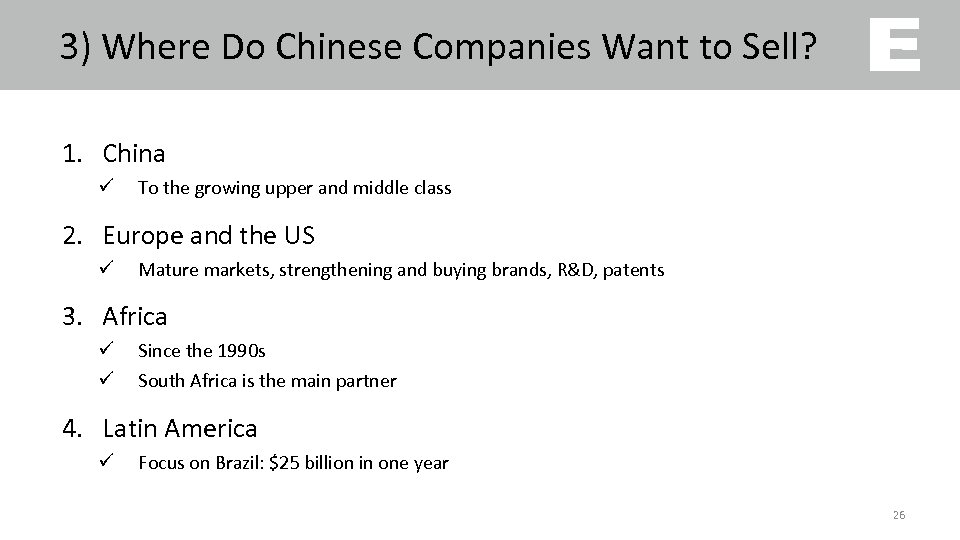 3) Where Do Chinese Companies Want to Sell? 1. China ü To the growing upper and middle class 2. Europe and the US ü Mature markets, strengthening and buying brands, R&D, patents 3. Africa ü ü Since the 1990 s South Africa is the main partner 4. Latin America ü Focus on Brazil: $25 billion in one year 26
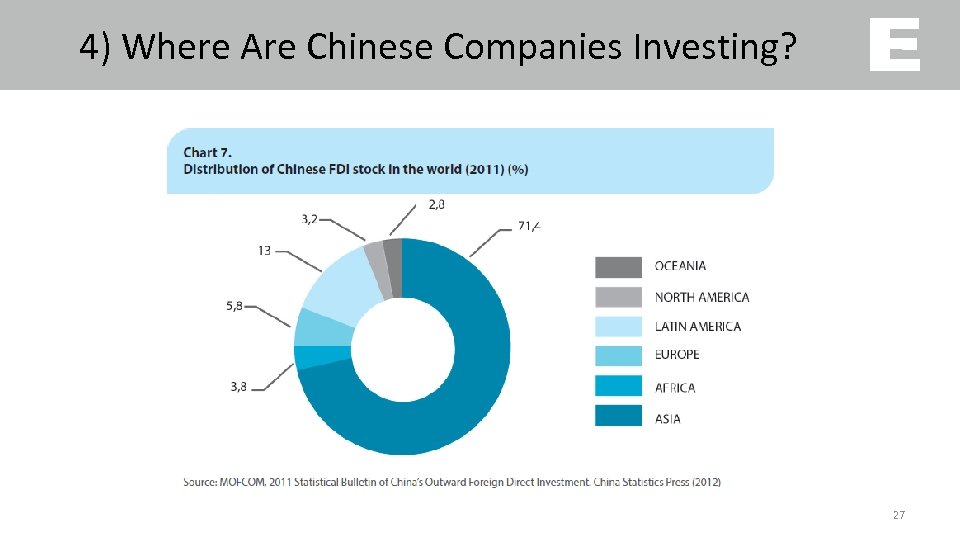 4) Where Are Chinese Companies Investing? 27
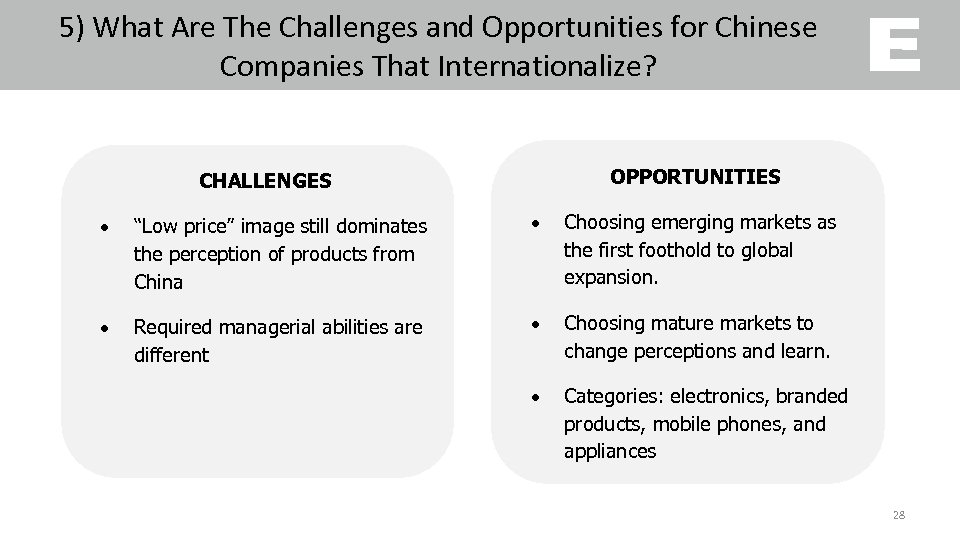 5) What Are The Challenges and Opportunities for Chinese Companies That Internationalize? OPPORTUNITIES CHALLENGES “Low price” image still dominates the perception of products from China Choosing emerging markets as the first foothold to global expansion. Required managerial abilities are different Choosing mature markets to change perceptions and learn. Categories: electronics, branded products, mobile phones, and appliances 28
 2. THE RENEWED ALLURE OF CHINA FOR EUROPEAN FIRMS 29
 European Investment in China: Some Facts and Figures Mao Deng Xiaoping Accumulated European FDI in China now: € 118 billion 30
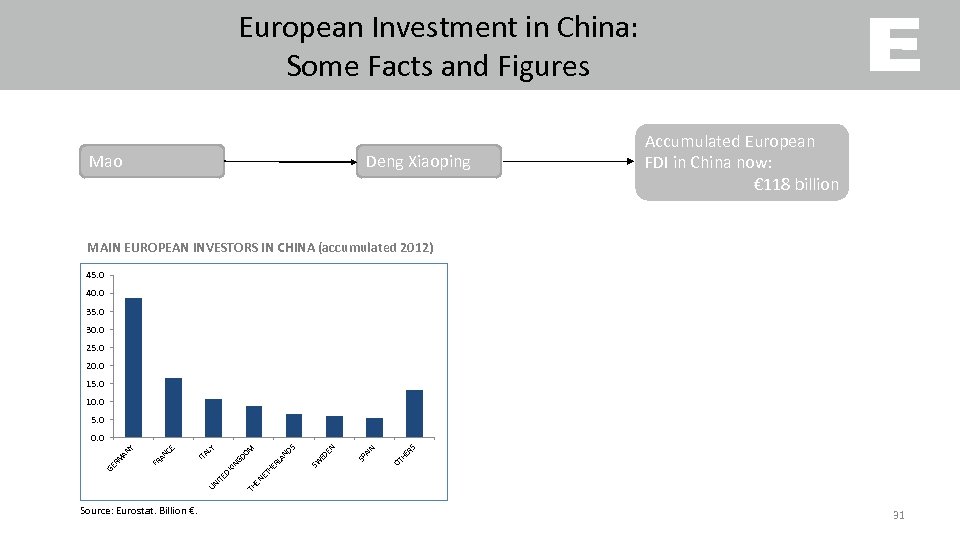 European Investment in China: Some Facts and Figures Mao Deng Xiaoping Accumulated European FDI in China now: € 118 billion MAIN EUROPEAN INVESTORS IN CHINA (accumulated 2012) 45. 0 40. 0 35. 0 30. 0 25. 0 20. 0 15. 0 10. 0 5. 0 OT HE RS N AI SP EN ED SW ND LA ER TH E NE TH KI ED IT UN Source: Eurostat. Billion €. S DO M NG IT AL Y E NC FR A GE RM AN Y 0. 0 31
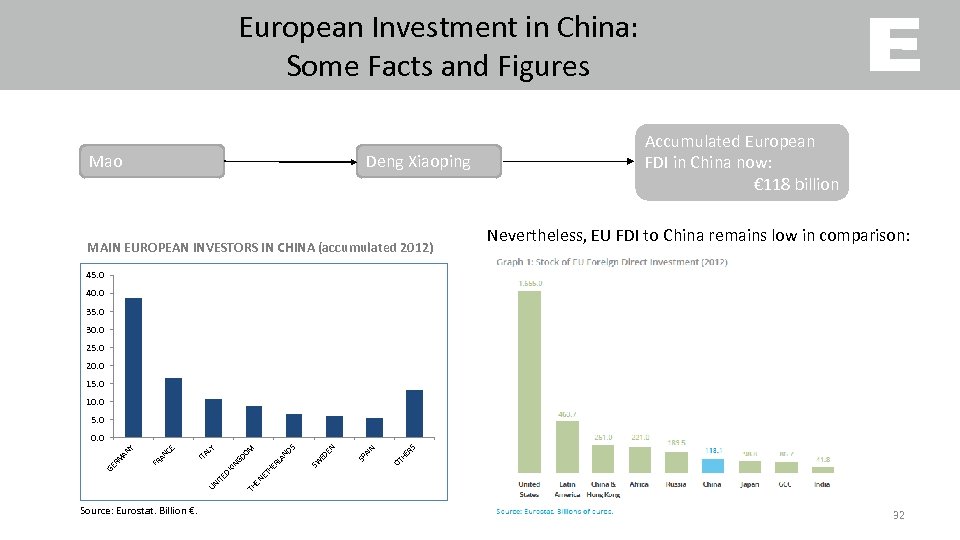 European Investment in China: Some Facts and Figures Mao Deng Xiaoping MAIN EUROPEAN INVESTORS IN CHINA (accumulated 2012) Accumulated European FDI in China now: € 118 billion Nevertheless, EU FDI to China remains low in comparison: 45. 0 40. 0 35. 0 30. 0 25. 0 20. 0 15. 0 10. 0 5. 0 OT HE RS N AI SP EN ED SW ND LA ER TH E NE TH KI ED IT UN Source: Eurostat. Billion €. S DO M NG IT AL Y E NC FR A GE RM AN Y 0. 0 32
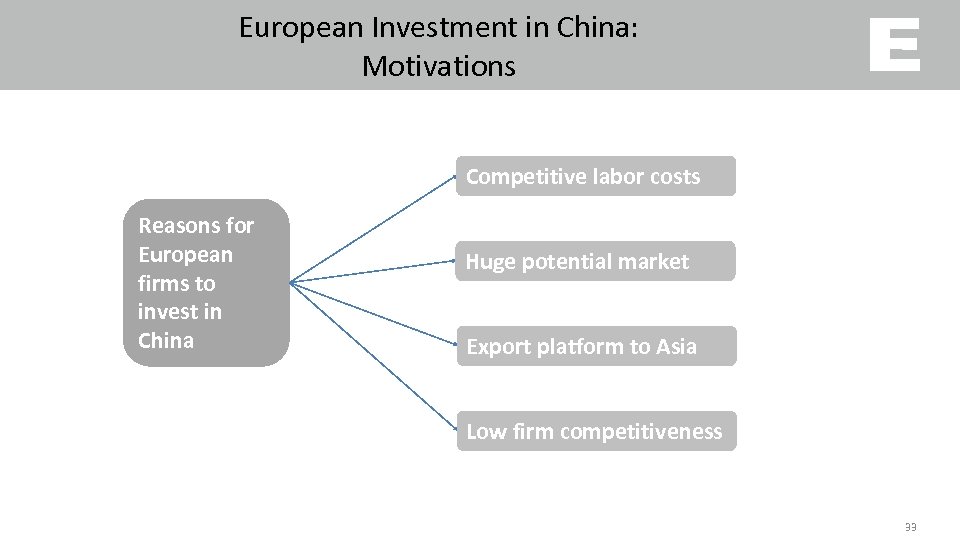 European Investment in China: Motivations Competitive labor costs Reasons for European firms to invest in China Huge potential market Export platform to Asia Low firm competitiveness 33
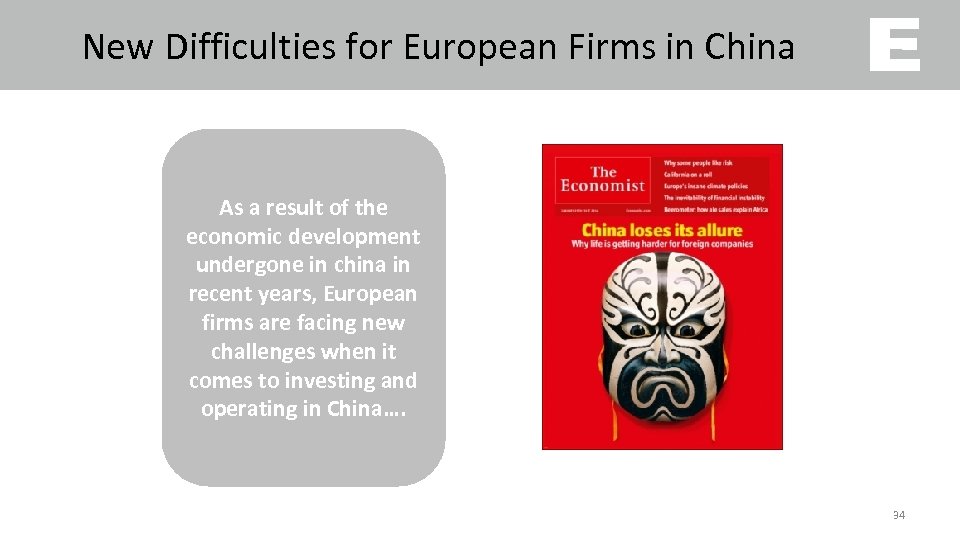 New Difficulties for European Firms in China As a result of the economic development undergone in china in recent years, European firms are facing new challenges when it comes to investing and operating in China…. 34
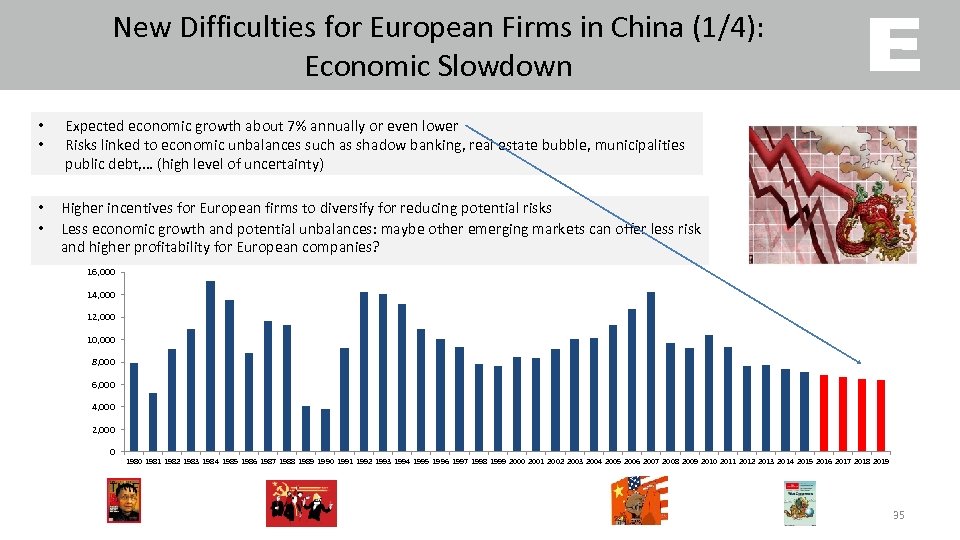 New Difficulties for European Firms in China (1/4): Economic Slowdown • • Expected economic growth about 7% annually or even lower Risks linked to economic unbalances such as shadow banking, real estate bubble, municipalities public debt, … (high level of uncertainty) • • Higher incentives for European firms to diversify for reducing potential risks Less economic growth and potential unbalances: maybe other emerging markets can offer less risk and higher profitability for European companies? 16, 000 14, 000 12, 000 10, 000 8, 000 6, 000 4, 000 2, 000 0 1981 1982 1983 1984 1985 1986 1987 1988 1989 1990 1991 1992 1993 1994 1995 1996 1997 1998 1999 2000 2001 2002 2003 2004 2005 2006 2007 2008 2009 2010 2011 2012 2013 2014 2015 2016 2017 2018 2019 35
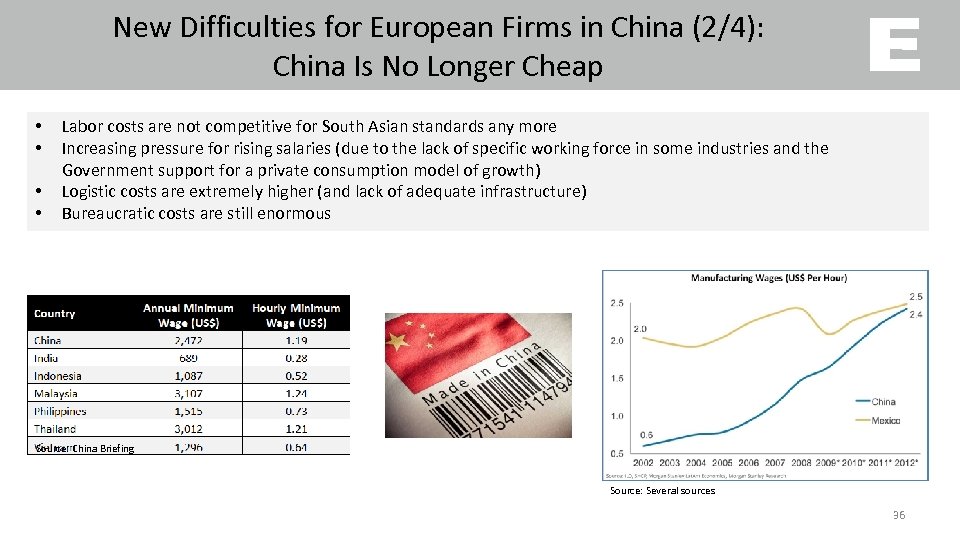 New Difficulties for European Firms in China (2/4): China Is No Longer Cheap • • Labor costs are not competitive for South Asian standards any more Increasing pressure for rising salaries (due to the lack of specific working force in some industries and the Government support for a private consumption model of growth) Logistic costs are extremely higher (and lack of adequate infrastructure) Bureaucratic costs are still enormous Source: China Briefing Source: Several sources 36
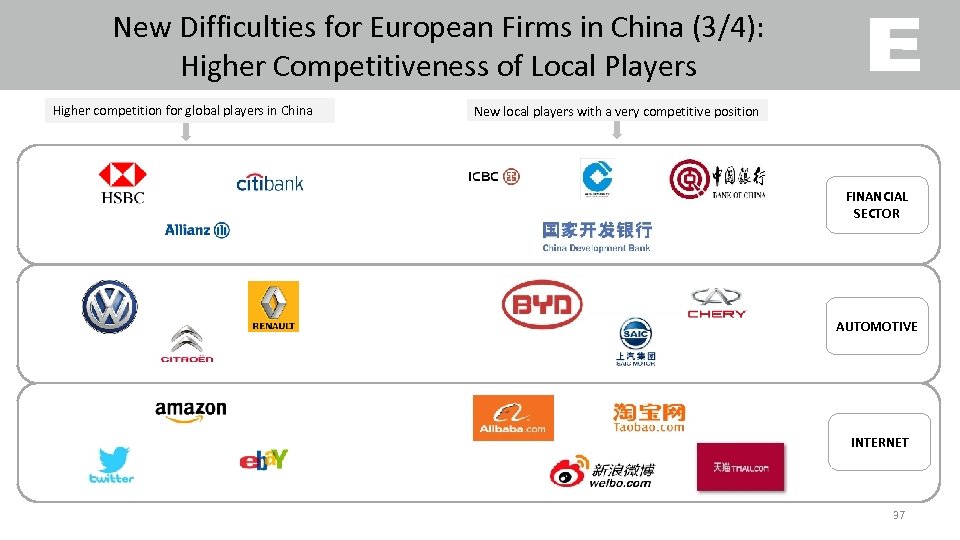 New Difficulties for European Firms in China (3/4): Higher Competitiveness of Local Players Higher competition for global players in China New local players with a very competitive position FINANCIAL SECTOR AUTOMOTIVE INTERNET 37
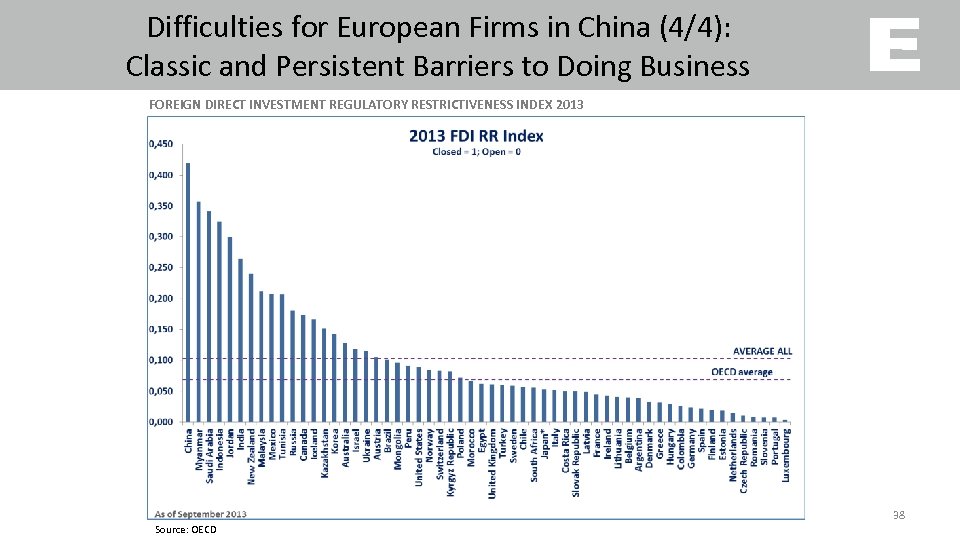 Difficulties for European Firms in China (4/4): Classic and Persistent Barriers to Doing Business FOREIGN DIRECT INVESTMENT REGULATORY RESTRICTIVENESS INDEX 2013 38 Source: OECD
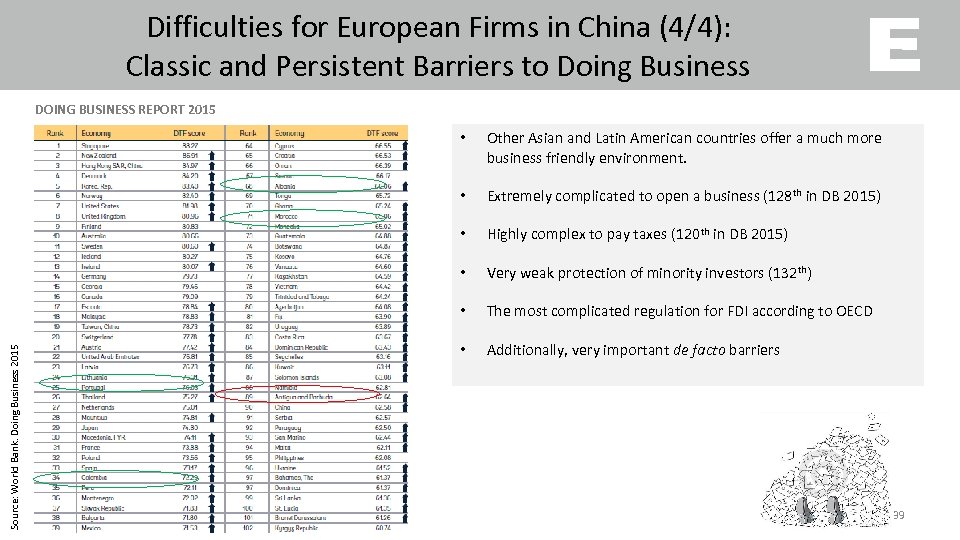 Difficulties for European Firms in China (4/4): Classic and Persistent Barriers to Doing Business DOING BUSINESS REPORT 2015 Other Asian and Latin American countries offer a much more business friendly environment. • Extremely complicated to open a business (128 th in DB 2015) • Highly complex to pay taxes (120 th in DB 2015) • Very weak protection of minority investors (132 th) • Source: World Bank. Doing Business 2015 • The most complicated regulation for FDI according to OECD • Additionally, very important de facto barriers 39
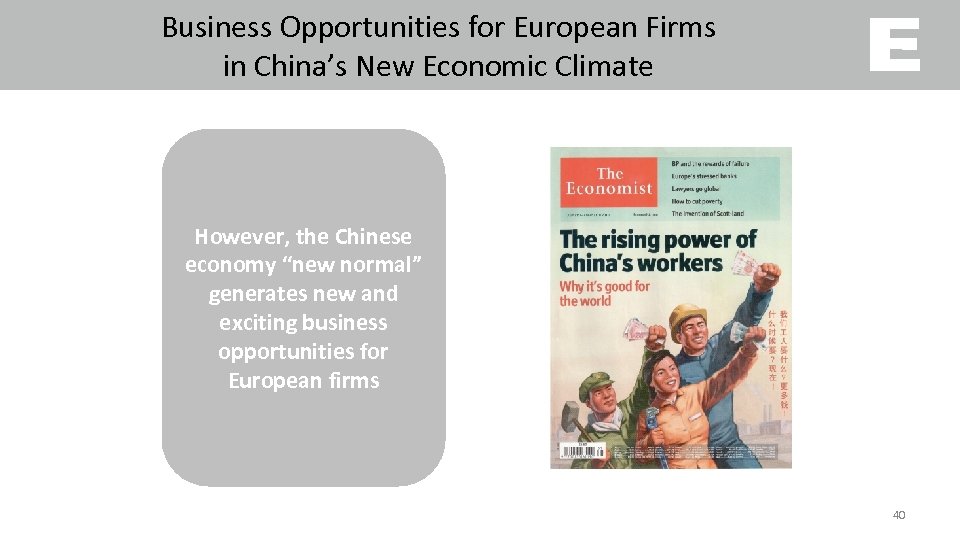 Business Opportunities for European Firms in China’s New Economic Climate However, the Chinese economy “new normal” generates new and exciting business opportunities for European firms 40
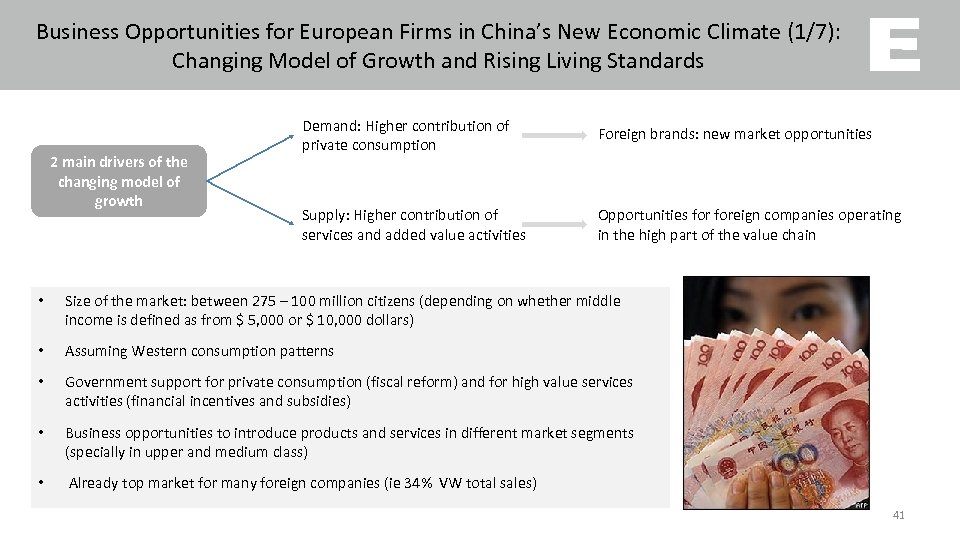 Business Opportunities for European Firms in China’s New Economic Climate (1/7): Changing Model of Growth and Rising Living Standards 2 main drivers of the changing model of growth Demand: Higher contribution of private consumption Foreign brands: new market opportunities Supply: Higher contribution of services and added value activities Opportunities foreign companies operating in the high part of the value chain • Size of the market: between 275 – 100 million citizens (depending on whether middle income is defined as from $ 5, 000 or $ 10, 000 dollars) • Assuming Western consumption patterns • Government support for private consumption (fiscal reform) and for high value services activities (financial incentives and subsidies) • Business opportunities to introduce products and services in different market segments (specially in upper and medium class) • Already top market for many foreign companies (ie 34% VW total sales) 41
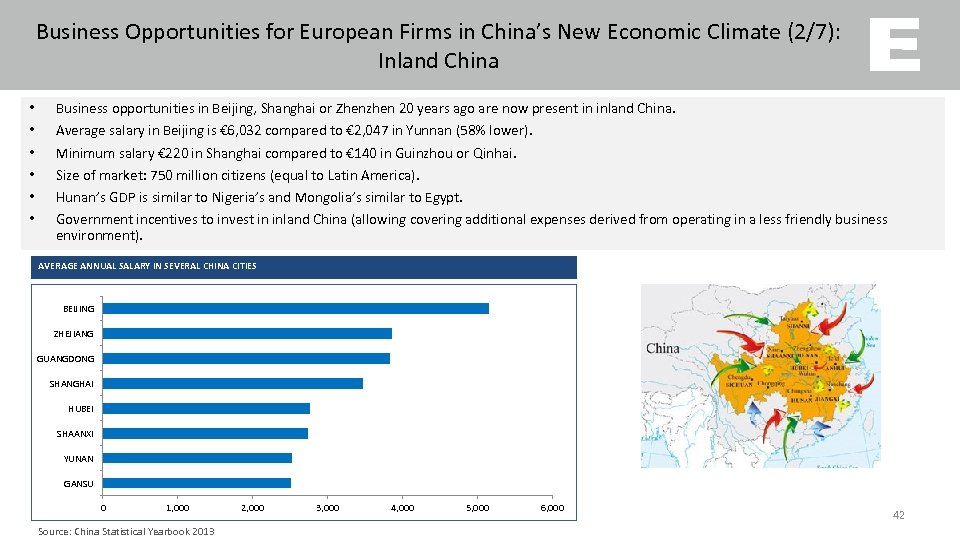 Business Opportunities for European Firms in China’s New Economic Climate (2/7): Inland China • • • Business opportunities in Beijing, Shanghai or Zhenzhen 20 years ago are now present in inland China. Average salary in Beijing is € 6, 032 compared to € 2, 047 in Yunnan (58% lower). Minimum salary € 220 in Shanghai compared to € 140 in Guinzhou or Qinhai. Size of market: 750 million citizens (equal to Latin America). Hunan’s GDP is similar to Nigeria’s and Mongolia’s similar to Egypt. Government incentives to invest in inland China (allowing covering additional expenses derived from operating in a less friendly business environment). AVERAGE ANNUAL SALARY IN SEVERAL CHINA CITIES BEIJING ZHEJIANG GUANGDONG SHANGHAI HUBEI SHAANXI YUNAN GANSU 0 1, 000 Source: China Statistical Yearbook 2013 2, 000 3, 000 4, 000 5, 000 6, 000 42
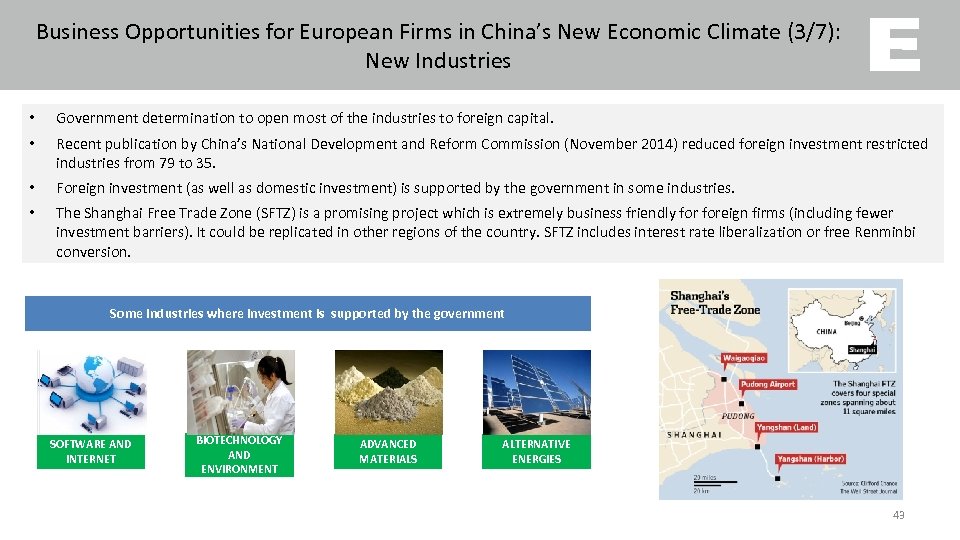 Business Opportunities for European Firms in China’s New Economic Climate (3/7): New Industries • Government determination to open most of the industries to foreign capital. • Recent publication by China’s National Development and Reform Commission (November 2014) reduced foreign investment restricted industries from 79 to 35. • Foreign investment (as well as domestic investment) is supported by the government in some industries. • The Shanghai Free Trade Zone (SFTZ) is a promising project which is extremely business friendly foreign firms (including fewer investment barriers). It could be replicated in other regions of the country. SFTZ includes interest rate liberalization or free Renminbi conversion. Some industries where investment is supported by the government SOFTWARE AND INTERNET BIOTECHNOLOGY AND ENVIRONMENT ADVANCED MATERIALS ALTERNATIVE ENERGIES 43
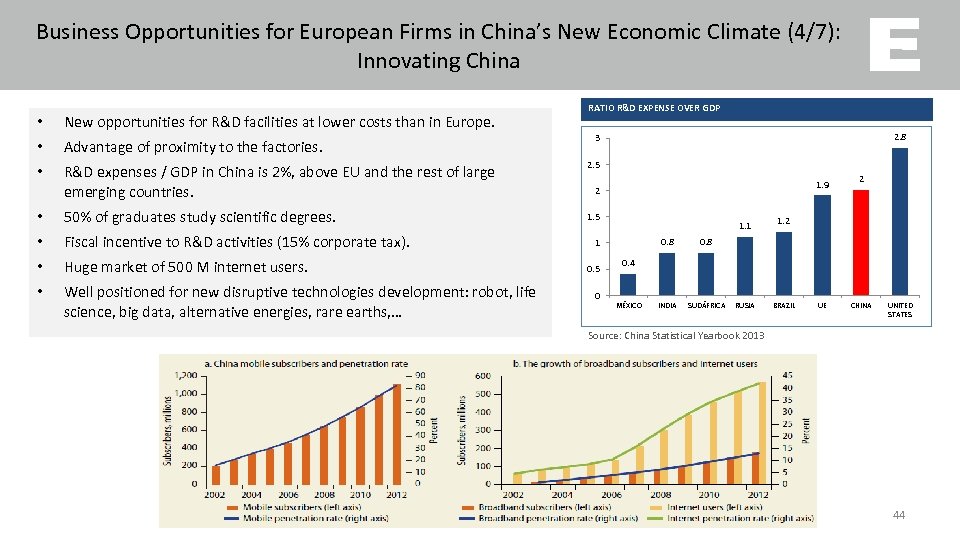 Business Opportunities for European Firms in China’s New Economic Climate (4/7): Innovating China RATIO R&D EXPENSE OVER GDP • New opportunities for R&D facilities at lower costs than in Europe. • Advantage of proximity to the factories. • R&D expenses / GDP in China is 2%, above EU and the rest of large emerging countries. 2. 5 • 50% of graduates study scientific degrees. 1. 5 • Fiscal incentive to R&D activities (15% corporate tax). • Huge market of 500 M internet users. • Well positioned for new disruptive technologies development: robot, life science, big data, alternative energies, rare earths, … 2. 8 3 1. 9 2 1. 1 0. 8 1 0. 5 0 SUDÁFRICA 1. 2 0. 8 INDIA 2 0. 4 MÉXICO RUSIA BRAZIL UE CHINA UNITED STATES Source: China Statistical Yearbook 2013 44
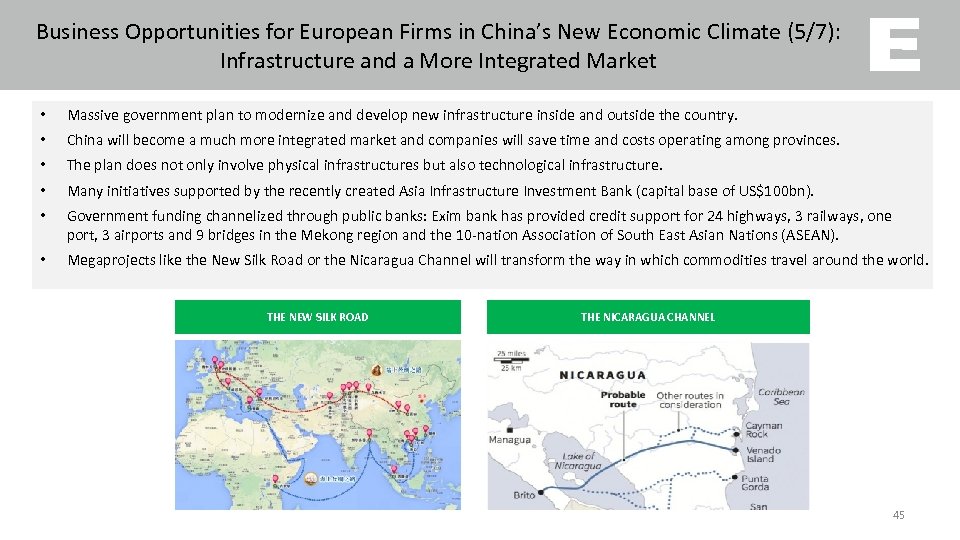 Business Opportunities for European Firms in China’s New Economic Climate (5/7): Infrastructure and a More Integrated Market • Massive government plan to modernize and develop new infrastructure inside and outside the country. • China will become a much more integrated market and companies will save time and costs operating among provinces. • The plan does not only involve physical infrastructures but also technological infrastructure. • Many initiatives supported by the recently created Asia Infrastructure Investment Bank (capital base of US$100 bn). • Government funding channelized through public banks: Exim bank has provided credit support for 24 highways, 3 railways, one port, 3 airports and 9 bridges in the Mekong region and the 10 -nation Association of South East Asian Nations (ASEAN). • Megaprojects like the New Silk Road or the Nicaragua Channel will transform the way in which commodities travel around the world. THE NEW SILK ROAD THE NICARAGUA CHANNEL 45
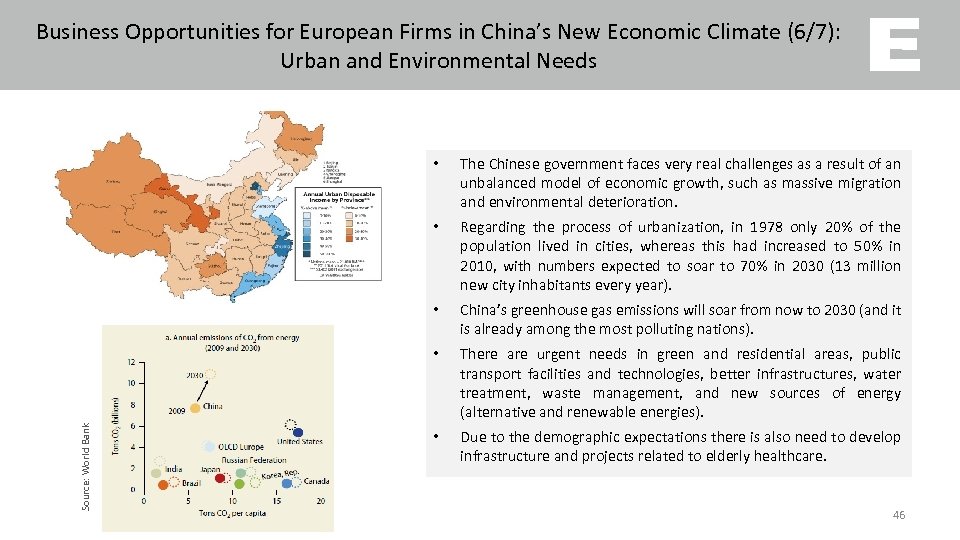 Business Opportunities for European Firms in China’s New Economic Climate (6/7): Urban and Environmental Needs The Chinese government faces very real challenges as a result of an unbalanced model of economic growth, such as massive migration and environmental deterioration. • Regarding the process of urbanization, in 1978 only 20% of the population lived in cities, whereas this had increased to 50% in 2010, with numbers expected to soar to 70% in 2030 (13 million new city inhabitants every year). • China’s greenhouse gas emissions will soar from now to 2030 (and it is already among the most polluting nations). • Source: World Bank • There are urgent needs in green and residential areas, public transport facilities and technologies, better infrastructures, water treatment, waste management, and new sources of energy (alternative and renewable energies). • Due to the demographic expectations there is also need to develop infrastructure and projects related to elderly healthcare. 46
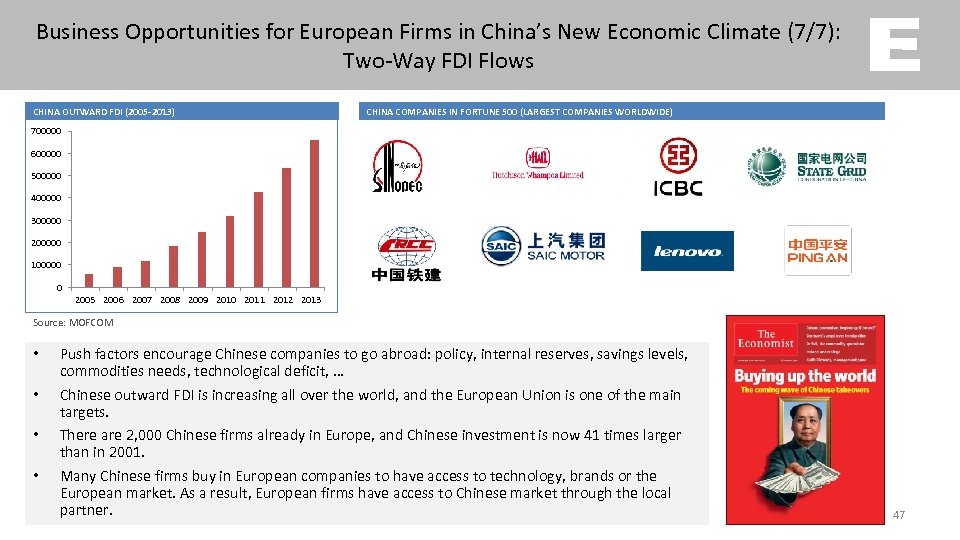 Business Opportunities for European Firms in China’s New Economic Climate (7/7): Two-Way FDI Flows CHINA OUTWARD FDI (2005 -2013) CHINA COMPANIES IN FORTUNE 500 (LARGEST COMPANIES WORLDWIDE) 700000 600000 500000 400000 300000 200000 100000 0 2005 2006 2007 2008 2009 2010 2011 2012 2013 Source: MOFCOM • • Push factors encourage Chinese companies to go abroad: policy, internal reserves, savings levels, commodities needs, technological deficit, … Chinese outward FDI is increasing all over the world, and the European Union is one of the main targets. There are 2, 000 Chinese firms already in Europe, and Chinese investment is now 41 times larger than in 2001. Many Chinese firms buy in European companies to have access to technology, brands or the European market. As a result, European firms have access to Chinese market through the local partner. 47
 Application: The Three Paragraph Paper Given current economic and policy conditions, what might the outlook be for the following 3 European firms who are considering investing in China? 1. A German luxury car brand, 2. A Spanish firm specialized in smart city grids, and 3. A large French producer of low-cost electronic devices. Please reflect on these cases for 5 minutes, and then write 1 paragraph per case, discussing the challenges and opportunities each might encounter when investing in China, and offering recommendations. 48
 Conclusion Questions? This powerpoint presentation and the matching teaching plan were developed as a part of the Jean Monnet project MEKBiz (Mainstreaming EU Knowledge in Business Studies and Strategy), hosted by ESADEgeo – Center for Global Economy and Geopolitics and partially funded by the European Commission. “The European Commission support for the production of this publication does not constitute an endorsement of the contents which reflects the views only of the authors, and the Commission cannot be held responsible for any use which may be made of the information contained therein. ” 49