 Скачать презентацию Chinese Culinary Medicine Herbs and Foods for Reversing
110582807f1b1e0a14d3a7df53c3ccb8.ppt
- Количество слайдов: 40



Chinese Culinary Medicine Herbs and Foods for Reversing Inflammation Efrem Korngold, OMD, LAc Chinese Medicine Works San Francisco, California Sponsored by the University Of Arizona College of Medicine, Arizona Health Sciences Center © 2007 Chinese Medicine Works
Chinese Culinary Medicine Herbs and Foods for Reversing Inflammation Efrem Korngold, OMD, LAc Disclosures: Shareholder, Board Member, Formulator, Kan Herb Company Santa Cruz, California I intend to discuss off-label products or Instruments not approved by the FDA including Chinese medicinal herbs and nutritional supplements © 2007 Chinese Medicine Works
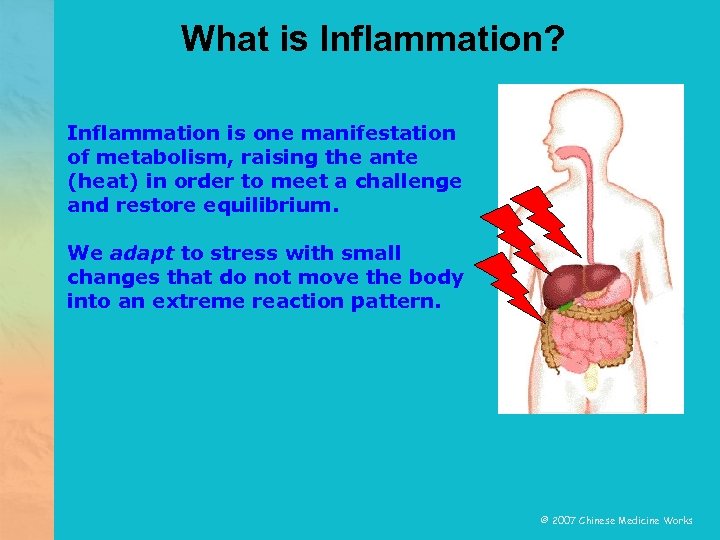
What is Inflammation? Inflammation is one manifestation of metabolism, raising the ante (heat) in order to meet a challenge and restore equilibrium. We adapt to stress with small changes that do not move the body into an extreme reaction pattern. © 2007 Chinese Medicine Works
Systemic Inflammation and Obesity Calories = Heat With the discovery of interleukins (IL), the concept of systemic inflammation developed. During clinical studies, inflammatory-related molecule levels were reduced and increased levels of antiinflammatory molecules were seen within four weeks after patients began a very low calorie diet. In chronic inflammation, the immune cells may attack fat similar to bacteria and fungi. © 2007 Chinese Medicine Works
In Chinese Medicine Inflammation = Excess Internal Heat The concept of inflammation…has been extant in Chinese Medicine for hundreds, perhaps thousands of years. The body attempts to maintain homeostasis by discharging excess heat through the bowels, urine, breath and perspiration. Excessive heat in the blood has a vulcanizing effect on the intima of vessel walls, producing an inflammatory state that generates all the conditions for the formation of atherosclerotic plaque. Excerpted from A Chinese Model of Inflammation in Atherosclerosis, Leon I. Hammer, MD and Robert C. Heffron, MD © 2007 Chinese Medicine Works
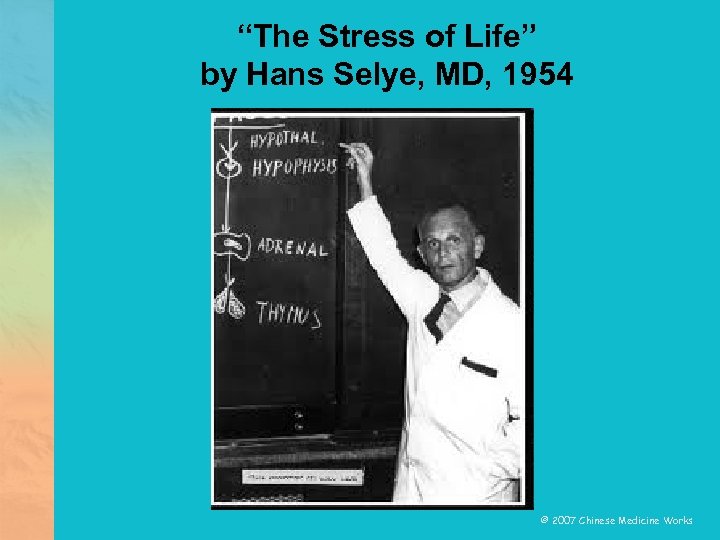
“The Stress of Life” by Hans Selye, MD, 1954 © 2007 Chinese Medicine Works
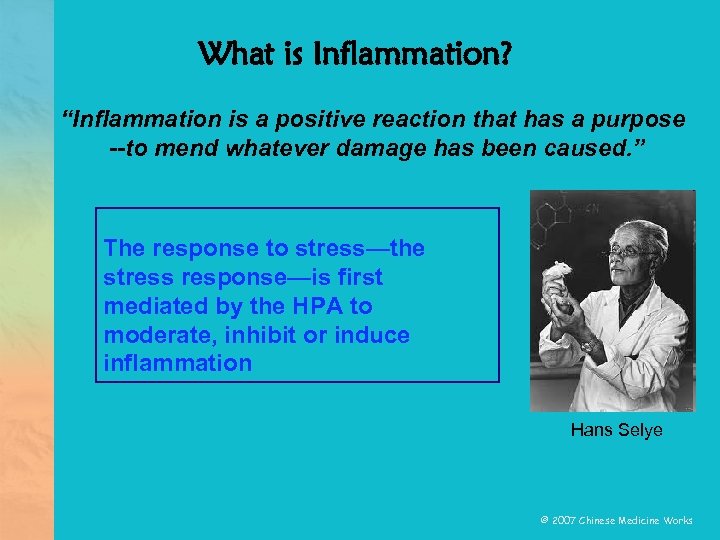
What is Inflammation? “Inflammation is a positive reaction that has a purpose --to mend whatever damage has been caused. ” The response to stress—the stress response—is first mediated by the HPA to moderate, inhibit or induce inflammation Hans Selye © 2007 Chinese Medicine Works
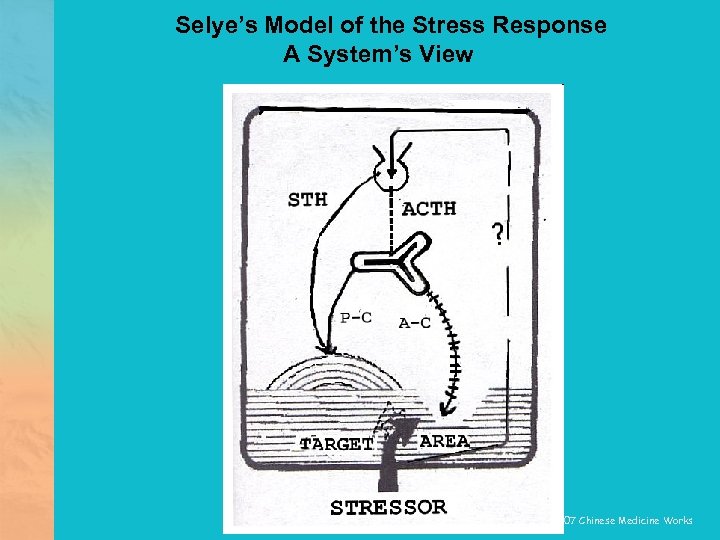
Selye’s Model of the Stress Response A System’s View © 2007 Chinese Medicine Works
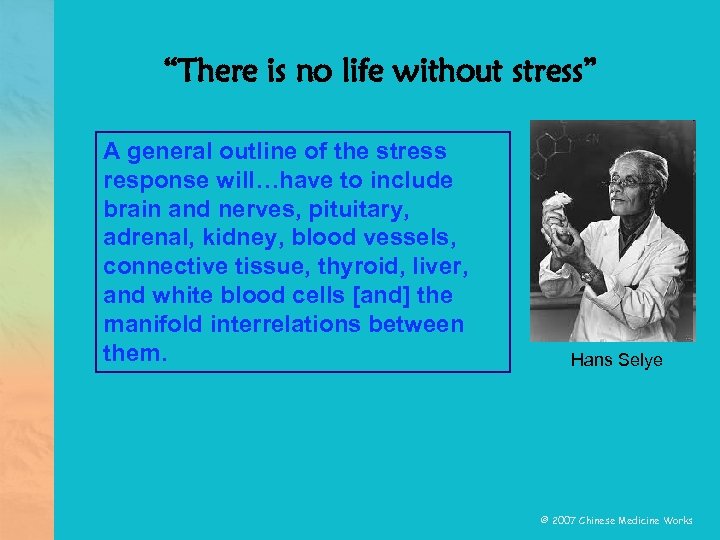
“There is no life without stress” A general outline of the stress response will…have to include brain and nerves, pituitary, adrenal, kidney, blood vessels, connective tissue, thyroid, liver, and white blood cells [and] the manifold interrelations between them. Hans Selye © 2007 Chinese Medicine Works
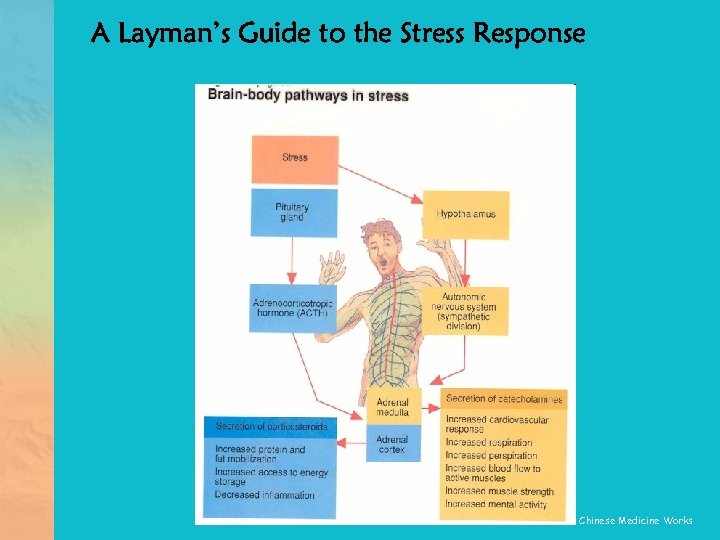
A Layman’s Guide to the Stress Response © 2007 Chinese Medicine Works
Selye’s list of warning signs indicate a person is about to become maladapted to foods and other stressors General irritability, hyper-excitation or depression Pounding of the heart Dryness of the throat and mouth Impulsive behavior, emotional instability Inability to concentrate Feelings of unreality, weakness or dizziness Predilection to become fatigued and loss of joie do vivre ‘Floating anxiety’ Emotional tension and hyper-alertness Trembling, nervous tics Easily startled Stuttering and other speech difficulties which are frequently stress-induced Grinding of the teeth Insomnia due to being ‘keyed up’ Hyper-motility (hyperkinesias), Inability to relax Sweating Frequent need to urinate Gastrointestinal dysfunction – diarrhea, indigestion, queasiness, irritable bowel Migraine headaches Premenstrual tension or missed menstrual cycles Pain in the neck or lower back Loss of or excessive appetite Nightmares Accident proneness © 2007 Chinese Medicine Works
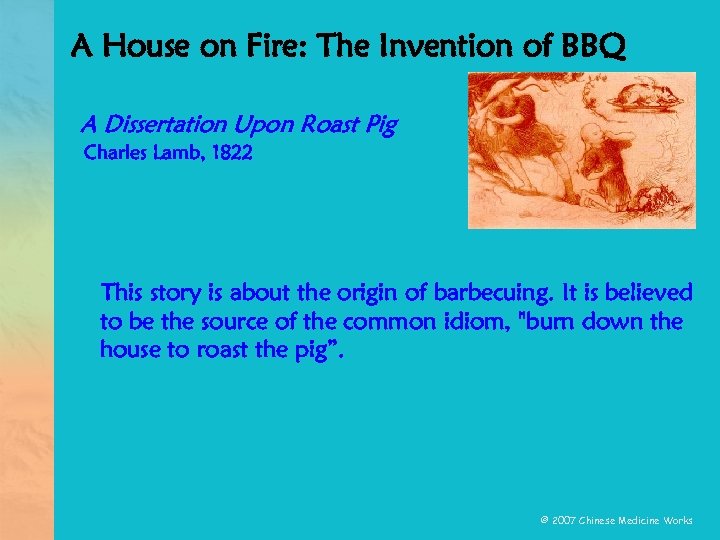
A House on Fire: The Invention of BBQ A Dissertation Upon Roast Pig Charles Lamb, 1822 This story is about the origin of barbecuing. It is believed to be the source of the common idiom, "burn down the house to roast the pig”. © 2007 Chinese Medicine Works
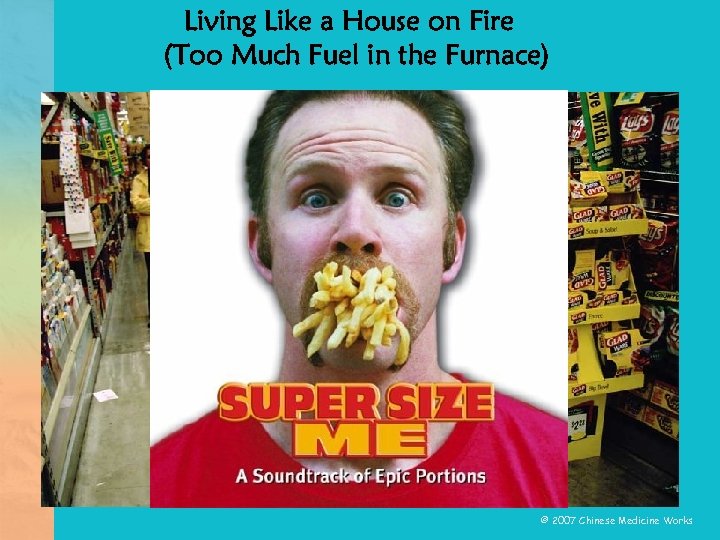
Living Like a House on Fire (Too Much Fuel in the Furnace) © 2007 Chinese Medicine Works
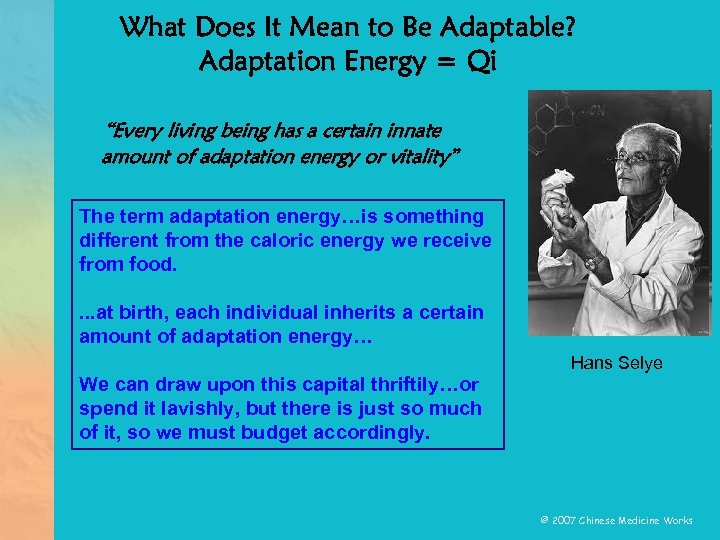
What Does It Mean to Be Adaptable? Adaptation Energy = Qi “Every living being has a certain innate amount of adaptation energy or vitality” The term adaptation energy…is something different from the caloric energy we receive from food. . at birth, each individual inherits a certain amount of adaptation energy… Hans Selye We can draw upon this capital thriftily…or spend it lavishly, but there is just so much of it, so we must budget accordingly. © 2007 Chinese Medicine Works
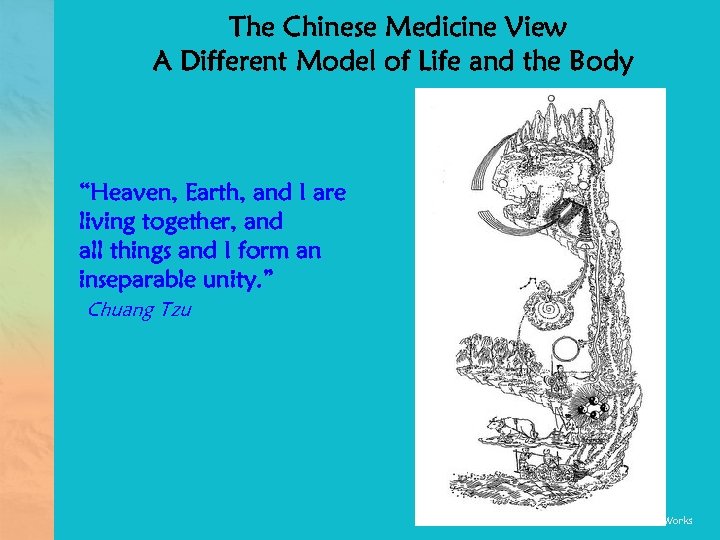
The Chinese Medicine View A Different Model of Life and the Body “Heaven, Earth, and I are living together, and all things and I form an inseparable unity. ” Chuang Tzu © 2007 Chinese Medicine Works
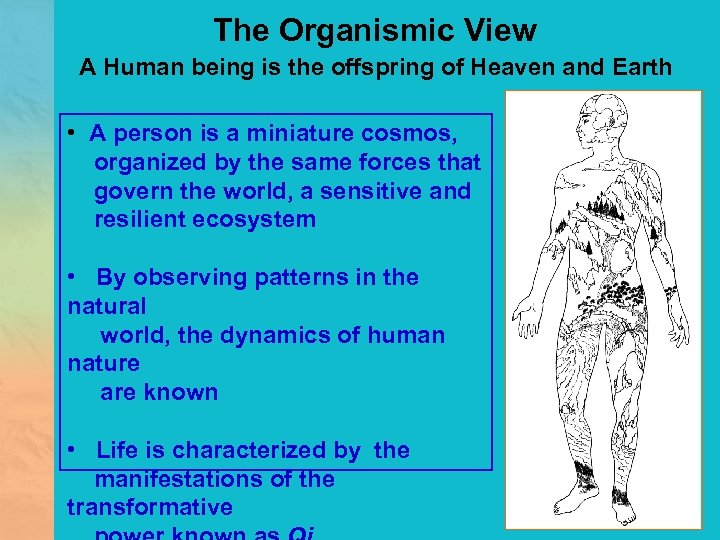
The Organismic View A Human being is the offspring of Heaven and Earth • A person is a miniature cosmos, organized by the same forces that govern the world, a sensitive and resilient ecosystem • By observing patterns in the natural world, the dynamics of human nature are known • Life is characterized by the manifestations of the transformative © 2007 Chinese Medicine Works
Sun Si Miao – Master Physician of the 7 th Century Food is able to expel evil and stabilize the viscera and bowels, to please the spirit and clear the will, thereby protecting Blood and Qi. If you are able to use food to correct chronic disorders, release emotions, and chase away disease, you can call yourself an outstanding physician. People who practice medicine must first thoroughly understand the source of the disorder. Then, use food to treat it, and if food will not cure it, resort to the application of drugs. Nurturing Life in Classical Chinese Medicine, Journal of Chinese Medicine (2011), Excerpt from Essential Prescriptions Worth a Thousand in Gold © 2007 Chinese Medicine Works
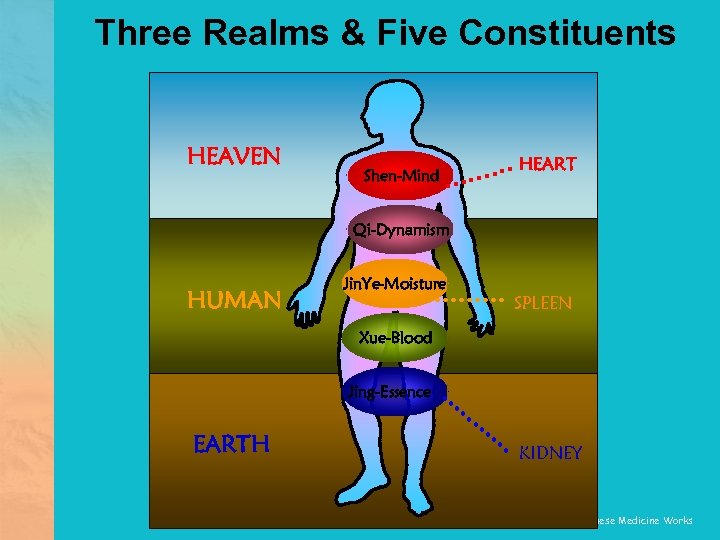
Three Realms & Five Constituents HEAVEN Shen-Mind HEART Qi-Dynamism HUMAN Jin. Ye-Moisture SPLEEN Xue-Blood Jing-Essence EARTH KIDNEY © 2007 Chinese Medicine Works
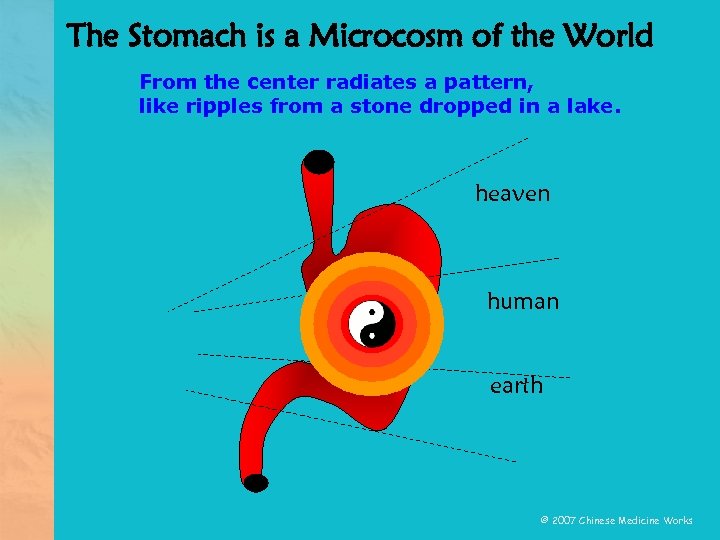
The Stomach is a Microcosm of the World From the center radiates a pattern, like ripples from a stone dropped in a lake. heaven human earth © 2007 Chinese Medicine Works
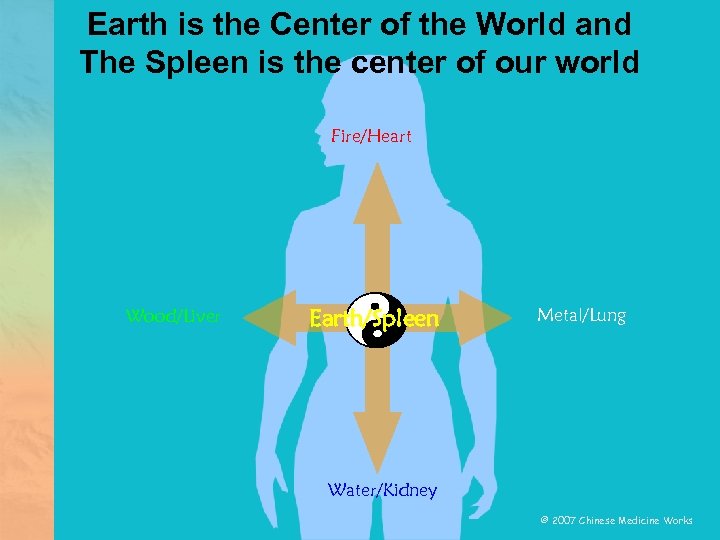
Earth is the Center of the World and The Spleen is the center of our world Fire/Heart Wood/Liver Earth/Spleen Metal/Lung Water/Kidney © 2007 Chinese Medicine Works
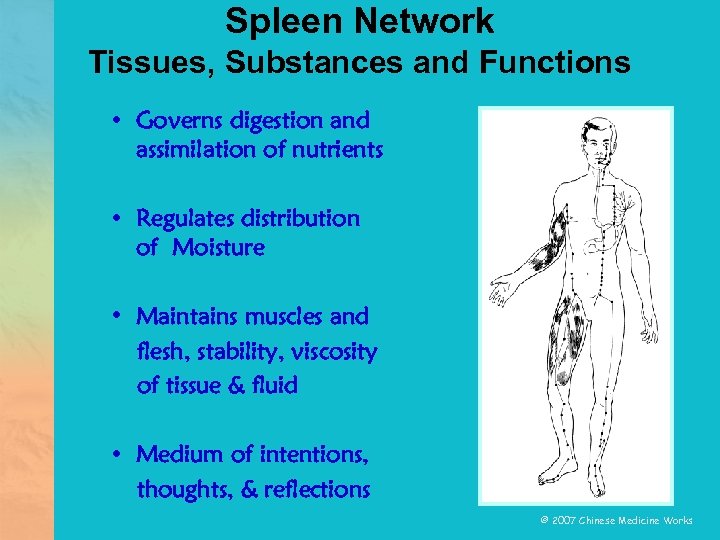
Spleen Network Tissues, Substances and Functions • Governs digestion and assimilation of nutrients • Regulates distribution of Moisture • Maintains muscles and flesh, stability, viscosity of tissue & fluid • Medium of intentions, thoughts, & reflections © 2007 Chinese Medicine Works
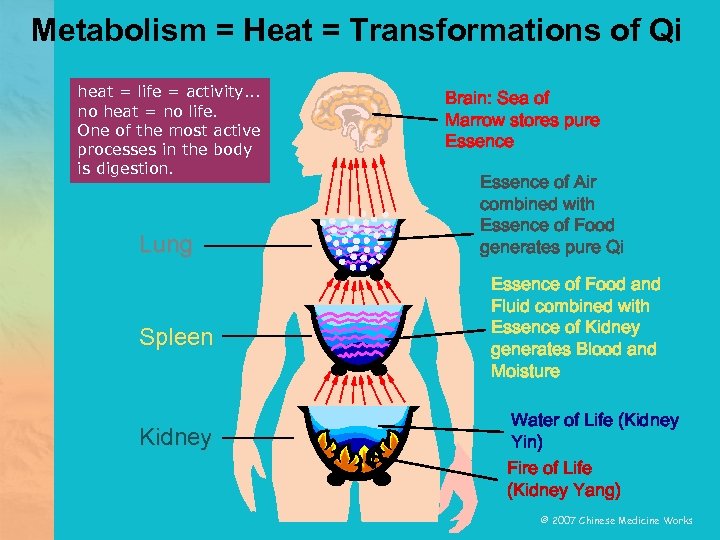
Metabolism = Heat = Transformations of Qi heat = life = activity. . . no heat = no life. One of the most active processes in the body is digestion. Lung Spleen Kidney Brain: Sea of Marrow stores pure Essence of Air combined with Essence of Food generates pure Qi Essence of Food and Fluid combined with Essence of Kidney generates Blood and Moisture Water of Life (Kidney Yin) Fire of Life (Kidney Yang) © 2007 Chinese Medicine Works
Metabolism = Heat = Transformations of Qi The body recruits a large percentage of its available Qi to move blood into the digestive tract and raise the temperature so that metabolic transformations can occur. As the Blood (Yin) and Qi (Yang) are gathering in the Stomach, they are withdrawn from the exterior, and also from the brain. A good reason to be sitting down while you’re eating! © 2007 Chinese Medicine Works
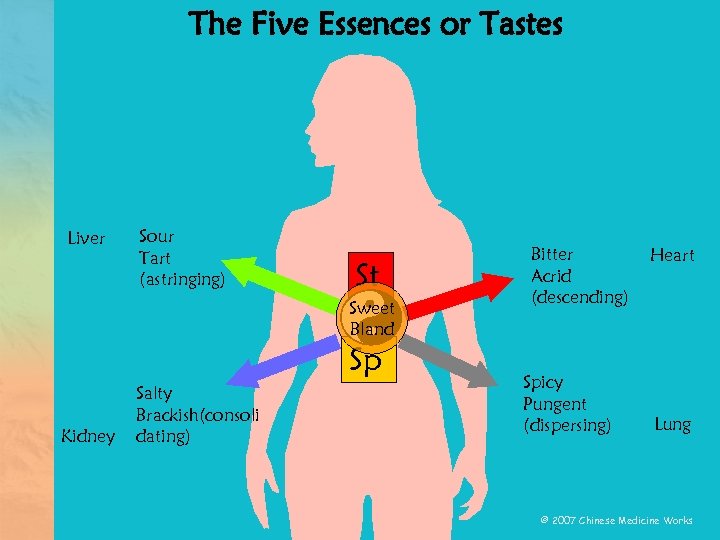
The Five Essences or Tastes Liver Sour Tart (astringing) St Sweet Bland Sp Kidney Salty Brackish(consoli dating) Bitter Acrid (descending) Spicy Pungent (dispersing) Heart Lung © 2007 Chinese Medicine Works
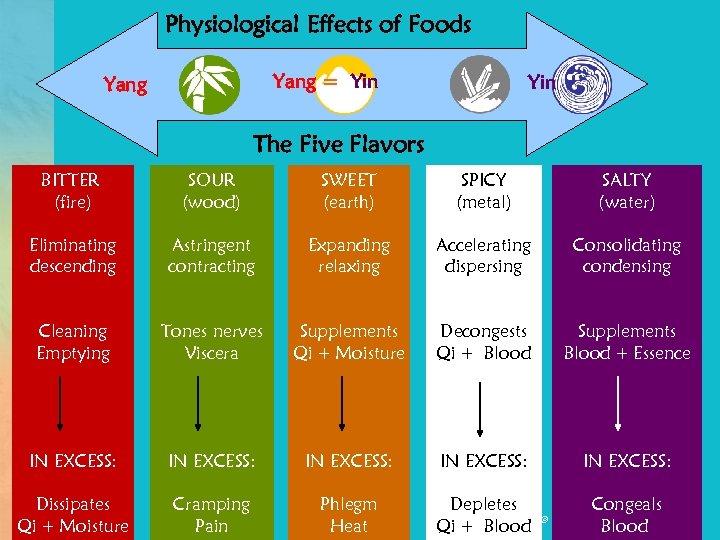
Physiological Effects of Foods Yang = Yin Yang Yin The Five Flavors BITTER (fire) SOUR (wood) SWEET (earth) SPICY (metal) SALTY (water) Eliminating descending Astringent contracting Expanding relaxing Accelerating dispersing Consolidating condensing Cleaning Emptying Tones nerves Viscera Supplements Qi + Moisture Decongests Qi + Blood Supplements Blood + Essence IN EXCESS: IN EXCESS: Dissipates Qi + Moisture Cramping Pain Phlegm Heat Depletes Qi + Blood Congeals Blood © 2007 Chinese Medicine Works
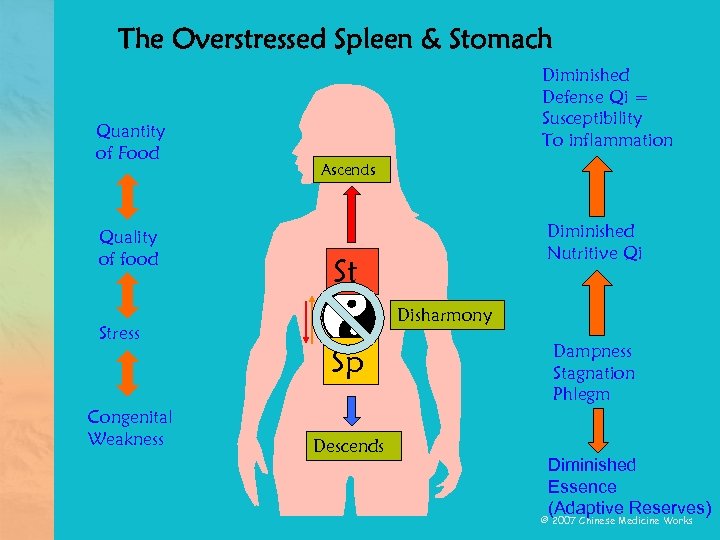
The Overstressed Spleen & Stomach Quantity of Food Quality of food Stress Congenital Weakness Diminished Defense Qi = Susceptibility To inflammation Ascends Diminished Nutritive Qi St Disharmony Sp Descends Dampness Stagnation Phlegm Diminished Essence (Adaptive Reserves) © 2007 Chinese Medicine Works
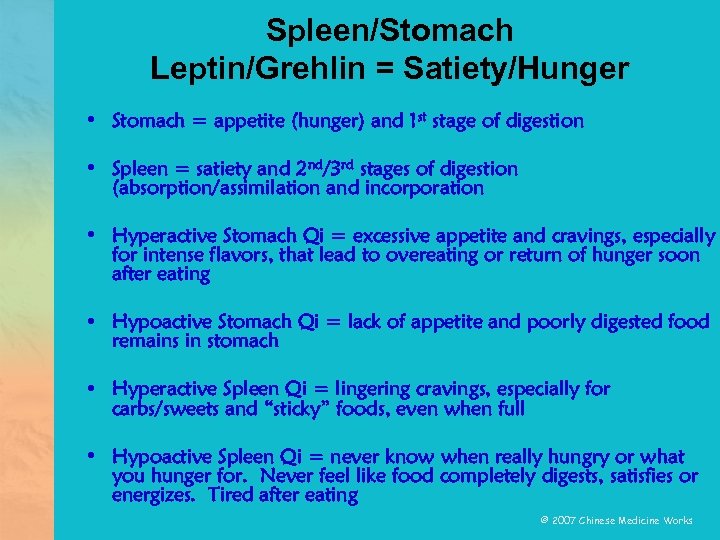
Spleen/Stomach Leptin/Grehlin = Satiety/Hunger • Stomach = appetite (hunger) and 1 st stage of digestion • Spleen = satiety and 2 nd/3 rd stages of digestion (absorption/assimilation and incorporation • Hyperactive Stomach Qi = excessive appetite and cravings, especially for intense flavors, that lead to overeating or return of hunger soon after eating • Hypoactive Stomach Qi = lack of appetite and poorly digested food remains in stomach • Hyperactive Spleen Qi = lingering cravings, especially for carbs/sweets and “sticky” foods, even when full • Hypoactive Spleen Qi = never know when really hungry or what you hunger for. Never feel like food completely digests, satisfies or energizes. Tired after eating © 2007 Chinese Medicine Works
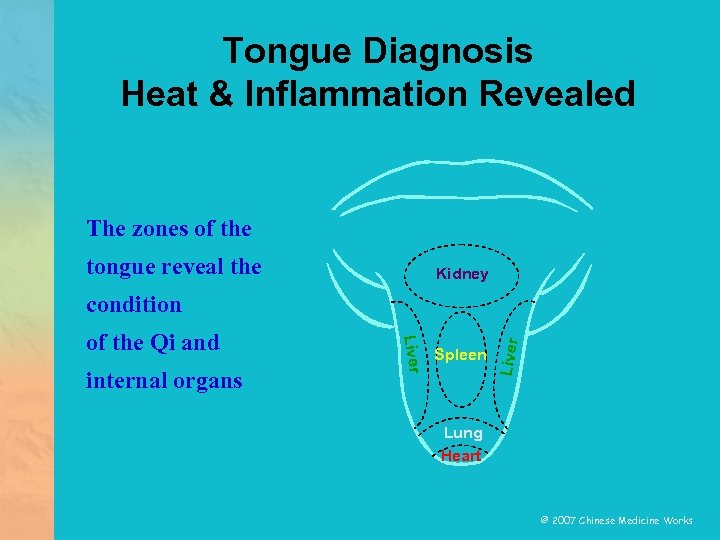
Tongue Diagnosis Heat & Inflammation Revealed The zones of the tongue reveal the Kidney internal organs Liver of the Qi and Spleen Liver condition Lung Heart © 2007 Chinese Medicine Works
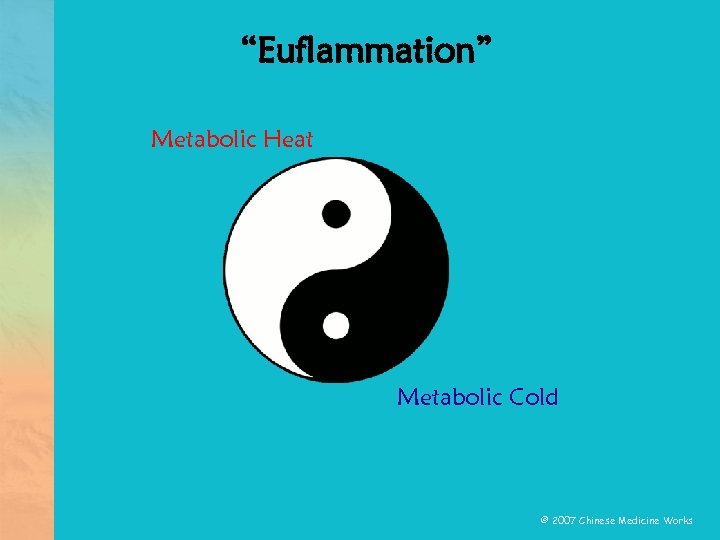
“Euflammation” Metabolic Heat Metabolic Cold © 2007 Chinese Medicine Works
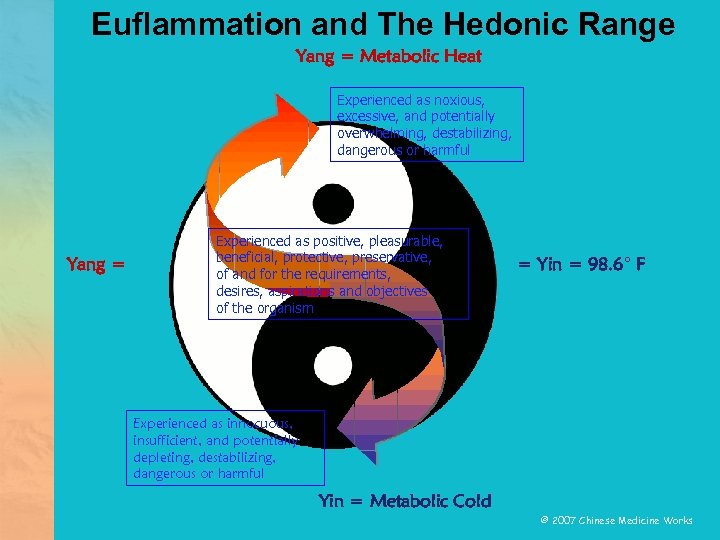
Euflammation and The Hedonic Range Yang = Metabolic Heat Experienced as noxious, excessive, and potentially overwhelming, destabilizing, dangerous or harmful Yang = Experienced as positive, pleasurable, beneficial, protective, preservative, of and for the requirements, desires, aspirations and objectives of the organism = Yin = 98. 6° F Experienced as innocuous, insufficient, and potentially depleting, destabilizing, dangerous or harmful Yin = Metabolic Cold © 2007 Chinese Medicine Works
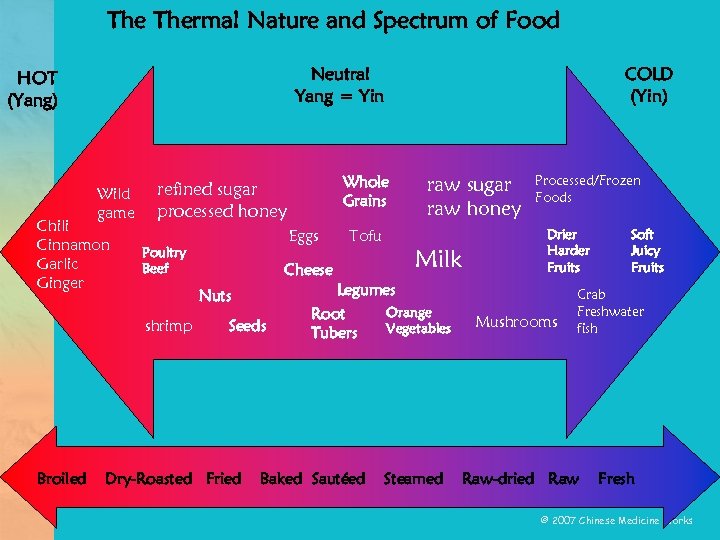
The Thermal Nature and Spectrum of Food Neutral Yang = Yin HOT (Yang) Wild game Chili Cinnamon Garlic Ginger Eggs Tofu Cheese Nuts shrimp Broiled Whole Grains refined sugar processed honey Poultry Beef Seeds Dry-Roasted Fried COLD (Yin) raw sugar raw honey Milk Legumes Orange Root Vegetables Tubers Baked Sautéed Steamed Processed/Frozen Foods Drier Harder Fruits Mushrooms Soft Juicy Fruits Crab Freshwater fish Raw-dried Raw Fresh © 2007 Chinese Medicine Works
Lotus Leaves – A Medicinal Food For Type 2 Diabetes The effect of lotus leaf extract (NNE) in diabetes is clear. In vivo studies showed that (NNE) possesses the ability to regulate blood glucose levels in fasted normal mice and high-fat-diet-induced diabetic mice. NNE and its active constituent catechin are useful in the control of hyperglycemia in non-insulin-dependent diabetes mellitus. Huang CF, Chen YW, Yang CY, Lin HY, Way TD, Chiang W, Liu SH, J Agric Food Chem. 2011 Feb 23; 59(4): 1087 -94. Epub 2011 Jan 14 © 2007 Chinese Medicine Works
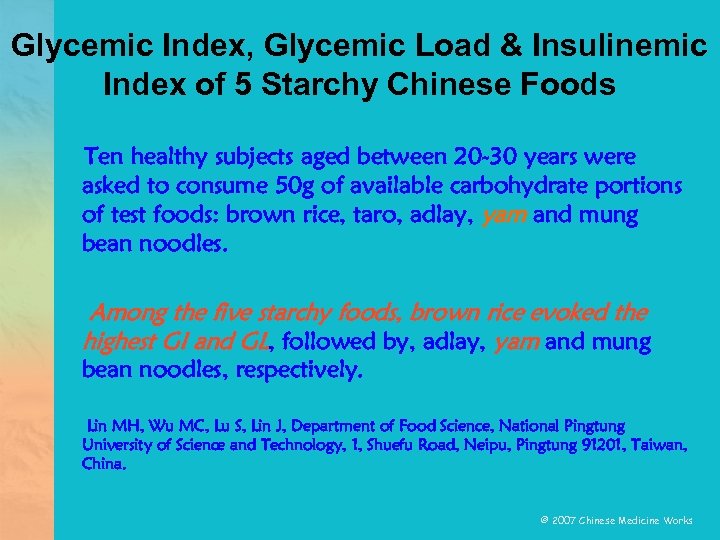
Glycemic Index, Glycemic Load & Insulinemic Index of 5 Starchy Chinese Foods Ten healthy subjects aged between 20 -30 years were asked to consume 50 g of available carbohydrate portions of test foods: brown rice, taro, adlay, yam and mung bean noodles. Among the five starchy foods, brown rice evoked the highest GI and GL, followed by, adlay, yam and mung bean noodles, respectively. Lin MH, Wu MC, Lu S, Lin J, Department of Food Science, National Pingtung University of Science and Technology, 1, Shuefu Road, Neipu, Pingtung 91201, Taiwan, China. © 2007 Chinese Medicine Works
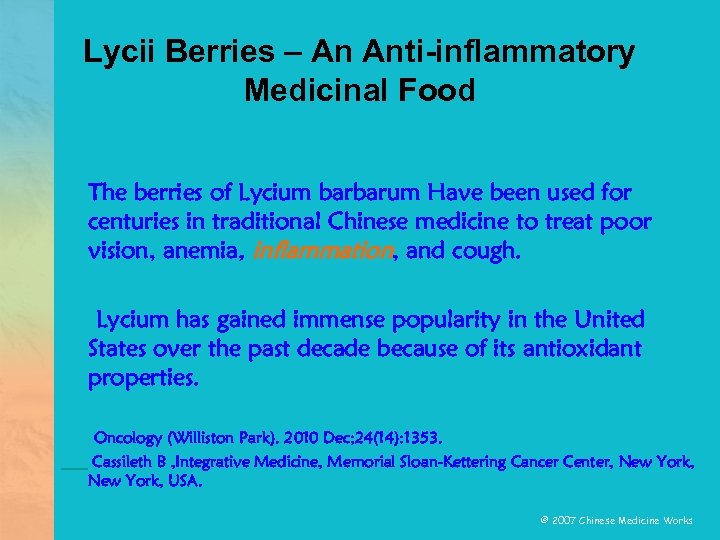
Lycii Berries – An Anti-inflammatory Medicinal Food The berries of Lycium barbarum Have been used for centuries in traditional Chinese medicine to treat poor vision, anemia, inflammation, and cough. Lycium has gained immense popularity in the United States over the past decade because of its antioxidant properties. Oncology (Williston Park). 2010 Dec; 24(14): 1353. Cassileth B , Integrative Medicine, Memorial Sloan-Kettering Cancer Center, New York, USA. © 2007 Chinese Medicine Works
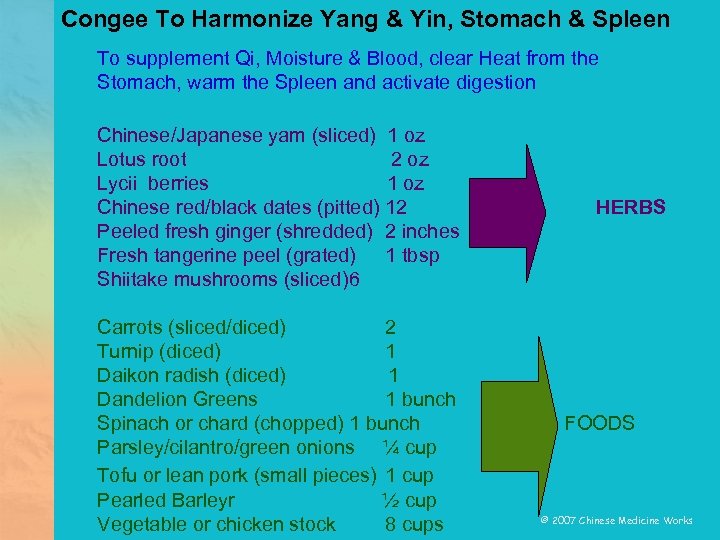
Congee To Harmonize Yang & Yin, Stomach & Spleen To supplement Qi, Moisture & Blood, clear Heat from the Stomach, warm the Spleen and activate digestion Chinese/Japanese yam (sliced) 1 oz Lotus root 2 oz Lycii berries 1 oz Chinese red/black dates (pitted) 12 Peeled fresh ginger (shredded) 2 inches Fresh tangerine peel (grated) 1 tbsp Shiitake mushrooms (sliced)6 Carrots (sliced/diced) 2 Turnip (diced) 1 Daikon radish (diced) 1 Dandelion Greens 1 bunch Spinach or chard (chopped) 1 bunch Parsley/cilantro/green onions ¼ cup Tofu or lean pork (small pieces) 1 cup Pearled Barleyr ½ cup Vegetable or chicken stock 8 cups HERBS FOODS © 2007 Chinese Medicine Works
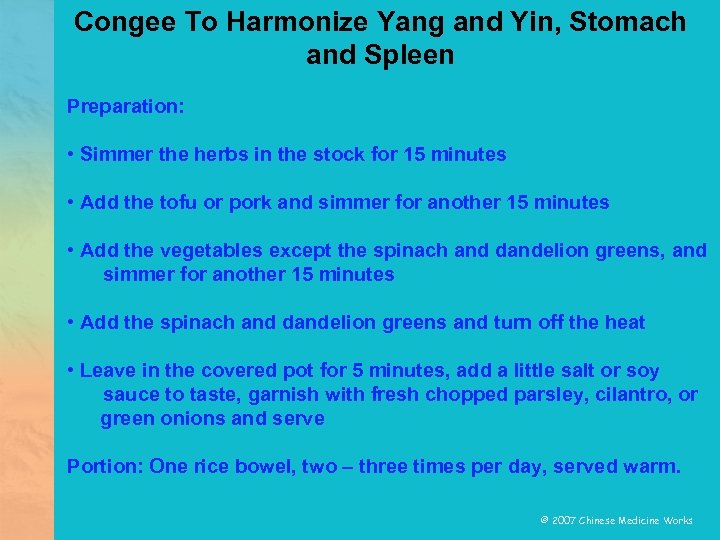
Congee To Harmonize Yang and Yin, Stomach and Spleen Preparation: • Simmer the herbs in the stock for 15 minutes • Add the tofu or pork and simmer for another 15 minutes • Add the vegetables except the spinach and dandelion greens, and simmer for another 15 minutes • Add the spinach and dandelion greens and turn off the heat • Leave in the covered pot for 5 minutes, add a little salt or soy sauce to taste, garnish with fresh chopped parsley, cilantro, or green onions and serve Portion: One rice bowel, two – three times per day, served warm. © 2007 Chinese Medicine Works
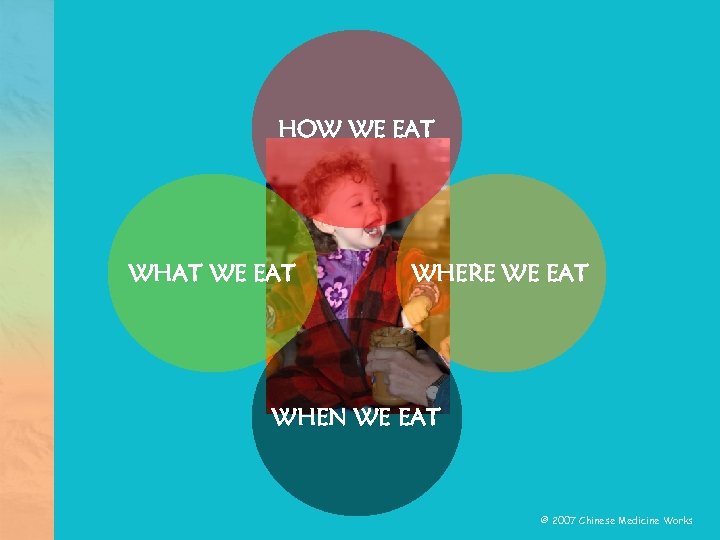
HOW WE EAT WHAT WE EAT WHERE WE EAT WHEN WE EAT © 2007 Chinese Medicine Works
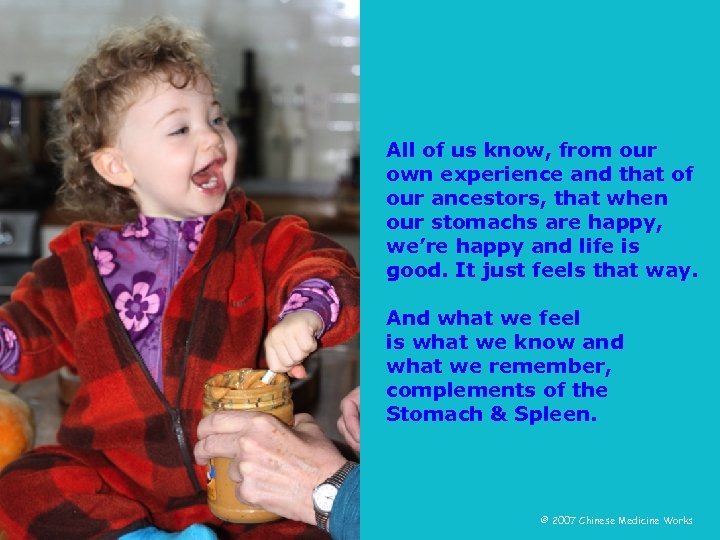
All of us know, from our own experience and that of our ancestors, that when our stomachs are happy, we’re happy and life is good. It just feels that way. And what we feel is what we know and what we remember, complements of the Stomach & Spleen. © 2007 Chinese Medicine Works
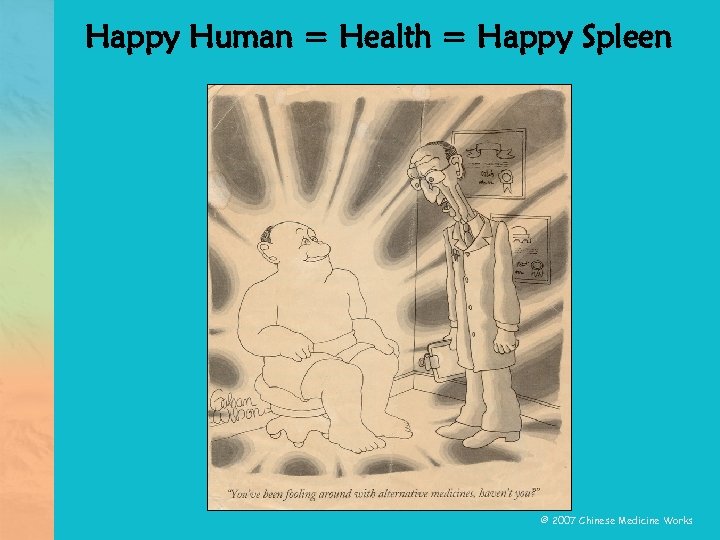
Happy Human = Health = Happy Spleen © 2007 Chinese Medicine Works
Read More About Chinese Medicine! www. chinese-medicine-works. com © 2007 Chinese Medicine Works
Скачать презентацию Chinese Culinary Medicine Herbs and Foods for Reversing
110582807f1b1e0a14d3a7df53c3ccb8.ppt