 Скачать презентацию Chinese consume many more vegetables grains and fruits
4d94a136045936298316c98759040137.ppt
- Количество слайдов: 4




Chinese consume many more vegetables, grains and fruits that Americans or Britons. The daily fibre intake of the average Chinese is three times that of the average American. The average Chinese derives anywhere from six to 24 percent of their daily calories from fat, compared to 39 percent for the average American, and a shocking 45 percent for the average Briton. The Chinese eat more calories daily than Americans per pound of body weight, but suffer less obesity. This seems to square well with current nutritional practice in the West, which advises that grains and complex carbohydrates should be the basis of a healthy diet, supplemented with vegetables and fruits, with dairy products and animal proteins used in smaller proportion and fats, oils and sweets used only sparingly.
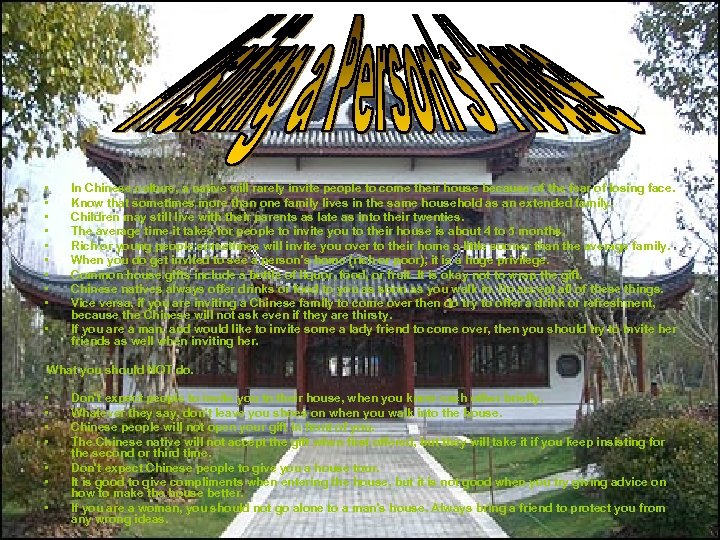
• • • In Chinese culture, a native will rarely invite people to come their house because of the fear of losing face. Know that sometimes more than one family lives in the same household as an extended family. Children may still live with their parents as late as into their twenties. The average time it takes for people to invite you to their house is about 4 to 5 months. Rich or young people sometimes will invite you over to their home a little sooner than the average family. When you do get invited to see a person's home (rich or poor), it is a huge privilege. Common house gifts include a bottle of liquor, food, or fruit. It is okay not to wrap the gift. Chinese natives always offer drinks or food to you as soon as you walk in. Do accept all of these things. Vice versa, if you are inviting a Chinese family to come over then do try to offer a drink or refreshment, because the Chinese will not ask even if they are thirsty. If you are a man, and would like to invite some a lady friend to come over, then you should try to invite her friends as well when inviting her. What you should NOT do. • • Don't expect people to invite you to their house, when you know each other briefly. Whatever they say, don't leave you shoes on when you walk into the house. Chinese people will not open your gift in front of you. The Chinese native will not accept the gift when first offered, but they will take it if you keep insisting for the second or third time. Don't expect Chinese people to give you a house tour. It is good to give compliments when entering the house, but it is not good when you try giving advice on how to make the house better. If you are a woman, you should not go alone to a man's house. Always bring a friend to protect you from any wrong ideas.
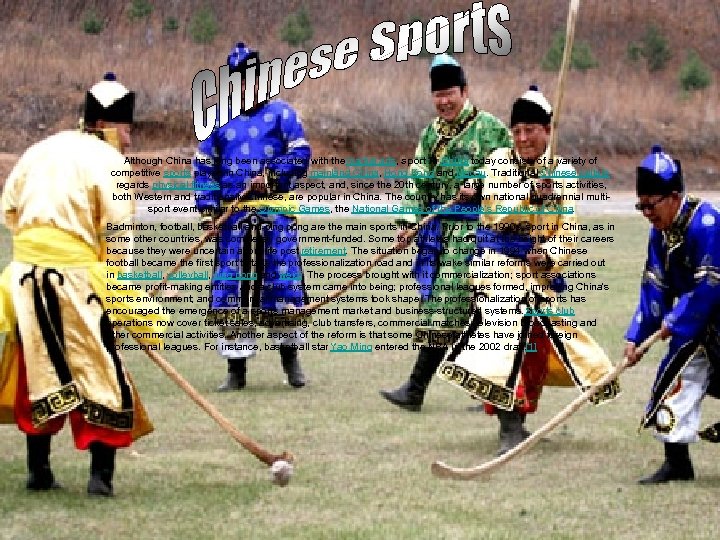
Although China has long been associated with the martial arts, sport in China today consists of a variety of competitive sports played in China, including mainland China, Hong Kong and Macau. Traditional Chinese culture regards physical fitness as an important aspect, and, since the 20 th century, a large number of sports activities, both Western and traditionally Chinese, are popular in China. The country has its own national quadrennial multisport event similar to the Olympic Games, the National Games of the People's Republic of China. Badminton, football, basketball and ping pong are the main sports in China. Prior to the 1990 s, sport in China, as in some other countries, was completely government-funded. Some top athletes had quit at the height of their careers because they were uncertain about life post retirement. The situation began to change in 1994 when Chinese football became the first sport to take the professionalization road and in its wake similar reforms were carried out in basketball, volleyball, ping pong and weiqi. The process brought with it commercialization; sport associations became profit-making entities and a club system came into being; professional leagues formed, improving China's sports environment; and commercial management systems took shape. The professionalization of sports has encouraged the emergence of a sports management market and business-structured systems. Sports club operations now cover ticket sales, advertising, club transfers, commercial matches, television broadcasting and other commercial activities. Another aspect of the reform is that some Chinese athletes have joined foreign professional leagues. For instance, basketball star Yao Ming entered the NBA in the 2002 draft. [1]
Скачать презентацию Chinese consume many more vegetables grains and fruits
4d94a136045936298316c98759040137.ppt