 Скачать презентацию CHINA S POWER SECTOR GRAPPLING WITH THE GLOBAL FOOTPRINT
2d605b1a7f509ede391da62e32592494.ppt
- Количество слайдов: 16



CHINA’S POWER SECTOR: GRAPPLING WITH THE GLOBAL “FOOTPRINT” ROBERT W. GEE PRESIDENT GEE STRATEGIES GROUP LLC 62 ND ANNUAL MEETING ENERGY BAR ASSOCIATION WASHINGTON, D. C. MAY 1, 2008
Overview • China’s economic juggernaut and its significance for escalating energy demand • Challenges in achieving sustainable development • Major highlights of China’s current energy strategy • Efforts to reform government oversight of energy industry and to introduce measures to liberalize power sector • Issues regarding carbon/greenhouse gas (GHG) mitigation 2
China’s Economic growth: Driving Energy Demand • China’s economy → has grown an average of 10 percent per year over last 25 years • China consumes: – Half of the world’s cement – Quarter of all steel – Two-fifths of all copper • China is a prodigious consumer of petroleum – Second largest oil consumer in the world; third largest oil importer – Accounts for nearly one-third of global oil growth in the last decade, adding demand equivalent to one medium size country per year 3
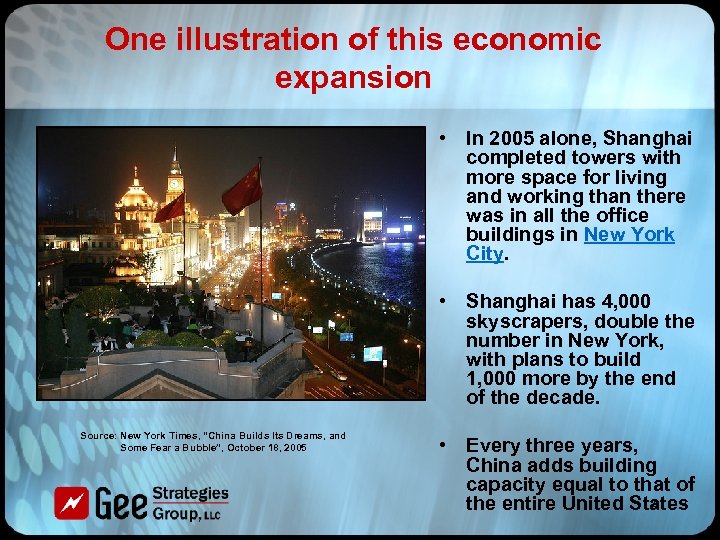
One illustration of this economic expansion • In 2005 alone, Shanghai completed towers with more space for living and working than there was in all the office buildings in New York City. • Shanghai has 4, 000 skyscrapers, double the number in New York, with plans to build 1, 000 more by the end of the decade. Source: New York Times, “China Builds Its Dreams, and Some Fear a Bubble”, October 18, 2005 • Every three years, China adds building capacity equal to that of 4 the entire United States
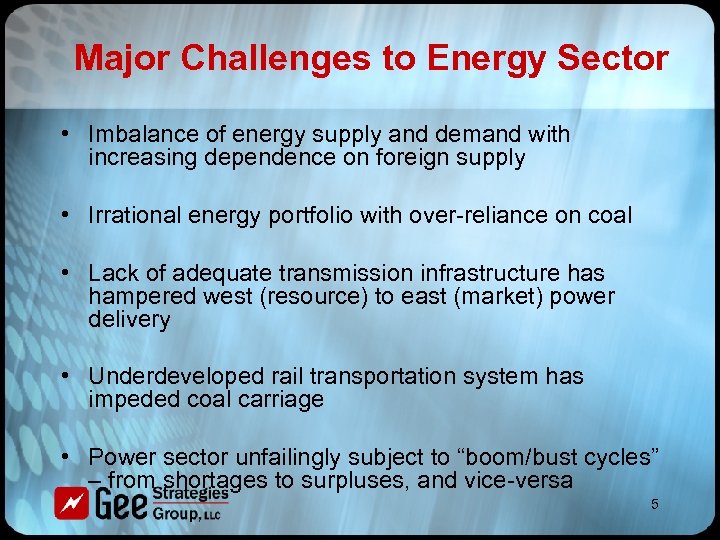
Major Challenges to Energy Sector • Imbalance of energy supply and demand with increasing dependence on foreign supply • Irrational energy portfolio with over-reliance on coal • Lack of adequate transmission infrastructure has hampered west (resource) to east (market) power delivery • Underdeveloped rail transportation system has impeded coal carriage • Power sector unfailingly subject to “boom/bust cycles” – from shortages to surpluses, and vice-versa 5
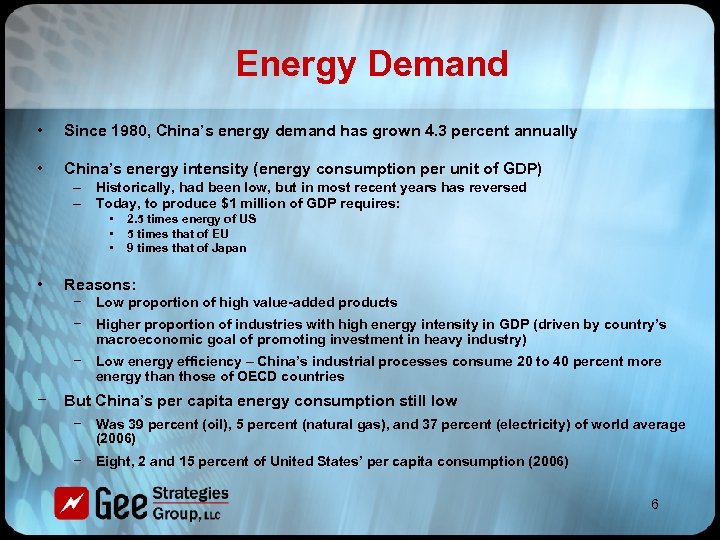
Energy Demand • Since 1980, China’s energy demand has grown 4. 3 percent annually • China’s energy intensity (energy consumption per unit of GDP) – Historically, had been low, but in most recent years has reversed – Today, to produce $1 million of GDP requires: • • 2. 5 times energy of US 5 times that of EU 9 times that of Japan Reasons: − Low proportion of high value-added products − Higher proportion of industries with high energy intensity in GDP (driven by country’s macroeconomic goal of promoting investment in heavy industry) − Low energy efficiency – China’s industrial processes consume 20 to 40 percent more energy than those of OECD countries − But China’s per capita energy consumption still low − Was 39 percent (oil), 5 percent (natural gas), and 37 percent (electricity) of world average (2006) − Eight, 2 and 15 percent of United States’ per capita consumption (2006) 6
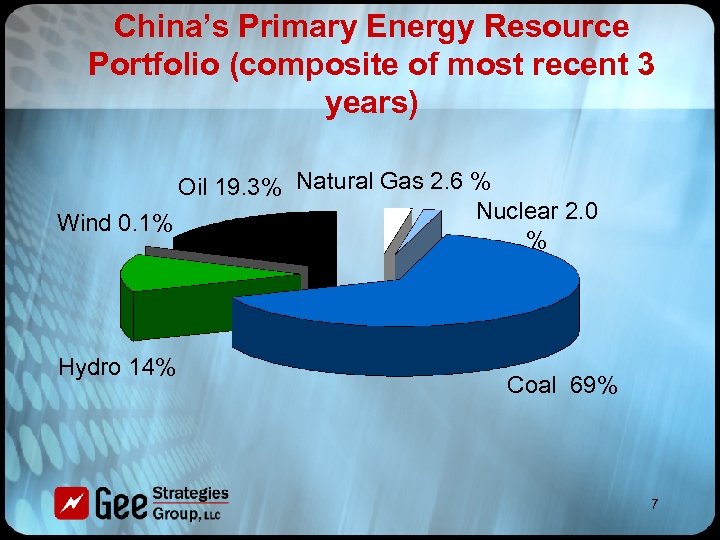
China’s Primary Energy Resource Portfolio (composite of most recent 3 years) Oil 19. 3% Natural Gas 2. 6 % Nuclear 2. 0 Wind 0. 1% % Hydro 14% Coal 69% 7
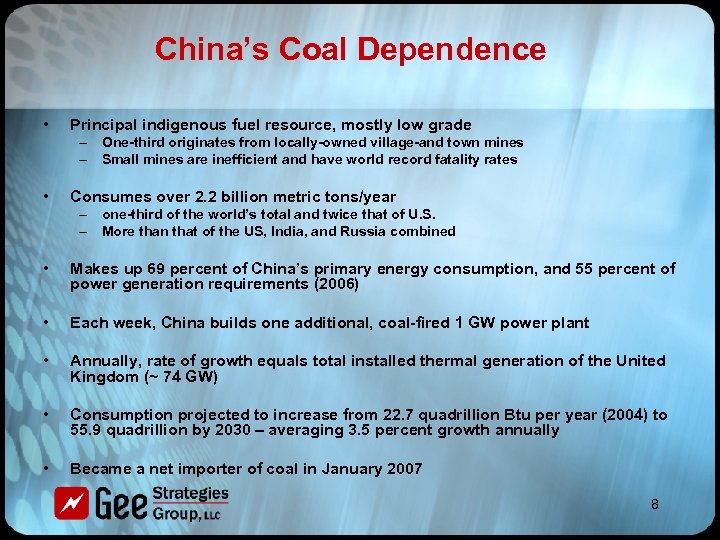
China’s Coal Dependence • Principal indigenous fuel resource, mostly low grade – One-third originates from locally-owned village-and town mines – Small mines are inefficient and have world record fatality rates • Consumes over 2. 2 billion metric tons/year – one-third of the world’s total and twice that of U. S. – More than that of the US, India, and Russia combined • Makes up 69 percent of China’s primary energy consumption, and 55 percent of power generation requirements (2006) • Each week, China builds one additional, coal-fired 1 GW power plant • Annually, rate of growth equals total installed thermal generation of the United Kingdom (~ 74 GW) • Consumption projected to increase from 22. 7 quadrillion Btu per year (2004) to 55. 9 quadrillion by 2030 – averaging 3. 5 percent growth annually • Became a net importer of coal in January 2007 8
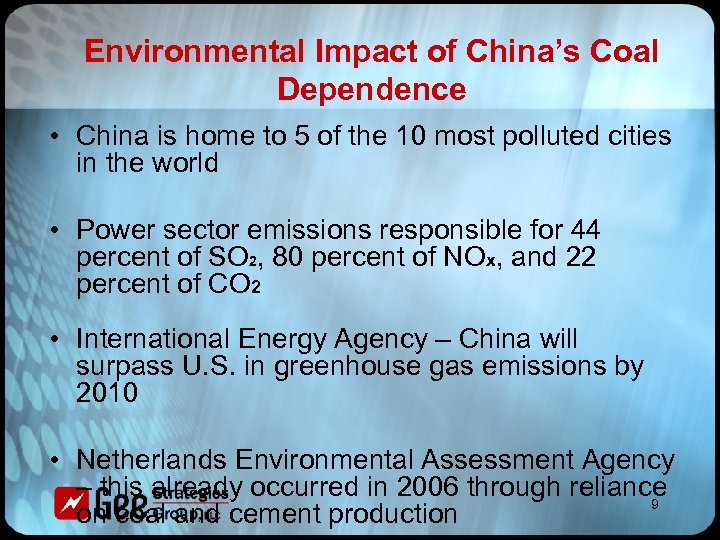
Environmental Impact of China’s Coal Dependence • China is home to 5 of the 10 most polluted cities in the world • Power sector emissions responsible for 44 percent of SO 2, 80 percent of NOx, and 22 percent of CO 2 • International Energy Agency – China will surpass U. S. in greenhouse gas emissions by 2010 • Netherlands Environmental Assessment Agency – this already occurred in 2006 through reliance 9 on coal and cement production
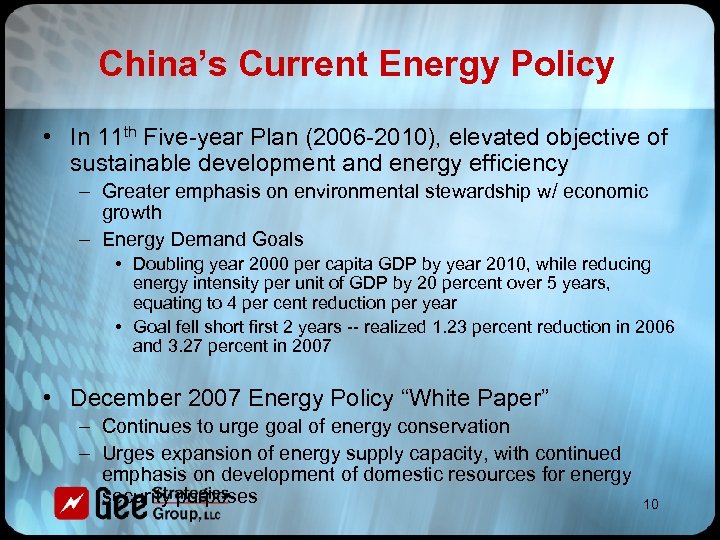
China’s Current Energy Policy • In 11 th Five-year Plan (2006 -2010), elevated objective of sustainable development and energy efficiency – Greater emphasis on environmental stewardship w/ economic growth – Energy Demand Goals • Doubling year 2000 per capita GDP by year 2010, while reducing energy intensity per unit of GDP by 20 percent over 5 years, equating to 4 per cent reduction per year • Goal fell short first 2 years -- realized 1. 23 percent reduction in 2006 and 3. 27 percent in 2007 • December 2007 Energy Policy “White Paper” – Continues to urge goal of energy conservation – Urges expansion of energy supply capacity, with continued emphasis on development of domestic resources for energy security purposes 10
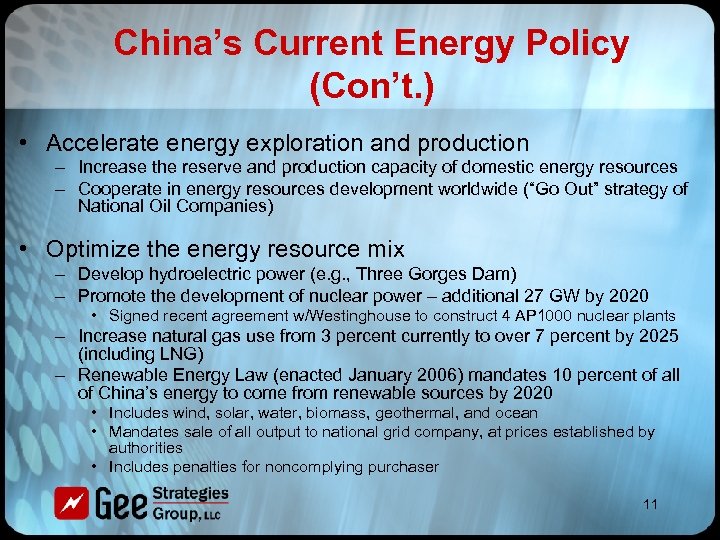
China’s Current Energy Policy (Con’t. ) • Accelerate energy exploration and production – Increase the reserve and production capacity of domestic energy resources – Cooperate in energy resources development worldwide (“Go Out” strategy of National Oil Companies) • Optimize the energy resource mix – Develop hydroelectric power (e. g. , Three Gorges Dam) – Promote the development of nuclear power – additional 27 GW by 2020 • Signed recent agreement w/Westinghouse to construct 4 AP 1000 nuclear plants – Increase natural gas use from 3 percent currently to over 7 percent by 2025 (including LNG) – Renewable Energy Law (enacted January 2006) mandates 10 percent of all of China’s energy to come from renewable sources by 2020 • Includes wind, solar, water, biomass, geothermal, and ocean • Mandates sale of all output to national grid company, at prices established by authorities • Includes penalties for noncomplying purchaser 11
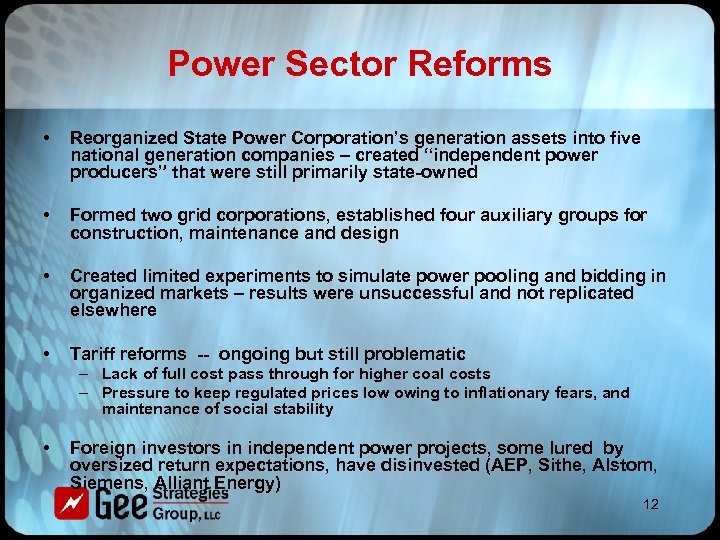
Power Sector Reforms • Reorganized State Power Corporation’s generation assets into five national generation companies – created “independent power producers” that were still primarily state-owned • Formed two grid corporations, established four auxiliary groups for construction, maintenance and design • Created limited experiments to simulate power pooling and bidding in organized markets – results were unsuccessful and not replicated elsewhere • Tariff reforms -- ongoing but still problematic – Lack of full cost pass through for higher coal costs – Pressure to keep regulated prices low owing to inflationary fears, and maintenance of social stability • Foreign investors in independent power projects, some lured by oversized return expectations, have disinvested (AEP, Sithe, Alstom, Siemens, Alliant Energy) 12
Regulatory Reforms • Over several years, government reorganizations were implemented to reform the decision-making process • But progress is still hampered by – interagency infighting over jurisdiction – Battles between market-oriented officials and state-enterprise supporters – Lack of transparency in decision-making processes • In 2002, State Electricity Regulatory Commission (SERC) formed – But still not a independent regulator – Tariff jurisdiction still shared with National Development and Reform Commission (NDRC) – NDRC still responsible for energy policy • In March 2008, National Energy Commission created to develop “national energy strategies” – But administration and oversight still resides in Energy Bureau of NDRC – Possible prelude to creation of Energy Ministry to consolidate decision making authority which is now diffuse • Continued discussion of enacting new Energy Law, but not likely this year 13
China’s Greenhouse Gas Mitigation Strategy: The 900 Pound Global “Gorilla” • As non-Annex I developing country under Kyoto Protocol, China is exempted from obligations to reduce GHG • In June 2007, China announced National Climate Change Program – Rejected caps on carbon emissions – Emphasized renewable and clean energy deployment, greater research & development, population control, and raising public awareness – Looked toward leadership of developed world to reduce global intensity of carbon • US’ ability to influence China’s acceptance of carbon controls is limited until it also adopts regulation of carbon emissions • China seeks technology for carbon emission mitigation, but disfavors reliance on commercial technology transfer – Uses analogy of medicine for public health (e. g. , polio vaccine) – Wants technology transferred as a public good 14
Final Thoughts • Coal use will continue to dominate China’s resource mix in its power sector and general economy • Market equilibrium between energy supply and demand will increasingly be frustrated by continued controls on energy commodity costs and delivered power prices • No significant regulatory reform envisioned at this time • Any control of China’s future carbon emissions will be postponed for years • For more, see China’s Power Sector: Global Economic and Environmental Implications, 28 ENERGY LAW JOURNAL 421 (2007) by Robert W. Gee, Songbin Zhu, and Xiaolin Li (http: //ebanet. org/docs/elj 282/Chinas_Power_Sector. pdf) 15

朱 Robert W. Gee 健 榮 President Gee Strategies Group LLC 7609 Brittany Parc Court Falls Church, VA 22304 U. S. A. 703. 593. 0116 703. 698. 2033 (fax) rwgee@geestrategies. com www. geestrategies. com 16
Скачать презентацию CHINA S POWER SECTOR GRAPPLING WITH THE GLOBAL FOOTPRINT
2d605b1a7f509ede391da62e32592494.ppt