Скачать презентацию CHINA S JUDICIAL SYSTEM Перевод слов 1 According
АНГЛИЙСКИЙ.pptx
- Количество слайдов: 18
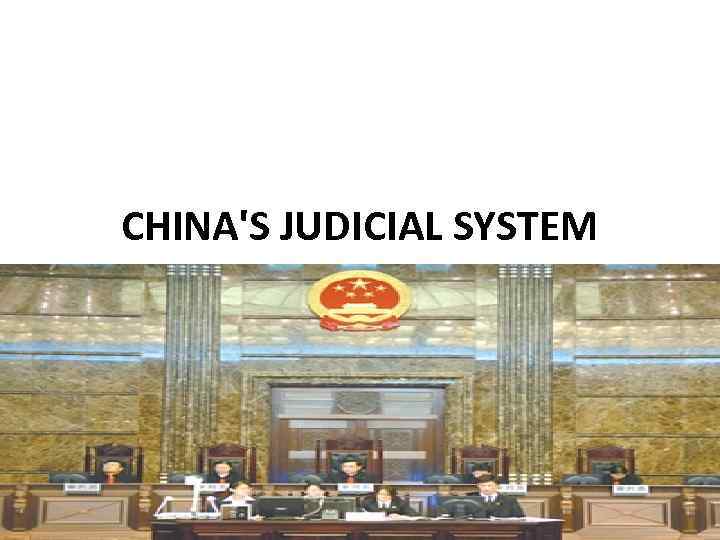 CHINA'S JUDICIAL SYSTEM
 Перевод слов: • 1)According to Criminal Procedure Law of PRC-Уголовнопроцессуальный кодекс КНР • 2) behalf of the states- От имени государства • 3) PRC –Китайская Народная Республика • 4) chief-вождь • 5) The Supreme People's Court- Верховный народный суд • 6) The Higher People's Courts- высший народный суд • 7) provincial level- на областном уровне. • 8) responsible for settling civil disputes- несет ответственность за урегулирование гражданских споров. • 9) handling- обработка • 10) minor criminal cases – незначительные уголовные дела • 11) require- требуют • 12) formal handling- формальное обращение
 Strictly speaking, China's judicial system only refers to people's court system. According to Criminal Procedure Law of PRC, during the criminal proceeding, people's court, people's procuratorate and public security organ shall perform their task respectively as well as cooperate. In this meaning, people's procuratorate and public security organ both execute judicial power, although their judicial function are limited in a very relatively narrow scope.
 Thus broadly speaking, China's judicial system institutionally comprises of three parts: people's court system, the people's procuratorate system, the public security system. Corresponding to this, Judicial structure in the Chinese broad sense does not only refer to courts, but also to procuratorates and public security organs.
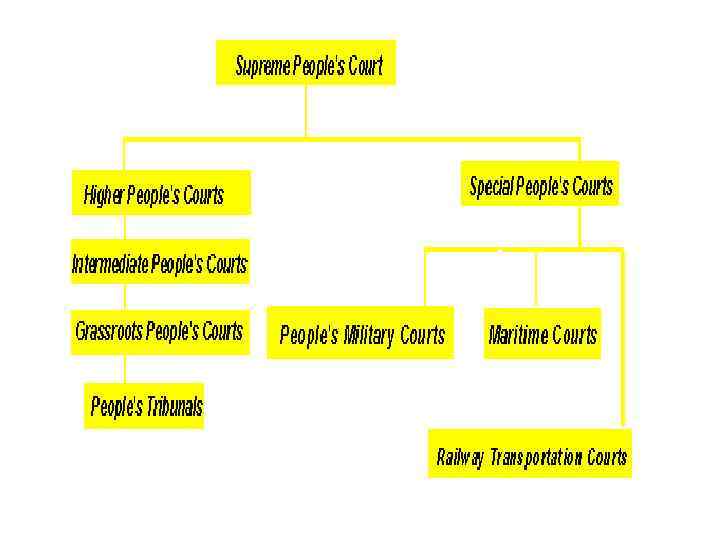
 People's Courts The people's courts are judicial organs exercising judicial power on behalf of the states. According to the Constitution The judicial authority of the PRC is exercised by the following people's courts: local people's courts at various levels; military courts and other special people's courts and the Supreme People's Courts. Within each court, there are usually several divisions, such as civil, economic, criminal, administrative and enforcement divisions.
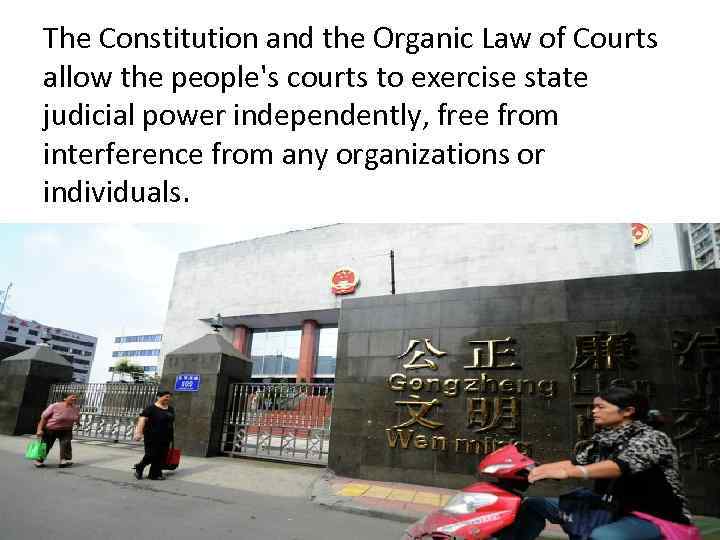 The Constitution and the Organic Law of Courts allow the people's courts to exercise state judicial power independently, free from interference from any organizations or individuals.
 The Supreme People's Court is the highest judicial organ of the State. The president of the Supreme People's Court is elected by the NPC and its standing committee. His term of office is five years and he may serve for no more than two consecutive terms. The Supreme People's Court has a criminal division, a civil division, and an economic division.
 Generally, it has jurisdiction over the following cases: • 1 Cases of first instance assigned by laws and other cases that it considers it should try itself; • 2. Appealed and protested cases against judgments and other orders of higher people's courts and special people's courts; • 3. Protested cases filed by the Supreme People's Procuratorate.
 The Higher People's Courts are courts of provinces, autonomous regions and municipalities directly under the Central Government. The internal structure is almost the same as that of the Supreme People's Court according to the definition of the organic Law. A higher people's court deals with cases of the first instance assigned by laws and decrees, cases of the first instance transferred from people's courts at the next lower level, cases of appeals and of protests lodged against judgments and orders of people's courts at the next lower level, and cases of protests lodged by people's procuratorates.
 The Intermediate People's Courts They are the courts established in capitals or prefectures in the provincial level. The scope of jurisdiction by an intermediate people's court covers cases of first instance assigned by laws and decrees, cases of first instance transferred from the basic people's courts, and appealed and protested cases from the lower court.
 The Basic People's Courts. The basic courts, as the lowest level, are normally located at the county, municipal districts and autonomous counties. A basic people's court may set up a number of people's tribunal according to the conditions of the locality, population and cases involved. A people's tribunal is a component of the basic people's court, and its judgments and orders are considered as judgments and orders of the basic people's court with the same legal effects. In practice, a tribunal of this nature is often set up in big town or townships where there is a concentrated population.
 As defined in the Organic Law, the basic people's court adjudicates all criminal and civil cases of the first instance except where the law provides otherwise. Besides trying cases, a basic people's court is also responsible for settling civil disputes, handling minor criminal cases that do not require formal handling, and directing the work of the people's mediation committees.
 The Special Courts The special courts include military courts, railway courts and maritime courts. The military court that is established within the PLA is in charge of hearing criminal cases involving servicemen. This is a relatively closed system. The railway and transport court deals with criminal cases and economic disputes relating to railways and transportation
 Qualifications of Judges are elected with the following qualifications: • -A citizen of the People's Republic of China; • - At least 23 years of age • - Supports the Constitution of the People's Republic of China; • - In good political, professional and moral standing; • - In good health
 Thank you for your attention!