


 Скачать презентацию China s Higher Education Market Opportunities and Risks Ying
fbeedc29cd6d3806ddbfeaf3bde9cf9d.ppt
- Количество слайдов: 26
 China’s Higher Education Market: Opportunities and Risks Ying Shea, CEO Go 4 it China Jan. 21, 2004 Washington, DC
 Topics § The Chinese Higher Education Market Overview § Market Challenges § The Road Ahead: Strategies to win 2
 CHINA’S PRIVATE EDUCATION MARKET OVERVIEW § Huge market potential with many unmet needs as current public school system not able to satisfy increasing demands on better education quality; § Regulatory environment is slowly easing up and become more favorable for private education’s development ; § Privately funded schools increasing rapidly, but many lacks sound professional management and quality curriculum; § Thus create an opportunity for high quality private education. 3
 The Characteristics of Chinese Higher Education § Enrollment and public finding for higher education continue to see double digit growth; § Shift from an elite system to a mass system; § More openness in allowing for private investment in higher education; § More focus on quality of education to develop more comprehensive skills and capabilities for increasingly globalized workforce demand; § Strong economic orientation for international cooperative programs § Increasing use of ICT in educational access & delivery system. 4
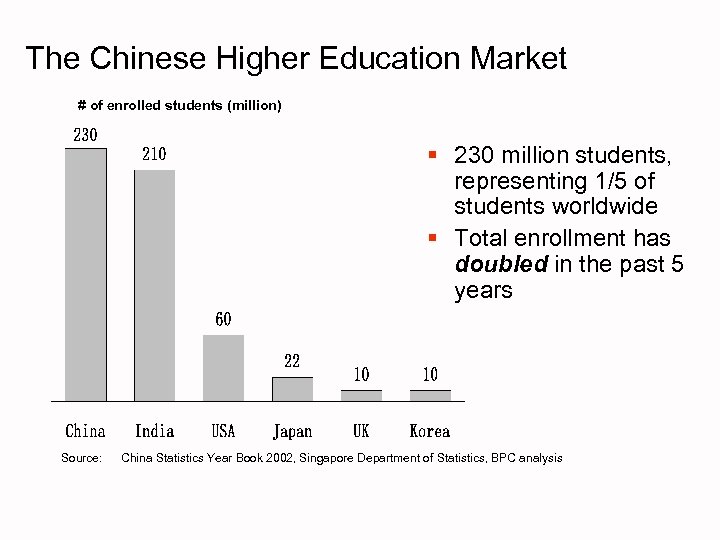 The Chinese Higher Education Market # of enrolled students (million) § 230 million students, representing 1/5 of students worldwide § Total enrollment has doubled in the past 5 years Source: China Statistics Year Book 2002, Singapore Department of Statistics, BPC analysis 5
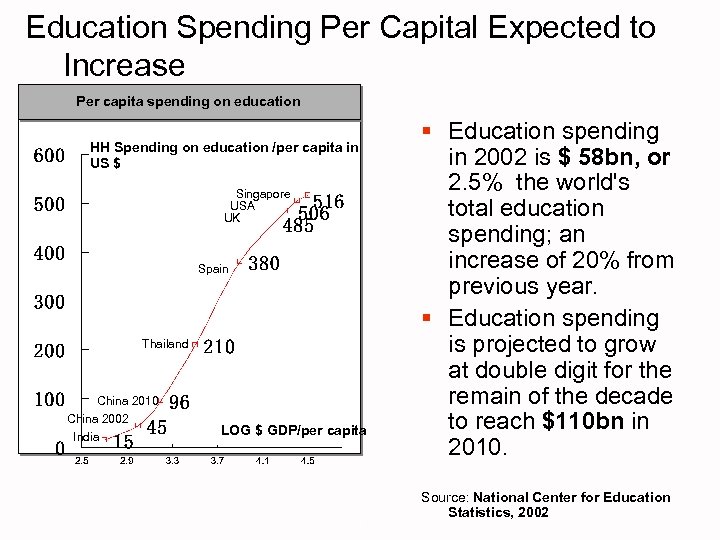 Education Spending Per Capital Expected to Increase Per capita spending on education HH Spending on education /per capita in US $ Singapore USA UK Spain Thailand China 2010 China 2002 India LOG $ GDP/per capita § Education spending in 2002 is $ 58 bn, or 2. 5% the world's total education spending; an increase of 20% from previous year. § Education spending is projected to grow at double digit for the remain of the decade to reach $110 bn in 2010. Source: National Center for Education Statistics, 2002 6
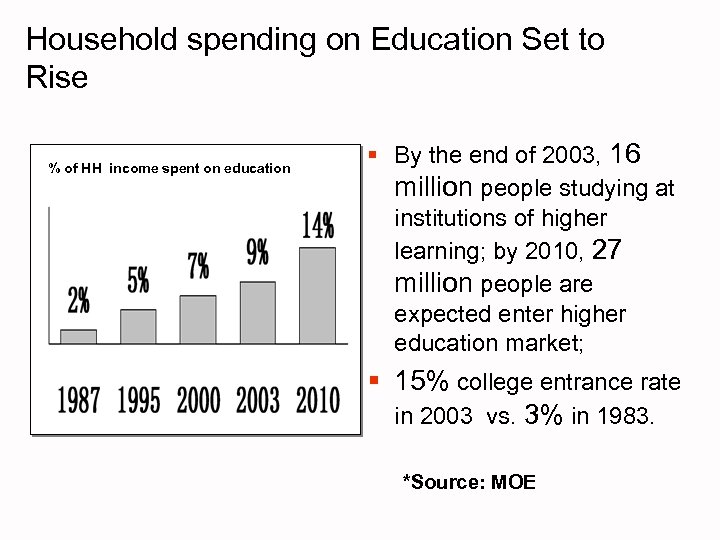 Household spending on Education Set to Rise § By the end of 2003, 16 million people studying at institutions of higher learning; by 2010, 27 million people are expected enter higher education market; % of HH income spent on education § 15% college entrance rate in 2003 vs. 3% in 1983. *Source: MOE 7
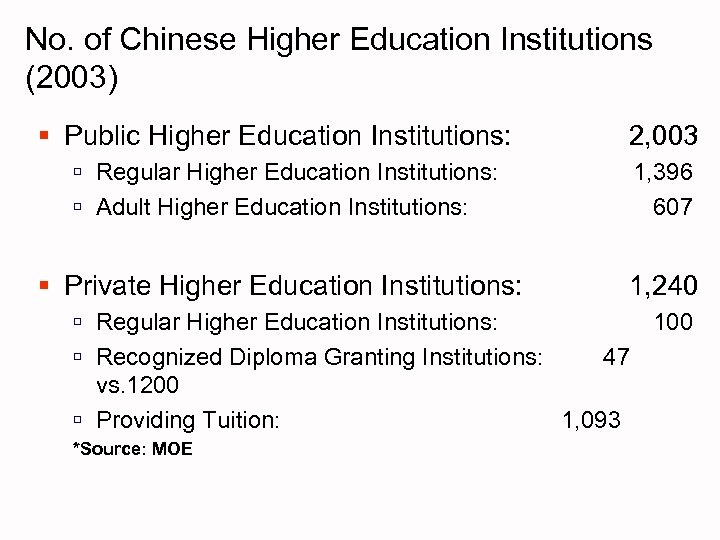 No. of Chinese Higher Education Institutions (2003) § Public Higher Education Institutions: 2, 003 ú Regular Higher Education Institutions: ú Adult Higher Education Institutions: 1, 396 607 § Private Higher Education Institutions: 1, 240 ú Regular Higher Education Institutions: 100 ú Recognized Diploma Granting Institutions: 47 vs. 1200 ú Providing Tuition: 1, 093 *Source: MOE 8
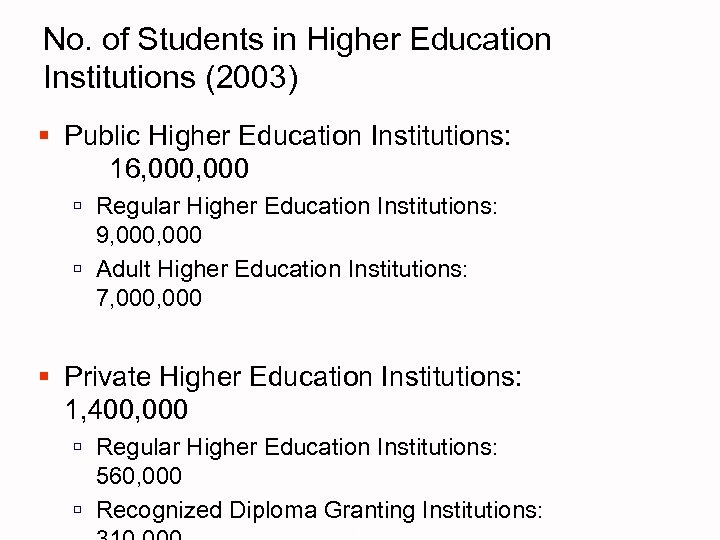 No. of Students in Higher Education Institutions (2003) § Public Higher Education Institutions: 16, 000 ú Regular Higher Education Institutions: 9, 000 ú Adult Higher Education Institutions: 7, 000 § Private Higher Education Institutions: 1, 400, 000 ú Regular Higher Education Institutions: 560, 000 ú Recognized Diploma Granting Institutions: 9
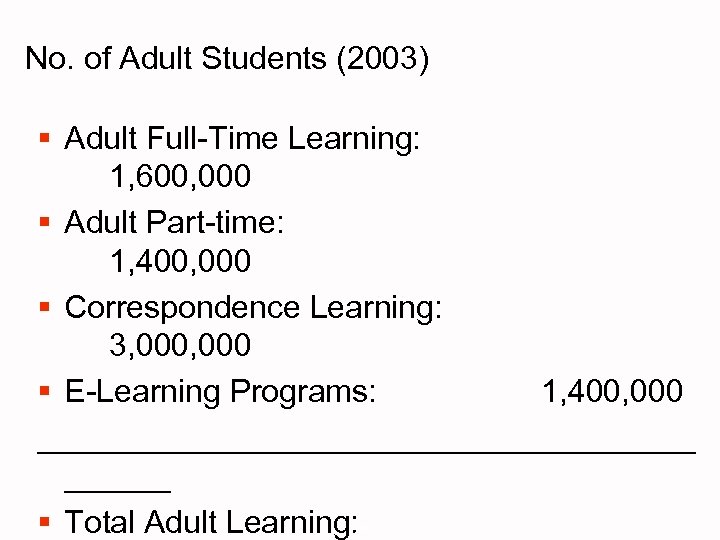 No. of Adult Students (2003) § Adult Full-Time Learning: 1, 600, 000 § Adult Part-time: 1, 400, 000 § Correspondence Learning: 3, 000 § E-Learning Programs: 1, 400, 000 ___________________ § Total Adult Learning: 10
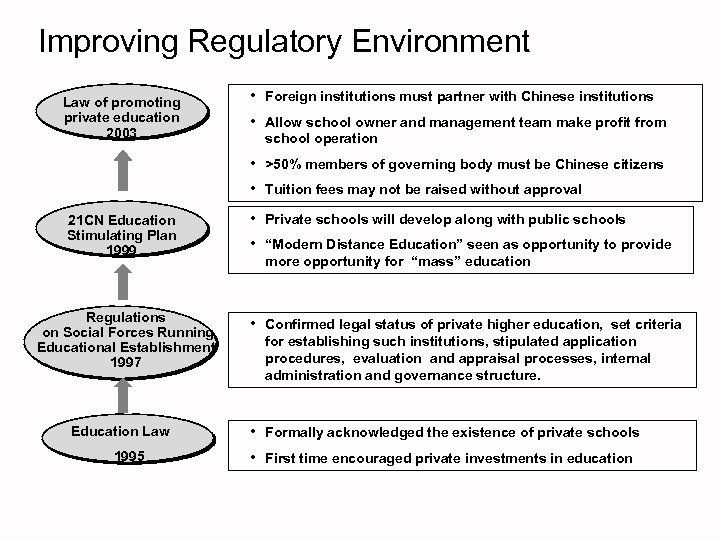 Improving Regulatory Environment Law of promoting private education 2003 • Foreign institutions must partner with Chinese institutions • Allow school owner and management team make profit from school operation • >50% members of governing body must be Chinese citizens • Tuition fees may not be raised without approval 21 CN Education Stimulating Plan 1999 Regulations on Social Forces Running Educational Establishment 1997 Education Law 1995 • Private schools will develop along with public schools • “Modern Distance Education” seen as opportunity to provide more opportunity for “mass” education • Confirmed legal status of private higher education, set criteria for establishing such institutions, stipulated application procedures, evaluation and appraisal processes, internal administration and governance structure. • Formally acknowledged the existence of private schools • First time encouraged private investments in education 11
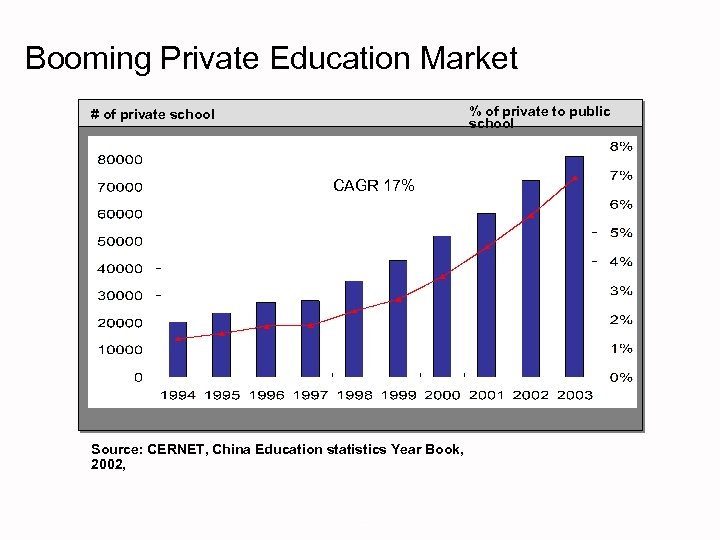 Booming Private Education Market % of private to public school # of private school CAGR 17% Source: CERNET, China Education statistics Year Book, 2002, 12
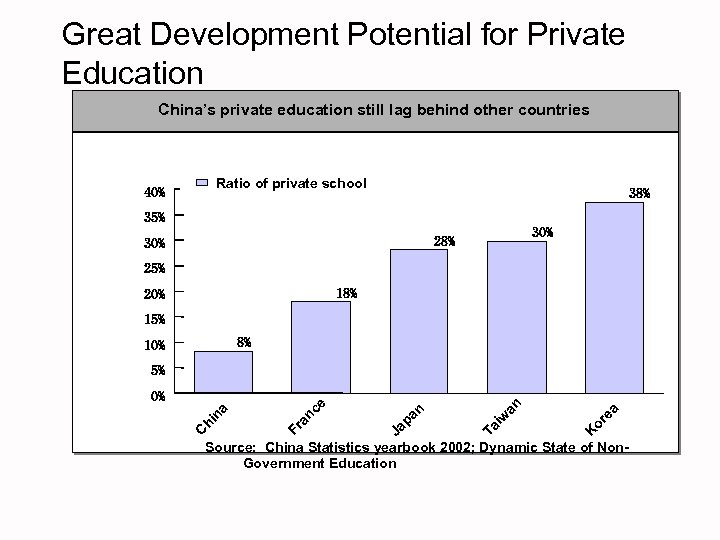 Great Development Potential for Private Education China’s private education still lag behind other countries Ratio of private school 40% 38% 35% 30% 28% 30% 25% 18% 20% 15% 8% 10% 5% or ea an K Ja p Ta iw an ce Fr an C hi na 0% Source: China Statistics yearbook 2002; Dynamic State of Non. Government Education 13
 Topics § The Chinese Higher Education Market Overview § Market Challenges § The Road Ahead: Strategies to win 14
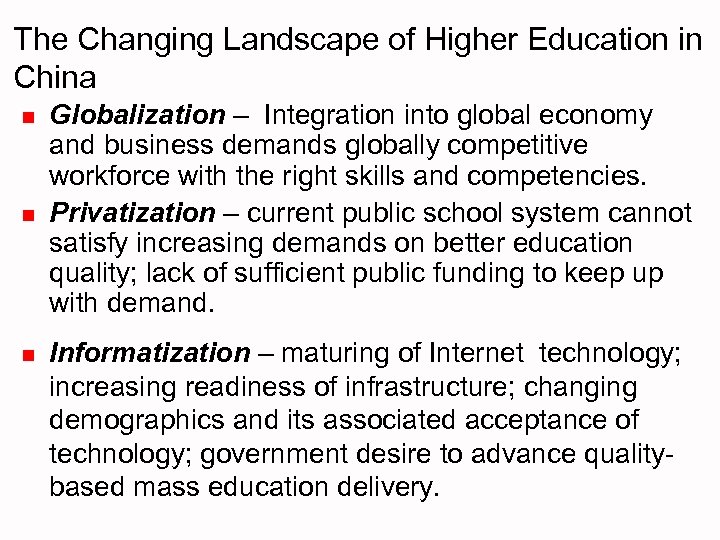 The Changing Landscape of Higher Education in China n n n Globalization – Integration into global economy and business demands globally competitive workforce with the right skills and competencies. Privatization – current public school system cannot satisfy increasing demands on better education quality; lack of sufficient public funding to keep up with demand. Informatization – maturing of Internet technology; increasing readiness of infrastructure; changing demographics and its associated acceptance of technology; government desire to advance qualitybased mass education delivery. 15
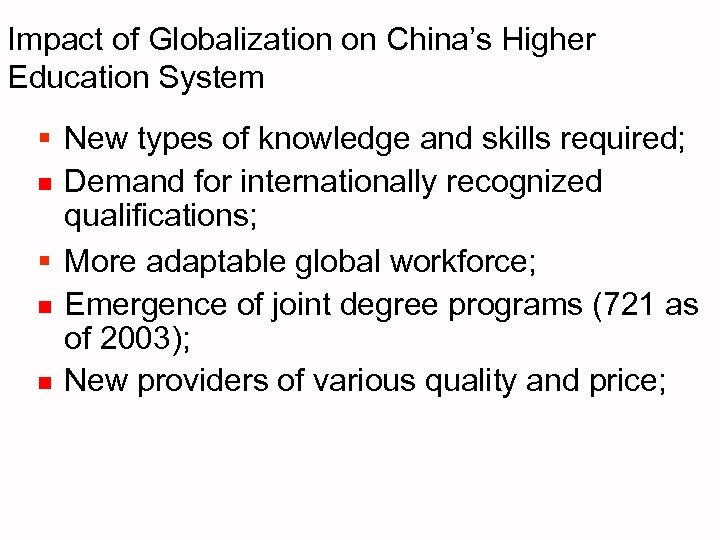 Impact of Globalization on China’s Higher Education System § New types of knowledge and skills required; n Demand for internationally recognized qualifications; § More adaptable global workforce; n Emergence of joint degree programs (721 as of 2003); n New providers of various quality and price; 16
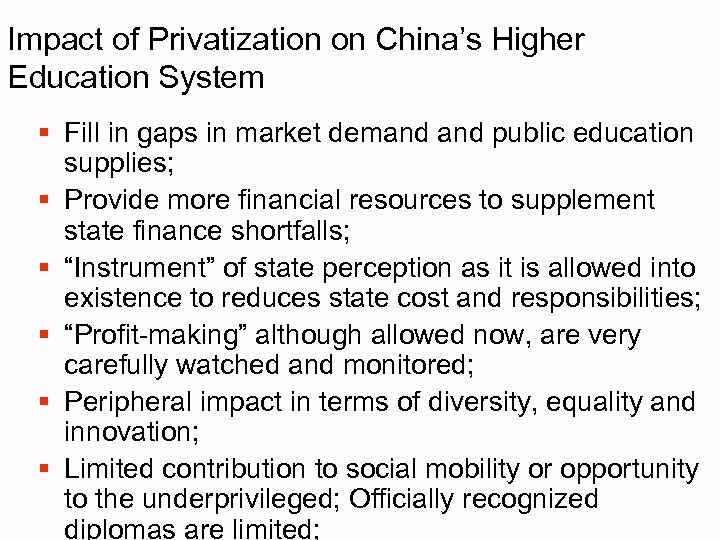 Impact of Privatization on China’s Higher Education System § Fill in gaps in market demand public education supplies; § Provide more financial resources to supplement state finance shortfalls; § “Instrument” of state perception as it is allowed into existence to reduces state cost and responsibilities; § “Profit-making” although allowed now, are very carefully watched and monitored; § Peripheral impact in terms of diversity, equality and innovation; § Limited contribution to social mobility or opportunity to the underprivileged; Officially recognized diplomas are limited; 17
 Impact of ICT on China’s Higher Education System § Expanded access over vast areas varying levels of socio-economic development; § Pedagogical approaches to more student directed learning vs. teacher centered teaching; § Demand for more directly applicable knowledge and skills constantly; § Growing effectiveness in uses of ICT’s will advance higher education delivery to masses; § Governments fostering greater creativity in distribution models; § Quality remains a major concern; new assessment and quality assurance need to be created. 18
 National Educational Information Infrastructure § CERNET (China Education & Research Network) now connects more than 100 higher education institutions; § CETV restructured; from one way TV transmission to interactive satellite digital delivery systems § More than 2, 000 study centers across China § 66 leading Chinese higher educational institutions authorized to offer online courses. § The national system for Radio Television University including 1 CRTVU + 44 PRTVU + >800 branch schools + >1, 900 work stations + 18, 000 distance learning courses + 1. 5 mn students 19
 Characteristics of Chinese Private Higher Education § Private Education = Min. Ban Colleges (People- run educational institutions, privately and collectively owned, non-state run ) § Competition from state-run higher education institutions; § Imitation of public sectors and seeing affiliations to gain footing and legitimacy; § “Market Oriented” curriculum – higher vocational education; § Perceived as lower grade education resulting from lower admission standard; § Lower quality teaching staff; 20
 The Known and Unknown Risks n Regulatory ambiguities: No mention of distance education in the new regulation on private investment in higher education. n Economic & investment climate n Market – under/ over supply; competition; negative demographics; pricing affordability; reputation n Partner selection n Top “brand” schools in top cities not necessarily best partners n Divergent approaches to educational administration n Financial status and administrative capacity 21
 Topics § The Chinese Higher Education Market Overview § Market Challenges § The Road Ahead: Strategies to win 22
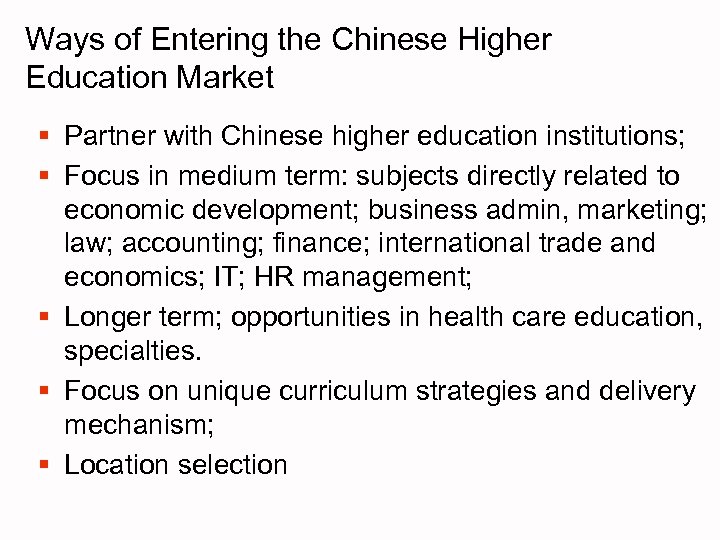 Ways of Entering the Chinese Higher Education Market § Partner with Chinese higher education institutions; § Focus in medium term: subjects directly related to economic development; business admin, marketing; law; accounting; finance; international trade and economics; IT; HR management; § Longer term; opportunities in health care education, specialties. § Focus on unique curriculum strategies and delivery mechanism; § Location selection 23
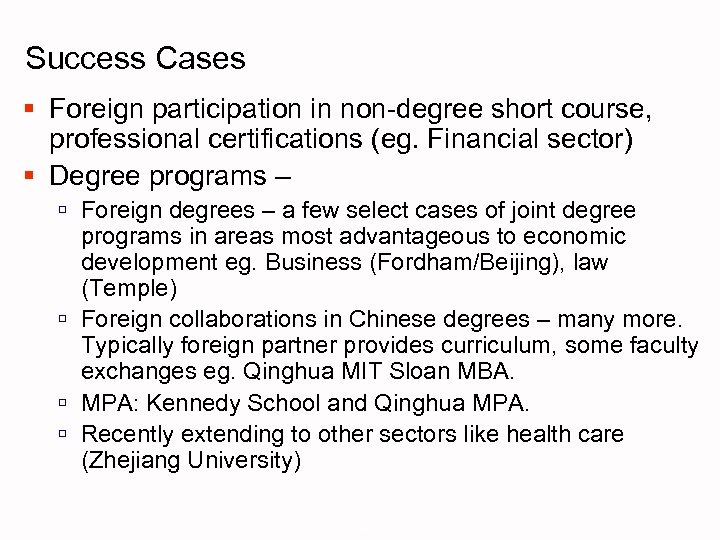 Success Cases § Foreign participation in non-degree short course, professional certifications (eg. Financial sector) § Degree programs – ú Foreign degrees – a few select cases of joint degree programs in areas most advantageous to economic development eg. Business (Fordham/Beijing), law (Temple) ú Foreign collaborations in Chinese degrees – many more. Typically foreign partner provides curriculum, some faculty exchanges eg. Qinghua MIT Sloan MBA. ú MPA: Kennedy School and Qinghua MPA. ú Recently extending to other sectors like health care (Zhejiang University) 24
 Winning Approaches to the Mass Market § Private Distance Education for the Mass? ú ú ú Approval? Brand Differentiation Price Delivery Quality 25
 Q&A Thank you Ying Shea CEO, Go 4 it China Ying@go 4 it. com. cn 26