 Скачать презентацию China Review Focus Get both handouts Get
b1148db0b09b4155ec8327d696b7ed3c.ppt
- Количество слайдов: 29



China Review

Focus Get both handouts. Get out your Review Unit Study Guide (key terms and years) Turn in your comparative essay with rubric to my desk.
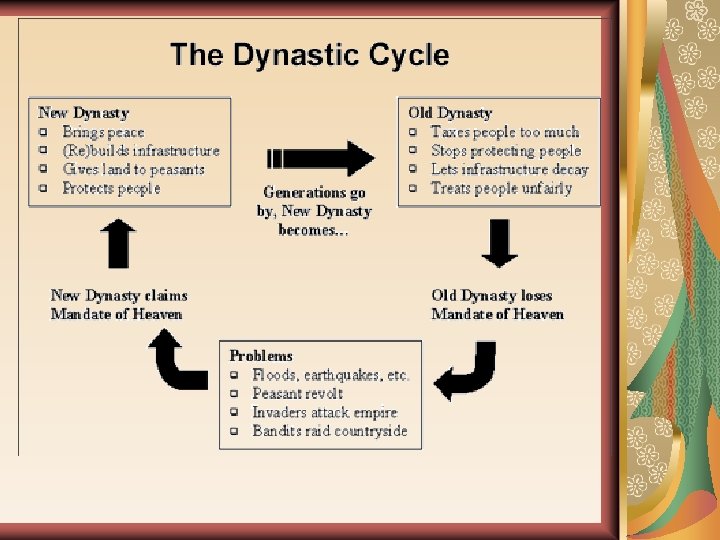
Dynasties A dynasty is a series of rulers from the same family Historically, royal rule was descended from father to son Dynastic cycle Emperor comes to power and gains the Mandate of Heaven Upward rise (wealth and population increase) to peak Downward spiral (natural disasters, corruption, etc. ) Emperor loses the Mandate of Heaven Civil war until a new emperor, with the Mandate of Heaven, comes to power Mandate of Heaven Described by philosopher Mencius Belief that the emperor was chosen by heaven to rule
Chinese Dynasties Song Shang, Zhou, Qin, Han X 2 Sui, Tang, Song X 2 Yuan, Ming, Qing, Republic X 2 Mao Zedong X 2
Shang Warrior-kings; human sacrifices to ancestors Writing began (oracle bones) Developed bronze, glazed pottery, silk industries Yellow River (Huang He) agriculture
Zhou (1045 -256 BCE) Invaded China from NW; claimed Mandate of Heaven Set up a loose central government Feudal power held by strong nobles Decline led to Warring States Period. Confucius, Laozi
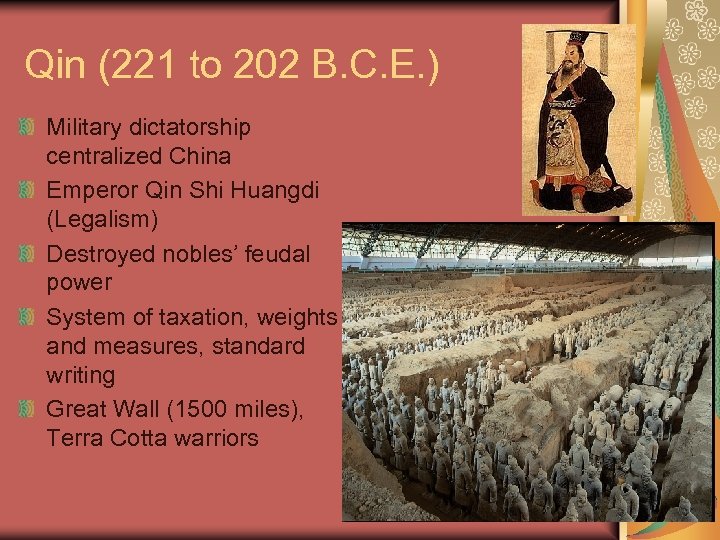
Qin (221 to 202 B. C. E. ) Military dictatorship centralized China Emperor Qin Shi Huangdi (Legalism) Destroyed nobles’ feudal power System of taxation, weights and measures, standard writing Great Wall (1500 miles), Terra Cotta warriors
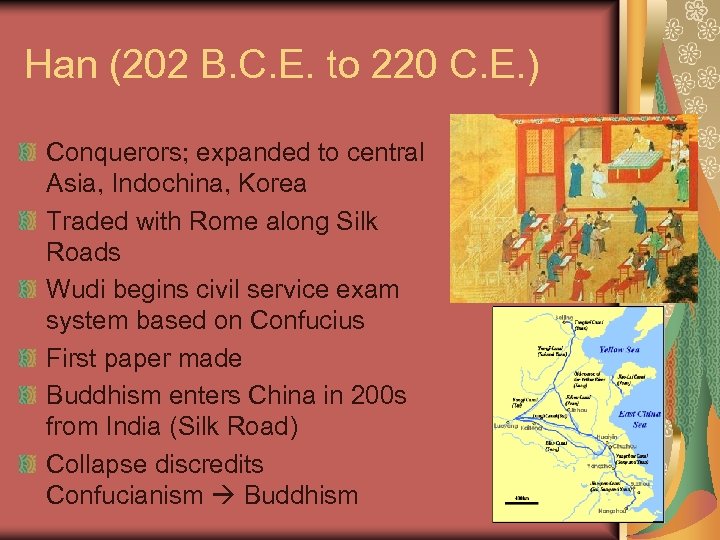
Han (202 B. C. E. to 220 C. E. ) Conquerors; expanded to central Asia, Indochina, Korea Traded with Rome along Silk Roads Wudi begins civil service exam system based on Confucius First paper made Buddhism enters China in 200 s from India (Silk Road) Collapse discredits Confucianism Buddhism
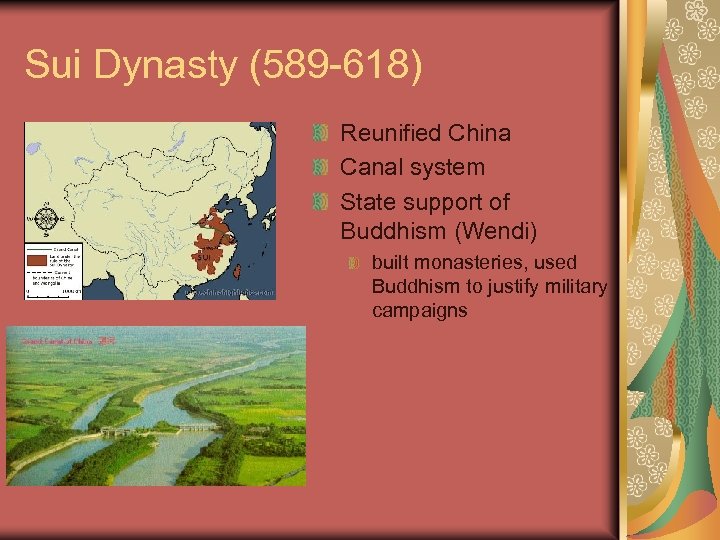
Sui Dynasty (589 -618) Reunified China Canal system State support of Buddhism (Wendi) built monasteries, used Buddhism to justify military campaigns
Tang Dynasty (618 – 907) “Golden Age” of arts and literature Education and government reforms Extended boundaries of empire Alliance and peace treaties with neighbors; tribute system High point of influence on Japan State action against Buddhism; emergence of Neo-Confucianism Empress Wu – only female to lead
Neoconfucianism Confucian revival with elements of Daoism and Buddhism Sought to understand the universe through reason and tradition; offered path to salvation
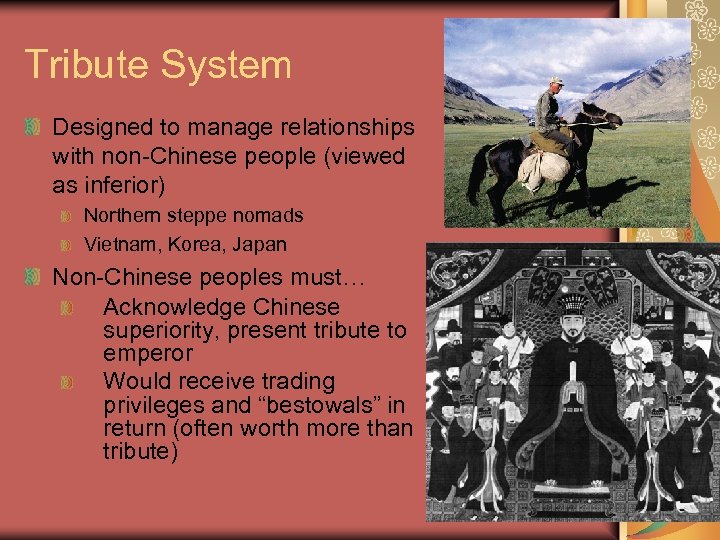
Tribute System Designed to manage relationships with non-Chinese people (viewed as inferior) Northern steppe nomads Vietnam, Korea, Japan Non-Chinese peoples must… Acknowledge Chinese superiority, present tribute to emperor Would receive trading privileges and “bestowals” in return (often worth more than tribute)
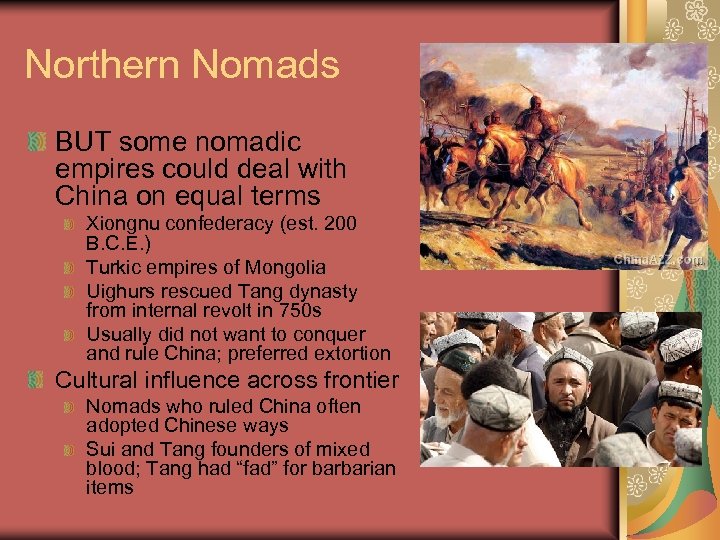
Northern Nomads BUT some nomadic empires could deal with China on equal terms Xiongnu confederacy (est. 200 B. C. E. ) Turkic empires of Mongolia Uighurs rescued Tang dynasty from internal revolt in 750 s Usually did not want to conquer and rule China; preferred extortion Cultural influence across frontier Nomads who ruled China often adopted Chinese ways Sui and Tang founders of mixed blood; Tang had “fad” for barbarian items
Song Dynasty (960 – 1279) “Economic revolution” Increased urbanization, cosmopolitan Powerful only in southern China; nomads ruled North Inventions: gunpowder, compass, printing Foot binding, especially elite women Neo-Confucianism
China’s Economic Revolution Rapid population growth 50 120 million people Improvement in agricultural and iron production Most urbanized region in the world Hangzhou (capital) had over 1 million Network of canals, rivers, and lakes provided cheap transport that bound China together Production for market (v. local consumption) Use of paper money
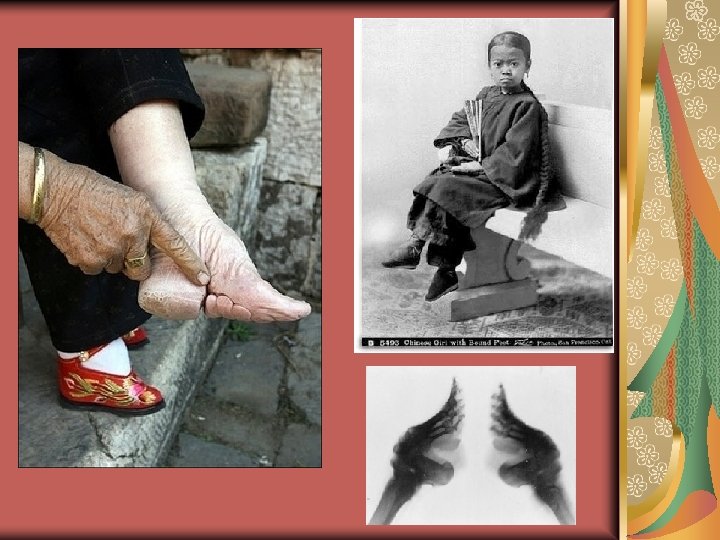
Foot Binding Tang: elite women in north had greater freedom (influence of steppe nomads) Song: tightening of patriarchal restrictions on women Foot binding starts around 1000 C. E. Associated with images of female beauty and eroticism Kept women restricted to the house Growth of textile production displaces women from economic role
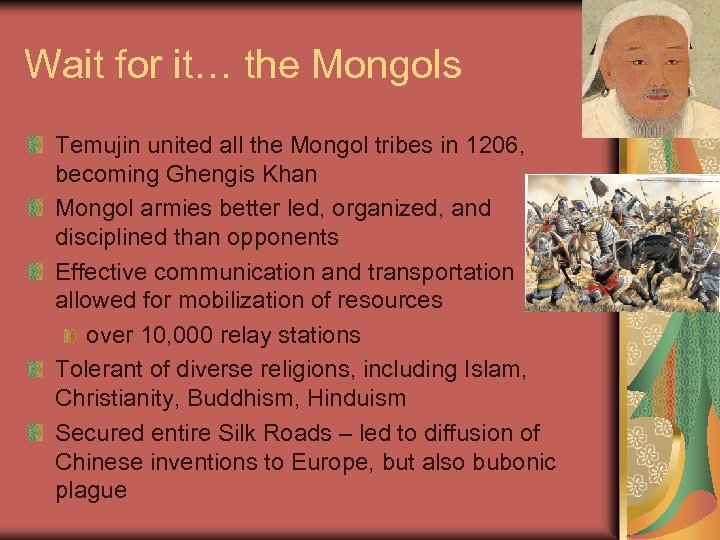
Wait for it… the Mongols Temujin united all the Mongol tribes in 1206, becoming Ghengis Khan Mongol armies better led, organized, and disciplined than opponents Effective communication and transportation allowed for mobilization of resources over 10, 000 relay stations Tolerant of diverse religions, including Islam, Christianity, Buddhism, Hinduism Secured entire Silk Roads – led to diffusion of Chinese inventions to Europe, but also bubonic plague
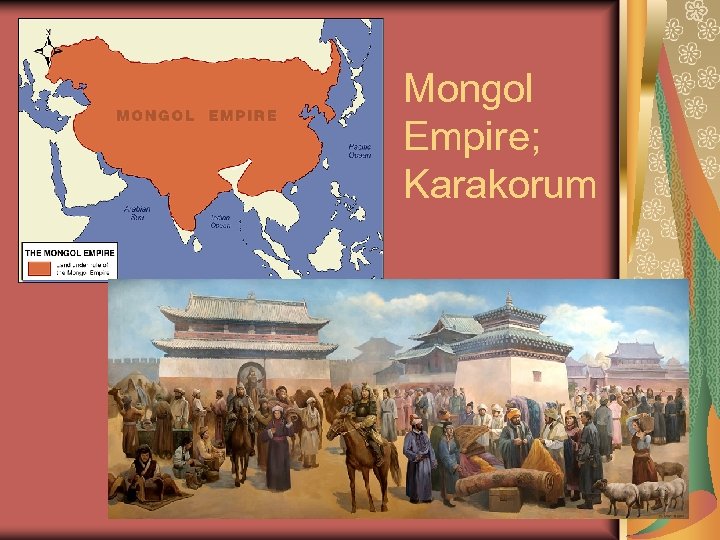
Mongol Empire; Karakorum
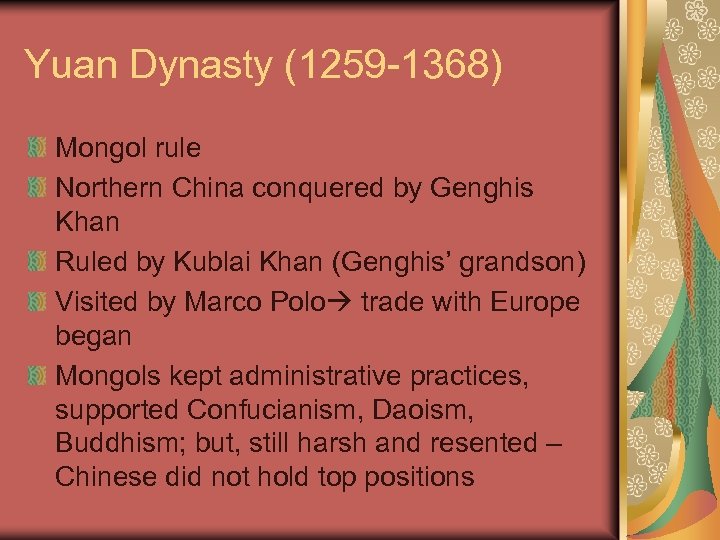
Yuan Dynasty (1259 -1368) Mongol rule Northern China conquered by Genghis Khan Ruled by Kublai Khan (Genghis’ grandson) Visited by Marco Polo trade with Europe began Mongols kept administrative practices, supported Confucianism, Daoism, Buddhism; but, still harsh and resented – Chinese did not hold top positions
China and World Economy Diffusion of technological innovations: paper, printing, gunpowder, compass Defeated by Abbasids at Battle of Talas River (751) diffusion of paper Silk Road and growing participation in Indian Ocean trade Foreign merchants along port cities China also benefited from interaction Buddhism from India – enters via Silk Roads; Mahayana becomes popular Champa rice from Vietnam– new strain grown in half time
“Sinification” Adopting Chinese culture Korea, Vietnam, and Japan were all influenced by China during postclassical era, but maintained distinctive identities
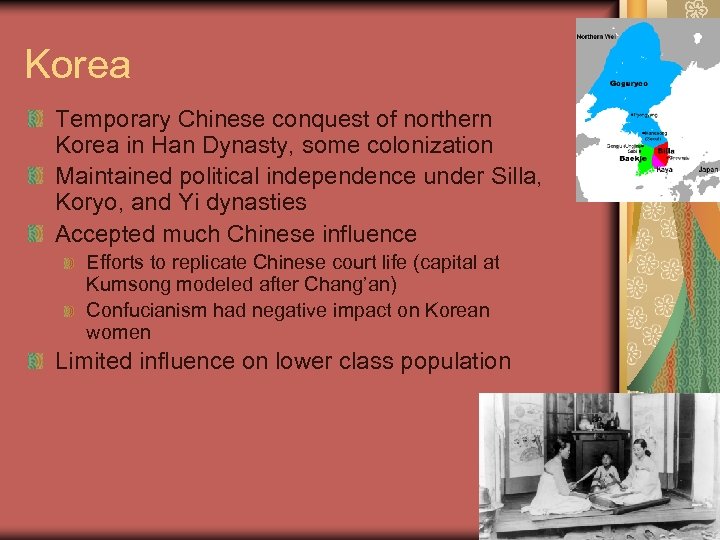
Korea Temporary Chinese conquest of northern Korea in Han Dynasty, some colonization Maintained political independence under Silla, Koryo, and Yi dynasties Accepted much Chinese influence Efforts to replicate Chinese court life (capital at Kumsong modeled after Chang’an) Confucianism had negative impact on Korean women Limited influence on lower class population
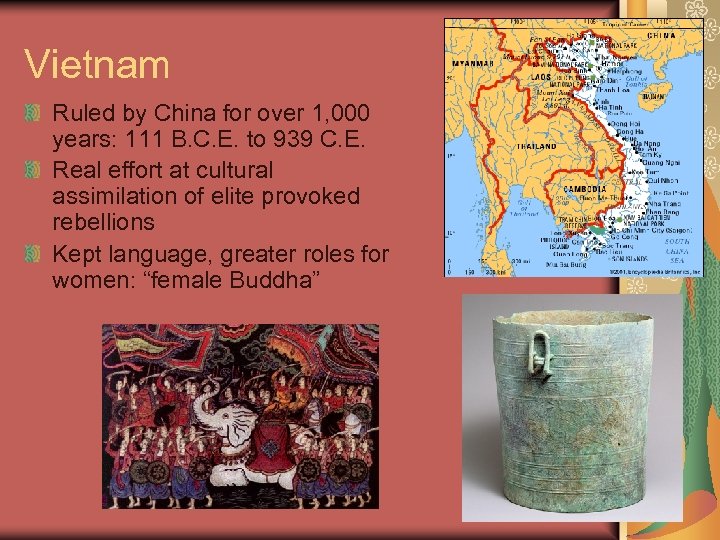
Vietnam Ruled by China for over 1, 000 years: 111 B. C. E. to 939 C. E. Real effort at cultural assimilation of elite provoked rebellions Kept language, greater roles for women: “female Buddha”
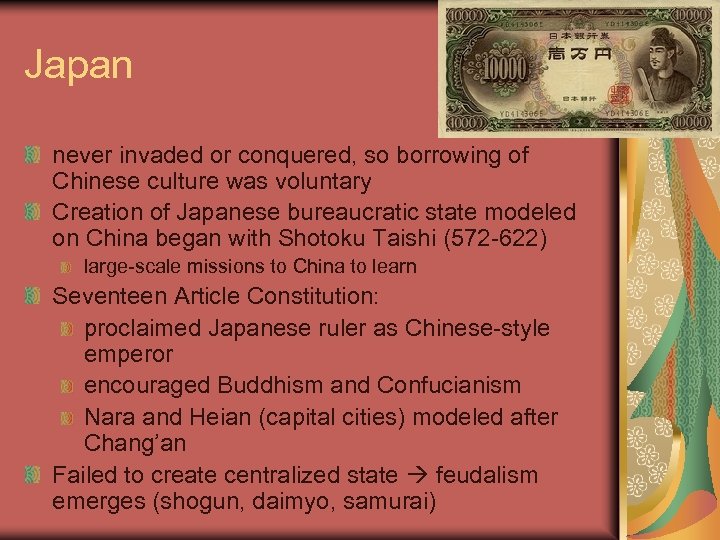
Japan never invaded or conquered, so borrowing of Chinese culture was voluntary Creation of Japanese bureaucratic state modeled on China began with Shotoku Taishi (572 -622) large-scale missions to China to learn Seventeen Article Constitution: proclaimed Japanese ruler as Chinese-style emperor encouraged Buddhism and Confucianism Nara and Heian (capital cities) modeled after Chang’an Failed to create centralized state feudalism emerges (shogun, daimyo, samurai)
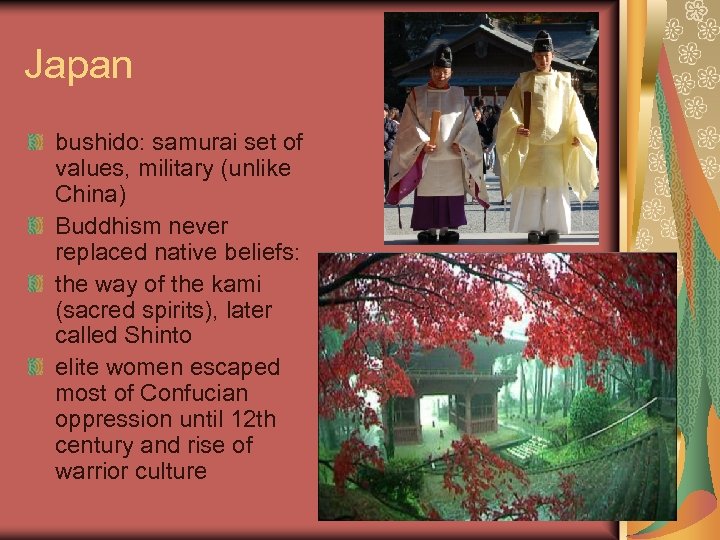
Japan bushido: samurai set of values, military (unlike China) Buddhism never replaced native beliefs: the way of the kami (sacred spirits), later called Shinto elite women escaped most of Confucian oppression until 12 th century and rise of warrior culture
Essential Vocabulary 1. Neoconfucianism 2. Emperor Wendi 3. Empress Wu 4. Ghengis Khan 5. Kublai Khan 6. tribute system 7. foot binding 8. Battle of Talas River 9. Champa Rice 10. Sinification 11. Bushido 12. Shinto 13. Shotoku Taishi 14. Seventeen Article Constitution 15. Samurai, daimyo, shogun
Your Turn 1. From the Han Dynasty to the Yuan, identify changes and continuities in Chinese: Society Politics Religion Gender Technology Economics
Скачать презентацию China Review Focus Get both handouts Get
b1148db0b09b4155ec8327d696b7ed3c.ppt