


 Скачать презентацию China One Child Policy Saki Amagai and Kyory
bdb074af0dec04aeeeab67de80db871d.ppt
- Количество слайдов: 22
 China: One Child Policy Saki Amagai and Kyory Park
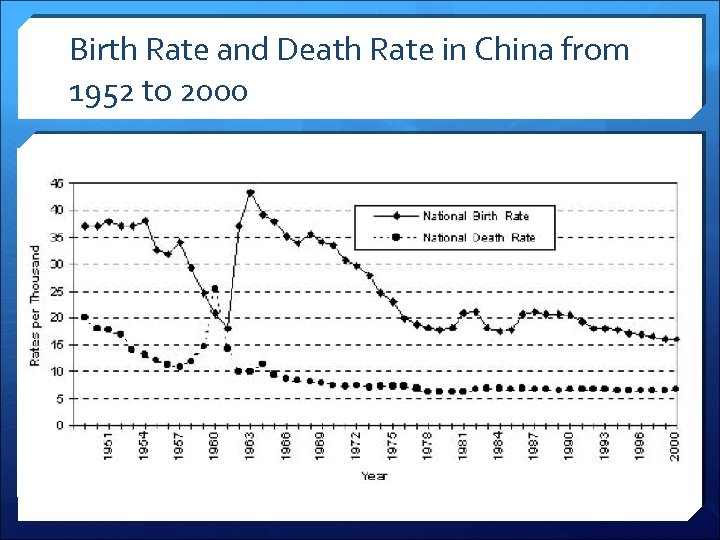 Birth Rate and Death Rate in China from 1952 to 2000
 Brief History of China #1 Until 1949, Chinese leaders saw only the advantages of a rapidly growing population, but the disadvantages soon became apparent as the Chinese population kept on increasing. Advantages: -economic growth from increased purchases -more great minds to lead more industrial, medical and agricultural innovations -better public facilities Disadvantages: -use of excessive amount of natural resources -lots of pollution -overcrowding and civil unrest -food shortage -hard to govern and control
 Brief History #2 Chinese leaders gave vigorous propaganda support to the Ministry of Public Health’s mass birth control efforts in August 1956. However, it had little impact on fertility. The interest in birth control increased after the Great Leap Forward as rapid population growth became an obstacle to development. In 1964, Birth control offices were administered in governments; this was successful in the cities, where the birth rate was cut in half. The chaos of Cultural Revolution lead the program to a halt.
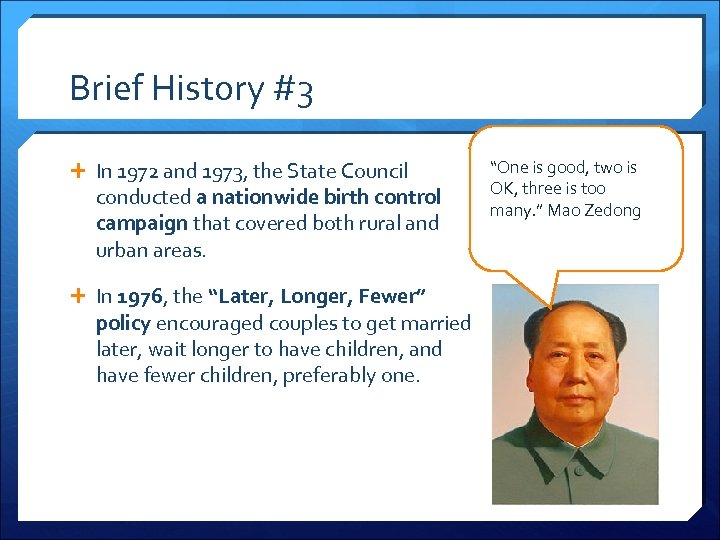 Brief History #3 In 1972 and 1973, the State Council conducted a nationwide birth control campaign that covered both rural and urban areas. In 1976, the “Later, Longer, Fewer” policy encouraged couples to get married later, wait longer to have children, and have fewer children, preferably one. “One is good, two is OK, three is too many. ” Mao Zedong
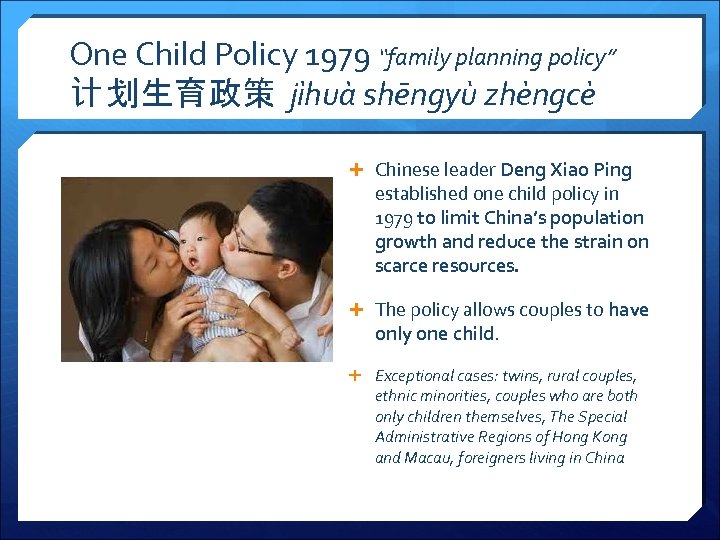 One Child Policy 1979 “family planning policy” 计 划生育政策 jìhuà shēngyù zhèngcè Chinese leader Deng Xiao Ping established one child policy in 1979 to limit China’s population growth and reduce the strain on scarce resources. The policy allows couples to have only one child. Exceptional cases: twins, rural couples, ethnic minorities, couples who are both only children themselves, The Special Administrative Regions of Hong Kong and Macau, foreigners living in China
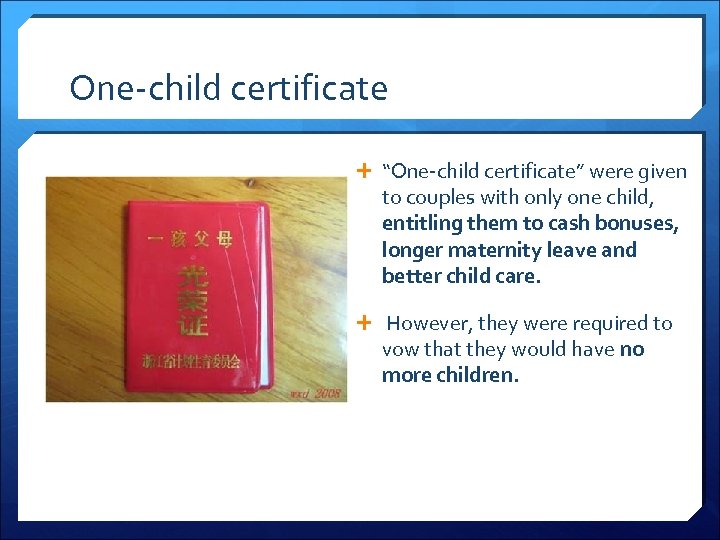 One-child certificate “One-child certificate” were given to couples with only one child, entitling them to cash bonuses, longer maternity leave and better child care. However, they were required to vow that they would have no more children.
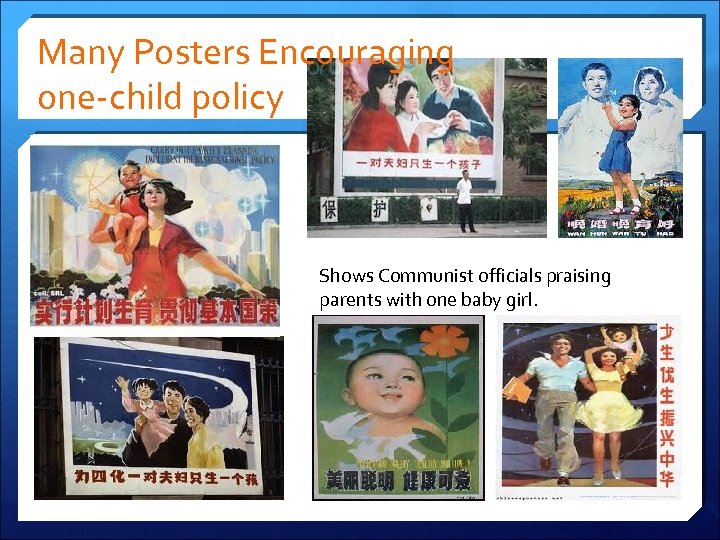 Many Posters Encouraging one-child policy Shows Communist officials praising parents with one baby girl.
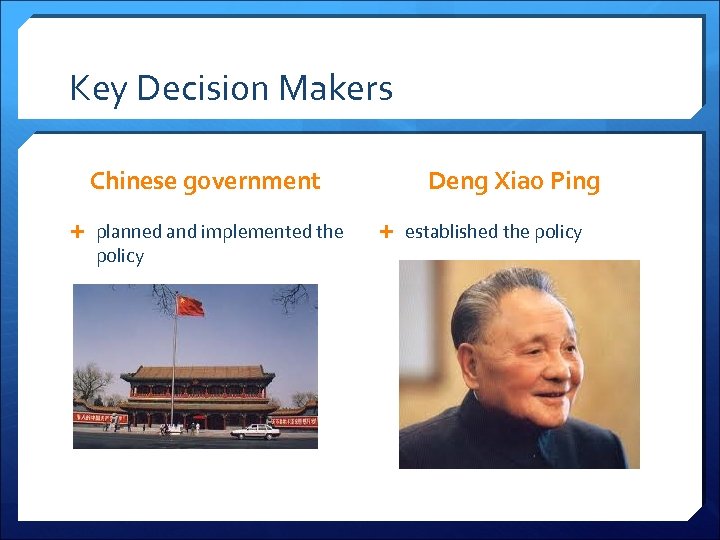 Key Decision Makers Chinese government planned and implemented the policy Deng Xiao Ping established the policy
 Stake holders U. S. State Department, the Parliament of the United Kingdom, Amnesty International: planning programs contribute to infanticide Chinese government: concern about overpopulation Guerilla moms: women who exiled themselves to escape the pressure brought about the policy Feminists: oppose the idea of forced abortion and demand China to respect young girls’ rights. “If we accept that a mother can kill her own child, how can we tell other people not to kill each other? ” : Mother Teresa Chinese couples: forced to pay fines / forced into abortion
 Manner of Consultation Forced by the Chinese government to limit the population growth of China and to reduce the need of scarce resources. No referendum or vote. Chinese government had been encouraging from the past. Ministry of Public Health’s mass birth control efforts in August 1956 a nationwide birth control campaign conducted by the State Council in 1972 and 1973. In 1976, the “Later, Longer, Fewer” policy
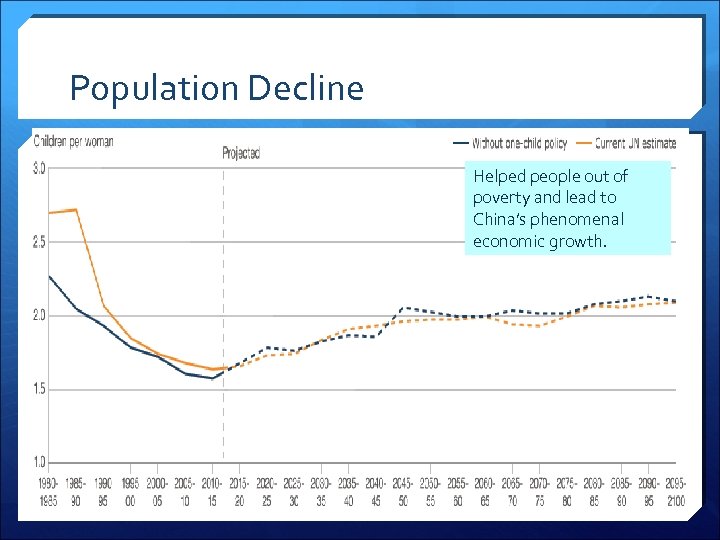 Population Decline Helped people out of poverty and lead to China’s phenomenal economic growth.
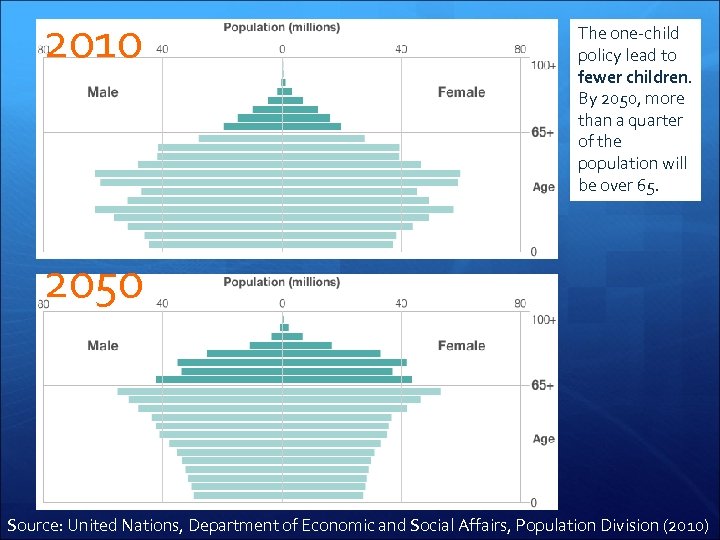 2010 The one-child policy lead to fewer children. By 2050, more than a quarter of the population will be over 65. 2050 Source: United Nations, Department of Economic and Social Affairs, Population Division (2010)
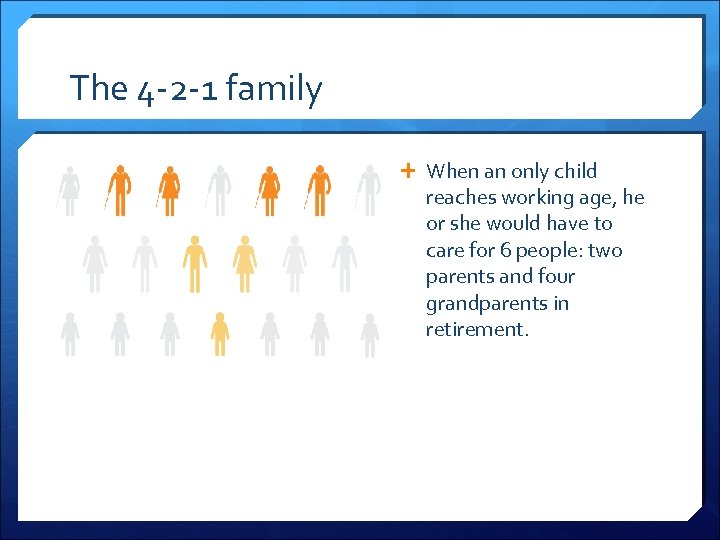 The 4 -2 -1 family When an only child reaches working age, he or she would have to care for 6 people: two parents and four grandparents in retirement.
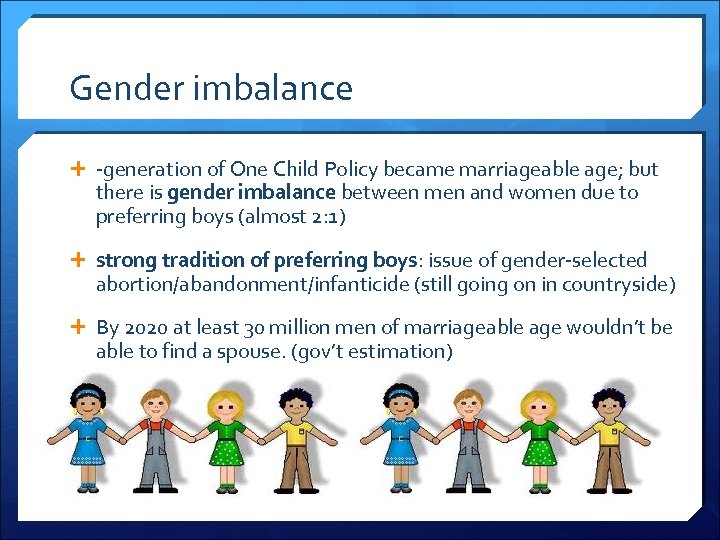 Gender imbalance -generation of One Child Policy became marriageable age; but there is gender imbalance between men and women due to preferring boys (almost 2: 1) strong tradition of preferring boys: issue of gender-selected abortion/abandonment/infanticide (still going on in countryside) By 2020 at least 30 million men of marriageable age wouldn’t be able to find a spouse. (gov’t estimation)
 Video: One child policy dilemma http: //www. bbc. co. uk/news/world-asia-china-19677676
 Forced abortion With few exceptions, pregnancies that are considered “out of plan” and therefore illegal are forced into abortion. The Government randomly searches for pregnant and terminate pregnancies using force. This lead to China’s abnormally high female suicide rate. 500 women commit a suicide each day, killing more women than men. 13 million abortions are performed each year, which averages to 35, 000 abortions a day.
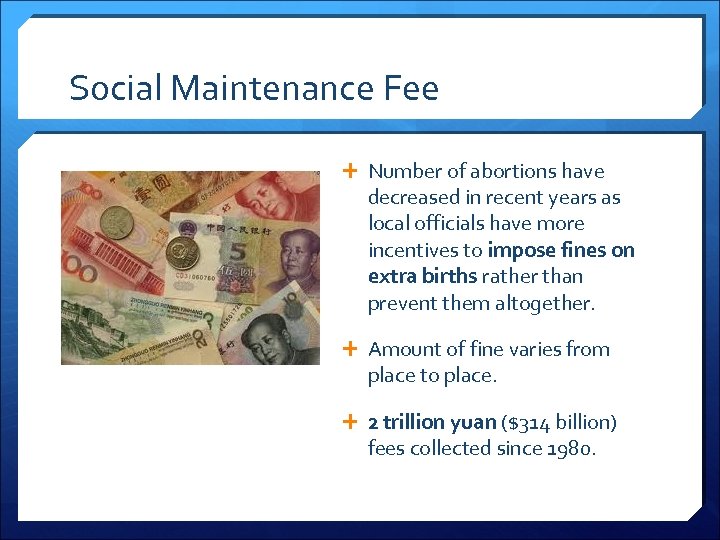 Social Maintenance Fee Number of abortions have decreased in recent years as local officials have more incentives to impose fines on extra births rather than prevent them altogether. Amount of fine varies from place to place. 2 trillion yuan ($314 billion) fees collected since 1980.
 Current Issue: Molly Zhang, a 31 year old account manager in a lightning industry, had to pay a fine that was roughly equal to her annual salary, for violating China’s onechild policy by having a her second son. She says, “This is a lot of money, but I didn’t want to have just one child. ” Lin Chang Jie is battling to save his family’s business. The decreasing number of workers forces him to pay higher wages. He says, “Wages are going up, up. If we don’t like somebody’s work we can’t say anything, incase they leave. ”
 Our Opinions Kyory: In China’s case, I understand the need of birth control since there’s too many people; however I’m totally against the means of China. I think forced abortion and mandatory sterilization is very inhumane. The government should consider a way to increase the welfare level so that it can support the population, not how to kill young children. Saki: Though One Child Policy is a violent, cruel policy, I think it was unavoidable because China needed to decrease the growing population, and it was successful in doing so. But China should now start being less strict on this policy, because drastic drop in population could also cause trouble (ex. the 4 -2 -1 family). I think China is a little extreme and should make more gradual changes.
 Discussion Question 1. What do you think is a problem with the one-child policy? 2. If you were a Chinese leader, what would you do to decrease the rapidly growing Chinese population? Why?
 Bibliography Ageing China: Changes and Challenges, BBC. 19 September 2 o 12. Retrieved on January 3 rd 2013 from http: //www. bbc. co. uk/news/world-asia-19630110 Total Fertility Rate, The World Factbook. 2012. Retrieved on January 3 rd 2013 from https: //www. cia. gov/library/publications/the-worldfactbook/rankorder/2127 rank. html? country. Name=China&country. Code=ch®ion. Code= eas&rank=181 Statics about Forced Abortion in China, All Girls Allowed. 2010. Retrieved on January 3 rd 2013 from http: //www. allgirlsallowed. org/forced-abortion-statistics One Child Policy in China, Jeffrey Hays. 2012. Retrieved on January 3 rd 2013 from http: //factsanddetails. com/china. php? itemid=128 Advantages and Disadvantages of Population Growth, e. How. 2012. Retrieved on January 3 rd 2013 from http: //www. ehow. com/info_8681317_advantages-disadvantages-population -growth. html China’s One-Child Policy, Population Research Institute. 2001. Retrieved on January 3 rd 2013 from http: //www. pop. org/content/chinas-one-child-policy-1455