 Скачать презентацию China Mobile Leader s Programme Mobile Technology Jon Crowcroft
642a01274573601d14214e880d114bb8.ppt
- Количество слайдов: 99



China Mobile Leader’s Programme Mobile Technology Jon Crowcroft http: //www. cl. cam. ac. uk/~jac 22 Jon. crowcroft@cl. cam. ac. uk +gmail, hotmail +441223763633 +447733 231822 +linkedin, facebook, myspace
4 Areas • Mobile Social Networks • Data Collection • Energy • Programming
1. Online Mobile Social Nets & Real Life
We meet, we connect, we communicate • We meet in real life in the real world • We use text messages, phones, IM • We make friends on facebook, Second Life • How are these related? • How do they affect each other? • How do they change with new technology?
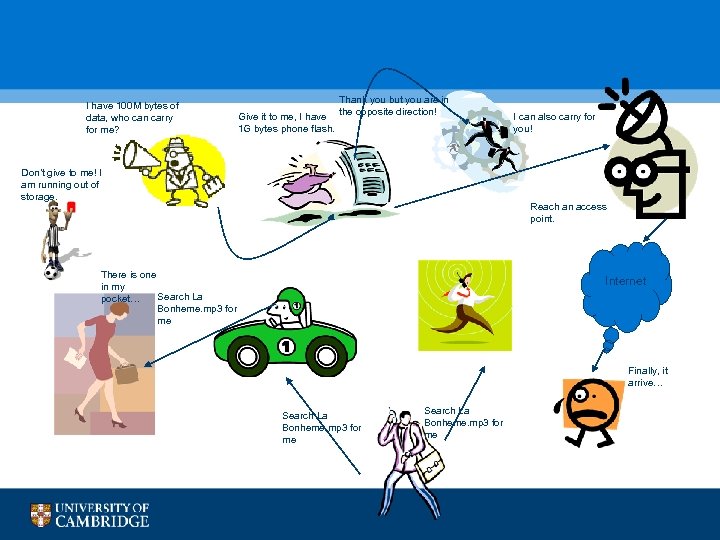
I have 100 M bytes of data, who can carry for me? Give it to me, I have 1 G bytes phone flash. Thank you but you are in the opposite direction! Don’t give to me! I am running out of storage. I can also carry for you! Reach an access point. There is one in my Search La pocket… Bonheme. mp 3 for me Internet Finally, it arrive… Search La Bonheme. mp 3 for me
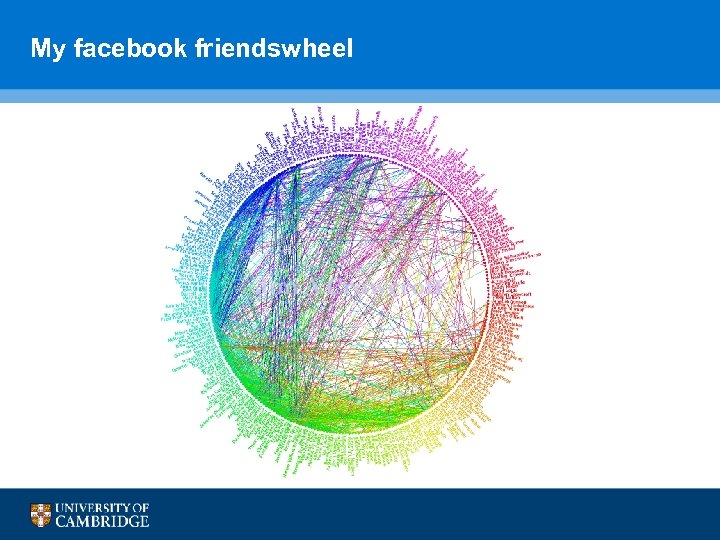
My facebook friendswheel
My email statistics!
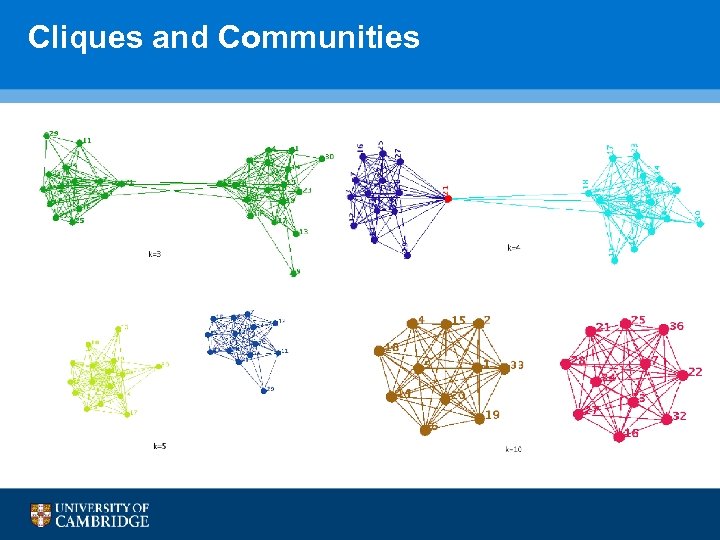
Cliques and Communities
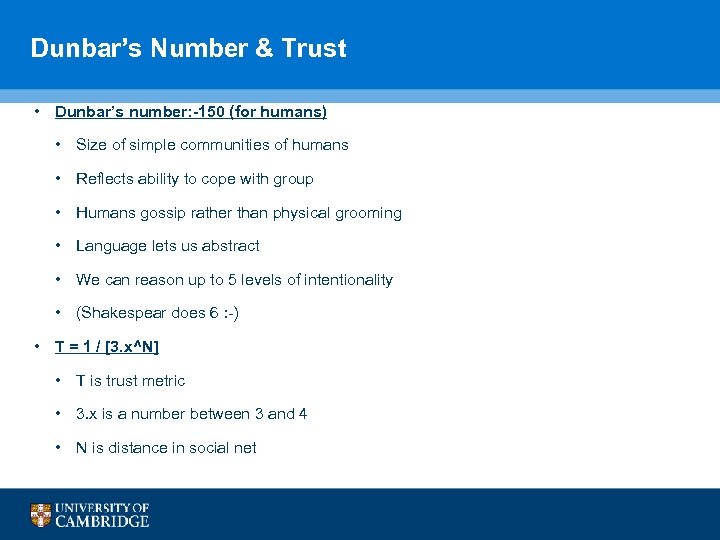
Dunbar’s Number & Trust • Dunbar’s number: -150 (for humans) • Size of simple communities of humans • Reflects ability to cope with group • Humans gossip rather than physical grooming • Language lets us abstract • We can reason up to 5 levels of intentionality • (Shakespear does 6 : -) • T = 1 / [3. x^N] • T is trust metric • 3. x is a number between 3 and 4 • N is distance in social net
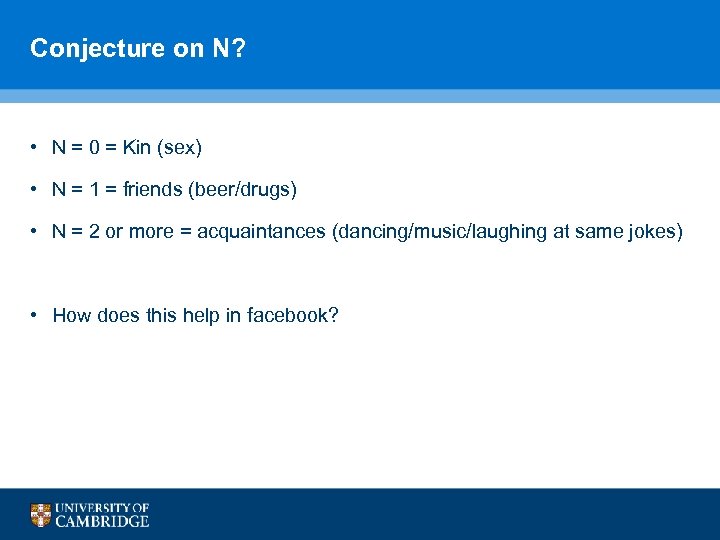
Conjecture on N? • N = 0 = Kin (sex) • N = 1 = friends (beer/drugs) • N = 2 or more = acquaintances (dancing/music/laughing at same jokes) • How does this help in facebook?
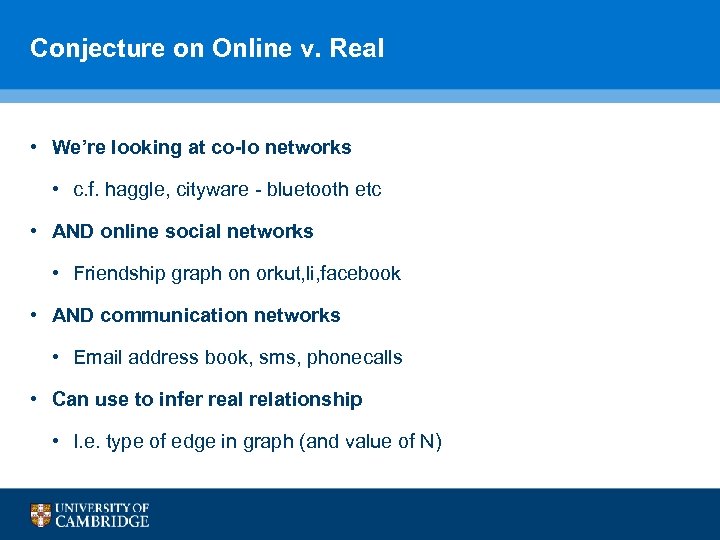
Conjecture on Online v. Real • We’re looking at co-lo networks • c. f. haggle, cityware - bluetooth etc • AND online social networks • Friendship graph on orkut, li, facebook • AND communication networks • Email address book, sms, phonecalls • Can use to infer real relationship • I. e. type of edge in graph (and value of N)
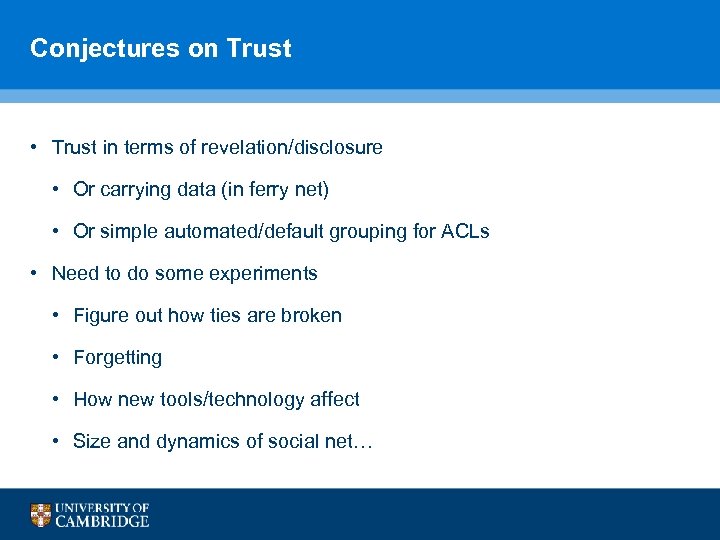
Conjectures on Trust • Trust in terms of revelation/disclosure • Or carrying data (in ferry net) • Or simple automated/default grouping for ACLs • Need to do some experiments • Figure out how ties are broken • Forgetting • How new tools/technology affect • Size and dynamics of social net…
EU Social Net Project Questions • What net/edge type is more likely to cause an edge in another net? • Does meeting someone dominate over online or vice versa • i. e. how does new tech affect x (size of immediate gang) and • N (scope of gang/level of intentionality reasoning? )? • Can you use this to detect dodgy behaviour (spam, bullying, etc)?
Ongoing studies • Data? • We have large datasets for single edge-type/modality • (6 M phone call timeloc, 1 M social net) • But only very small datasets for 2 or 3 modalities • 30 army base people -> retirement • 100 school leavers -> University • Very heavy-lifting • Not only lots of data processsing, but worse: • Interview eahc user for context • Privacy? • Correlating (datamining) the different nets is massive breach of trust • Usefulness?
Usefulness? 1. Improve privacy 1. 2. 2. As mentioned, could auto-default Fb settings and relate to phone/locn Could also use as interest based filter Fundamental understanding of social groups 1. How society/technology co-evolve 2. Social inclusion and accessibility (!) 3. Epidemiology (*) 4. Buzztraq 1. Use currency of local interest to 2. Fetch content…
Epidemiology • Two projects • Emulation (ESRC) • Run s/w on smart phone that mimics a disease • Has a “vector” and SIR(!) parameter person • Run on “real socieity” based on meeting duration/proximity/frequency • Flubook (Horizon) • Panic button (“Not well”/”Feelin better”) • Uploads list of contacts in last week via free SMS • Puts anonymized data on google maps • Alerts trusted friendship group on facebook
SIR • Susceptibility, Infectiousness, Recovery • Given contact distribution, • Can compute progress of epidemic • Whether collapse (S, I low, R high) • Or go pandemic (S, I high) • As with relationship between online and RL behaviour for socialising, • Flubook might alter contact rate… • …. systematically for subset of population • …(social or geographic) with high S/I • Help prevent/collapse epidemic

Thank you… • Questions? …
And another thing • Virtualising online social self • Floating it in the “cloud” • Crypt content, but allow cloud/fb to match interests (for advertising) • Migrate it to track user (and handset) • Performance gain • handset can be meagre cpu/memory • Latency reduced • Synchronisation/persistence assured • Don’t care if handset lost/stolen : -)
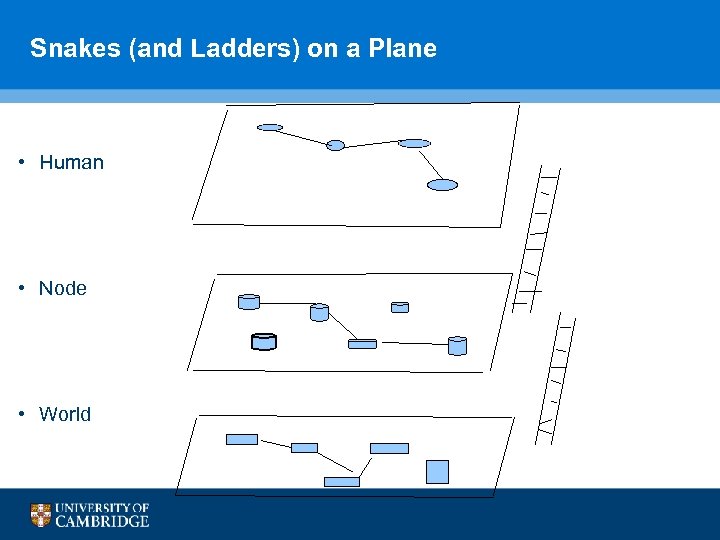
Snakes (and Ladders) on a Plane • Human • Node • World
Threads of your life • Human level is activities & relationships • Nodal level is processing and storage • World level is location and context
Idea is… • To allow mobile (compact/portable) representation of your activities and relationships (0 wned by ou) • Roam across arbitrary nodes in environment (embedded or handset owned by anyone) • While recording where you are and context (= other people)
2. Data Collection for Modelling Contact Networks Eiko Yoneki and Jon Crowcroft eiko. yoneki@cl. cam. ac. uk Systems Research Group University of Cambridge Computer Laboratory
Outline • Purposes of Data Collection Modelling Human Contact Networks • Proximity Data Collection Methodology • Issues for Data Collection • Examples of Data Analysis • Extending to Collect/Correlate Online Data • Conclusion
Purpose of Data Collection • Building communication protocol based on proximity • EU FP 6 Haggle Project • Inferring social interaction, opinion dynamics Apply results to networking and computer systems • EU FP 7 Socialnets, EU FP 7 Recognition • Network modelling for epidemiology • EPSRC Data Driven Network Modelling for Epidemiology • Understanding behaviour to infectious disease outbreak - social and economic influences • ESRC Flu. Phone Project 25
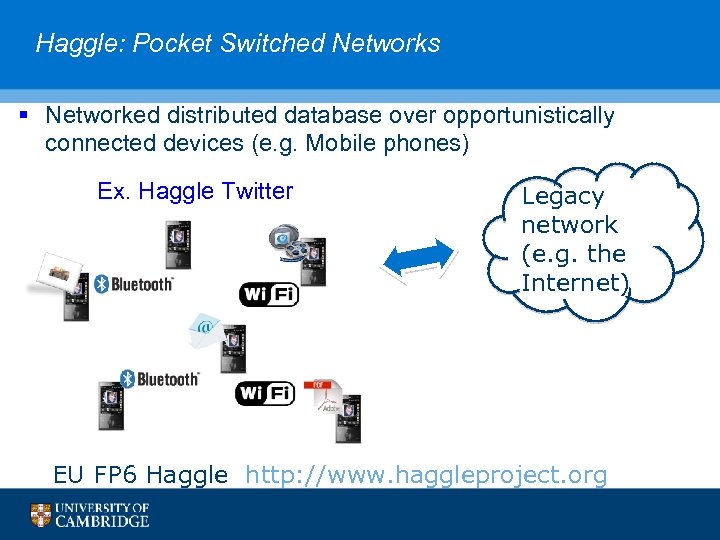
Haggle: Pocket Switched Networks § Networked distributed database over opportunistically connected devices (e. g. Mobile phones) Ex. Haggle Twitter Legacy network (e. g. the Internet) EU FP 6 Haggle http: //www. haggleproject. org 26
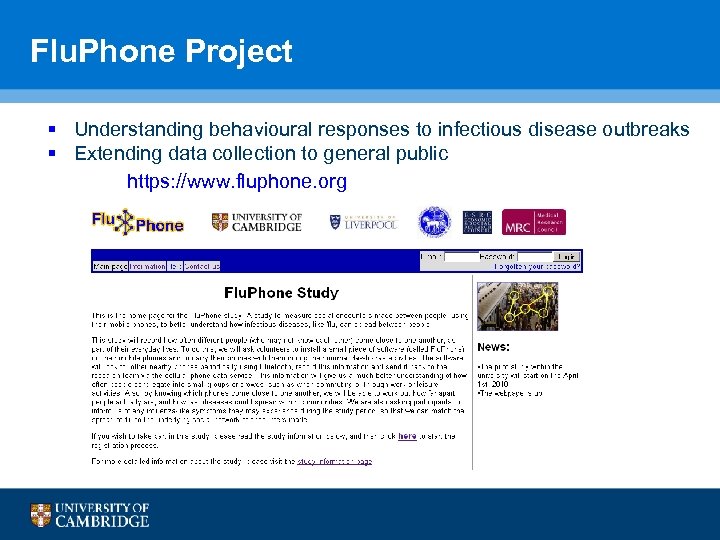
Flu. Phone Project § Understanding behavioural responses to infectious disease outbreaks § Extending data collection to general public https: //www. fluphone. org 27
Purpose of Data Collection • Robust data collection from real world • Post-facto analysis and modelling yield insight into human interactions • Data is useful from building communication protocol to understanding disease spread Modelling Contact Networks: Empirical Approach 28
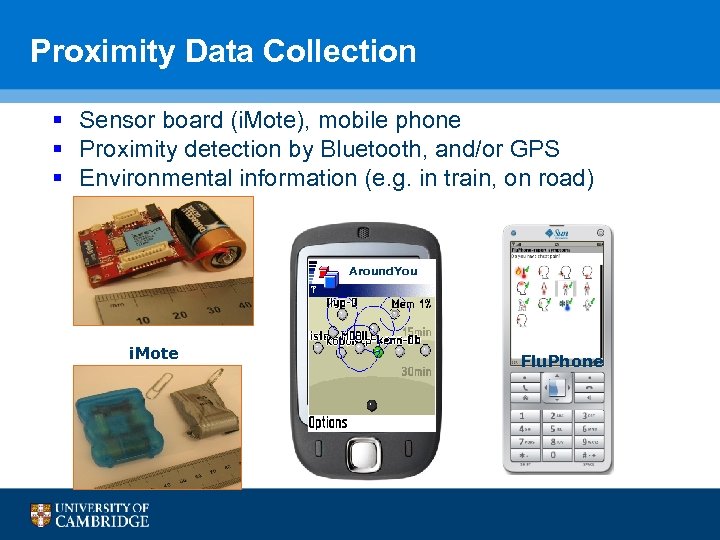
Proximity Data Collection § Sensor board (i. Mote), mobile phone § Proximity detection by Bluetooth, and/or GPS § Environmental information (e. g. in train, on road) Around. You i. Mote Flu. Phone 29
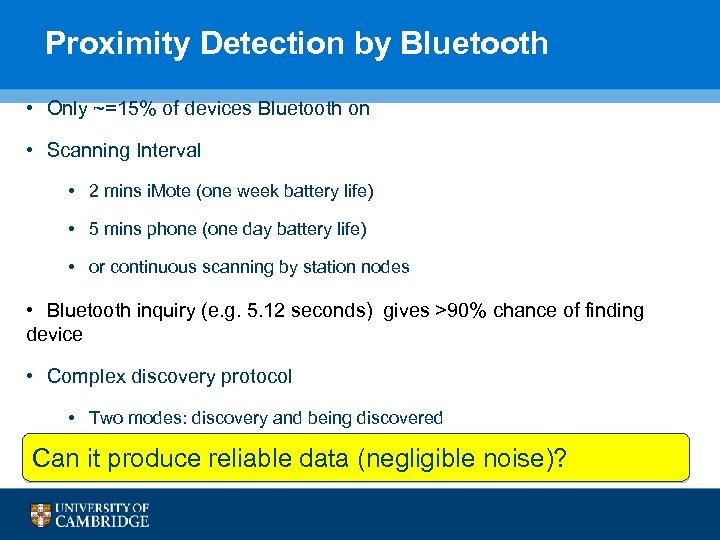
Proximity Detection by Bluetooth • Only ~=15% of devices Bluetooth on • Scanning Interval • 2 mins i. Mote (one week battery life) • 5 mins phone (one day battery life) • or continuous scanning by station nodes • Bluetooth inquiry (e. g. 5. 12 seconds) gives >90% chance of finding device • Complex discovery protocol • Two modes: discovery and being discovered • Can it produce reliable 5~10 m discover range data (negligible noise)? 30
Sensor Board or Phone or. . . § i. Mote needs disposable battery § Expensive § Third world experiment § Mobile phone § Rechargeable § Additional functions (messaging, tracing) § Smart phone: location assist applications § Provide device or software § Combine with online information (e. g. Twitter) 31
Phone Price vs Functionality § ~<20 GBP range § Single task (no phone call when application is running) § ~>100 GBP § GPS capability § Multiple tasks – run application as a background job § Challenge to provide software for every operation system of mobile phone 32
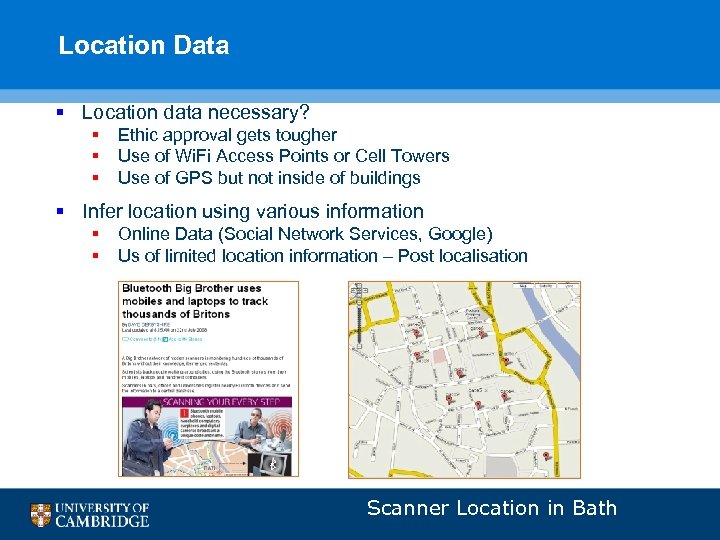
Location Data § Location data necessary? § § § Ethic approval gets tougher Use of Wi. Fi Access Points or Cell Towers Use of GPS but not inside of buildings § Infer location using various information § § Online Data (Social Network Services, Google) Us of limited location information – Post localisation Scanner Location in Bath 33
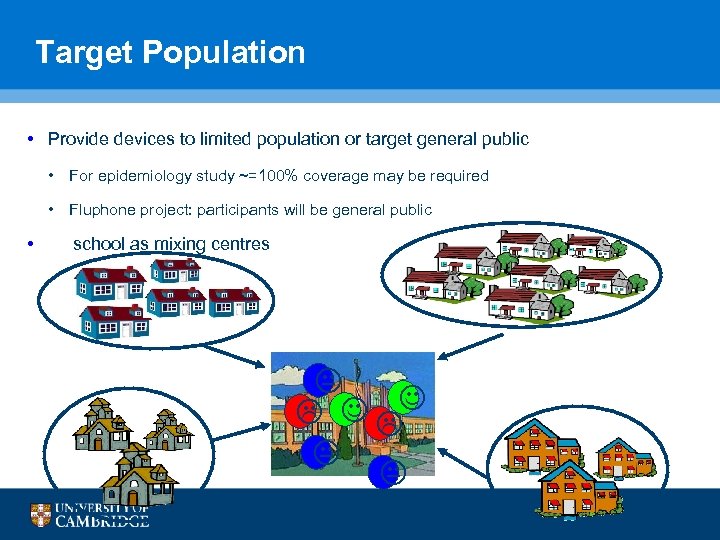
Target Population • Provide devices to limited population or target general public • For epidemiology study ~=100% coverage may be required • Fluphone project: participants will be general public • Or school as mixing centres 34
Experiment Parameters vs Data Quality • Battery life vs Granularity of detection interval • Duration of experiments • Day, week, month, or year? • Data rate • Data Storage • Contact /GPS data <50 K per device per day (in compressed format) • Server data storage for receiving data from devices • Extend storage by larger memory card • Collected data using different parameters or methods aggregated? 35
Data Retrieval Methods • Retrieving collected data: • • Tracking station Online (3 G, SMS) Uploading via Web via memory card • Incentive for participating experiments • Collection cycle: real-time, day, or week? 36
Data Transformation for Analysis • Transform to discrete version of contact data • Deal with noise and missing data • Ex. transitivity closure • Data analysis requires high performance computer and storage • Low volume - raw data in compact format • Transformation of raw data for analysis increases data volume 37
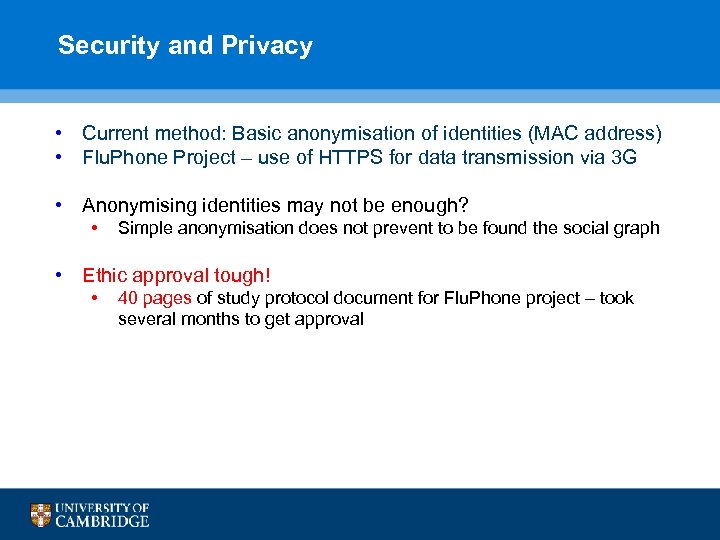
Security and Privacy • Current method: Basic anonymisation of identities (MAC address) • Flu. Phone Project – use of HTTPS for data transmission via 3 G • Anonymising identities may not be enough? • Simple anonymisation does not prevent to be found the social graph • Ethic approval tough! • 40 pages of study protocol document for Flu. Phone project – took several months to get approval 38
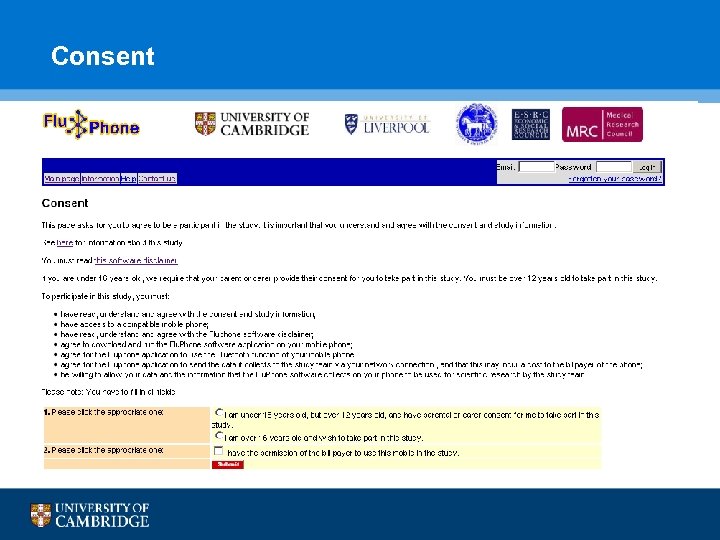
Consent 39
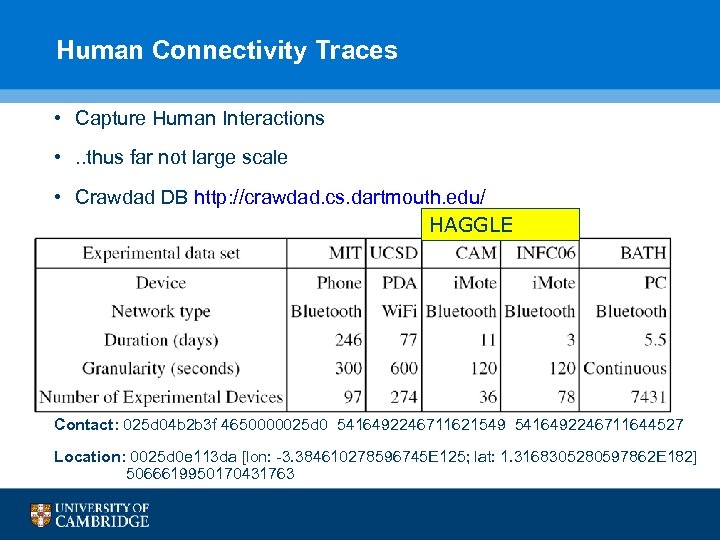
Human Connectivity Traces • Capture Human Interactions • . . thus far not large scale • Crawdad DB http: //crawdad. cs. dartmouth. edu/ HAGGLE Contact: 025 d 04 b 2 b 3 f 4650000025 d 0 5416492246711621549 5416492246711644527 Location: 0025 d 0 e 113 da [lon: -3. 384610278596745 E 125; lat: 1. 3168305280597862 E 182] 5066619950170431763 40
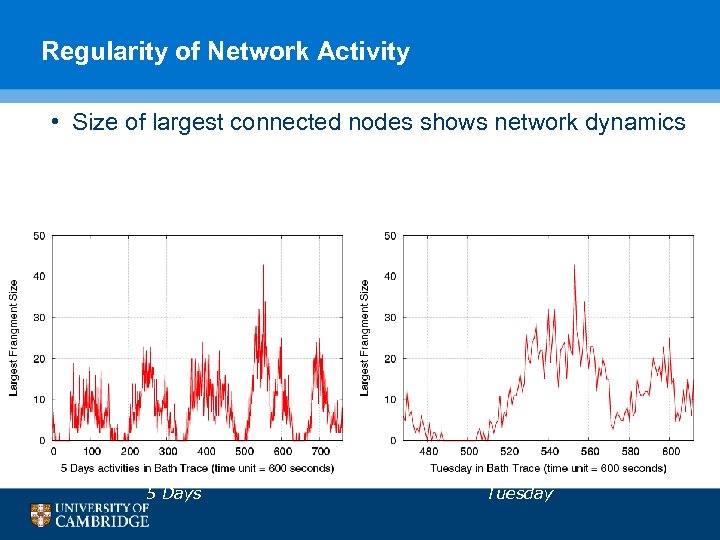
Regularity of Network Activity • Size of largest connected nodes shows network dynamics 5 Days Tuesday 41
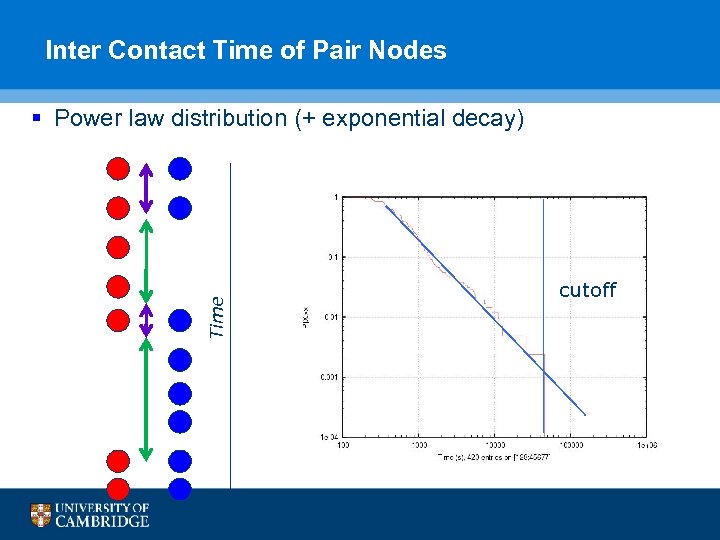
Inter Contact Time of Pair Nodes Time § Power law distribution (+ exponential decay) cutoff 42
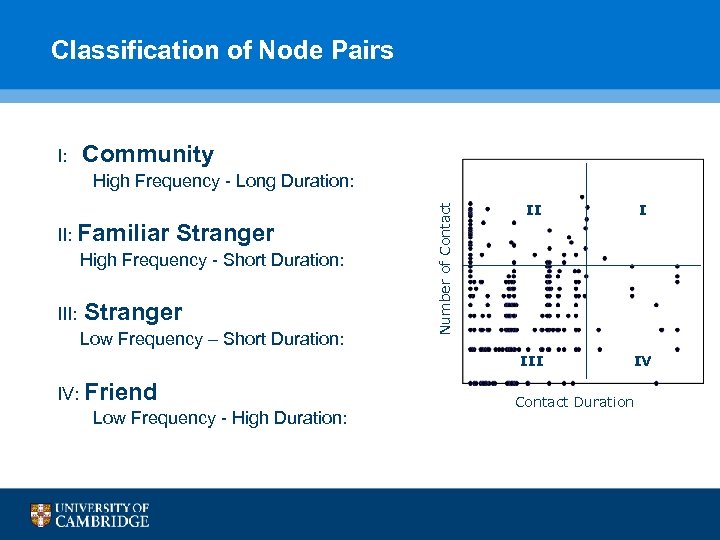
Classification of Node Pairs I: Community High Frequency - Long Duration: Stranger Low Frequency – Short Duration: IV: Friend Low Frequency - High Duration: Number of Contact III: I II: Familiar Stranger High Frequency - Short Duration: II IV Contact Duration 43
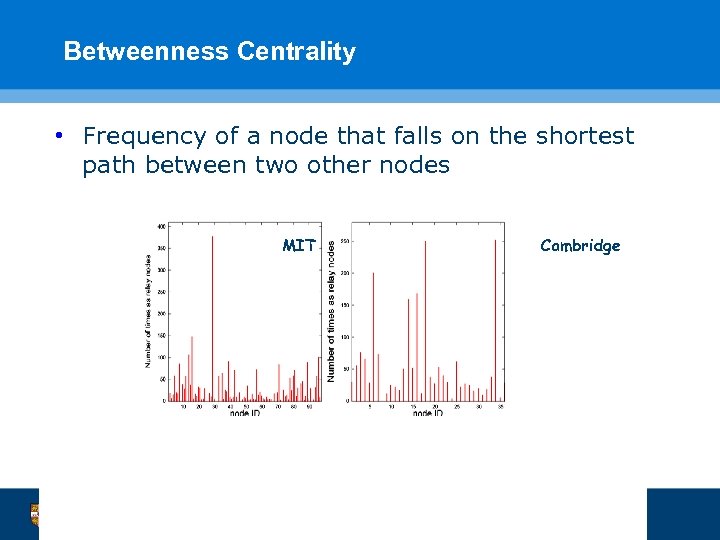
Betweenness Centrality • Frequency of a node that falls on the shortest path between two other nodes MIT Cambridge 44
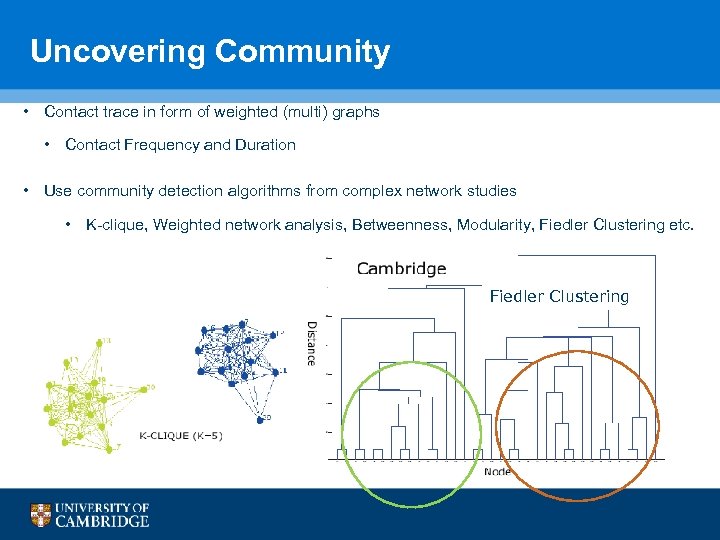
Uncovering Community • Contact trace in form of weighted (multi) graphs • Contact Frequency and Duration • Use community detection algorithms from complex network studies • K-clique, Weighted network analysis, Betweenness, Modularity, Fiedler Clustering etc. Fiedler Clustering 45
Visualisation of Community Dynamics 46
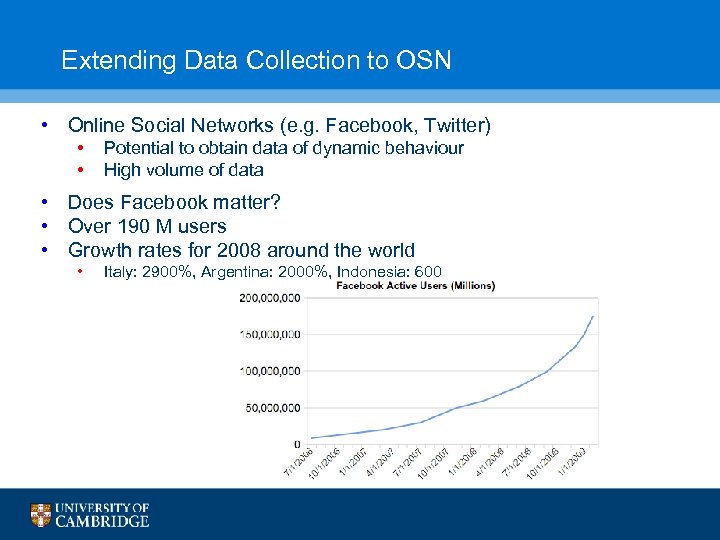
Extending Data Collection to OSN • Online Social Networks (e. g. Facebook, Twitter) • • Potential to obtain data of dynamic behaviour High volume of data • Does Facebook matter? • Over 190 M users • Growth rates for 2008 around the world • Italy: 2900%, Argentina: 2000%, Indonesia: 600 47
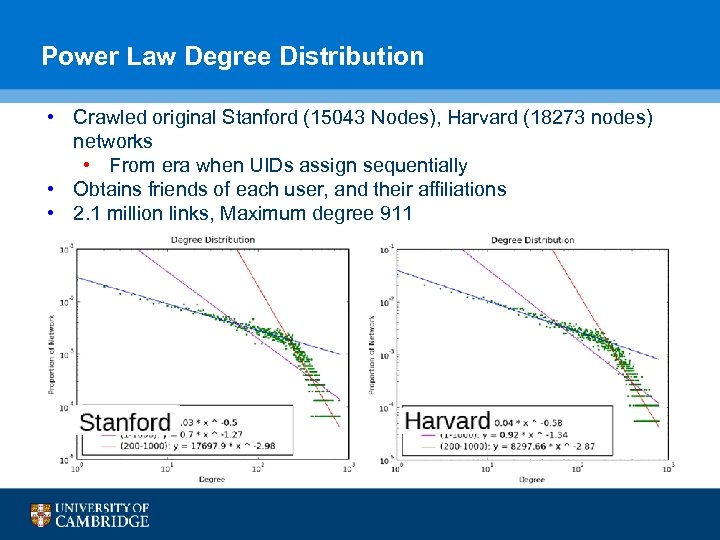
Power Law Degree Distribution • Crawled original Stanford (15043 Nodes), Harvard (18273 nodes) networks • From era when UIDs assign sequentially • Obtains friends of each user, and their affiliations • 2. 1 million links, Maximum degree 911 48
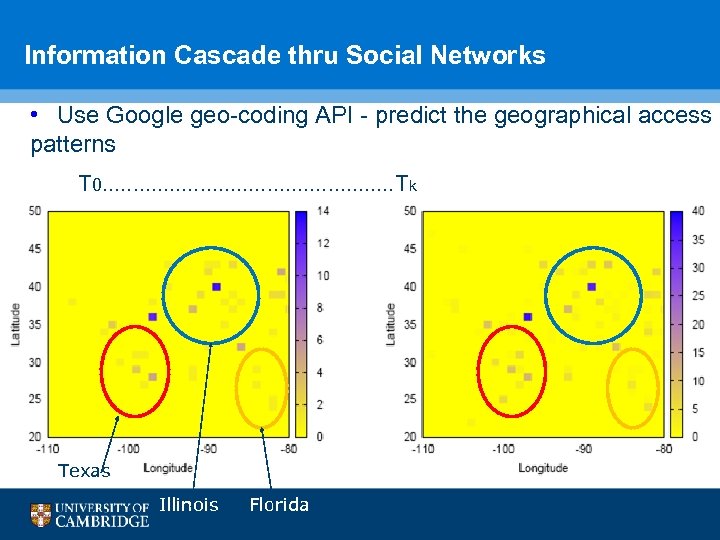
Information Cascade thru Social Networks • Use Google geo-coding API - predict the geographical access patterns T 0. . . T k Texas Illinois Florida 49
Conclusions • Real World Data is Powerful! • Analyse Network Structure of Social Systems to Model Dynamics Emerging Research Area • Weighted networks • Modularity • Centrality (e. g. Degree) • Community evolution and dynamics • Network measurement metrics • Patterns of interactions • Plan purpose of data collection first that leads to decide data collection method • Solve ethic issues/approval in advance • Combine data collection using device and available online data for efficiency and accuracy 50
Conclusions • Real World Data is Powerful! • Analyse Network Structure of Social Systems to Model Dynamics Emerging Research Area • Weighted networks • Modularity • Centrality (e. g. Degree) • Community evolution and dynamics Thank You! • Network measurement metrics • Patterns of interactions • Plan purpose of data collection first that leads to decide data collection method • Solve ethic issues/approval in advance • Combine data collection using device and available online data for efficiency and accuracy 51
3. Challenging Opportunities Jon Crowcroft, http: //www. cl. cam. ac. uk/~jac 22
History (personal: -) • Manet • Mobileman • Tschudin et al • Incredibles • Dtn • Interplanetary/Oceanographic • Pocket Switched & Mobile Social • Oppnet • Drive-Thru • Disaster
Choosing Adversity • Perverse, but valid research motive • Make the network really bad • (like it was in 1970 s) • And maybe neat new ideas will emerge • Which will work really, really well on a rock-solid network
Compete with Infrastructure • “They have the guns, we have the numbers” • But maybe opportunities give us information the infrastructure guys can’t or won’t get…
Incentives • Hard to compute • Mostly assume rational selfish players • Recent market failures prove this is nonsense • What to do instead? • Use a priori social knowledge • Travel plans, SIM, Fb/Buzz data
Privacy and Risk Aversion • May be over sold • Known: younger people are more cavalier with their online presence than older (pre web) generation • But needs respect • at least informed choice (opt out) by user • Prob. With id+loc is it is 2/3 of what you need to find out everything • (2 digits of postcode, age +gender) • There may be some trigger event which will change public view
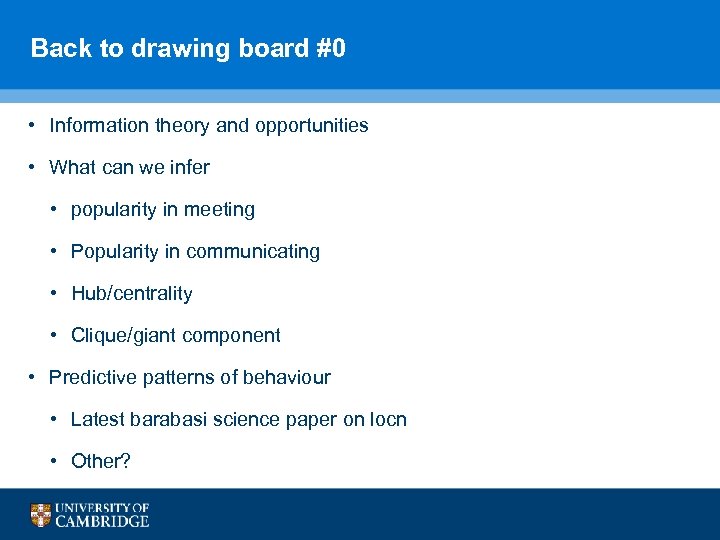
Back to drawing board #0 • Information theory and opportunities • What can we infer • popularity in meeting • Popularity in communicating • Hub/centrality • Clique/giant component • Predictive patterns of behaviour • Latest barabasi science paper on locn • Other?
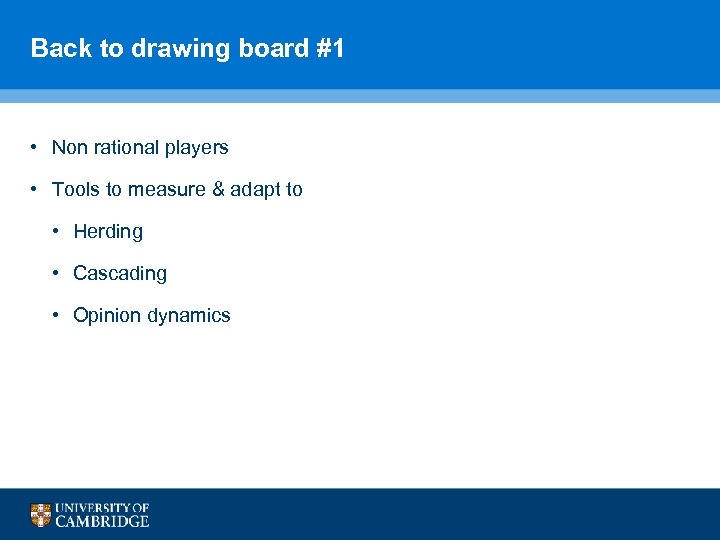
Back to drawing board #1 • Non rational players • Tools to measure & adapt to • Herding • Cascading • Opinion dynamics
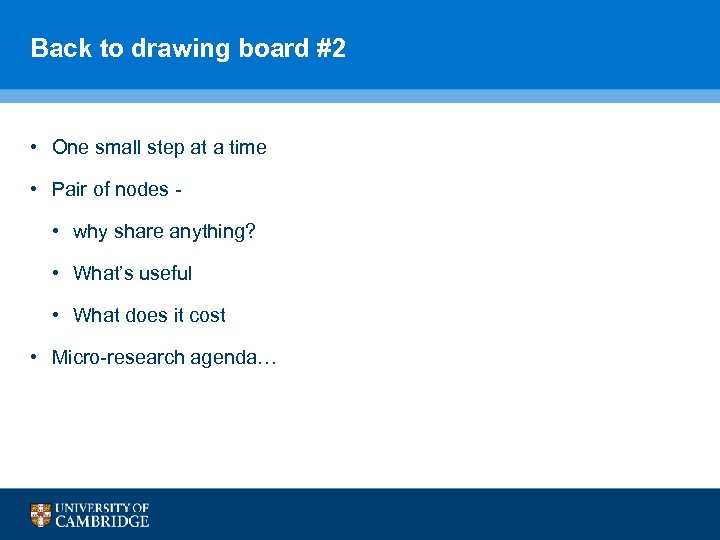
Back to drawing board #2 • One small step at a time • Pair of nodes • why share anything? • What’s useful • What does it cost • Micro-research agenda…
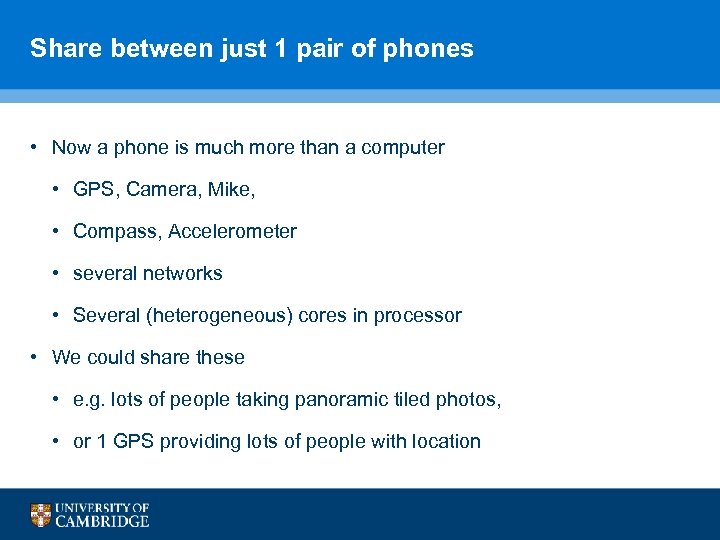
Share between just 1 pair of phones • Now a phone is much more than a computer • GPS, Camera, Mike, • Compass, Accelerometer • several networks • Several (heterogeneous) cores in processor • We could share these • e. g. lots of people taking panoramic tiled photos, • or 1 GPS providing lots of people with location
Lets look at actual resource costs • Phone OS now about same as Desktop • Android == Linux • Iphone == OSX • Windows Mobile 6 (actually Windows 7!) • Etc etc • Software uses resources too • E. g. Java garbage collector surprise • Power/network aware applications…
Narseo’s results… • We’ve started looking at resource use in battery terms • Calibrate OS tools for battery charge reporting • By opening up phone and putting probe on battery: ) • Then run experiment with lots of users…
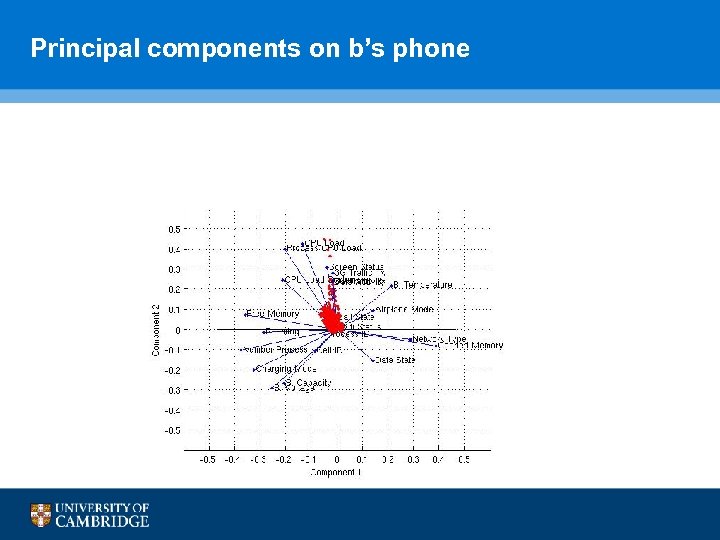
Principal components on b’s phone
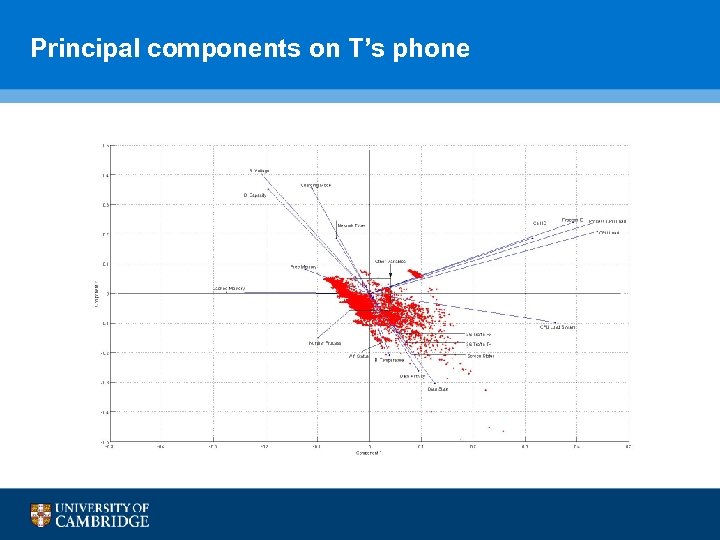
Principal components on T’s phone
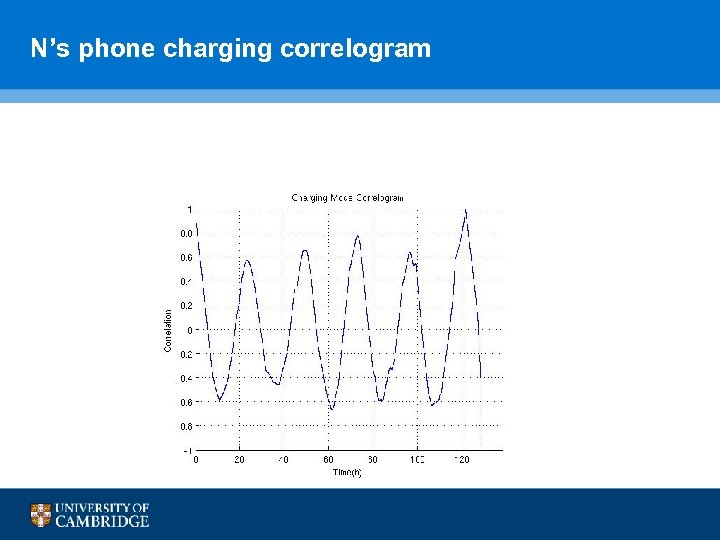
N’s phone charging correlogram
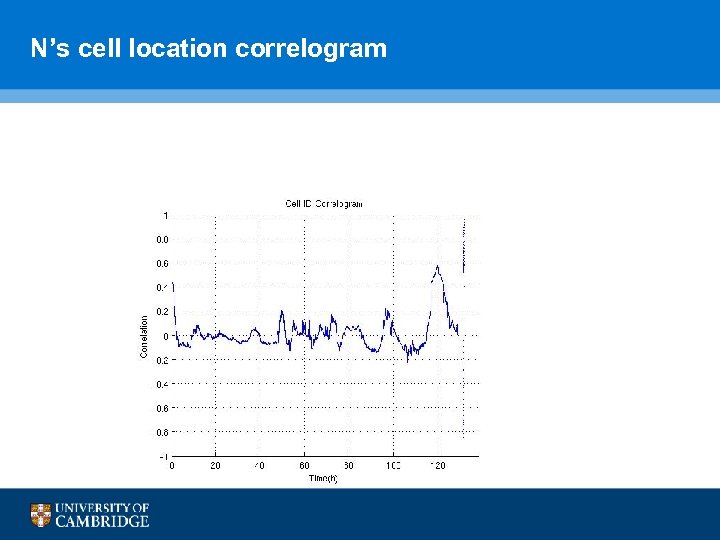
N’s cell location correlogram
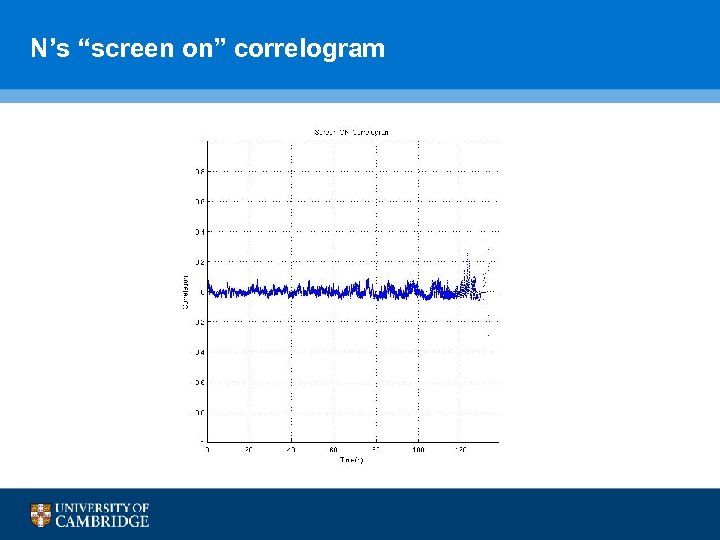
N’s “screen on” correlogram
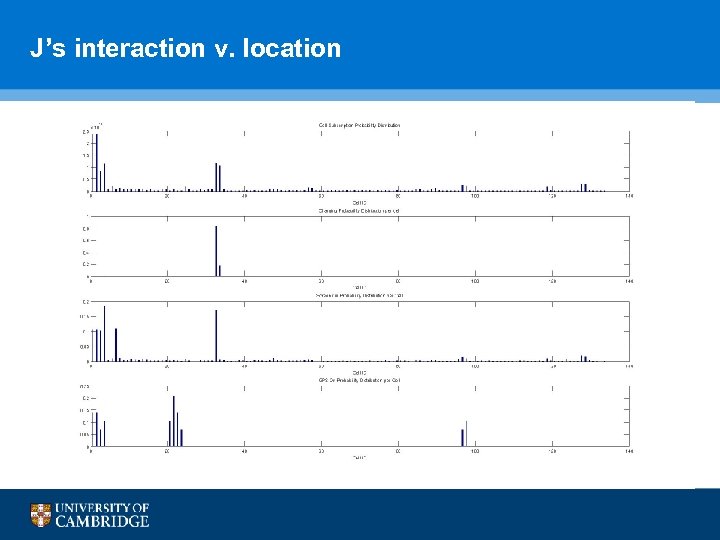
J’s interaction v. location
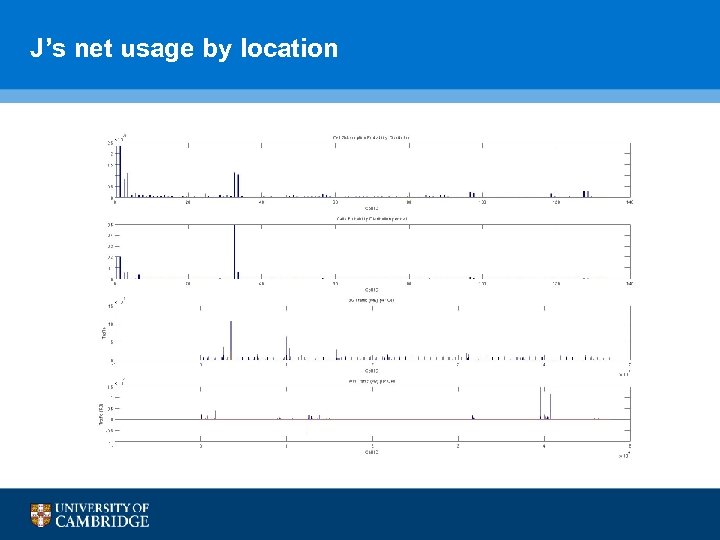
J’s net usage by location
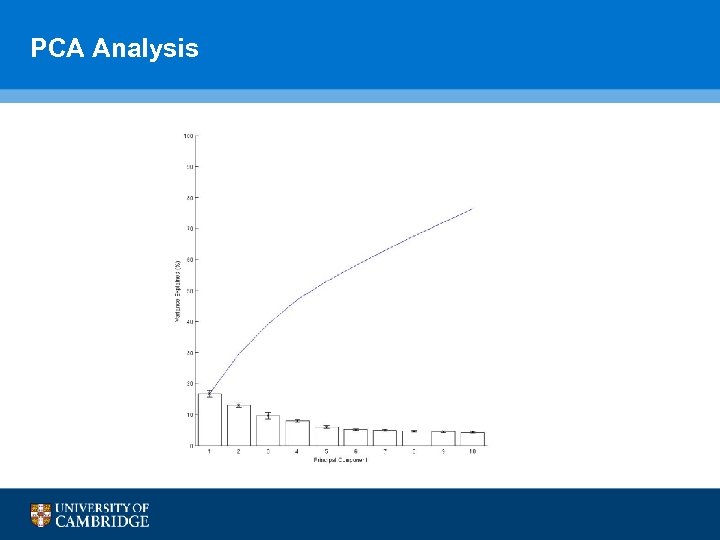
PCA Analysis
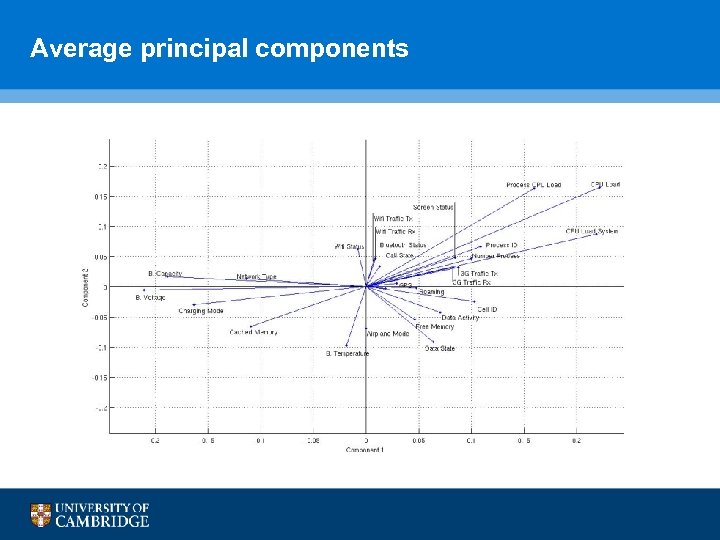
Average principal components
Fooling the user • Buzz/Mobile Social • Driving License • Smart Badges: )
Back to Drawing Board #3 • What business model fools user best? • What are the ethics? • Buzz was first “big bang” social mix • Take 1 network (gmail contacts, sorted by frequency of interaction) • And bootstrap another with it • How big a cognitive dissonance would this be to do on an opportunistic net? • Without informed consent, would cause major headaches • Possibly illegal – viz healthcare workers
Acknowledgements • Thanks to MSR for a bunch of Wi. Mo phones • Thanks to Google for a bunch of Android phones • Thanks to volunteers in Cambridge for abandoning almost all privacy : -)
Questions… • Do we need both the guns and the numbers? • The truth is out there…
D 3 N* 4 Programming Distributed Computation in Pocket Switched Networks Eiko Yoneki, Ioannis Baltopoulos and Jon Crowcroft University of Cambridge Computer Laboratory Systems Research Group * Data Driven Declarative Networking
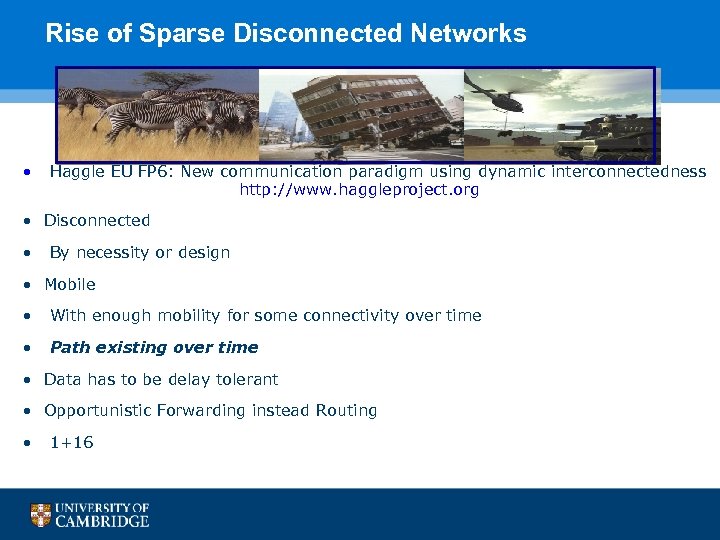
Rise of Sparse Disconnected Networks • Haggle EU FP 6: New communication paradigm using dynamic interconnectedness http: //www. haggleproject. org • Disconnected • By necessity or design • Mobile • With enough mobility for some connectivity over time • Path existing over time • Data has to be delay tolerant • Opportunistic Forwarding instead Routing • 1+16 78
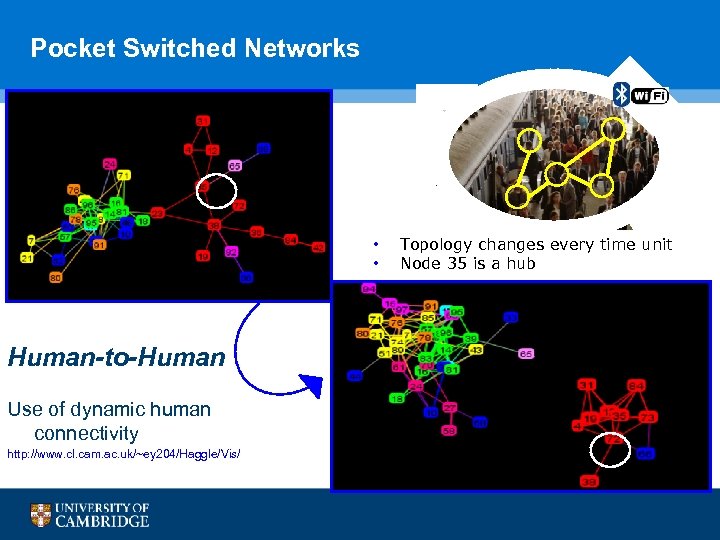
Pocket Switched Networks • • Human-to-Human Use of dynamic human connectivity http: //www. cl. cam. ac. uk/~ey 204/Haggle/Vis/ Topology changes every time unit Node 35 is a hub
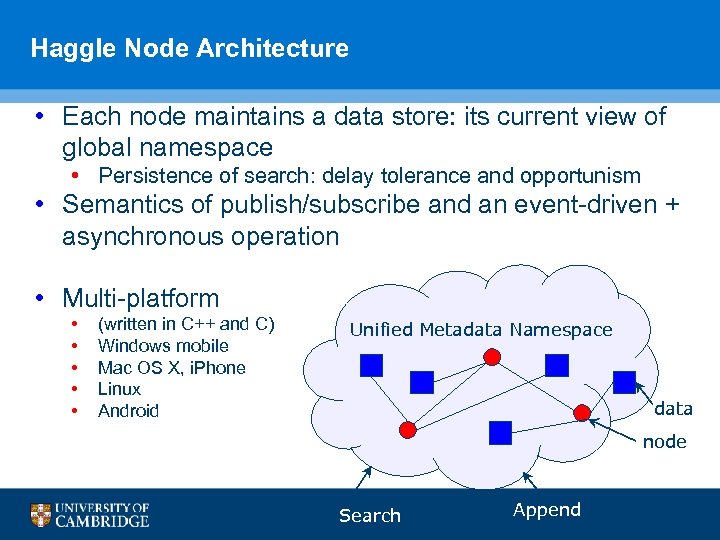
Haggle Node Architecture • Each node maintains a data store: its current view of global namespace • Persistence of search: delay tolerance and opportunism • Semantics of publish/subscribe and an event-driven + asynchronous operation • Multi-platform • • • (written in C++ and C) Windows mobile Mac OS X, i. Phone Linux Android Unified Metadata Namespace data node Search Append 80
D 3 N Data-Driven Declarative Networking • How to program distributed computation? • Use Declarative Networking ?
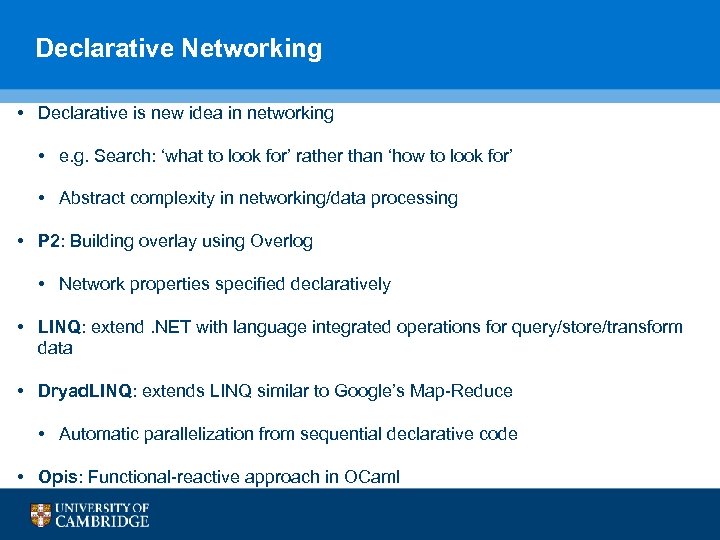
Declarative Networking • Declarative is new idea in networking • e. g. Search: ‘what to look for’ rather than ‘how to look for’ • Abstract complexity in networking/data processing • P 2: Building overlay using Overlog • Network properties specified declaratively • LINQ: extend. NET with language integrated operations for query/store/transform data • Dryad. LINQ: extends LINQ similar to Google’s Map-Reduce • Automatic parallelization from sequential declarative code • Opis: Functional-reactive approach in OCaml
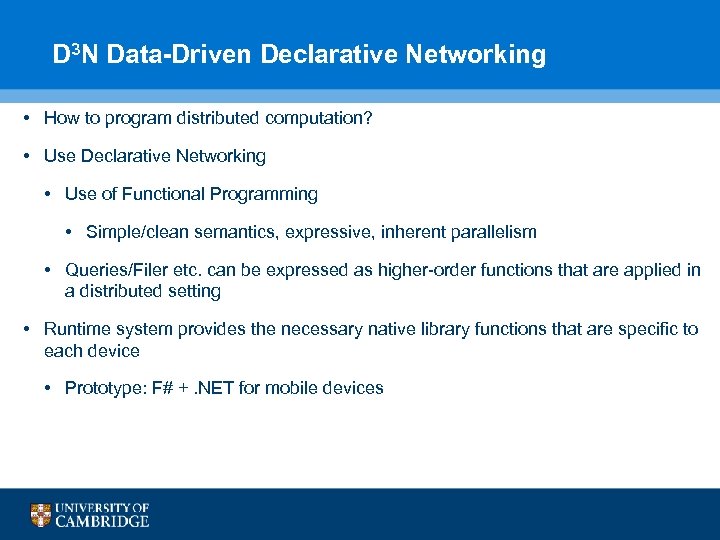
D 3 N Data-Driven Declarative Networking • How to program distributed computation? • Use Declarative Networking • Use of Functional Programming • Simple/clean semantics, expressive, inherent parallelism • Queries/Filer etc. can be expressed as higher-order functions that are applied in a distributed setting • Runtime system provides the necessary native library functions that are specific to each device • Prototype: F# +. NET for mobile devices
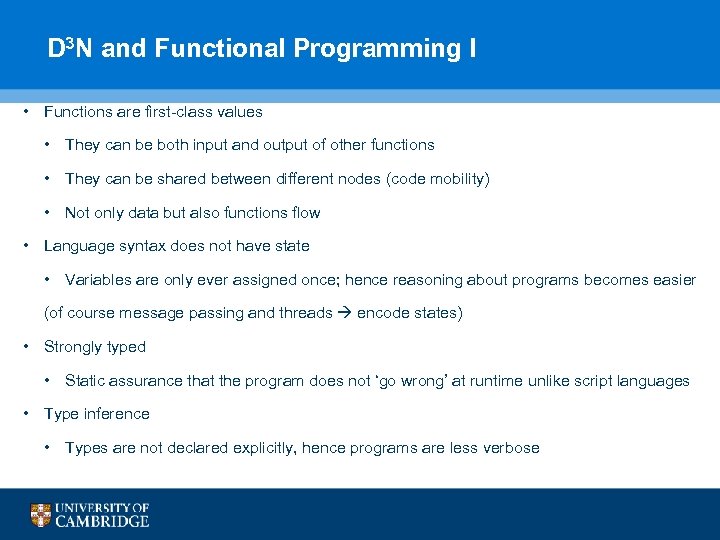
D 3 N and Functional Programming I • Functions are first-class values • They can be both input and output of other functions • They can be shared between different nodes (code mobility) • Not only data but also functions flow • Language syntax does not have state • Variables are only ever assigned once; hence reasoning about programs becomes easier (of course message passing and threads encode states) • Strongly typed • Static assurance that the program does not ‘go wrong’ at runtime unlike script languages • Type inference • Types are not declared explicitly, hence programs are less verbose
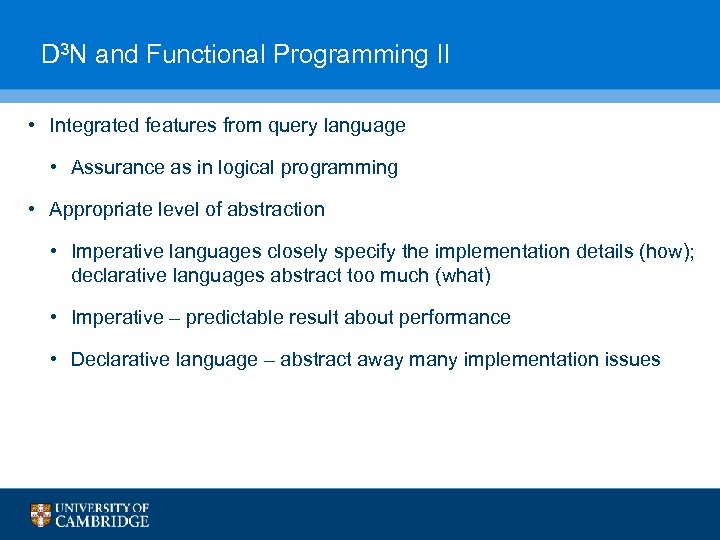
D 3 N and Functional Programming II • Integrated features from query language • Assurance as in logical programming • Appropriate level of abstraction • Imperative languages closely specify the implementation details (how); declarative languages abstract too much (what) • Imperative – predictable result about performance • Declarative language – abstract away many implementation issues
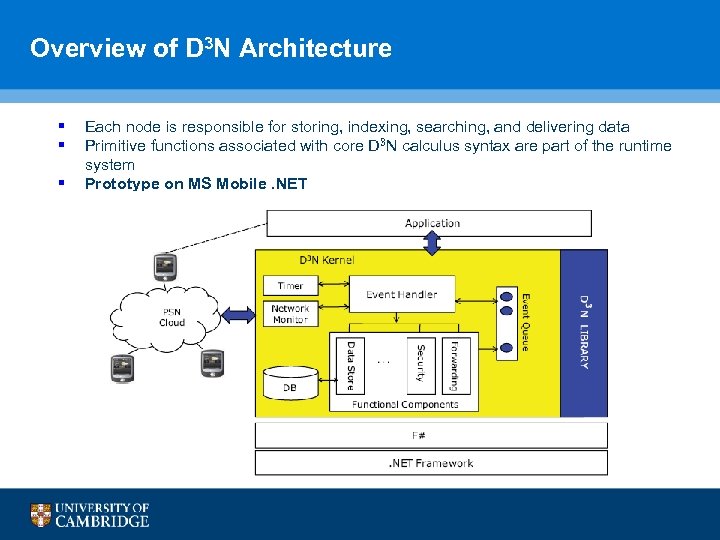
Overview of D 3 N Architecture § § § Each node is responsible for storing, indexing, searching, and delivering data Primitive functions associated with core D 3 N calculus syntax are part of the runtime system Prototype on MS Mobile. NET 86
D 3 N Syntax and Semantics I • Very few primitives • Integer, strings, lists, floating point numbers and other primitives are recovered through constructor application • Standard FP features • Declaring and naming functions through let-bindings • Calling primitive and user-defined functions (function application) • Pattern matching (similar to switch statement) • Standard features as ordinary programming languages (e. g. ML or Haskell) 87
D 3 N Syntax and Semantics II • Advanced features • Concurrency (fork) • Communication (send/receive primitives) • Query expressions (local and distributed select) 88
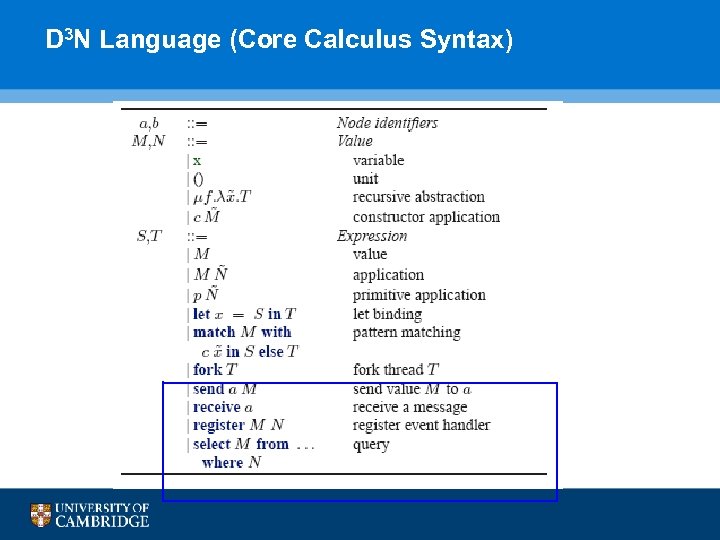
D 3 N Language (Core Calculus Syntax) 89
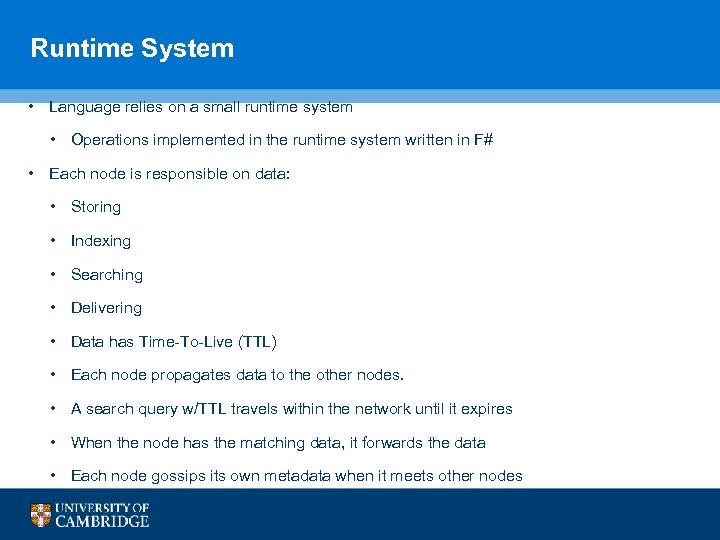
Runtime System • Language relies on a small runtime system • Operations implemented in the runtime system written in F# • Each node is responsible on data: • Storing • Indexing • Searching • Delivering • Data has Time-To-Live (TTL) • Each node propagates data to the other nodes. • A search query w/TTL travels within the network until it expires • When the node has the matching data, it forwards the data • Each node gossips its own metadata when it meets other nodes 90
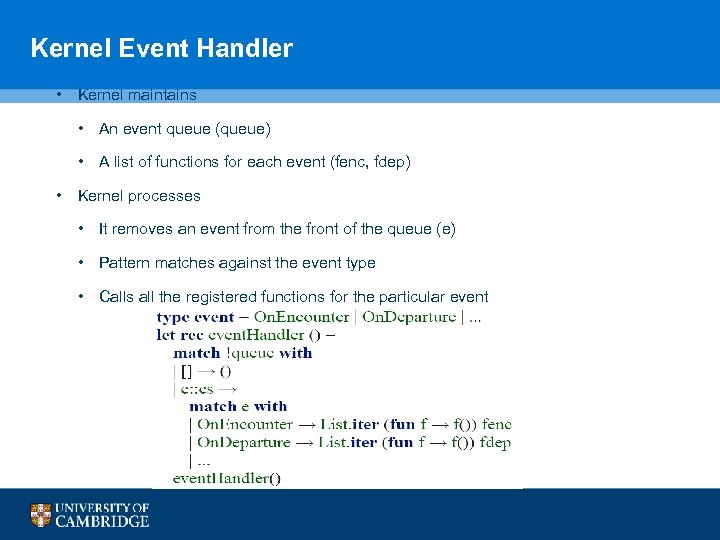
Kernel Event Handler • Kernel maintains • An event queue (queue) • A list of functions for each event (fenc, fdep) • Kernel processes • It removes an event from the front of the queue (e) • Pattern matches against the event type • Calls all the registered functions for the particular event 91
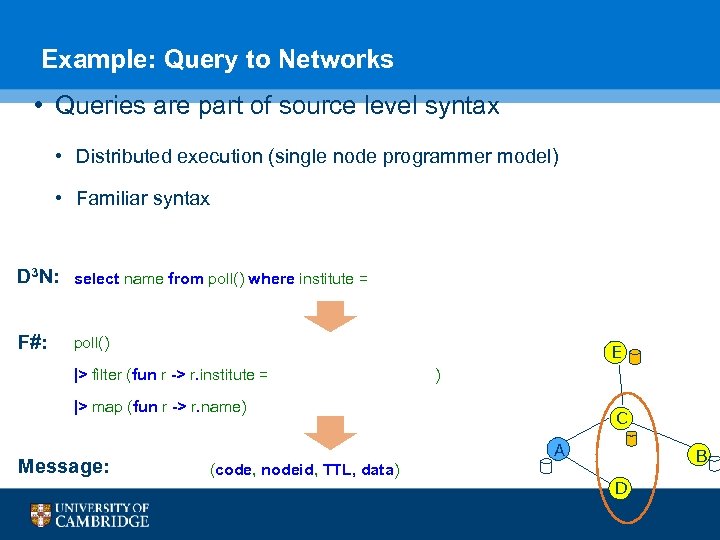
Example: Query to Networks • Queries are part of source level syntax • Distributed execution (single node programmer model) • Familiar syntax D 3 N: select name from poll() where institute = “Computer Laboratory” F#: poll() E |> filter (fun r -> r. institute = “Computer Laboratory”) |> map (fun r -> r. name) Message: C A B (code, nodeid, TTL, data) D
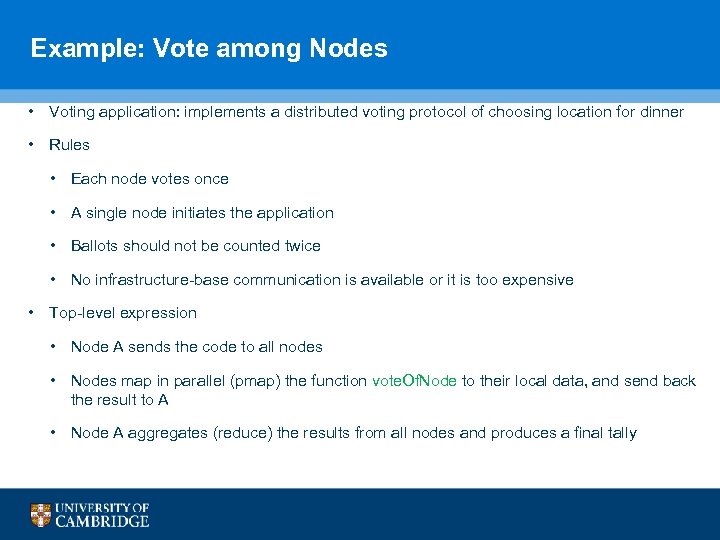
Example: Vote among Nodes • Voting application: implements a distributed voting protocol of choosing location for dinner • Rules • Each node votes once • A single node initiates the application • Ballots should not be counted twice • No infrastructure-base communication is available or it is too expensive • Top-level expression • Node A sends the code to all nodes • Nodes map in parallel (pmap) the function vote. Of. Node to their local data, and send back the result to A • Node A aggregates (reduce) the results from all nodes and produces a final tally 93
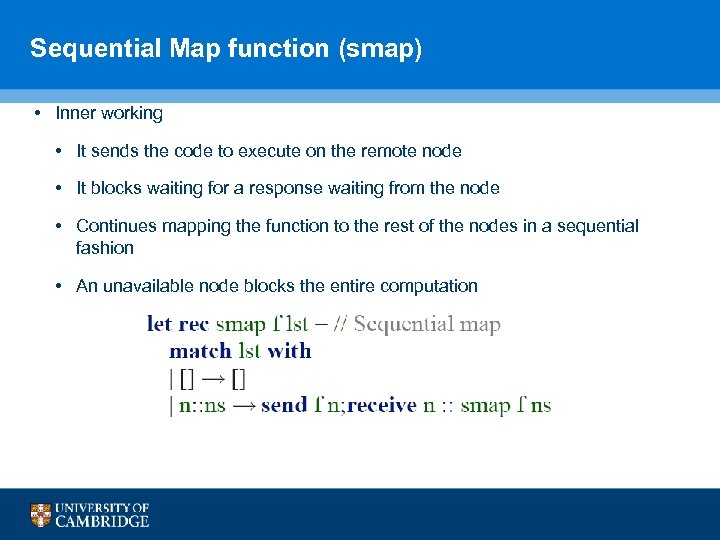
Sequential Map function (smap) • Inner working • It sends the code to execute on the remote node • It blocks waiting for a response waiting from the node • Continues mapping the function to the rest of the nodes in a sequential fashion • An unavailable node blocks the entire computation 94
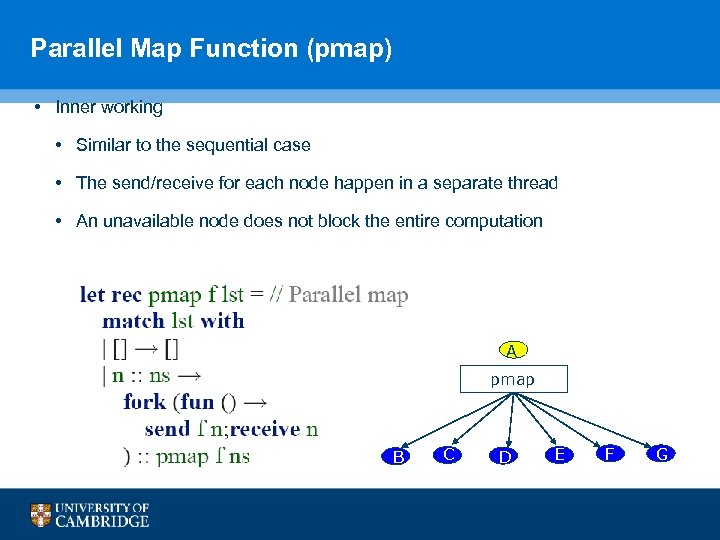
Parallel Map Function (pmap) • Inner working • Similar to the sequential case • The send/receive for each node happen in a separate thread • An unavailable node does not block the entire computation A pmap B C D E F G 95
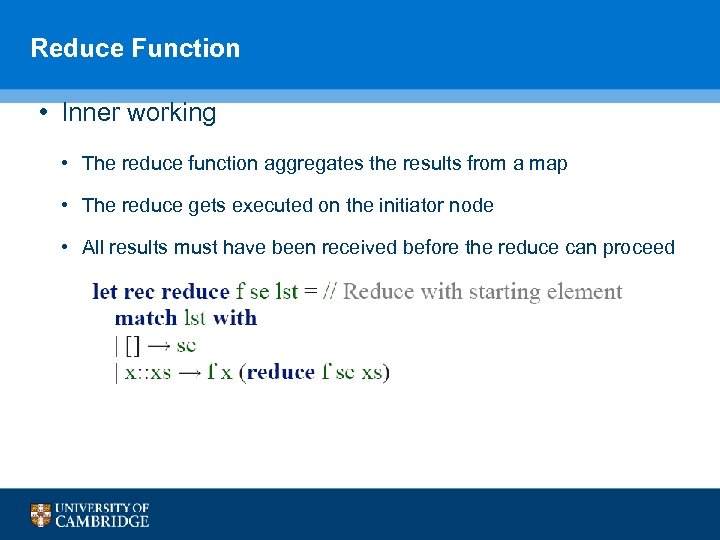
Reduce Function • Inner working • The reduce function aggregates the results from a map • The reduce gets executed on the initiator node • All results must have been received before the reduce can proceed 96
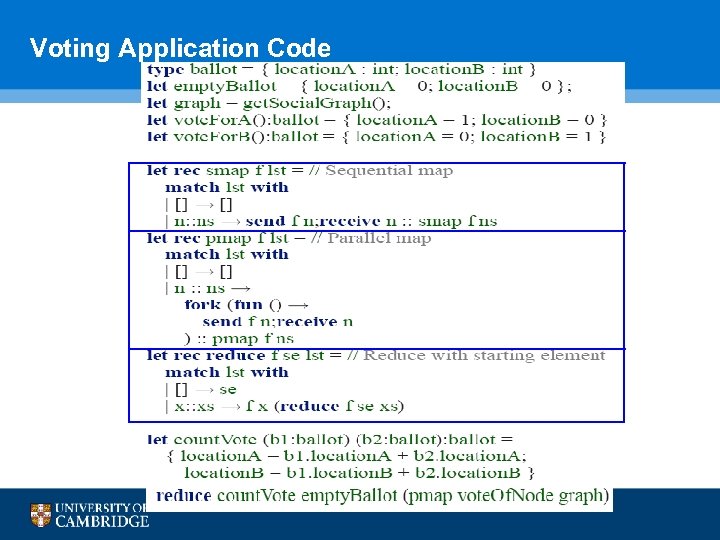
Voting Application Code 97
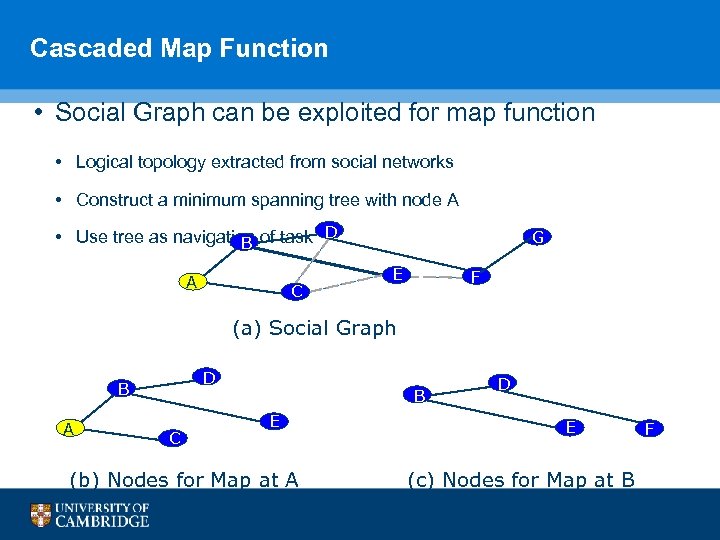
Cascaded Map Function • Social Graph can be exploited for map function • Logical topology extracted from social networks • Construct a minimum spanning tree with node A • Use tree as navigation of task D B A C G E F (a) Social Graph D B A C B E (b) Nodes for Map at A D E F (c) Nodes for Map at B 98
Outlook and Future Work • Current reference implementation: • F# targeting. NET platform taking advantage of a vast collection of. NET libraries for implementing D 3 N primitives • Future work: • Security issues are currently out of the scope of this paper. Executable code migrating from node to node • Validate and verify the correctness of the design by implementing a compiler targeting various mobile devices • Disclose code in public domain http: //www. cl. cam. ac. uk/~ey 204 Email: eiko. yoneki@cl. cam. ac. uk
Скачать презентацию China Mobile Leader s Programme Mobile Technology Jon Crowcroft
642a01274573601d14214e880d114bb8.ppt