


 Скачать презентацию China and the West A Fascinating Chapter in
258e959e1f0d72b5e2a37ac5d544fce5.ppt
- Количество слайдов: 46
 China and the West: A Fascinating Chapter in the 19 th Century San-pao Li, Ph. D. Department of Asian and Asian American Studies California State University, Long Beach October 11, 2001
 Some Defining Characteristics of a Modern Society *Emphasis on efficiency and utility *Prevalence of rationalism *Scientific and technological advancement *Due respect to individual worth and dignity *The concept of progress *High level of literacy *Sound social welfare system 2
 Some Defining Characteristics of a Modern Society *High GNP and per capita income *High degree of urbanization *L’esprit de lois *A pluralistic society *Shared concern for ecologically healthy environment *Adequate health care delivery system 3
 Some Defining Characteristics of a Modern Society *Generous investment in infrastructure *Rapid transportation and communication *Encourages creativity and fulfillment of individual’s potential and faculty *Rapid change *Clear division of labor *International- mindedness *Other 4
 Modernity (Modernization) Modernization involves the systematic, sustained, and purposeful application of human energies to the “rational” control of man’s physical and social environment for various human purposes. Benjamin Schwartz (Harvard University) 5
 Modernity (Modernization) Modernity is always an incomplete state of becoming. 6
 China’s Tortuous Process of Modernization Foreign Aggression and Domestic Rebellion (18001864) T’ung-chih Restoration (1862 -1874) Self-Strengthening Movement in an Age of Accelerated Foreign Imperialism (1874 -1895) Reform and Revolution (1898 -1912) The May Fourth Movement: Ideological Awakening (1919 -1923 -1930’s) The Great Proletarian Cultural Revolution (19661976) The Four Modernizations (1978 -present) 7
 China’s Tortuous Process of Modernization Foreign Aggression and Domestic Rebellion -1864) (1800 T’ung-chih Restoration (1862 -1874) Self-Strengthening Movement in an Age of Accelerated Foreign Imperialism (1874 -1895) Reform and Revolution (1898 -1912) The May Fourth Movement: Ideological Awakening (19191923 -1930’s) The Great Proletarian Cultural Revolution (1966 -1976) The Four Modernizations (1978 -present) 8
 China’s Tortuous Process of Modernization Foreign Aggression and Domestic Rebellion (1800 -1864) 9 Trade and Proselytization 9 The Opium War (1839 -1841) 9 The Nanking Treaty (1842) 9 Internal Decay and Unrest 9 The Taiping Rebellion (1850 -1864) 9
 China’s Tortuous Process of Modernization Foreign Aggression and Domestic Rebellion 1864) (1800 - T’ung-chih Restoration (1862 -1874) Self-Strengthening Movement in an Age of Accelerated Foreign Imperialism (1874 -1895) Reform and Revolution (1898 -1912) The May Fourth Movement: Ideological Awakening (19191923 -1930’s) The Great Proletarian Cultural Revolution (1966 -1976) The Four Modernizations (1978 -present) 10
 China’s Tortuous Process of Modernization T’ung-chih Restoration (1862 -1874) Chinese ego was severely battered § Government appeared hopeless and demoralized § The Taipings devastated much of China § British and French navies brushed past Taku defenses § The emperor fled to Jehol and died there § 11
 China’s Tortuous Process of Modernization T’ung-chih Restoration (1862 -1874) The Restoration, for all its obvious influence on later periods, was NOT the seedbed of 20 th-century movements to fashion a new China, but the last great effort to reassert the validity of Chinese traditional institutions. 12
 China’s Tortuous Process of Modernization T’ung-chih Restoration (1862 -1874) The Restoration was perhaps the most elaborate, the most consistent, and the most fully documented conservative program in history. Mary Wright, The T’ung-chih Restoration 13
 China’s Tortuous Process of Modernization Foreign Aggression and Domestic Rebellion 1864) T’ung-chih Restoration (1862 -1874) (1800 - Self-Strengthening Movement in an Age of Accelerated Foreign Imperialism (18741895) Reform and Revolution (1898 -1912) The May Fourth Movement: Ideological Awakening (19191923 -1930’s) The Great Proletarian Cultural Revolution (1966 -1976) The Four Modernizations (1978 -present) 14
 China’s Tortuous Process of Modernization The Self-Strengthening Movement (1874 -1895) 4 Arsenals 4 Shipyards 4 Railroads 4 Telegraph Lines 4 Translation Bureau 15
 China’s Tortuous Process of Modernization The Self-Strengthening Movement (1874 -1895) The Ti-Yong Dichotomy Chinese Learning for the essential principles (ti) Western Learning for the practical applications (yong) 16
 China’s Tortuous Process of Modernization The Self-Strengthening Movement -1895) * The (1874 traditional Chinese state was attacked and mortally wounded * The imperial military was discredited * The agrarian economy was disrupted * The emperor’s prestige was dimmed * Superficial adoption of arms and technology proved unavailing * The old order was unable to respond adequately 17
 China’s Tortuous Process of Modernization The Self-Strengthening Movement (1874 -1895) Deceptively easy to adopt new technologies Put a thin veneer over the surface of an ancient civilization 18
 China’s Tortuous Process of Modernization The Self-Strengthening Movement (1874 -1895) New ideas and attitudes resulted from contact with the West remained minor elements in the broad stream of Chinese tradition 19
 China’s Tortuous Process of Modernization The Self-Strengthening Movement (1874 -1895) Ideas of change were spreading, but veeeeeery slowly. 20
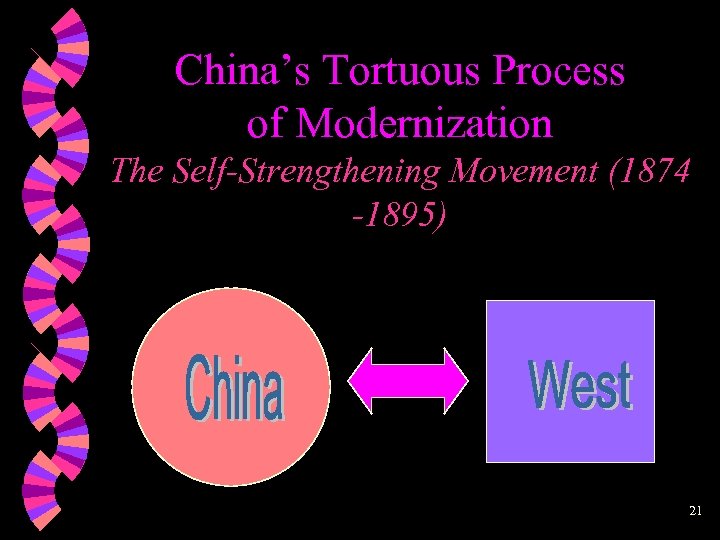 China’s Tortuous Process of Modernization The Self-Strengthening Movement (1874 -1895) 21
 China’s Tortuous Process of Modernization The Self-Strengthening Movement (1874 -1895) China’s modernization was inspired by Western examples and yet had to be superimposed upon old indigenous institutions, which persisted so strongly as to slow down the need or demand for innovation. 22
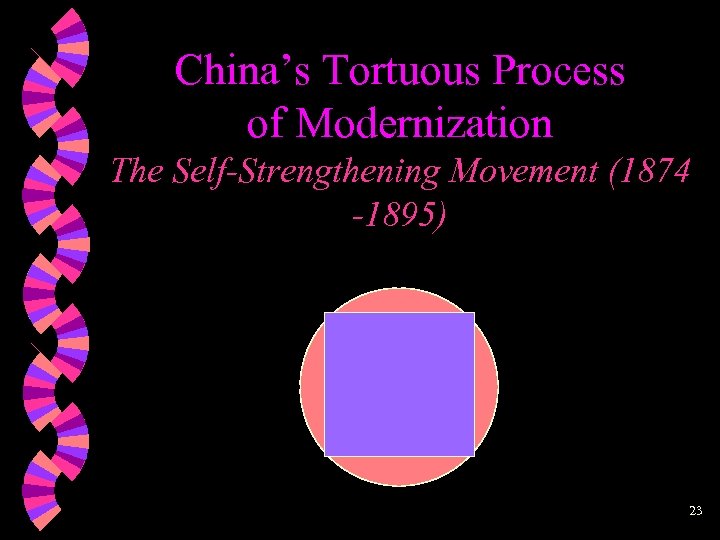 China’s Tortuous Process of Modernization The Self-Strengthening Movement (1874 -1895) 23
 China’s Tortuous Process of Modernization Faustian-Prometheanism Faust The old philosopher who sold his soul to the devil in exchange for knowledge and power. The hero of several medieval German legends and later literary and operatic works. 24
 China’s Tortuous Process of Modernization Faustian-Prometheanism Prometheus A giant in Greek mythology who stole fire from heaven, consequently was tied to a huge rock on Caucasus with his liver picked by the eagles. Having the quality of being life-bringing, creative, and courageously original. 25
 China’s Tortuous Process of Modernization Faustian-Prometheanism Faustian restlessness skeptical, critical, and bold in evalutating tradition) and (be re- Promethean defiance (releasing the energy of individuals, concept of linear progress) 26
 China’s Tortuous Process of Modernization Foreign Aggression and Domestic Rebellion (18001864) T’ung-chih Restoration (1862 -1874) Self-Strengthening Movement in an Age of Accelerated Foreign Imperialism (1874 -1895) Reform and Revolution (1898 -1912) The May Fourth Movement: Ideological Awakening (19191923 -1930’s) The Great Proletarian Cultural Revolution (1966 -1976) The Four Modernizations (1978 -present) 27
 China’s Tortuous Process of Modernization Reform and Revolution (1898 -1912) China’s defeat by Japan in 1894 Ø Sino-Japanese Treaty of Shimonoseki Ø The 1898 Reform (100 days) Ø The 1911 Revolution (Dr. Sun Yat-sen) Ø Founding of the Republic of China Ø 28
 China’s Tortuous Process of Modernization Reform and Revolution -1912) (1898 Ø Realization of the true spirit or essence of Western civilization Ø The emergence and persistence of radical revolt against China’s cultural tradition 29
 China’s Tortuous Process of Modernization Foreign Aggression and Domestic Rebellion (18001864) T’ung-chih Restoration (1862 -1874) Self-Strengthening Movement in an Age of Accelerated Foreign Imperialism (1874 -1895) Reform and Revolution (1898 -1912) The May Fourth Movement: Ideological Awakening (1919 -1923 -1930’s) The Great Proletarian Cultural Revolution (1966 -1976) The Four Modernizations (1978 -present) 30
 China’s Tortuous Process of Modernization The May Fourth Movement (1919 -1923 -1930’s) The patriotic feelings and zeal for reform culminated in the incident of May 4, 1919, from which the movement took its name. 3, 000+ students from 14 universities in Beijing held mass demonstration. 31
 China’s Tortuous Process of Modernization The May Fourth Movement (1919 -1923 -1930’s) Began as a socio-political reform movement Publication of the New Citizen (1902) Publication of the New Youth (1915) China’s intellectual revolution Science and Democracy 32
 China’s Tortuous Process of Modernization The May Fourth Movement (1919 -1923 -1930’s) Radical anti-traditionalism Attacked traditional Chinese ethics, philosophy, religion, and many varieties of social and political institutions Advocated liberalism, pragmatism, nationalism, anarchism, and socialism 33
 China’s Tortuous Process of Modernization The May Fourth Movement (1919 -1923 -1930’s) With 400+ newspapers and magazines Vigorously spread the tide of new thought and new literature A period marked by iconoclasm, criticism, and furious destruction Left unchallenged virtually NO tradition that appeared doubtful 34
 China’s Tortuous Process of Modernization The May Fourth Movement (1919 -1923 -1930’s) Decline of traditional ethics Challenged traditional family system Emancipation of women Vernacular literature emerged The press and public education made progress Modern intelligentsia became a major factor in China’s subsequent political development 35
 China’s Tortuous Process of Modernization The May Fourth Movement (1919 -1923 -1930’s) Emergence of a new awareness 36
 China’s Tortuous Process of Modernization The May Fourth Movement (1919 -1923 -1930’s) Involution vs. Revolution The development of certain phenomena within a large cultural context that is not itself undergoing significant or basic change. 37
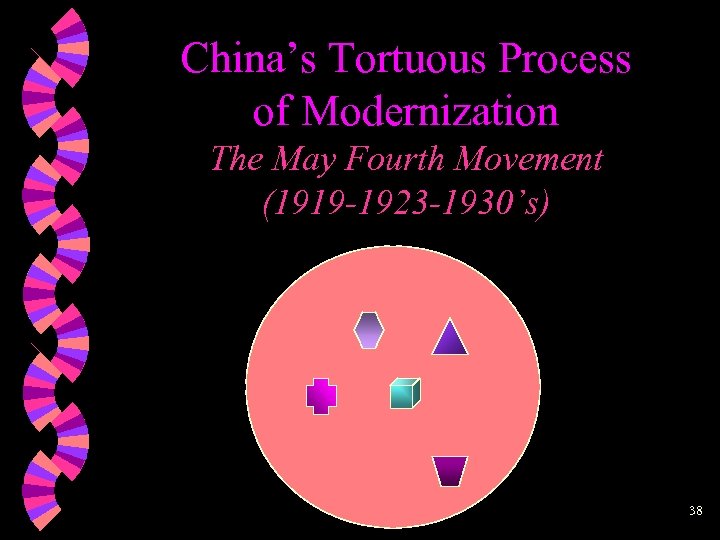 China’s Tortuous Process of Modernization The May Fourth Movement (1919 -1923 -1930’s) 38
 China’s Tortuous Process of Modernization Between May Fourth and Fourth June Sino-Japanese War (1937 -1945) The Notorious Nanjing Massacre (1937) 300, 000 slaughtered in Nanjing The Communist Takeover Founding of PRC on October 1, 1949 The rule of the Chinese Communists The Cultural Revolution 39
 China’s Tortuous Process of Modernization Foreign Aggression and Domestic Rebellion (18001864) T’ung-chih Restoration (1862 -1874) Self-Strengthening Movement in an Age of Accelerated Foreign Imperialism (18741895) Reform and Revolution (1898 -1912) The May Fourth Movement: Ideological Awakening (1919 -1923 -1930’s) The Great Proletarian Cultural Revolution (1966 -1976) The Four Modernizations (1978 -present) 40
 China’s Tortuous Process of Modernization The Great Proletarian Cultural Revolution (1966 -1976) Ø Totalistic antitraditionalism Ø Intellectual holocaust of unprecedented magnitude 41
 China’s Tortuous Process of Modernization Foreign Aggression and Domestic Rebellion (18001864) T’ung-chih Restoration (1862 -1874) Self-Strengthening Movement in an Age of Accelerated Foreign Imperialism (1874 -1895) Reform and Revolution (1898 -1912) The May Fourth Movement: Ideological Awakening (19191923 -1930’s) The Great Proletarian Cultural Revolution (1966 -1976) The Four Modernizations (1978 -present) 42
 China’s Tortuous Process of Modernization The Four Modernizations -present) and technology W Agriculture W Industry W National defense W (Democracy? ? ? ) (1978 W Science 43
 China’s Tortuous Process of Modernization The Four Modernizations -present) (1978 W From central planning to market economy W From villages to urban centers W Political ideology is losing its magical power and potency 44
 Conclusion A Thought-Provoking Question Nobel Prize in Literature 1950 A Polish novelist Henryk Sienkiewicz Quo Vadis (Whither Goest Thou? ) 45
 Thank you! Your Comments and Suggestions Are Welcome! 46