


 Скачать презентацию CHINA and ROME Empires of the East and
d49769da22f8f08211dc5aca28f922eb.ppt
- Количество слайдов: 29
 CHINA and ROME Empires of the East and the West
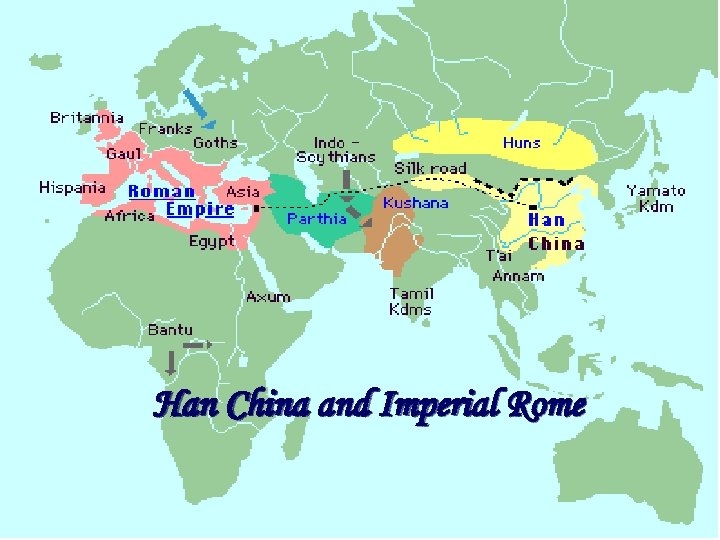 Han China and Imperial Rome
 Pre- Empire States j CHINA j. Shang Dynasty, c. 1750 bce-1100 bce j introduction of writing j. Zhou Dynasty, c. 1100 bce- 221 bce j establishment of Confucianism and Taoism j Qin (Chin) Dynasty, 221 bce-206 bce j origin of name of China E ROME Ø Etruscan Civilization, c. 700 bce-509 bce Ø Legendary Roman kings, 753 bce-509 bce Ø Ø Ø patricians: aristocrats and professionals plebians: farmers, craftsmen, laborers patronage system Ø pater -- paternalism Ø pietas -- duty Ø Roman Republic, 509 bce -27 bce
 Qin (Chin) Dynasty : 221 -206 bce j First unified the country by subjugating the Warring States j. Established central bureaucracy j. Legalism supplanted Confucianism: persecuted scholars and burned books j. Standardized writing, currency, weights and measures j. Major building projects j Used forced labor of convicts j Roads and canals j Palaces j Connected fortification walls to build 5000 kilometer Great Wall
 Mausoleum of 1 st Qin Emperor Shin. Huangdi j Shi. Huangdi’s Mausoleum was discovered in 1974 by farmers digging a well. The 13 year-old emperor had ordered 800, 000 workers to build his tomb. j Terra Cotta Army j Rebellions broke out after Emperor’s death in 210 bce: dynasty overthrown after only 15 years of rule
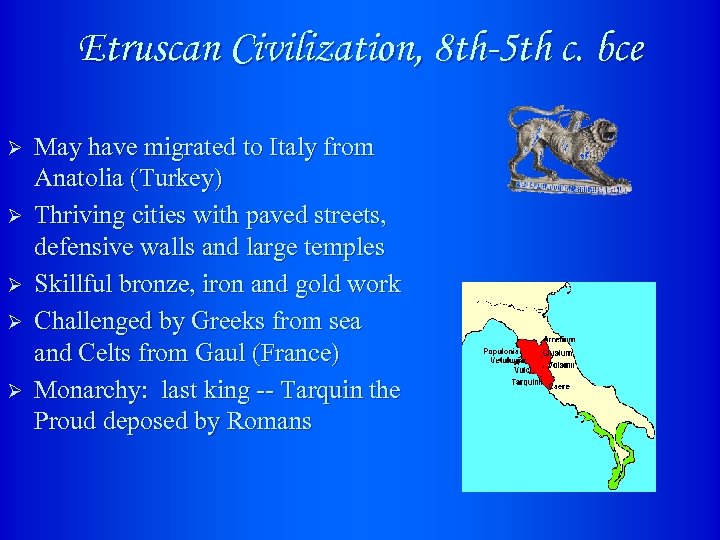 Etruscan Civilization, 8 th-5 th c. bce Ø Ø Ø May have migrated to Italy from Anatolia (Turkey) Thriving cities with paved streets, defensive walls and large temples Skillful bronze, iron and gold work Challenged by Greeks from sea and Celts from Gaul (France) Monarchy: last king -- Tarquin the Proud deposed by Romans
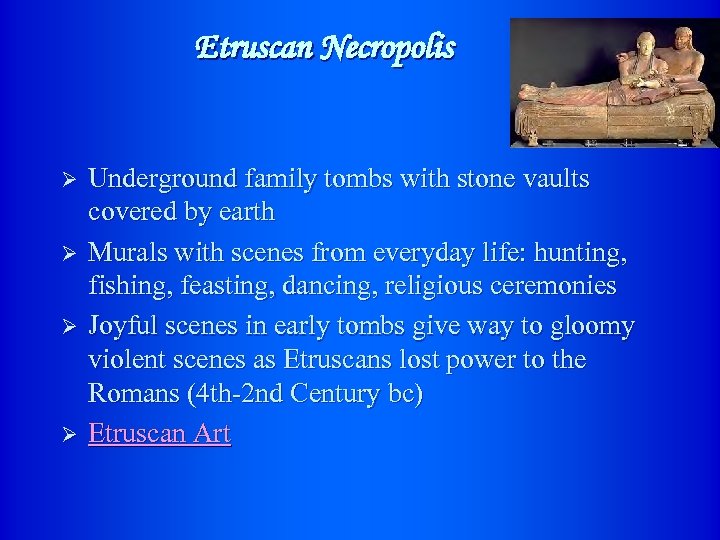 Etruscan Necropolis Ø Ø Underground family tombs with stone vaults covered by earth Murals with scenes from everyday life: hunting, fishing, feasting, dancing, religious ceremonies Joyful scenes in early tombs give way to gloomy violent scenes as Etruscans lost power to the Romans (4 th-2 nd Century bc) Etruscan Art
 Liberated Etruscan Women ¯ “Etruscan women take particular care of their bodies and exercise often, sometimes along with the men, and sometimes by themselves. It is not a disgrace for them to be seen naked. They do not share their couches with their husbands but with the other men who happen to be present, and they propose toasts to anyone they choose. They are expert drinkers and very attractive. The Etruscans raise all the children that are born, without knowing who their fathers are. ” Theopompus of Chios, 4 th cent. BCE
 Roman Kingdom: Regnum Romanum 753 -510 bce Ø Ø In Roman legend, the Trojan hero Aeneas sailed across the Mediterranean Sea to Italy and founded Lavinium. His son Iulus went on to found the city of Alba Longa. From Alba Longa's royal family came the twins Romulus and Remus, who went on to found the city of Rome in 753 BCE. The kingdom ended with the expulsion of Lucius Tarquinius Superbus in 510 BCE and the establishment of the Roman Republic.
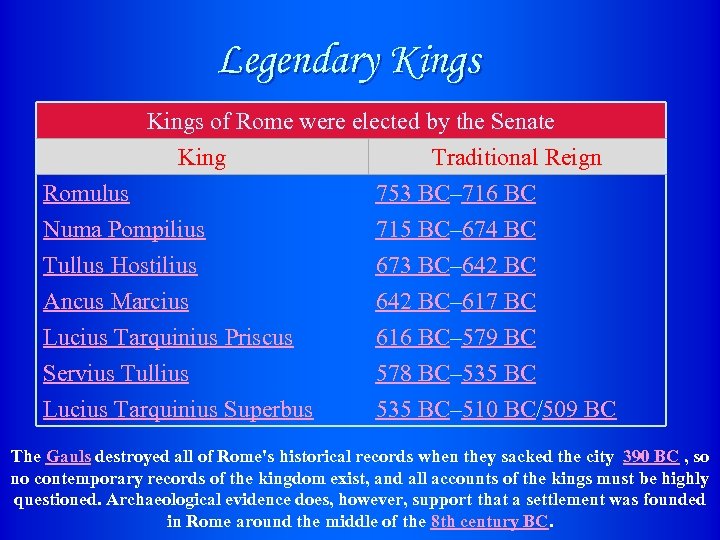 Legendary Kings of Rome were elected by the Senate King Traditional Reign Romulus 753 BC– 716 BC Numa Pompilius 715 BC– 674 BC Tullus Hostilius Ancus Marcius Lucius Tarquinius Priscus Servius Tullius Lucius Tarquinius Superbus 673 BC– 642 BC– 617 BC 616 BC– 579 BC 578 BC– 535 BC– 510 BC/509 BC The Gauls destroyed all of Rome's historical records when they sacked the city 390 BC , so no contemporary records of the kingdom exist, and all accounts of the kings must be highly questioned. Archaeological evidence does, however, support that a settlement was founded in Rome around the middle of the 8 th century BC.
 Accomplishments of the Roman Kings Ø Ø Ø Ø Settlement and continual expansion of the city of Rome (aided by rape of the Sabine women) Establishment of Senate to serve as king’s council Establishment of Roman legions Establishment of the Vestal Virgins Reform of the calendar to 360 days, adding the months of January and February Introduction of coinage Establishment of a census dividing the population into classes according to wealth
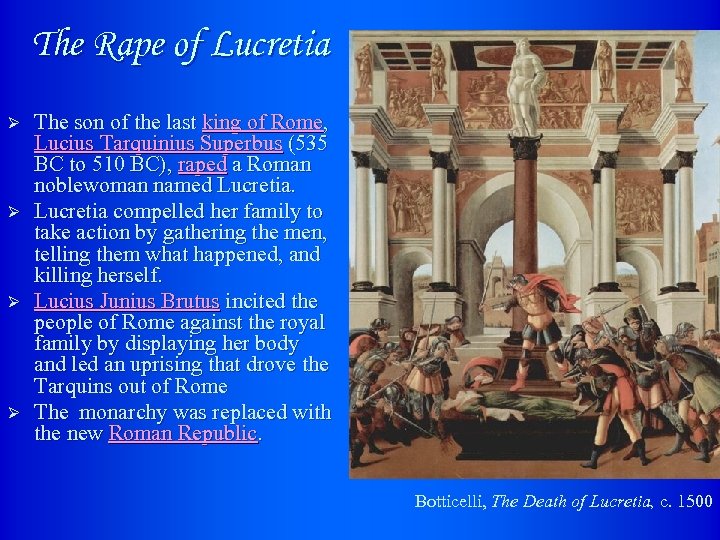 The Rape of Lucretia Ø Ø The son of the last king of Rome, Lucius Tarquinius Superbus (535 BC to 510 BC), raped a Roman noblewoman named Lucretia compelled her family to take action by gathering the men, telling them what happened, and killing herself. Lucius Junius Brutus incited the people of Rome against the royal family by displaying her body and led an uprising that drove the Tarquins out of Rome The monarchy was replaced with the new Roman Republic. Botticelli, The Death of Lucretia, c. 1500
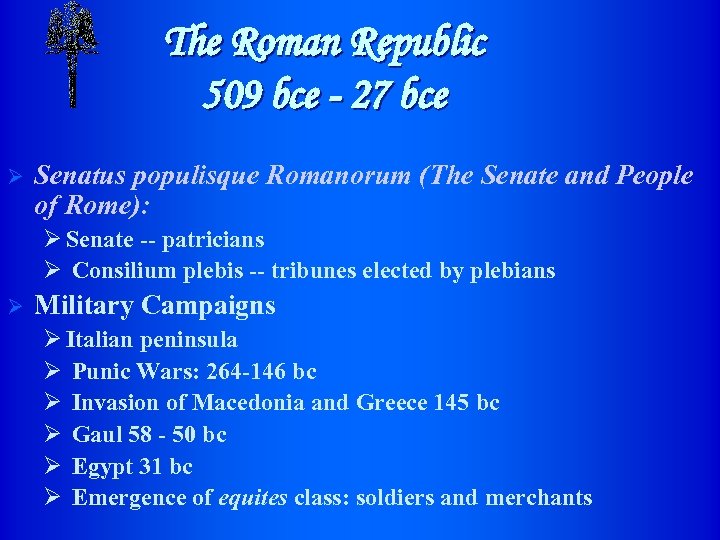 The Roman Republic 509 bce - 27 bce Ø Senatus populisque Romanorum (The Senate and People of Rome): Ø Senate -- patricians Ø Consilium plebis -- tribunes elected by plebians Ø Military Campaigns Ø Italian peninsula Ø Punic Wars: 264 -146 bc Ø Invasion of Macedonia and Greece 145 bc Ø Gaul 58 - 50 bc Ø Egypt 31 bc Ø Emergence of equites class: soldiers and merchants
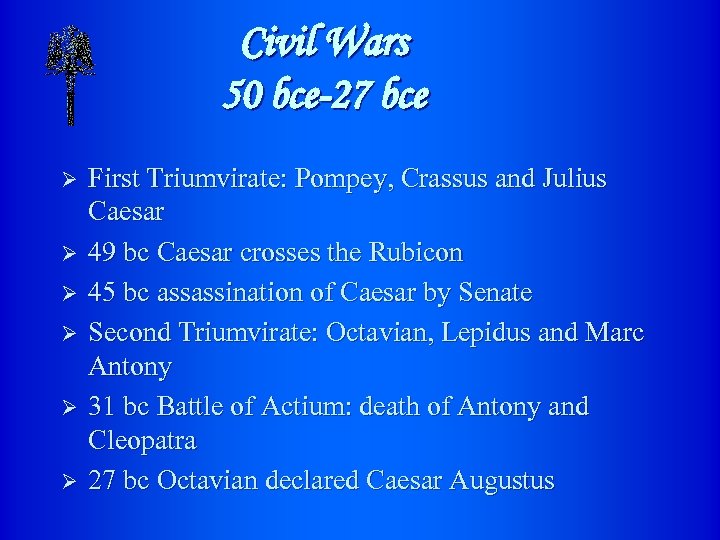 Civil Wars 50 bce-27 bce Ø Ø Ø First Triumvirate: Pompey, Crassus and Julius Caesar 49 bc Caesar crosses the Rubicon 45 bc assassination of Caesar by Senate Second Triumvirate: Octavian, Lepidus and Marc Antony 31 bc Battle of Actium: death of Antony and Cleopatra 27 bc Octavian declared Caesar Augustus
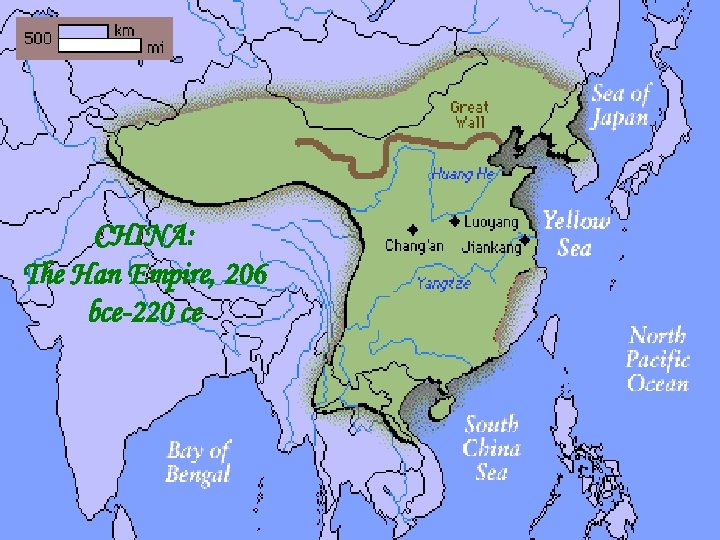 CHINA: The Han Empire, 206 bce-220 ce
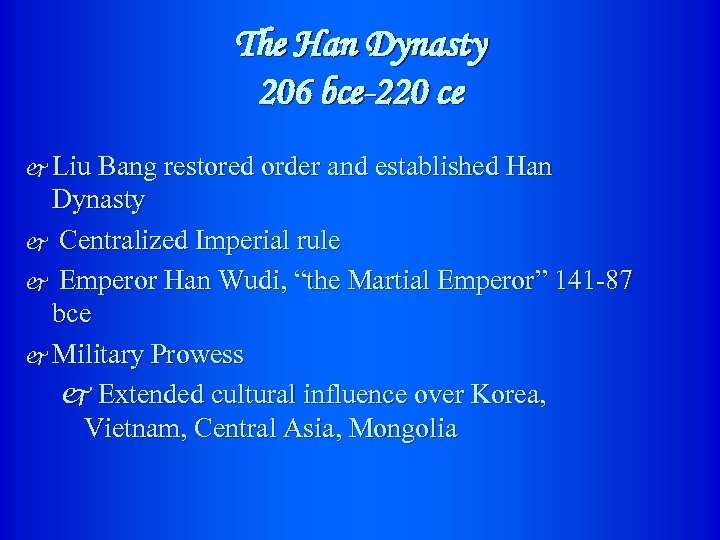 The Han Dynasty 206 bce-220 ce j Liu Bang restored order and established Han Dynasty j Centralized Imperial rule j Emperor Han Wudi, “the Martial Emperor” 141 -87 bce j Military Prowess j Extended cultural influence over Korea, Vietnam, Central Asia, Mongolia
 Confucianism Restored j State philosophy j Honored and employed scholars in government j Instituted civil service exam system Imperial University established 124 bce to educate bureaucrats j China’s most famous historian: Sima Qian (145 -87 bce) j
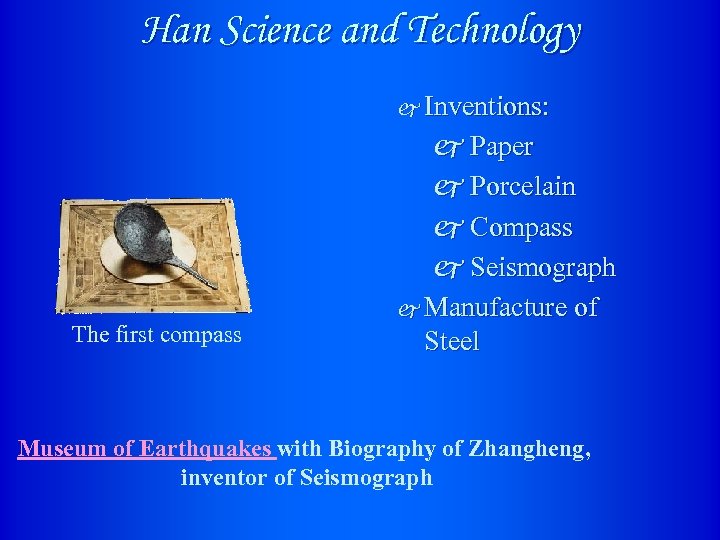 Han Science and Technology j Inventions: The first compass j Paper j Porcelain j Compass j Seismograph j Manufacture of Steel Museum of Earthquakes with Biography of Zhangheng, inventor of Seismograph
 Sima Qian (145 -87 bce) China’s most famous historian ý Shiji (史記, "history record"), an overview of the history of China covering more than two thousand years from the earliest times to his own day during the reign of Emperor Han Wudi ý Historians regard Sima Qian’s work as their model, which stands as the "official format" of the history of China. ý In writing Shiji, Sima Qian initiated a new writing style by presenting history in a series of biographies ý
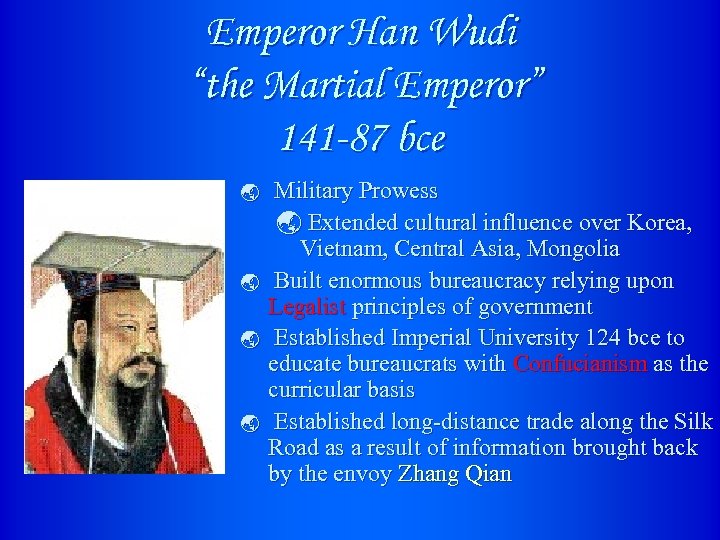 Emperor Han Wudi “the Martial Emperor” 141 -87 bce ý ý Military Prowess ý Extended cultural influence over Korea, Vietnam, Central Asia, Mongolia Built enormous bureaucracy relying upon Legalist principles of government Established Imperial University 124 bce to educate bureaucrats with Confucianism as the curricular basis Established long-distance trade along the Silk Road as a result of information brought back by the envoy Zhang Qian
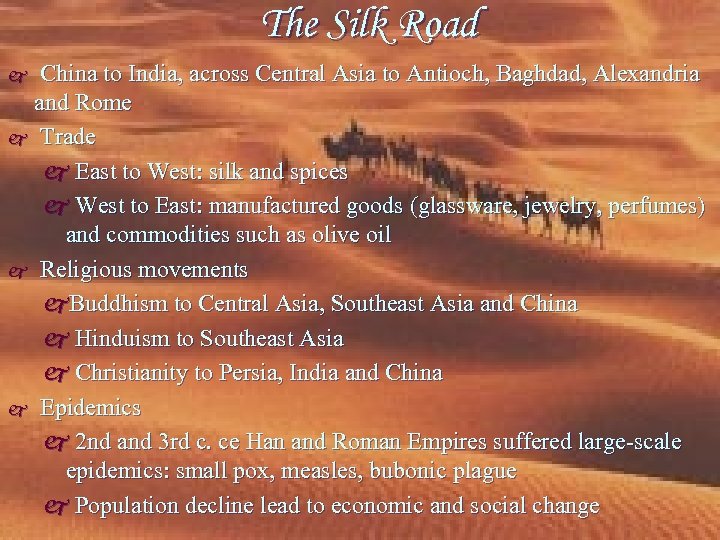 The Silk Road China to India, across Central Asia to Antioch, Baghdad, Alexandria and Rome j Trade j East to West: silk and spices j West to East: manufactured goods (glassware, jewelry, perfumes) and commodities such as olive oil j Religious movements j. Buddhism to Central Asia, Southeast Asia and China j Hinduism to Southeast Asia j Christianity to Persia, India and China j Epidemics j 2 nd and 3 rd c. ce Han and Roman Empires suffered large-scale epidemics: small pox, measles, bubonic plague j Population decline lead to economic and social change j
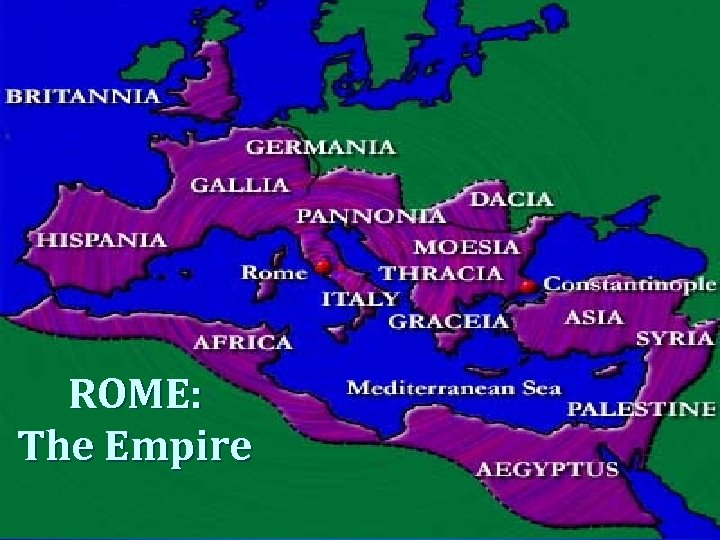 ROME: The Empire
 Pax Romana 27 bce - 180 ce Ø Caesar Augustus’ reign (27 bc-14 ad) considered the Golden Age of Rome Ø Establishment of law and civil order throughout Empire Ø Rome became an international city Ø Public works: aqueducts, public baths, theatres, marketplaces, roads, libraries Ø Economy rested on slavery: slaves ranged from field laborers to secretaries, teachers, and artists -- often earned enough to buy freedom
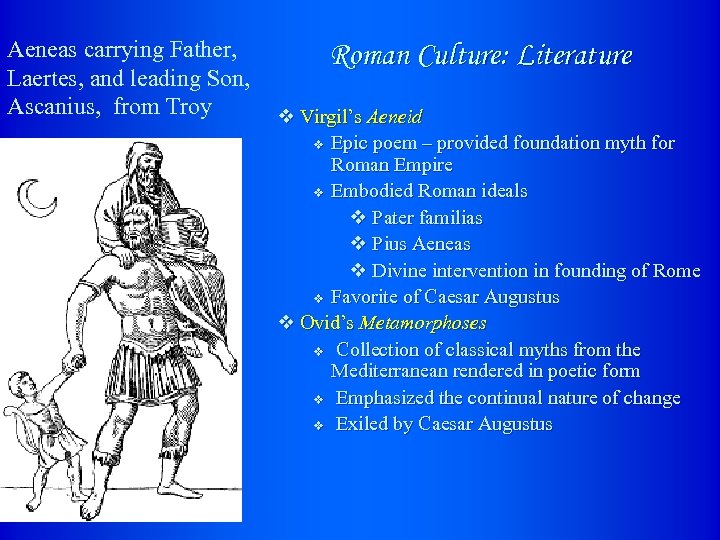 Aeneas carrying Father, Laertes, and leading Son, Ascanius, from Troy Roman Culture: Literature v Virgil’s Aeneid v Epic poem – provided foundation myth for Roman Empire v Embodied Roman ideals v Pater familias v Pius Aeneas v Divine intervention in founding of Rome v Favorite of Caesar Augustus v Ovid’s Metamorphoses v Collection of classical myths from the Mediterranean rendered in poetic form v Emphasized the continual nature of change v Exiled by Caesar Augustus
 Roman Culture: Philosophy § Stoicism § Held that emotions like fear or envy either were, or arose from, false judgements § The sage--a person who had attained moral and intellectual perfection--would not undergo emotions: the sage is utterly immune to misfortune and virtue is sufficient for happiness. § Epicureanism § § Based upon the teachings of Epicurus (c. 340–c. 270 BC), A general attack on superstition and divine intervention The greatest good was to seek modest pleasures to attain a state of tranquility and freedom from fear as well as absence of bodily pain through knowledge of the workings of the world and the limits of desires. Neo-Platonism § School of philosophy that took shape in the 3 rd century ce, based on the teachings of Plato and earlier Platonists § Human perfection and happiness were attainable in this world, without awaiting an afterlife. Perfection and happiness could be achieved through philosophical contemplation
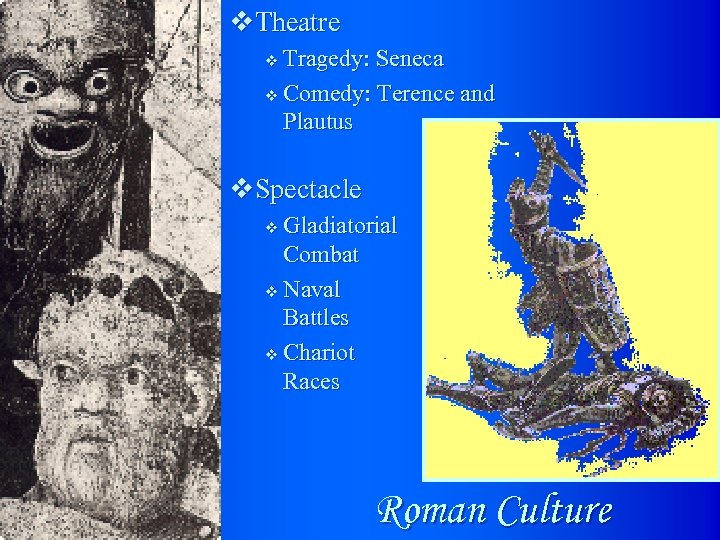 v. Theatre Tragedy: Seneca v Comedy: Terence and Plautus v v. Spectacle Gladiatorial Combat v Naval Battles v Chariot Races v Roman Culture
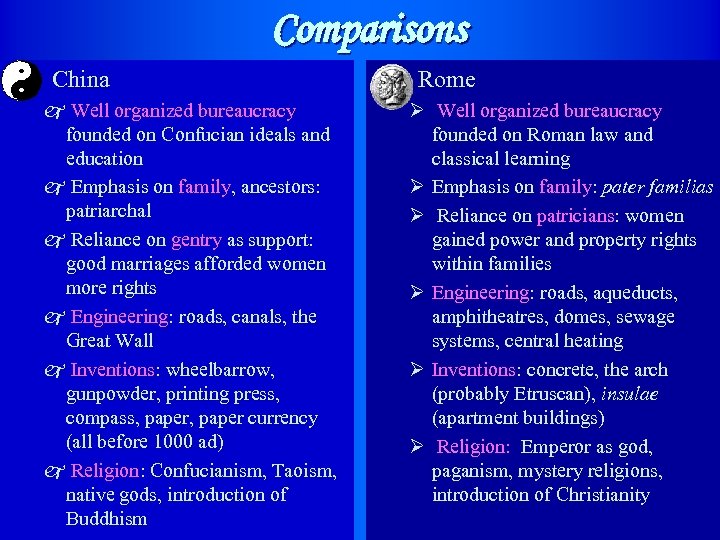 Comparisons j China j Well organized bureaucracy founded on Confucian ideals and education j Emphasis on family, ancestors: patriarchal j Reliance on gentry as support: good marriages afforded women more rights j Engineering: roads, canals, the Great Wall j Inventions: wheelbarrow, gunpowder, printing press, compass, paper currency (all before 1000 ad) j Religion: Confucianism, Taoism, native gods, introduction of Buddhism Ø Rome Ø Well organized bureaucracy founded on Roman law and classical learning Ø Emphasis on family: pater familias Ø Reliance on patricians: women gained power and property rights within families Ø Engineering: roads, aqueducts, amphitheatres, domes, sewage systems, central heating Ø Inventions: concrete, the arch (probably Etruscan), insulae (apartment buildings) Ø Religion: Emperor as god, paganism, mystery religions, introduction of Christianity
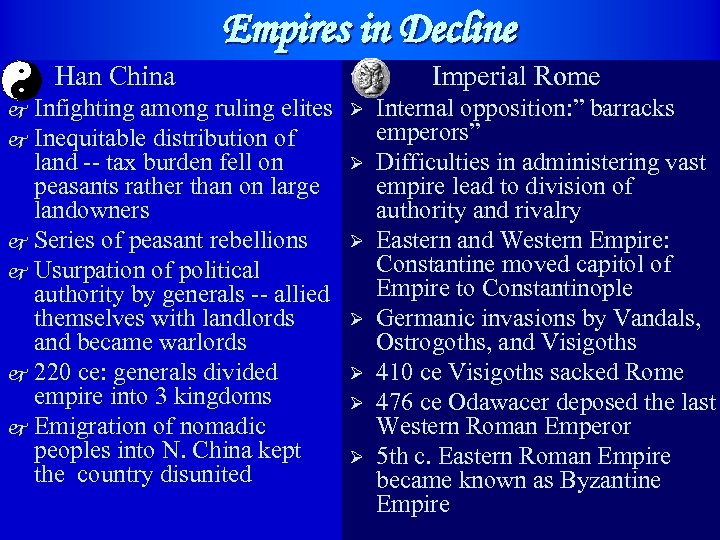 Empires in Decline j Han China Infighting among ruling elites j Inequitable distribution of land -- tax burden fell on peasants rather than on large landowners j Series of peasant rebellions j Usurpation of political authority by generals -- allied themselves with landlords and became warlords j 220 ce: generals divided empire into 3 kingdoms j Emigration of nomadic peoples into N. China kept the country disunited j E Ø Ø Ø Ø Imperial Rome Internal opposition: ” barracks emperors” Difficulties in administering vast empire lead to division of authority and rivalry Eastern and Western Empire: Constantine moved capitol of Empire to Constantinople Germanic invasions by Vandals, Ostrogoths, and Visigoths 410 ce Visigoths sacked Rome 476 ce Odawacer deposed the last Western Roman Emperor 5 th c. Eastern Roman Empire became known as Byzantine Empire
 CHINA and ROME END