


 Скачать презентацию Children Values and Consumer Culture Tim Kasser Ph
8433e4621d426f6bb3a20e415a0786ff.ppt
- Количество слайдов: 66
 Children, Values and Consumer Culture Tim Kasser, Ph. D.
 Advertisements
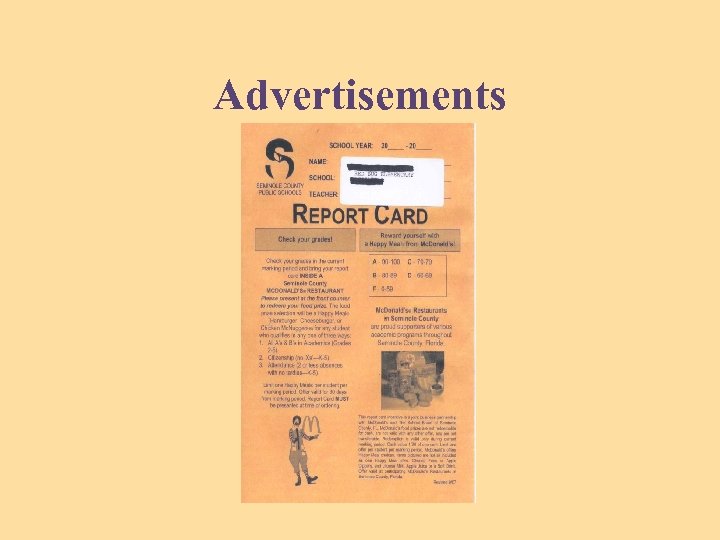 Advertisements
 Political Discourse • “…the American people have got to go about their business. We cannot let the terrorists achieve the objective of frightening our nation to the point where we don’t conduct business, where people don’t shop” (reported in The New York Times, October 12, 2001)
 Materialism’s allure • The percentage of incoming, U. S. , first-year college students reporting different values to be “very important” or “essential”:
 American Freshman survey
 Messages • Can purchase happiness • Important to work and consume • Life is meaningful and people are successful to the extent they have money, possessions, and the right image
 Stated goals of a Montessori Education • Feel self-confident & a sense of inner freedom • Develop curiosity, love of learning, & persistence • Learn responsibility, cooperation, honesty, kindness & a sense of common humanity • Foster respect for the environment and contribute to the community and planet.
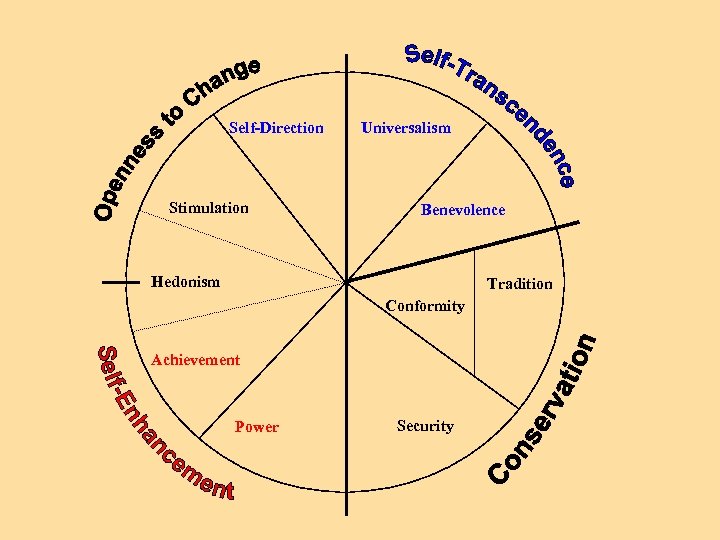
 Values & Goals • Guiding principles in life • Affect people’s attitudes towards particular objects and policies • Orient people to engage in particular behaviors • Many different types of values and goals exist • Organized in systems
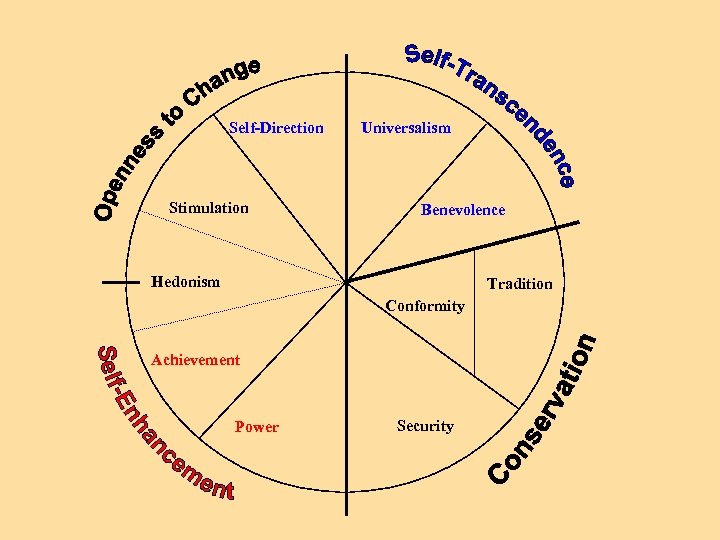
 Values & Goals • Some values are compatible, others are in conflict • Data can be represented with circumplex models – Compatible values are next to each other
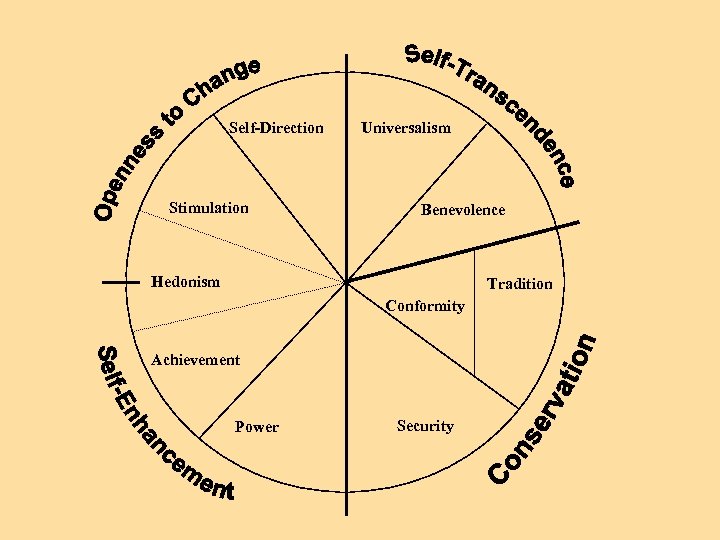 Self-Direction Stimulation Universalism Benevolence Hedonism Tradition Conformity Achievement Power Security
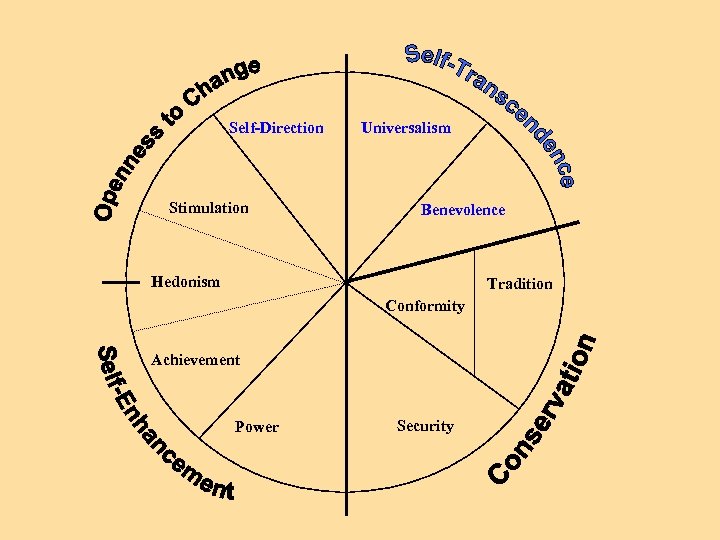 Self-Direction Stimulation Universalism Benevolence Hedonism Tradition Conformity Achievement Power Security
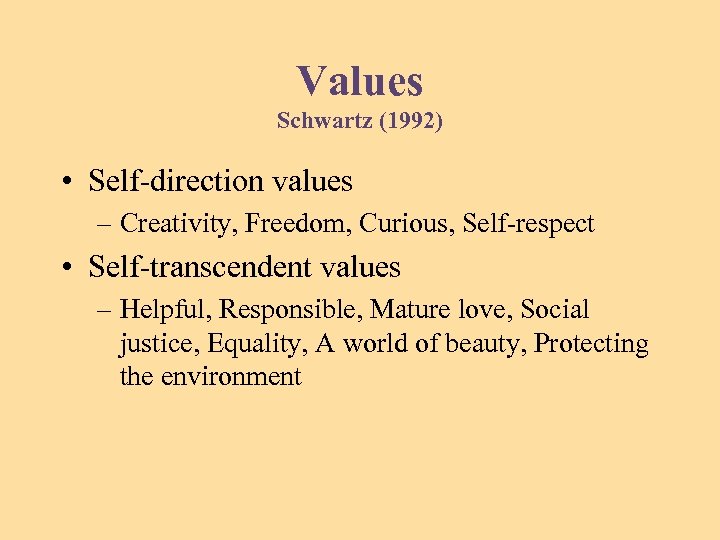 Values Schwartz (1992) • Self-direction values – Creativity, Freedom, Curious, Self-respect • Self-transcendent values – Helpful, Responsible, Mature love, Social justice, Equality, A world of beauty, Protecting the environment


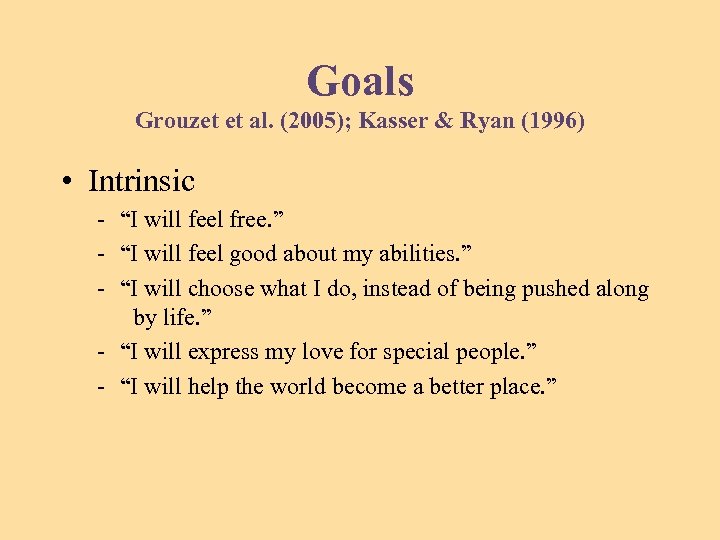 Goals Grouzet et al. (2005); Kasser & Ryan (1996) • Intrinsic - “I will feel free. ” - “I will feel good about my abilities. ” - “I will choose what I do, instead of being pushed along by life. ” - “I will express my love for special people. ” - “I will help the world become a better place. ”
 Values & Goals • Some values are compatible, others are in conflict • Data can be represented with circumplex models – Compatible values are next to each other
 Values & Goals • Some values are compatible, others are in conflict • Data can be represented with circumplex models – Compatible values are next to each other – Conflicting values are on opposite sides
 Self-Direction Stimulation Universalism Benevolence Hedonism Tradition Conformity Achievement Power Security
 Values Schwartz (1992) • Self-enhancement values – Social power, wealth, authority, successful, influential

 Goals Grouzet et al. (2005); Kasser & Ryan (1996) • Extrinsic – “I will have enough money to buy everything I want. ” – “I will achieve the ‘look’ I've been after. ” – “I will be admired by many people. ”
 Stated goals of a Montessori Education • Feel self-confident & a sense of inner freedom • Develop curiosity, love of learning, & persistence • Learn responsibility, cooperation, honesty, kindness & a sense of common humanity • Foster respect for the environment and contribute to the community and planet.
 Well-being Correlates
 Measures of Well-being Kasser & Ryan (1993, 1996); Sheldon & Kasser (1995, 1998) • Distress: – – Anxiety Depression Physical Symptoms Unpleasant emotions • Happiness – – Self-actualization Vitality Life Satisfaction Pleasant Emotions
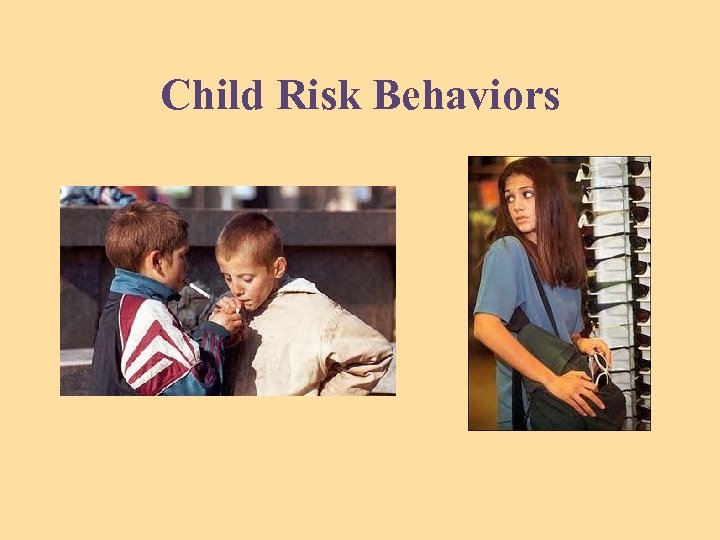 Child Risk Behaviors
 Child Risk Behaviors • Conduct disorder – Cohen & Cohen (1996); Kasser & Ryan (1993) • Smoking and drinking – Kasser & Ryan (2001); Williams et al. (2000)
 Educational Outcomes
 Educational Outcomes • Academic Achievement & Mastery vs. Performance Orientation – Ku, Banerjee, & Dittmar (in press) • Academic Achievement & Test Anxiety – Mouratidis & Vansteenkiste (2011)
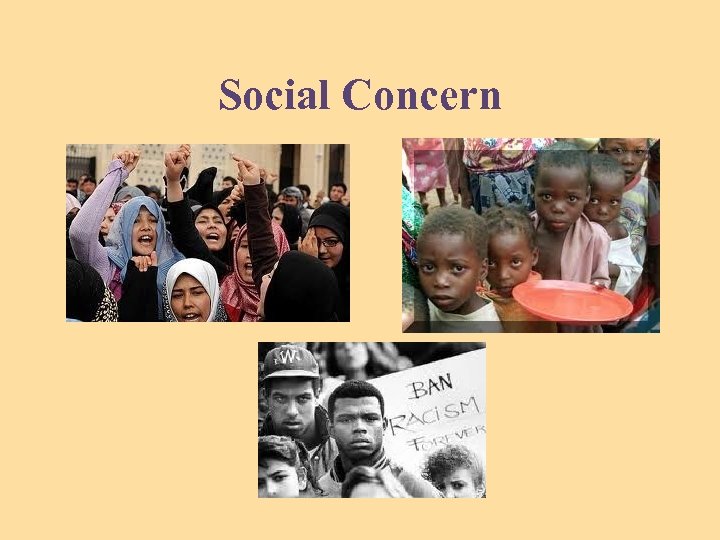 Social Concern
 Social Attitudes • Empathy – Sheldon & Kasser (1995) • Social dominance orientation – Duriez et al. (2007) • Racial & Ethnic Prejudice – Duriez et al. (2007); Roets et al. (2006)
 Social Behavior • Cooperative vs. competitive behavior – Sheldon et al. (2000) • Pro-social behavior – Sheldon & Kasser (1995); Mc. Hoskey (1999) • Helping behavior – Vohs et al. (2006)
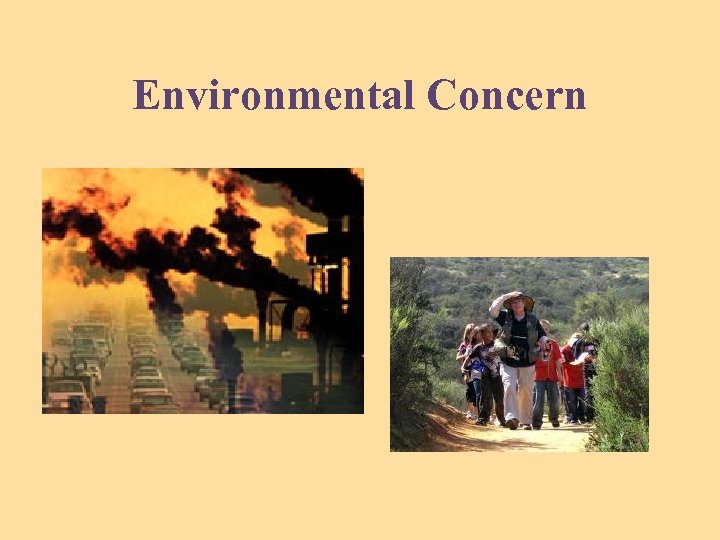 Environmental Concern
 Eco-Attitudes • Attitudes towards the environment – Good (2007); Saunders & Munro (2000) • Concern about effects of environmental damage on other people, animals, and future generations – Schultz et al. (2005)
 Eco-Behaviors • Frequency of riding bikes, recycling, reuse, etc. – Gatersleben et al (2008); Kasser (2005); Richins & Dawson (1992) • Size of Ecological Footprint – 400 N Americans – transportation, housing, food – Brown & Kasser (2005)
 Suggestions for Montessori Educators • • Interpersonal Style Framing and Priming Nature Marketing
 Suggestions for Montessori Educators • • Interpersonal Style Framing and Priming Nature Marketing
 Interpersonal Style • Montessori suggests that “when adults provide clear limits but set children free within those boundaries, and sensitively respond to children’s needs…. children show high levels of … desirable characteristics” (Lillard, 2005, pgs. 32 -33)
 Interpersonal Style • Children orient towards Intrinsic (and away from Extrinsic) values when provided with a parental environment that is warm, democratic, stable, involved, & nurturing – Cohen & Cohen (1996); Flouri (2004); Kasser et al. , (1995); Rindfleisch et al. , (2002); Williams et al. , (2000)
 Interpersonal Style Sheldon & Kasser (2008) • Imagine person who likes you and – tends to be “very accepting and non-evaluative of you” OR – “seems to accept you only to the extent that you live up to certain standards of performance” • Shift towards Intrinsic and away from Extrinsic values if imagine accepting person
 Interpersonal Style – Suggestions for schools • Keep it up Montessori educators!!!
 Suggestions for Montessori Educators • • Interpersonal Style Framing and Priming Nature Marketing
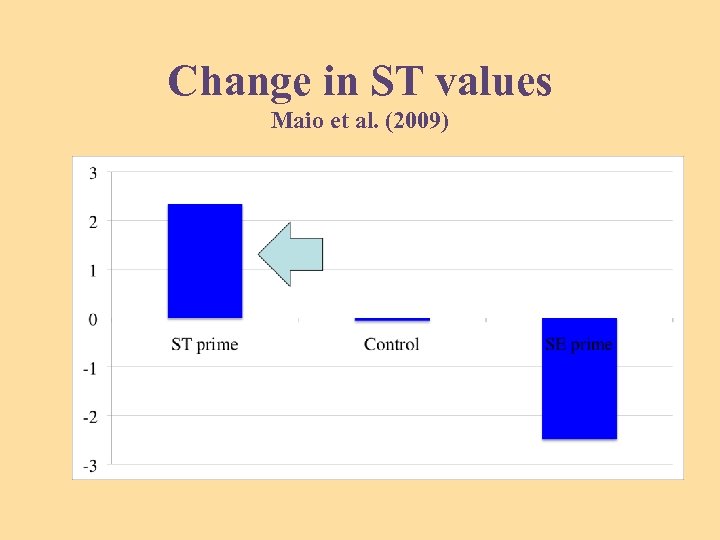
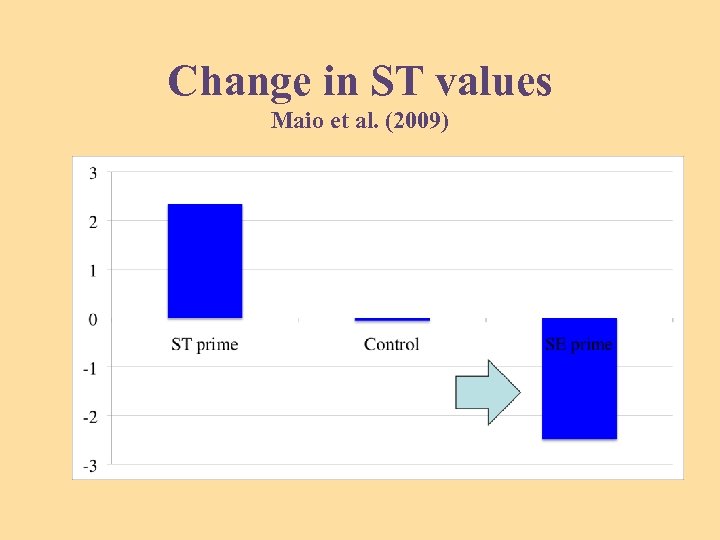
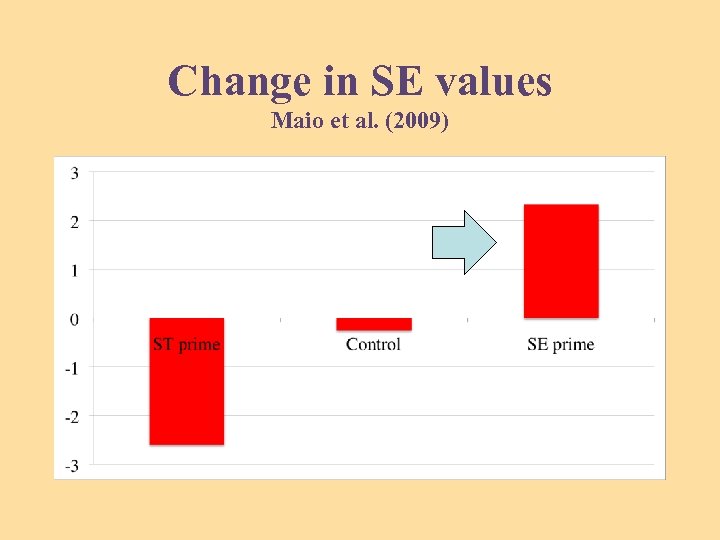
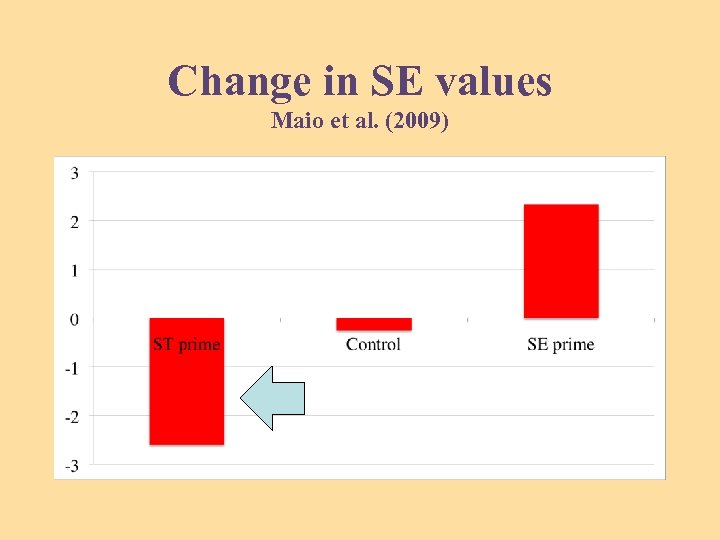
 Framing and Priming Maio et al. (2009) • Cardiff students given pre-test measure of SE, ST, and other values • Then either – Told that their peers highly valued 4 of the -Transcendent aims – Told that their peers highly valued 4 of the Enhancement aims – Memorized value-irrelevant words (control) Self- • Then given post-test value measure with new SE, ST, and other values
 Self-Direction Stimulation Universalism Benevolence Hedonism Tradition Conformity Achievement Power Security
 Change in ST values Maio et al. (2009)
 Change in ST values Maio et al. (2009)
 Change in SE values Maio et al. (2009)
 Change in SE values Maio et al. (2009)
 Framing and Priming Vansteenkiste et al. (2004) • Belgian education students • Asked to read a text on recycling framed as: – Helping the community (intrinsic) – Saving money (extrinsic)
 Framing and Priming Vansteenkiste et al. (2004) • Compared to those given Extrinsic frames, those given Intrinsic frames: – Learned material more deeply – Were more likely to visit library to learn more – Were more likely to go on later trip to recycling plant
 Framing & Priming– Suggestions for schools • Beware very subtle ways that Extrinsic values may be encouraged • Work instead to frame activities and assignments around Intrinsic values
 Suggestions for Montessori Educators • • Interpersonal Style Framing and Priming Nature Marketing
 Nature Weinstein et al. (2009) • Conducted 4 studies exposing people to photos of natural or human-made scenes • Measured feelings of immersion in scene • Then assessed importance of Extrinsic vs. Intrinsic Aspirations
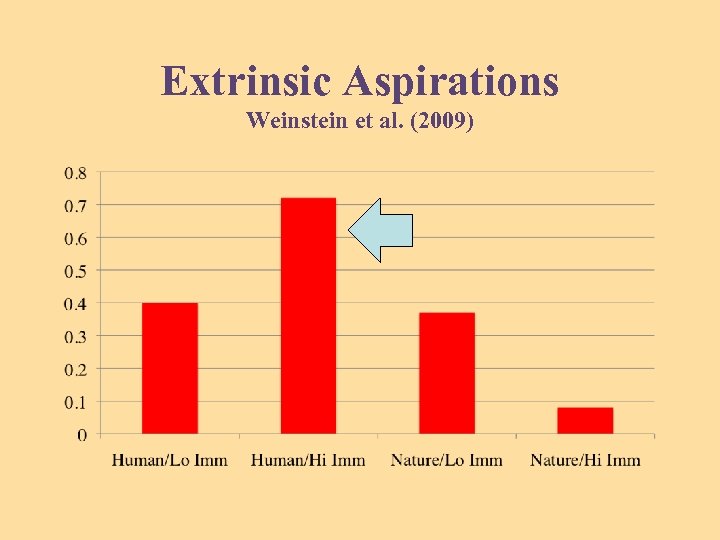 Extrinsic Aspirations Weinstein et al. (2009)
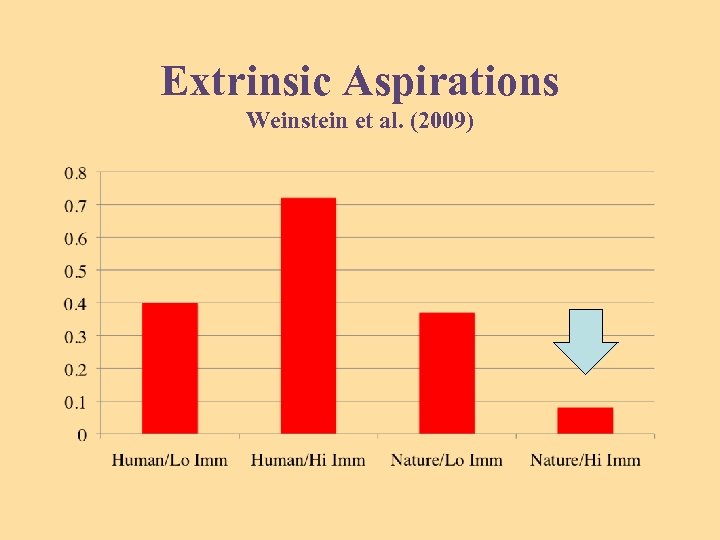 Extrinsic Aspirations Weinstein et al. (2009)
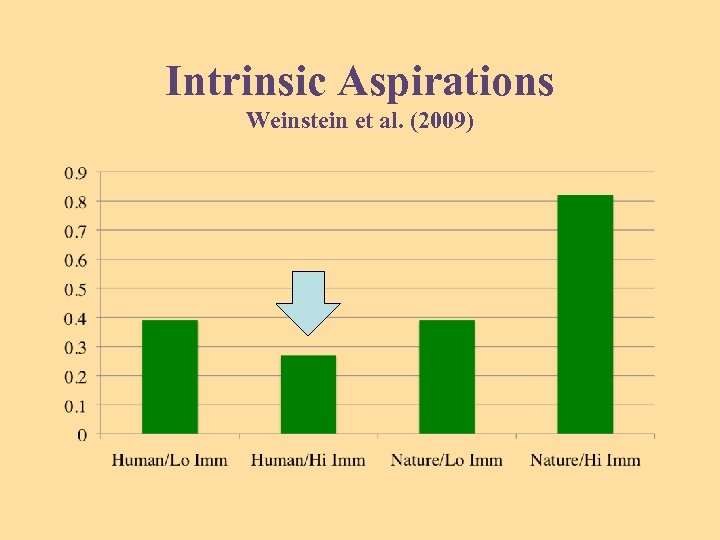 Intrinsic Aspirations Weinstein et al. (2009)
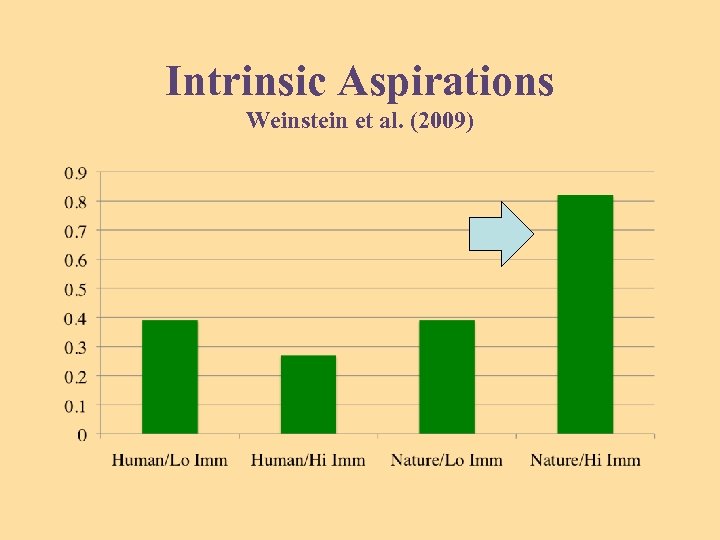 Intrinsic Aspirations Weinstein et al. (2009)
 Nature – Suggestions for schools • Develop more lessons involving exposure to nature, either in or out of the class • Make sure immersion is high
 Suggestions for Montessori Educators • • Interpersonal Style Framing and Priming Nature Marketing
 Marketing • Children who watch more TV have higher consumer values, lower well-being, and worse environmental attitudes – Cheung & Chan (1996); Good (2007); Nairn, Ormrod, & Bottomley (2007); Schor (2004) • Children in schools with Channel One have stronger consumer orientation – Brand & Greenberg (1994)
 American Freshman survey
 Marketing Twenge & Kasser (in press) • Changes in Materialism levels of HS seniors over time are predicted by the % of U. S. GNP from advertising – Both for concurrent spending and spending when child was 13 • Result holds after controlling for other societal-level factors (e. g. , GNP per capita, divorce rates, etc. )
 Marketing – Suggestions for schools • Educate parents about AAP guidelines and how to raise screen-free children – no screen time < 2 years – no TV in child’s bedroom • Intervene with adolescents and parents to shift focus from “spending” to “sharing and saving” – Kasser et al. , (2011)
 Marketing Suggestions for Policy • Remove ads from schools and public places • Revoke tax subsidy on advertising, and use revenue to promote intrinsic values • End advertising to children
 Summary • Consumer culture’s values may undermine the goals of a Montessori education • Many Montessori practices already support Intrinsic values, but educators could also – Beware of Extrinsic frames – Bring students into nature more often – Confront marketing and consumer culture
 Thanks! If you want a copy of this slideshow or other writings of mine, e-mail me at: tkasser@knox. edu