


 Скачать презентацию Child Welfare Law COURT IMPROVEMENT PROGRAM TRAINING A
fecc19efc97dbe410f40cb209f19722a.ppt
- Количество слайдов: 101
 Child Welfare Law COURT IMPROVEMENT PROGRAM TRAINING A MULTI-DISCIPLINARY CURRICULUM FOR IMPROVEMENT OF THE CHILD WELFARE SYSTEM
 Introduction 2 Orientation with facilities Overview of the Day Trainee Introductions The Case Problem: Marianne’s Case
 Objectives 3 Understand the basic legal framework of the Child Welfare System Learn basic laws that govern child welfare proceedings Identify professionals who can provide information about the law in a particular case Identify legally-imposed timelines for court proceedings Understand the basic language used in dependency hearings Describe the legal role of each professional within dependency hearings Understand what happens generally during court proceedings and courtroom culture
 The Legal Framework 4 A GENERAL OVERVIEW OF THE CHILD WELFARE SYSTEM
 Legal Framework 5 The Development of Child Welfare Law Background: Children and society Parents’ rights under the Constitution Children’s rights under the Constitution Government intervention Basic federal law Basic state law
 Background: Children and Society 6 Family Law and the Wealthy Inheritance Family Law and the Poor Implications for society The Rise of Parens Patriae Child welfare as a legal issue
 Sources of Law & Principles 7 Three Main Sources of Law The U. S. Constitution State law / Regulations / Chief Justice Directives Federal law / Regulations Principles Reunification Parens Patriae Child’s Best Interest
 Parents‘ Rights 8 Child’s education Meyer v. Nebraska; Pierce v. Society of Sisters Care, custody, and control Troxel v. Granville Parental fitness hearing before deprivation of custody Stanley v. Illinois Unwed father’s and mother’s have equal rights Caban v. Mohammed Religious education Wisconsin v. Yoder
 Children’s Constitutional Rights 9 Due process in delinquency adjudicatory hearings In re Gault Bill of Rights and 14 th Amendment Tinker v. Des Moines Freedom from unnecessary confinement Parham v. J. R. Notably, no constitutional right to counsel in dependency and neglect proceedings (unless ICWA applies)
 Government Intervention 10 When is it allowed? Answers: When there is a founded report and investigation of child maltreatment (abuse and neglect). Define: “Abuse and Neglect” • Acts that threaten the health or welfare of a child Some jurisdictions allow emergency protective custody if a child is in imminent danger of injury or there is probable cause abuse has occurred. Absence of parents Delinquency Juvenile status offense (running away or truancy) Disability Dependency Issues (custody proceedings during a divorce, for example)
 Government Intervention 11 Fundamental rights jurisprudence Termination of parental rights Prince v. Massachusetts Requires a hearing on “parental fitness” Stanley v. Illinois Burden of Proof: “Clear and convincing” evidence. Santosky v. Kramer
 Government Intervention: Duties 12 Once the State takes custody of a child, it has a duty to avoid placement in an abusive environment. Youngberg v. Romero However, if the child is not in the State’s custody, there is no duty to act to protect the child. Deshaney v. Winnebago County Department General duty to make “reasonable efforts” to preserve families actionable by HHS, not private individuals. Suter v. Artist M.
 Federal Law 13 Funding Incentives for States Foster Care Reimbursement Adoption Assistance Reimbursement Promoting Safe and Stable Families Program Child Welfare Services Program Chafee Foster Care Independence Program Child Abuse Prevention and Treatment Act Programs
 Federal Law 14 Substantive Federal Child Welfare Laws The Child Abuse Prevention and Treatment Act (CAPTA) Adoption Assistance and Child Welfare Act (AACWA) Titles IV-B and IV-E of the Social Security Act Adoption and Safe Families Act (ASFA) The Indian Child Welfare Act (ICWA) The Multi-Ethnic Placement Act (MEPA) The Foster Care Independence Act (Chafee) Temporary Assistance for Needy Families (TANF) Fostering Connections to Success and Increasing Adoptions Act
 State Law 15 Basic overview of state child welfare law and process: Mandatory reporting of abuse and neglect Custody hearing Adjudication Disposition Placement Permanency hearing Termination of Parental Rights / Final Orders Review hearing
 Reflection and Application 16 Brief Review History of Child Welfare Law Sources of rights and responsibilities Parents’ constitutional rights Children’s constitutional rights Government intervention Federal laws State laws Application: Marianne’s Case
 How A Case Begins 17 STATE LAW AND INITIATING A CHILD WELFARE CASE
 18 Who Reports? How a Case Begins 1. Who Reports? 2. Who Investigates? 3. Outcomes of the report? 4. Answer: Anyone, but especially some professionals. Reports should be based on suspicion of abuse or neglect. Mandatory Reporters: What’s it like in the DHS? Some professionals are required to make reports if they have reasonable cause to know or suspect that a child has been abused or neglected. They must also report if they observe the child subjected to conditions that would reasonably result in abuse or neglect. EX: Physician, social worker, clergy
 19 Reports What? How to Begin a Case 1. Who Reports? 2. Who Investigates? 3. Outcomes of the report? 4. What’s it like in the DHS? Define: Abuse and Neglect Acts that threaten the health or welfare of a child. For example: Non-accidental skin bruising, bleeding, malnutrition, failure to thrive, burns, etc. , Any case in which a child is subject to unlawful sexual behavior; The child’s caretaker failing to provide adequate food, clothing, education, shelter, medical care, or supervision; The child being subject to emotional abuse that substantially impairs or places at risk the child’s intellectual or psychological functioning or development; When the caretaker has abandoned the child When the child’s environment is injurious.
 20 Reporting Procedures How a Case Begins 1. Who Reports? 2. Who Investigates? 3. Outcomes of the report? 4. What’s it like in the DHS? Reports of child abuse or neglect are to be immediately made to county DHS or local law enforcement, promptly followed by a written report. This report is admissible in D&N proceedings. It is subject to confidentiality requirements. DHS gives copies of all reports to the district attorney and to local law enforcement.
 21 Who Investigates? How a Case Begins 1. Who Reports? 2. Who Investigates? 3. Outcomes of the report? 4. What’s it like in the DHS? DHS must begin investigating after receiving the report. Protecting the child and, if appropriate, preserving the family are the immediate concerns. After the investigation is completed, the findings are assessed.
 22 Post-Investigation How a Case Begins 1. Who Reports? 2. Who Investigates? 3. Outcomes of the report? 4. What’s it like in the DHS? DHS determines if the report is confirmed or unfounded. It is confirmed if supported by a preponderance of the evidence. Confirmed reports are forwarded to the state Department of Human Services within sixty days. DHS may be liable for not investigating allegations of abuse when recommending placement with an abusive family member.
 23 Post Investigation How to Begin a Case 1. Who Investigates? 3. Outcomes of the report? 4. What’s it like in the DHS? DHS may file a D&N petition. Must be done in 10 Who Reports? 2. days of court taking temporary custody. Petition must include facts and evidence of reasonable efforts DHS may seek a court order to take the child into protective custody. Preliminary Protective Hearing Within 72 hours of taking custody DHS may: Recommend removal Send child home with supervision & services Send child home without services
 24 How to Begin a Case 1. Who Reports? 2. Who Investigates? 3. Outcomes of the report? 4. What’s it like in the DHS? Post-Investigation DHS must provide “reasonable efforts” to prevent or eliminate the need for out-of-home placement of a child. DHS must develop, with the family, an individual case plan for all abused and neglected children and families of such children in each case opened for service. If reasonable efforts fail or are impracticable, then DHS may seek a court order to obtain custody of the child.
 25 Temporary Custody How to Begin a Case 1. Who Reports? 2. Who Investigates? 3. Outcomes of the report? 4. What’s it like in the DHS? DHS may seek a court order for custody of a child at any time of the day or night. If custody is granted by the court, the parent or guardian is entitled to a hearing within 72 hours, excluding weekends and holidays. Emergency exception may apply. At the preliminary protective hearing, the court will determine the initial, temporary placement of the child.
 26 The Regulatory Environment of How a Case Begins 1. Who Investigates? 3. Outcomes of the report? Who Reports? 2. the DHS 4. What’s it like in the DHS? While dependency proceedings are governed by state, federal and constitutional provisions, DHS also has its own extensive regulatory framework. Taken as a whole, this system provides comprehensive safeguards necessary to help ensure the child’s best interest.
 27 Rules and Regulations Governing How to Begin a Case 1. Who Reports? 2. Who Investigates? 3. Outcomes of the report? the Colorado DHS 4. What’s it like in the DHS? Statutes of Colorado’s Children’s Code, Title 19 CDHS Regulations as listed in Volume VII Policy-based Agency Letters
 Reflection: Marianne’s Case 28 Do you suspect abuse or neglect? Who, if anyone, should report? To whom should they report? What should be done next? What if the investigation yields no abuse or neglect? What if the abuse or neglect is confirmed?
 Ice-Breaker 29 FLOW CHART AND NETWORKING
 Overview: Case Process 30 A GROUP DISCUSSION OF THE LEGALLY IMPOSED TIMELINES AND LANGUAGE COMMONLY USED IN DEPENDENCY PROCEEDINGS
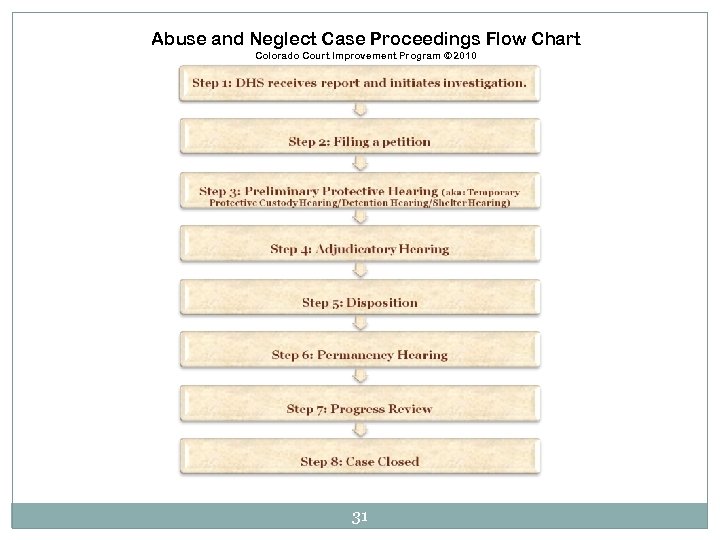 Abuse and Neglect Case Proceedings Flow Chart Colorado Court Improvement Program © 2010 31
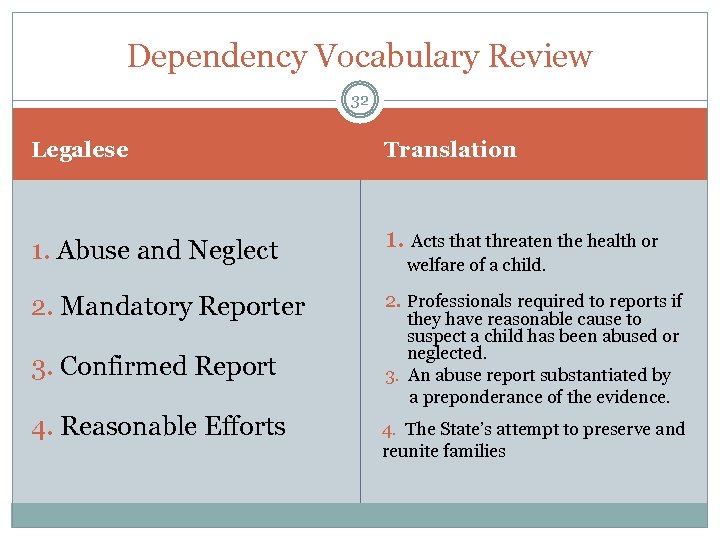 Dependency Vocabulary Review 32 Legalese 1. Abuse and Neglect 2. Mandatory Reporter 3. Confirmed Report 4. Reasonable Efforts Translation 1. Acts that threaten the health or welfare of a child. 2. Professionals required to reports if they have reasonable cause to suspect a child has been abused or neglected. 3. An abuse report substantiated by a preponderance of the evidence. 4. The State’s attempt to preserve and reunite families
 Roles and Responsibilities 33 IDENTIFYING THE MAJOR PARTIES IN THE PROCEEDINGS AND THEIR FUNCTION IN THE CHILD WELFARE SYSTEM
 Brainstorming Session 34 Who is involved? Who is needed? What must be done? As a group, brainstorm and identify the major players in child welfare proceedings and their responsibilities. Hint: Think in terms of three categories: Fact witnesses Legal representatives Legal decision makers
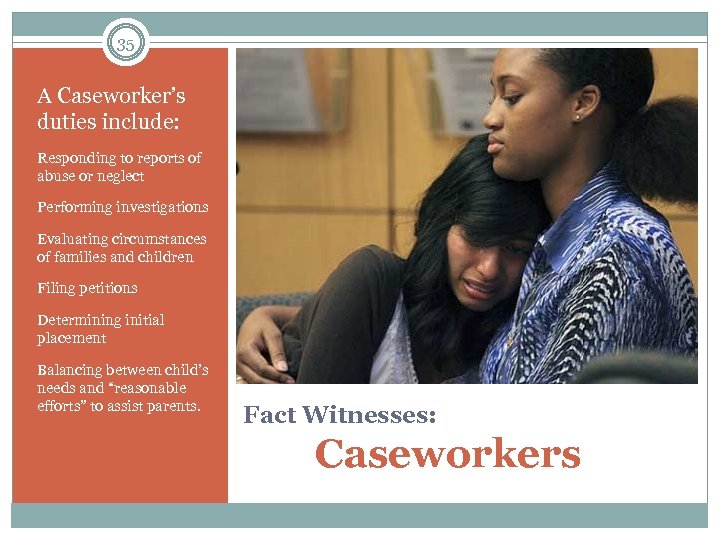 35 A Caseworker’s duties include: Responding to reports of abuse or neglect Performing investigations Evaluating circumstances of families and children Filing petitions Determining initial placement Balancing between child’s needs and “reasonable efforts” to assist parents. Fact Witnesses: Caseworkers
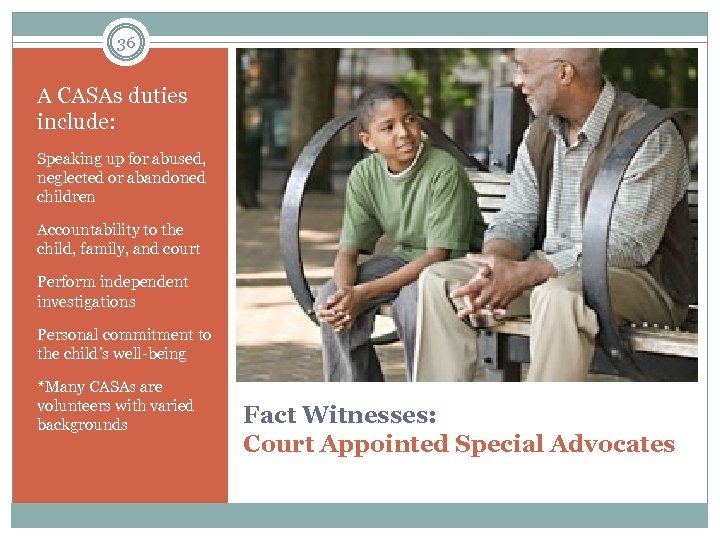 36 A CASAs duties include: Speaking up for abused, neglected or abandoned children Accountability to the child, family, and court Perform independent investigations Personal commitment to the child’s well-being *Many CASAs are volunteers with varied backgrounds Fact Witnesses: Court Appointed Special Advocates
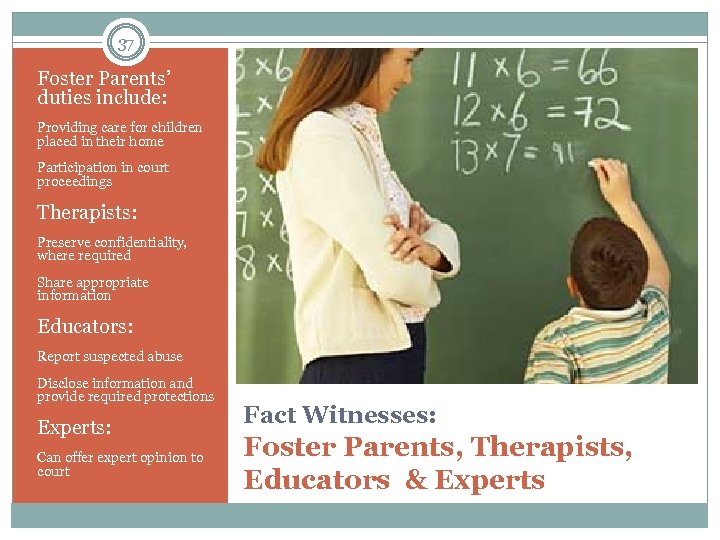 37 Foster Parents’ duties include: Providing care for children placed in their home Participation in court proceedings Therapists: Preserve confidentiality, where required Share appropriate information Educators: Report suspected abuse Disclose information and provide required protections Experts: Can offer expert opinion to court Fact Witnesses: Foster Parents, Therapists, Educators & Experts
 38 GALs duties include: Represent the child’s best interests; Conduct and independent investigation Navigating between the child’s wishes and what is best for the child Advocating on behalf of the child Collaborating with lawyers, judges and caseworkers to promote the child’s welfare Legal Professionals Guardian ad litem
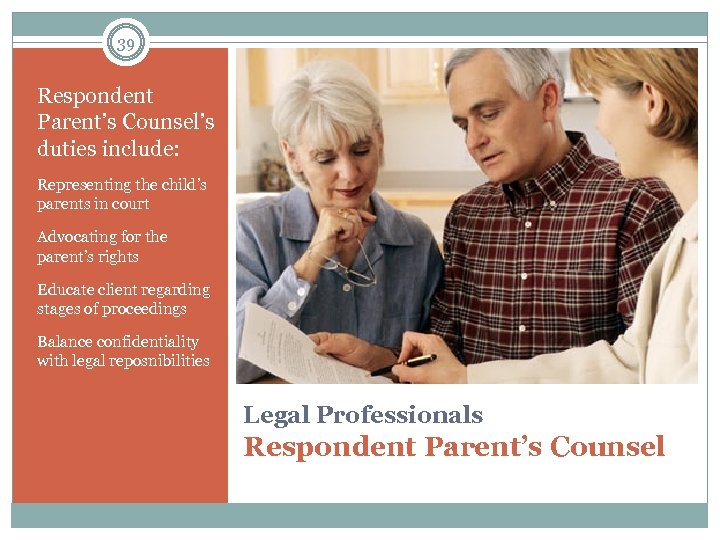 39 Respondent Parent’s Counsel’s duties include: Representing the child’s parents in court Advocating for the parent’s rights Educate client regarding stages of proceedings Balance confidentiality with legal reposnibilities Legal Professionals Respondent Parent’s Counsel
 40 County Attorney’s duties include: Represent the People of the State of Colorado and DHS in all court proceedings Exercise candid professional judgment and give legal advice Counsel the agency regarding legal and policy objectives Legal Professionals County Attorney
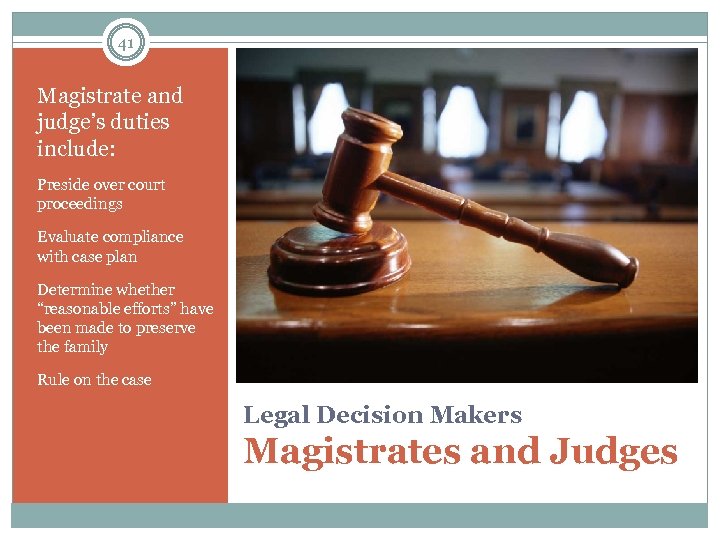 41 Magistrate and judge’s duties include: Preside over court proceedings Evaluate compliance with case plan Determine whether “reasonable efforts” have been made to preserve the family Rule on the case Legal Decision Makers Magistrates and Judges
 42 Reflecting on Roles and Responsibilities Who represents Marianne? Who represents DHS? Who represents Leon, Brianne, and Sandra? What potential conflicts or tensions arise out of this model? What are some possible solutions to those conflicts? Application: Marianne’s Case
 Legal Decision Making 43 STATE LAW, FEDERAL LAW AND THE COURTROOM CULTURE
 Overview: Legal Decision Making 44 Integral relationships between witnesses, lawyers, and judges Rules of Evidence Court proceedings Courtroom culture and etiquette
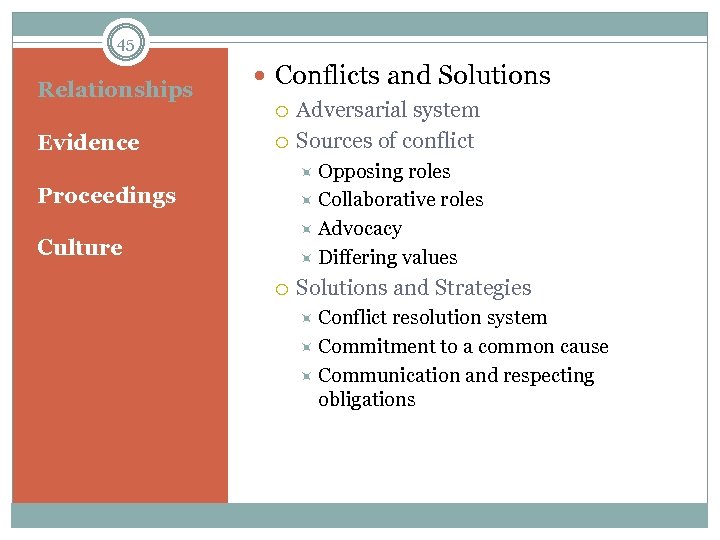 45 Relationships Conflicts and Solutions Evidence Adversarial system Sources of conflict Opposing roles Proceedings Collaborative roles Advocacy Culture Differing values Solutions and Strategies Conflict resolution system Commitment to a common cause Communication and respecting obligations
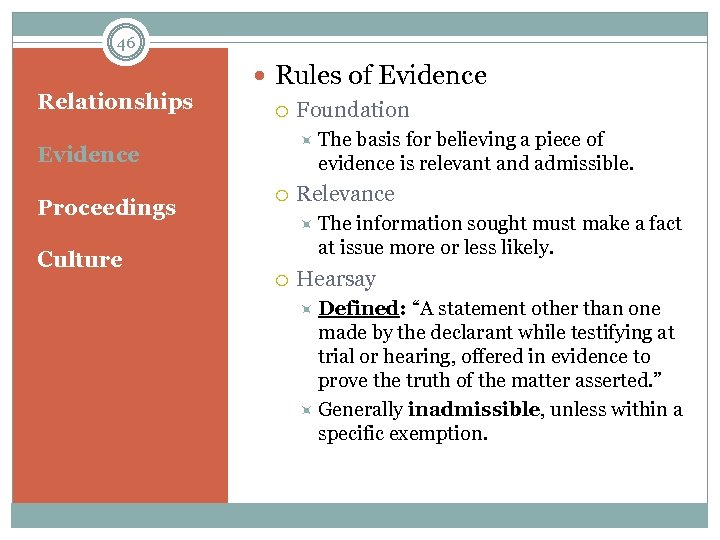 46 Relationships Rules of Evidence The basis for believing a piece of Evidence Proceedings Culture Foundation evidence is relevant and admissible. Relevance The information sought must make a fact at issue more or less likely. Hearsay Defined: “A statement other than one made by the declarant while testifying at trial or hearing, offered in evidence to prove the truth of the matter asserted. ” Generally inadmissible, unless within a specific exemption.
 47 Relationships Standards of Proof Liberal standards Evidence Hearsay is admissible “Any evidence of probative value” Proceedings Culture Preliminary Protective Hearing Adjudication “Preponderance of the evidence” Colorado Rules of Evidence Hearsay inadmissible
 48 Relationships General Court Proceedings Determine initial placement Evidence Proceedings Preliminary Protective Hearing Evaluate continued jurisdiction Pretrial Discovery and Motions Interrogatories Production of documents Culture Depositions Request for admissions Adjudication Trial: Proving allegations by a “preponderance of the evidence” Disposition (aka Treatment Plan Hearing) Custody, contact. services
 49 Relationships Courtroom Culture and Etiquette Attire Business attire Evidence Modest and generally conservative Proceedings Culture Etiquette Manners Language “Your Honor, ” not “Judge” or “you” Legal representatives as “sir” and “ma’am” Body Language Confidence Respect Humility Treating others Appropriately – Parties, Witnesses & Court Staff
 Considering Cultural Context 50 Explore culture and subculture of each family to determine specific needs of the family and create an effective service plan Recognize individual assumptions from personal life experiences and the impact on interpretation of facts Create a balance between cultural context and compliance with the law at every stage of the proceedings
 Reflection: Children in the courtroom 51 Courts must consult with youth in an age appropriate manner concerning the proposed permanency plan. How is this facilitated in your court? What have you seen as benefits of youth participation? Challenges?
 The Court Process: Part 1 52 REPORT TO ADJUDICATION
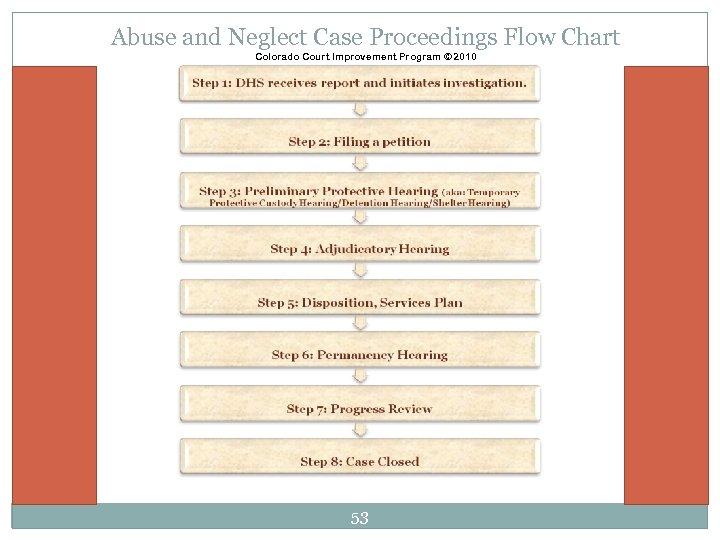 Abuse and Neglect Case Proceedings Flow Chart Colorado Court Improvement Program © 2010 53
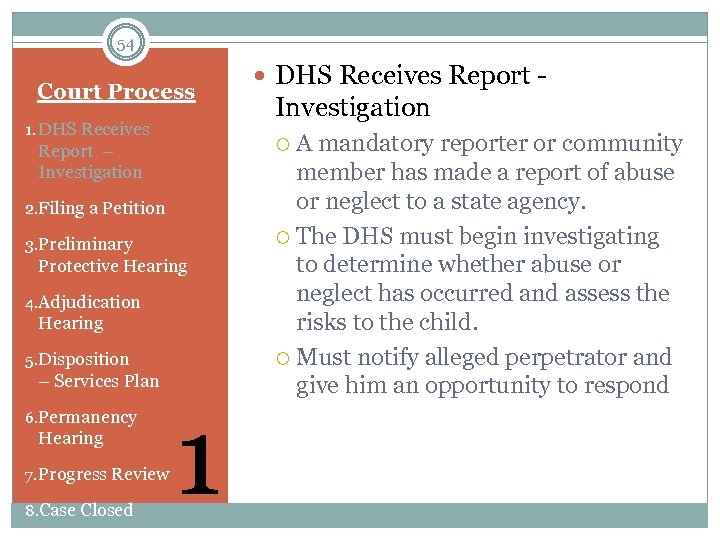 54 Court Process 1. DHS Receives 2. Filing a Petition 3. Preliminary Protective Hearing 4. Adjudication Hearing 5. Disposition – Services Plan Hearing 7. Progress Review 8. Case Closed Investigation A mandatory reporter or community member has made a report of abuse or neglect to a state agency. The DHS must begin investigating to determine whether abuse or neglect has occurred and assess the risks to the child. Must notify alleged perpetrator and give him an opportunity to respond Report – Investigation 6. Permanency DHS Receives Report - 1
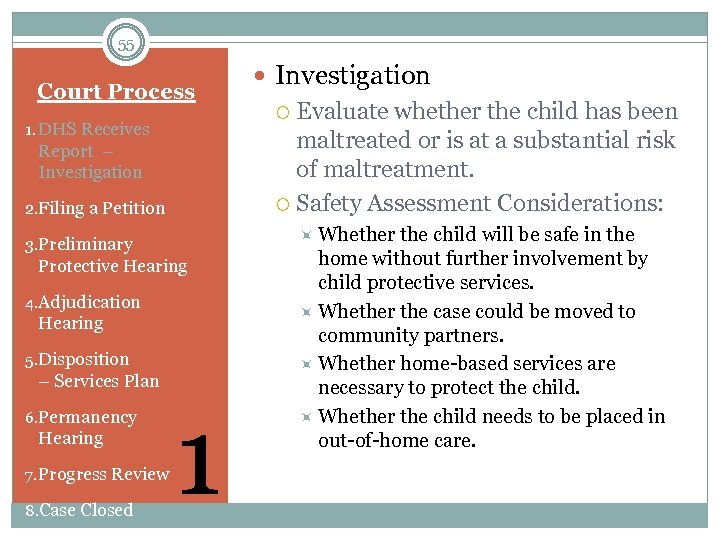 55 Court Process 1. DHS Receives Report – Investigation 2. Filing a Petition Protective Hearing 4. Adjudication Hearing 5. Disposition – Services Plan Hearing 7. Progress Review 8. Case Closed Evaluate whether the child has been maltreated or is at a substantial risk of maltreatment. Safety Assessment Considerations: Whether the child will be safe in the 3. Preliminary 6. Permanency Investigation 1 home without further involvement by child protective services. Whether the case could be moved to community partners. Whether home-based services are necessary to protect the child. Whether the child needs to be placed in out-of-home care.
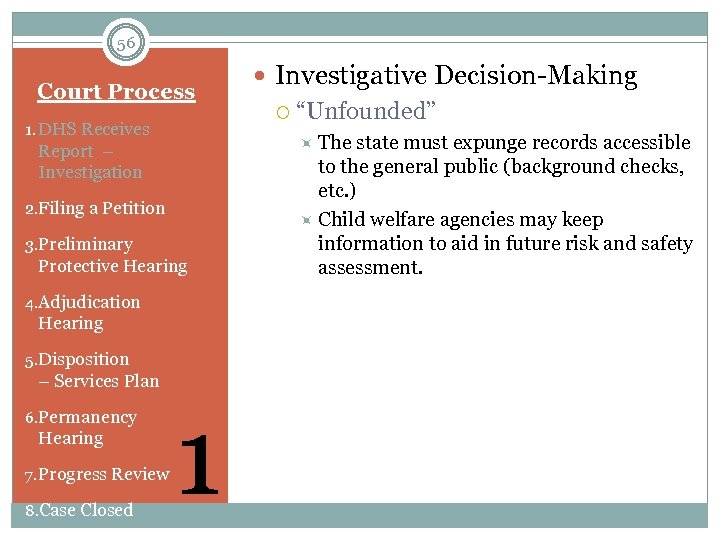 56 Court Process 1. DHS Receives 2. Filing a Petition 3. Preliminary Protective Hearing 4. Adjudication Hearing 5. Disposition – Services Plan Hearing 7. Progress Review 8. Case Closed “Unfounded” The state must expunge records accessible Report – Investigation 6. Permanency Investigative Decision-Making 1 to the general public (background checks, etc. ) Child welfare agencies may keep information to aid in future risk and safety assessment.
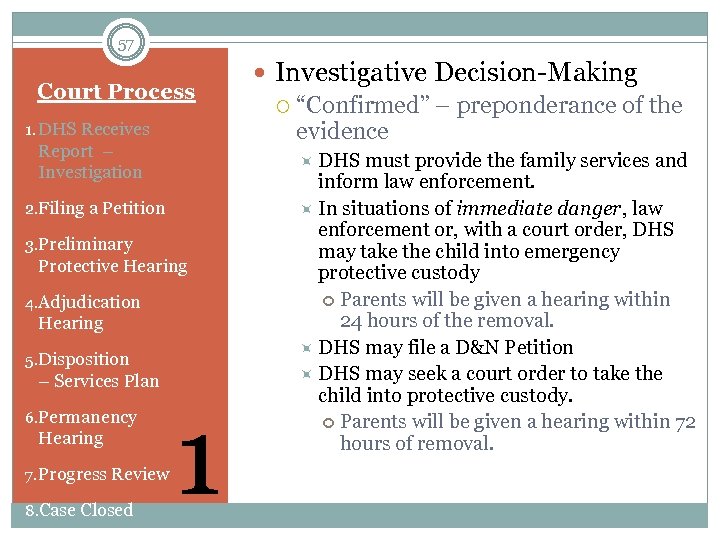 57 Court Process 1. DHS Receives Report – Investigation DHS must provide the family services and 2. Filing a Petition 3. Preliminary Protective Hearing 4. Adjudication Hearing 5. Disposition – Services Plan 6. Permanency Hearing 7. Progress Review 8. Case Closed Investigative Decision-Making “Confirmed” – preponderance of the evidence 1 inform law enforcement. In situations of immediate danger, law enforcement or, with a court order, DHS may take the child into emergency protective custody Parents will be given a hearing within 24 hours of the removal. DHS may file a D&N Petition DHS may seek a court order to take the child into protective custody. Parents will be given a hearing within 72 hours of removal.
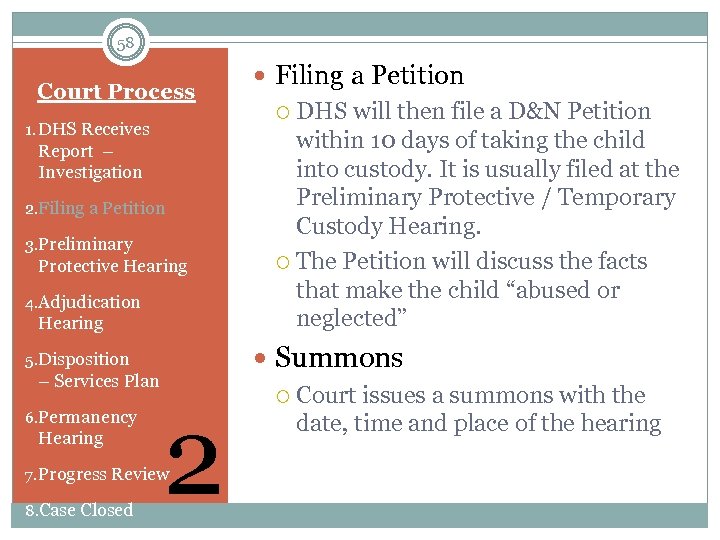 58 Court Process 1. DHS Receives Report – Investigation 2. Filing a Petition 3. Preliminary Protective Hearing 4. Adjudication Hearing 5. Disposition – Services Plan 6. Permanency Hearing 2 7. Progress Review 8. Case Closed Filing a Petition DHS will then file a D&N Petition within 10 days of taking the child into custody. It is usually filed at the Preliminary Protective / Temporary Custody Hearing. The Petition will discuss the facts that make the child “abused or neglected” Summons Court issues a summons with the date, time and place of the hearing
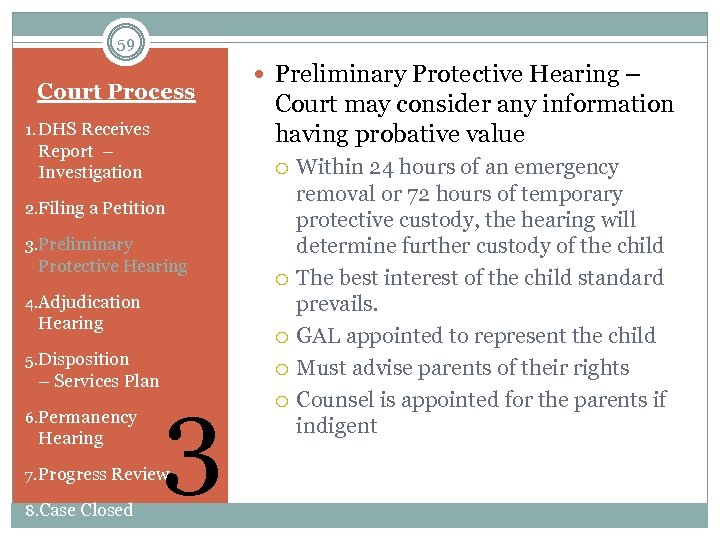 59 Court Process 1. DHS Receives Report – Investigation Preliminary Protective Hearing – Court may consider any information having probative value 2. Filing a Petition 3. Preliminary Protective Hearing 4. Adjudication Hearing 5. Disposition – Services Plan 6. Permanency Hearing 3 7. Progress Review 8. Case Closed Within 24 hours of an emergency removal or 72 hours of temporary protective custody, the hearing will determine further custody of the child The best interest of the child standard prevails. GAL appointed to represent the child Must advise parents of their rights Counsel is appointed for the parents if indigent
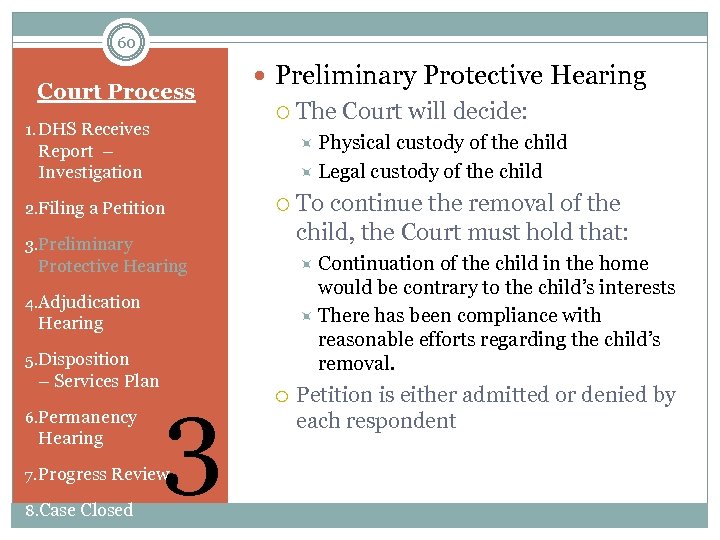 60 Court Process 1. DHS Receives Preliminary Protective Hearing Physical custody of the child Report – Investigation Legal custody of the child 2. Filing a Petition 3. Preliminary would be contrary to the child’s interests There has been compliance with reasonable efforts regarding the child’s removal. 4. Adjudication Hearing 5. Disposition 6. Permanency Hearing 3 7. Progress Review 8. Case Closed To continue the removal of the child, the Court must hold that: Continuation of the child in the home Protective Hearing – Services Plan The Court will decide: Petition is either admitted or denied by each respondent
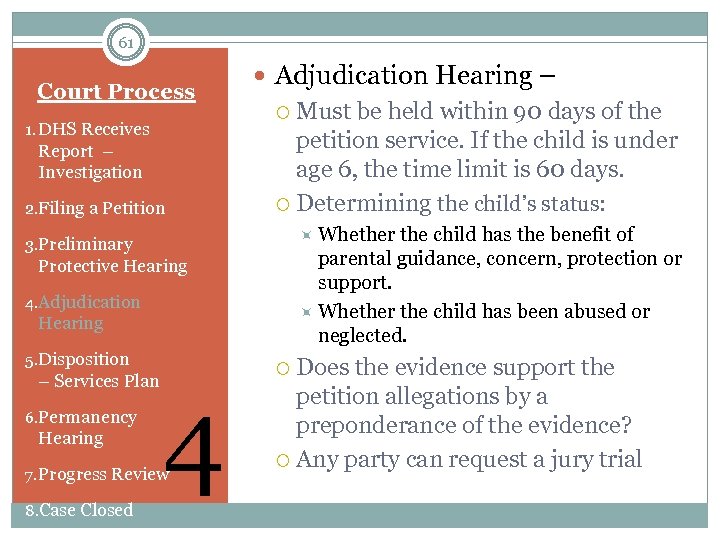 61 Court Process 1. DHS Receives Report – Investigation 2. Filing a Petition Adjudication Hearing – Must be held within 90 days of the petition service. If the child is under age 6, the time limit is 60 days. Determining the child’s status: Whether the child has the benefit of 3. Preliminary parental guidance, concern, protection or support. Whether the child has been abused or neglected. Protective Hearing 4. Adjudication Hearing 5. Disposition – Services Plan 6. Permanency Hearing 4 7. Progress Review 8. Case Closed Does the evidence support the petition allegations by a preponderance of the evidence? Any party can request a jury trial
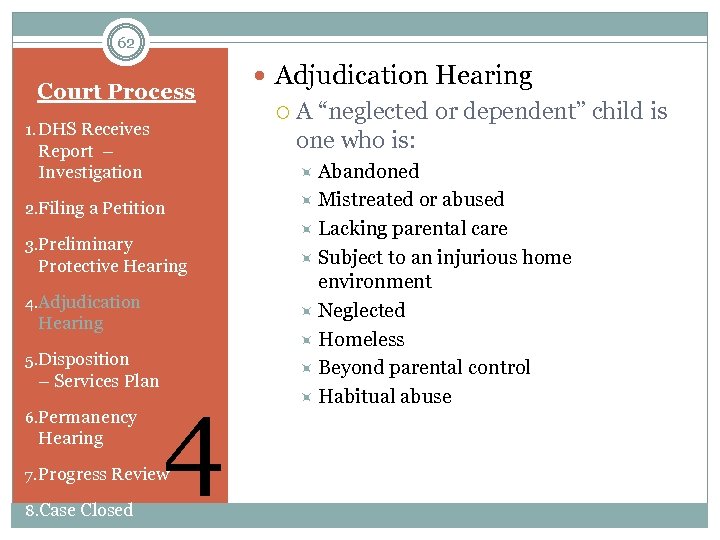 62 Court Process 1. DHS Receives Report – Investigation 3. Preliminary Protective Hearing 4. Adjudication Hearing 5. Disposition 6. Permanency Hearing 4 7. Progress Review 8. Case Closed A “neglected or dependent” child is one who is: Abandoned 2. Filing a Petition – Services Plan Adjudication Hearing Mistreated or abused Lacking parental care Subject to an injurious home environment Neglected Homeless Beyond parental control Habitual abuse
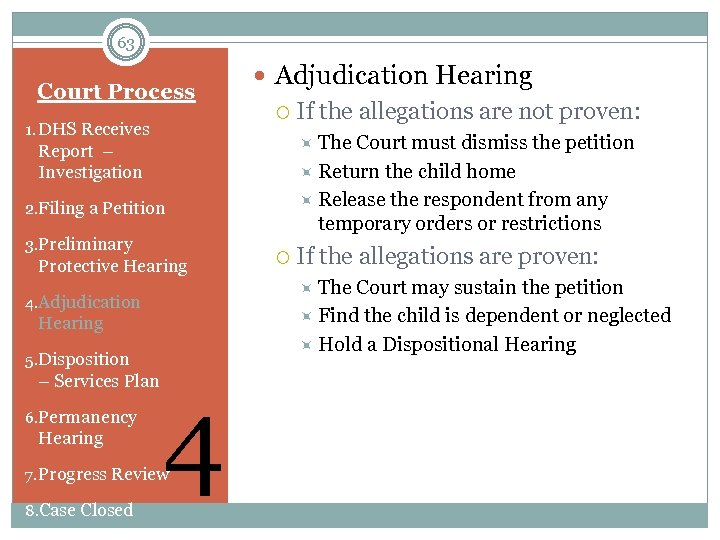 63 Court Process 1. DHS Receives Adjudication Hearing The Court must dismiss the petition Report – Investigation Return the child home Release the respondent from any 2. Filing a Petition 3. Preliminary Protective Hearing 4. Adjudication 5. Disposition 6. Permanency Hearing 4 7. Progress Review 8. Case Closed temporary orders or restrictions If the allegations are proven: The Court may sustain the petition Find the child is dependent or neglected Hearing – Services Plan If the allegations are not proven: Hold a Dispositional Hearing
 The Court Process Part 2 64 DISPOSITION TO CLOSING
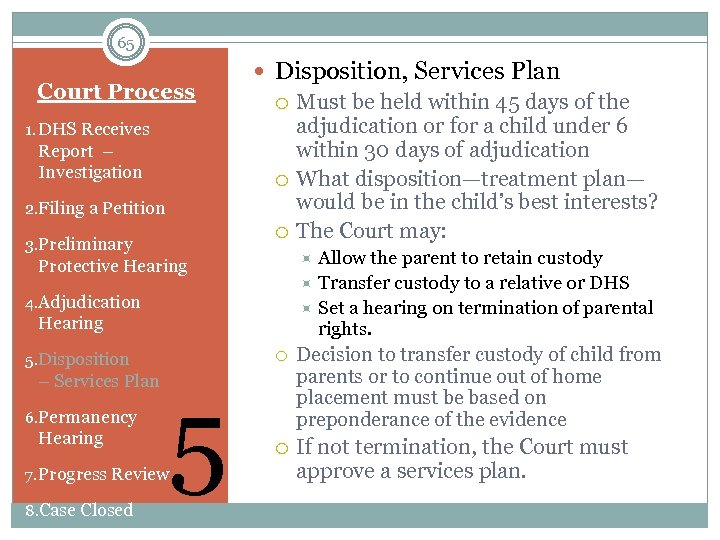 65 Court Process 1. DHS Receives Report – Investigation 2. Filing a Petition 3. Preliminary Disposition, Services Plan Must be held within 45 days of the adjudication or for a child under 6 within 30 days of adjudication What disposition—treatment plan— would be in the child’s best interests? The Court may: Allow the parent to retain custody Transfer custody to a relative or DHS Set a hearing on termination of parental rights. Protective Hearing 4. Adjudication Hearing 5. Disposition – Services Plan 6. Permanency Hearing 7. Progress Review 8. Case Closed 5 Decision to transfer custody of child from parents or to continue out of home placement must be based on preponderance of the evidence If not termination, the Court must approve a services plan.
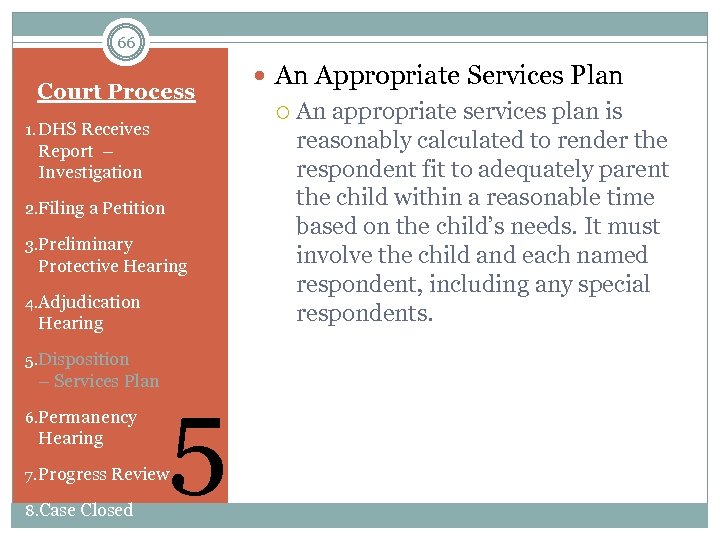 66 Court Process 1. DHS Receives Report – Investigation 2. Filing a Petition 3. Preliminary Protective Hearing 4. Adjudication Hearing 5. Disposition – Services Plan 6. Permanency Hearing 7. Progress Review 8. Case Closed 5 An Appropriate Services Plan An appropriate services plan is reasonably calculated to render the respondent fit to adequately parent the child within a reasonable time based on the child’s needs. It must involve the child and each named respondent, including any special respondents.
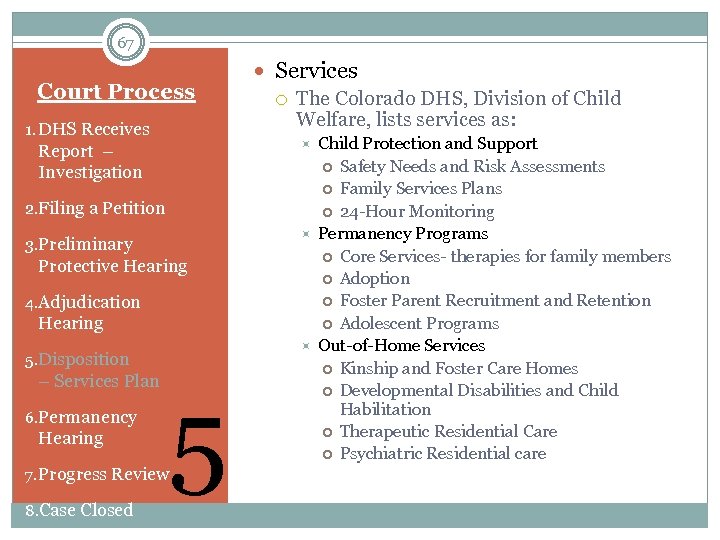 67 Court Process 1. DHS Receives Services The Colorado DHS, Division of Child Welfare, lists services as: Report – Investigation 2. Filing a Petition 3. Preliminary Protective Hearing 4. Adjudication Hearing 5. Disposition – Services Plan 6. Permanency Hearing 7. Progress Review 8. Case Closed 5 Child Protection and Support Safety Needs and Risk Assessments Family Services Plans 24 -Hour Monitoring Permanency Programs Core Services- therapies for family members Adoption Foster Parent Recruitment and Retention Adolescent Programs Out-of-Home Services Kinship and Foster Care Homes Developmental Disabilities and Child Habilitation Therapeutic Residential Care Psychiatric Residential care
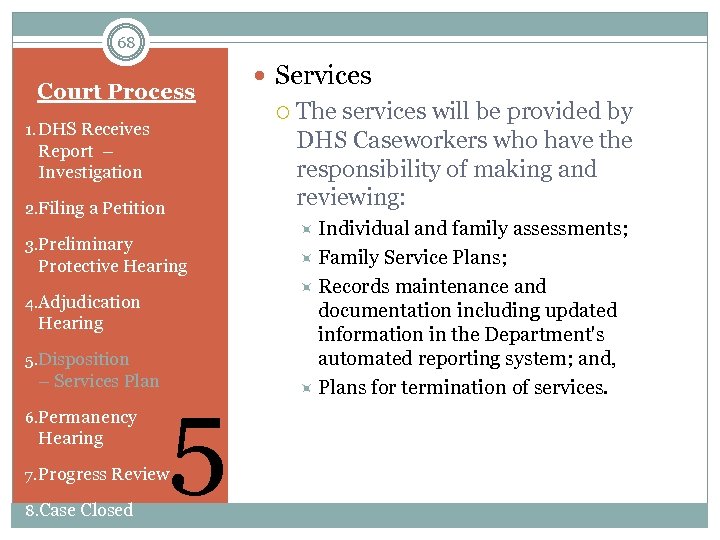 68 Court Process 1. DHS Receives Report – Investigation 2. Filing a Petition Protective Hearing 4. Adjudication Hearing 5. Disposition 6. Permanency Hearing 7. Progress Review 8. Case Closed The services will be provided by DHS Caseworkers who have the responsibility of making and reviewing: Individual and family assessments; 3. Preliminary – Services Plan Services 5 Family Service Plans; Records maintenance and documentation including updated information in the Department's automated reporting system; and, Plans for termination of services.
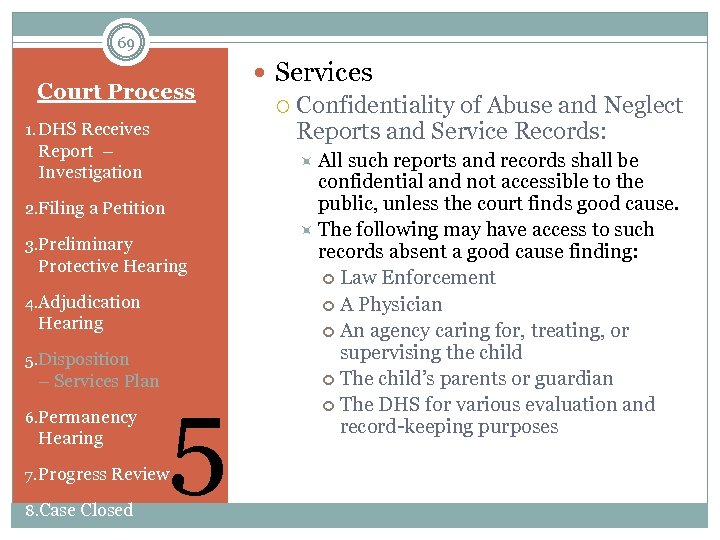 69 Court Process 1. DHS Receives Report – Investigation All such reports and records shall be 2. Filing a Petition 3. Preliminary Protective Hearing 4. Adjudication Hearing 5. Disposition – Services Plan 6. Permanency Hearing 7. Progress Review 8. Case Closed Services Confidentiality of Abuse and Neglect Reports and Service Records: 5 confidential and not accessible to the public, unless the court finds good cause. The following may have access to such records absent a good cause finding: Law Enforcement A Physician An agency caring for, treating, or supervising the child The child’s parents or guardian The DHS for various evaluation and record-keeping purposes
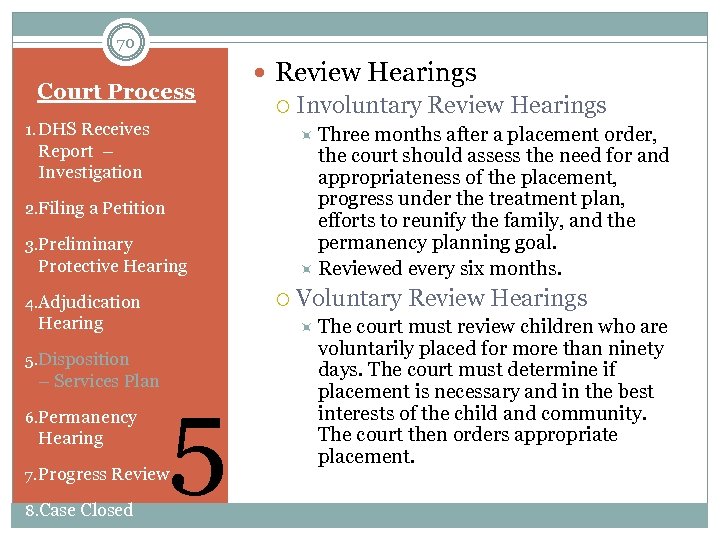 70 Court Process 1. DHS Receives Review Hearings Involuntary Review Hearings Three months after a placement order, Report – Investigation the court should assess the need for and appropriateness of the placement, progress under the treatment plan, efforts to reunify the family, and the permanency planning goal. Reviewed every six months. 2. Filing a Petition 3. Preliminary Protective Hearing 4. Adjudication Hearing The court must review children who are 5. Disposition – Services Plan 6. Permanency Hearing 7. Progress Review 8. Case Closed Voluntary Review Hearings 5 voluntarily placed for more than ninety days. The court must determine if placement is necessary and in the best interests of the child and community. The court then orders appropriate placement.
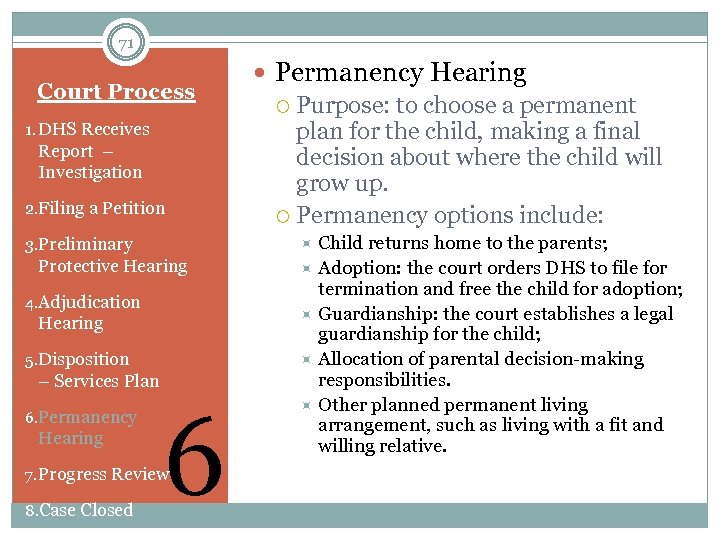 71 Court Process 1. DHS Receives Report – Investigation 2. Filing a Petition 3. Preliminary 4. Adjudication Hearing 5. Disposition – Services Plan Hearing 6 7. Progress Review 8. Case Closed Child returns home to the parents; Adoption: the court orders DHS to file for termination and free the child for adoption; Guardianship: the court establishes a legal guardianship for the child; Allocation of parental decision-making responsibilities. Other planned permanent living arrangement, such as living with a fit and willing relative. Protective Hearing 6. Permanency Hearing Purpose: to choose a permanent plan for the child, making a final decision about where the child will grow up. Permanency options include:
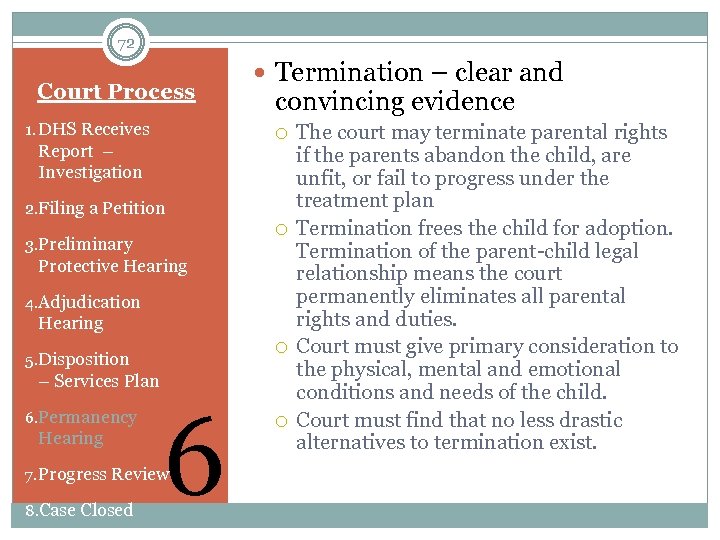 72 Court Process 1. DHS Receives Termination – clear and convincing evidence Report – Investigation 2. Filing a Petition 3. Preliminary Protective Hearing 4. Adjudication Hearing 5. Disposition – Services Plan 6. Permanency Hearing 6 7. Progress Review 8. Case Closed The court may terminate parental rights if the parents abandon the child, are unfit, or fail to progress under the treatment plan Termination frees the child for adoption. Termination of the parent-child legal relationship means the court permanently eliminates all parental rights and duties. Court must give primary consideration to the physical, mental and emotional conditions and needs of the child. Court must find that no less drastic alternatives to termination exist.
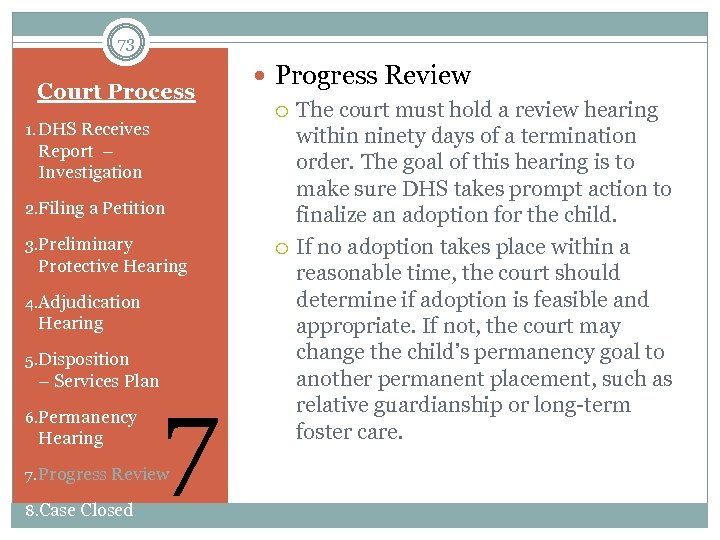 73 Court Process 1. DHS Receives Progress Review Report – Investigation 2. Filing a Petition 3. Preliminary Protective Hearing 4. Adjudication Hearing 5. Disposition – Services Plan 6. Permanency Hearing 7 7. Progress Review 8. Case Closed The court must hold a review hearing within ninety days of a termination order. The goal of this hearing is to make sure DHS takes prompt action to finalize an adoption for the child. If no adoption takes place within a reasonable time, the court should determine if adoption is feasible and appropriate. If not, the court may change the child’s permanency goal to another permanent placement, such as relative guardianship or long-term foster care.
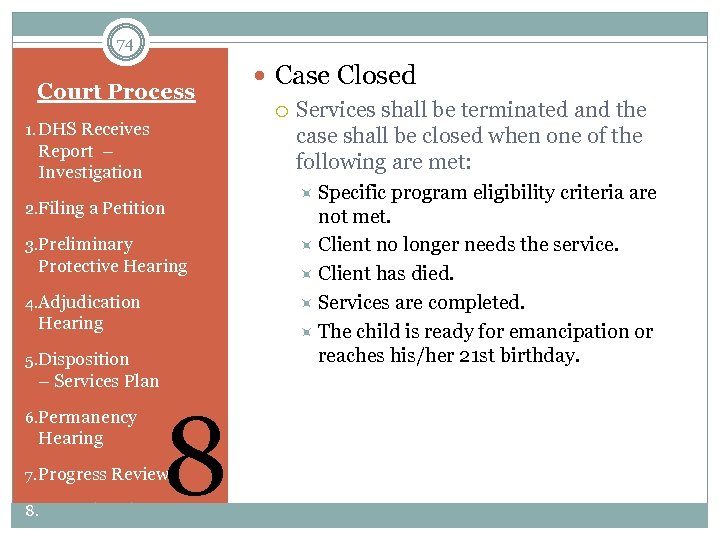 74 Court Process 1. DHS Receives Report – Investigation 2. Filing a Petition 3. Preliminary Protective Hearing 4. Adjudication Hearing 5. Disposition – Services Plan 6. Permanency Hearing 8 7. Progress Review 8. Case Closed Services shall be terminated and the case shall be closed when one of the following are met: Specific program eligibility criteria are not met. Client no longer needs the service. Client has died. Services are completed. The child is ready for emancipation or reaches his/her 21 st birthday.
 The Court Process Applied 75 MARIANNE’S CASE
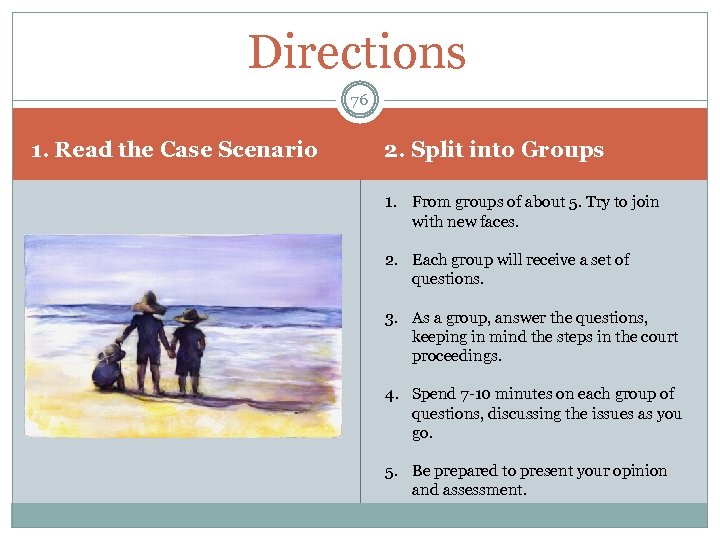 Directions 76 1. Read the Case Scenario 2. Split into Groups 1. From groups of about 5. Try to join with new faces. 2. Each group will receive a set of questions. 3. As a group, answer the questions, keeping in mind the steps in the court proceedings. 4. Spend 7 -10 minutes on each group of questions, discussing the issues as you go. 5. Be prepared to present your opinion and assessment.
 Apply 77 What are the roles and responsibilities of the people involved? What are the unique characteristics of this family? What information could be gathered to identify a sense of the cultural context of the mother and children? How did the case begin? What is the current status of the parties? What are the potential conflicts between the parties involved?
 Extend 78 What will happen at the Preliminary Protective Hearing? What decisions will be made? What evidence should be presented to the court? Who should offer it? Are there any systemic barriers or problems you foresee?
 Predict 79 What will happen at the Adjudicatory Hearing? What decisions will be made? Do you believe the children are neglected, abused or dependent? What will the Disposition be? What should it be? What services would best suit this family?
 Reflect 80 What kind of reviews will be done and how often will they occur? What would their permanency plan look like? Or would it be termination? What do you feel would be the best future plan for this family, these children? How might you collaborate with other parties involved in the case?
 Recap 81 STATE & FEDERAL LAW, RIGHTS, PROCESS AND THE CHILD WELFARE SYSTEM
 Overview: Recap 82 Legal Framework How a Case Begins Case Process Roles and Responsibilities Legal Decision Making Court Process Overarching Values and Policy
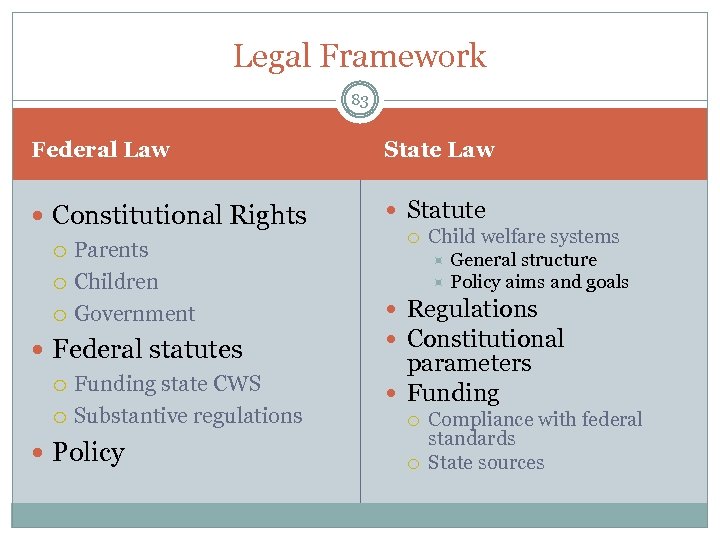 Legal Framework 83 Federal Law State Law Constitutional Rights Statute Parents Children Government Federal statutes Funding state CWS Substantive regulations Policy Child welfare systems General structure Policy aims and goals Regulations Constitutional parameters Funding Compliance with federal standards State sources
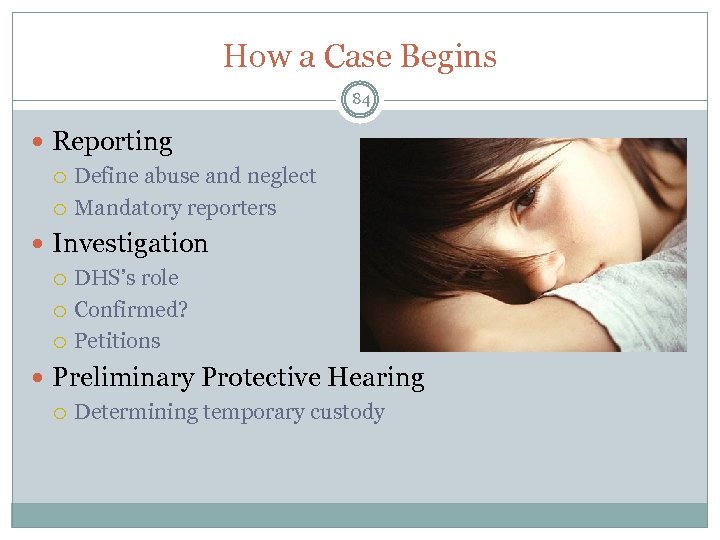 How a Case Begins 84 Reporting Define abuse and neglect Mandatory reporters Investigation DHS’s role Confirmed? Petitions Preliminary Protective Hearing Determining temporary custody
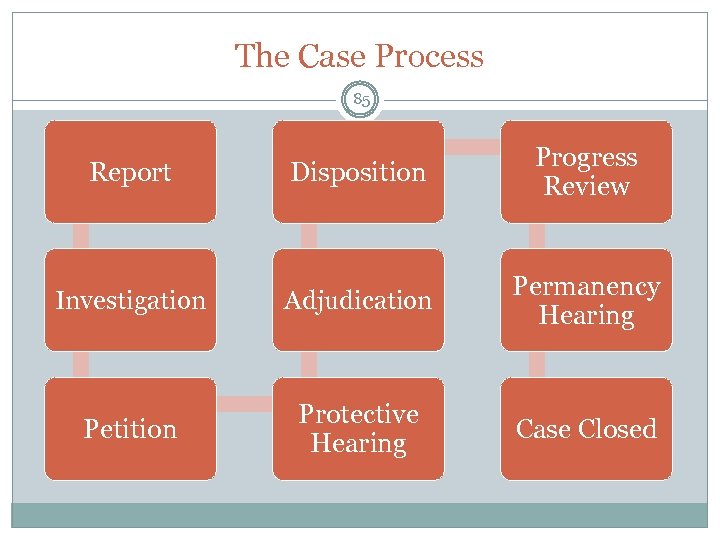 The Case Process 85 Disposition Progress Review Investigation Adjudication Permanency Hearing Petition Protective Hearing Case Closed Report
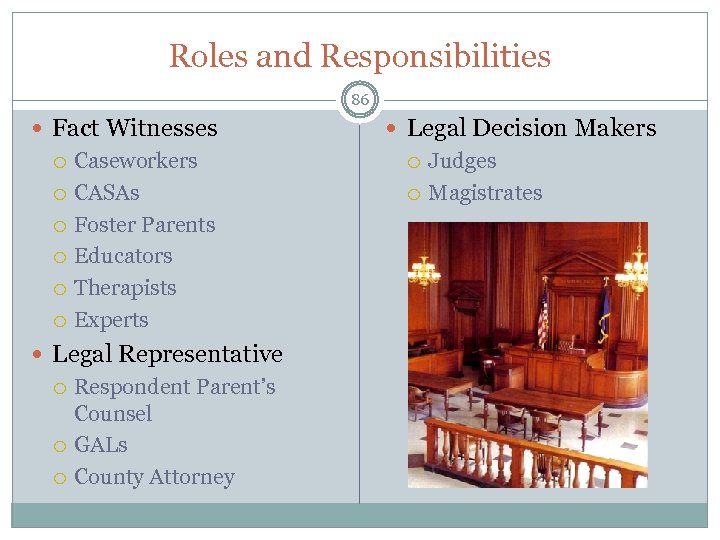 Roles and Responsibilities 86 Fact Witnesses Caseworkers CASAs Foster Parents Educators Therapists Experts Legal Representative Respondent Parent’s Counsel GALs County Attorney Legal Decision Makers Judges Magistrates
 Legal Decision Making 87 Integral relationships between witnesses, lawyers, and judges Rules of Evidence Consistency of decisions Court proceedings Courtroom culture and etiquette
 Court Proceedings 88 Steps in case process Relationships Conflicts Solutions Rules of Evidence Foundation Relevance Hearsay Culture and Etiquette
 Overarching Values and Policy 89 Children’s rights v. social implications Bill of Rights 14 th Amendment Children as people, not property Child’s best interest Parens Patriae
 Network 90 15 MINUTE NETWORKING BREAK
 Roles and Responsibilities Applied 91 AN INTERACTIVE ROLE PLAY OF MARRIANNE’S CASE
 Role Play Activity Directions 92 Locate Role Play Marker on your chair Sit in groups according to your letter/role J = Judges CW = Caseworker RPC = Respondent Parent’s Counsel GAL = Guardian ad litem CA = County Attorney As a group, read the contents of the “Goals and Motives” envelope. Do not share the information (yet)! Assign a scribe and liaison
 Role Play Activity Directions 93 Your Task: 1. 2. 3. Form an effective services plan for Marianne’s Case Meet both of your goals Satisfy your groups assigned motive To Succeed: Accomplish two of the above three tasks within the allotted time. Rules: Do not share your motives You may share or alter (compromise) your goals, but not accomplishing any part of your goals automatically results in failing to complete your task, per se. Note: You may choose to complete task 1 & 3 to succeed, but you must still accomplish at least part of your goals.
 Role Play Activity Directions 94 You will be given 20 minutes to modify the proposed services plan. Be sure to send your liaison to the other groups and find out their goals and potential motives. Remember! You will need to produce a final services plan a an entire group, so you will need to keep other’s goals in mind when you make your own modifications. Next, you will be asked to contribute your proposed modifications to produce a final services plan. Hint: Try to prioritize your top 3 modifications. Finally, the group will reflect on the process, roles, and responsibilities required to make legal decisions.
 Modify the Proposed Case Plan (20 min) 95 Write your modifications in the space provided. Remember to send out your liaison. Remember to try to fulfill your goals and make decisions based upon your motives. Need a little inspiration? Refer to the included thought-questions for suggestions.
 Produce a Final Case Plan (20 min) 96 Custody: Parties Involved: Services Required: Compliance: Records
 Reflection 97 What information did you need? To whom did you go to acquire it? How did the cultural context of the mother and children shape the case plan? What conflicts arose? What solutions did you employ to address them? How did the differing role affect the final product? Are you happy with the plan? Were the child’s best interests met by the Final Services Plan?
 Closing 98 RESPONSES TO THE COURSE MATERIALS AND OBJECTIVES
 Questions 99 What will you do differently now? How will you use the information you learned today to better promote and protect the safety, permanency and well being of children and families? What will you take from this course that will directly transfer into your job tomorrow? What will you take from this course that you will ponder in the future?
 Question & Answer 100
 Thank You 101