 Скачать презентацию Child rearing practices vary considerably from
87a4a223f869102ef440e9cbbdba75ed.ppt
- Количество слайдов: 7




• Child rearing practices vary considerably from place to place • • • Environment Traditions Beliefs about children Does this result in different attachment patterns? Universal vs. culturally specific www. psychlotron. or Cross-cultural Variation
• Van Ijzendoorn & Kroonenberg (1988) • • • Meta analysis of studies of attachment in different countries Looked at proportions of different SSC attachment types Secure attachment always the most common, but significant variation www. psychlotron. or Cross-cultural Research
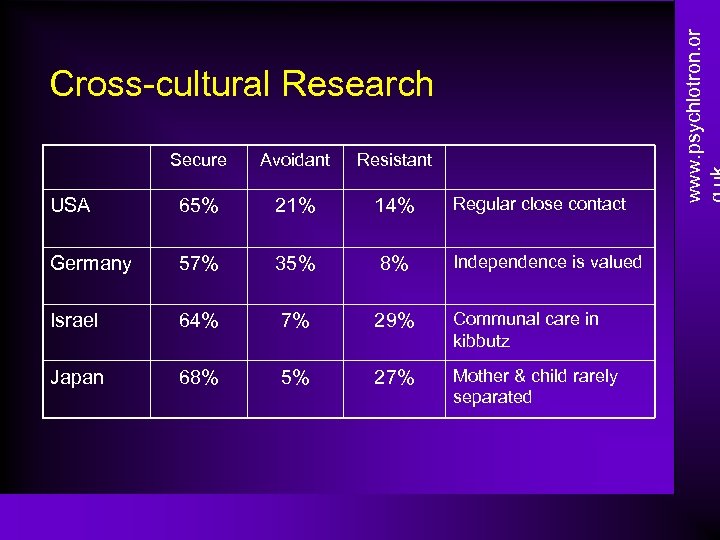
Secure Avoidant Resistant USA 65% 21% 14% Germany 57% 35% 8% Israel 64% 7% 29% Communal care in kibbutz Japan 68% 5% 27% Mother & child rarely separated Regular close contact Independence is valued www. psychlotron. or Cross-cultural Research
• Many studies have limited samples • • • Cannot claim to be representative of each culture E. g. in Israel kibbutz vs. urban Probably more variation within cultures than between them www. psychlotron. or Cross-cultural Research
• Reliable findings • • • Grossman & Grossman (1991) - high proportion of ‘avoidant’ children in Germany Takahashi (1990) - 32% of children resistant; none avoidant From US/UK point of view such findings might seem alarming www. psychlotron. or Cross-cultural Research
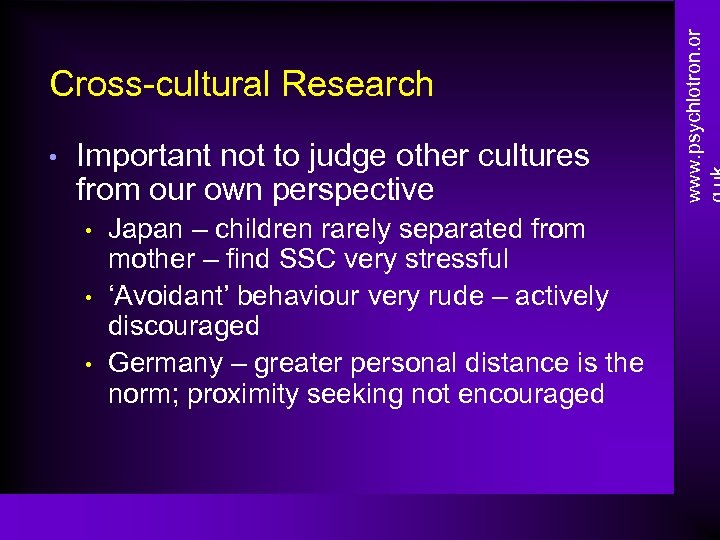
• Important not to judge other cultures from our own perspective • • • Japan – children rarely separated from mother – find SSC very stressful ‘Avoidant’ behaviour very rude – actively discouraged Germany – greater personal distance is the norm; proximity seeking not encouraged www. psychlotron. or Cross-cultural Research

• • • Findings suggest attachment has some universal features There is variation both between and within cultures SSC may not be best tool for crosscultural research as it assumes behaviour always has same significance as in US/UK www. psychlotron. or Cross-cultural Variation
Скачать презентацию Child rearing practices vary considerably from
87a4a223f869102ef440e9cbbdba75ed.ppt