


 Скачать презентацию Child Health Evaluation and Research Unit Division of
46b795fbfb7d852f6d546fd5b5dcb139.ppt
- Количество слайдов: 23
 Child Health Evaluation and Research Unit Division of General Pediatrics, University of Michigan Factors Related to the Formation of Smallpox Response Teams in US Hospitals UM Research Team: Alex R. Kemper, MD, MS; Anne E. Cowan, MPH; Matthew M. Davis, MD, MAPP; Emily J. Kennedy, MPH; Sarah J. Clark, MPH; and Gary L. Freed, MD, MPH CDC Collaborator: Pamela L. Y. H. Ching, MS, SD, RD, LD National Immunization Conference May 13, 2004
 Background • October 2002: ACIP/HICPAC recommended that hospitals vaccinate teams of healthcare workers to prepare for a potential smallpox outbreak • January 2003: Smallpox Pre-Event Vaccination Program (SPVP) implemented at state and local levels with CDC assistance • Hospital participation lower than expected
 Objectives • Understand factors influencing hospitals’ decisions to participate in the SPVP • Identify factors that would lead nonparticipants to change their decision • Describe policies developed by participating hospitals to implement vaccination program
 Methods: Hospital Selection • Smallpox preparedness coordinators from 24 states with estimated hospital participation of 25 -75% were contacted by CDC • 9 states provided hospital contact information: CA, KY, ME, MI, MS, MN, UT, VA, and WY • Acute care hospitals chosen to represent variation in size, county, affiliation, and decision to participate in SPVP • 148 hospitals in final sample – Ranged from 5 in MS to 21 in UT
 Methods: Interview Process • Semi-structured telephone interviews were conducted with hospital decision-makers between June-November 2003 • Interview protocol (~20 minutes): – – – Individuals involved in decision Hospital’s ultimate decision Whether specific factors considered Key factor(s) in decision SPVP participants: program implementation SPVP non-participants: factors that would change decision
 Specific Factors Addressed in Interview • Perceived risk of smallpox outbreak • Risks of vaccination – Safety for vaccinees – Exposure of patients/close contacts of employees – Policies for vaccinated employees • Costs to hospital – Compensation for adverse events – Liability – Other costs • Stakeholder influences – Employees – General public – Other outside parties
 Results • Decision-makers at 123 of 148 hospitals (83%) were interviewed – Response rates ranged from 60 -94% across states • 88 of 123 hospitals (72%) decided to participate in SPVP – No staff were vaccinated at 22 of these 88 hospitals
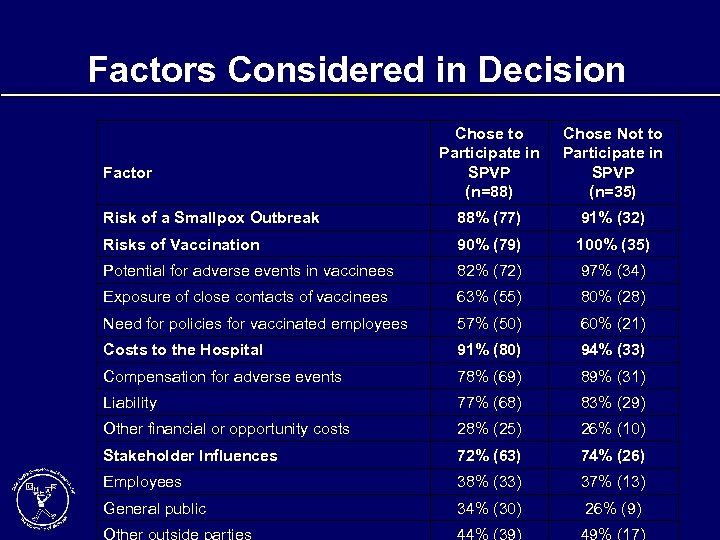 Factors Considered in Decision Chose to Participate in SPVP (n=88) Chose Not to Participate in SPVP (n=35) Risk of a Smallpox Outbreak 88% (77) 91% (32) Risks of Vaccination 90% (79) 100% (35) Potential for adverse events in vaccinees 82% (72) 97% (34) Exposure of close contacts of vaccinees 63% (55) 80% (28) Need for policies for vaccinated employees 57% (50) 60% (21) Costs to the Hospital 91% (80) 94% (33) Compensation for adverse events 78% (69) 89% (31) Liability 77% (68) 83% (29) Other financial or opportunity costs 28% (25) 26% (10) Stakeholder Influences 72% (63) 74% (26) Employees 38% (33) 37% (13) General public 34% (30) 26% (9) Other outside parties 44% (39) 49% (17) Factor
 Factors Considered in Decision (continued) Risk of Smallpox Outbreak • Hospitals made own assessment of risk of a smallpox outbreak • Many also assessed their perceived risk of exposure – e. g. , proximity to urban areas, likelihood of receiving case as transfer patient • Almost all felt the risk of outbreak was low – “The risk of an outbreak didn’t seem likely, but if it were to happen, it would be devastating and we felt we needed to be prepared ahead of time. ”
 Factors Considered in Decision (continued) Risks of Vaccination • Participating hospitals found ways to address safety concerns – e. g. , employee education, screening protocols • Those that decided not to participate had unresolved concerns about vaccine safety or determined that risks too great • Many hospitals struggled over need to develop employee policies to protect contacts of vaccinees
 Factors Considered in Decision (continued) Costs to Hospital • Regardless of decision, liability and workers’ compensation major concerns – federal legislation did not necessarily alleviate concerns • Workers’ compensation addressed in varying ways • A few smaller hospitals concerned with cost of lost work time (e. g. , nursing shortages)
 Factors Considered in Decision (continued) Stakeholder Influences • Employees not a significant influence – though unions very influential in some cases • Public opinion not a major consideration – balance between positive view of being prepared with stigma of “smallpox hospital” label • Main outside stakeholders: local and state health departments, federal government, and other hospitals within community or corporate network
 Factors Considered in Decision (continued) Stakeholder Influences (continued) • Influence of state and local public health officials overwhelmingly positive – “Local public health officials worked along side us and we developed a better relationship regarding the entire disaster planning program” • In a few cases, influence of public health officials was negative – “The main reason we ended up not participating was due to the lack of preparedness and technical support from the local health department. ”
 Key Factors
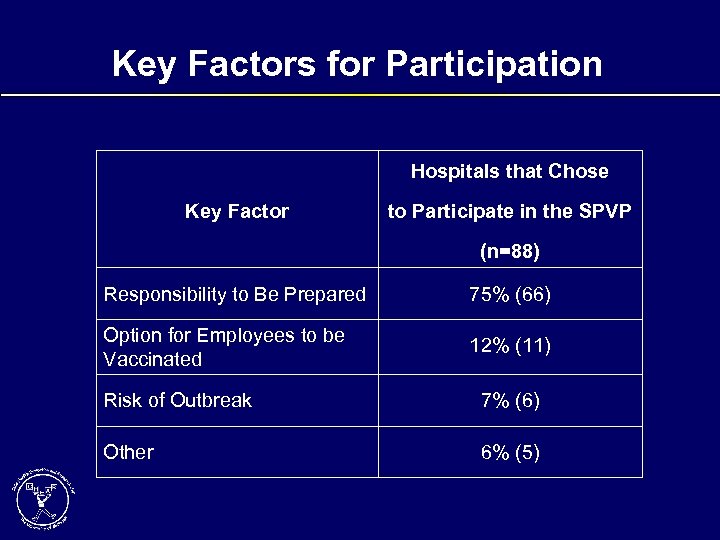 Key Factors for Participation Hospitals that Chose Key Factor to Participate in the SPVP (n=88) Responsibility to Be Prepared 75% (66) Option for Employees to be Vaccinated 12% (11) Risk of Outbreak 7% (6) Other 6% (5)
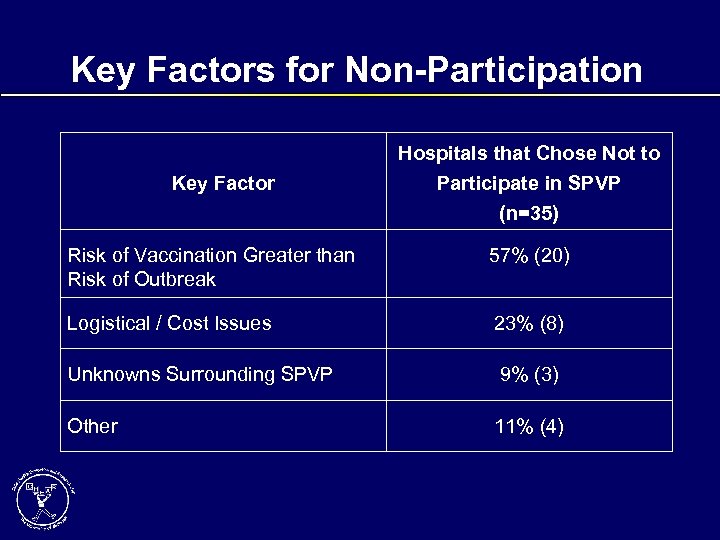 Key Factors for Non-Participation Key Factor Hospitals that Chose Not to Participate in SPVP (n=35) Risk of Vaccination Greater than Risk of Outbreak 57% (20) Logistical / Cost Issues 23% (8) Unknowns Surrounding SPVP 9% (3) Other 11% (4)
 Factors That Would Change Non-Participants’ Decision • Outbreak of smallpox somewhere in world most commonly cited • Other factors included: – more adequate compensation – comprehensive information on safety of vaccine – more/better information risk of outbreak
 Program Participants: Recruitment Strategies • Healthcare worker participation voluntary in all cases • About 50% of hospitals offered vaccination to all employees • Others offered vaccination only to certain personnel, with wide variability across hospitals: – “We concentrated on ED staff due to their high skill level. We also tried to get volunteers from Infectious Disease, Dermatology, and Psychiatry. ” – “Vaccine was offered only to patient care providers (RNs, MDs, ED staff), security officers, and infection control. ” – “Vaccine was offered to everyone except personnel in obstetrics and oncology. ”
 Program Participants: Recruitment Strategies (continued) • Given occupational mix of vaccinees, few hospitals developed specific smallpox response teams – At the vast majority of hospitals, only nurses or physicians were vaccinated – Ancillary staff (e. g. , housekeeping, security), laboratory personnel, respiratory therapists, and radiology technicians were rarely vaccinated
 Program Participants: Site Care • Almost all hospitals developed a policy for care of the vaccination site – Most designated staff to perform site checks, usually an employee health or infection control nurse – Several hospitals allowed vaccinated staff to check their sites themselves • Most adhered to recommendation that site checks be conducted daily
 Program Participants: Policies for Vaccinated Staff • Some hospitals went above and beyond guidelines with respect to employee leave / reassignment policies – One hospital furloughed vaccinees (3 -day, paid) – Several hospitals reassigned employees, though specific policies varied • Some hospitals offered paid leave in the event of an adverse reaction to vaccination
 Discussion • Hospitals considered many complex issues in (1) deciding whether to participate in SPVP and (2) implementing vaccination program – available information not always complete/consistent – variation across hospitals even within same community • State/local public health played key role in addressing–or failing to address–uncertainty
 Discussion (continued) • Future smallpox preparedness efforts can benefit from: – consistent messages conveyed across all levels of public health – a more collaborative approach between local public health officials and individual hospitals – buy-in from national level stakeholders (e. g. , American Hospital Association)