 Скачать презентацию Child Abuse Neglect Three Questions One Answer
bb274ff08161c1da5b13745ba6ff0091.ppt
- Количество слайдов: 58



Child Abuse & Neglect: Three Questions, One Answer Harold A. Johnson Michigan State University 3/2/2010 - EHDI National Convention Chicago, IL
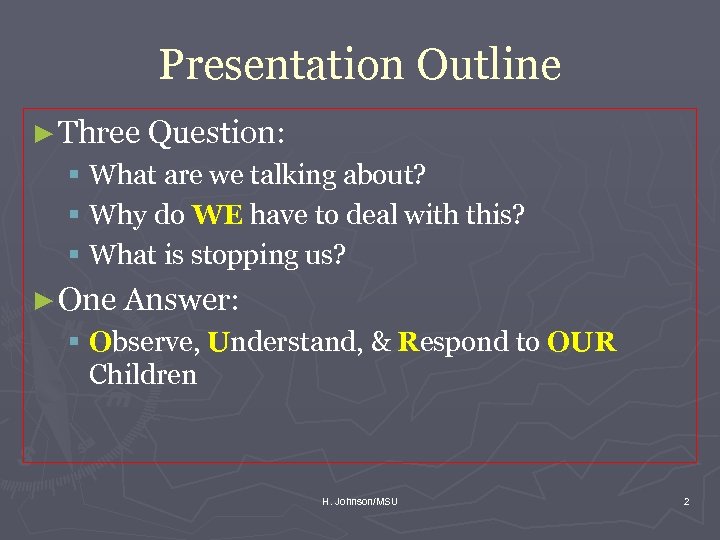
Presentation Outline ► Three Question: § What are we talking about? § Why do WE have to deal with this? § What is stopping us? ► One Answer: § Observe, Understand, & Respond to OUR Children H. Johnson/MSU 2
What are we talking about? http: //www. childhelp. org/ http: //www. dcmp. org/ Web site for video: http: //www. dcmp. org/Flash. Landing/Secure. Flash. aspx? G=31653 p: // H. Johnson/MSU 3
Why do WE have to deal with this? ► Every State legally mandates that a wide range of professionals report suspected child abuse and neglect (Crosson-Tower, 2003). ► State-by-state presentation of the law can be found at. . . http: //www. childwelfare. gov/systemwide/laws_policies/state/ H. Johnson/MSU 4
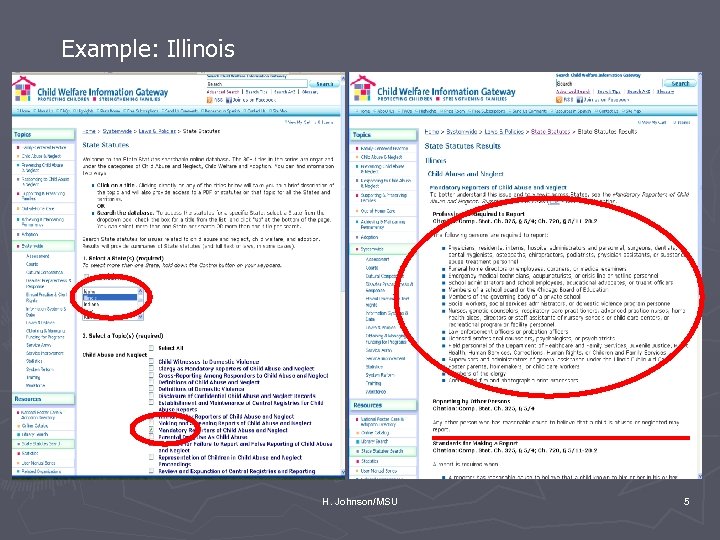
Example: Illinois H. Johnson/MSU 5
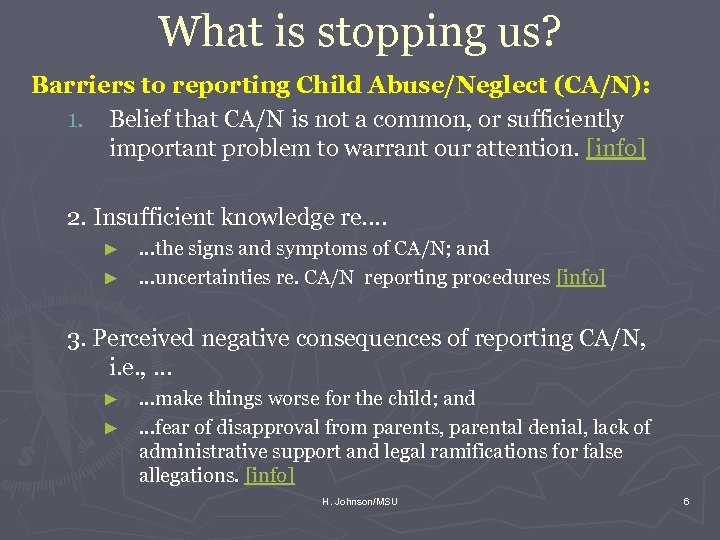
What is stopping us? Barriers to reporting Child Abuse/Neglect (CA/N): 1. Belief that CA/N is not a common, or sufficiently important problem to warrant our attention. [info] 2. Insufficient knowledge re. . . . the signs and symptoms of CA/N; and ►. . . uncertainties re. CA/N reporting procedures [info] ► 3. Perceived negative consequences of reporting CA/N, i. e. , . . . make things worse for the child; and ►. . . fear of disapproval from parents, parental denial, lack of administrative support and legal ramifications for false allegations. [info] ► H. Johnson/MSU 6
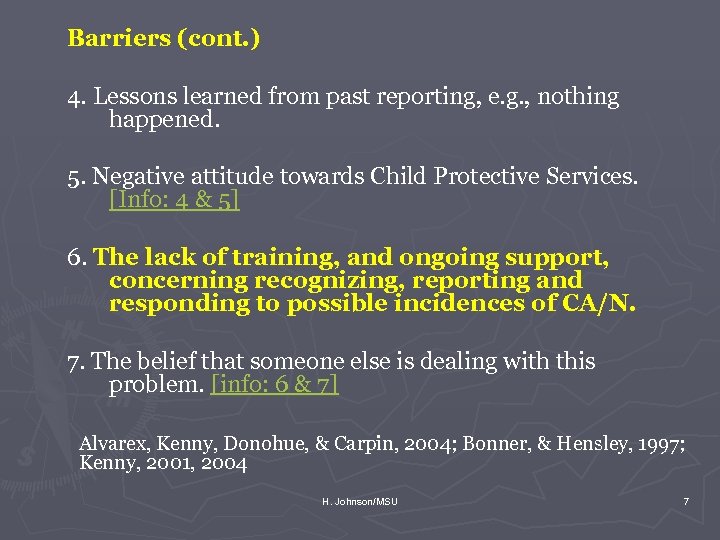
Barriers (cont. ) 4. Lessons learned from past reporting, e. g. , nothing happened. 5. Negative attitude towards Child Protective Services. [Info: 4 & 5] 6. The lack of training, and ongoing support, concerning recognizing, reporting and responding to possible incidences of CA/N. 7. The belief that someone else is dealing with this problem. [info: 6 & 7] Alvarex, Kenny, Donohue, & Carpin, 2004; Bonner, & Hensley, 1997; Kenny, 2001, 2004 H. Johnson/MSU 7
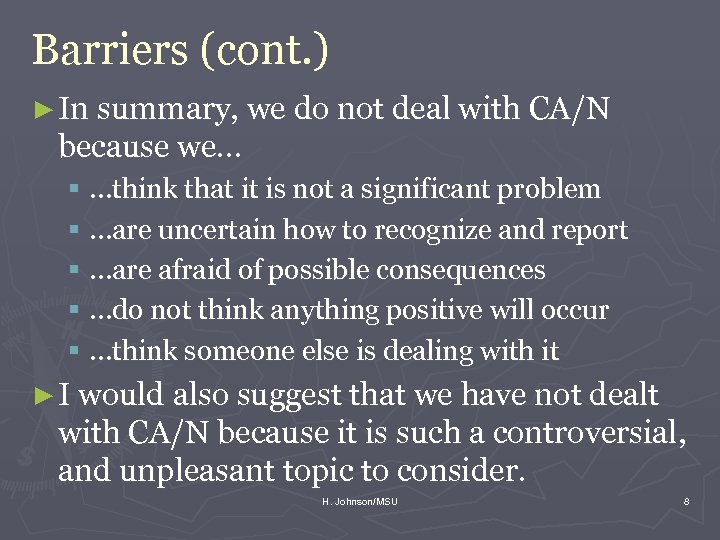
Barriers (cont. ) ► In summary, we do not deal with CA/N because we. . . §. . . think that it is not a significant problem §. . . are uncertain how to recognize and report §. . . are afraid of possible consequences §. . . do not think anything positive will occur §. . . think someone else is dealing with it ► I would also suggest that we have not dealt with CA/N because it is such a controversial, and unpleasant topic to consider. H. Johnson/MSU 8
► In reality, . . . §. . . EHDI gives us a unique opportunity to identify children who are d/hh and provide critical support to their families. §. . . inherent within this opportunity is the need to effectively observe, understand respond to the concerns and needs of families and their children. §. . . I think, but do not yet know, that our most effective EHDI colleagues are those that not only know a LOT and communicate well, but they also have excellent observational skills. 9
► In reality, . . . (cont. ) §. . . given the increased risk for maltreatment experienced by children who are d/hh, §. . . the legal requirements to be “mandatory reporters, ” and §. . . the impact of maltreatment upon health, learning, language and academic performance, §. . . EHDI colleagues must be prepared to observe, understand, and respond to suspected cases of maltreatment. ► This keynote address represents an initial challenge to meet this need. H. Johnson/MSU 10
One Answer ► Observe, Understand, & Respond to OUR Children §. . . we can protect our children from the horrific realities of child abuse and neglect, or at the very least reduce the duration of such maltreatment, by: ►acknowledging our children’s increased risks for maltreatment; ►collaborating with colleagues to learn and share more information (deafed-childabuse-neglectcol. wiki. educ. msu. edu/); and ►urging EHDI to provided CA/N training and support 11
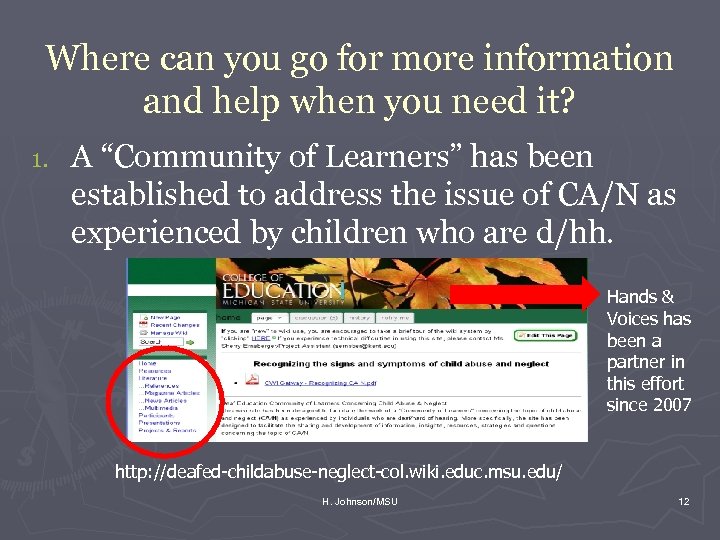
Where can you go for more information and help when you need it? 1. A “Community of Learners” has been established to address the issue of CA/N as experienced by children who are d/hh. Hands & Voices has been a partner in this effort since 2007 http: //deafed-childabuse-neglect-col. wiki. educ. msu. edu/ H. Johnson/MSU 12
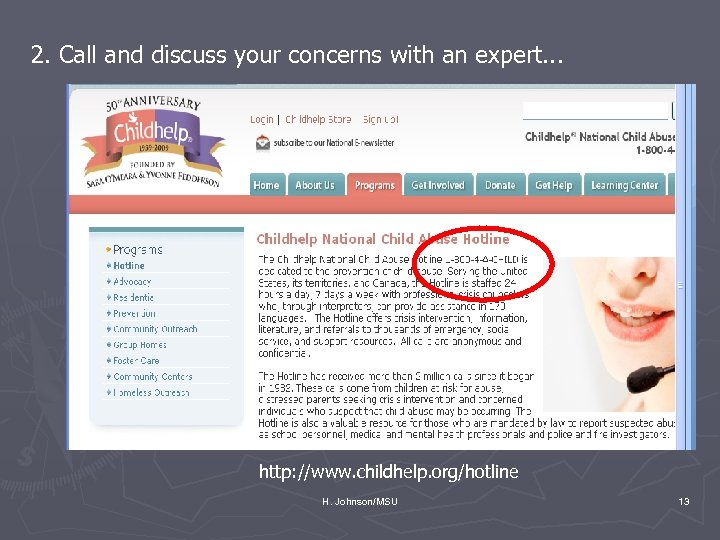
2. Call and discuss your concerns with an expert. . . http: //www. childhelp. org/hotline H. Johnson/MSU 13
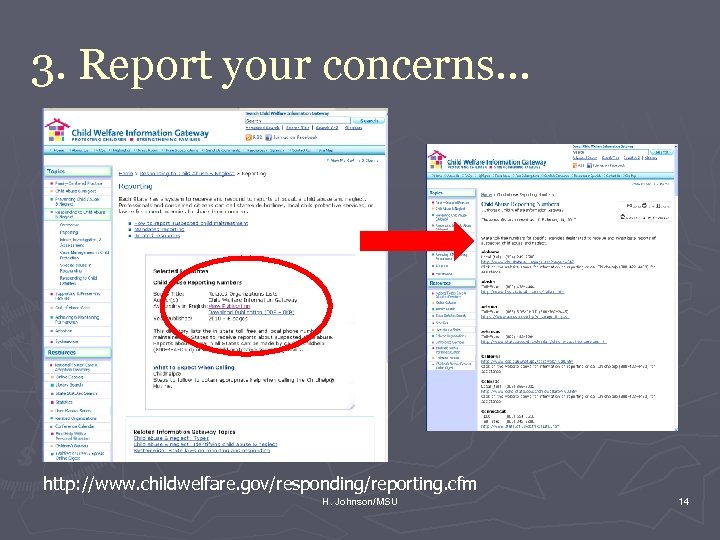
3. Report your concerns. . . http: //www. childwelfare. gov/responding/reporting. cfm H. Johnson/MSU 14
Thank You I hope you will join the effort to Observe, Understand, and Respond to possible instances of CA/N experienced by our children 15
Contact Information ► ► ► Harold A. Johnson/Professor Deaf Education Teacher Preparation 343 A Erickson Hall Michigan State University East Lansing, MI 48824 517 432 -3926 [office] 517 353 -6393 [fax] 35. 8. 171. 220 [video ph] Harold. a. johnson 3 [Skype] MSUE_H_Johnson [i. Visit] www. educ. msu. edu/deafed [Web] H. Johnson/MSU 16

What do we Know about Child Abuse and Neglect (CA/N)? H. Johnson/MSU 17
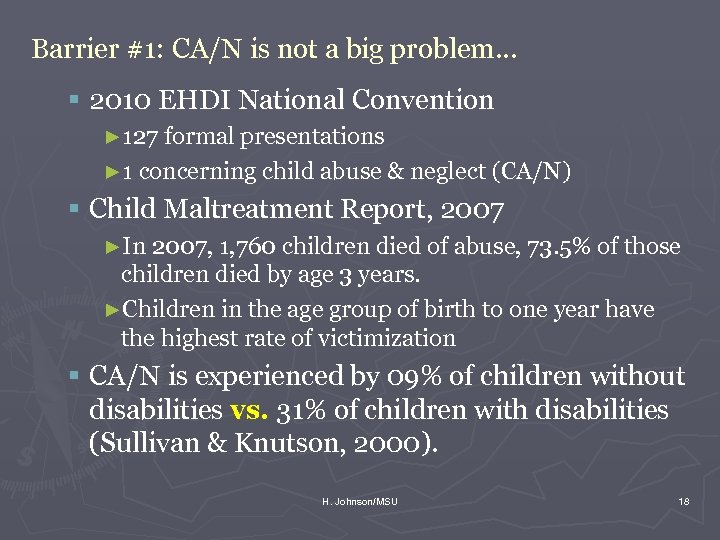
Barrier #1: CA/N is not a big problem. . . § 2010 EHDI National Convention ► 127 formal presentations ► 1 concerning child abuse & neglect (CA/N) § Child Maltreatment Report, 2007 ►In 2007, 1, 760 children died of abuse, 73. 5% of those children died by age 3 years. ►Children in the age group of birth to one year have the highest rate of victimization § CA/N is experienced by 09% of children without disabilities vs. 31% of children with disabilities (Sullivan & Knutson, 2000). H. Johnson/MSU 18
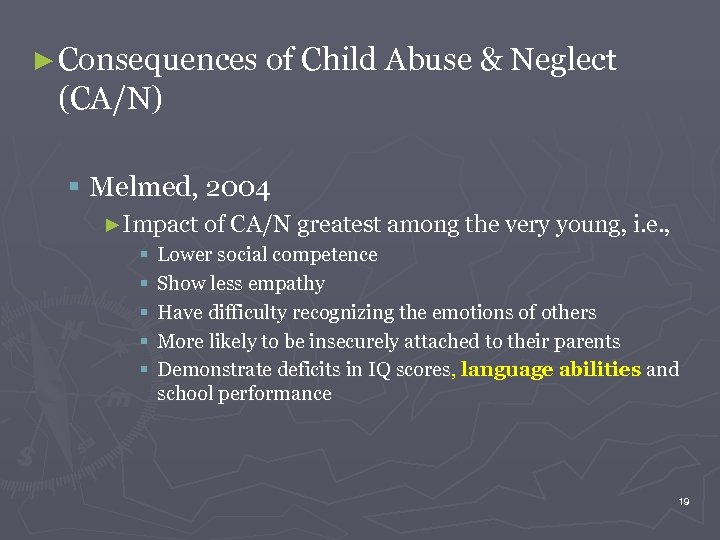
► Consequences of Child Abuse & Neglect (CA/N) § Melmed, 2004 ►Impact of CA/N greatest among the very young, i. e. , § Lower social competence § Show less empathy § Have difficulty recognizing the emotions of others § More likely to be insecurely attached to their parents § Demonstrate deficits in IQ scores, language abilities and school performance 19
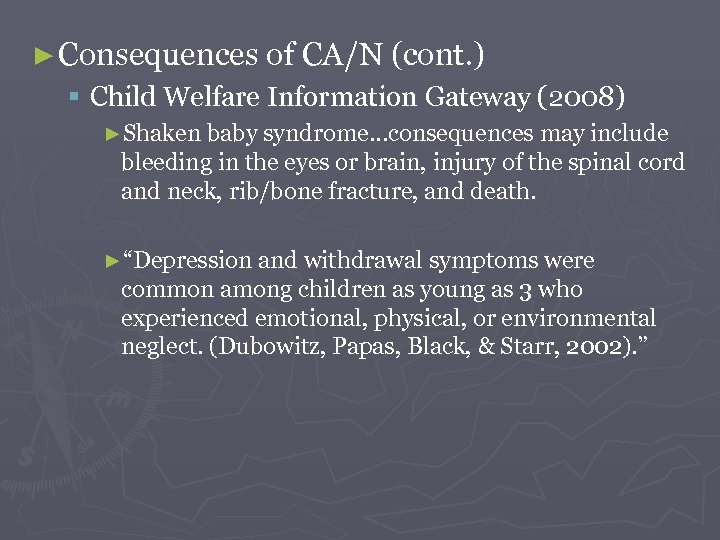
► Consequences of CA/N (cont. ) § Child Welfare Information Gateway (2008) ►Shaken baby syndrome. . . consequences may include bleeding in the eyes or brain, injury of the spinal cord and neck, rib/bone fracture, and death. ►“Depression and withdrawal symptoms were common among children as young as 3 who experienced emotional, physical, or environmental neglect. (Dubowitz, Papas, Black, & Starr, 2002). ”
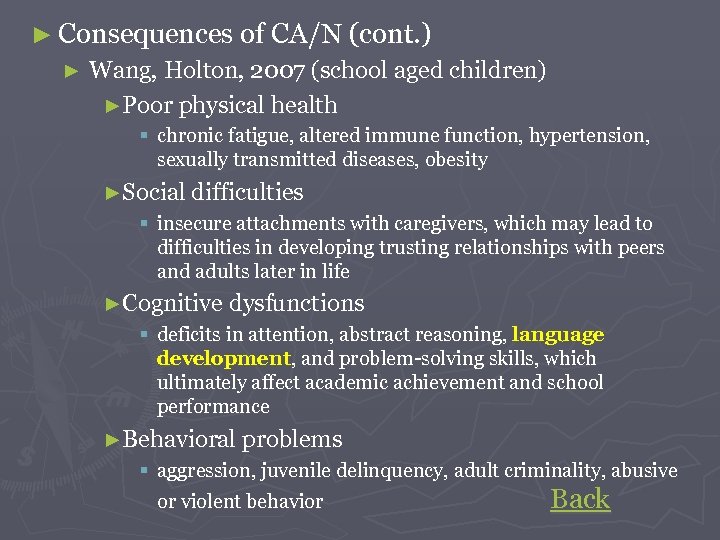
► Consequences of CA/N (cont. ) ► Wang, Holton, 2007 (school aged children) ►Poor physical health § chronic fatigue, altered immune function, hypertension, sexually transmitted diseases, obesity ►Social difficulties § insecure attachments with caregivers, which may lead to difficulties in developing trusting relationships with peers and adults later in life ►Cognitive dysfunctions § deficits in attention, abstract reasoning, language development, and problem-solving skills, which ultimately affect academic achievement and school performance ►Behavioral problems § aggression, juvenile delinquency, adult criminality, abusive or violent behavior Back
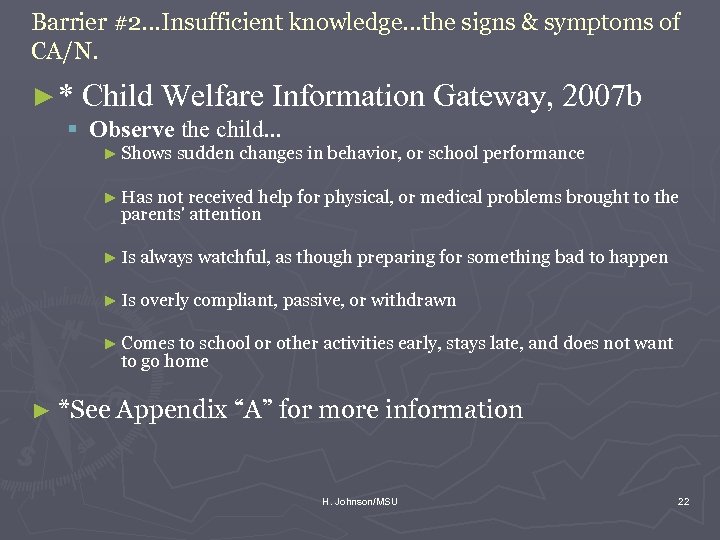
Barrier #2. . . Insufficient knowledge. . . the signs & symptoms of CA/N. ► * Child Welfare Information Gateway, 2007 b § Observe the child. . . ► Shows sudden changes in behavior, or school performance ► Has not received help for physical, or medical problems brought to the parents' attention ► Is always watchful, as though preparing for something bad to happen ► Is overly compliant, passive, or withdrawn ► Comes to school or other activities early, stays late, and does not want to go home ► *See Appendix “A” for more information H. Johnson/MSU 22
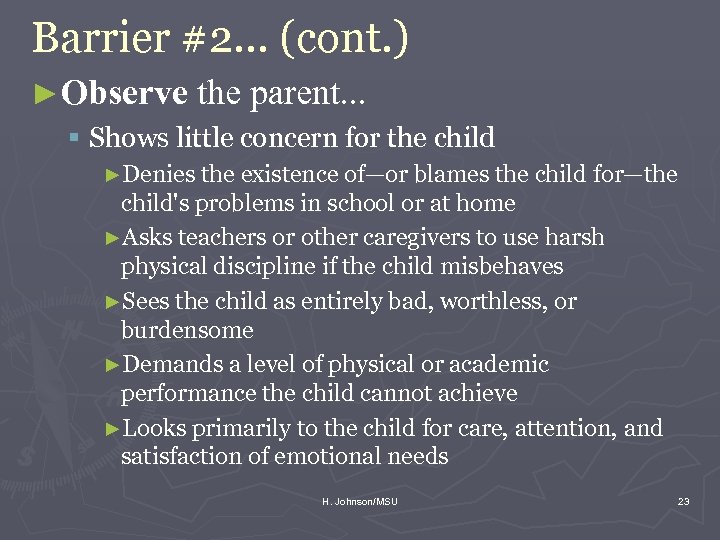
Barrier #2. . . (cont. ) ►Observe the parent. . . § Shows little concern for the child ►Denies the existence of—or blames the child for—the child's problems in school or at home ►Asks teachers or other caregivers to use harsh physical discipline if the child misbehaves ►Sees the child as entirely bad, worthless, or burdensome ►Demands a level of physical or academic performance the child cannot achieve ►Looks primarily to the child for care, attention, and satisfaction of emotional needs H. Johnson/MSU 23
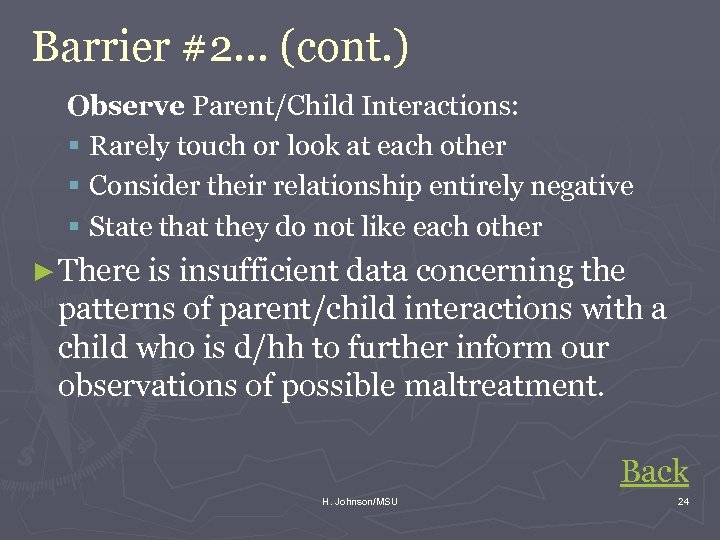
Barrier #2. . . (cont. ) Observe Parent/Child Interactions: § Rarely touch or look at each other § Consider their relationship entirely negative § State that they do not like each other ► There is insufficient data concerning the patterns of parent/child interactions with a child who is d/hh to further inform our observations of possible maltreatment. Back H. Johnson/MSU 24
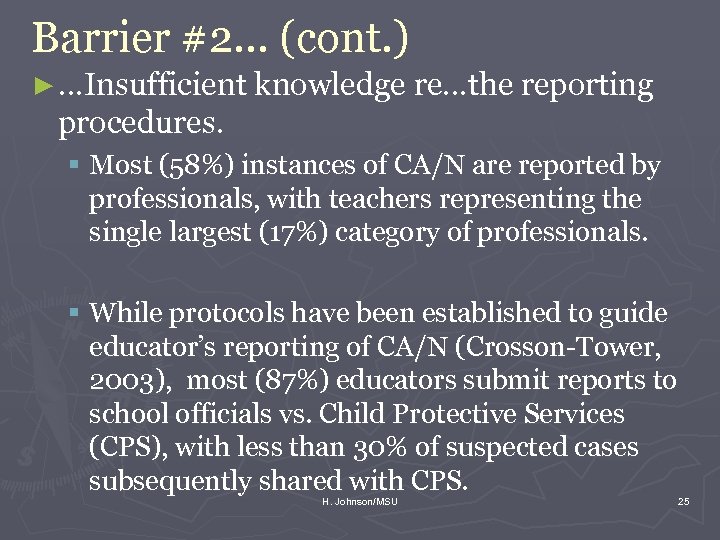
Barrier #2. . . (cont. ) ►. . . Insufficient knowledge re. . . the reporting procedures. § Most (58%) instances of CA/N are reported by professionals, with teachers representing the single largest (17%) category of professionals. § While protocols have been established to guide educator’s reporting of CA/N (Crosson-Tower, 2003), most (87%) educators submit reports to school officials vs. Child Protective Services (CPS), with less than 30% of suspected cases subsequently shared with CPS. H. Johnson/MSU 25
Barrier #3. Perceived negative consequences of reporting ►. . . perception that reporting make things worse for the child; § In the majority of cases, maltreatment does not increase as a result of reporting and in less than 3% of reported cases result in children being removed from the home (Alvarex, et al, 2004) 26
Barrier #3. (cont. ) ►. . . fear of disapproval from parents, parental denial, lack of administrative support and legal ramifications for false allegations. § Most (76%) educators do not think that their administrators will support them if they made a CA/N report (Kenny, 2004). § All states provide immunity to those professionals who report CA/N in good faith (Alvarex, et al, 2004) ► What support and directions have you been provided in relation to reporting CA/N? H. Johnson/MSU Back 27
Barriers #4 & 5 ► Barriers #4 & 5. Lessons learned from past reporting, e. g. , nothing happened, and Negative attitude towards Child Protective Services (CPS). § Interactions between mandatory reporters and CPS are often difficult (Alvarex, et al, 2004) § CPS services are underfunded and overwhelmed, with most of the available funds being used to respond to, vs. prevent CA/N (Freundlich, 2007) H. Johnson/MSU 28
Barriers #4 & 5 (cont. ) § Insufficient CPS data collection and training concerning the documentation, recognition and response to CA/N as experienced by children with disabilities (Alvarex et al, 2004; Horner. Johnson, & Drum, 2006; Kendall-Tackett, Lyon, Tallaferro, & Little, 2005). § In relation to instances of sexual abuse, educational systems frequently disbelieve victims, and fail to effectively deal with perpetrators (Shakeshaft, 2004) ► Back 29
Barriers #6 & 7 ► Barriers # 6 & 7. The lack of training, and ongoing support, concerning recognizing, reporting and responding to possible incidences of CA/N & The belief that someone else is dealing with this problem. § Who in Deaf Education is providing leadership, training, support and services re. CA/N? ►Recent proposal to the Council on the Education of the Deaf (Appendix “C”) H. Johnson/MSU 30
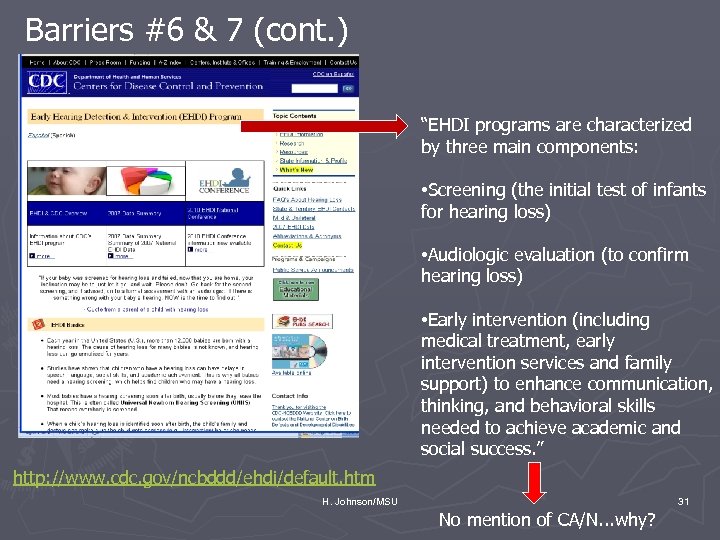
Barriers #6 & 7 (cont. ) “EHDI programs are characterized by three main components: • Screening (the initial test of infants for hearing loss) • Audiologic evaluation (to confirm hearing loss) • Early intervention (including medical treatment, early intervention services and family support) to enhance communication, thinking, and behavioral skills needed to achieve academic and social success. ” http: //www. cdc. gov/ncbddd/ehdi/default. htm H. Johnson/MSU 31 No mention of CA/N. . . why?
Barriers #6 & 7 (cont. ) ► Survey Results & the literature base § Kenny (2001; 2004) indicates. . . ►. . . that less than 30% of suspected CA/N cases known to school personnel are formally reported. ►. . . teachers need more training re. legal mandates of reporting, how to recognize and how to report suspected instances of CA/N. ►. . . training should be ongoing and include experientially exercises and hypothetical situations. ►. . . the better the CA/N training, the more cognizant teachers became of the difficulty in recognizing the signs and systems of CA/N H. Johnson/MSU 32
Barriers #6 & 7 (cont. ) ► Implications: § Children who are d/hh are three times more likely to experience CA/N than their hearing peers § Professionals who work with children who are d/hh are not well prepared to recognize, report, or respond to possible instances of CA/N § With a few notable exceptions, CA/N has largely been ignored by the major organizations within the field of Deaf Education. § Ignoring CA/N increase the length and impact of the abuse. Back H. Johnson/MSU 33
Reference List H. Johnson/MSU 34
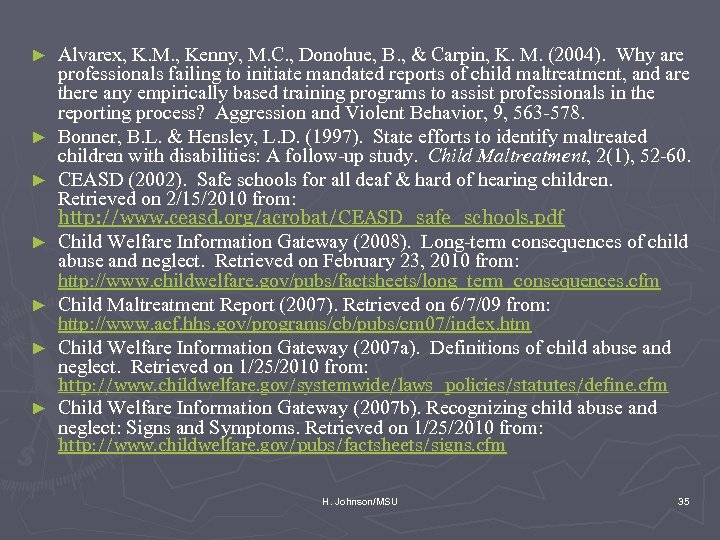
► ► ► Alvarex, K. M. , Kenny, M. C. , Donohue, B. , & Carpin, K. M. (2004). Why are professionals failing to initiate mandated reports of child maltreatment, and are there any empirically based training programs to assist professionals in the reporting process? Aggression and Violent Behavior, 9, 563 -578. Bonner, B. L. & Hensley, L. D. (1997). State efforts to identify maltreated children with disabilities: A follow-up study. Child Maltreatment, 2(1), 52 -60. CEASD (2002). Safe schools for all deaf & hard of hearing children. Retrieved on 2/15/2010 from: http: //www. ceasd. org/acrobat/CEASD_safe_schools. pdf Child Welfare Information Gateway (2008). Long-term consequences of child abuse and neglect. Retrieved on February 23, 2010 from: http: //www. childwelfare. gov/pubs/factsheets/long_term_consequences. cfm Child Maltreatment Report (2007). Retrieved on 6/7/09 from: http: //www. acf. hhs. gov/programs/cb/pubs/cm 07/index. htm Child Welfare Information Gateway (2007 a). Definitions of child abuse and neglect. Retrieved on 1/25/2010 from: http: //www. childwelfare. gov/systemwide/laws_policies/statutes/define. cfm ► Child Welfare Information Gateway (2007 b). Recognizing child abuse and neglect: Signs and Symptoms. Retrieved on 1/25/2010 from: http: //www. childwelfare. gov/pubs/factsheets/signs. cfm H. Johnson/MSU 35
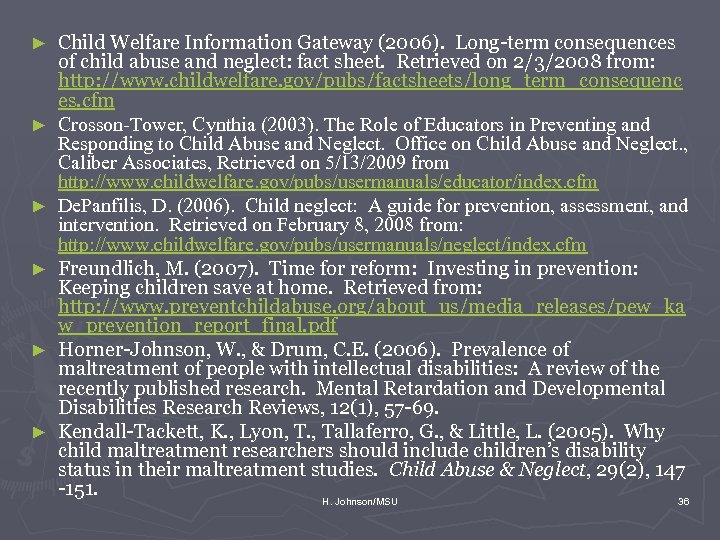
► ► ► Child Welfare Information Gateway (2006). Long-term consequences of child abuse and neglect: fact sheet. Retrieved on 2/3/2008 from: http: //www. childwelfare. gov/pubs/factsheets/long_term_consequenc es. cfm Crosson-Tower, Cynthia (2003). The Role of Educators in Preventing and Responding to Child Abuse and Neglect. Office on Child Abuse and Neglect. , Caliber Associates, Retrieved on 5/13/2009 from http: //www. childwelfare. gov/pubs/usermanuals/educator/index. cfm De. Panfilis, D. (2006). Child neglect: A guide for prevention, assessment, and intervention. Retrieved on February 8, 2008 from: http: //www. childwelfare. gov/pubs/usermanuals/neglect/index. cfm Freundlich, M. (2007). Time for reform: Investing in prevention: Keeping children save at home. Retrieved from: http: //www. preventchildabuse. org/about_us/media_releases/pew_ka w_prevention_report_final. pdf Horner-Johnson, W. , & Drum, C. E. (2006). Prevalence of maltreatment of people with intellectual disabilities: A review of the recently published research. Mental Retardation and Developmental Disabilities Research Reviews, 12(1), 57 -69. Kendall-Tackett, K. , Lyon, T. , Tallaferro, G. , & Little, L. (2005). Why child maltreatment researchers should include children’s disability status in their maltreatment studies. Child Abuse & Neglect, 29(2), 147 -151. H. Johnson/MSU 36
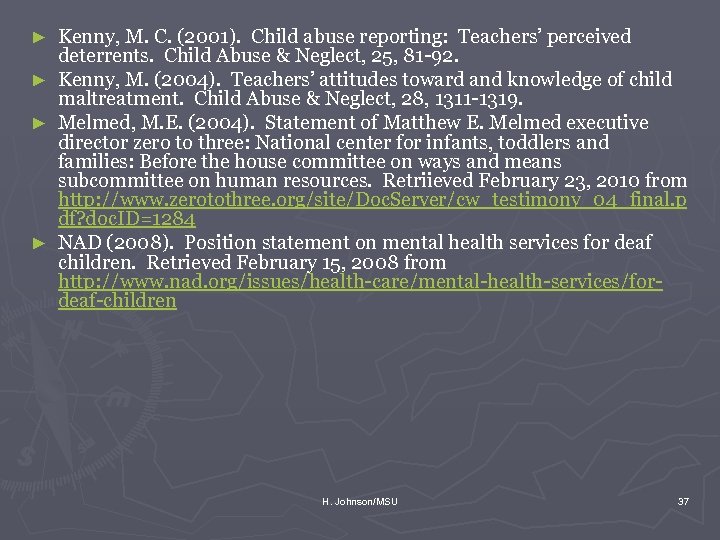
Kenny, M. C. (2001). Child abuse reporting: Teachers’ perceived deterrents. Child Abuse & Neglect, 25, 81 -92. ► Kenny, M. (2004). Teachers’ attitudes toward and knowledge of child maltreatment. Child Abuse & Neglect, 28, 1311 -1319. ► Melmed, M. E. (2004). Statement of Matthew E. Melmed executive director zero to three: National center for infants, toddlers and families: Before the house committee on ways and means subcommittee on human resources. Retriieved February 23, 2010 from http: //www. zerotothree. org/site/Doc. Server/cw_testimony_04_final. p df? doc. ID=1284 ► NAD (2008). Position statement on mental health services for deaf children. Retrieved February 15, 2008 from http: //www. nad. org/issues/health-care/mental-health-services/fordeaf-children ► H. Johnson/MSU 37
► ► Shakeshaft, Charol (2004). Educator Sexual Misconduct: A synthesis of existing literature. U. S. Dept of Education (purchase order ED-02 PO-3281) Policy and Program Studies Service. Retrieved January 11, 2009 from http: //www. ed. gov/rschstat/research/pubs/misconductreview/report. pdf Sullivan, P. M. , & Knutson, J. F. (2000). Maltreatment and disabilities: A population-based epidemiological study. Child Abuse & Neglect, 24(10), 1257 -1273. Wang, C-T. , & Holton, J. (2007). Total estimated cost of child abuse and neglect in the United States. Retrieved on 2/3/2008 from: http: //www. preventchildabuse. org/about_us/media_releases/pcaa_p ew_economic_impact_study_final. pdf Willis, Richard G. , & Vernon, Mc. Cay (2002). Residential psychiatric treatment of emotionally disturbed deaf youth. American Annals of the Deaf, 147(1), pp 31 -37. H. Johnson/MSU 38

Bibliography H. Johnson/MSU 39
► ► Do? Tell! Kids Against Child Abuse DVD (n. d. ). Information presented in ASL, English, & Spanish. Retrieved on February 8, 2008 from: http: //www. kidsagainstchildabuse. org/ Durity, Richard & Oxman, Amy (2006). Addressing the Trauma Treatment Needs of Children Who Are Deaf or Hard of Hearing and the Hearing Children of Deaf Parents. Retrieved January 11, 2009, from http: //www. nctsnet. org/nctsn_assets/pdfs/edu_materials/Trauma_D eaf_Hard-of-Hearing_Children. pdf Horner-Johnson, W. , & Drum, C. E. (2006). Prevalence of maltreatment of people with intellectual disabilities: A review of the recently published research. Mental Retardation and Developmental Disabilities Research Reviews, 12(1), 57 -69. Obinna, Jennifer, Krueger, Sarah, Osterbaan, Constance, Sadusky, Jane M, De. Vore, Wendy (2005). Understanding the Needs of the Victims of Sexual Assault in the Deaf Community: A Needs Assessment and Audit. Retrieved January 11, 2009 from http: //www. ncjrs. gov/pdffiles 1/nij/grants/212867. pdf H. Johnson/MSU 40
► Sullivan, Patricia M. , Vernon, Mc. Cay, & Scanlan, John, M. (1987). Sexual abuse of deaf youth. American Annals of the Deaf, 32(4), 256 -262 H. Johnson/MSU 41
Appendixes ► Appendix “A”: Definitions of CA/H ► Appendix “B”: Recognizing Child Abuse and Neglect: Signs and Symptoms ► Appendix “C”: Collaboration Proposal H. Johnson/MSU 42
Appendix “A”: Definitions of CA/N ►Child Welfare Information Gateway (2007 a). Definitions of child abuse and neglect. Retrieved on 1/25/2010 from: http: //www. childwelfare. gov/systemwide/la ws_policies/statutes/define. cfm H. Johnson/MSU 43
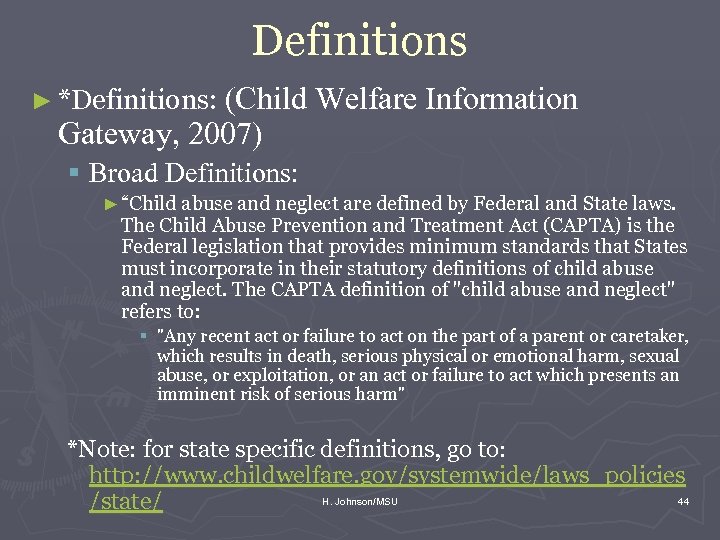
Definitions ► *Definitions: (Child Welfare Information Gateway, 2007) § Broad Definitions: ► “Child abuse and neglect are defined by Federal and State laws. The Child Abuse Prevention and Treatment Act (CAPTA) is the Federal legislation that provides minimum standards that States must incorporate in their statutory definitions of child abuse and neglect. The CAPTA definition of "child abuse and neglect" refers to: § "Any recent act or failure to act on the part of a parent or caretaker, which results in death, serious physical or emotional harm, sexual abuse, or exploitation, or an act or failure to act which presents an imminent risk of serious harm" *Note: for state specific definitions, go to: http: //www. childwelfare. gov/systemwide/laws_policies H. Johnson/MSU 44 /state/
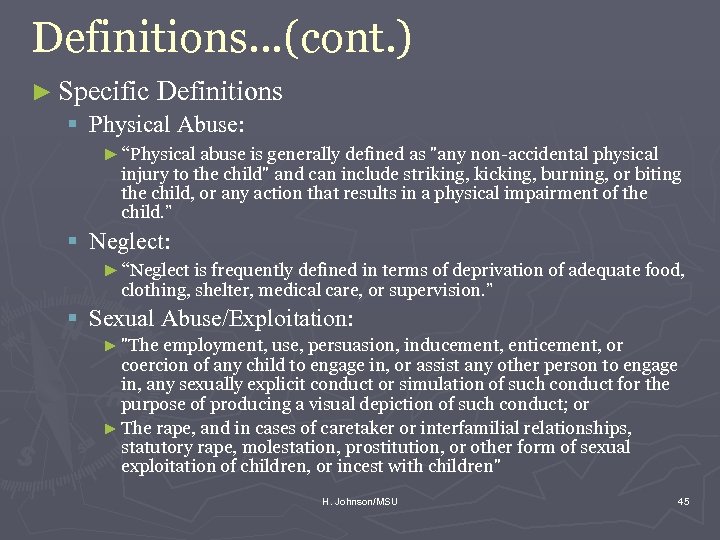
Definitions. . . (cont. ) ► Specific Definitions § Physical Abuse: ► “Physical abuse is generally defined as "any non-accidental physical injury to the child" and can include striking, kicking, burning, or biting the child, or any action that results in a physical impairment of the child. ” § Neglect: ► “Neglect is frequently defined in terms of deprivation of adequate food, clothing, shelter, medical care, or supervision. ” § Sexual Abuse/Exploitation: ► "The employment, use, persuasion, inducement, enticement, or coercion of any child to engage in, or assist any other person to engage in, any sexually explicit conduct or simulation of such conduct for the purpose of producing a visual depiction of such conduct; or ► The rape, and in cases of caretaker or interfamilial relationships, statutory rape, molestation, prostitution, or other form of sexual exploitation of children, or incest with children" H. Johnson/MSU 45
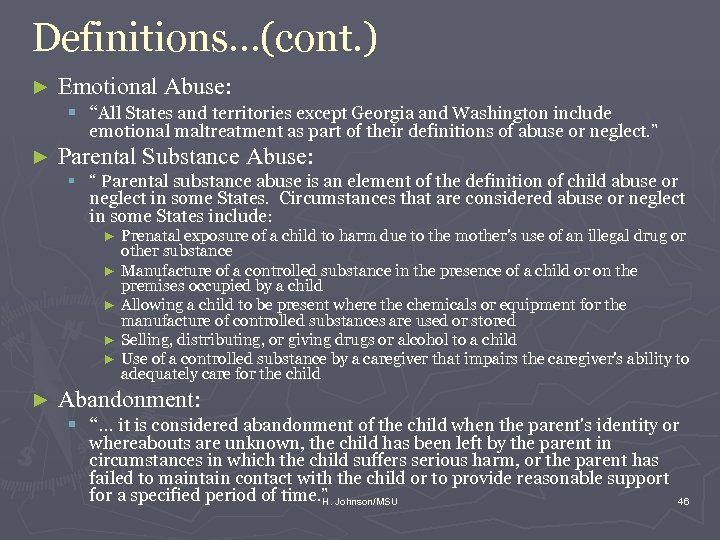
Definitions. . . (cont. ) ► Emotional Abuse: § “All States and territories except Georgia and Washington include emotional maltreatment as part of their definitions of abuse or neglect. ” ► Parental Substance Abuse: § “ Parental substance abuse is an element of the definition of child abuse or neglect in some States. Circumstances that are considered abuse or neglect in some States include: Prenatal exposure of a child to harm due to the mother's use of an illegal drug or other substance ► Manufacture of a controlled substance in the presence of a child or on the premises occupied by a child ► Allowing a child to be present where the chemicals or equipment for the manufacture of controlled substances are used or stored ► Selling, distributing, or giving drugs or alcohol to a child ► Use of a controlled substance by a caregiver that impairs the caregiver's ability to adequately care for the child ► ► Abandonment: § “. . . it is considered abandonment of the child when the parent's identity or whereabouts are unknown, the child has been left by the parent in circumstances in which the child suffers serious harm, or the parent has failed to maintain contact with the child or to provide reasonable support for a specified period of time. ” Johnson/MSU H. 46
Appendix B: Recognizing Child Abuse and Neglect: Signs and Symptoms ►Child Welfare Information Gateway (2007 b). Recognizing child abuse and neglect: Signs and Symptoms. Retrieved on 1/25/2010 from: http: //www. childwelfare. gov/pubs/factshee ts/signs. cfm H. Johnson/MSU 47
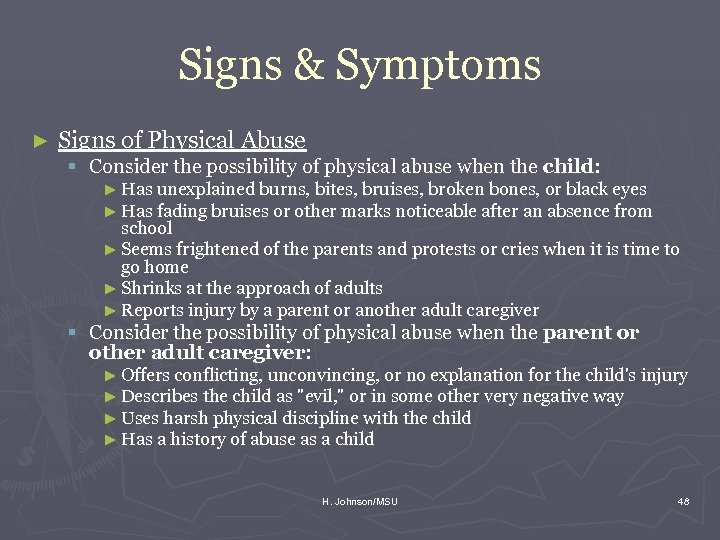
Signs & Symptoms ► Signs of Physical Abuse § Consider the possibility of physical abuse when the child: ► Has unexplained burns, bites, bruises, broken bones, or black eyes ► Has fading bruises or other marks noticeable after an absence from school ► Seems frightened of the parents and protests or cries when it is time to go home ► Shrinks at the approach of adults ► Reports injury by a parent or another adult caregiver § Consider the possibility of physical abuse when the parent or other adult caregiver: ► Offers conflicting, unconvincing, or no explanation for the child's injury ► Describes the child as "evil, " or in some other very negative way ► Uses harsh physical discipline with the child ► Has a history of abuse as a child H. Johnson/MSU 48
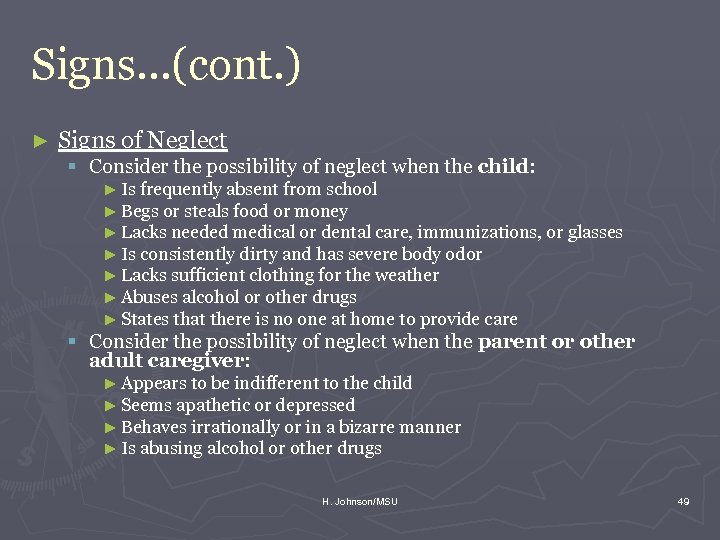
Signs. . . (cont. ) ► Signs of Neglect § Consider the possibility of neglect when the child: ► Is frequently absent from school ► Begs or steals food or money ► Lacks needed medical or dental care, immunizations, or glasses ► Is consistently dirty and has severe body odor ► Lacks sufficient clothing for the weather ► Abuses alcohol or other drugs ► States that there is no one at home to provide care § Consider the possibility of neglect when the parent or other adult caregiver: ► Appears to be indifferent to the child ► Seems apathetic or depressed ► Behaves irrationally or in a bizarre manner ► Is abusing alcohol or other drugs H. Johnson/MSU 49
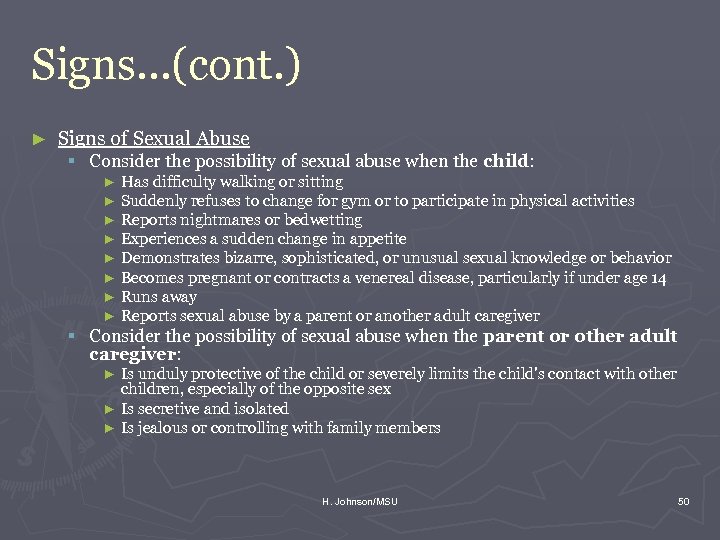
Signs. . . (cont. ) ► Signs of Sexual Abuse § Consider the possibility of sexual abuse when the child: ► ► ► ► Has difficulty walking or sitting Suddenly refuses to change for gym or to participate in physical activities Reports nightmares or bedwetting Experiences a sudden change in appetite Demonstrates bizarre, sophisticated, or unusual sexual knowledge or behavior Becomes pregnant or contracts a venereal disease, particularly if under age 14 Runs away Reports sexual abuse by a parent or another adult caregiver § Consider the possibility of sexual abuse when the parent or other adult caregiver: Is unduly protective of the child or severely limits the child's contact with other children, especially of the opposite sex ► Is secretive and isolated ► Is jealous or controlling with family members ► H. Johnson/MSU 50
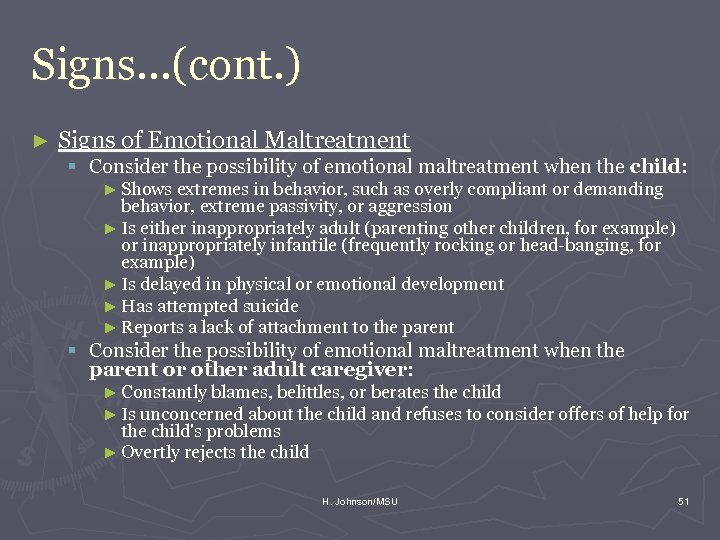
Signs. . . (cont. ) ► Signs of Emotional Maltreatment § Consider the possibility of emotional maltreatment when the child: ► Shows extremes in behavior, such as overly compliant or demanding behavior, extreme passivity, or aggression ► Is either inappropriately adult (parenting other children, for example) or inappropriately infantile (frequently rocking or head-banging, for example) ► Is delayed in physical or emotional development ► Has attempted suicide ► Reports a lack of attachment to the parent § Consider the possibility of emotional maltreatment when the parent or other adult caregiver: ► Constantly blames, belittles, or berates the child ► Is unconcerned about the child and refuses to consider offers of help for the child's problems ► Overtly rejects the child H. Johnson/MSU 51
Appendix “C”: Collaboration Proposal H. Johnson/MSU 52
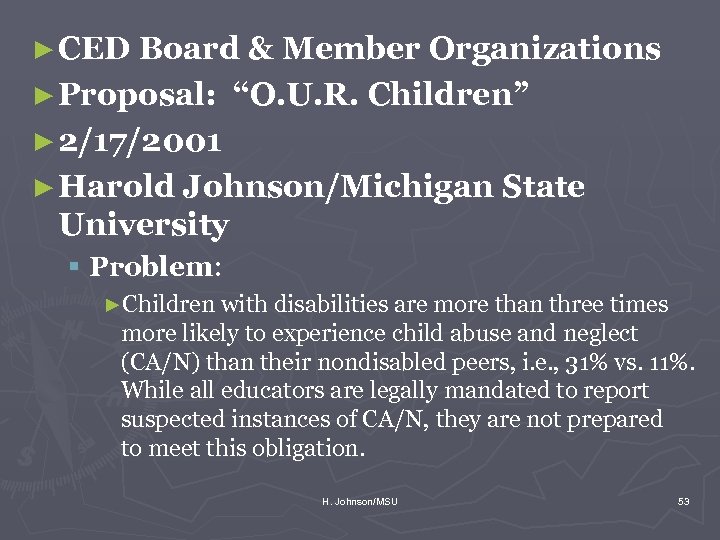
► CED Board & Member Organizations ► Proposal: “O. U. R. Children” ► 2/17/2001 ► Harold Johnson/Michigan State University § Problem: ►Children with disabilities are more than three times more likely to experience child abuse and neglect (CA/N) than their nondisabled peers, i. e. , 31% vs. 11%. While all educators are legally mandated to report suspected instances of CA/N, they are not prepared to meet this obligation. H. Johnson/MSU 53
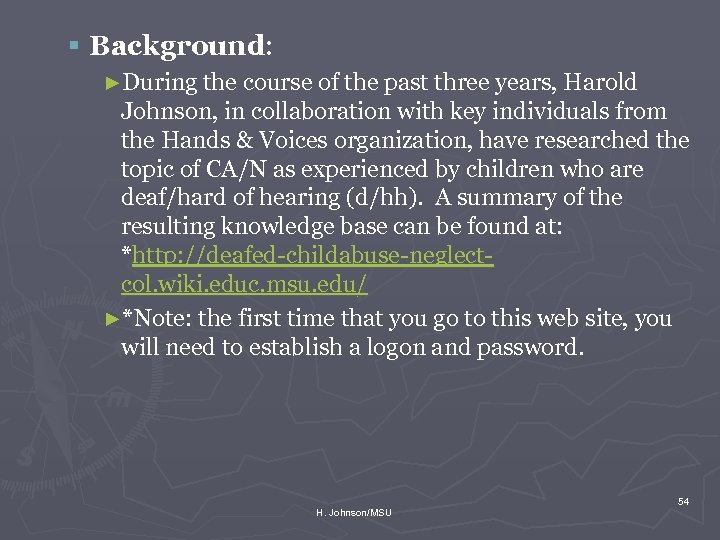
§ Background: ►During the course of the past three years, Harold Johnson, in collaboration with key individuals from the Hands & Voices organization, have researched the topic of CA/N as experienced by children who are deaf/hard of hearing (d/hh). A summary of the resulting knowledge base can be found at: *http: //deafed-childabuse-neglectcol. wiki. educ. msu. edu/ ►*Note: the first time that you go to this web site, you will need to establish a logon and password. H. Johnson/MSU 54
§ Proposal ►CED Board agree to include the topic of CA/N, as experienced by children who are d/hh, as an agenda item, for one Board meeting a year, for the next three years. ►Each CED member organizations task one individual to work with Harold Johnson for the next three years concerning the topic of CA/N, as experienced by children who are d/hh. H. Johnson/MSU 55
► Proposal (cont. ) ►Harold Johnson, in collaboration Hands & Voices and designated individuals from CED member organization will: § Year 1: document how each CED member organization has/is/plans to address CA/N in relation to informing parents and preparing professionals, plus, resulting “lessons learned, ” questions, concerns and suggestions. Synthesis of the resulting information to be presented at a CED Board meeting. § Year 2: design, implement, and evaluate a pilot study to inform parents of children who are d/hh and prepare the professionals who work with them how to Observe, Understand, and Respond to possible incidences of CA/N as experienced by children who are d/hh. Synthesis of the resulting information to be presented at a CED Board meeting. H. Johnson/MSU 56
§ Proposal (cont. ) ►Harold Johnson, . . . will: § Year 3: offer CED member organizations a program to effectively and efficiently inform parents of children who are d/hh, and prepare the professionals who work with them, how to Observe, Understand, and Respond to possible incidences of CA/N as experienced by children who are d/hh. Synthesis of the resulting information to be presented at a CED Board meeting. H. Johnson/MSU 57
§ Outcomes: ►The following outcomes are projected to occur if CED and its member organization accept this proposal: 1. CED visibility will be increased as it works to proactively address a horrific problem that has been largely ignored by the field of Deaf Education. 2. CED member organizations will be: ► recognized for the CA/N related work they have already carried out; ► assisted in the design, piloting, and possible implementation of programs to inform, and when appropriate, prepare their members to Observe, Understand, and Respond to possible incidences of CA/N as experienced by children who are d/hh; and 3. CED, its member organizations and Hands & Voices will be both prepared and positioned to seek additional Federal/foundation funds to support collaboratively efforts to reduce the incidence, duration, and impact of CA/N as experienced by children who are d/hh. H. Johnson/MSU 58
Скачать презентацию Child Abuse Neglect Three Questions One Answer
bb274ff08161c1da5b13745ba6ff0091.ppt