


 Скачать презентацию Chicago Conquers the Midwest 1850 -1890 Economic
e902eeaf4013b493e69af4e2e28de607.ppt
- Количество слайдов: 16
 Chicago Conquers the Midwest 1850 -1890
 Economic Breakthrough • Erie Canal improves economy in U. S. • Symbiotic relationship between Midwest and East ▫ Midwest provides agriculture ▫ East provides manufacturing • Many cities have opportunity to profit from water access: ▫ Green Bay, Milwaukee, Detroit, Toledo, Cleveland • The city that builds greatest access to waterway transportation will benefit the most
 Economic Breakthrough • Chicago “wins” due to I&M Canal • Farmers bring harvest short distances to ports along canal • Cost decrease = profit increase • I&M Canal triples Chicago’s geographic control • Usefulness of canal is short-lived
 Railroad is King • Ogden proposes regional railroad from Chicago to Galena (< 5 miles from Mississippi River) in 1836 • Depression of 1837 stalls plans • 1 st 10 miles operational in 1848; 1850 tracks reach Elgin (50 miles); 1852 = Rockford (80 miles); 1853 = Freeport (110 miles) • 1857 = 3000 miles of track & 100 trains enter & leave city daily • Not always welcomed – rural citizens alarmed & distrustful of big businesses
 Railroad is King • RRs expand geographic control even more = economic development • Chicago’s economic reach: ▫ 1840 = 100 miles west of Lake Michigan ▫ 1880 = Oregon • Until after Civil War, Chicago = RR continental divide ▫ Both east and west lines begin and end in Chicago • Also benefit from RR passengers using Chicago as a rest point before transferring trains
 Railroad is King • • Many benefits to RRs: Faster RRs don’t freeze Not limited to waterways – access to more people • Chicago replaces St. Louis as #1 midwestern city ▫ ▫ St. Louis impt. b/c Mississippi & Missouri Rivers Missouri gvt. doesn‘t spend money on RRs St. Louis farther from New York Missouri takes RRs to court & lose
 Railroad is King • RR causes population increase ▫ 30, 000 to 110, 000 from 1850 to 1860 • Allows Chicago to DOMINATE 4 industries: ▫ ▫ Grain trade Lumber Meatpacking Mail-order catalogs
 The Grain Industry • Corn is primary crop in Midwest ▫ ▫ ▫ High yield Stores well Multiple uses Low waste Low profits • Wheat = lucrative cash crop ▫ Difficult to harvest ▫ Damages easily ▫ Spoils quickly
 The Grain Industry • Cyrus Mc. Cormick invents mechanical reaper to harvest wheat – 3 problems for Mc. Cormick ▫ Needs to convince farmers to buy it ▫ Farmers don’t have cash prior to harvest – no $$ to purchase reaper ▫ Huge machine difficult to transport • Mc. Cormick uses advertising, credit, and RRs to solve these problems • Factors the increase grain sales: ▫ Grain elevator ▫ Crimean War (Russia vs. Ottoman Empire)
 The Grain Industry • Chicago Board of Trade (CBOT) ▫ Organizes buying and selling of wheat ▫ No direct contact between sellers & buyers ▫ Farmer brings grain & given receipt for type and quality – given grain receipt ▫ All similar types of grain combined ▫ Buyer purchases from common stash & given receipt redeemable in grain ▫ Buying streamlined – prices uniform & regulated ▫ Grain receipt = new type of currency ▫ Leads to grain futures market
 The Lumber Industry • • Lumber demand high b/c no trees in prairies WI, MN have plenty of forests Lumber needed for buildings, roads, RRs White Pine popular ▫ Floats (easy to transport) ▫ Massive trees • Plenty of workers – farmers were lumberjacks in winter • RRs then ship lumber – declines in 1880 s b/c RRs go directly to lumber yards
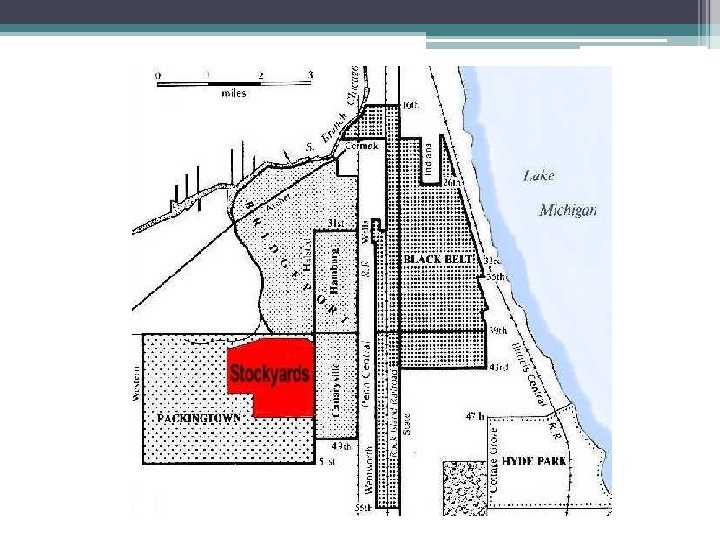
 The Meatpacking Industry • Stock Yards = Chicago’s biggest tourist attraction (10, 000 visitors per day) • Pre-Civil War = small, competing stock yards – very inconvenient • Civil War changes needs • Stock Yards consolidate ▫ 3 miles of water troughs ▫ 10 miles of feed troughs ▫ 30 miles of drainage for waste into Chicago River
 The Meatpacking Industry • People prefer fresh beef – provides problems to ship to East • Refrigerated railcars solve problem • Beef war ensues between Chicago and Eastern butchers • Only 45% of steer = consumable • Other 55% used for margarine, combs, bouillon, instrument strings, glue, fertilizer, buttons, etc. • Use of immigrant workers = very low wages • Declines in 1900
 Mail-order Catalog Industry • A. Montgomery Ward opens 1 st mail order catalog • Ward = travelling salesman • Sees farmers suspicious of middlemen ▫ Bought cheap items in city and sell high to farmers • Ward buys mass quantities of goods (like Costco) – allows for low prices • Low prices = suspect of fraud • Money back guarantee • 1872 = 163 items to 40 famers • 1900 = 70, 000 items to 2, 000 customers
 Mail-order Catalog Industry • Richard Sears & Alvah Roebuck become competitors • Sears = much better advertising ▫ Uses hyperbole ▫ Treats farmers like city folk ▫ People trust Sears like family • 1893 = 196 pages • 1900 = > 1, 100 pages • Catalogs give farmers access to city goods