 Скачать презентацию Chemistry Content Review Periodic Table of the Elements
786f53f8f77d8e016363e8e164630f04.ppt
- Количество слайдов: 81



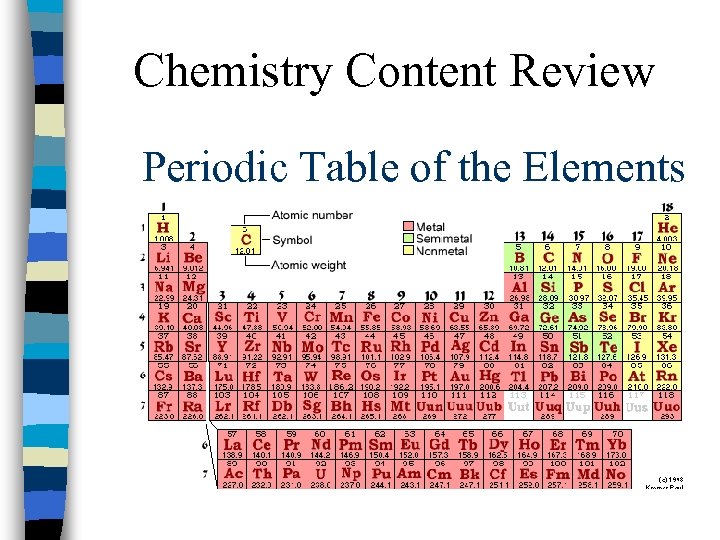
Chemistry Content Review Periodic Table of the Elements
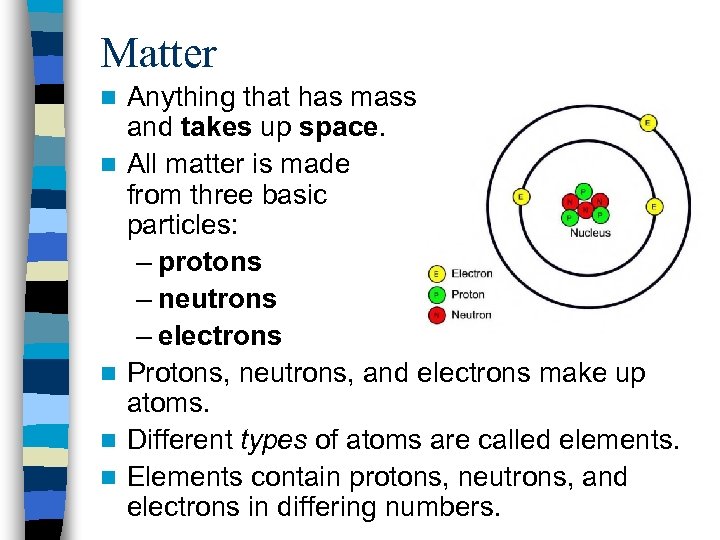
Matter n n Anything that has mass and takes up space. All matter is made from three basic particles: – protons – neutrons – electrons Protons, neutrons, and electrons make up atoms. Different types of atoms are called elements. Elements contain protons, neutrons, and electrons in differing numbers. n n n
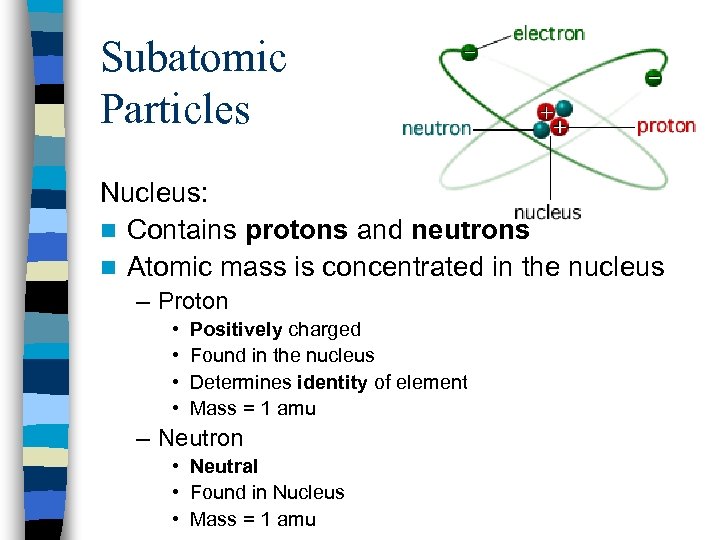
Subatomic Particles Nucleus: n Contains protons and neutrons n Atomic mass is concentrated in the nucleus – Proton • • Positively charged Found in the nucleus Determines identity of element Mass = 1 amu – Neutron • Neutral • Found in Nucleus • Mass = 1 amu
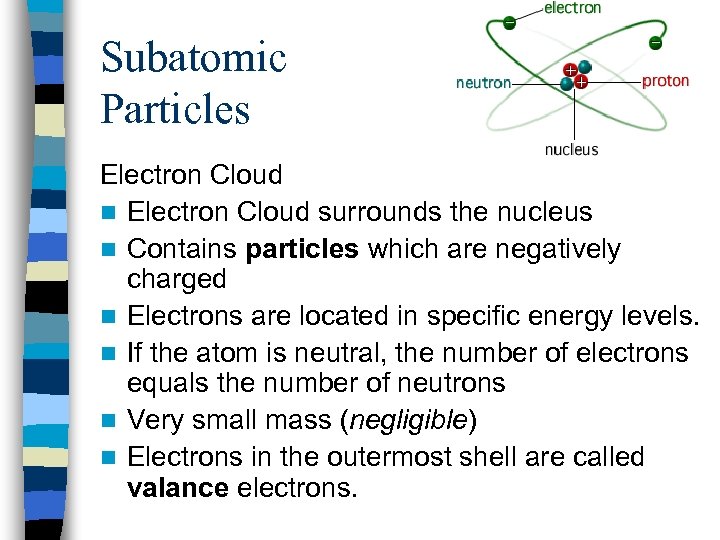
Subatomic Particles Electron Cloud n Electron Cloud surrounds the nucleus n Contains particles which are negatively charged n Electrons are located in specific energy levels. n If the atom is neutral, the number of electrons equals the number of neutrons n Very small mass (negligible) n Electrons in the outermost shell are called valance electrons.
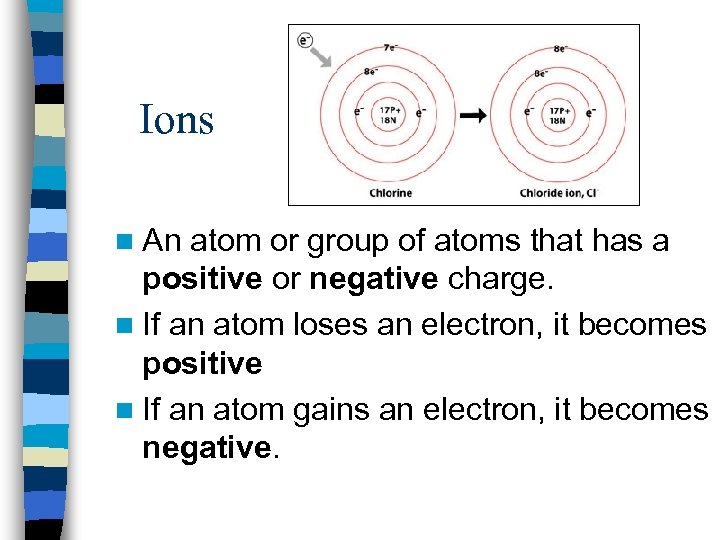
Ions n An atom or group of atoms that has a positive or negative charge. n If an atom loses an electron, it becomes positive n If an atom gains an electron, it becomes negative.
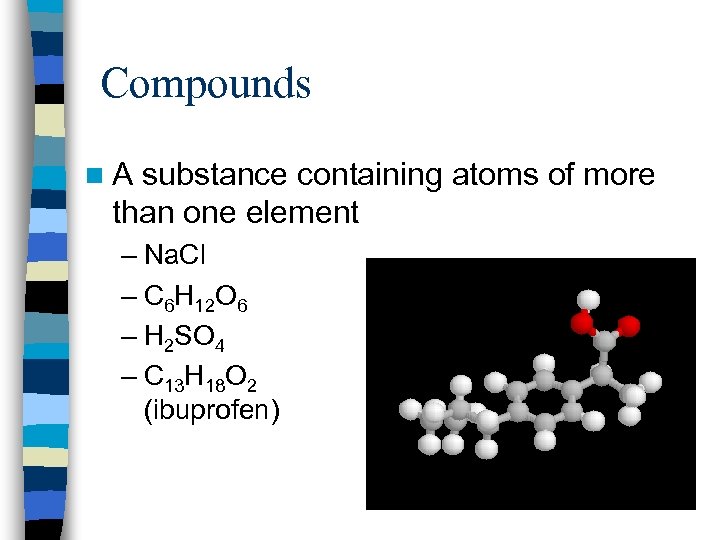
Compounds n A substance containing atoms of more than one element – Na. Cl – C 6 H 12 O 6 – H 2 SO 4 – C 13 H 18 O 2 (ibuprofen)
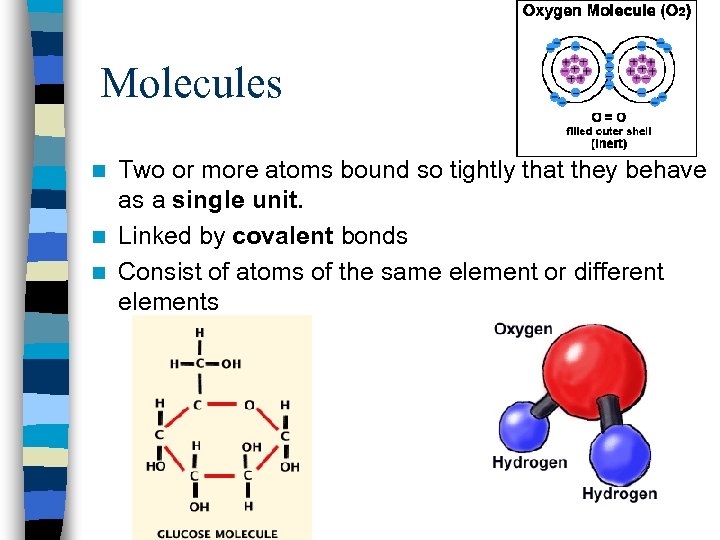
Molecules Two or more atoms bound so tightly that they behave as a single unit. n Linked by covalent bonds n Consist of atoms of the same element or different elements n
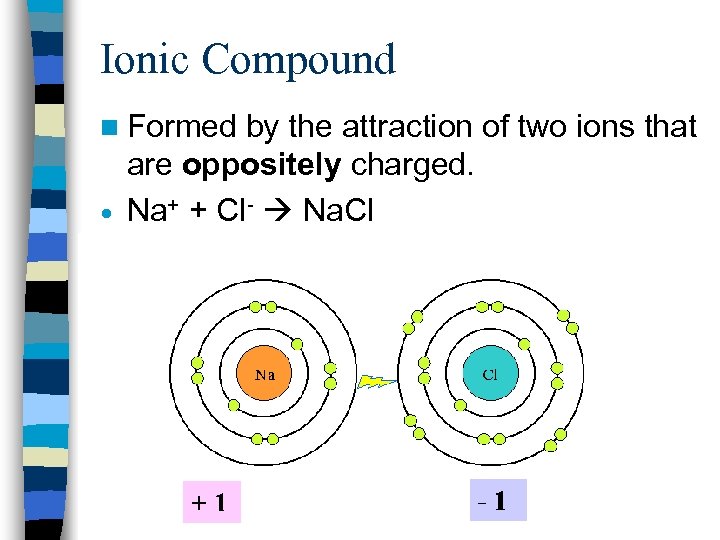
Ionic Compound n Formed by the attraction of two ions that are oppositely charged. Na+ + Cl- Na. Cl
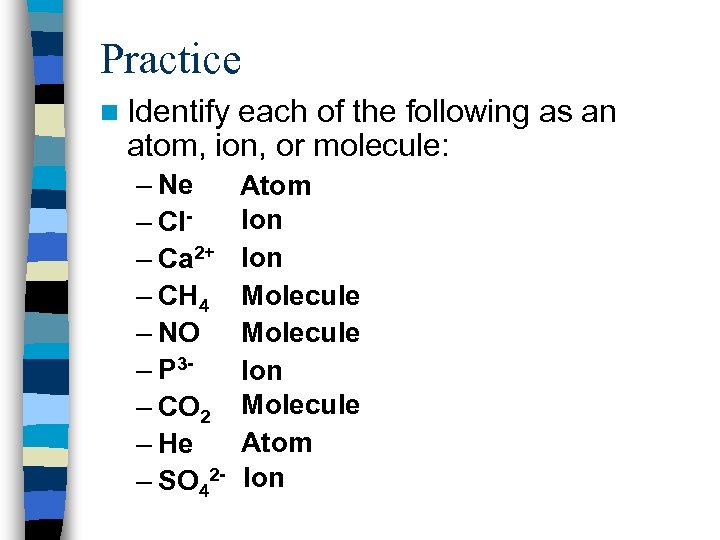
Practice n Identify each of the following as an atom, ion, or molecule: – Ne – Cl– Ca 2+ – CH 4 – NO – P 3– CO 2 – He – SO 42 - Atom Ion Molecule Atom Ion
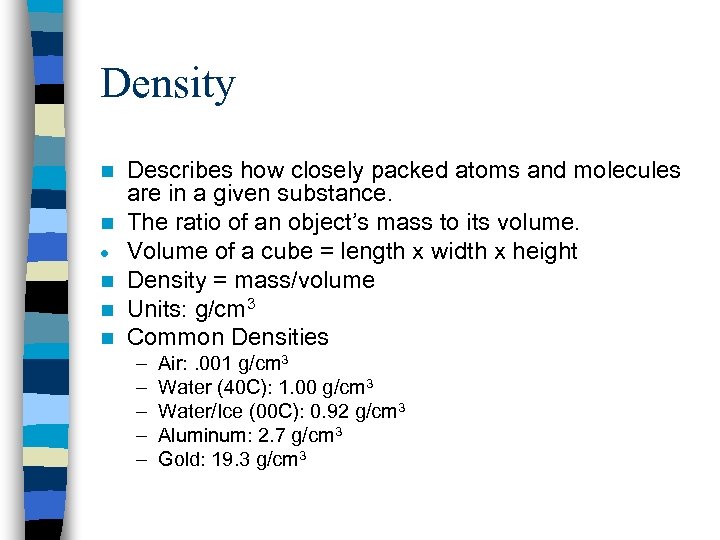
Density n n n Describes how closely packed atoms and molecules are in a given substance. The ratio of an object’s mass to its volume. Volume of a cube = length x width x height Density = mass/volume Units: g/cm 3 Common Densities – – – Air: . 001 g/cm 3 Water (40 C): 1. 00 g/cm 3 Water/Ice (00 C): 0. 92 g/cm 3 Aluminum: 2. 7 g/cm 3 Gold: 19. 3 g/cm 3
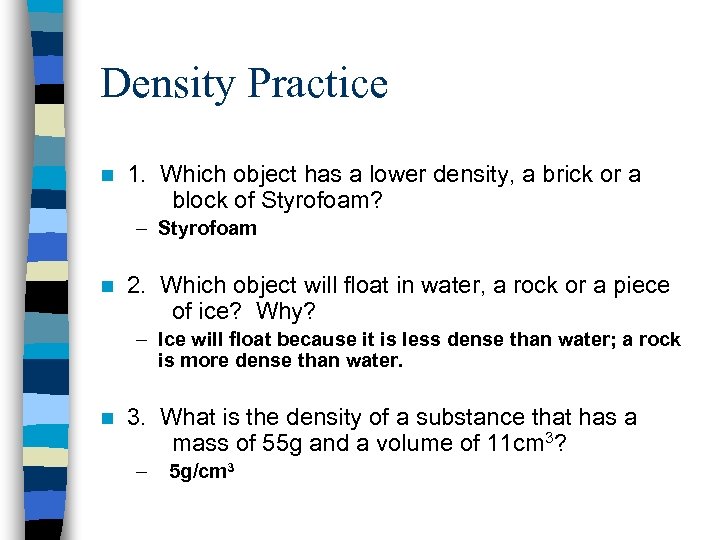
Density Practice n 1. Which object has a lower density, a brick or a block of Styrofoam? – Styrofoam n 2. Which object will float in water, a rock or a piece of ice? Why? – Ice will float because it is less dense than water; a rock is more dense than water. n 3. What is the density of a substance that has a mass of 55 g and a volume of 11 cm 3? – 5 g/cm 3
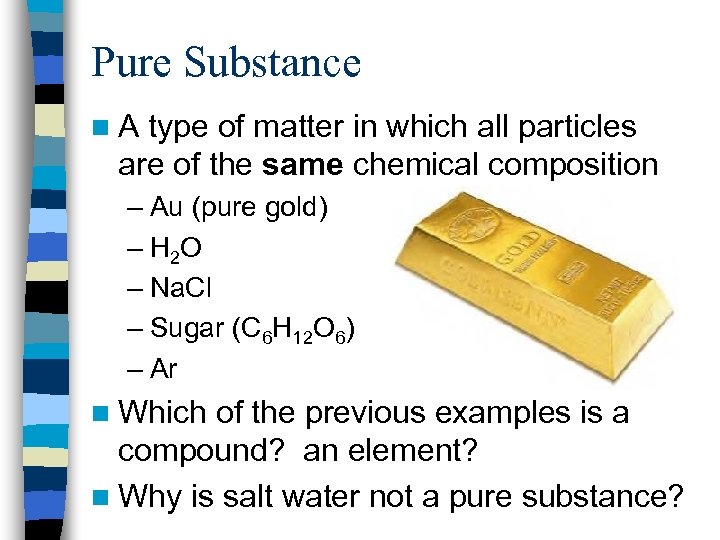
Pure Substance n A type of matter in which all particles are of the same chemical composition – Au (pure gold) – H 2 O – Na. Cl – Sugar (C 6 H 12 O 6) – Ar n Which of the previous examples is a compound? an element? n Why is salt water not a pure substance?
Mixtures n Two or more pure substances physically mixed together. n Cannot be represented by a chemical formula. – Salt water – Sand rocks – Air
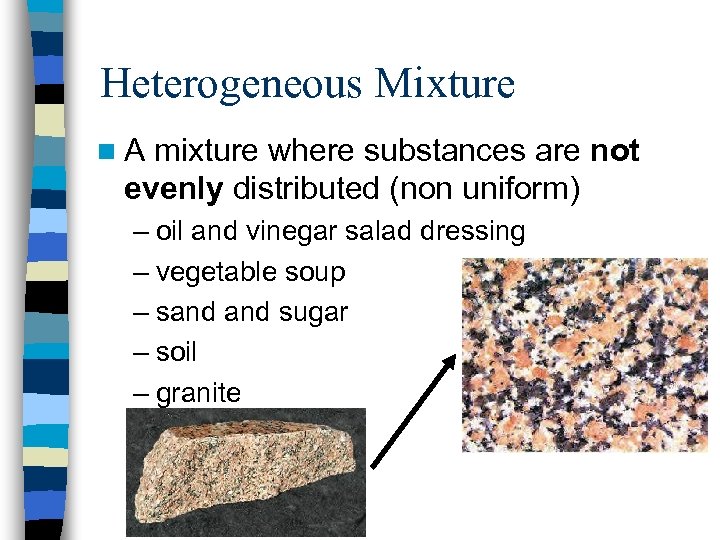
Heterogeneous Mixture n A mixture where substances are not evenly distributed (non uniform) – oil and vinegar salad dressing – vegetable soup – sand sugar – soil – granite
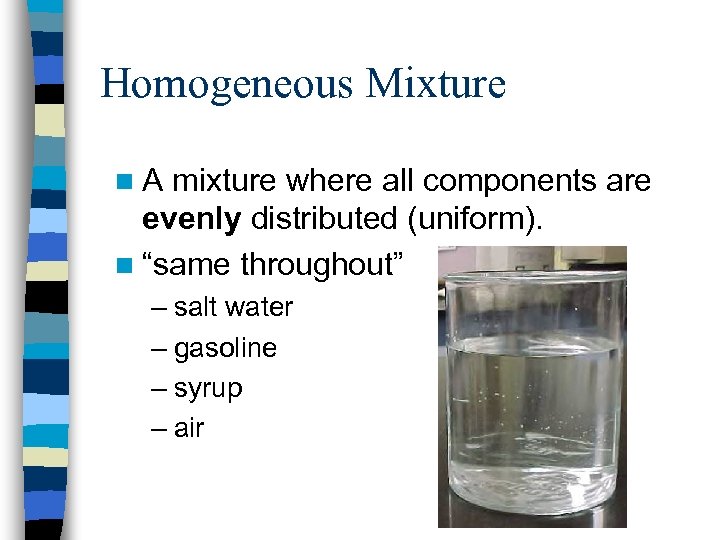
Homogeneous Mixture n A mixture where all components are evenly distributed (uniform). n “same throughout” – salt water – gasoline – syrup – air
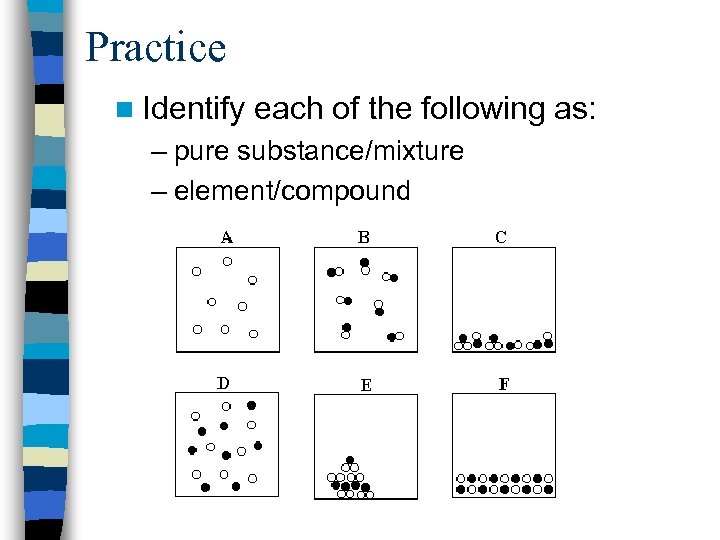
Practice n Identify each of the following as: – pure substance/mixture – element/compound
Solution n Formed when one substance is dissolved by another. n In order to be dissolved, a substance must be soluble. n A homogeneous mixture. n Particles are evenly distributed. n Parts cannot be separated by filtering. n Solvent—does the dissolving n Solute—dissolved by the solvent
Solution Practice n Identify the solute and solvent in each of the following: – Salt water – iced tea – kool aid – paint/paint thinner – nail polish/acetone
Types of Solutions n Solid dissolved in a liquid. – Salt water n Gas dissolved in a liquid – Coca-cola n Two solids – Metal alloys: brass = copper + zinc n Two gasses – Air: nitrogen (78% vol), oxygen (21% vol), argon (1% vol), carbon dioxide (0. 03% vol). n In solutions of two solids or two gases, the solvent is the component present in largest quantity.
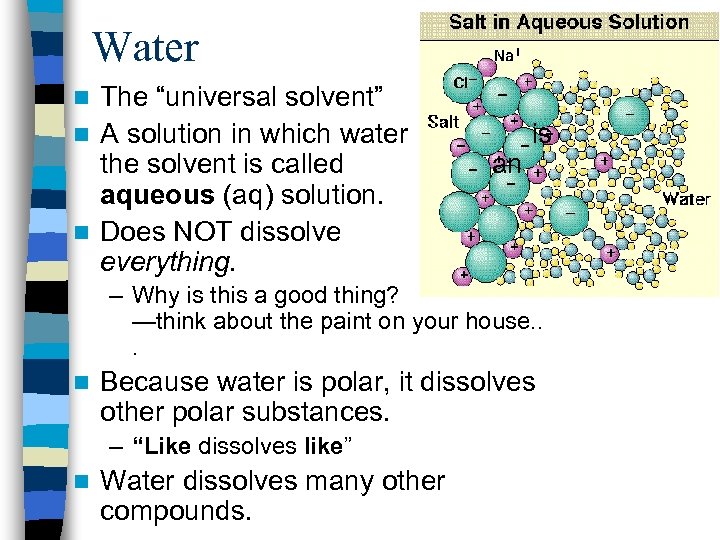
Water The “universal solvent” n A solution in which water is the solvent is called an aqueous (aq) solution. n Does NOT dissolve everything. n – Why is this a good thing? —think about the paint on your house. . . n Because water is polar, it dissolves other polar substances. – “Like dissolves like” n Water dissolves many other compounds.
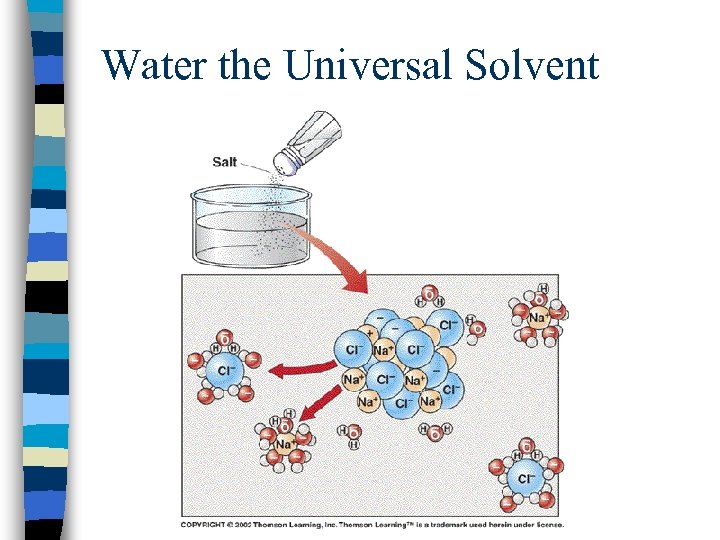
Water the Universal Solvent
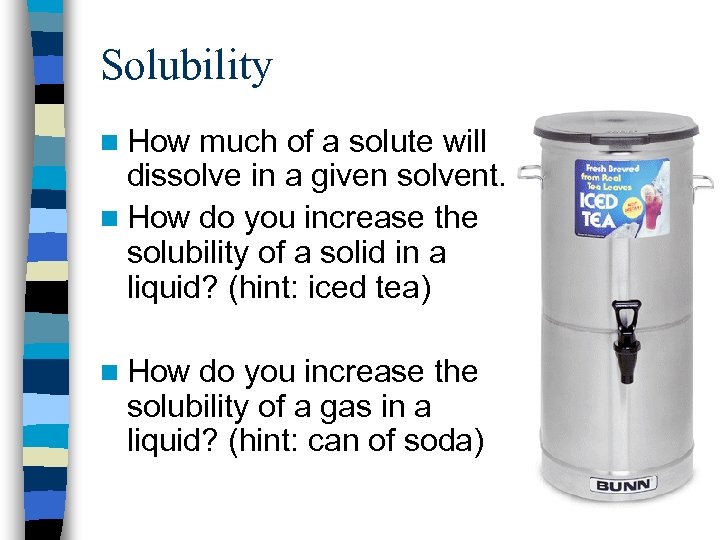
Solubility n How much of a solute will dissolve in a given solvent. n How do you increase the solubility of a solid in a liquid? (hint: iced tea) n How do you increase the solubility of a gas in a liquid? (hint: can of soda)
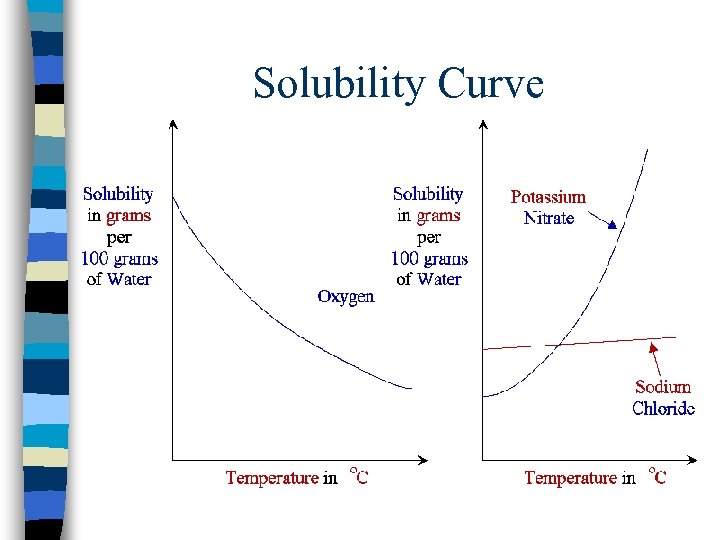
Solubility Curve
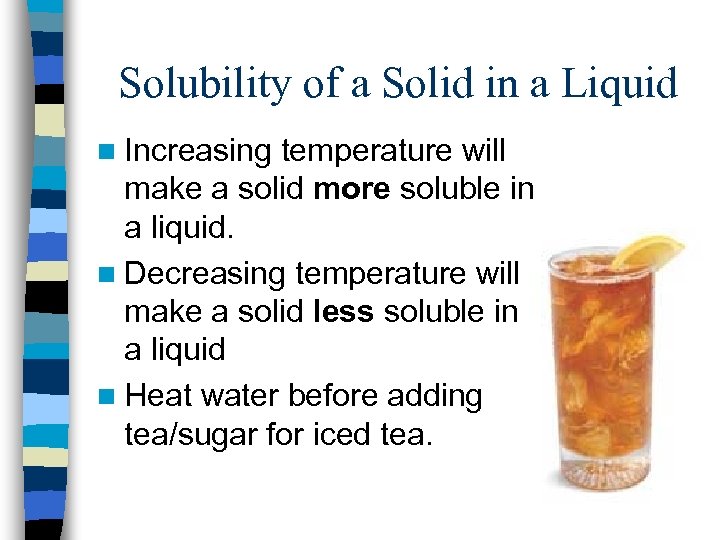
Solubility of a Solid in a Liquid n Increasing temperature will make a solid more soluble in a liquid. n Decreasing temperature will make a solid less soluble in a liquid n Heat water before adding tea/sugar for iced tea.
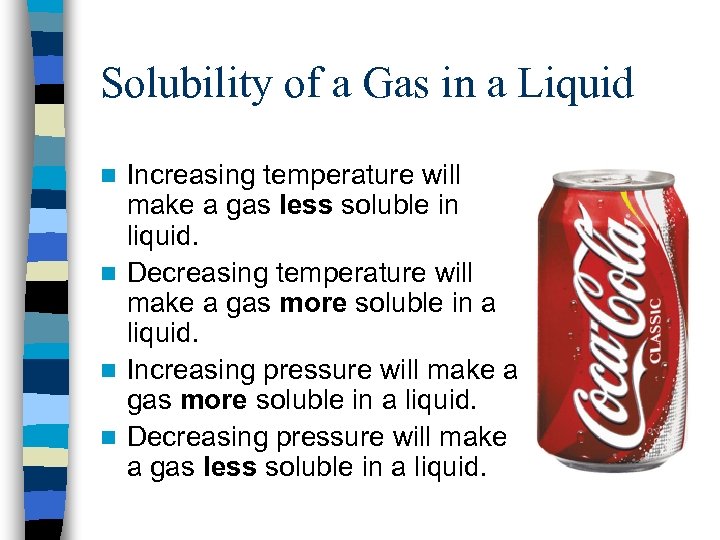
Solubility of a Gas in a Liquid Increasing temperature will make a gas less soluble in liquid. n Decreasing temperature will make a gas more soluble in a liquid. n Increasing pressure will make a gas more soluble in a liquid. n Decreasing pressure will make a gas less soluble in a liquid. n
Types of Solutions n Saturated – Holding the maximum solute at a given temperature. n Unsaturated – Holding less than the maximum solute at a given temperature. n Supersaturated – Holding more than the maximum solute at a given temperature.
Solution Questions n What term is used to describe a substance that is not soluble in another substance, such as oil in water? – Insoluble n A solid substance is dissolved in a liquid. If the solid comes out of solution and settles to the bottom, it is called a _______. – precipitate.
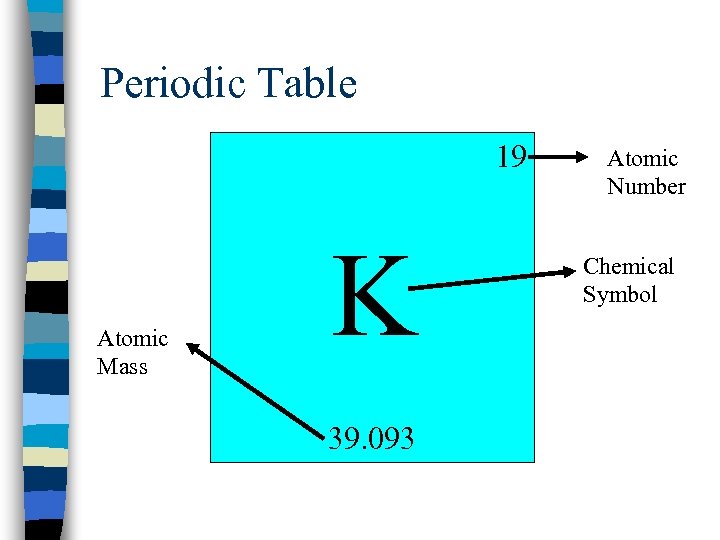
Periodic Table 19 Atomic Mass K 39. 093 Atomic Number Chemical Symbol
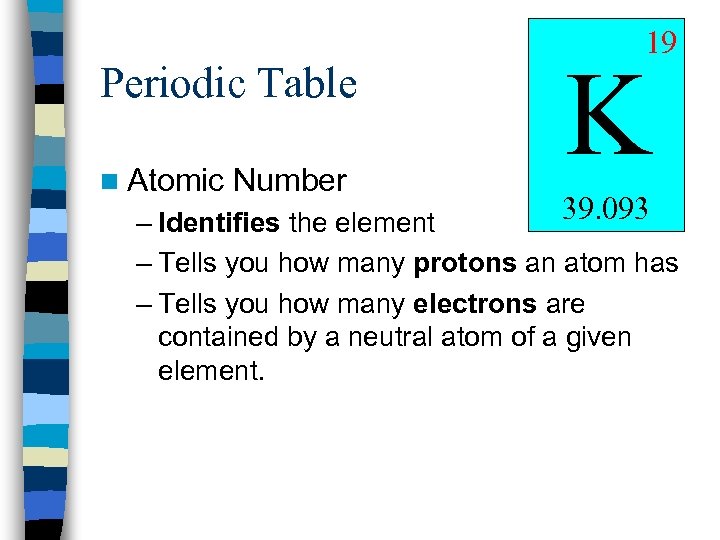
Periodic Table n Atomic Number 19 K 39. 093 – Identifies the element – Tells you how many protons an atom has – Tells you how many electrons are contained by a neutral atom of a given element.
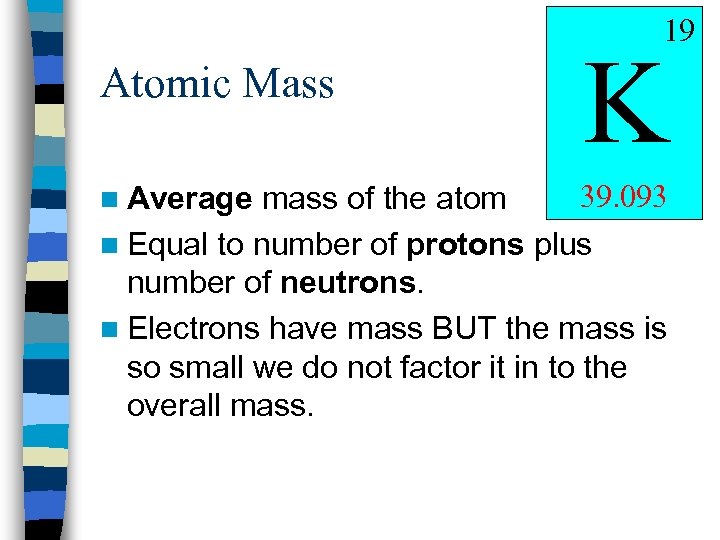
19 Atomic Mass K 39. 093 n Equal to number of protons plus number of neutrons. n Electrons have mass BUT the mass is so small we do not factor it in to the overall mass. n Average mass of the atom
Practice n How many protons and neutrons do the following atoms contain? – Oxygen – Bromine – Carbon-14 – Atomic Number 53 – Atomic Number 10
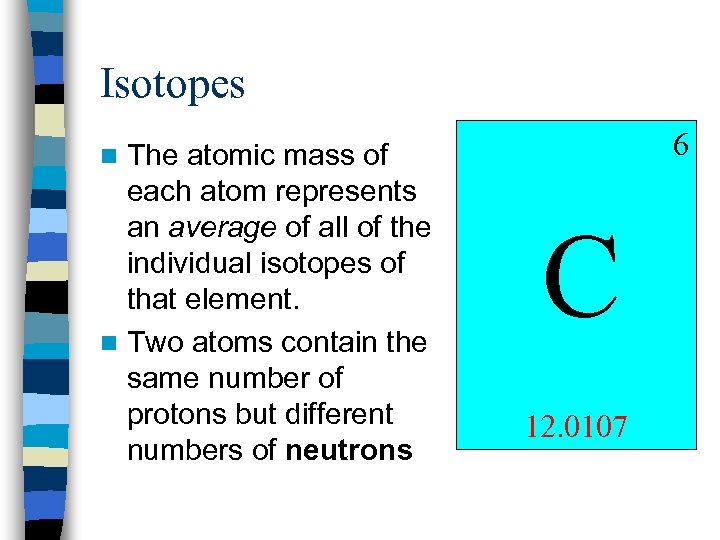
Isotopes The atomic mass of each atom represents an average of all of the individual isotopes of that element. n Two atoms contain the same number of protons but different numbers of neutrons 6 n C 12. 0107
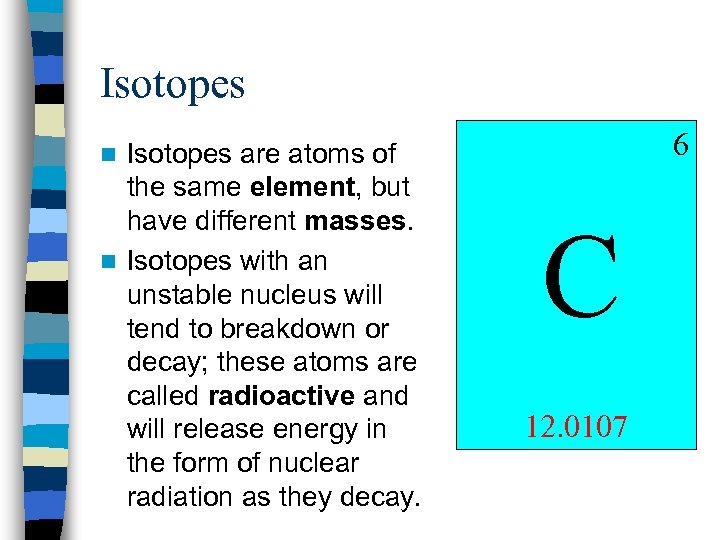
Isotopes are atoms of the same element, but have different masses. n Isotopes with an unstable nucleus will tend to breakdown or decay; these atoms are called radioactive and will release energy in the form of nuclear radiation as they decay. 6 n C 12. 0107
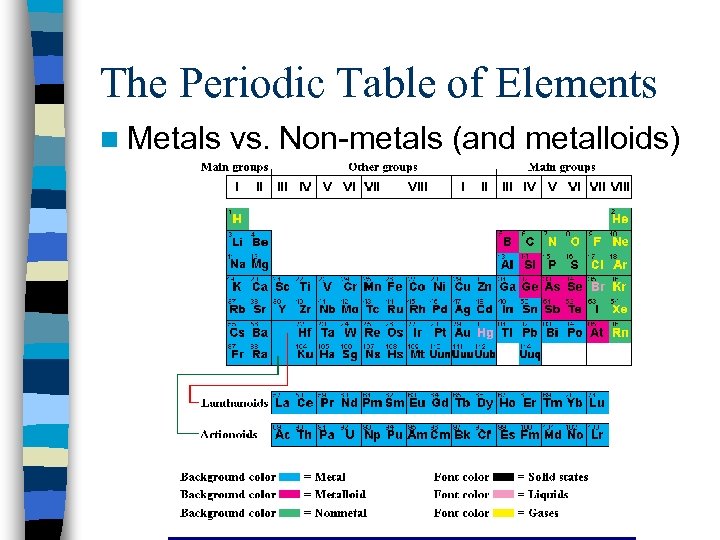
The Periodic Table of Elements n Metals vs. Non-metals (and metalloids)
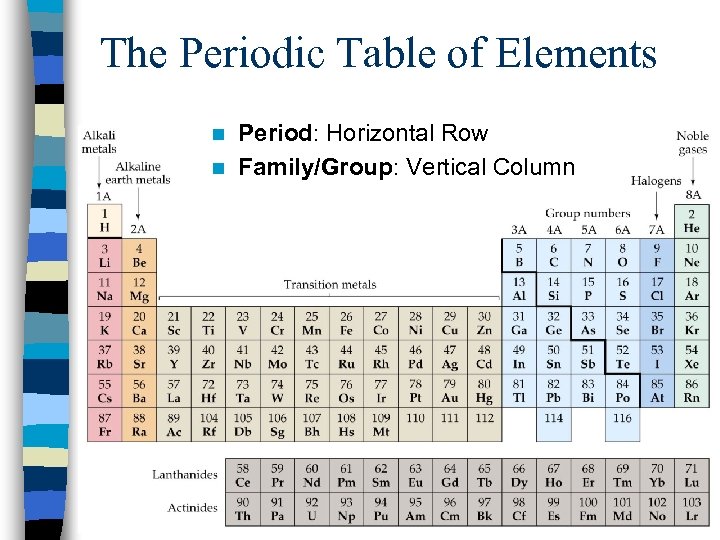
The Periodic Table of Elements Period: Horizontal Row n Family/Group: Vertical Column n
Oxidation States In order to become stable, atoms will gain or lose a certain number of electrons. n The goal is to have a full outer shell (octet rule) n A full outer shell contains eight electrons. n When atoms gain or lose electrons, they become ions and take on a certain charge. n – This charge is referred to as the oxidation number.
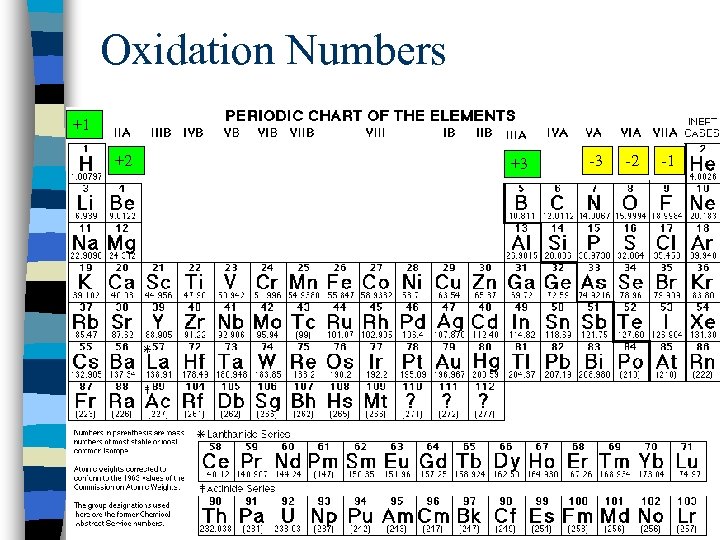
Oxidation Numbers +1 +2 +3 -3 -2 . -1
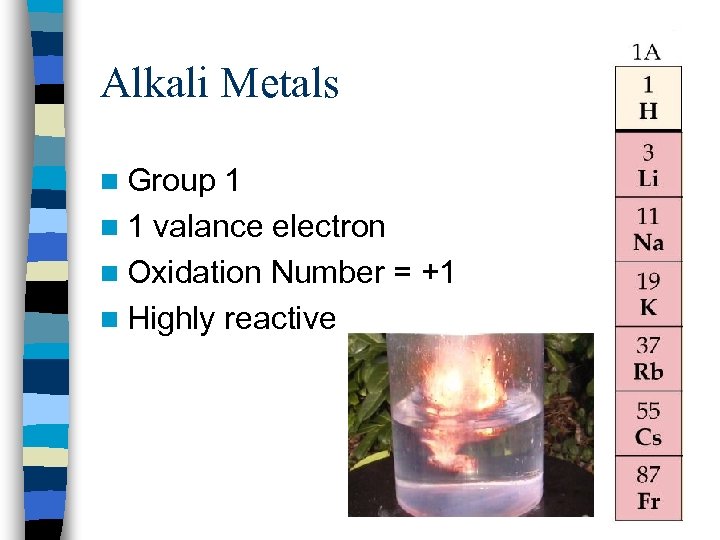
Alkali Metals n Group 1 n 1 valance electron n Oxidation Number = +1 n Highly reactive
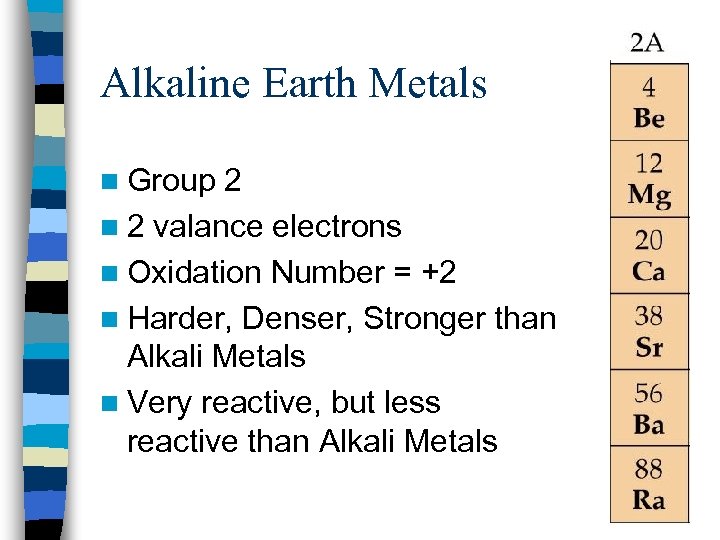
Alkaline Earth Metals n Group 2 n 2 valance electrons n Oxidation Number = +2 n Harder, Denser, Stronger than Alkali Metals n Very reactive, but less reactive than Alkali Metals
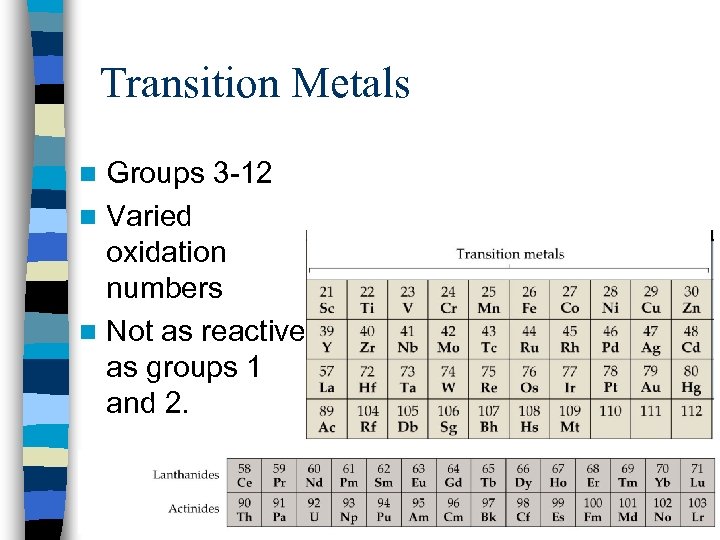
Transition Metals Groups 3 -12 n Varied oxidation numbers n Not as reactive as groups 1 and 2. n
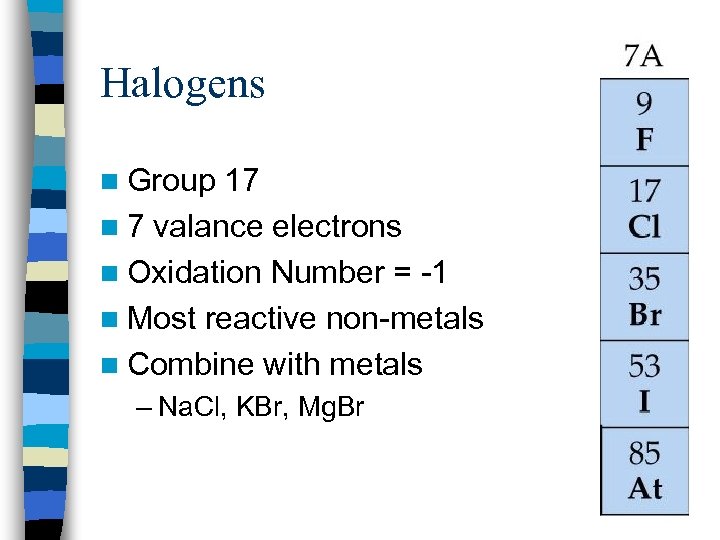
Halogens n Group 17 n 7 valance electrons n Oxidation Number = -1 n Most reactive non-metals n Combine with metals – Na. Cl, KBr, Mg. Br
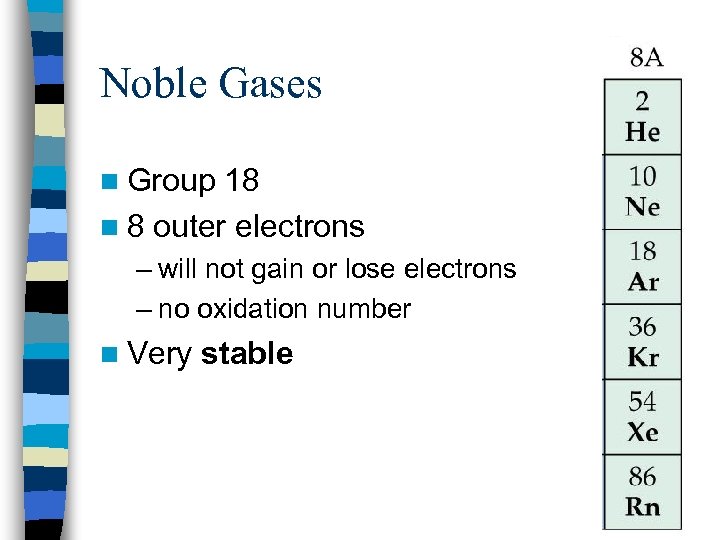
Noble Gases n Group 18 n 8 outer electrons – will not gain or lose electrons – no oxidation number n Very stable
Bonding n When forming compounds, atoms will bond in a way that leads to an overall charge of zero. n Bonding is due to interactions of the electron clouds that surround an atom. n Types of bonds – Ionic – Covalent
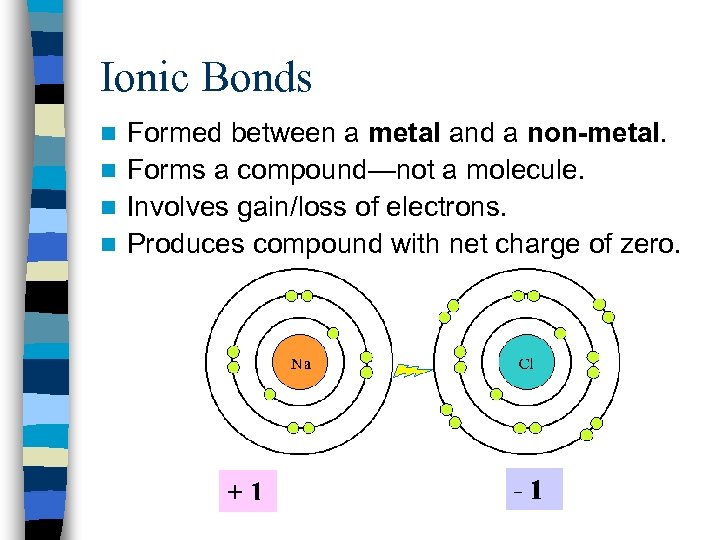
Ionic Bonds Formed between a metal and a non-metal. n Forms a compound—not a molecule. n Involves gain/loss of electrons. n Produces compound with net charge of zero. n
Ionic Bonds n How to predict bonding pattern: – Na + Cl – Ca + Br – Ba + I – Mg + O – Al + O
Covalent Bonds n Involves the sharing of electrons. n Produces a molecule. n Formed between two non-metals n Examples – Water (H 2 O) – Sugar (C 6 H 12 O 6) – Hydrogen gas (H 2) n Diatomic Molecules: – H 2, F 2, Cl 2, Br 2, I 2, N 2, O 2
Bonding Practice What type of bond is produced when electrons are shared between atoms? n What type of bond is produced when atoms with opposite charges are attracted to each other? n What type of bond will be produced when the following atoms combine? n – – C + O Mg + Cl O + O Ba + Br
Periodic Properties n Electron Affinity – The ability of an atom to attract and hold extra electrons. n Electronegativity – The tendency of an atom to attract electrons to itself when combined with another atom. – How might this predict bonding patterns?
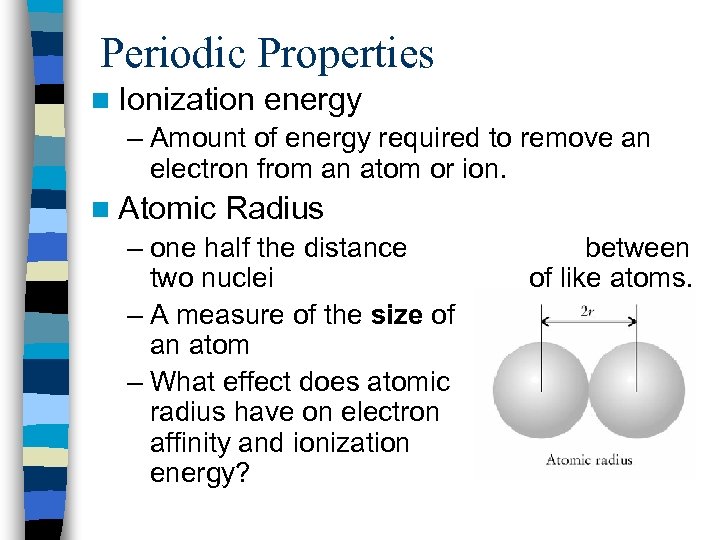
Periodic Properties n Ionization energy – Amount of energy required to remove an electron from an atom or ion. n Atomic Radius – one half the distance between two nuclei of like atoms. – A measure of the size of an atom – What effect does atomic radius have on electron affinity and ionization energy?
Periodic Properties n Reactivity o Metals Increases as you move down a family. Decreases as you move across a period. Francium is most reactive metal. o Nonmetals Decreases as you move down a family. Increases as you move across a period. Fluorine is the most reactive nonmetal.
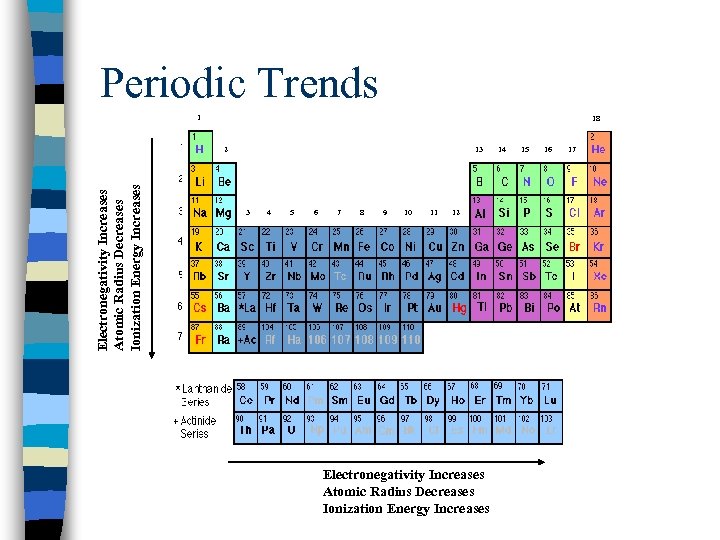
Periodic Trends 1 18 Electronegativity Increases Atomic Radius Decreases Ionization Energy Increases 2 13 3 4 5 6 7 8 9 10 11 12 Electronegativity Increases Atomic Radius Decreases Ionization Energy Increases 14 15 16 17
Periodic Properties Practice n List the following elements from highest to lowest electronegativity: – Al, Ca, Cl – I, Xe, Rb – N, Bi, As – Cs, Li, K
Periodic Properties Practice n List the following elements from largest to smallest atomic radius: – Al, Ca, Cl – I, Xe, Rb – N, Bi, As – Cs, Li, K
Periodic Properties Practice n List the following elements from highest to lowest ionization energy: – Al, Ca, Cl – I, Xe, Rb – N, Bi, As – Cs, Li, K
Chemical Reactions The process by which the atoms of one or more substances are rearranged to form different substances n. Reactant – The starting substance in a chemical reaction. n. Product – The substance formed during a chemical reaction. n. Catalyst – A substance that increases the rate of a chemical reaction by lowering activation energies but is not itself consumed in the reaction.
Chemical Reactions n Chemical Equation – a statement using chemical formulas to describe the identities and relative amounts of the reactants and products involved in the chemical reaction. n Law of Conservation of Matter – Matter is neither created nor destroyed – All chemical reactions should be balanced; the mass of the products should equal the mass of the reactants.
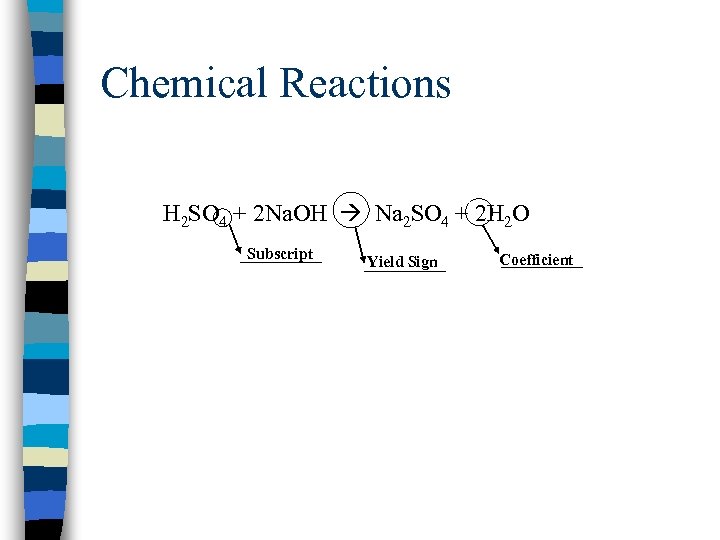
Chemical Reactions H 2 SO 4 + 2 Na. OH Na 2 SO 4 + 2 H 2 O Subscript Yield Sign Coefficient
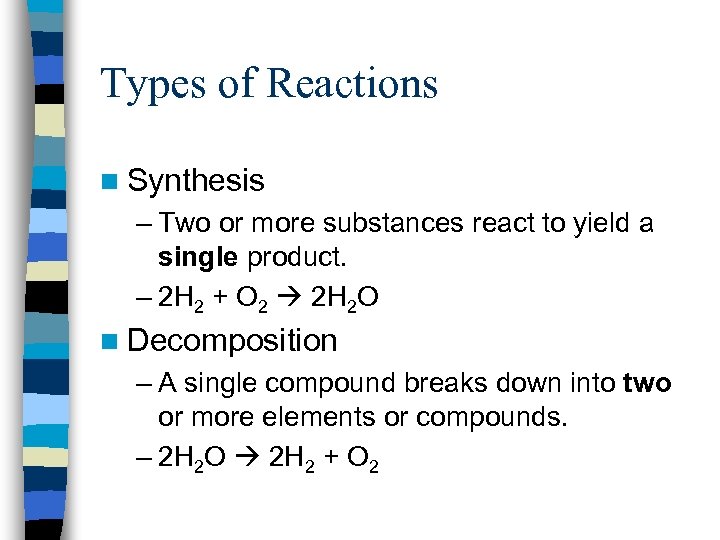
Types of Reactions n Synthesis – Two or more substances react to yield a single product. – 2 H 2 + O 2 2 H 2 O n Decomposition – A single compound breaks down into two or more elements or compounds. – 2 H 2 O 2 H 2 + O 2
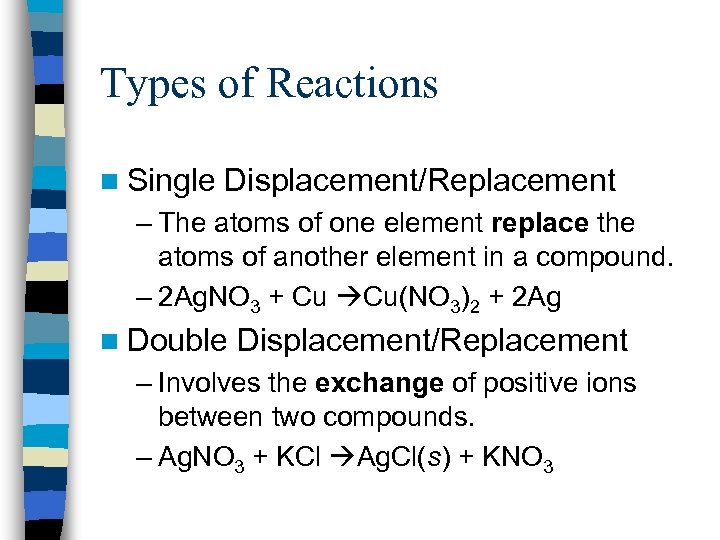
Types of Reactions n Single Displacement/Replacement – The atoms of one element replace the atoms of another element in a compound. – 2 Ag. NO 3 + Cu Cu(NO 3)2 + 2 Ag n Double Displacement/Replacement – Involves the exchange of positive ions between two compounds. – Ag. NO 3 + KCl Ag. Cl(s) + KNO 3
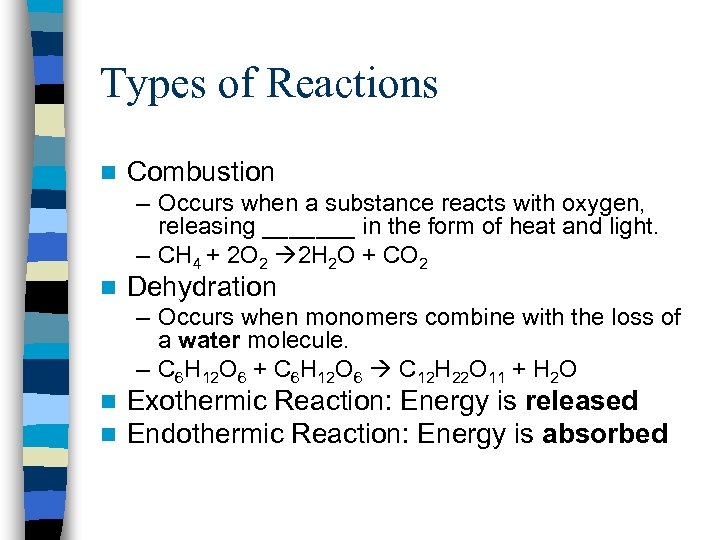
Types of Reactions n Combustion – Occurs when a substance reacts with oxygen, releasing _______ in the form of heat and light. – CH 4 + 2 O 2 2 H 2 O + CO 2 n Dehydration – Occurs when monomers combine with the loss of a water molecule. – C 6 H 12 O 6 + C 6 H 12 O 6 C 12 H 22 O 11 + H 2 O n n Exothermic Reaction: Energy is released Endothermic Reaction: Energy is absorbed
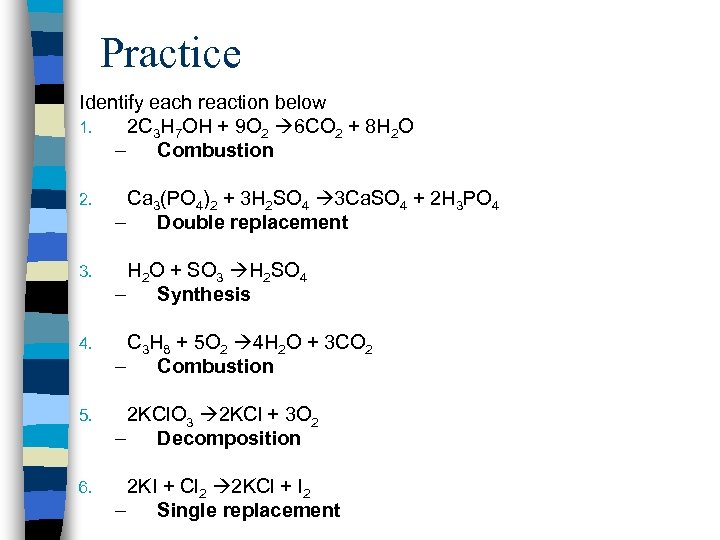
Practice Identify each reaction below 1. 2 C 3 H 7 OH + 9 O 2 6 CO 2 + 8 H 2 O – Combustion 2. Ca 3(PO 4)2 + 3 H 2 SO 4 3 Ca. SO 4 + 2 H 3 PO 4 – Double replacement 3. H 2 O + SO 3 H 2 SO 4 – Synthesis 4. C 3 H 8 + 5 O 2 4 H 2 O + 3 CO 2 – Combustion 5. 2 KCl. O 3 2 KCl + 3 O 2 – Decomposition 6. 2 KI + Cl 2 2 KCl + I 2 – Single replacement
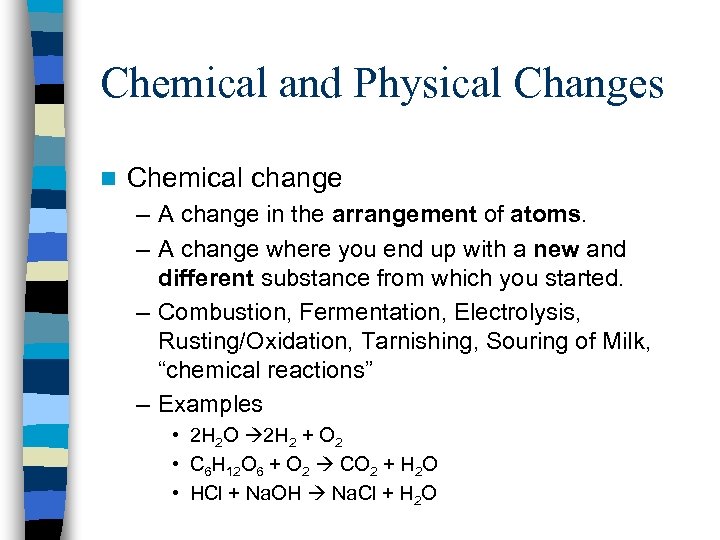
Chemical and Physical Changes n Chemical change – A change in the arrangement of atoms. – A change where you end up with a new and different substance from which you started. – Combustion, Fermentation, Electrolysis, Rusting/Oxidation, Tarnishing, Souring of Milk, “chemical reactions” – Examples • 2 H 2 O 2 H 2 + O 2 • C 6 H 12 O 6 + O 2 CO 2 + H 2 O • HCl + Na. OH Na. Cl + H 2 O
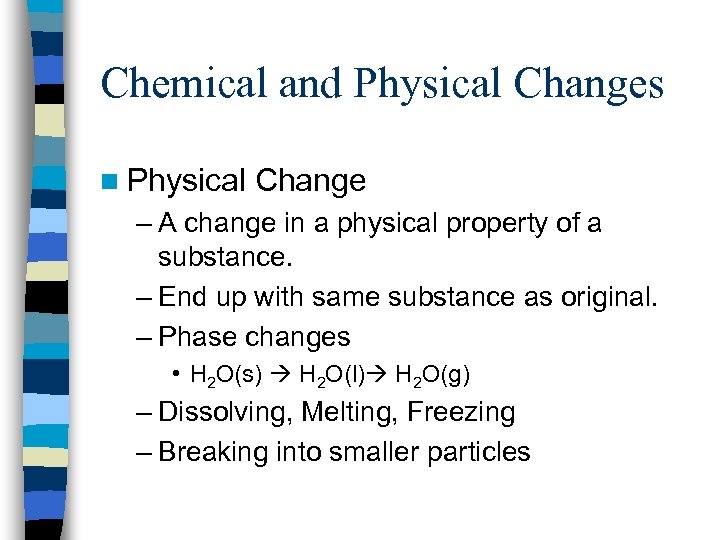
Chemical and Physical Changes n Physical Change – A change in a physical property of a substance. – End up with same substance as original. – Phase changes • H 2 O(s) H 2 O(l) H 2 O(g) – Dissolving, Melting, Freezing – Breaking into smaller particles
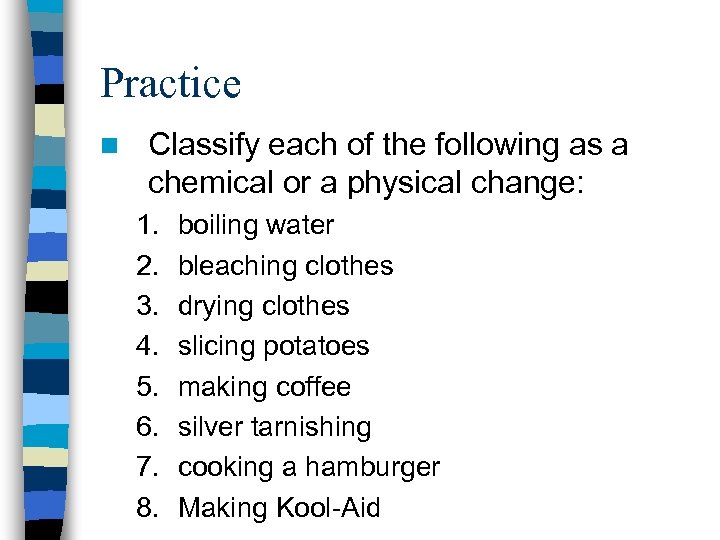
Practice n Classify each of the following as a chemical or a physical change: 1. 2. 3. 4. 5. 6. 7. 8. boiling water bleaching clothes drying clothes slicing potatoes making coffee silver tarnishing cooking a hamburger Making Kool-Aid
Acids and Bases n Acid – Forms H+ when dissolved in water. – Acidic solutions have more H+ than OH-. – p. H less than 7 – Examples • • • HCl Lemon juice Vinegar H 2 SO 4 Stomach Acid
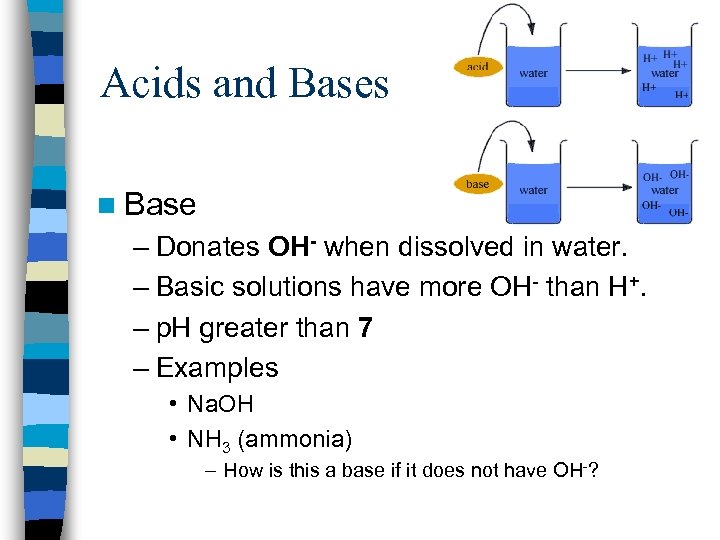
Acids and Bases n Base – Donates OH- when dissolved in water. – Basic solutions have more OH- than H+. – p. H greater than 7 – Examples • Na. OH • NH 3 (ammonia) – How is this a base if it does not have OH-?
![Examples of Acids and Bases [H+] p. H Example 1 X 100 0 HCl](https://present5.com/presentation/786f53f8f77d8e016363e8e164630f04/image-67.jpg "Examples of Acids and Bases [H+] p. H Example 1 X 100 0 HCl")
Examples of Acids and Bases [H+] p. H Example 1 X 100 0 HCl 1 x 10 -1 1 Stomach acid 1 x 10 -2 2 Lemon juice 1 x 10 -3 3 Vinegar 1 x 10 -4 4 Soda 1 x 10 -5 5 Rainwater 1 x 10 -6 6 Milk Neutral 1 x 10 -7 7 Pure water Bases 1 x 10 -8 8 Egg whites 1 x 10 -9 9 Baking Soda 1 x 10 -10 10 Tums® antacid 1 x 10 -11 11 Ammonia 1 x 10 -12 12 Mineral Lime - Ca(OH)2 1 x 10 -13 13 Drano® 1 x 10 -14 14 Na. OH Acids
Acid and Base Terms n Neutralization: an acid reacts with a base to produce a neutral solution. – Produces a salt and water – HCl + Na. OH Na. Cl + H 2 O
Acid and Base Terms Hydrogen ion: H+ n Hydroxide ion: OHn Indicator: a compound that changes color in the presence of an acid or base. n – Phenolpthalein – Litmus paper: red (acid), blue (base) n p. H: a measure of the hydronium (hydrogen) ion concentration in a solution.
Acid Rain n Normal Rain is slightly acidic due to reaction of water with dissolved CO 2 n Pollutants such as sulfur oxides and nitrogen oxides decrease the p. H further. n Rain with a p. H less than 5. 5 is considered acid rain. n How would acid rain affect plants? n How would acid rain affect buildings and monuments?
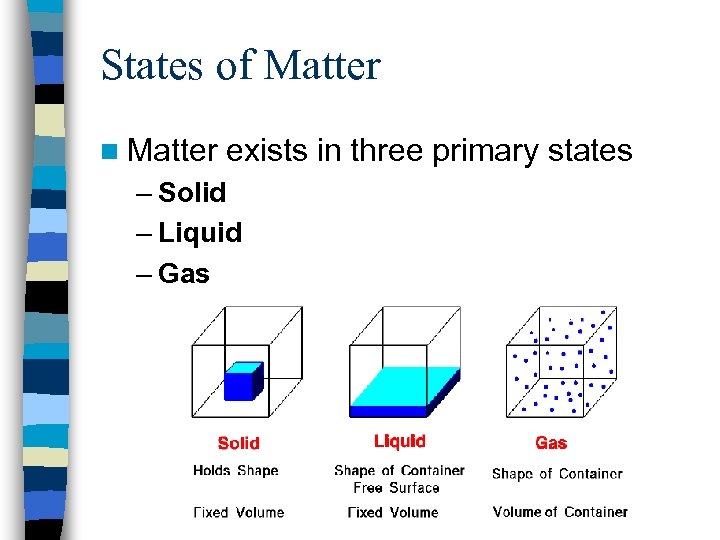
States of Matter n Matter exists in three primary states – Solid – Liquid – Gas
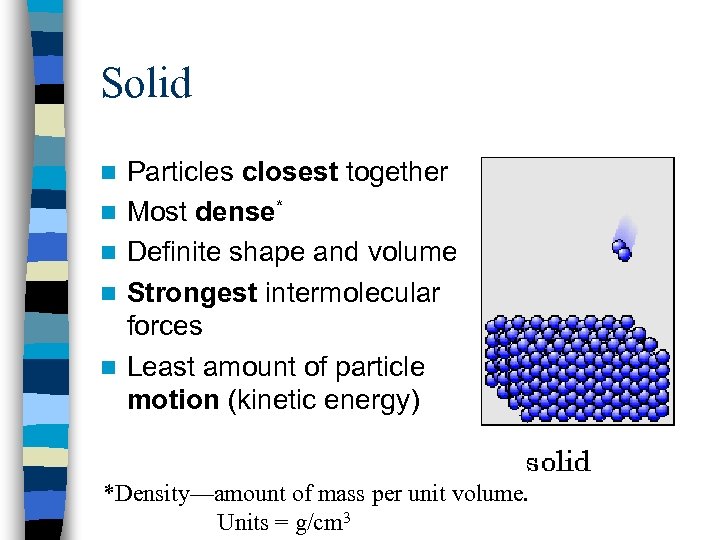
Solid n n n Particles closest together Most dense* Definite shape and volume Strongest intermolecular forces Least amount of particle motion (kinetic energy) *Density—amount of mass per unit volume. Units = g/cm 3
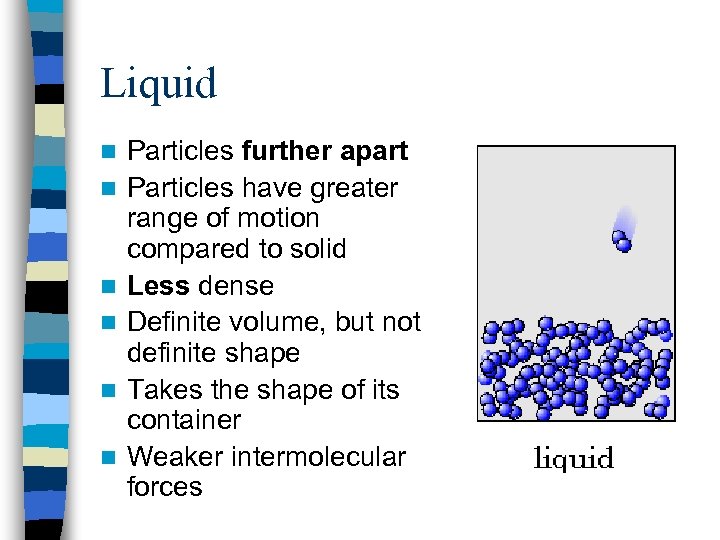
Liquid n n n Particles further apart Particles have greater range of motion compared to solid Less dense Definite volume, but not definite shape Takes the shape of its container Weaker intermolecular forces
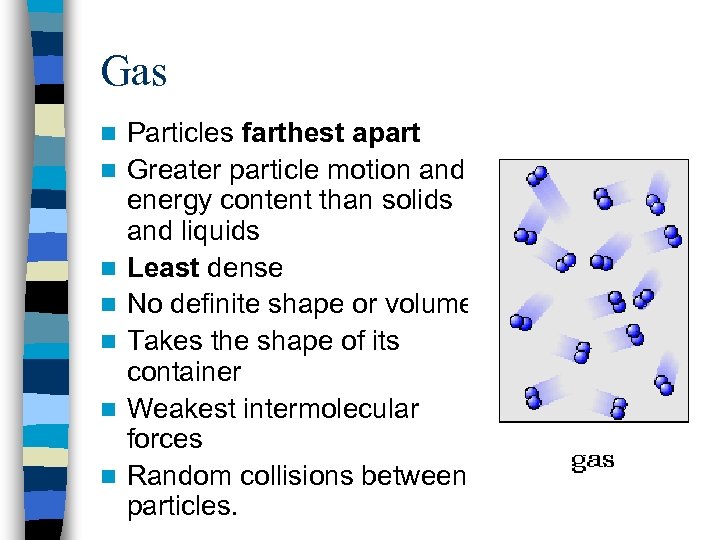
Gas n n n n Particles farthest apart Greater particle motion and energy content than solids and liquids Least dense No definite shape or volume. Takes the shape of its container Weakest intermolecular forces Random collisions between particles.
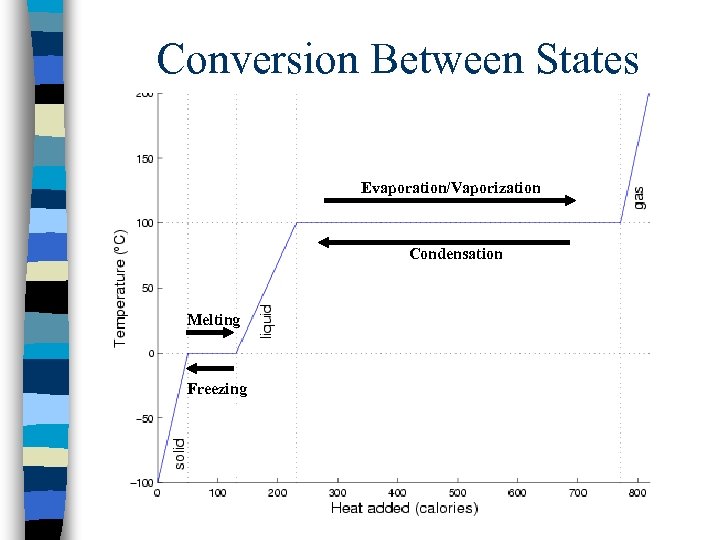
Conversion Between States Evaporation/Vaporization Condensation Melting Freezing
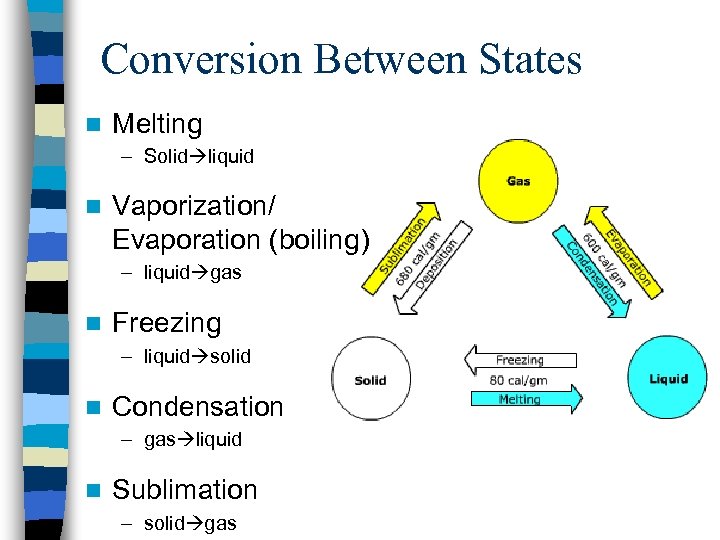
Conversion Between States n Melting – Solid liquid n Vaporization/ Evaporation (boiling) – liquid gas n Freezing – liquid solid n Condensation – gas liquid n Sublimation – solid gas
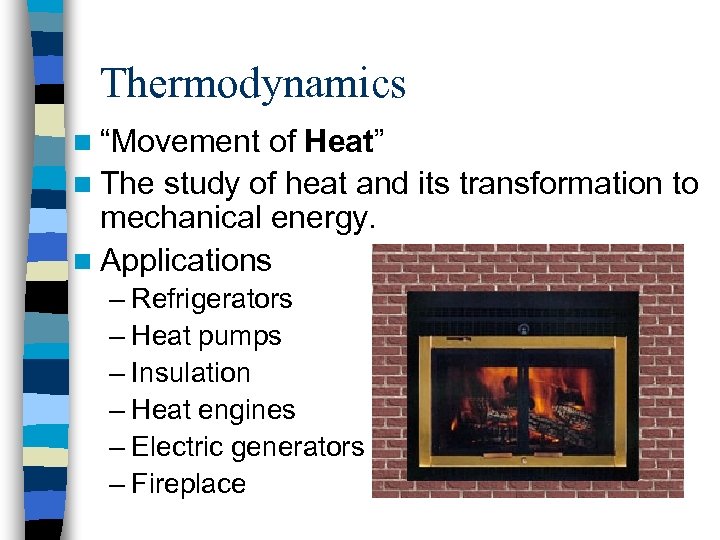
Thermodynamics n “Movement of Heat” n The study of heat and its transformation to mechanical energy. n Applications – Refrigerators – Heat pumps – Insulation – Heat engines – Electric generators – Fireplace
Temperature n Tells us how warm or cold an object is relative to some standard. n A measure of the average kinetic energy of a substance. n Temperature is measured using a thermometer. – How does a thermometer work?
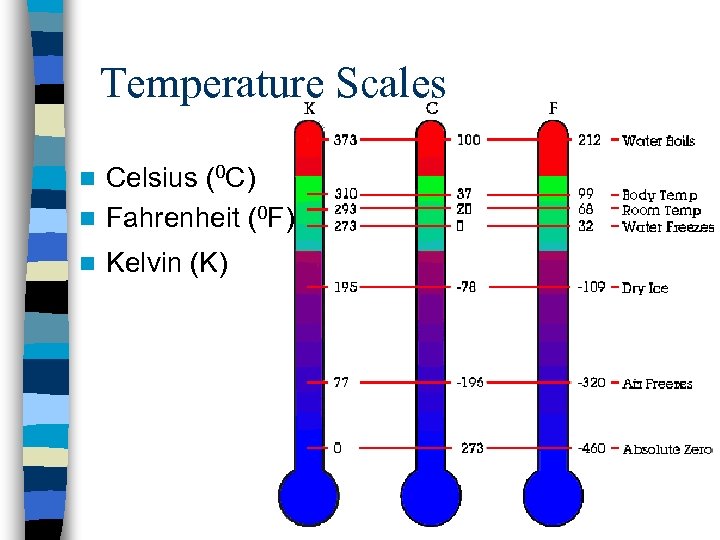
Temperature Scales Celsius (0 C) n Fahrenheit (0 F) n n Kelvin (K)
Important Temperatures n Absolute Zero – 0 K n -Freezing Point H 2 O – 0 0 C – 320 F n Boiling Point H 2 O – 1000 C – 2120 F
What Causes Temperature? n Kinetic-Molecular Theory – Matter made up of tiny particles that are always in motion. – As the particles gain energy, they move faster. – Faster moving particles have greater average kinetic energy. – The more kinetic energy particles have, the greater the temperature of the object or substance.
Скачать презентацию Chemistry Content Review Periodic Table of the Elements
786f53f8f77d8e016363e8e164630f04.ppt