


 Скачать презентацию Chemistry 125 Lecture 39 January 13 2010 Reaction
64ea04becc85c131a18b90940c383dd6.ppt
- Количество слайдов: 29
 Chemistry 125: Lecture 39 January 13, 2010 Reaction Order Information, Understanding Changes in Bond Dissociation Energies, and Predicting Rate Constants This For copyright notice see final page of this file
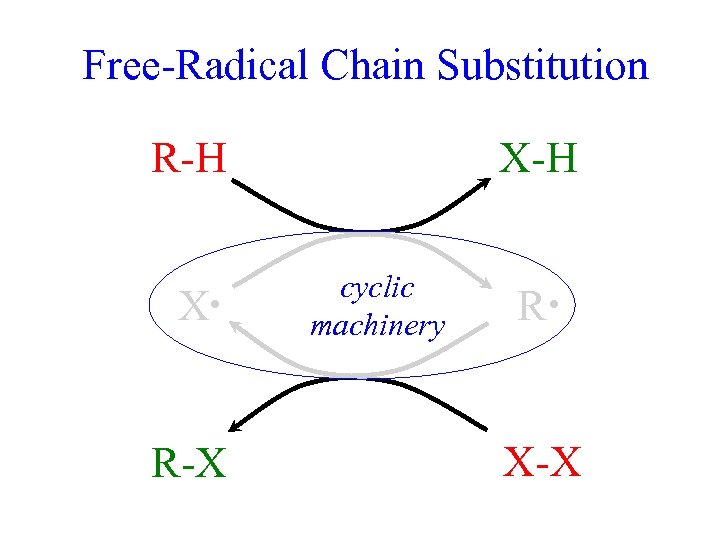 Free-Radical Chain Substitution R-H X • R-X X-H cyclic machinery R • X-X
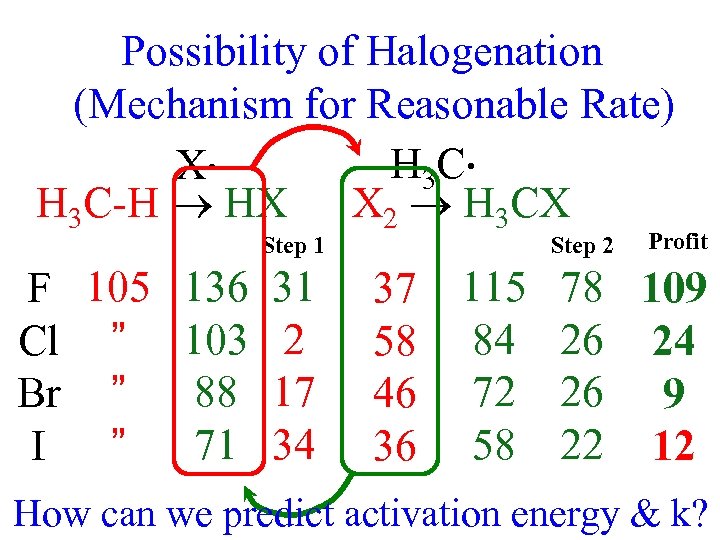 Possibility of Halogenation (Mechanism for Reasonable Rate) (Equilibrium) H 3 C • X • H 3 C-H + X 2 HX H 3 CX HX X 2 + 3 Cost Step 1 F 105 136 142 136 37 31 37 Cl ” 103 163 103 58 2 58 88 151 46 Br ” 46 17 88 71 141 36 I ” 36 34 71 Return Step 2 115 84 72 58 Profit 78 251 26 187 26 160 22 129 109 24 9 12 How can we predict activation energy & k?
 Digression: on Reaction Order The kinetic analogue of the Law of Mass Action (i. e. dependance of rate on concentrations) can provide insight about reaction mechanism.
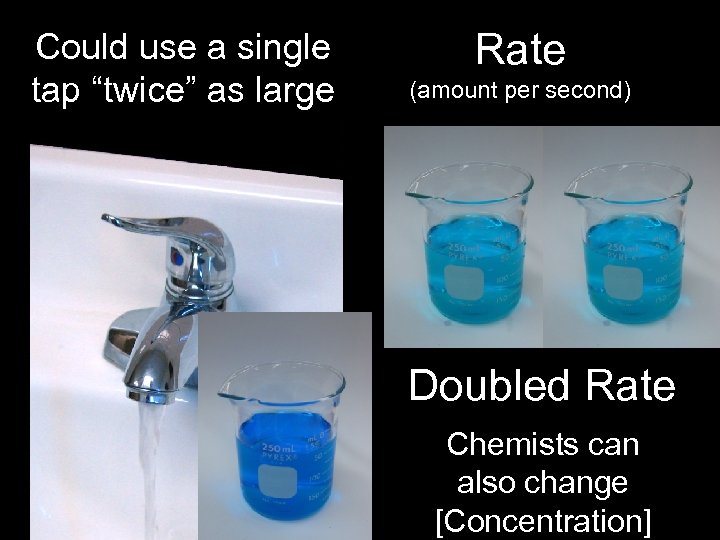 Could use a single tap “twice” as large Rate (amount per second) Doubled Rate Chemists can also change [Concentration]
![Rate “Laws”: Kinetic Order Rate = d [Prod] / d t = k concentration(s)?](https://present5.com/presentation/64ea04becc85c131a18b90940c383dd6/image-6.jpg "Rate “Laws”: Kinetic Order Rate = d [Prod] / d t = k concentration(s)?") Rate “Laws”: Kinetic Order Rate = d [Prod] / d t = k concentration(s)? Dependent on Mechanism Discovered by Experiment Simple One-Step Reactions 0 th Order: Rate = k
Rate “Laws”: Kinetic Order Rate = d [Prod] / d t = k concentration(s)? Dependent on Mechanism Discovered by Experiment Simple One-Step Reactions 0 th Order: Rate = k
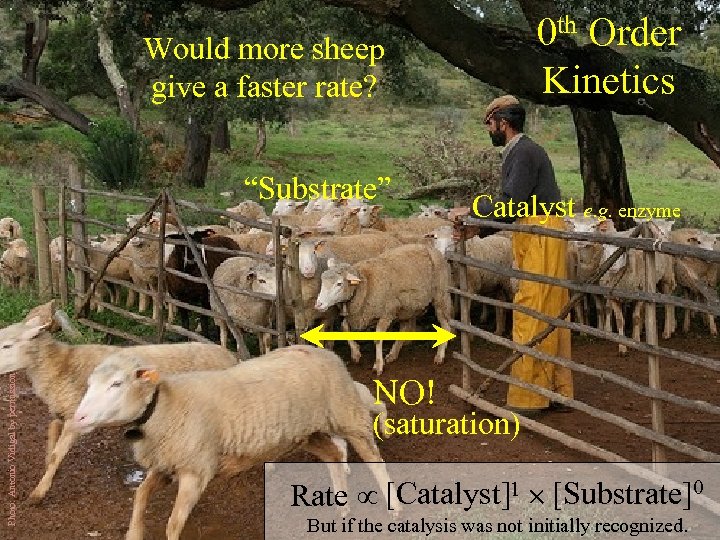 0 th Order Kinetics Would more sheep give a faster rate? Photo: Antonio Vidigal by permission “Substrate” Catalyst e. g. enzyme NO! (saturation) Rate [Catalyst]1 [Substrate]0 But if the catalysis was not initially recognized.
![Rate “Laws”: Kinetic Order Rate = d [Prod] / d t = k concentration(s)?](https://present5.com/presentation/64ea04becc85c131a18b90940c383dd6/image-8.jpg "Rate “Laws”: Kinetic Order Rate = d [Prod] / d t = k concentration(s)?") Rate “Laws”: Kinetic Order Rate = d [Prod] / d t = k concentration(s)? Dependent on Mechanism Discovered by Experiment Simple One-Step Reactions 0 th Order: Rate = k 1 st Order: Rate = k [A] (Reasonable)
Rate “Laws”: Kinetic Order Rate = d [Prod] / d t = k concentration(s)? Dependent on Mechanism Discovered by Experiment Simple One-Step Reactions 0 th Order: Rate = k 1 st Order: Rate = k [A] (Reasonable)
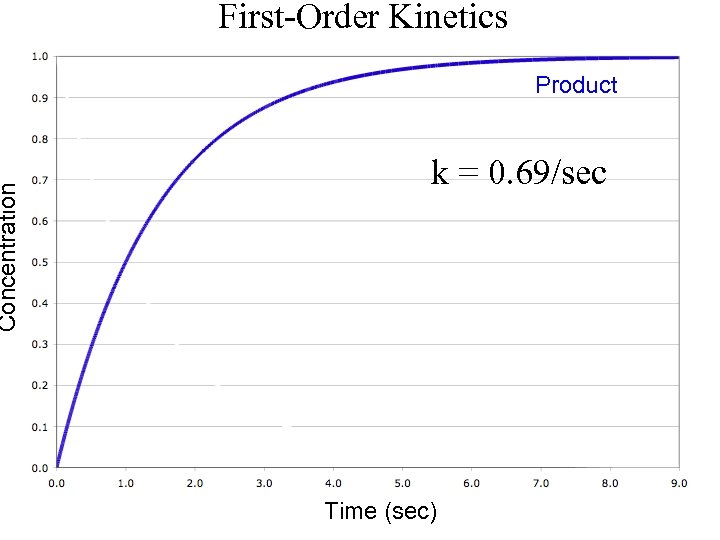 Concentration First-Order Kinetics Product k = 0. 69/sec Time (sec)
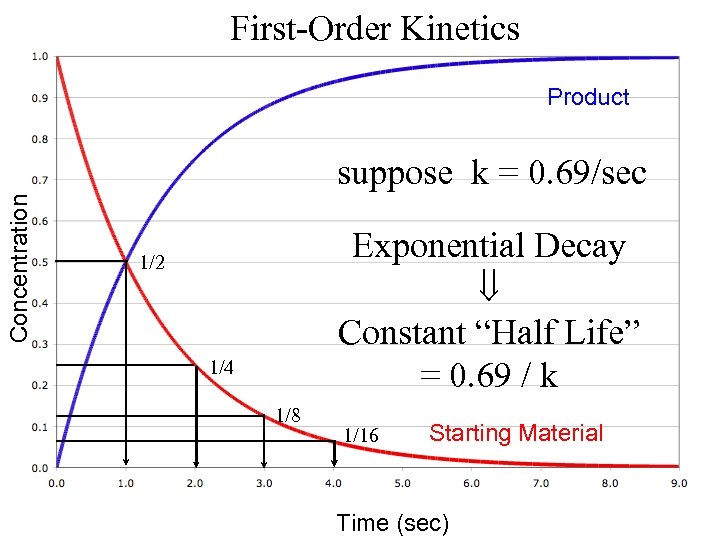 First-Order Kinetics Product Concentration suppose k = 0. 69/sec Exponential Decay Constant “Half Life” = 0. 69 / k 1/2 1/4 1/8 1/16 Starting Material Time (sec)
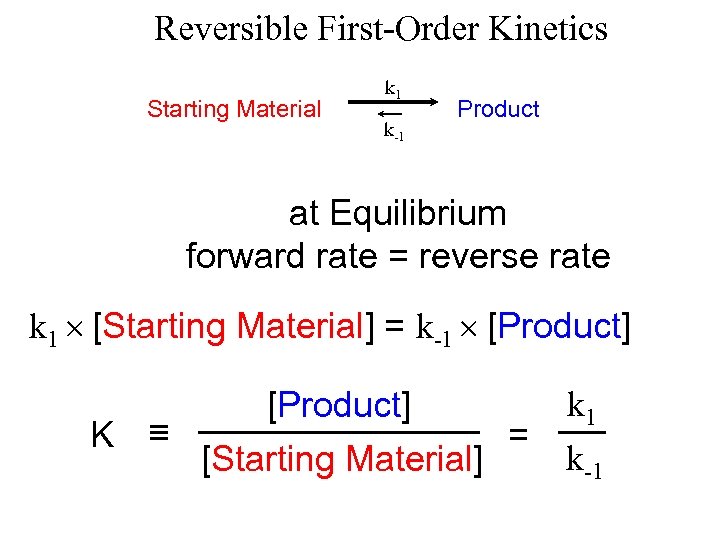 Reversible First-Order Kinetics Starting Material k 1 k-1 Product at Equilibrium forward rate = reverse rate k 1 [Starting Material] = k-1 [Product] K [Product] = [Starting Material] k 1 k-1
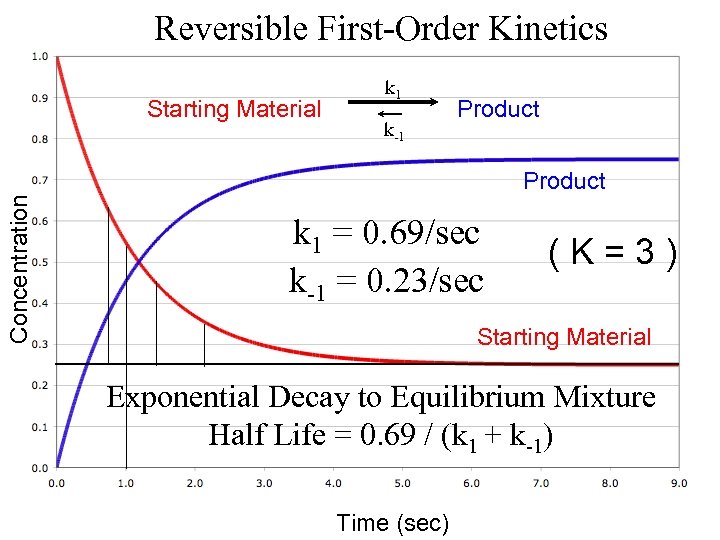 Reversible First-Order Kinetics Starting Material k 1 k-1 Product Concentration Product k 1 = 0. 69/sec k-1 = 0. 23/sec ( K = 3 ) Starting Material Exponential Decay to Equilibrium Mixture Half Life = 0. 69 / (k 1 + k-1) Time (sec)
![Rate Laws: Kinetic Order Rate = d [Prod] / d t = k concentration(s)?](https://present5.com/presentation/64ea04becc85c131a18b90940c383dd6/image-13.jpg "Rate Laws: Kinetic Order Rate = d [Prod] / d t = k concentration(s)?") Rate Laws: Kinetic Order Rate = d [Prod] / d t = k concentration(s)? Dependent on Mechanism Discovered by Experiment Simple One-Step Reactions 0 th Order: Rate = k 1 st Order: Rate = k [A] [B] a catalyst or [B] >> [A] 2 nd Order: Rate = k [A]2 or Rate = k [A] [B] “ 1 st Order in A” k If [B] is (effectively) constant “Pseudo” 1 st Order
Rate Laws: Kinetic Order Rate = d [Prod] / d t = k concentration(s)? Dependent on Mechanism Discovered by Experiment Simple One-Step Reactions 0 th Order: Rate = k 1 st Order: Rate = k [A] [B] a catalyst or [B] >> [A] 2 nd Order: Rate = k [A]2 or Rate = k [A] [B] “ 1 st Order in A” k If [B] is (effectively) constant “Pseudo” 1 st Order
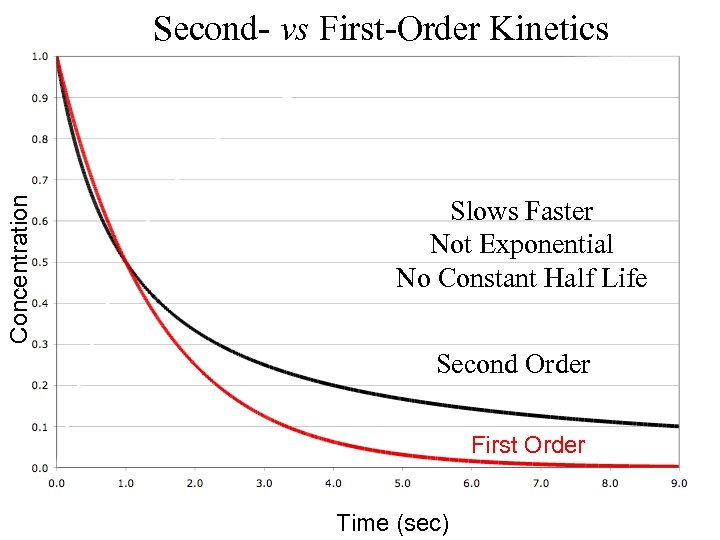 Concentration Second- vs First-Order Kinetics Slows Faster Not Exponential No Constant Half Life Second Order First Order Time (sec)
![Rate Laws: Kinetic Order Rate = d [Prod] / d t = k concentration(s)?](https://present5.com/presentation/64ea04becc85c131a18b90940c383dd6/image-15.jpg "Rate Laws: Kinetic Order Rate = d [Prod] / d t = k concentration(s)?") Rate Laws: Kinetic Order Rate = d [Prod] / d t = k concentration(s)? Dependent on Mechanism Discovered by Experiment Complex Reactions The Rate-Limiting Step Who Cares? Rapid pre“equilibrium” with starting material reactive intermediate (low concentration)
Rate Laws: Kinetic Order Rate = d [Prod] / d t = k concentration(s)? Dependent on Mechanism Discovered by Experiment Complex Reactions The Rate-Limiting Step Who Cares? Rapid pre“equilibrium” with starting material reactive intermediate (low concentration)
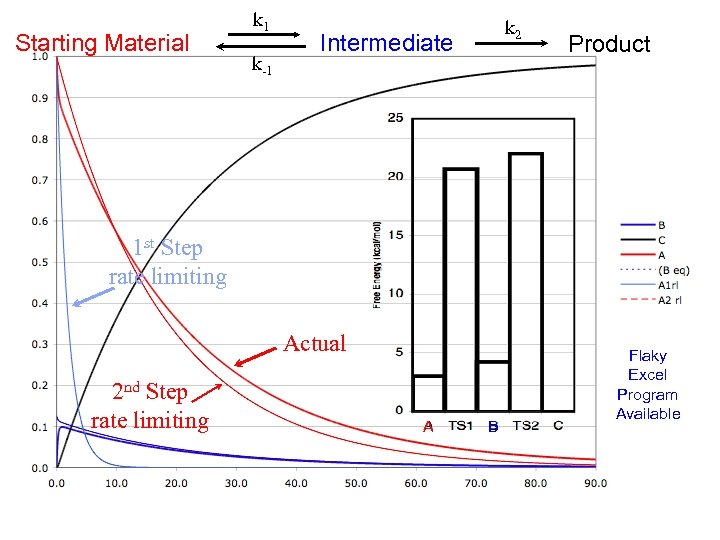 Starting Material k 1 k-1 k 2 Intermediate Product 1 st Step rate limiting Actual 2 nd Step rate limiting A B Flaky Excel Program Available
![Rate Laws: Kinetic Order Rate = d [Prod] / d t = k concentration(s)?](https://present5.com/presentation/64ea04becc85c131a18b90940c383dd6/image-17.jpg "Rate Laws: Kinetic Order Rate = d [Prod] / d t = k concentration(s)?") Rate Laws: Kinetic Order Rate = d [Prod] / d t = k concentration(s)? Dependent on Mechanism Discovered by Experiment Complex Reactions The Rate-Limiting Step Fractional Order Importance of e. g. Rate = k [A] [B]1/4 “Dominant” species B 4 dominant / B reactive in B 4 4 B [dominant species] quantity added (how much you think you have) Others follow Law of Mass Action.
Rate Laws: Kinetic Order Rate = d [Prod] / d t = k concentration(s)? Dependent on Mechanism Discovered by Experiment Complex Reactions The Rate-Limiting Step Fractional Order Importance of e. g. Rate = k [A] [B]1/4 “Dominant” species B 4 dominant / B reactive in B 4 4 B [dominant species] quantity added (how much you think you have) Others follow Law of Mass Action.
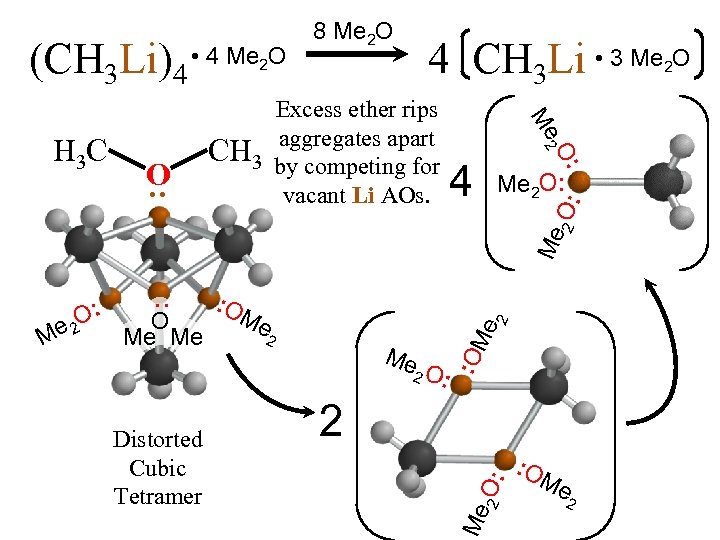 4 CH 3 Li • 3 Me O 2 Me 2 O: Me 4 O: 2 : O O Me : H 3 C Excess ether rips aggregates apart CH 3 by competing for vacant Li AOs. : 2 2 O: (CH 3 Li)4 • 4 Me O 8 Me 2 O 2 Me 2 O: Distorted Cubic Tetramer Me 2 2 O: O Me Me : O M e 2 Me O: : O Me 2
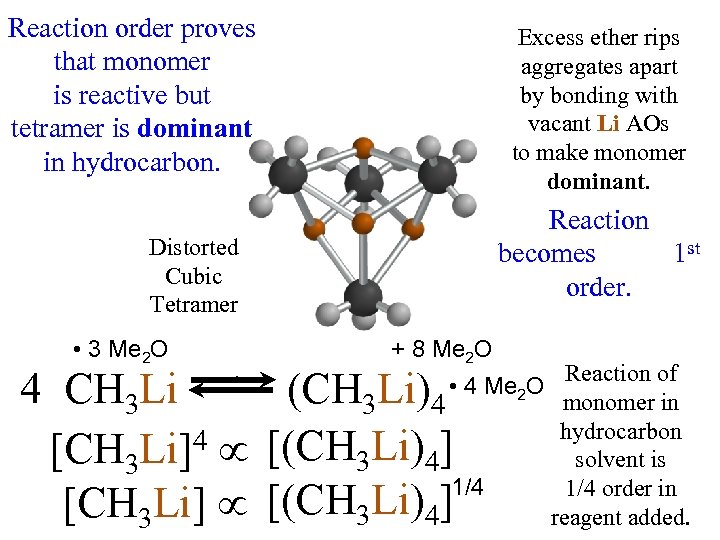 Reaction order proves that monomer is reactive but tetramer is dominant in hydrocarbon. Excess ether rips aggregates apart by bonding with vacant Li AOs to make monomer dominant. Reaction becomes 1 st order. Distorted Cubic Tetramer • 3 Me 2 O 4 CH 3 Li [CH 3 Li]4 K = [CH 3 Li] + 8 Me 2 O (CH 3 Li)4 [(CH 3 Li)4] 1/4 [(CH 3 Li)4] [CH 3 Li]4 • 4 Me 2 O Reaction of monomer in hydrocarbon solvent is 1/4 order in reagent added.
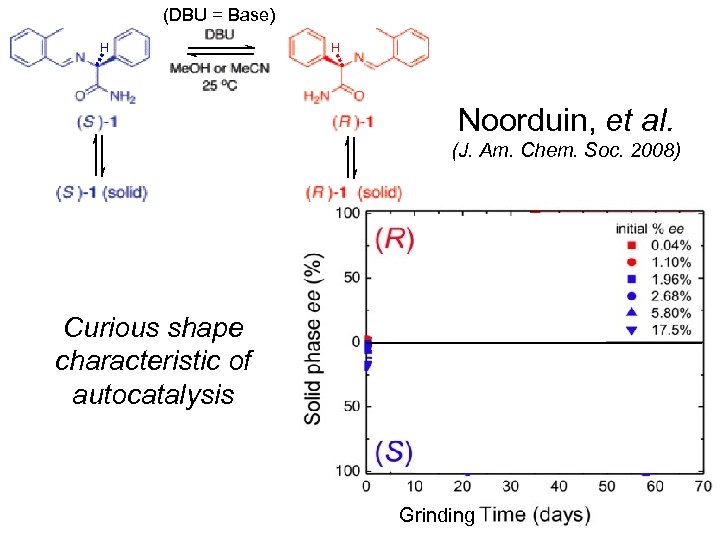 (DBU = Base) H H Noorduin, et al. (J. Am. Chem. Soc. 2008) Curious shape characteristic of autocatalysis Grinding
 Back to Bond Dissociation Energies for Predicting Rate Constants Free-Radical Substitution for Simplicity [minimal solvent influence]
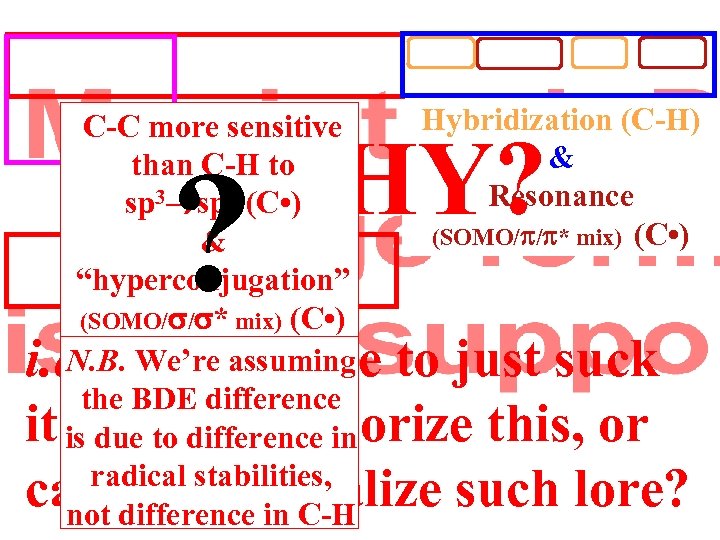 Ellison II Hybridization (C-H) C-C more sensitive than C-H to Overlap (C-X) sp 3 sp 2 (C • ) && E-Match (C-X) “hyperconjugation” (SOMO/ / * mix) (C • ) N. B. We’re assuming the BDE difference is due to difference in radical stabilities, not difference in C-H WHY? ? & Resonance (SOMO/ / * mix) (C • ) i. e. Do we have to just suck it up and memorize this, or can we rationalize such lore?
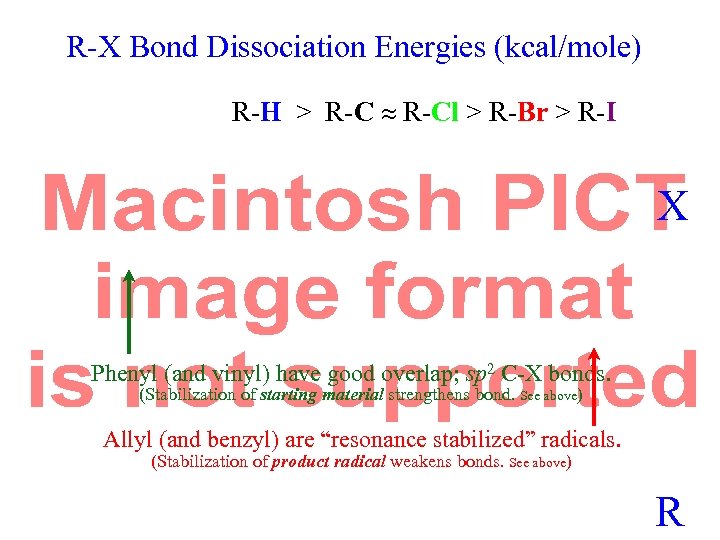 R-X Bond Dissociation Energies (kcal/mole) R-H > R-Cl > R-Br > R-I X Phenyl (and vinyl) have good overlap; sp 2 C-X bonds. (Stabilization of starting material strengthens bond. See above) Allyl (and benzyl) are “resonance stabilized” radicals. (Stabilization of product radical weakens bonds. See above) R
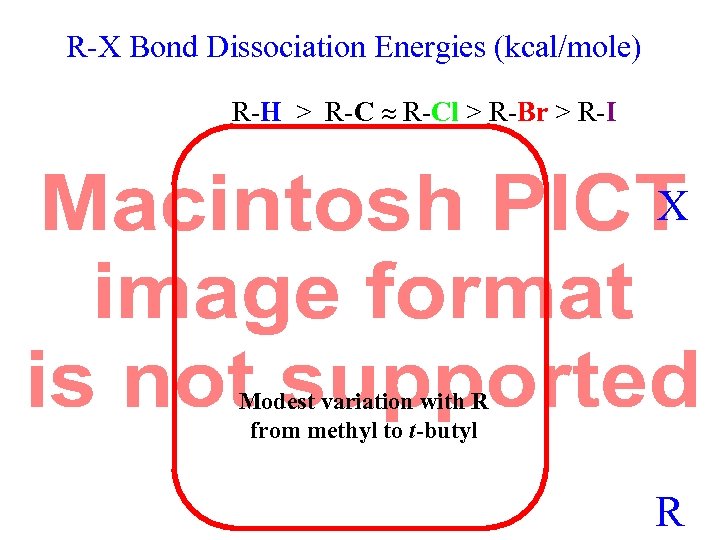 R-X Bond Dissociation Energies (kcal/mole) R-H > R-Cl > R-Br > R-I X Modest variation with R from methyl to t-butyl R
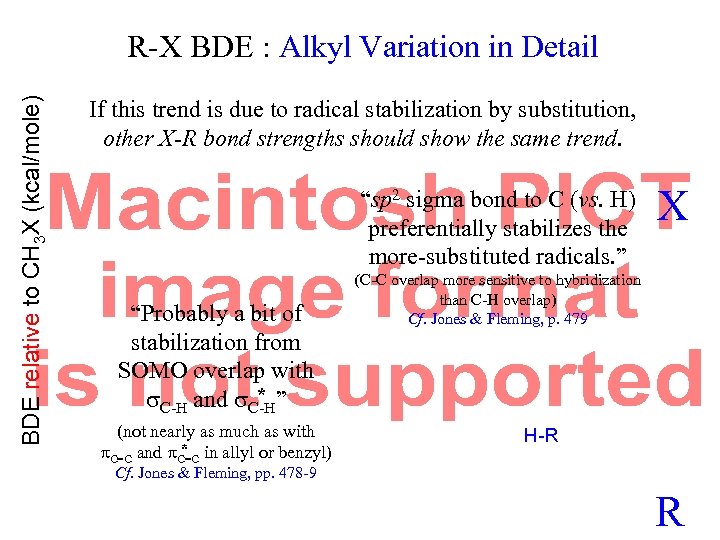 BDE relative to CH 3 X (kcal/mole) R-X BDE : Alkyl Variation in Detail If this trend is due to radical stabilization by substitution, other X-R bond strengths should show the same trend. “sp 2 sigma bond to C (vs. H) preferentially stabilizes the more-substituted radicals. ” “Probably a bit of stabilization from SOMO overlap with * C-H and C-H” (not nearly as much as with * C=C and C=C in allyl or benzyl) X (C-C overlap more sensitive to hybridization than C-H overlap) Cf. Jones & Fleming, p. 479 H-R Cf. Jones & Fleming, pp. 478 -9 R
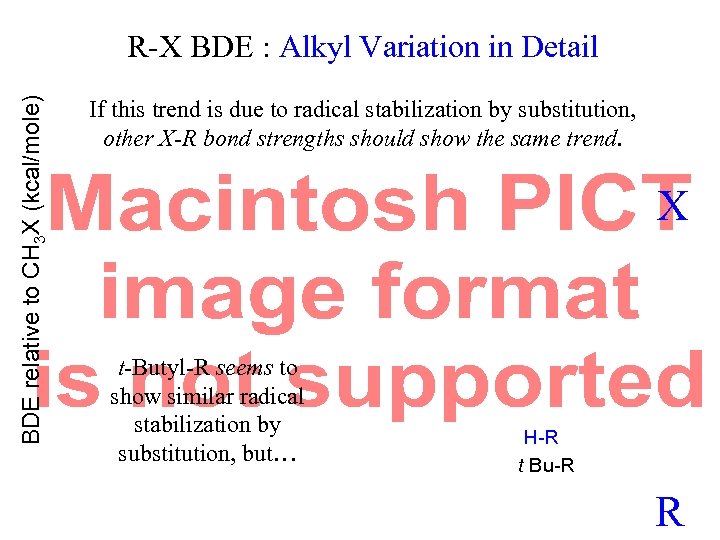 BDE relative to CH 3 X (kcal/mole) R-X BDE : Alkyl Variation in Detail If this trend is due to radical stabilization by substitution, other X-R bond strengths should show the same trend. X t-Butyl-R seems to show similar radical stabilization by substitution, but… H-R t Bu-R R
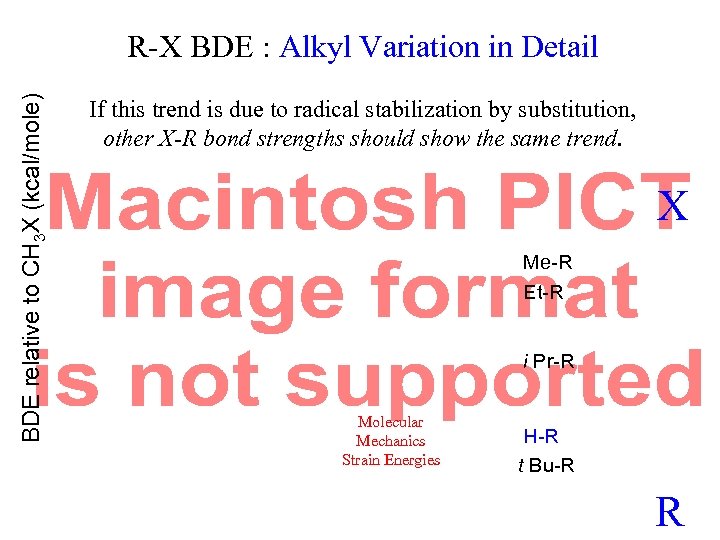 BDE relative to CH 3 X (kcal/mole) R-X BDE : Alkyl Variation in Detail If this trend is due to radical stabilization by substitution, other X-R bond strengths should show the same trend. X Me-R Et-R i Pr-R Molecular Mechanics Strain Energies H-R t Bu-R R
 Exam Dates Wednesday, Feb. 3 Friday, Feb 26 Monday, April 5 Friday, May 7 (9 am) Grad TAs Senior Peer Tutors Eugene Douglas Hayley Israel TBA Andrew Moir Connie Wang
 End of Lecture 39 Jan. 13, 2010 Copyright © J. M. Mc. Bride 2010. Some rights reserved. Except for cited third-party materials, and those used by visiting speakers, all content is licensed under a Creative Commons License (Attribution-Non. Commercial-Share. Alike 3. 0). Use of this content constitutes your acceptance of the noted license and the terms and conditions of use. Materials from Wikimedia Commons are denoted by the symbol . Third party materials may be subject to additional intellectual property notices, information, or restrictions. The following attribution may be used when reusing material that is not identified as third-party content: J. M. Mc. Bride, Chem 125. License: Creative Commons BY-NC-SA 3. 0